Screened as part of a “date night” event at ArcLight’s Lights, Camera, Cocktails program, a local mixologist (Julieta Campos of The Whistler) served special cocktails inspired by the movie both before and during the film, as well as intermission. Here’s the napkin they gave us:
We also got bottled water, popcorn, and hot dogs. Yum!
The audience was a little chatty because of the booze, but it didn’t kill the event. We chatted with some people over hotdogs during intermission. The movie is tops.
I seriously doubt that any documentary about a defunct local dance club from the ‘80s and ‘90s holds much interest to very many outside the city where it was located. With 2350 Last Call: The Neo Story — its title incorporates the club’s address on Clark Street — director and documentarian Eric Richter starts at the “farewell party” in July 2015 and goes backward, telling the story of Chicago’s iconic nightspot Neo’s 36 year history.
Starting as a new wave bar in the early ‘80s, Neo evolved into an industrial goth club and for a long time created its own scene. That alley was the perfect lead in! Neo attracted some famous guests, obvious ones like Al Jourgensen and My Life with the Thrill Kill Kult, both on Wax Trax at one point. Neo also attracted some not so obvious ones, like Debbie Harry, Trent Reznor, Prince, and David Bowie. Richter lovingly tells about some of the theme nights (like Nocturna), the music, and of course regulars, from bouncer Kimball Paul (R.I.P) to a Mexican guy who looked like he’d be at home on a Herb Alpert and Tijuana Brass record cover.
For all his local focus, Richter does something that puts 2350 Last Call: The Neo Story beyond mere local interest: he gets to the heart of club culture and community, something that simply doesn’t exist anymore.
Jaimz Asmundson’s music video “Plastic Heart” by Ghost Twin was a fitting prelude. It’s irreverent, fun, and over the top with its tongue in cheek goth and satanic sensibilities.
With Suzanne Shelton, Jeff Moyer, Scary Lady Sarah, Brian Dickie
Production: Eric Richter Films
Distribution: Eric Richter Films
World Premiere
Screening introduced by CIMMfest cofounder Carmine Cervi and followed by a live Q and A with director Eric Richter and Eric Richter, Suzanne Shelton, Jeff Moyer, Scary Lady Sarah, Brian Dickie
Let’s get this out up front: the appeal of Who Framed Roger Rabbit is not its outstanding narrative. Based on Gary K. Wolf’s novel Who Censored Roger Rabbit?, Jeffrey Price and Peter S. Seaman’s screenplay is competently written but it’s conventional if not downright pedestrian, a standard whodunnit complete with hiding, seeking, and a clock ticking. The situations are goofy, the characters are even goofier, and the jokes…well, they’re silly. The whole thing relies too heavily on farce and slapstick for my taste.
Los Angeles, 1947: alcoholic private investigator Eddie Valiant (Bob Hoskins) is summoned to the studios of movie mogul R.K. Maroon (Alan Tilvern). Studio star Roger Rabbit (Charles Fleischer) is unraveling over romantic rumors involving his amply curvaceous toon wife Jessica (Kathleen Turner) and human Marvin Acme (Stubby Kaye), the inventor and maker of the sundry gadgets used in cartoons. It’s affecting the studio’s bottom line, so Maroon hires Valiant to check it out.
After catching Jessica’s act at an underground club, Valiant spies on her and Acme in her dressing room. He takes pictures of them playing “patty-cake.” He turns them over to Maroon, who shows them to Roger. Assuming the worst, he promptly freaks.
The next morning, Acme is found dead — a cartoon safe crushing his head. Naturally, all signs point to Roger. Dastardly Judge Doom (Christopher Lloyd), cloaked in a black cape and an evil hidden agenda, is following Roger’s tail. Valiant is unwillingly yanked into a crazy adventure to exonerate Roger, find a will, and stop Doom from selling Toontown, the appropriately named neighborhood where toons live, to a freeway developer.
Despite its shortcomings, Who Framed Roger Rabbit is a technical marvel unlike much before it. Directed by Robert Zemeckis, it took awhile to make. It was a box office blockbuster, and it’s easy to see why. From the outset, it’s a dazzling mix of animated characters, or “toons,” interacting with real people. The look and technique are impeccable, with natural movement and even toons and humans touching that melds seamlessly without any jumps or visual hiccups. An ongoing gag with Roger handcuffed to Valiant, for example, is flawless. Clearly, this film was assembled with painstaking attention to timing. It is, in a word, neat.
Plus, the incorporation of classic cartoons — from Betty Boop to Woody Woodpecker to Droopy, to a scene with Bugs Bunny and Mickey Mouse to a piano duel between Daffy Duck and Donald Duck — is really, really fun. I’m sure this is the only place you’ll ever see Warner Brothers and Disney characters together, and it’s a hoot.
With Joanna Cassidy, Lou Hirsch, Mike Edmonds, Eugene Guirterrez, Mae Questel, Mel Blanc, Tony Anselmo, Mary T. Radford, Joe Alaskey, David Lander, Richard Williams, Wayne Allwine, Tony Pope, Peter Westy, Cherry Davis, Nancy Cartwright
Production: Touchstone Pictures, Amblin Entertainment
For those who don’t know, queercore (or homocore, as it’s sometimes called — personally, I find that term clunky so I don’t use it) is rooted in the North American punk scene. In an oversimplified nutshell, it’s LGBT punk rock, and its heyday was the mid ’80s to mid ’90s. It developed in response to the homophobic machismo that increasingly characterized the ’80s postpunk scene coast to coast.
Yony Leyser’s Queercore: How to Punk a Revolution is thorough and fun even if it is fairly standard. Using interviews, footage from concerts and other live performances, films, home videos, and a treasure trove of zines and old flyers, he starts in Toronto, where filmmaker Bruce LaBruce and artist G.B. Jones published the queer punk zine J.D.s. They confess that one of their goals was to manufacture a scene, or at least make it sound there was one where it didn’t actually exist. It worked.
LaBruce, Jones, Lynn Breedlove of Tribe 8, Jon Ginoli of Pansy Division, Genesis P-Orridge, and others discuss their role in the queercore movement and what it was (and is) for them. Even John Waters has his take. Leyser focuses on more than just bands, getting into the entire culture: zines (elemental to the movement), art, films (particularly LaBruce’s), politics, and AIDS. He also ties in subsequent scenes like riot grrrls and mainstream successes like Green Day, Hole, Sonic Youth, Bikini Kill, and Nirvana.
Queercore: How to Punk a Revolution is a comprehensive, inclusive, and engaging documentary. Irreverent, fun, and at times ridiculous, it’s a fitting tribute.
With Silas Howard, Kim Gordon, Peaches, Kathleen Hanna, Patty Schemel, Justin Bond, Dennis Cooper, Jayne County, Scott Treleaven, Tom Jennings, Rick Castro, Jody Bleyle
Production: Desire Productions, Totho
Distribution: Edition Salzgeber (Germany)
Screening followed by a live Q and A with director Yony Leyser
When I found it that it was showing on the big screen in its original scratchy 35mm format, I had to see it again. I dragged Aaron with me. It’s much better big!
Screening introduced and followed by a live Q and A with actor Antonio Fargas.
“The film which you are about to see is an account of the tragedy which befell a group of five youths, in particular Sally Hardesty and her invalid brother, Franklin. It is all the more tragic in that they were young. But, had they lived very, very long lives, they could not have expected nor would they have wished to see as much of the mad and macabre as they were to see that day. For them an idyllic summer afternoon drive became a nightmare.”
— Narrator
“Look what your brother did to the door! Ain’t he got no pride in his home?”
— Old Man
I didn’t expect much when I sat down for the low budget slasher classic The Texas Chain Saw Massacre, a movie that somehow escaped me all these years. I’ve got to admit, it’s not bad.
The premise is simple: five friends in their 20s, three guys and two girls, are driving a van on a road trip through rural Texas in the summer. The purpose of the trip is to check on a few dearly departed relatives of Sally (Marilyn Burns) and her disabled brother, Franklin (Paul Alan Partain), after a gruesome grave robbery in the town where they grew up. It’s very Scooby Doo.
They pick up a crazy hitchhiker (Edwin Neal) outside a slaughterhouse who grosses them all out talking about killing cattle with a sledgehammer. He passes around a few photos of some he finished off himself. He’s dirty, scabby, and jittery. He snaps a photo no one asked him to, then has the nerve to charge them two bucks for it. He invites them over for dinner (head cheese) with his family before he cuts his hand with a pocketknife. Freaked, they pull over and throw his nasty ass out.
That’s not the worst of it — it’s just the beginning. Working from a screenplay he wrote with Kim Henkel, director Tobe Hooper taps into something pretty fucked up here. Mixing hicks with chainsaws is unsettling enough, but “Leatherface” (Gunnar Hansen), the masked executioner behind that sliding freezer door, is truly frightening. So is decomposing “grandfather” (John Dugan). When you stop to think about it, so is a gas station barbeque.
All the essential elements of horror are here: characters stranded in the middle of nowhere, empty houses, no phones or gas, bugs, bones, rotting corpses, chases in the dark, falling down, power tools as weapons, kidnapping, a faceless menace, and a bunch of blood.
Cinematographer Daniel Pearl creates some surprisingly artful shots, particularly on the highway, in a sunflower patch, and a scene with feathers. They look great. The artful moments, however, are far and few between. The pacing is strange: the first four victims are picked off in quick succession, leaving just Burns, who has nothing to do but run around and scream for nearly the entire second half. Even after all she goes through, no one needs that. Still, for all its flaws, I winced, I snickered, I looked away in disgust. But I saw the whole thing through to the end — no pun intended.
I hate to spoil the ending, but contrary to the movie poster…none of this is true.
With Allen Danziger, William Vail, Teri McMinn, Jim Siedow, John Larroquette
Production: Vortex
Distribution: Bryanston Pictures (USA), Astral Films (Canada), New Gold Entertainment (Italy), Succéfilm AB (Sweden), Jugendfilm-Verleih (West Germany), Bac Films (France), New Line Cinema (USA), René Chateau Productions (France), Filmways Australasian Distributors (Australia)
“I take what I need and I move on. And if people can’t move with me, well then I’m sorry.”
— Madonna
Wow, I completely forgot about this tawdry exposé made for TV — American TV, which is even worse — chronicling Madonna’s early years in New York City. It aired on Fox in the mid-nineties, and it’s actually amazing only for how awful it is. All the stops are pulled out, and it’s a trainwreck: the overriding theme is that Madonna is an ambitious whore. OK, National Enquirer.
Based on Christopher Andersen’s 1991 biography — totally unauthorized, I add — Michael J. Murray’s script is just plain sad. Some of it is remarkably accurate, but some of it…not so much. I recognize every single interview where he culled material to tell the Material Girl’s story — in Time, Rolling Stone, Vanity Fair, Interview, and a few other magazines. He doesn’t just lift background, he lifts dialogue. Verbatim. That opening monologue is straight from a letter to Stephen Jon Lewicki in which she begs to appear in his softcore film A Certain Sacrifice. The characters are all real people even if their names are changed: her donut shop manager (Kenner Ames), Dan Gilroy (Jeff Yagher), Camille Barbone (Wendie Malick), Mark Kamins (Mitch Roth), Seymour Stein (Don Francks), frequent collaborator Steve Bray (Ephraim Hylton), and last but not least her father, Silvio Ciccone (Dean Stockwell).
I’m mildly impressed that her mother (Jenny Parsons), shown entirely in black and white flashbacks, even comes up. And the many guys she slept with, some of them with a purpose. And that gumcracking? Brilliant!
Terumi Matthews plays a young Madonna, and I’ll give her this: she nails the megastar’s ideosynchrocies perfectly! However, the vignettes and Catholic imagery stolen straight from the video for “Oh Father” are so lame that I feel like I should say a rosary after seeing this. So should you. Don’t even get me started on where this story starts — the first MTV Video Music Awards? Really? She was already on her second album by then.
In any event, Madonna: Innocence Lost is not flattering, but it’s still a hoot. It plays on Madonna’s bad side, like “Blond Ambition” is a bad thing. The problem is, this approach fails when you’re dealing with someone who used that very name for one of her biggest tours. Shocking? Fuck no.
With Diana Leblanc, Nigel Bennett, Dominique Briand, Tom Melissis , Christian Vidosa, Dino Bellisario, Kelly Fiddick, Gil Filar, Maia Filar, Diego Fuentes, Matthew Godfrey, Evon Murphy, Stephane Scalia, Chandra West
Production: Fox Television Studios, Jaffe/Braunstein Films
Distribution: Fox Network, RTL Entertainment (Netherlands), True Entertainment (UK)
With The Florida Project (https://moviebloke.com/2017/10/03/the-florida-project/), Sean Baker sparked my curiosity in his work. Big time. Sure, I heard of him and caught an earlier film, Tangerine (https://moviebloke.com/2015/07/28/tangerine/), before that. Now, though, I’m practically obsessed with seeing what else he’s done, more than any other director in recent memory. For my latest foray into Baker, I went back to Four Letter Words, his first feature film.
Truly a show about nothing, Four Letter Words takes place at the end of a house party in suburban Los Angeles. It’s 3:30 a.m. Art (Fred Berman), who’s in his second or third year of college — and on his third or fourth major — is home from school and threw a get-together at his parents’ house, inviting his BFFs from high school. It’s clear that it’s time for everyone to go but he doesn’t want to be alone.
Baker’s style is very much ‘90s DIY. Four Letter Words feels a lot like early Richard Linklater or Kevin Smith, loaded with naturalistic dialogue and rants mostly about sex, slacker characters, dumb antics, and mundane events that transpire over the course of an hour or so.
Baker explores the outlook of suburban men in their 20s. Four Letter Words isn’t revolutionary or terribly insightful. It’s neither a major work nor required viewing, but it’s mildly interesting because it shows what draws him in.
With David Ari, Henry Beylin, Darcy Bledsoe, Edward Coyne, Matthew Dawson, Thomas Donnarumma, Loren Ecker, Karren Karagulian, Robyn Parsons, David Prete, Matthew Maher, Vincent Radwinsky, Susan Stanley, Jay Thames, Artyom Trubnikov, Paul Weissman
George Clooney’s Suburbicon probably isn’t going to end up on anyone’s “best” list, nor should it. Too bad, because it’s got all the right elements: an experienced director with a strong point of view and his heart in the right place, a story by Joel and Ethan Coen, and a solid cast. The trailer sold me.
I guess I can see where this was headed. Unfortunately, though, some bizarre calls from the director’s chair drive Suburbicon into the ground. What could’ve been a biting and clever comment about race and the postwar American Dream, isn’t. Instead, Suburbicon is a confused jumble of ideas that don’t seem thought out or placed very well.
Suburbicon, which gets its name from the fictional suburban housing development where the film takes place, involves two concurrent stories that play out separately in late ‘50s suburbia. The main story, the one that the Coen brothers developed over 30 years ago, follows the boneheaded attempts of daft Suburbicon resident Gardner Lodge (Matt Damon) at covering his tracks in an insurance scam he perpetrates with his sister-in-law, Margaret (Julianne Moore, who pulls a Patty Duke and does double duty also playing Gardner’s wife, Rose). Gardner is also dodging two amateur hitmen (Glenn Fleshler and Alex Hassell) who are trying to reach him. To make matters worse, his grade school age son, Nicky (Noah Jupe), inadvertently threatens to blow his cover. It isn’t long before it’s clear that Gardner’s in way over his head.
Meanwhile, the Mayers, a black family, move into Suburbicon, right next door to the Lodges. This subplot is based on an actual event that happened in Levittown, Pennsylvania, in 1957 (http://ushistoryscene.com/article/levittown/). In fact, the film uses what appears to be real-life footage from it. The residents don’t want a black family living near them, apparently because they think it will cause the neighborhood to go to hell. So, they stage a protest outside the Mayers’ house, chanting, playing instruments all night, and eventually trespassing and vandalizing. In the midst of this brouhaha, Nicky befriends the son, Andy (Tony Espinosa), who’s about the same age.
The residents get louder and more violent as the Coen plot develops into something darker and more violent.
Suburbicon has a few big problems. First, it clearly wants to make a grand statement or observation. It fails because it doesn’t integrate the two plots. We don’t get much about the Mayers. Whatever point this subplot was supposed to make is completely overshadowed by the main plot, and it comes off as merely an ironic parallel. It’s weird, manipulative, and simply doesn’t work.
Second, I have no idea how all that happens inside the Lodge residence does so with the huge mob next door. How does no one notice what’s going on right outside the door? How does everyone in that huge mob miss the people coming and going from the Lodge residence? Some of them are bloody. Hello?
Third, the plot twists are evident a mile away.
Fourth, neither Damon nor Moore pulls off the sinister vibe their characters call for. Somehow Clooney misses the mark on the sheer weirdness of the plot and the characters despite the sharp, exaggerated dialogue you usually get from the Coen brothers. Oscar Isaac is the only actor who nails it; his small part as an insurance investigator, regrettably short, stands out as the only bright spot here — although both Jupe and Nancy Daly as Gardner’s secretary deserve an honorable mention. Overall, though, the end result here is hopelessly flat and surprisingly lifeless. It’s frustrating to see.
I didn’t hate Suburbicon, but I didn’t love it. Its points are muddled. I expected a lot more, and there was so much to work with here.
With Karimah Westbrook, Leith M. Burke, Megan Ferguson, Jack Conley, Gary Basaraba, Michael D. Cohen, Steven Shaw, Don Baldaramos, Ellen Crawford, Cathy Giannone, Allan Wasserman, Mark Leslie Ford, Richard Kind, Robert Pierce, Pamela Dunlap, Jack Conley, Frank Califano, Lauren Burns
Production: Paramount Pictures, Black Bear Pictures, Silver Pictures, Smoke House Pictures
Ferenc Török’s excellent 1945, which he says took over a decade to finish, doesn’t end up where it looks like it’s going. The story takes place on a hot summer Saturday in August 1945 during a transitional time in Hungary — after the Nazis surrendered but before the Soviets left.
Two men in black, one old (Iván Angelus) and the other young (Marcell Nagy), arrive at the train station of a small rural village. They have two large trunks in tote, which they are bringing into town. They walk in silence behind the wagon as the hired driver (Miklós B. Székely) and his son (György Somhegyi) lead the way.
The stationmaster (István Znamenák) alerts the town clerk, István Szentes (Péter Rudolf), who’s in the midst of preparations for his son’s (Bence Tasnádi) wedding. The two visitors are Orthodox Jews who survived the Holocaust. The villagers are thrown into a state of paranoia, fearing the purpose of this unwanted intrusion.
Based on Gábor T. Szántó’s short story “Homecoming,” Török effectively sets up the narrative using the construct of a Western: an ominous sky, strangers in black, and nervous lawmen and townsfolk all ready for a conflict to erupt.
The conflict in 1945, however, started long before this day: it started when the apparently all Catholic residents betrayed their only Jewish neighbor, the owner of the local drug store. István’s wife, Anna (Eszter Nagy-Kálózy), turned him in to the Nazis. István took over his store and moved his family into his house. Everyone, from the police to the village priest (Béla Gados), looked the other way.
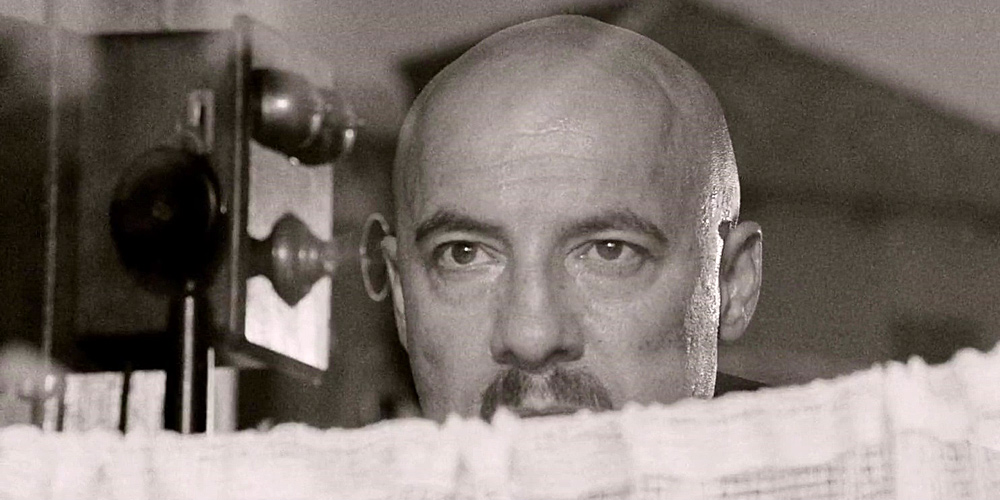
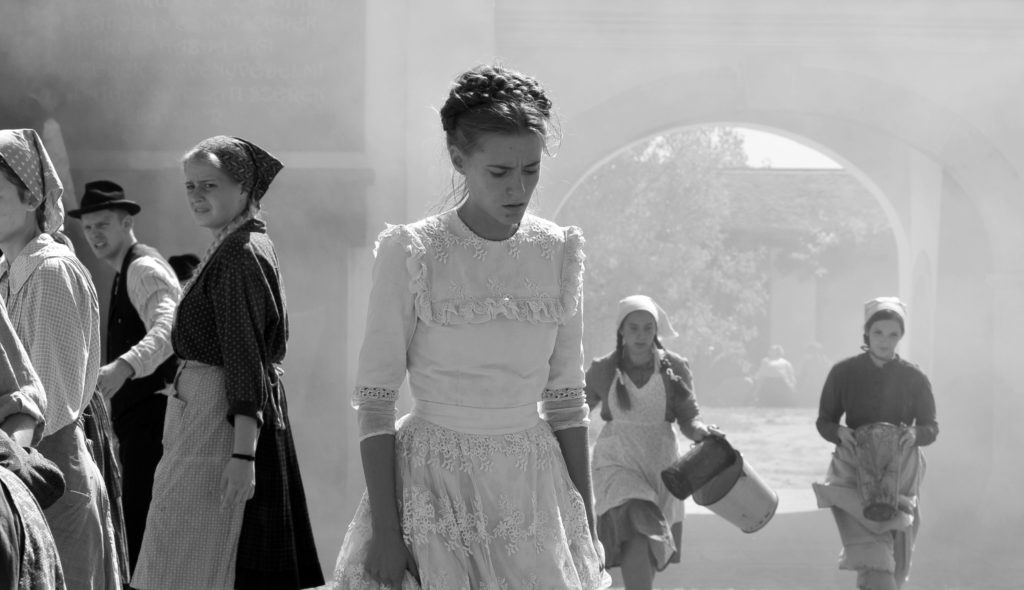
Török shows the conflicted villagers struggling to rectify their personal gain with the dishonorable way they achieved it. Török’s pacing is perfect, unfolding slowly with an ever-increasing sense of unease and doom. It doesn’t hurt that the ensemble case is tops. Elemér Ragályi’s gorgeous black and white cinematography emulates the look of films from the 1930s and 1940s:
1945 is one of the more memorable films I caught at this year’s festival.
With Tamás Szabó Kimmel, Dóra Sztarenki, Ági Szirtes, József Szarvas, Sándor Terhes, Tünde Szalontay, Mari Nagy, János Derzsi, Tibor Mertz, Bálint Adorjáni, Vivianne Bánovits, Rita Kerkay, Zsolt Dér, Gergö Mikola, Máté Novkov
Production: Katapult Films
Distribution: Menemsha Films
Screening introduced and followed by a live Q and A with Ferenc Török




 moviebloke