Letters from Baghdad

(USA/UK/France 2016)

“We rushed into the business with our usual disregard for a comprehensive political scheme.”

—Gertrude Bell

According to the promotional poster for Sabine Krayenbühl and Zeva Oelbaum’s Letters from Baghdad, the so-called “Queen of the Desert” and “female Lawrence of Arabia” Gertrude Bell “was as controversial as the history she made.” Well, that certainly sounds promising!

Born into a wealthy family, Bell immersed herself in the Middle East in the early 20th Century and used her talents as a writer and a schmoozer to intimately acquaint herself with the area, its people, and their culture (https://en.wikipedia.org/wiki/Gertrude_Bell). Her contacts with influential expats and various Arab leaders combined with her knowledge of the culture led to an appointment as a British officer during World War I and a direct hand in drawing up the borders of modern Iraq.

Tilda Swinton gives Bell her voice, reading off camera Bell’s actual writings about events that occurred on her many trips and the people she met. In Bell’s own words, Swinton offers history, observations, and even some Victorian Era dish. Bell had at least as much influence as T. E. Lawrence a.k.a. Lawrence of Arabia (played here by Eric Loscheider in a staged “talking head” interview made to look like old footage).

Bell’s life and the impact of her deeds a century later make for an interesting story. Painstakingly researched, Krayenbühl and Oelbaum pull from diverse source material—letters, diaries, photos—to show what cities like Baghdad and Damascus were like a hundred years ago. They do a great job humaninzing Bell, getting into personality flaws and personal disappointments. In both respects, Letters to Baghdad works really well.

Not everything works as well as it could, though. Some important items are treated superfically. For example, they mention the tension between the Sunni, Shia, and Kurds even back then, but Krayenbühl and Oelbaum don’t delve into it. They touch on Bell’s reasoning for the borders she devised, but they don’t give much critical assessment to it. I left with the distinct feeling that I didn’t get the whole story. Another problem: the staged interviews give a lot of information, but they’re cheesy.

I found myself glancing at my watch about halfway through Letters from Baghdad. It’s a well made documentary, but it’s not as enthralling as it promises to be.

With Ammar Haj Ahmad, Helen Ryan, Rachael Stirling, Robert Ian Mackenzie, Christopher Villiers, Lucy Robinson, Elizabeth Rider, Michael Higgs, Joanna David, Michelle Eugene, Paul McGann, Pip Torrens

Production: Between the Rivers Productions, Letters From Baghdad, Missing in Action Films

Distribution: Vitagraph Films (USA)

95 minutes
Not rated

(Landmark Century) C

http://lettersfrombaghdadthemovie.com/about/

Wonder Woman

(USA 2017)

Director Patty Jenkins aims to do for Wonder Woman what Christopher Nolan—and I suppose to a lesser degree Tim Burton—did for Batman: take an iconic comic book superhero that got campy over the years and return it to its darker roots, producing something dramatic, perhaps weightier, and far more artful. Jenkins doesn’t entirely pull it off with Wonder Woman, but she’s on the right track. I see a sequel or two in the near future, so she’s got time to get there.

To Jenkins’s credit, Wonder Woman is not what I expected. Aside from a nod or two—and that goddamned tiara—all the cut-rate kitsch of the ’70s TV series is gone. This Wonder Woman means business even if she’s still, shall we say, absurd.

Jenkins goes back to the beginning: young Diana (Lilly Aspell and Emily Carey) lives on Themyscira, a hidden island inhabited by war-ready buff goddesses. Queen Hippolyta (Connie Nielsen), Diana’s mother, shields her from the strident ways of her subjects. It all has to do with an old score Ares (David Thewlis) seeks to settle—yes, that Ares, the son of Zeus and the god of war. General Antiope (Robin Wright), Hippolyta’s sister and Diana’s aunt/mentor, isn’t having it: she recognizes Diana’s potential and trains her on the sly. Diana blossoms into a beautiful woman (Gal Gadot) with serious supernatural power.

Diana stumbles upon Steve Trevor (Chris Pine), a drowning American pilot whose plane crashes off the coast of Themyscira. She rescues him, unwittingly exposing the island to an invasion by German forces. Persuaded by the awesome power of Diana’s Lasso of Hestia, Steve confesses that he’s a spy in the “war to end all wars”—World War I. Spider-sensing Ares is behind it, Diana embarks with Steve on a mission filled with romance, adventure, and espionage in an effort to track down the god and stop the madness.

Wonder Woman starts out all Xena: Warrior Princess, silly and weird in a geeky softcore straight guy “lesbian porn” way that no doubt would appeal to the likes of Wayne and Garth. Thankfully, it moves in another direction once Pine shows up about 40 minutes in. I found myself enjoying Wonder Woman more as the story got to Europe—that storyline is more believable even if it too is silly. The battle scenes are decent with some Hollywood excess and humor thrown in. I love how the theme of gender equality is the star of every scene—neither subtle nor heavy-handed, it’s simply a given.

For all its perks, Wonder Woman is ultimately a typical blockbuster that emphasizes form over substance. If nothing else, it surprises, which is always a plus. Frankly, though, I could’ve kept going completely oblivious to the fact that Wonder Woman is more than Lynda Carter. She was more a lot more fun.

With Danny Huston, Saïd Taghmaoui, Ewen Bremner, Eugene Brave Rock, Lucy Davis, Elena Anaya, Doutzen Kroes

Production: DC Entertainment, Atlas Entertainment, Cruel & Unusual Films, Rat-Pac Dune Entertainment LLC, Tencent Pictures, Wanda Pictures

Distribution: Warner Brothers, Karo Premiere (Russia), NOS Audiovisuais (Portugal), Roadshow Entertainment (New Zealand), Roadshow Films (Australia), SF Studios (Norway), Tanweer Alliances (Greece)

141 minutes
Rated PG-13

(ArcLight) C

http://wonderwomanfilm.com

Okja

(USA/South Korea 2017)

“We needed a miracle, and then we got one.”

—Lucy Mirando

Bong Joon-ho’s Okja, now streaming on Netflix, is a lot of things; dull is not one of them. A slick, fast-paced, mesmerizing mix of fantasy, sci-fi, comedy, action, satire, and social consciousness, this film has a lot going on—and a lot going for it. I was lucky to see it on the big screen before its official release, and that’s how I recommend seeing it if you can. Sorry, Netflix, Okja is simply too good for TV.

The story begins ten years ago in 2007: in a desperate but brilliant attempt to rebrand a disreputable family business—to make a silk purse out of a sow’s ear, so to speak—Lucy Mirando (Tilda Swinton) announces her master plan to breed an all-natural “superpig” that leaves a minimal footprint, feeds the world, and tastes great (https://superpigproject.com). Her company, Mirando Corporation, devises a competition, sending twenty-some piglets to real farmers across the globe to raise them; the company will monitor each pig over the next ten years and declare a “winner” based on the results. Mirando hires animal television show host Dr. Johnny Wilcox (Jake Gyllenhaal), a zoologist whose star is fading, to lend credibility to the project as well as to generate public interest in it.

Fast forward to 2017: Mirando’s plan is coming to fruition without any hiccups, which makes her happier than a pig in…well, you know. Unfortunately for Mirando, a young South Korean girl named Mija (Ahn Seo-hyun), whose grandfather (Byun Hee-bong) signed onto the project, threatens to derail the entire mission. Mija, you see, essentially raised her grandfather’s pig, Okja. They’ve become dependent on each other. He never explained to her what the deal really is—that Mirando’s silk purse is nothing more than lipstick on a pig.

Dr. Johnny and his television crew show up at their home in the mountains and marvel over Okja, now a magnificently enormous hippopotamus-like creature. He presents her grandfather with an award and takes Okja to Manhattan—actually, New Jersey—for a pig roast sponsored by the Mirando Corporation.

To put it lightly, Mija’s not having it—she takes off after Okja on a chaotic chase through Seoul, where she encounters the Animal Liberation Front, a group of inept animal rights activists led by idealistic but ineffective Jay (Paul Dano). They make a pact, but unfortunately she doesn’t speak English. Mija ends up at the world headquarters of Mirando Corporation in New York City, completely unaware of the cards she holds.

I went into Okja blind—the only thing I knew about it was that its central character is a big pig. I left more than satisfied: the cast is stellar, the effects are flawless, and the script is smart and strong despite its flaws. If that don’t beat a pig a-pecking, I don’t know what does.

In simplest terms, Okja is about our complicated consumerist relationship with food. As one pig farmer put it best, “Okja’s a fake pig in a movie I watched on Netflix. But plenty of real animals are suffering inside a horrific system that don’t have to.” (http://www.huffingtonpost.com/entry/okja-thoughts-from-a-pig-farmer_us_595bd1cde4b0f078efd98cbd). On this point alone, Okja will resonate with anyone who’s ever connected with an animal—pig, dog, cat, bird, horse, aardvark. The story has been compared to E.T. (https://moviebloke.com/2016/03/29/e-t-the-extra-terrestrial-e-t/), and it’s pretty wonderful. The final scene, which takes place in a slaughterhouse, is hard to watch—I got anxious. And queasy. I thought of Morrissey!

Appropriately, the acting is hammy; I love that Swinton plays twins again. She looks like a deranged Uma Thurman in Pulp Fiction. Gyllenhaal teeters on insufferable with his wimpy sniveling, but to his credit he manages to keep it in check. I’m usually unimpressed with computer animation, but here it’s amazingly well done; Okja looks as real as the humans. I think the trick is her eyes. Even with its Hollywood ending, Okja is definitely one of this year’s more interesting movies.

With Steven Yeun, Lily Collins, Yoon Je-moon, Shirley Henderson, Daniel Henshall, Devon Bostick, Choi Woo-shik, Giancarlo Esposito

Production: Kate Street Picture Company, Lewis Pictures, Plan B Entertainment

Distribution: Netflix

118 minutes
Not rated

(AMC River East) B

https://www.netflix.com/title/80091936

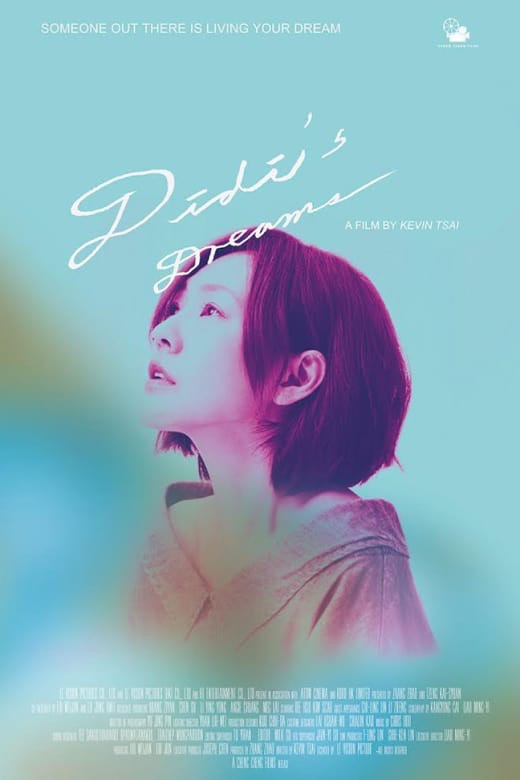
Didi’s Dreams [Didi’s Dream]

(Taiwan/China 2017)

Just in time for summer, Didi’s Dreams [吃吃的愛] is the cinematic equivalent of a glass of lemonade: cool, refreshing, and sweet with a slightly tart afterburn, it’s a real treat on a hot day. Too bad its North American run is an extremely limited one.

An intentionally fluffy melodrama, the story follows the misadventures of its titular character, Didi (Dee Hsu), a hungry young twenty-something wannabe actress. Determined to catch her big break, she auditions for anything: a probiotic commercial, a model on a QVC-type shopping network, an extra in a zombie flick, a female wrestler. She’s not exactly picky, calculated, or disciplined about getting there—she just wants to be famous. To her credit—and the dismay of many a producer and director—she’s earnest in her efforts.

Didi’s boyfriend, Xiao-kou (Scar Kim), literally rolls along with her, carting her around on his scooter. He proves to be her rock when she receives devastating news from her doctor (Chuan-cheng Tao).

Didi has a sister, Lingling (Lin Chi-lin), who also happens to be an actress—a famous one like Didi aims to be. Some bad blood between them after their mother died, shown mainly through flashbacks, caused a falling out. As a result, they haven’t spoken in years. A scandal, a TV talk show, and a twist of fate (or maybe just a publicity stunt) bring them together—cast as sisters in a major motion picture.

While all this goes on, Didi has a recurring dream about Chunmei (also played by Hsu), her psychic alterego who runs an interplanetary noodle shop in, um, outer space. Her clientele is a creature cantina of sorts. Chunmei can’t seem to get over losing her love, and it’s affecting her broth. One particular customer, an astronaut (Zifeng Li), holds her attention. While not immediately clear, a connection to Didi comes through as the story progresses.

Director Kevin Tsai keeps it mostly light here, serving up a tangy mix of comedy, tragedy, and fantasy in a wink-wink soap opera way—more Telemundo than Dynasty. Tsai and Ming-Yi Liao’s screenplay is not at all deep, but it’s packed with surprises despite a few sappy clichés. I like where the narrative goes.

Visually, Didi’s Dreams is a colorful stunner, loaded with cute faces, vivid imagery, snazzy sets, and cool costumes. Jing-Pin Yu’s cinematography glistens; it’s slick without going overboard. I can’t imagine enjoying this film as much without it. It all looks great on the big screen—my favorite scenes are at the noodle shop and that probiotic commercial.

Yes, there are flaws. However, the whole thing is put together so well, I easily forgave them. I could’ve done without the remake of “Moon River” from Breakfast at Tiffany’s over the closing credits, but the analogy is apt. Didi’s Dreams is a fun little sparkler that caught me off guard.

With Jin Shijia, David Chao, William Shen, Vincent Liang, Bruce Chen, Junior Han, Gigi Lin, Vila Fan, Yu-Lin Shen, Hank Chen, Tender Huang, Riva Chang, Berry Wen-i Kuo

Production: Cheng Cheng Films

Distribution: Le Vision Pictures, Atom Cinema, Kbro HK Limited

91 minutes
Not rated

(ShowPlace ICON) B-

http://www.chengchengfilm.com/didis-dreams-1/

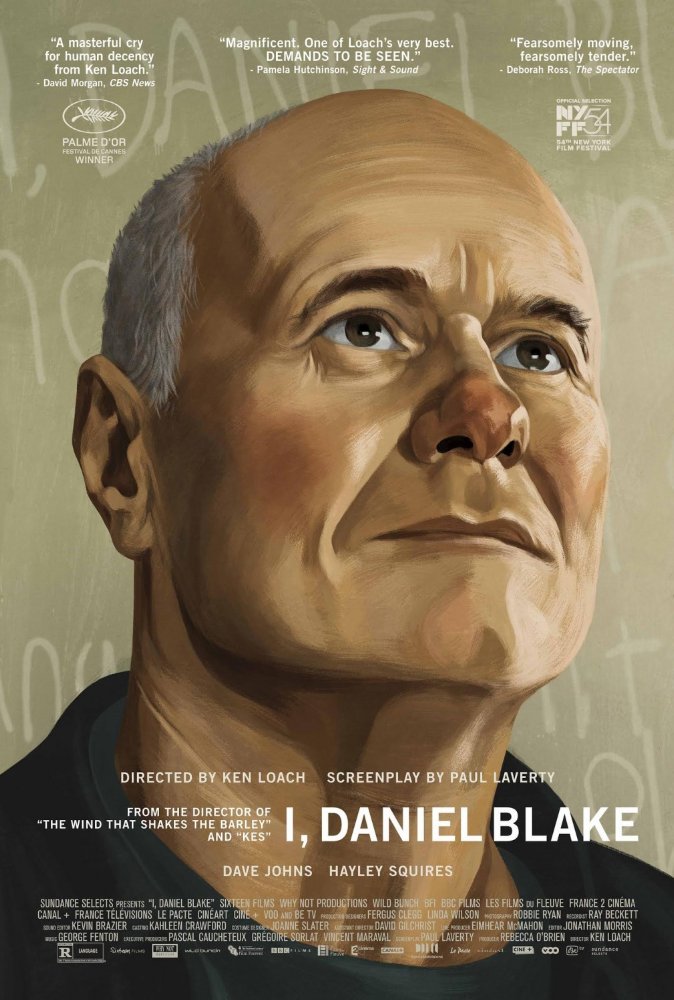
I, Daniel Blake

(UK/France/Belgium 2016)

I Daniel Blake.jpg

Ken Loach’s I, Daniel Blake has gotten a lot of attention and praise. Good: it wrestles with a topic that’s timely on both sides of the Atlantic—and elsewhere, for that matter. A political and poweful message, Loach has touched many a nerve. Case in point: I, Daniel Blake won the Palm d’Or at the Cannes Film Festival, where it finished with a 15-minute standing ovation (http://variety.com/2016/film/global/palme-dor-ken-loach-rebecca-obrien-1201785482/). 15 whole minutes?! Wow.

Daniel Blake (Dave Johns) is a kind of antihero. He’s gruff, he’s private, he’s not handsome or young. He probably goes to church. A heart attack seems like the thing that would change his life, but what really does is a new neighbor (Hayley Squires) and her two kids (Briana Shann and Dylan McKiernan).

I didn’t stand up, but I get it. Bureaucracy versus common sense is always fertile ground for storytelling. I applaud Loach for what he’s saying here, I really do. I, Daniel Blake is a good film: it’s engaging, brave, and relatable. The acting is good all around. So is the premise.

In my opinion, though, it just isn’t a great film. We’re talking shades of meaning here, so if you have five seconds to spare, I’ll tell you why. First, I’ve seen this device many times before—in the last year, even. A cranky old man meets a character that represents youth and hope, and it totally melts the icy facade and changes his life. Well, OK. This sense of hope is usually personified by the very person society looks down on. Next?

Second, I saw where the plot was going way before I got there. Again and again. Predictability is never groundbreaking.

Third, I can’t help but think that this film takes the easy way out. A heart attack in a movie ends only one way. And it’s only a sad ending. Yeah, I, Daniel Blake is emotionally manipulative.

So, my issues center on Paul Laverty’s writing. I wish I had a better way to tell this story. I don’t. For all its pluses and minuses, though, I’d rather watch something more intense. Overall, I, Daniel Blake is disappointingly soft.

With Kate Rutter, Sharon Percy, Kema Sikazwe, Steven Richens, Amanda Payne, Chris Mcglade, Shaun Prendergast, Gavin Webster, Sammy T. Dobson, Mickey Hutton, Colin Coombs, David Murray, Stephen Clegg, Andy Kidd , Dan Li, Jane Birch, Micky McGregor, Neil Stuart Morton

Production: Sixteen Films, Why Not Productions, Wild Bunch, British Film Institute (BFI), BBC Films, Les Films du Fleuve, Canal+, Ciné+

Distribution: Entertainment One Films (UK), Le Pacte (France), Cinéart (Belgium/Netherlands), Cinema (Italy), Feelgood Entertainment (Greece), Prokino Filmverleih (Germany), Scanbox Entertainment (Denmark), Sundance Selects (USA), Transmission Films (Australia), Vertigo Média Kft. (Hungary), Canibal Networks (Mexico), Cine Canibal (Mexico), Imovision (Brazil), Mont Blanc Cinema (Argentina), Longride (Japan)

100 minutes
Rated R

(Music Box) B

https://www.wildbunch.biz/movie/i-daniel-blake/