Okja

(USA/South Korea 2017)

“We needed a miracle, and then we got one.”

—Lucy Mirando

Bong Joon-ho’s Okja, now streaming on Netflix, is a lot of things; dull is not one of them. A slick, fast-paced, mesmerizing mix of fantasy, sci-fi, comedy, action, satire, and social consciousness, this film has a lot going on—and a lot going for it. I was lucky to see it on the big screen before its official release, and that’s how I recommend seeing it if you can. Sorry, Netflix, Okja is simply too good for TV.

The story begins ten years ago in 2007: in a desperate but brilliant attempt to rebrand a disreputable family business—to make a silk purse out of a sow’s ear, so to speak—Lucy Mirando (Tilda Swinton) announces her master plan to breed an all-natural “superpig” that leaves a minimal footprint, feeds the world, and tastes great (https://superpigproject.com). Her company, Mirando Corporation, devises a competition, sending twenty-some piglets to real farmers across the globe to raise them; the company will monitor each pig over the next ten years and declare a “winner” based on the results. Mirando hires animal television show host Dr. Johnny Wilcox (Jake Gyllenhaal), a zoologist whose star is fading, to lend credibility to the project as well as to generate public interest in it.

Fast forward to 2017: Mirando’s plan is coming to fruition without any hiccups, which makes her happier than a pig in…well, you know. Unfortunately for Mirando, a young South Korean girl named Mija (Ahn Seo-hyun), whose grandfather (Byun Hee-bong) signed onto the project, threatens to derail the entire mission. Mija, you see, essentially raised her grandfather’s pig, Okja. They’ve become dependent on each other. He never explained to her what the deal really is—that Mirando’s silk purse is nothing more than lipstick on a pig.

Dr. Johnny and his television crew show up at their home in the mountains and marvel over Okja, now a magnificently enormous hippopotamus-like creature. He presents her grandfather with an award and takes Okja to Manhattan—actually, New Jersey—for a pig roast sponsored by the Mirando Corporation.

To put it lightly, Mija’s not having it—she takes off after Okja on a chaotic chase through Seoul, where she encounters the Animal Liberation Front, a group of inept animal rights activists led by idealistic but ineffective Jay (Paul Dano). They make a pact, but unfortunately she doesn’t speak English. Mija ends up at the world headquarters of Mirando Corporation in New York City, completely unaware of the cards she holds.

I went into Okja blind—the only thing I knew about it was that its central character is a big pig. I left more than satisfied: the cast is stellar, the effects are flawless, and the script is smart and strong despite its flaws. If that don’t beat a pig a-pecking, I don’t know what does.

In simplest terms, Okja is about our complicated consumerist relationship with food. As one pig farmer put it best, “Okja’s a fake pig in a movie I watched on Netflix. But plenty of real animals are suffering inside a horrific system that don’t have to.” (http://www.huffingtonpost.com/entry/okja-thoughts-from-a-pig-farmer_us_595bd1cde4b0f078efd98cbd). On this point alone, Okja will resonate with anyone who’s ever connected with an animal—pig, dog, cat, bird, horse, aardvark. The story has been compared to E.T. (https://moviebloke.com/2016/03/29/e-t-the-extra-terrestrial-e-t/), and it’s pretty wonderful. The final scene, which takes place in a slaughterhouse, is hard to watch—I got anxious. And queasy. I thought of Morrissey!

Appropriately, the acting is hammy; I love that Swinton plays twins again. She looks like a deranged Uma Thurman in Pulp Fiction. Gyllenhaal teeters on insufferable with his wimpy sniveling, but to his credit he manages to keep it in check. I’m usually unimpressed with computer animation, but here it’s amazingly well done; Okja looks as real as the humans. I think the trick is her eyes. Even with its Hollywood ending, Okja is definitely one of this year’s more interesting movies.

With Steven Yeun, Lily Collins, Yoon Je-moon, Shirley Henderson, Daniel Henshall, Devon Bostick, Choi Woo-shik, Giancarlo Esposito

Production: Kate Street Picture Company, Lewis Pictures, Plan B Entertainment

Distribution: Netflix

118 minutes
Not rated

(AMC River East) B

https://www.netflix.com/title/80091936

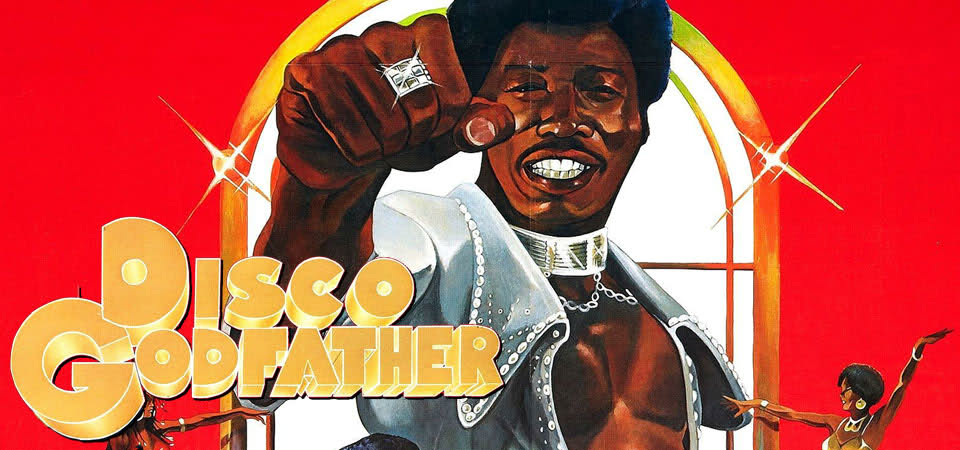
Disco Godfather [The Avenging Disco Godfather]

(USA 1979)

Dear God the Father! Some movies are so terrible, you love them for everything wrong with them—what’s bad is exactly what endears them. Other movies…well, they’re just terrible. It’s a thin line. Sadly, Disco Godfather falls into the latter category.

J. Robert Wagoner and Cliff Roquemore’s screenplay stars Rudy Ray Moore as Tucker Williams, an L.A. cop-turned-DJ at the trashy-ass Blueberry Hill Disco, which looks like a repurposed Denny’s. The plot involves Williams’s nephew, Bucky (Julius J. Carry III), who’s gotten hooked on “angel dust.”

One word: YAWN! What were they thinking? Disco Godfather is so boring, I’d rather watch reruns of 2 Broke Girls. The only thing that saves it from total failure is the wardrobe—Felice Hurtes, Jimmy Lynch, and Kimberly Sizemore deserve major kudos for finding the cool Goodwill stores. Fuck this bullshit: watch Dolemite and call it a day. They could have tried a little harder here.

With Carol Speed, Jimmy Lynch, Jerry Jones, Lady Reed, Hawthorne James, Frank Finn, Julius J. Carry III, Bishop Pat Patterson, Pucci Jhones, Howard Jackson, Yetta Collier, Pat Washington, Doc Watson, Leroy Daniels, Melvin Smith, Ronny Harris, Dolorise Parr, John Casino, Keith David

Production: Generation International

Distribution: Transvue Pictures (USA), Xenon Pictures

93 minutes
Rated R

(DVD purchase) D-

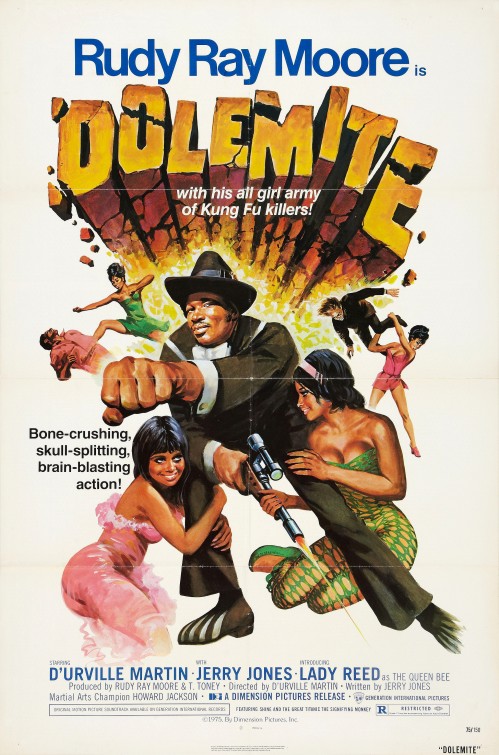
Dolemite

(USA 1975)

Dolemite (Rudy Ray Moore) is his name, and fuckin’ up mutha fuckas is his game!

He’s the baddest pimp around—well, around Los Angeles, anyway—and he looks every bit the part. Dolemite owns a nightclub and whorehouse but he’s doing time on a drug beef. Maybe it’s bogus, maybe not. Maybe some bad cops set him up, maybe it was archenemy Willie Green (D’Urville Martin), who took over the club and is running shit now. Either way, mother pimp Queen Bee (Lady Reed) and Dolemite’s army of ass-kickin’ kung fu hookers are none too happy about it.

To get out of the big house, Dolemite makes a deal with the po-po, Agent Blakeley (Jerry Jones), to, I think, help clean up his old hood. Dolemite uses this as an opportunity to exact revenge on Green and reclaim his, um, stature in the community.  Along the way, he kicks a lot of ass, takes on two crooked cokehead cops—Mitchell (John Kerry) and White—and gets laid. A lot. He even cuss raps at the end.

Dolemite is not a movie to see because it’s a work of art. On the contrary, it’s terrible. But that’s what makes it so much fun to watch—that’s why it’s a cult classic. Like a lot of things before the late ’80s, it’s not P.C. (i.e., politically correct)—as if that isn’t obvious from the movie poster. The directing by Martin, which probably explains why he has so little screen time, is sloppy. You can count the number of times boom mics pop in. The fight scenes are laughable—Dolemite knocks people out barely lifting a finger (or here,  leg) and sometimes without even touching them. Don’t even get me going on the martial arts stuff!

The plot is confusing and watered down. Jones wrote the screenplay with Moore, and the writing is just bad. I admit, I watched it drunk this time, but I’ve seen Dolemite before while sober. No difference. The events are scattered and at points seem random. The characters are colorful—shady Reverend Gibbs (West Gale), a possible parody of former Chicago leader Mayor Daley (Monte “Hy” Pike), the clearly trippin’ Hamburger Pimp (Vainus Rackstraw), and the many fox females—wander in and out, often without any reason.

Despite all that, Dolemite unquestionably has a charm of its own. Moore likes to rhyme, and he punctuates pretty much every sentence with “mutha FUCKA!” His crib is rent-to-own fabulous—check it out:

Dolemite set 2.jpg

Dolemite set 1.png

The wardrobe looks like it was borrowed from the Salvation Army. The climax at the nightclub goes on longer than it should but is still a showstopper. The soundtrack is a trip. If nothing else—and there is nothing else—Dolemite is a good time.

With Brenda DeLong, Terri Mosley, Marilyn Shaw, Lynell Smith, Vera Howard, Joy Martin, Jana Bisbing, Brenda Banks, Pat Haywood, René Van Clief, Pat Jones, Lola Mayo, Charlene Soulter, Liz Sample, Karolynn Hill, Dino Washington, Johnny J. Brown, Cardella Di Milo

Production: Comedian International Enterprise Productions (C.I.E.)

Distribution: Dimension Pictures, Xenon Pictures

90 minutes
Rated R

(DVD) C-

http://xenonpictures.com/wp/dolemite/

http://www.shockingimages.com/dolemite/films/dolemite.php

The Seduction of Mimi [Mimì metallurgico ferito nell’onore]

(Italy 1972)

I never heard of Lina Wertmüller until a retrospective of her work showed at a theater near me. The Seduction of Mimi [Mimì metallurgico ferito nell’onore] is an excellent starting point because it’s a textbook example of her style and the themes that inspire her. Plus, it’s an entertaining movie.

Mimi (Giancarlo Giannini) is a laborer in Sicily. His trouble begins after he votes for the communist candidate in a local election—his employer has been pushing its employees to vote for the mafia candidate. The ballot is supposed to be secret, but Mimi learns that it isn’t when he’s fired. Fearing that things will get complicated, he leaves his wife, Rosalia (Agostina Belli), behind and skips town.

Mimi ends up in Turin, where he finds work on an illegal construction site. He witnesses an on-the-job fatality and proves to be a problem when he learns that the mafia bosses running the job plan to dump the body. To keep him quiet, they place him in a union job at a factory.

It isn’t long before Mimi meets the alluring Fiorella (Mariangela Melato) selling sweaters on the street. He’s hooked on her; in fact, he knocks her up and she gives birth to a son. This is where The Seduction of Mimi gets really fun. Mimi is promoted to a management position back in Sicily. Naturally, he brings Fiorella and the baby with him. He’s protective of his new family and paranoid that Rosalia will find out about it, so he leads a thorny double life that…let’s just say doesn’t end well.

The Seduction of Mimi is rough, moving along like an episode of The Benny Hill Show. It’s compelling nonetheless because it has a certain elegance. Wertmüller is known for mixing sex, class, and politics. It’s a tricky feat, but she manages to pull it off while keeping The Seduction of Mimi totally amusing even by today’s standards. The stuff with the mafia and the gay rumor that gets out because Mimi won’t have sex with Rosalia are both hilarious. The whole revenge subplot that involves getting Amalia (Elena Fiore) pregnant is brilliant on so many levels, and that scene at the end where all of Mimi’s children clamor for him calling him “Papa!” is perfect. Giannini with his bug-eyed Chaplinesque faces looks crazy throughout this film, nicely underscoring the insanity of his situation. I smiled a lot during this film.

With Turi Ferro, Luigi Diberti, Tuccio Musumeci, Ignazio Pappalardo, Gianfranco Barra, Livia Giampalmo

Production: Euro International Film

Distribution: New Line Cinema (USA), Kino Lorber

121 minutes
Rated R

(Gene Siskel Film Center) B

https://www.kinolorber.com/film/theseductionofmimi

https://youtu.be/gI1C1gy-D1c

Eraserhead

(USA 1977)

I learned of David Lynch’s Eraserhead, his first feature length film, during my freshman year in college (thank you, U.D.). Somehow, seeing it escaped me until it screened at a recent Lynch retrospective.

The basic premise is easy to follow: Henry Spencer (John Nance, later Jack) is a schlubby factory worker who learns he fathered a mutant baby out of wedlock. At the insistence of her mother (Jeanne Bates), his freaked out girlfriend, Mary (Charlotte Stewart), moves into Henry’s tiny one-room apartment with the baby, who looks like a diseased E.T. wrapped in gauze. The baby cries constantly, driving Mary out of the apartment and leaving Henry to care for it. His neighbor, Beautiful Girl Across the Hall (Judith Anna Roberts), serves as an ever-increasing temptation and torment.

Really, it’s not the plot but Lynch’s presentation that makes Eraserhead unique. To be clear, it’s not his best film—not even close. It isn’t exactly representative of his work, either. Still, it’s interesting to see his trademarks in their infancy: a horrific and surreal atmosphere, bizarre imagery that here includes lots of spermatozoan objects and seemingly random scenes, spooky characters like the Lady in the Radiator (Laurel Near), and of course Lynch’s dry and twisted wit. The sets and costumes are assembled with early 20th Century industrial junk. The soundtrack is essentially white noise in the background. Frederick Elmes and Herbert Cardwell’s cinematography is rich and textured, using black and white to create a look and mood that resembles a silent film. Their camerawork sets up a sense of claustrophobia that lingers for the duration of the film.

Like most of Lynch’s work, Eraserhead is open to interpretation. In simplest terms, it’s a horror story about the demands of the family on the individual, from small talk and dinners with in-laws to appeasing a partner to child rearing to straying from the family unit. In the tradition of great American playwrights like Eugene O’Neill, Tennessee Williams, Arthur Miller, Edward Albee, and August Wilson, Lynch focuses on the pains and dysfunction that often make familial burdens difficult to bear.

I didn’t quite grasp everything here—how pencilmaking fits into the big picture, for example. Regardless, Eraserhead is infinitely interesting. I didn’t find it particularly scary, but it definitely leaves an impression—I guess in that sense it’s a haunting tale. It’s a weird and original film. Here’s the weirdest thing about it: I actually felt something emotional for that mutant baby. Go figure.

In 2004, the United States Library of Congress deemed Eraserhead “culturally, historically, or aesthetically significant” and selected it for preservation in the National Film Registry (https://www.loc.gov/programs/national-film-preservation-board/film-registry/complete-national-film-registry-listing/).

With Allen Joseph, Jack Fisk, Jean Lange, Hal Landon Jr., Gill Dennis, Darwin Joston, Jennifer Lynch, Peggy Lynch

Production: American Film Institute (AFI), Libra Films

Distribution: Libra Films International (USA), Creative Exposure (Canada), Mainline Pictures (UK), Toei Yoga and Comstock (Japan), Chapel Distribution and Umbrella Entertainment (Australia), Eye Film Instituut (Netherlands), Potemkine Films (France)

89 minutes
Not rated

(Music Box) B-

David Lynch: A Complete Retrospective

http://www.davidlynch.de/head.html

Blue Velvet

(USA 1986)

Who hasn’t seen Blue Velvet? Even though David Lynch was already established by the time it came out, it’s the film that introduced me to him. I saw it once or twice in late high school or early college, definitely on VHS. The River’s Edge was the only comparison I had, and that was a weird film but…not on the same level. I found Blue Velvet totally watchable because it’s very dark, very sexual, very fucking weird, and very voyeuristic.

That was then, this is now: Blue Velvet is still all of those things, but I don’t remember it having the sense of humor it does. It’s curiously funny. It marks the start of Lynch’s style as we know it: not just surreal (he had already done Eraserhead), but macabre and perverted underneath the innocuous and mundane premise. Lynch sets up his narrative in pieces that refer back and forth, like a moving puzzle. It’s brilliant, and it’s a formula that’s served him well.

Blue Velvet starts with a severed ear on the ground, bugs crawling all over it. A local college kid turned stalker (Kyle MacLachlan) proves a bit too curious when his minor obsession with a night club singer (Isabella Rossellini) leads him into a sadomasochistic nightmare that neither he nor we viewers can turn away from. The whole bizarre and sordid story goes full circle back to where it started: that ear. 

Dennis Hopper as Frank, the gas-huffing sociopath who ends every sentence with the F-word, colors the mood here. None of it would work, though, without Rossellini’s vulnerability, which is crucial. 

Lynch considered Molly Ringwald instead of Laura Dern and Val Kilmer instead of MacLachlan. Thank goodness it happened how it did; what a different film Blue Velvet would have been. For a movie that relies so heavily on nuance, that could’ve ruined Lynch’s career. It didn’t. 

With Hope Lange, Dean Stockwell, George Dickerson, Priscilla Pointer, Frances Bay, Jack Harvey, Ken Stovitz, Brad Dourif, Jack Nance, J. Michael Hunter, Dick Green, Fred Pickler, Philip Markert, Leonard Watkins, Moses Gibson, Selden Smith, Peter Carew, Jon Jon Snipes, Angelo Badalamenti, Jean Pierre Viale, Donald Moore, A. Michelle Depland, Michelle Sasse, Katie Reid, Sparky

Production: De Laurentiis Entertainment Group

Distribution: De Laurentiis Entertainment Group, 20th Century Fox (UK), Transmundo Films (Argentina), AMLF (France), Concorde Film (Netherlands), Concorde Filmverleih (West Germany), Finnkino (Finland), Hoyts Distribution (Australia), Shochiku-Fuji Company (Japan)

120 minutes
Rated R

(Music Box) B+

David Lynch: A Complete Retrospective

Count Us In

(Spain 2015)

After a chance meeting with a former professor, two starving filmmakers (David Pareja and Daniel Pérez Prada) sign on to a mysterious project knowing nothing about it. Imagine their shock and horror when they realize they’re pegged to film an execution for ISIS.

Writer and director Pablo Vara has a wicked, irreverent, witty and actually brave sense of humor that I love. It’s exactly what we need right now.

With: Ignacio Grifol, Juan Aragón

Production: Mavericks Studio

Distribution: Cinequest

17 minutes
Not rated

(AMC River East) B+

Chicago Latin International Film Festival

http://payments.cinequest.org/WebSales/pages/info.aspx?evtinfo=59706~78899376-35a9-4153-8303-e1557be2dc32&#.WbtD763MxUM

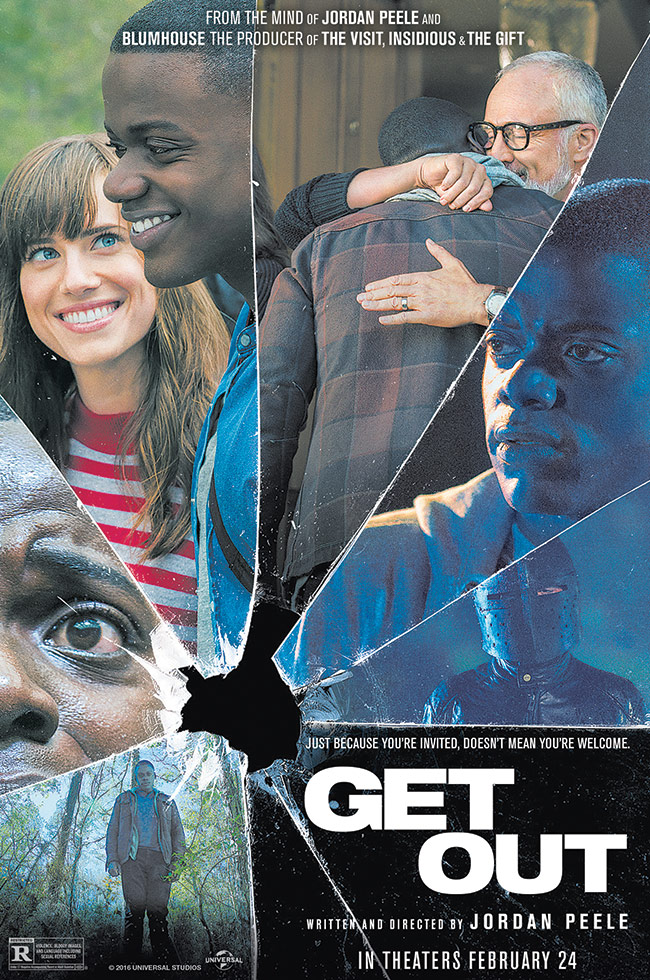
Get Out

(USA 2017)

I caught the hype surrounding Jordan Peele’s first feature length film, Get Out, a comedy horror flick that takes on race—specifically, the dynamics of white power and black subordination. He wrote the script and directed the film. I went into Get Out with some doubt and maybe trepidation about how it might come off. The concept is one that seems too easy to go horribly sideways.

I guess if anyone can pull it off, it’s Peele—and I’m relieved to report that he succeeds. With an oddly compelling mix of Guess Who’s Coming To Dinner, Meet the Parents, Nightmare on Elm Street, and The Stepford Wives, he takes on the cultural idiosyncrasies of Caucasian cultural dominance within the constructs of a horror flick. He’s got a lot of points to make, and he gets them across in a sharp but entertaining way. Like the best horror movies, Get Out makes you squirm—but it does so on multiple levels.

New York City photographer Chris (Daniel Kaluuya) is black. His girlfriend, Rose Arlington (Allison Williams), is white. She invites him on a weekend getaway to her parents’ home in upstate New York because, well, it’s time for him to meet the fam. Chris agrees, going into it nervously and not without personal baggage. His hyperactive best bud, Rod (Lil Rel Howery), a TSA agent who always expects the worst, is not helping.

Rose’s parents are, like the quiet town where they live, nice. Or at least welcoming. Dean (Bradley Whitford) drops silly slang, affects a bizarre accent, and praises President Obama. Missy (Catherine Keener) is more direct, asking pointed questions in a weird attempt to get to know Chris. It’s awkward and doesn’t quite break the ice, but it’s harmless. Right?

The family’s two longterm servants, maid Georgina (Betty Gabriel) and gardener Walter (Marcus Henderson), carry themselves like they’ve had lobotomies. Rose’s younger brother, Jeremy (Caleb Landry Jones), is, um, aggressively complimentary to Chris. On top of it, the Armitages’ neighbors are not quite right, obsessed with Chris and his virility.

During the first part of Get Out, Peele keeps things light but lets a sense of creepy unease simmer. The laughs are there, but like all of the characters coming and going from the house, something is off. He makes a major shift in tone once Missy insists on hypnotizing Chris, ostensibly to help him quit smoking. What was innocuous up to now becomes nefarious.

Ultimately, the evil here is not a monster hiding under the bed, but rather something more obvious that exists in broad daylight. I could have done without the bloody finale, but it works in the context of the film; Peele plays with genre, so I see why it’s here. Either way, Get Out is a bold move that pays off.

With Stephen Root, LaKeith Stanfield, Ashley LeConte Campbell, John Wilmot, Caren Larkey, Julie Ann Doan, Rutherford Cravens, Geraldine Singer, Yasuhiko Oyama, Richard Herd, Erika Alexander, Jeronimo Spinx, Ian Casselberry, Trey Burvant, Zailand Adams

Production: Blumhouse Productions, Monkeypaw Productions, QC Entertainment

Distribution: Universal Pictures

104 minutes
Rated R

(ArcLight) B

https://www.uphe.com/movies/get-out

https://youtu.be/A2JbO9lnVLE

Storytelling

(USA 2001)


“I just thought Marcus would be different. I mean, he’s got C.P.”

—Vi

I get why Todd Solondz doesn’t appeal to everyone: his outlook isn’t warm and fuzzy, his characters aren’t heroic or even admirable, and his blunt, unflattering and brutal honesty is easy to misinterpret as cruel or tasteless. To all that, I shrug; his films don’t put the viewer at ease, and that’s exactly what draws me to him. A master of the uncomfortable, he shines a light on subjects that are hard to discuss in mixed company if not off limits altogether. And he’s not moralistic about it—he leaves it to the viewer to arrive at his or her own conclusions. His moral ambiguity is perhaps the strongest characteristic of his work, and I suspect it more than anything makes people cringe because, well, it’s confusing. They don’t know what to think.

So be it. Barring one scene in Happiness that scarred me forever, Solondz’s fourth film, Storytelling, is probably his most uncomfortable—it opens with Vi (Selma Blair) riding Marcus (Leo Fitzpatrick, who played Telly in Kids), a classmate crippled from cerebral palsy. Comprised of two unconnected storylines, “Fiction” and “Non Fiction,” Solondz pulls out a broad range of societal taboos—American ones, anyway. I won’t go through them here like a grocery list, but they all involve sex and/or abuse of power.

Side note: Censorship is an unintended subject—a big red block obscures one scene in the U.S. release. It wasn’t planned that way, but rather came about by contract (http://www.indiewire.com/2002/01/interview-the-sad-comedy-solondz-discusses-storytelling-80562/ ) (https://www.brainyquote.com/quotes/quotes/t/toddsolond355306.html). My DVD doesn’t have the red block—the scene is graphic, but not pornographic. Concealing it wasn’t worth the effort or the P.R.

The first and shorter story, “Fiction,” is about the aforementioned Vi, a wannabe writer who probably doesn’t belong in the writing class she’s taking. The class is taught by Pulitzer Prize winning Gary Scott (Robert Wisdom), an imposing egomaniac author who’s also a black man. His critiques of his students’ work is harsh—except when it comes to Catherine (Aleksa Palladino), a bookish pseudointellectual who looks like she’s into S&M. Guess what happens when Vi finds herself in a bar with Scott, and an opportunity to go home with him presents itself? You’ll have to read the book—or in this case the writing assignment, as Vi does what any writer would: she writes about the experience.

The second—and longer—story, “Non Fiction,” is about unsuccessful schlub Toby Oxman (Paul Giamati), a floundering self-proclaimed documentary filmmaker, as he sets out to make an exposé on the everyday American teenager. The problem is, he can’t find a subject. Enter slackerish pothead Scooby Livingston (Steven Weber) and his dysfunctional family led by father Marty (John Goodman). A series of unplanned mishaps threatens to derail the whole project, until one morbid event turns the whole thing around. Belle and Sebastian proves a nice choice for the music.

Storytelling is not quite as intriguing as Welcome to the Dollhouse or Happiness, but it’s still quintessential Solondz. The lines here are quotable gold—particularly the exchanges between Scooby’s youngest brother, Mikey (Jonathan Osser), and the Livingstons’ housekeeper, Consuela (Lupe Ontiveros), which are nothing short of awesome. I love that Solondz calls out his critics—it’s the film equivalent of Madonna’s “Human Nature.” “Fiction” is definitely the more impactful of the two segments, but that’s because “Non Fiction” is just too long and meandering for its own good; it peters out around two-thirds of the way through. Storytelling doesn’t immediately come to mind when Solondz’s name comes up, but parts of it will definitely haunt you. Unlike his other films, I’m not sure what to make of this one.

A third scene, “Autobiography,” was shot but left out of the final product (https://en.wikipedia.org/wiki/Storytelling_(film) ) (http://www.imdb.com/title/tt0250081/trivia?ref_=tt_trv_trv ). It starred James Van Der Beek as a closeted high school football player and featured a gay sex scene with Steve Rosen. I don’t know about the sex scene, but I think a third story would have added impact.

With Maria Thayer, Steve Rosen, Julie Hagerty, Noah Fleiss, Conan O’Brien

Production: Good Machine, Killer Films, New Line Cinema

Distribution: Fine Line Features

87 minutes
Rated R

(DVD purchase) B

http://www.toddsolondz.com

All About Eve

(USA 1950)

“Fasten your seatbelts, it’s going to be a bumpy night.”

—Margo Channing

That iconic line succinctly captures the essence of Joseph L. Mankiewicz’s All About Eve, a sharp commentary on the treacherous relationship between female ambition and the American obsession with youth that still rings—and stings—true nearly 70 years later.

Based on Mary Orr’s short story The Wisdom of Eve, Bette Davis is Broadway legend Margo Channing, who’s turning 40 and sees doors closing in her professional and personal life. One rainy night, Karen Richards (Celeste Holm), Margo’s bestie, happens upon a young starstruck fan waiting backstage to meet Margo after a performance of her latest play, the aptly titled Aged in Wood. The fan, of course, is wide-eyed Eve Harrington (Anne Baxter), a mousy but well-spoken girl in an oversized trenchcoat who says she followed Margo from San Francisco to New York City and has seen every performance of the play—from the back of the house.

Karen, whose husband is none other than playwright Lloyd Richards (Hugh Marlowe), Margo’s frequent collaborator and author of Aged in Wood, brings Eve into Margo’s dressing room to meet her. Lloyd is there, along with Margo’s fiancé, director Bill Simpson (Gary Merrill), and her crusty sharp-tongued maid, Birdie (Thelma Ritter). Eve wins over everyone in the room with her poignant backstory about a poor midwestern upbringing on a farm, a husband killed in the War, and a humble stiff upper lip. Everyone, that is, except Birdie—she smells a rat.

Margo takes Eve under her wing as her personal assistant. Eve quickly proves to be an ace at organizing Margo’s affairs—and sneaking herself squarely into the middle of them. She aligns with caustic theater critic Addison DeWitt (George Sanders), who like Birdie doesn’t buy what Eve puts out there but unlike Birdie sees a mutual opportunity. Things sour all around when Margo learns that her producer, Max Fabian (Gregory Ratoff), designates Eve as her understudy without consulting her first.

Often compared to Sunset Boulevard for a variety of reasons, All About Eve is not as dark or campy but is way bitchier. From a technical standpoint, the script is tighter, the production more sophisticated, and the story a lot wittier. All things considered, it’s way more fun and has held up quite well—sure, the voiceovers are overdramatic, but these are theater people so it fits. I found it particularly interesting to see this film again right around the beginning of the FX series Feud, which not only is half about Davis but elaborates on the same issues that All About Eve raises. It underscores much of what Davis said about the industry in interviews late in her life.

None of the men here have any reason to worry about their age; for all of them, their success has nothing to do with how old they are or even how they look (their thing is power, but that’s another discussion). The women, on the other hand, constantly struggle to secure and then maintain their positions—and they’re ruthless about it. Eve earns the acting award she gets at the end (which is really the beginning): she fools everyone to manipulate them into giving her what she wants. It’s clear that sooner than later, she’ll be right where Margo is, for better but more likely for worse.

In one of her earlier roles, Marilyn Monroe makes an amusingly memorable appearance as dippy starlet Miss Casswell, who’s trying to catch a break. She’s got the best line of all: “I don’t want to make trouble. All I want is a drink.” Amen!

In 1990, the United States Library of Congress deemed All About Eve “culturally, historically, or aesthetically significant” and selected it for preservation in the National Film Registry (https://www.loc.gov/programs/national-film-preservation-board/film-registry/complete-national-film-registry-listing/).

With Barbara Bates, Craig Hill, Helen Mowery, Steven Geray

Production: 20th Century Fox

Distribution: 20th Century Fox

138 minutes
Not rated

(AMC River East) A

Fathom Events