Snow-White

(USA 1933)

Max Fleischer’s Snow-White is nothing like Walt Disney’s — and that’s good. Fleischer offers a dark, edgy, and weirdly trippy death-focused version of the story most know from Disney. He “staffs” this short with characters from his Betty Boop cartoons.

Betty Boop (Mae Questel) — as Snow White — is off to a bad start when a magic mirror with Cab Calloway in it tells the Evil Queen (Questel), who looks and acts a lot like Olive Oyl, that Betty is “the fairest in the land.” The Queen orders her flunkies, Bimbo and Ko-Ko the Clown, to kill Betty — off with her head!

Bimbo and Ko-Ko don’t really want to hurt Betty. They take her to the forest, where she escapes by jumping into a river that freezes her into a box that looks like a coffin and carries her down a hill to the seven dwarves. Meanwhile, Bimbo and Ko-Ko fall into a hole and land in a cave where the Queen is. She turns them into monsters as they sing a blues number.

The Queen asks the mirror again who the fairest in the land is, and this time the mirror explodes into a puff of smoke that puts her face to face with Betty. Things don’t end well for the Queen.

Roland C. Crandall’s animation is rough and jagged and kind of jumpy, giving the whole thing a nervous energy and a sketchy vibe. He loads this cartoon with ghosts, skeletons, armored executioners, and other creepy goblins. Ko-Ko dancing to “St. James Infirmary Blues” is rotoscoped from footage of Calloway performing the song. This Snow-White has a Cajun flavor to it. It’s an interesting approach.

In 1994, the United States Library of Congress deemed Snow-White “culturally, historically, or aesthetically significant” and selected it for preservation in the National Film Registry (https://www.loc.gov/programs/national-film-preservation-board/film-registry/complete-national-film-registry-listing/).

With Billy Murray

Production: Fleischer Studios

Distribution: Paramount Pictures

7 minutes
Not rated

(YouTube) C+

The Asphalt Jungle

(USA 1950)

I expected crime noir classic The Asphalt Jungle to be something of a cheesefest: stiffly acted, overly melodramatic, and maybe a bit hamfisted in its morality, like The Hardy Boys for adults of the Greatest Generation. Thankfully, John Huston’s film adaptation of W.R. Burnett’s 1949 novel is none of that.

No sooner is Doc Riedenschneider (Sam Jaffe) out of the big house when he hatches a plan to do what he does best: steal. Like, a million bucks or more in jewels from a jewelry store (not Jared’s). Yes, a jewel heist. He pitches his plan to Cobby (Marc Lawrence), a two-bit gambling bookie, who puts him in touch with Alonzo Emmerich (Louis Calhern), a rich but shady attorney. Emmerich buys in, not just providing financial backing but also agreeing to handle disposing the booty for cash.

Doc assembles a crew of petty thieves consisting of a “box man,” or a safecracker (Anthony Caruso), a driver (James Whitmore), and an all-important “hooligan” (Sterling Hayden) to execute the plan. The heist goes off without a hitch, mission accomplished. It’s smooth; uneventful, even. That is, until a stray bullet accidentally hits one of the crew members.

This is where the plot gets really interesting, as human nature and a slew of bad decisions rear their ugly heads. It doesn’t help that at the same time, sundry troubles that have been brewing alongside all the planning are coming to a boil. Soon, it’s every man for himself in a sticky web of deception, doublecrossing, and death.

The Asphalt Jungle is an exquisitely layered and calibrated drama that’s tough to turn away from — and tough not to appreciate. Written by Huston with Ben Maddow, the screenplay is tight. The characters — a collection of urban lowlife thieves, thugs, private detectives, crooked cops, and good looking dames — all have dimension. Interestingly, what would probably be the most intense scene in most movies — the break-in — isn’t; the intensity and the drama come from what happens after that. A manhunt that ends in Cleveland and an attempted swindle serve as the ticking clock here. This is the perfect thriller for a hot summer night in the city. Bonus: The Asphalt Jungle features a young but unmistakable Marilyn Monroe in one of her earliest roles.

In 2008, the United States Library of Congress deemed The Asphalt Jungle “culturally, historically, or aesthetically significant” and selected it for preservation in the National Film Registry (https://www.loc.gov/programs/national-film-preservation-board/film-registry/complete-national-film-registry-listing/).

With Jean Hagen, John McIntire, Barry Kelley, Teresa Celli, William “Wee Willie” Davis, Dorothy Tree, Brad Dexter, Helene Stanley, John Maxwell, Strother Martin, Jack Warden, Tim Ryan

Production: Metro-Goldwyn-Mayer

Distribution: Metro-Goldwyn-Mayer

112 minutes
Not rated

(Music Box) A-

Noir City

https://www.warnerbros.com/asphalt-jungle

The Hitman’s Bodyguard

(USA 2017)

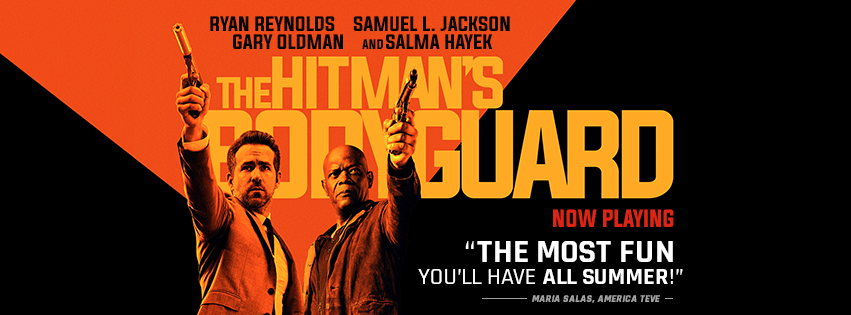
“Get Triggered,” commands one of the movie posters for Patrick Hughes’s The Hitman’s Bodyguard. I don’t know what that means here, but this film is a bit fluffy to trigger much more than some chuckles — after all the eyerolling, of course. That’s how it went for me.

Ryan Reynolds is Michael Bryce, a humiliated professional bodyguard whose career took a hit — get it? — after a client (Tsuwayuki Saotome) was shot and killed right in front of him. Now, he barely ekes out a living guarding low profile corporate executives addicted to speed. He operates out of his run down car, which is where he also lives (as evident from his “bathroom,” an empty water bottle). To make matters worse, Michael is still reeling from a breakup with Amelia (Élodie Yung), an Interpol agent he blames for his sad state.

Amelia is charged with a simple but very consequential mission: to deliver notorious hitman Darius Kincaid (Samuel L. Jackson) to the International Court of Justice at the Hague. Darius has agreed to testify against Vladislav Dukhovich (Gary Oldman), the depraved dictator of Belarus on trial for crimes against humanity. Unfortunately for the prosecution, Dukhovich has a stalwart and invincible army of goons that hunts and kills any witness who has any dirt on him. Darius is the prosecution’s last hope, and the clock is ticking.

When Amelia’s armored car is attacked by Dukhovich’s men, she and Darius go into hiding. She contacts Michael for a favor: to complete the mission and get the star witness to the Hague. She doesn’t tell him who the witness is, and it turns out that Michael and Darius have a history. It ain’t pretty.

Not surprisingly, The Hitman’s Bodyguard is light fare, a stock comedy/action quasi buddy flick. It’s a perfect summer movie; frankly, I’m not sure why it wasn’t released earlier. Tom O’Connor’s screenplay is repetitive, predictable, and loaded with F-bombs, but it’s fun and isn’t at all serious. Reynolds and Jackson have an amusing love/hate relationship filled with banter about everything from murder to love to pop music that wouldn’t be out of place in Pulp Fiction. In between their banter is nonstop action — car chases, explosions, shoot outs in helicopters and boats, cat and mouse games.

Jackson does what he does best: causes grief and cusses with force. Reynolds plays a good square with earnestness. If these two had better chemistry, The Hitman’s Bodyguard would be a more memorable film. Salma Hayek is the best thing about this movie: she’s dramatic and severe and hilarious as Sonia Kincaid, the streetwise but still crazy wife of Darius. Rotting away in an Amsterdam prison, she’s relentless about protesting the grave injustice done to her. She effortlessly steals every scene she’s in.

With Michael Gor, Tine Joustra, Yuri Kolokolnikov, Rod Hallett, Joaquim de Almeida, Kirsty Mitchell, Richard E. Grant

Production: Millennium Films, Cristal Pictures

Distribution: Lionsgate Films

118 minutes
Rated R

(ArcLight) C+

http://www.thehitmansbodyguard.movie/mobile/

Dunkirk

(USA / UK / France / Netherlands 2017)

I have mixed feelings about Christopher Nolan’s spectacular Dunkirk, a World War II military drama that has very little to do with battle. Told from three perspectives — land (“the mole”), sea, and air — the story here centers on an evacuation, that of British and allied soldiers from the beaches of Dunkirk, a fishing village in northern France at the Belgian border, over a ten-day period in late Spring 1940 (https://en.wikipedia.org/wiki/Dunkirk_evacuation).

I have to admit ignorance here: I knew nothing about the Dunkirk evacuation going into this film. Nolan doesn’t spend any time on background or what led to this point; instead, he just picks up with British soldier Tommy (Fionn Whitehead) fleeing German fire outside the beach. I wish I had known ahead of time because I would have done some research. I thought a better job could have been done telling the story.

The structure, jumping between the three perspectives, takes a little work to follow. What exactly is going on is unclear and confusing, and it creates a nice sense of claustrophobia and panic in many scenes — especially that boat scene. This is good. However, keeping track of the characters is a tough task not made any easier by giving all the soldiers the exact same black hair dye. I found it hard to relate to or care much about any of them because I was kept at arm’s length. I couldn’t get invested. While definitely not the same story, Dunkirk is a kind of a big budget Son of Saul — just not as good.

As a spectacle, though, Dunkirk is magnificent. Cinematographer Hoyte van Hoytema shot it on 70 millimeter film, and he packs this picture with gorgeous wide shots of the beach, the sea, and throngs of desperate soldiers. He beautifully captures the hopelessness of the situation with a drab palette of only a few army colors: greens, greys, blues, and cold whites that convey a chill I could see and feel. The sound is over the top loud. If nothing else, Dunkirk is total sensory overload. It’s worth seeing for that alone.

Side note: I’m not sure which is the bigger surprise here — that 1D’s Harry Styles actually isn’t terrible, or that Tom Hardy is hidden under aviator goggles for the entire film. The latter is a bummer. He’s so hot!

With Mark Rylance, Tom Glynn-Carney, Jack Lowden, Aneurin Barnard, James D’Arcy, Barry Keoghan, Kenneth Branagh, Cillian Murphy, Michael Caine

Production: Syncopy, Warner Brothers, Dombey Street Productions, Kaap Holland Film, Canal+, Ciné+, RatPac-Dune Entertainment

Distribution: Warner Brothers, Karo Premiere (Russia), NOS Audiovisuais (Portugal), Roadshow Entertainment (New Zealand), Roadshow Films (Australia)

106 minutes
Rated PG-13

(Music Box) C+

http://www.dunkirkmovie.com

The Birdcage

(USA 1996)

“It’s aspirin with the ‘A’ and the ‘S’ scraped off.”

— Agador

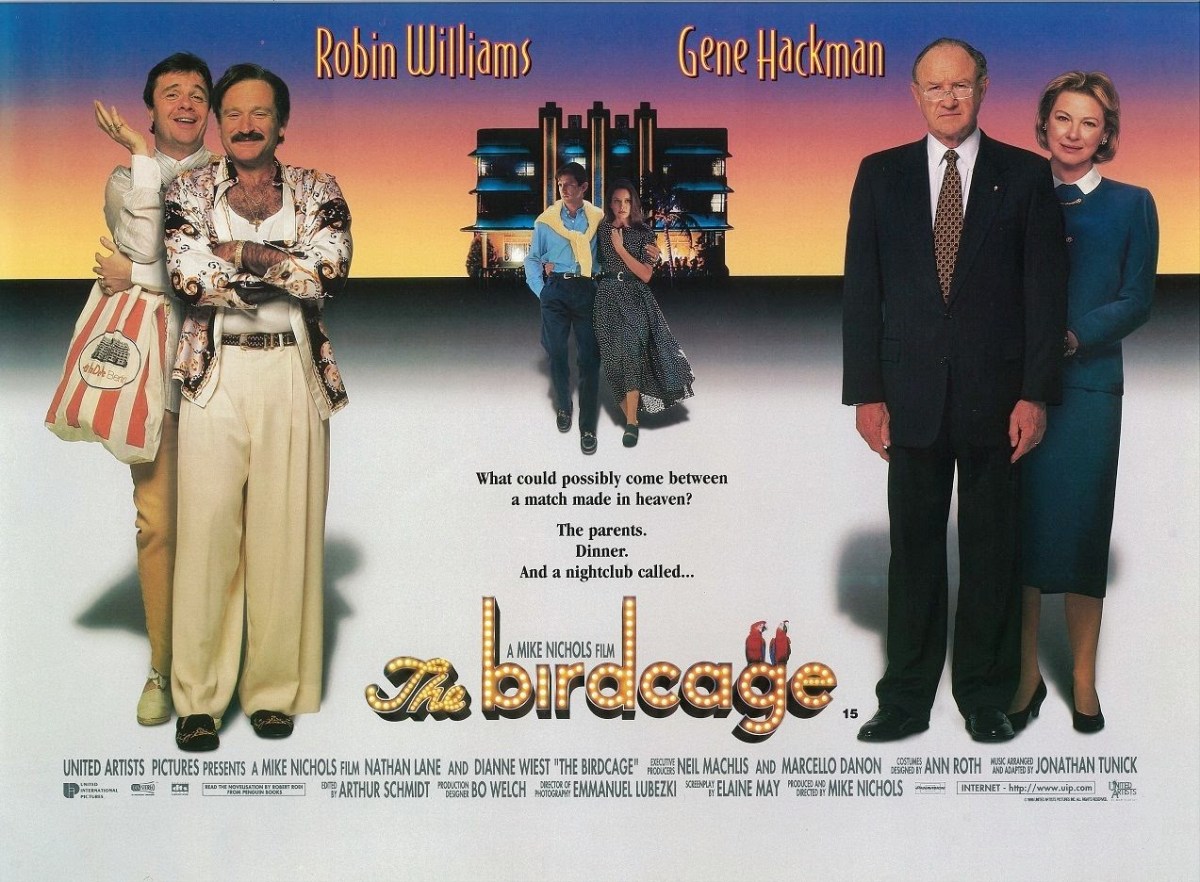
Mark Caro’s latest presentation in his “Is It Still Funny?” series, The Birdcage, is director Mike Nichols’s 1996 Americanized remake of Jean Poiret’s classic 1979 French farce La Cage aux Folles. I’m not sure it was intentional, but this presentation coincides with National Drag Day, something I didn’t know existed.

I left the theater with three impressions: one, things have changed quite a bit in two decades; two, The Birdcage is still funny even if it is silly and dated; and three, Robin Williams could do anything well.

Armand Goldman (Williams) owns and operates a drag nightclub, the Birdcage, in South Beach. His flamboyant husband, Albert (Nathan Lane), is the club’s star attraction. Armand’s son, Val (Dan Futterman), announces his engagement to Barbara Keeley (Calista Flockhart), the daughter of right wing Republican senator Kevin Keeley (Gene Hackman). The kids want to — and should — introduce their parents to each other, but the problem is Barbara’s father, who no doubt will not approve.

Val has a solution: Armand can fake being straight — and married to his biological mother, Katherine Archer (Christine Baranski), who didn’t have much to do with him growing up but maybe will do him this one solid. And the Keeleys will be no worse not knowing the truth.

Albert, who’s a gay giveaway, can’t be part of it. He can’t even be around. This puts Armand — and the entire household — in a tricky situation. Albert is delicate at the moment, and this will hurt him. Little does anyone know how important he’ll prove to be in pulling off the ruse.

It’s easy to dismiss The Birdcage as fluff. The whole thing — plot, setting, characters, that dinner — is really, really silly. The humor relies heavily on stereotypes — histrionic Albert, house “boy” Agador (Hank Azaria), and conservative Kevin are the most obvious examples. Madonna dancers Luis Camacho and Kevin Stea have bit parts as…dancers, big shock. There’s a lot of camp and physical humor here, which doesn’t make for sophisticated comedy.

Nonetheless, the actors bring it, particularly Lane, who imbues his role with unexpected tenderness. Elaine May updates and punches up the screenplay with political jabs and cultural witticisms. At the center of the insanity is Williams, who despite a few glimmers of his wacky old self (“You do Fosse, Fosse, Fosse! You do Martha Graham, Martha Graham, Martha Graham! Or Twyla, Twyla, Twyla! Or Michael Kidd, Michael Kidd, Michael Kidd, Michael Kidd! Or Madonna, Madonna, Madonna!”), plays the Straight Man — that might sound contradictory considering his character here, but I’m not referring to his orientation. And he does it well. The result is a guilty pleasure.

With Dianne Wiest, Tom McGowan, Grant Heslov, James Lally, Luca Tommassini, André Fuentes, Tony Gonzalez, Dante Lamar Henderson, Scott Kaske, Tim Kelleher, Ann Cusack, Stanley DeSantis, J. Roy Helland, Anthony Giaimo, Lee Delano, David Sage, Michael Kinsley, Tony Snow, Dorothy Constantine

Production: United Artists Pictures

Distribution: United Artists (USA), United International Pictures (UIP), Filmes Lusomundo (Portugal)

117 minutes
Rated R

(Music Box) B-

http://www.mgm.com/#/our-titles/187/The-Birdcage/

https://youtu.be/MxfXR1zSj1k

Wonder Woman

(USA 2017)

Director Patty Jenkins aims to do for Wonder Woman what Christopher Nolan—and I suppose to a lesser degree Tim Burton—did for Batman: take an iconic comic book superhero that got campy over the years and return it to its darker roots, producing something dramatic, perhaps weightier, and far more artful. Jenkins doesn’t entirely pull it off with Wonder Woman, but she’s on the right track. I see a sequel or two in the near future, so she’s got time to get there.

To Jenkins’s credit, Wonder Woman is not what I expected. Aside from a nod or two—and that goddamned tiara—all the cut-rate kitsch of the ’70s TV series is gone. This Wonder Woman means business even if she’s still, shall we say, absurd.

Jenkins goes back to the beginning: young Diana (Lilly Aspell and Emily Carey) lives on Themyscira, a hidden island inhabited by war-ready buff goddesses. Queen Hippolyta (Connie Nielsen), Diana’s mother, shields her from the strident ways of her subjects. It all has to do with an old score Ares (David Thewlis) seeks to settle—yes, that Ares, the son of Zeus and the god of war. General Antiope (Robin Wright), Hippolyta’s sister and Diana’s aunt/mentor, isn’t having it: she recognizes Diana’s potential and trains her on the sly. Diana blossoms into a beautiful woman (Gal Gadot) with serious supernatural power.

Diana stumbles upon Steve Trevor (Chris Pine), a drowning American pilot whose plane crashes off the coast of Themyscira. She rescues him, unwittingly exposing the island to an invasion by German forces. Persuaded by the awesome power of Diana’s Lasso of Hestia, Steve confesses that he’s a spy in the “war to end all wars”—World War I. Spider-sensing Ares is behind it, Diana embarks with Steve on a mission filled with romance, adventure, and espionage in an effort to track down the god and stop the madness.

Wonder Woman starts out all Xena: Warrior Princess, silly and weird in a geeky softcore straight guy “lesbian porn” way that no doubt would appeal to the likes of Wayne and Garth. Thankfully, it moves in another direction once Pine shows up about 40 minutes in. I found myself enjoying Wonder Woman more as the story got to Europe—that storyline is more believable even if it too is silly. The battle scenes are decent with some Hollywood excess and humor thrown in. I love how the theme of gender equality is the star of every scene—neither subtle nor heavy-handed, it’s simply a given.

For all its perks, Wonder Woman is ultimately a typical blockbuster that emphasizes form over substance. If nothing else, it surprises, which is always a plus. Frankly, though, I could’ve kept going completely oblivious to the fact that Wonder Woman is more than Lynda Carter. She was more a lot more fun.

With Danny Huston, Saïd Taghmaoui, Ewen Bremner, Eugene Brave Rock, Lucy Davis, Elena Anaya, Doutzen Kroes

Production: DC Entertainment, Atlas Entertainment, Cruel & Unusual Films, Rat-Pac Dune Entertainment LLC, Tencent Pictures, Wanda Pictures

Distribution: Warner Brothers, Karo Premiere (Russia), NOS Audiovisuais (Portugal), Roadshow Entertainment (New Zealand), Roadshow Films (Australia), SF Studios (Norway), Tanweer Alliances (Greece)

141 minutes
Rated PG-13

(ArcLight) C

http://wonderwomanfilm.com

The Wizard of Oz

(USA 1939)

“For twenty-three years, I’ve been dying to tell you what I thought of you! And now… well, being a Christian woman, I can’t say it!”

—Auntie Em


“Toto, I’ve a feeling we’re not in Kansas any more.”

—Dorothy


“I’ll get you, my pretty. And your little dog, too!”

—The Wicked With of the West


“Only bad witches are ugly.”

—Glenda


“Why, anybody can have a brain. That’s a very mediocre commodity. Every pusillanimous creature that crawls on the Earth or slinks through slimy seas has a brain.”

“Hearts will never be practical until they can be made unbreakable.”

“You are under the unfortunate impression that just because you run away you have no courage; you’re confusing courage with wisdom.”

—The Wizard of Oz

Growing up when I did, The Wizard of Oz aired on TV every year, and only once a year. It was a special event. I distinctly remember it being on Thanksgiving, but digging around online contradicts me—while some sources back me up, others say Easter, February, and even Christmas. Whatever. I’ve seen it so many times, I know it by heart. So do many people. Like Willy Wonka and the Chocolate Factory (https://moviebloke.com/2016/03/26/willy-wonka-and-the-chocolate-factory/ ), The Wizard of Oz is a celluloid relic from my childhood that still stirs something in me.

This annual tradition stopped sometime in the ’90s, probably because home video and cable allowed one to see it anytime. So, I was downright thrilled to see a screening near me over a different holiday weekend this year: Memorial Day. I’ve only seen this film on the big screen once or maybe twice before, so I couldn’t resist.

This is where I usually launch into the story, where I might get into some of the details of Dorothy (Judy Garland) and her weird Technicolor odyssey to the Emerald City after a tornado lifts her, Toto (Terry), and her farmhouse out of Kansas and drops her somewhere over the rainbow in Munchkinland—right on top of the unseen Wicked Witch of the East, whose crazy striped socks and shriveled feet are permanently etched in my memory—provoking the ire of the Wicked Witch of the West (Margaret Hamilton) thanks to a pair of ruby slippers.

Let’s be honest, though: we all know the story. Does anything more need to be said about The Wizard of Oz, which is probably the best known and most seen film, ever? Classic and iconic, it set a cinematic benchmark that hasn’t been surpassed nearly a century on, and probably never will be. Loaded with character, song, color, and cool props, it’s a one of a kind spectacle. Its magic continues to inspire.

Harold Rosson’s cinematography is top notch. Seeing it today, I was wowed by the sepiatone Kansas scenes, which were plain old black and white on TV. I always feel a rush when Dorothy opens the door after she crashes, but seeing Munchkinland on the big screen is so much more awesome. So is that scene in the poppy field, and so is the Emerald City with its otherworldy green glow—like paranormal depression glass. Marvelous!

Based on L. Frank Baum’s 1900 children’s book The Wonderful Wizard of Oz, the film’s history behind the camera is every bit as colorful as…well, Munchkinland. Victor Fleming is credited as director, but The Wizard of Oz actually had five: Norman Taurog, Richard Thorpe, George Cukor, Fleming, and King Vidor (https://www.shmoop.com/wizard-of-oz/director.html ). Over a dozen writers contributed to the screenplay (http://oz.wikia.com/wiki/Wizard_of_Oz_Screenwriters ). Although the munchkin suicide is by all accounts nothing more than a rumor, Hamilton was burned badly (https://www.thevintagenews.com/2016/09/06/priority-margaret-hamilton-wicked-witch-west-wizard-oz-suffered-3rd-degree-burns-face-hands-scene-munchkinland-exits-ball-flame/ ). Buddy Ebsen was initially cast as the Tin Man, but he dropped out of the film when he suffered a severe allergic reaction to the aluminum makeup used on his face (http://oz.wikia.com/wiki/Buddy_Ebsen ). However, his voice remains in the scene where Garland, Ray Bolger as the scarecrow, and Jack Haley, Ebsen’s replacement, sing “We’re Off to See the Wizard” after the Tin Man is reanimated with oil.

Legend has it (though it’s probably exaggerated) that the actors who played the munchkins were worse than drunk sailors, holding sex parties and trashing the hotel where they stayed in Culver City (http://www.seeing-stars.com/Hotels/CulverHotel.shtml ) (http://www.mirror.co.uk/tv/tv-news/wizard-oz-mucnhkins-didnt-just-9782402 ) (http://www.independent.co.uk/arts-entertainment/films/features/dogged-by-rumour-the-riddles-of-oz-1766264.html ). Garland allegedly claimed that she was repeatedly accosted by a number of them (http://people.com/celebrity/teenage-judy-garland-was-repeatedly-molested-by-munchkins-on-set-of-wizard-of-oz-says-her-ex-husband/ ). What a world, what a world!

In 1989, the United States Library of Congress deemed The Wizard of Oz “culturally, historically, or aesthetically significant” and selected it for preservation in the National Film Registry (https://www.loc.gov/programs/national-film-preservation-board/film-registry/complete-national-film-registry-listing/).

With Frank Morgan, Bert Lahr, Billie Burke, Charley Grapewin, Clara Blandick, Pat Walshe, Charles Becker, Buster Brodie

Production: Metro-Goldwyn-Mayer/MGM

Distribution: Metro-Goldwyn-Mayer/MGM, Warner Brothers

102 minutes
Not rated

(ArcLight) A+

http://www.thewizardofoz.warnerbros.com

Phantom of the Opera

(USA 1943)

I confess, I rolled my eyes when I found out that a print of Phantom of the Opera was chosen for a screening at the Nitrate Picture Show. I was totally unenthusiastic about seeing yet another version of something I’ve already seen more times than I care to admit. The trailer calls it “[a] story the world can never forget,” but that’s only because Gaston Leroux’s damned story won’t go away.

As it turns out, I quite enjoyed Arthur Lubin’s version. He switches gears with Eric Taylor and Samuel Hoffenstein’s screenplay, ditching horror in favor of romance and melodrama. In the process, he brings a really nice camp factor to the whole thing—I didn’t expect that. His version is a sillier, more fun soapy affair than what I’m used to.

Claude Rains is sympathetic as Erique Claudin, the downsized middle-aged composer who becomes the masked phantom after his publisher (Miles Mander) “steals” his new composition. One of my favorite moments of the entire film is the publisher’s exasperated secretary (Renee Carson) throwing acid from a baking pan in Claudin’s face. It’s so bizarre, it’s actually funny. Even with his acid face, Claudin has a crazy plan for making beautiful young soprano Christine Dubois (Susanna Foster) a star, even if she’ll never return his love. Her female rivalry with diva Biancarolli (Jane Farrar) stews while Anatole (Nelson Eddy), the baritone knight in shining armor, combs the Paris Opera House for the malformed monster (that would be Claudin) who murders anyone in his way. Things get dicier the closer Anatole gets to Claudin.

Phantom of the Opera is a treat for the senses, which makes it perfect for a nitrate print. A rich Technicolor dream, it won Oscars for cinematography (W. Howard Greene and Hal Mohr) and art direction (John B. Goodman, Alexander Golitzen, Russell A. Gausman, and Ira S. Webb) (https://www.oscars.org/oscars/ceremonies/1944). Edward Ward’s score is lovely.

With Edgar Barrier, Leo Carrillo, J. Edward Bromberg, Fritz Feld, Frank Puglia, Steven Geray, Barbara Everest, Hume Cronyn, Elvira Curci, Kate Lawson

Production: Universal Pictures

Distribution: Universal Pictures (USA), General Film Distributors (GFD) (UK), Motion Picture Export Association (MPEA) (Netherlands), Realart Pictures Inc. (USA), Universal Filmverleih (West Germany)

92 minutes
Not rated

(Dryden Theatre) B-

Nitrate Picture Show

Anchors Aweigh

(USA 1945)

“What a time we had tonight, mmm!” In his 1945 New York Times review, Bosley Crowther called Anchors Aweigh a “Gay Musical Film” (http://www.nytimes.com/movie/review?res=9F0DE3DC103BEE3BBC4851DFB166838E659EDE). Well, duh!

I doubt Crowther meant “gay” in the current sense of the word, but he certainly wasn’t wrong either way: between all the singing, dancing, handsome sailors in tight pants, and a very young and wide-eyed Frank Sinatra acting out a creepy attachment to Gene Kelly, the only thing that could make Anchors Aweigh any gayer would be an appearance by Judy Garland. Or a raunchy sex scene with all those sailors and the admiral who, in one number (“We Hate to Leave”), said he would beat them with a whip. I half expected and kinda wanted it to happen, but of course it didn’t. Oh well.

As a reward for their bravery, Navy seamen Joe Brady (Kelly) and Clarence Doolittle (Sinatra) are given a four-day leave in Hollywood. Joe plans to hook up with his dame, Lola. After stalking him on the streets of Los Angeles, sweet and naive ex choir boy Clarence asks the apparently more experienced Joe to teach him how to meet girls.

Enter Donald (Dean Stockwell, whom most of us know as a middle-aged man from his many ’80s and ’90s movies), a little tyke who’s running away from home to join the navy. Our boys take him home, where Donald lives with his Aunt Susie (Kathryn Grayson), a nice girl trying to get into the movie industry—if only she could catch a break. Clarence immediately falls head over heels and enlists Joe’s assistance in wooing her, which provides the story here.

Even though (and probably because) the characters, plot, and dialogue are totally corny, Anchors Aweigh is truly a frothy blast—it’s exactly the kind of film that comes to mind when I think of classic Hollywood. A vivacious affair, director George Sidney keeps everything about it big: the sets, the songs, the dance numbers. I was particularly taken by one sequence involving Kelly and various animated figures—it culminates in an awesome song-and-dance with none other than Jerry Mouse of Tom and Jerry cartoons. Flawless!

The whole spectacle is tied up in an amazing Technicolor bow; Charles Boyle and Robert Planck’s color palette is gorgeous, and seeing it on a nitrate print literally left me breathless. From a sensory perspective, Anchors Aweigh was hands down my favorite film at this year’s Nitrate Picture Show.

As a side note, I must confess that one thing threw me for a loop: Kelly and Sinatra (and Grayson, for that matter) are young and beautiful here—not the old timers I’m accustomed to seeing having grown up when I did. They’re actually hot, even by today’s standards. Kelly upstages Sinatra throughout the entire film, which I found bizarre and quite amusing.

With José Iturbi, Pamela Britton, Grady Sutton, Rags Ragland, Billy Gilbert, William Forrest

Production: Metro-Goldwyn-Mayer

Distribution: Metro-Goldwyn-Mayer

143 minutes
Not rated

(Dryden Theatre) A-

Nitrate Picture Show

The Bachelor and the Bobby-Soxer

(USA 1947)

Richard “Dick” Nugent (Cary Grant) is a dashing, self-absorbed playboy charged with inciting a brawl at a nightclub. A self-employed artist, he shows up late for his hearing before priggish Judge Margaret Turner (Myrna Loy), who’s put off by his casual indifference. Nevertheless, she dismisses the case when she sees that the whole thing started with two floozies (Veda Ann Borg and Carol Hughes) fighting over him. With a slam of her gavel and an eyeroll, she sends Dick on his way, warning him to watch himself.

A free man, Dick heads straight to his next appointment: he’s the guest lecturn at a high school where Margaret’s dramatic 17-year-old sister, Susan (Shirley Temple), is a student. She attends the lecture, and is immediately smitten. Susan approaches Dick afterward and offers to, err, model for him. He’s noncommittal, clearly unaware that he’s dealing with a determined gal.

That evening, Susan gets all dolled up and sneaks out to Dick’s apartment, a spacious two-story downtown suite I’d kill to have. He’s not home, but she persuades the young doorman (Ian Bernard?) to let her up so she can wait for him. Naturally, she falls asleep on the davenport.

A big misunderstanding leads to Dick punching Margaret’s date, district attorney Tommy Chamberlain (Rudy Vallee), when they show up at his apartment to rescue Susan soon after he gets home and discovers her there. Dick is sent to the slammer, where court psychiatrist Dr. Matt Beemish (Ray Collins)—Margaret and Susan’s uncle—figures out what’s up. The good doctor proposes a “simple” solution: Dick agrees to date Susan, Margaret agrees to allow Susan to date Dick until her infatuation runs its course, and Tommy agrees to drop the assault charge. All three grudgingly agree to the plan. Hilarity ensues, especially as Dick and Margaret start digging each other—and Susan proves to be a real pain in the ass.

Penned by future TV creator/writer Sidney Sheldon (The Patty Duke Show, I Dream of Jeannie, and Hart to Hart), The Bachelor and the Bobby-Soxer is a solid textbook screwball comedy. It actually feels like a sitcom. Sheldon won an Oscar for Best Original Screenplay for this (https://www.oscars.org/oscars/ceremonies/1948), and I can see why: his script is light and fun, capitalizing on the generation gap between youth culture and, I guess, middle age. I doubt the story would fly today; the whole premise reads as creepy by 21st Century standards. For a more innocent time, though, it totally works. And it’s amusing.

Director Irving Reis straddles the line between silly and ridiculous without going overboard. Grant, Loy, and Temple all have better work under their belt, but each still gives a memorable performance here even if their characters and this fluffy film are forgettable. I heard some grumbling from others in the audience, but I enjoyed this for what it is—and it ain’t Citizen Kane.

One final word about the nitrate print I saw: it was stunning, exceeding my expectations. I had my doubts that black and white film would make me sing the praises of nitrate, but The Bachelor and the Bobby-Soxer made me a believer; the whites were luminescent and the blacks and greys were deep and complex. Lovely!

With Lillian Randolph, Harry Davenport, Johnny Sands, Don Beddoe, Dan Tobin, Ransom Sherman, William Bakewell, Irving Bacon, Dore Schary

Production: RKO Radio Pictures, Vanguard Films

Distribution: RKO Radio Pictures

95 minutes
Not rated

(Dryden Theatre) C+

Nitrate Picture Show