If her take on Marie Antoinette is any clue, Sofia Coppola loves postpunk ’80s British bands like Siouxsie and the Banshees, the Cure, New Order, and New Romantic frontrunners Adam and the Ants and Bow Wow Wow. So do I. This in all likelihood is what drew me to Marie Antoinette: with three Bow Wow Wow songs (two remixed by My Bloody Valentine’s Kevin Shields), big hair, and a real MTV sensibility, its appeal to me is, well, a piece of cake.
All that is only part of the story. What really makes me love Marie Antionette is the sympathetic angle Coppola takes with this infamous character. Based on Antonia Fraser’s biography Marie Antoinette: The Journey, the first half of the movie is about the difficulties Marie (Kirsten Dunst) faces adapting to her new French surroundings and getting her new husband, Louis XVI (Jason Schwartzman, Coppola’s cousin), to consummate their marriage. She fails, and of course everyone blames her—even her mother (Marianne Faithfull). When she’s had enough, she says “fuck it” and becomes a full on rock star. This is where things get interesting.
Colorful and elaborate, Marie Antionette is not profound. So what? Lance Acord’s music video cinematography is perfect for what Coppola is going for; bordering on sensory overload, this film is busy, clever, and fun to watch. I know better than to take it as a history lesson.
With Judy Davis, Rip Torn, Rose Byrne, Asia Argento, Molly Shannon, Shirley Henderson, Danny Huston, Mary Nighy, Jamie Dornan, Steve Coogan, Tom Hardy
Production: Pricel, Tohokushinsha Film Corporation (TFC), American Zoetrope, Pathé, Commission du Film France, Commission du Film Île-de-France
“We rushed into the business with our usual disregard for a comprehensive political scheme.”
—Gertrude Bell
According to the promotional poster for Sabine Krayenbühl and Zeva Oelbaum’s Letters from Baghdad, the so-called “Queen of the Desert” and “female Lawrence of Arabia” Gertrude Bell “was as controversial as the history she made.” Well, that certainly sounds promising!
Born into a wealthy family, Bell immersed herself in the Middle East in the early 20th Century and used her talents as a writer and a schmoozer to intimately acquaint herself with the area, its people, and their culture (https://en.wikipedia.org/wiki/Gertrude_Bell). Her contacts with influential expats and various Arab leaders combined with her knowledge of the culture led to an appointment as a British officer during World War I and a direct hand in drawing up the borders of modern Iraq.
Tilda Swinton gives Bell her voice, reading off camera Bell’s actual writings about events that occurred on her many trips and the people she met. In Bell’s own words, Swinton offers history, observations, and even some Victorian Era dish. Bell had at least as much influence as T. E. Lawrence a.k.a. Lawrence of Arabia (played here by Eric Loscheider in a staged “talking head” interview made to look like old footage).
Bell’s life and the impact of her deeds a century later make for an interesting story. Painstakingly researched, Krayenbühl and Oelbaum pull from diverse source material—letters, diaries, photos—to show what cities like Baghdad and Damascus were like a hundred years ago. They do a great job humaninzing Bell, getting into personality flaws and personal disappointments. In both respects, Letters to Baghdad works really well.
Not everything works as well as it could, though. Some important items are treated superfically. For example, they mention the tension between the Sunni, Shia, and Kurds even back then, but Krayenbühl and Oelbaum don’t delve into it. They touch on Bell’s reasoning for the borders she devised, but they don’t give much critical assessment to it. I left with the distinct feeling that I didn’t get the whole story. Another problem: the staged interviews give a lot of information, but they’re cheesy.
I found myself glancing at my watch about halfway through Letters from Baghdad. It’s a well made documentary, but it’s not as enthralling as it promises to be.
With Ammar Haj Ahmad, Helen Ryan, Rachael Stirling, Robert Ian Mackenzie, Christopher Villiers, Lucy Robinson, Elizabeth Rider, Michael Higgs, Joanna David, Michelle Eugene, Paul McGann, Pip Torrens
Production: Between the Rivers Productions, Letters From Baghdad, Missing in Action Films
The premise of Lina Wertmüller’s Love & Anarchy [Film d’amore e d’anarchia, ovvero ‘stamattina alle 10 in via dei Fiori nella nota casa di tolleranza…’] has the ring of something from Federico Fellini or maybe Pedro Almodóvar (though Fellini makes a lot more sense because she actually worked as his assistant for a spell).
Freckly yokel farmer Tunin (Giancarlo Giannini) learns that his friend was murdered. Why? Because he was an anarchist who was plotting to assassinate “ll Duce” Benito Mussolini. What’s more, Mussolini’s fascist police killed him. To avenge his friend’s death, Tunin takes up his cause.
Tunin ends up at a brothel in Rome. He spends a night with Salomè (Mariangela Melato), who reveals that she’s a co-conspirator for her own reasons. As the story progresses, it becomes clear that the coup is a harebrained idea.
Salomè takes Tunin to a rural spot just outside Rome with her and another prostitute, Tripolina (Lina Polito). Salomè distracts Spatoletti (Eros Pagni), the head of Mussolini’s police, while Tunin checks out the area; they then devise a plan to execute the mission.
Meanwhile, Tunin and Tripolina fall in love. Convinced that he isn’t going to make it past the assassination alive, he persuades Tripolina to spend the next two days with him.
The same radical spunk that Wertmüller exhibits in The Seduction of Mimi is just as prevalent in Love & Anarchy; this film is loaded with decadent, sexy hijinks. However, it also its share of some really tender moments—that surprised me. Love & Anarchy turns out devastatingly sad—I left the theater literally bummed out. For all its ridiculous sociopolitical and sexual shenanigans, it’s a far more powerful film.
With Pina Cei, Elena Fiore, Giuliana Calandra, Isa Bellini, Isa Danieli, Enrica Bonaccorti, Anna Bonaiuto, Anita Branzanti, Maria Sciacca, Anna Melato, Gea Linchi, Anna Stivala, Roberto Herlitzka
Production: Euro International Film, Labrador Films
Sergei Eisenstein and Dmitriy Vasilev’s Alexander Nevsky [Алекса́ндр Не́вский] is an oddball film. An historical drama with major propagandist and nationalistic overtones, it depicts Prince Alexander a.k.a. Nevsky (Nikolay Cherkasov) in his battle against the Teutonics as they try to invade the medieval city of Novgorod. Spoiler alert: Nevsky defeats them.
Alexander Nevsky tried my patience; of all the films at this year’s Nitrate Picture Show, it’s the only one I can say bored me. The plot is dull and the execution of the narrative is boring. The acting is stiff and the dialogue, even translated with subtitles, is…severe? I got through it without hating it thanks to a tiny amount of lightheartedness spinkled throughout that makes the whole thing bearable.
One subplot in particular kept me engaged and amused: it involves Vasili Buslai (Nikolai Okhlopkov) and Gavrilo Oleksich (Andrei Abrikosov), two warriors competing for the affection of the same woman, Olga Danilovna, a Maid of Novgorod (Valentina Ivashova, and that’s her character’s name). The two men relentlessly try to outdo each other in courage and skill on the battlefield, as she’s the big prize waiting for the winner. It doesn’t turn out how I expected.
That said, Alexander Nevsky is definitely a worthwhile experience for its visuals. It has a cool neoclassical atomic age sensibility, mixing elements of mythology with a kind of futuristic sci-fi minimalism. The battlefield scenes are beautifully shot, evoking a sense of vast otherworldly shock and awe. Eduard Tisse’s cinematography shimmers, and he contrasts light and dark really nicely here. The nitrate print we saw was sharp. I see why this was included in the festival:
With Dmitriy Orlov, Vasili Novikov, Nikolai Arsky, Varvara Massalitinova , Amelfa Timoferevna, Valentina Ivashova, Aleksandra Danilova, Vladimir Yershov, Sergei Blinnikov, Ivan Lagutin, Lev Fenin, Naum Rogozhin
Production: Mosfilm
Distribution: Artkino Pictures, Progressive Film Institute (UK), Amkino Corporation (USA), Panthéon Distribution (France)
Based on the novel Sirená by Marie Majerová, a communist and feminist Czech author prolific before World War II (https://en.wikipedia.org/wiki/Marie_Majerová), Karel Steklý’s The Strike follows the Hudcový family during a mine workers’ strike outside Prague in the late 19th Century. Hudec (Ladislav Boháč) is a sort of foreman at a mine. His job makes him miserable, which is apparent from his drinking. He finds himself caught between the mine’s owner and the discontented, sorely underpaid workers that include his son Rudolf (Oleg Reif). Hudec tries to straddle the line between the two but ultimately joins the workers when pushed by his determined wife, Hudcová (Marie Vásová), who seems like she’s always hungry. The cost is devastating, especially for their preteen daughter Emča (Pavla Sucha).
Though not as elegant, The Strike recalls Metropolis (https://moviebloke.com/2015/09/12/metropolis/) both thematically and visually. Jaroslav Tuzar’s stark and grimy cinematography nicely highlights the plight of the workers, and it looks great in black and white. Nothing here is nuanced, though: the narrative is coarse and blunt, the acting is total amateur hour, and the moral is in-your-face. Still, The Strike is remarkable for its earnestness; the workers plotting a revolt, their riot, and the town police and corrupt mayor (Josef Benátský) standing behind the mine over the workers certainly all ring true and timely. It kept my interest all the way through.
I never heard of Steklý or The Strike or anyone involved with this picture until I saw it 70 years after its release. I’m not sure it ever enjoyed international distribution—I can’t find a trailer for it—and I can guess why: a dour postwar propaganda film, it likely would have turned off audiences with its Reefer Madness-like approach to capitalism and communism that seems to argue for the latter. Viewing it today, I saw it as an eerily accidental warning of what happens when the middle class disappears.
With Josef Bek, Josef Dekoj, Nadezda Gajerová, Vera Kalendová Bedrich Karen, Lída Matousková
Chicago filmmaker Lonnie Edwards made some waves with his 2015 documentary A Ferguson Story, which delved into some of the events following Officer Darren Wilson’s deadly shooting of unarmed black teen Michael Brown in Ferguson, Missouri. The subject of Exodus: Sounds of the Great Migration isn’t as heavy or bleak, but it’s every bit as intriguing.
Exodus: Sounds of the Great Migration is a smooth, flashy short film that honors the music and dance forms that black Americans brought to other parts of the country, mostly industrialized cities, through the Great Migration from the South during the first half of the 20th Century. In just a few minutes, Edwards demonstrates how both assimilated into urban life and continue to shape modern culture. I couldn’t find credits, but the guy tap dancing in the stairwell stood out; his taps are downright melodious.
Heart Like a Wheel is the kind of movie you see on late night TV: a mildly amusing true story about someone you’ve never heard of and her struggle to overcome adversity and maybe find herself in the process. In this case, that someone is Shirley Muldowney (Bonnie Bedelia), later known as “Cha Cha,” a 1960s housewife who became the first woman to obtain a license from the National Hot Rod Association (NHRA) and the first person ever to win two and then three Top Fuel titles (https://en.wikipedia.org/wiki/Shirley_Muldowney). Her struggle consists of establishing herself as a serious dragster. The adversity, well, that’s the sexist all-male drag race scene. You might say the whole thing is a drag.
One night, Shirley’s mechanic husband, Jack (Leo Rossi), lets her race his sports car on the street. She beats Jack’s rival and discovers that she digs the thrill of drag racing. Soon, she’s hanging out at the racetrack, where she meets Connie Kalitta (Beau Bridges), a veteran racer and womanizer. Jealous of her success, Jack leaves Shirley to her own devices.
I picked up Heart Like a Wheel for one reason, and one reason only: I read that My Life with the Thrill Kill Kult sampled this movie in a song or two. Overall, it’s a mixed bag, but I was pleasantly surprised to find that it’s better than mediocre. The acting is good. Ken Friedman’s screenplay is competent if not exactly deep, peppered with some snappy dialogue. When a skeezy reporter (Martin Casella) asks Shirley what a beautiful girl like her is doing at a racetrack, for example, her one-word response is casual, bored, and totally fucking awesome: “Winning.” Director Jonathan Kaplan stages realistic fight scenes, particularly between Connie and Shirley’s teenage son, John (played by a young Anthony Edwards). He even throws in a couple of real racers (Steve Evans and Sam Posey) and fire. It was nominated for an Academy Award for costume design (https://www.oscars.org/oscars/ceremonies/1984). The whole thing comes off like a soap opera, but it works. I never did catch those samples, though.
Bonus: the DVD I have includes trailers for four other films, The Turning Point, Kenny & Company, Rhinestone with Dolly Parton and Sylvester Stallone, and Six Pack with Kenny Rogers and Anthony Michael Hall. They all look as awful as “Born to Win” by Jill Michaels, the Heart Like a Wheel theme song.
With Hoyt Axton, Creed Bratton, Tiffany Brissette, Michael Cavanaugh, Diane Delano, Mitzi Hoag, Nora Heflin, Brandon Brent Williams
“Cheating on a quiz show? That’s sort of like plagiarizing a comic strip.”
—Mark Van Doren
The quiz show scandal of the late 1950s doesn’t sound like a riveting topic for a film, but that’s exactly what it is in Quiz Show, Robert Redford’s fourth directing gig. Every aspect of this film is spectacularly elegant, starting with Bobby Darin crooning “Mack the Knife” as the opening credits roll over shots of armored security guards transferring sealed questions and answers from a bank vault to a studio. Quiz Show is a modern morality play with lots of style.
It’s 1958, and NBC’s Twenty-One is the biggest game show in America. Homely goofball Herbert Stempel (John Turturro) of Queens is a surprise celebrity after an unprecedented winning streak, but the show’s ratings have “plateaued.” The show’s sponsor, Geritol, is ready for a change. So are producers Dan Enright (David Paymer) and Albert Freedman (Hank Azaria), who decide that a charismatic, television-ready new contestant is what the show needs.
WASPy college professor Charles Van Doren (Ralph Fiennes) happens to audition for another NBC game show, the less popular Tic Tac Dough. Handsome, polished, and hailing from an eminent intellectual family, “Charlie” fits the bill for Enright and Freedman’s vision.
Enright takes Stempel out for a steak dinner and asks him to “take a dive,” or purposely lose to Van Doren, on an upcoming show. Predictably, this isn’t something Stempel wants to do—at least, not without something in return. Enright fails to deliver on purposely vague promises, and Stempel publicly calls Twenty-One a fraud, saying it’s rigged. A judge seals the findings of a grand jury investigation, which gets some very minor press: a blurb in the paper. It catches the attention of ladder climbing Richard “Dick” Goodwin (Rob Morrow), a lawyer with the House Legislative Oversight Subcommittee in Washington, D.C., who plans to “put TV on trial.”
Quiz Show didn’t set the box office on fire during its original run, which is really odd (http://www.boxofficemojo.com/yearly/chart/?yr=1994). No matter, because it’s a fine drama. Based on the book Remembering America: A Voice From the Sixties by the real Richard Goodwin, Paul Attanasio’s screenplay is meticulously calibrated and cerebral, rich with strong characters, intertwined dilemmas, a fascinating plot, and a plethora of Fifties pop cultural references without nostalgia. Redford’s pacing is excellent: he sets up the story slowly then knocks down each character one after another. He draws superb performances out of the actors, too. The literary repartee between Van Doren and his genteel father, Mark (Paul Scofield), is one of the best things about this film. A wry and subtle sense of humor keeps the story exuberant: Martin Scorsese is great as fast talking Geritol CEO Martin Rittenhome, and Christopher McDonald makes an awesome Jack Barry.
Sure, Quiz Show isn’t an “exact word” historical documentary; Redford and Attanasio took some license. However, the result is an excellent depiction of good versus evil, not just in the television industry but in corporate America altogether. There’s not a lull or a dull moment here. The only criticism I have is Morrow’s unconvincing Boston accent; that can go. Everything else, though, is brilliant. Enright’s son, Don, wrote a piece about Quiz Show for the L.A. Times (http://articles.latimes.com/1994-09-19/entertainment/ca-40429_1_quiz-show); it’s another view worth considering.
With Mira Sorvino, Johann Carlo, Elizabeth Wilson, Allan Rich, Griffin Dunne
“I don’t know how I’m gonna live with myself if I don’t stay true to what I believe.”
—Desmond Doss
Like him or not, Mel Gibson has what it takes to direct a massive Hollywood picture. Hacksaw Ridge, his first directorial job in a decade, demonstrates that much—just in case earlier films like Braveheart, The Passion of the Christ, and Apocalypto didn’t.
Hacksaw Ridge depicts the remarkable and true story of Desmond Doss (Andrew Garfield), the Lynchburg, Virginia, Seventh-day Adventist who served as a medic in the U.S. Army during World War II. His story is unique: he enlisted, but as a conscientous objector for religious reasons. Refusing to kill or carry a gun, he rescued 75 or so wounded soldiers from the field during the Battle of Okinawa (http://www.collegedale-americanlegion.org/Pages/DesmondTDoss.aspx). President Harry S. Truman awarded Doss the Congressional Medal of Honor in 1945, the first time such a high accolade was bestowed upon someone who never even discharged a weapon (https://en.wikipedia.org/wiki/Desmond_Doss).
From a technical standpoint, Hacksaw Ridge is pretty awesome. The story is a good one. The battle scenes are clearly the centerpiece: they’re loud and extremely graphic. The prosthetics are spot on realistic. Cinematographer Simon Duggan starts out with warm, almost sepia tones in the early civilian scenes, but as the setting moves onto the battlefield he ditches color in favor of a washed out black, green, and white palette. Shaky closeups, slow motion shots, blurry pans, and quick cuts create a sense of confusion as gunfire and explosions and human carnage take over the screen. Hacksaw Ridge is no Son of Saul (https://moviebloke.com/2016/02/11/son-of-saul-saul-fia/), but it still overwhelms the senses albeit in a distanced, staged blockbuster way.
Otherwise, Hacksaw Ridge didn’t impress me all that much. At its core, it’s a standard-issue war movie complete with a sugary subplot about the girl, Dorothy Schutte (Teresa Palmer), waiting for Doss to hurry up and get back home so they can get married, and lots of humorous if mawkish male bonding through nicknames, insults, physical attacks, and simply having each other’s back. There’s a military court scene, trite “war is hell, boys” lines, soldiers who freak out once they get on the battlefield, likable characters who perish, and of course the superhuman heroic deeds of Doss.
Most character background is given hurried and superficial treatment: Doss’s alcoholic veteran father (Hugo Weaving) and his bad experience in World War I, Doss and Dorothy’s quick courtship, even the failed attempts of Sgt. Howell (Vince Vaughn) and Cpt. Glover (Sam Worthington) to persuade Doss to leave the Army. Too bad, because a little more insight could have made the film stronger. A particularly glaring example is brother Hal (Nathaniel Buzolic), who simply vanishes once he shows up at the dinner table in uniform. What happens to him? Did I miss it?
I’m conflcited on the message here, but I guess that’s okay because frankly Hacksaw Ridge is a conflicted film. Gibson maintains that it’s an anti-war statement (http://www.christianpost.com/news/mel-gibson-hacksaw-ridge-is-an-anti-war-movie-170318/). Fine, but that’s hard to believe considering the disproportionate amount of time and resources given to overblown battle scenes. I’m not sure the film honors Doss or his pacifist convictions. Moreover, what sure seems like a blatant parallel to the so-called religious liberty movement is, in my view, misguided and hollow, especially when Doss’s faith is treated more or less as incidental. Hacksaw Ridge sustained my interest, but I would have appreciated a little more depth.
With Luke Bracey, Darcy Bryce, Rachel Griffiths, Firass Dirani, Michael Sheasby, Luke Pegler, Nico Cortez, Goran D. Kleut, Harry Greenwood, Damien Thomlinson, Ben O’Toole
Ray Kroc’s name is synonymous with McDonald’s, the ubiquitous fast food institution that hasn’t needed an introduction for the entire time I’ve been alive. It seems strange that I’ve never known much about him even after living in Chicago for almost 20 years—at least, not until The Founder. Then again, maybe I still don’t.
Kroc (Michael Keaton) is a middle aged traveling salesman who hocks milkshake mixers to restaurants, mainly drive-ins and diners, in the 1950s. Based in Chicago, he has a nice enough home in suburban Arlington Heights, a supportive if not ambitious wife, Ethel (Laura Dern), and the means to afford a country club membership. Nonetheless, Kroc is neither wildly successful nor affluent. He isn’t setting the world on fire selling milkshake mixers, and his business ideas never seem to pan out. He doesn’t fit in with the WASPy professionals Ethel gravitates toward. Being the entrepreneur he is, he yearns for more.
While making cold calls in Missouri, Kroc gets a big order for mixers from San Bernardino, California. He drives out there and finds McDonald’s, an idyllic burger joint owned and operated by two brothers, affable Mac (John Carroll Lynch) and crusty Dick (Nick Offerman). Shiny and clean, the place is a welcoming sight. Mac shows Kroc the kitchen: it’s an intricate and super-efficient assembly line that delivers consistenly appetizing product in minutes. Disposable packaging means customers can take their food with them and eat it wherever they want, keeping the line moving while eliminating the need for clean up (not to mention dishes). Employees work together as a team. The customer service is flawlessly friendly. Dick explains that high-quality food and fast service are the hallmarks of McDonald’s. The brothers have hit something with their formula: the place is slammed with a customer base that overwhelmingly consists of middle class families. Kroc wants to franchise McDonald’s, something the brothers tried before but it didn’t work.
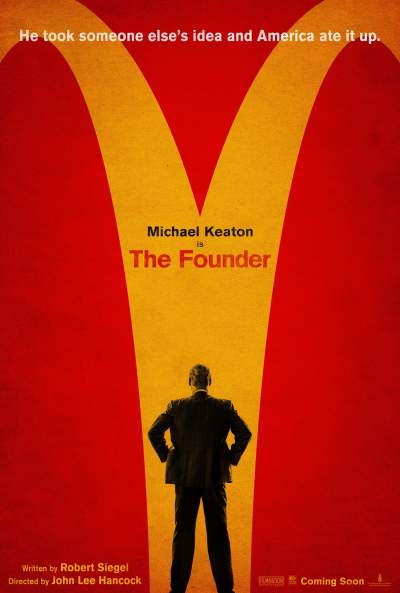
The Founder focuses less on Kroc’s personal life and more on the many problems he overcomes in executing his ambitious plan to make McDonald’s and its Golden Arches a symbol of America that seemlessly fits, as he puts it at one point, right in with the Stars and Stripes and crosses on churches. There’s a lot of dry stuff dealing with the nuts and bolts of business here—business models, contract negotiations, marketing, quality control, real estate, financing, trademarks, cutting costs, and of course double crossing. It’s a timely film—I can’t think of a more fitting movie to see on this particular Inauguration Day: one of the promotional posters for The Founder calls Kroc a rule breaker, a risk taker, and a game changer, and for better or worse that’s what he turned out to be. Michael Keaton is perfect for this role, playing Kroc as a ruthlessly driven goofball who has no good ideas of his own but certainly knows how to capitalize on those of others. American history is rich in such characters.
That said, I must admit that I have no idea how much of this story is accurate—not that I was compelled to find out on my own. The Founder doesn’t make me care. Pieces of the story seem to be missing. Robert Siegel’s script isn’t exactly objective—it borders on propaganda, especially when he overemphasizes the simplicity of the McDonald brothers. John Lee Hancock is a capable director, but he’s so ambiguous about his subject that he doesn’t say what he makes of him. I’m not sure he knows. His treatment lacks a certain nuance the material demands that could’ve made The Founder a lot more than it is. It’s not a terrible film, but I had higher expectations.
Also starring B.J. Novak, Linda Cardellini, Patrick Wilson, Justin Randell Brooke
Produced by FilmNation Entertainment, The Combine, Faliro House Productions S.A.



 moviebloke