Didi’s Dreams [Didi’s Dream]

(Taiwan/China 2017)

Just in time for summer, Didi’s Dreams [吃吃的愛] is the cinematic equivalent of a glass of lemonade: cool, refreshing, and sweet with a slightly tart afterburn, it’s a real treat on a hot day. Too bad its North American run is an extremely limited one.

An intentionally fluffy melodrama, the story follows the misadventures of its titular character, Didi (Dee Hsu), a hungry young twenty-something wannabe actress. Determined to catch her big break, she auditions for anything: a probiotic commercial, a model on a QVC-type shopping network, an extra in a zombie flick, a female wrestler. She’s not exactly picky, calculated, or disciplined about getting there—she just wants to be famous. To her credit—and the dismay of many a producer and director—she’s earnest in her efforts.

Didi’s boyfriend, Xiao-kou (Scar Kim), literally rolls along with her, carting her around on his scooter. He proves to be her rock when she receives devastating news from her doctor (Chuan-cheng Tao).

Didi has a sister, Lingling (Lin Chi-lin), who also happens to be an actress—a famous one like Didi aims to be. Some bad blood between them after their mother died, shown mainly through flashbacks, caused a falling out. As a result, they haven’t spoken in years. A scandal, a TV talk show, and a twist of fate (or maybe just a publicity stunt) bring them together—cast as sisters in a major motion picture.

While all this goes on, Didi has a recurring dream about Chunmei (also played by Hsu), her psychic alterego who runs an interplanetary noodle shop in, um, outer space. Her clientele is a creature cantina of sorts. Chunmei can’t seem to get over losing her love, and it’s affecting her broth. One particular customer, an astronaut (Zifeng Li), holds her attention. While not immediately clear, a connection to Didi comes through as the story progresses.

Director Kevin Tsai keeps it mostly light here, serving up a tangy mix of comedy, tragedy, and fantasy in a wink-wink soap opera way—more Telemundo than Dynasty. Tsai and Ming-Yi Liao’s screenplay is not at all deep, but it’s packed with surprises despite a few sappy clichés. I like where the narrative goes.

Visually, Didi’s Dreams is a colorful stunner, loaded with cute faces, vivid imagery, snazzy sets, and cool costumes. Jing-Pin Yu’s cinematography glistens; it’s slick without going overboard. I can’t imagine enjoying this film as much without it. It all looks great on the big screen—my favorite scenes are at the noodle shop and that probiotic commercial.

Yes, there are flaws. However, the whole thing is put together so well, I easily forgave them. I could’ve done without the remake of “Moon River” from Breakfast at Tiffany’s over the closing credits, but the analogy is apt. Didi’s Dreams is a fun little sparkler that caught me off guard.

With Jin Shijia, David Chao, William Shen, Vincent Liang, Bruce Chen, Junior Han, Gigi Lin, Vila Fan, Yu-Lin Shen, Hank Chen, Tender Huang, Riva Chang, Berry Wen-i Kuo

Production: Cheng Cheng Films

Distribution: Le Vision Pictures, Atom Cinema, Kbro HK Limited

91 minutes
Not rated

(ShowPlace ICON) B-

http://www.chengchengfilm.com/didis-dreams-1/

The Wizard of Oz

(USA 1939)

“For twenty-three years, I’ve been dying to tell you what I thought of you! And now… well, being a Christian woman, I can’t say it!”

—Auntie Em


“Toto, I’ve a feeling we’re not in Kansas any more.”

—Dorothy


“I’ll get you, my pretty. And your little dog, too!”

—The Wicked With of the West


“Only bad witches are ugly.”

—Glenda


“Why, anybody can have a brain. That’s a very mediocre commodity. Every pusillanimous creature that crawls on the Earth or slinks through slimy seas has a brain.”

“Hearts will never be practical until they can be made unbreakable.”

“You are under the unfortunate impression that just because you run away you have no courage; you’re confusing courage with wisdom.”

—The Wizard of Oz

Growing up when I did, The Wizard of Oz aired on TV every year, and only once a year. It was a special event. I distinctly remember it being on Thanksgiving, but digging around online contradicts me—while some sources back me up, others say Easter, February, and even Christmas. Whatever. I’ve seen it so many times, I know it by heart. So do many people. Like Willy Wonka and the Chocolate Factory (https://moviebloke.com/2016/03/26/willy-wonka-and-the-chocolate-factory/ ), The Wizard of Oz is a celluloid relic from my childhood that still stirs something in me.

This annual tradition stopped sometime in the ’90s, probably because home video and cable allowed one to see it anytime. So, I was downright thrilled to see a screening near me over a different holiday weekend this year: Memorial Day. I’ve only seen this film on the big screen once or maybe twice before, so I couldn’t resist.

This is where I usually launch into the story, where I might get into some of the details of Dorothy (Judy Garland) and her weird Technicolor odyssey to the Emerald City after a tornado lifts her, Toto (Terry), and her farmhouse out of Kansas and drops her somewhere over the rainbow in Munchkinland—right on top of the unseen Wicked Witch of the East, whose crazy striped socks and shriveled feet are permanently etched in my memory—provoking the ire of the Wicked Witch of the West (Margaret Hamilton) thanks to a pair of ruby slippers.

Let’s be honest, though: we all know the story. Does anything more need to be said about The Wizard of Oz, which is probably the best known and most seen film, ever? Classic and iconic, it set a cinematic benchmark that hasn’t been surpassed nearly a century on, and probably never will be. Loaded with character, song, color, and cool props, it’s a one of a kind spectacle. Its magic continues to inspire.

Harold Rosson’s cinematography is top notch. Seeing it today, I was wowed by the sepiatone Kansas scenes, which were plain old black and white on TV. I always feel a rush when Dorothy opens the door after she crashes, but seeing Munchkinland on the big screen is so much more awesome. So is that scene in the poppy field, and so is the Emerald City with its otherworldy green glow—like paranormal depression glass. Marvelous!

Based on L. Frank Baum’s 1900 children’s book The Wonderful Wizard of Oz, the film’s history behind the camera is every bit as colorful as…well, Munchkinland. Victor Fleming is credited as director, but The Wizard of Oz actually had five: Norman Taurog, Richard Thorpe, George Cukor, Fleming, and King Vidor (https://www.shmoop.com/wizard-of-oz/director.html ). Over a dozen writers contributed to the screenplay (http://oz.wikia.com/wiki/Wizard_of_Oz_Screenwriters ). Although the munchkin suicide is by all accounts nothing more than a rumor, Hamilton was burned badly (https://www.thevintagenews.com/2016/09/06/priority-margaret-hamilton-wicked-witch-west-wizard-oz-suffered-3rd-degree-burns-face-hands-scene-munchkinland-exits-ball-flame/ ). Buddy Ebsen was initially cast as the Tin Man, but he dropped out of the film when he suffered a severe allergic reaction to the aluminum makeup used on his face (http://oz.wikia.com/wiki/Buddy_Ebsen ). However, his voice remains in the scene where Garland, Ray Bolger as the scarecrow, and Jack Haley, Ebsen’s replacement, sing “We’re Off to See the Wizard” after the Tin Man is reanimated with oil.

Legend has it (though it’s probably exaggerated) that the actors who played the munchkins were worse than drunk sailors, holding sex parties and trashing the hotel where they stayed in Culver City (http://www.seeing-stars.com/Hotels/CulverHotel.shtml ) (http://www.mirror.co.uk/tv/tv-news/wizard-oz-mucnhkins-didnt-just-9782402 ) (http://www.independent.co.uk/arts-entertainment/films/features/dogged-by-rumour-the-riddles-of-oz-1766264.html ). Garland allegedly claimed that she was repeatedly accosted by a number of them (http://people.com/celebrity/teenage-judy-garland-was-repeatedly-molested-by-munchkins-on-set-of-wizard-of-oz-says-her-ex-husband/ ). What a world, what a world!

In 1989, the United States Library of Congress deemed The Wizard of Oz “culturally, historically, or aesthetically significant” and selected it for preservation in the National Film Registry (https://www.loc.gov/programs/national-film-preservation-board/film-registry/complete-national-film-registry-listing/).

With Frank Morgan, Bert Lahr, Billie Burke, Charley Grapewin, Clara Blandick, Pat Walshe, Charles Becker, Buster Brodie

Production: Metro-Goldwyn-Mayer/MGM

Distribution: Metro-Goldwyn-Mayer/MGM, Warner Brothers

102 minutes
Not rated

(ArcLight) A+

http://www.thewizardofoz.warnerbros.com

Eraserhead

(USA 1977)

I learned of David Lynch’s Eraserhead, his first feature length film, during my freshman year in college (thank you, U.D.). Somehow, seeing it escaped me until it screened at a recent Lynch retrospective.

The basic premise is easy to follow: Henry Spencer (John Nance, later Jack) is a schlubby factory worker who learns he fathered a mutant baby out of wedlock. At the insistence of her mother (Jeanne Bates), his freaked out girlfriend, Mary (Charlotte Stewart), moves into Henry’s tiny one-room apartment with the baby, who looks like a diseased E.T. wrapped in gauze. The baby cries constantly, driving Mary out of the apartment and leaving Henry to care for it. His neighbor, Beautiful Girl Across the Hall (Judith Anna Roberts), serves as an ever-increasing temptation and torment.

Really, it’s not the plot but Lynch’s presentation that makes Eraserhead unique. To be clear, it’s not his best film—not even close. It isn’t exactly representative of his work, either. Still, it’s interesting to see his trademarks in their infancy: a horrific and surreal atmosphere, bizarre imagery that here includes lots of spermatozoan objects and seemingly random scenes, spooky characters like the Lady in the Radiator (Laurel Near), and of course Lynch’s dry and twisted wit. The sets and costumes are assembled with early 20th Century industrial junk. The soundtrack is essentially white noise in the background. Frederick Elmes and Herbert Cardwell’s cinematography is rich and textured, using black and white to create a look and mood that resembles a silent film. Their camerawork sets up a sense of claustrophobia that lingers for the duration of the film.

Like most of Lynch’s work, Eraserhead is open to interpretation. In simplest terms, it’s a horror story about the demands of the family on the individual, from small talk and dinners with in-laws to appeasing a partner to child rearing to straying from the family unit. In the tradition of great American playwrights like Eugene O’Neill, Tennessee Williams, Arthur Miller, Edward Albee, and August Wilson, Lynch focuses on the pains and dysfunction that often make familial burdens difficult to bear.

I didn’t quite grasp everything here—how pencilmaking fits into the big picture, for example. Regardless, Eraserhead is infinitely interesting. I didn’t find it particularly scary, but it definitely leaves an impression—I guess in that sense it’s a haunting tale. It’s a weird and original film. Here’s the weirdest thing about it: I actually felt something emotional for that mutant baby. Go figure.

In 2004, the United States Library of Congress deemed Eraserhead “culturally, historically, or aesthetically significant” and selected it for preservation in the National Film Registry (https://www.loc.gov/programs/national-film-preservation-board/film-registry/complete-national-film-registry-listing/).

With Allen Joseph, Jack Fisk, Jean Lange, Hal Landon Jr., Gill Dennis, Darwin Joston, Jennifer Lynch, Peggy Lynch

Production: American Film Institute (AFI), Libra Films

Distribution: Libra Films International (USA), Creative Exposure (Canada), Mainline Pictures (UK), Toei Yoga and Comstock (Japan), Chapel Distribution and Umbrella Entertainment (Australia), Eye Film Instituut (Netherlands), Potemkine Films (France)

89 minutes
Not rated

(Music Box) B-

David Lynch: A Complete Retrospective

http://www.davidlynch.de/head.html

Blue Velvet

(USA 1986)

Who hasn’t seen Blue Velvet? Even though David Lynch was already established by the time it came out, it’s the film that introduced me to him. I saw it once or twice in late high school or early college, definitely on VHS. The River’s Edge was the only comparison I had, and that was a weird film but…not on the same level. I found Blue Velvet totally watchable because it’s very dark, very sexual, very fucking weird, and very voyeuristic.

That was then, this is now: Blue Velvet is still all of those things, but I don’t remember it having the sense of humor it does. It’s curiously funny. It marks the start of Lynch’s style as we know it: not just surreal (he had already done Eraserhead), but macabre and perverted underneath the innocuous and mundane premise. Lynch sets up his narrative in pieces that refer back and forth, like a moving puzzle. It’s brilliant, and it’s a formula that’s served him well.

Blue Velvet starts with a severed ear on the ground, bugs crawling all over it. A local college kid turned stalker (Kyle MacLachlan) proves a bit too curious when his minor obsession with a night club singer (Isabella Rossellini) leads him into a sadomasochistic nightmare that neither he nor we viewers can turn away from. The whole bizarre and sordid story goes full circle back to where it started: that ear. 

Dennis Hopper as Frank, the gas-huffing sociopath who ends every sentence with the F-word, colors the mood here. None of it would work, though, without Rossellini’s vulnerability, which is crucial. 

Lynch considered Molly Ringwald instead of Laura Dern and Val Kilmer instead of MacLachlan. Thank goodness it happened how it did; what a different film Blue Velvet would have been. For a movie that relies so heavily on nuance, that could’ve ruined Lynch’s career. It didn’t. 

With Hope Lange, Dean Stockwell, George Dickerson, Priscilla Pointer, Frances Bay, Jack Harvey, Ken Stovitz, Brad Dourif, Jack Nance, J. Michael Hunter, Dick Green, Fred Pickler, Philip Markert, Leonard Watkins, Moses Gibson, Selden Smith, Peter Carew, Jon Jon Snipes, Angelo Badalamenti, Jean Pierre Viale, Donald Moore, A. Michelle Depland, Michelle Sasse, Katie Reid, Sparky

Production: De Laurentiis Entertainment Group

Distribution: De Laurentiis Entertainment Group, 20th Century Fox (UK), Transmundo Films (Argentina), AMLF (France), Concorde Film (Netherlands), Concorde Filmverleih (West Germany), Finnkino (Finland), Hoyts Distribution (Australia), Shochiku-Fuji Company (Japan)

120 minutes
Rated R

(Music Box) B+

David Lynch: A Complete Retrospective

Mulholland Dr.

(USA/France 2001)

“No hay banda, il n’est pas d’orchestra. It is all an illusion.”

—The Magician at Club Silencio

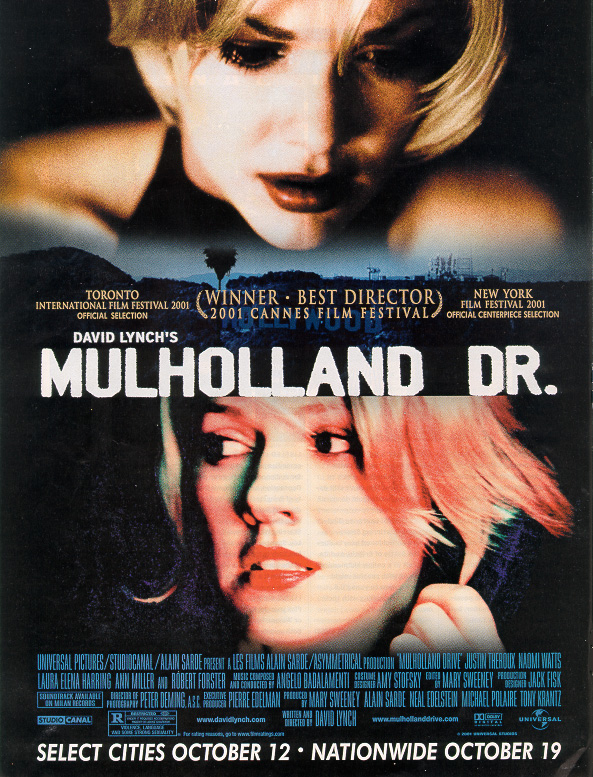
The perfect opener for a retrospective on its director, Mulholland Dr. is an inimitable film that’s really hard to write about. You can look for answers online all you want, but even after seeing it multiple times you still don’t know what happens in it.

Not unless you’re David Lynch. That doesn’t make it any less enjoyable, though.

I’ve seen Mulholland Dr. maybe three times, and I’m not sure. I have my theories. Maybe they’re right, maybe not. Who cares? As with any of Lynch’s best films, the draw to Mulholland Dr. is that it’s a puzzle. He makes you work to solve it, or at least try to. He gives you just enough to go on but leaves the whole thing open to interpretation. At points, he gets you so frustrated, you lose patience and you hate him. But you don’t want him to stop. It’s artistic sadomasochism.

What began as a project for television is a mystery mindfuck tailored to the big screen. Dreamlike, hypnotic, and erotic, Mulholland Dr. is visually demanding and aesthetically worth every minute. The premise is deceptively simple: perky and wide-eyed blond actress Betty (Naomi Watts) arrives in Hollywood and bumps into beautiful young brunette Rita (Laura Harring), who can’t remember who she is after a car accident on Mulholland Drive.

As the two set out looking for clues to Rita’s identity, Lynch throws in a bunch of random characters, muddled subplots, and perplexing events. The narrative arc he puts us on comes to an abrupt halt with a small blue box the girls acquire at a night club. This is where Lynch pulls the rug out from under us.

Mulholland Dr. is definitely a love story—one fraught with competition, petty jealousies, one-upmanship, and ultimately murder. Lynch’s trademark sense of humor flickers here and there, but this is still dark stuff. I see Mulholland Dr. as a denouncement of Hollywood and all its ruthless superficiality. It’s a town that eats you up and spits you out.

Motifs of filmmaking, commerce, ego, vision, and of course the color blue stand out. Rebekah Del Rio’s performance of “Llorando” is beautifully forlorn and eerie. I would be remiss not to mention Peter Deming’s cinematography, which makes Mulholland Dr. shine.

Sadly, Lynch hasn’t done a proper film since 2006. He’s the one living filmmaker whose work I miss the most. Mulholland Dr. is a testament to why: like the street where it takes its name, this film is twisting, treacherous, and ultimately breathtaking.

With Jeanne Bates, Robert Forster, Brent Briscoe, Patrick Fischler, Michael Cooke, Bonnie Aarons, Michael J. Anderson, Ann Miller, Angelo Badalamenti, Dan Hedaya, Daniel Rey, Justin Theroux, David Schroeder, Robert Katims, Marcus Graham, Tom Morris, Melissa George, Mark Pellegrino, Vincent Castellanos, Rena Riffel, Michael Des Barres, Lori Heuring, Billy Ray Cyrus, Tad Horino, Missy Crider, Melissa Crider, Tony Longo, Geno Silva, Katharine Towne, Lee Grant, Lafayette Montgomery, Kate Forster, James Karen, Chad Everett, Wayne Grace, Rita Taggart, Michele Hicks, Michael Weatherred, Michael Fairman, Johanna Stein, Richard Green, Conti Condoli, Lyssie Powell, Scott Coffey

Production: Les Films Alain Sarde, Asymmetrical Productions, Babbo Inc., Canal+, The Picture Factory

Distribution: Universal Pictures

147 minutes
Rated R

(Music Box) A-

David Lynch: A Complete Retrospective

http://www.lynchnet.com/mdrive/

Cool World

(USA 1992)

“That one, she’s a waste of ink.”

“What, you got ink for brains? Get down!”

—Det. Frank Harris

Oh boy. Ralph Bakshi’s Cool World is not good. It probably started out with some fun ideas, but man did they get lost in a morass of crap. A jailed cartoonist (Gabriel Byrne) draws a scantily clad floozie, Holli Would (Kim Basinger), whom he fantasizes about and no doubt spills a lot of seed over while he’s locked up. Upon his release from the big house, he gets zapped into Cool World, a fifth dimension where humans (“noids”) interact with cartoons (“scribbles”). They can’t have sex with each other, though—as if that’s the first thing you want to do with a cartoon.

Oh, there’s also a random, inelegantly placed storyline about Detective Frank Harris (Brad Pitt), Cool World’s one-man vice squad, and how he ends up there after a motorcycle accident that kills his mother (Janni Brenn-Lowen).

Where to begin? The plot is full of unexplained holes, and I didn’t care enough to bother trying to fill them in. The jokes are lame, and there’s an awful lot of filler. I’ve never seen Basinger as boring as she is here, with lines like, “Now you can buy me more fries, dickhead.” Whatever. Byrne is an even bigger snooze, unable to feign an ounce of excitement over…anything. Cool World is a blatant ripoff of Who Framed Roger Rabbit, Dick Tracy, and even Tim Burton’s Batman; sadly, the finished product doesn’t come close to any of them.

The animation, however, is cool: a kind of retro-futuristic Ren and Stimpy thing. The soundtrack, which features original songs by the likes of David Bowie, Thompson Twins, and My Life with the Thrill Kill Kult, is great even if it’s so 1992 with its techno-industrial sound. Plus, Pitt is actually decent despite the material, his affected accent and the awful suit and tie combo straight from U Men or Oak Tree aside. It’s strange and sad to see him in something as soulless as Cool World, but he’s nice to look at.

With Michele Abrams, Dierdre O’Connell, Frank Sinatra, Jr.

Production: Rough Draft Studios

Distribution: Paramount Pictures

102 minutes
Rated PG-13

(MoviePlex) D-

1 Mile to You

(USA 2017)

High school senior track star Kevin (Graham Rogers) is livin’ the dream in his Mississippi small town: he’s handsome, athletic, and setting records in the state. He and his girlfriend, sweet Ellie (Stefanie Scott), are working on a way to end up in the same city for college next year so they can be together.

Kevin’s happiness implodes after a track meet one Saturday in the fall: his coach (Tim Roth) loses control of the bus carrying his entire team, which leads to an accident that kills everyone on board—including Ellie, who happens to be his coach’s daughter. The only reason Kevin isn’t on the bus is because he has to go somewhere with his parents after the meet.

Kevin deals with his grief and his guilt by running—a lot. And hard. He quickly discovers that he can “communicate” with Ellie during the runner’s high he gets toward the end of a sustained, hard run. The chance to be with her again makes him run faster and faster, more and more.

For some reason—maybe his whole class was on the track team, I don’t know—Kevin switches schools. His new principal (Peter Coyote) coerces him into joining the track team, and he participates grudgingly. Kevin doesn’t like his new school, his new coach (Billy Crudup), or Henny (Liana Liberato), the girl who follows him everywhere. On top of that, a running rival (Thomas Cocquerel) is giving him shit. It’s all getting in the way of his time with Ellie.

Based on Jeremy Jackson’s Life at These Speeds: A Novel, 1 Mile to You is not what I expected. It’s an underwhelming melodrama disguised as a sports tragedy. The plot is somewhat promising and the film has a few good scenes, but the story lacks intensity. I’m not sure whether the problem is Marc Novak’s screenplay or Leif Tilden’s directing, but the characters don’t fully develop and Kevin’s catharsis is given shallow treatment. The whole thing is dull. Plus, the special effects that tell us Kevin is in his trance are, in a word, cheesy.

Tilden has a lot of talent to work with, but he underutilizes everyone except Rogers and maybe Crudup. While I won’t be surprised to see Rogers in bigger and better things in the future, 1 Mile to You did not impress me.

With Melanie Lynskey, Ty Parker, Peter Holden, Elizabeth Canavan, Jaren Mitchell, Casey Groves

Production: Cinema Revival, Culmination Productions, Ingenious Media, LATS Productions, WeatherVane Productions

Distribution: Paseo Miramar Pictures, Gravitas Ventures

104 minutes
Not rated

(Facets) C-

https://m.facebook.com/1MILETOYOU/

Donnie Darko

(USA 2001)

“Has he ever told you about his friend Frank, the giant bunny rabbit?”

—Dr. Lilian Thurman


“Every living creature on earth dies alone.”

—Grandma Death

Donnie Darko, a period piece set during a time I remember quite well—October 1988, the second full month of my college freshman year and the height of the Bush-Dukakis presidential election—has a great moody soundtrack that includes the likes of Tears for Fears, Joy Division, the Church, Duran Duran, and of course Echo and the Bunnymen. Even if it would have stuck out like a sore thumb, a song more fitting with the theme would have been Cher’s “If I Could Turn Back Time.”

October 2, 1988: troubled and highly medicated loner Donnie Darko (Jake Gyllenhaal), a middle class teen in suburban Middlesex, Virginia, sleepwalks outside of his house and meets Frank (James Duval), a new “friend.” Frank is a guy in a creepy rabbit suit—he looks like he was plucked from the cover of a heavy metal album. Frank tells Donnie that the world is coming to an end—in exactly 28 days, 6 hours, 42 minutes, and 12 seconds.

Thus begins the apocalyptic timewarping adventure of Donnie Darko. After being rudely awakened on a golf course the next morning, Donnie lumbers home in a daze to discover that a jet engine fell from the sky and crashed into his bedroom. His family, obviously already having assumed the worst, is shocked but relieved to see him approaching from the street—except maybe his mother (Mary McDonnell). Federal investigators can’t trace where the engine came from.

At school, a new student, Gretchen (Jena Malone), interrupts Donnie’s English class—taught by the young and snarky Ms. Pomeroy (Drew Barrymore). They’re discussing their reading assignment, Graham Greene’s short story “The Destructors.” Gretchen asks where she should sit, and Ms. Pomeroy directs her “next to the boy you think is the cutest.” Gretchen sits next to Donnie. Duh!

Donnie and Gretchen dig each other, which is a ray of light to his psychiatrist, Dr. Thurman (Katharine Ross). The doctor has been concerned about Donnie’s “hallucinations” of Frank, as well as some of his erratic behavior. Donnie is growing more and more obsessed with a senile elderly neighbor he and his friends nicknamed “Grandma Death” (Patience Cleveland) and a book about time travel. Everything comes to a head at a party Donnie and his sister Elizabeth (Maggie Gyllenhaal) throw while their parents are out of town on Halloween—which is 28 days from where this all started.

Simultaneously funny, foreboding, weird, and utterly thought-provoking, I can see why Donnie Darko has the following it does. Director and screenwriter Richard Kelly comes up with something unlike anything else I’ve ever seen. It’s a winning mix of teen comedy, science fiction, and fantasy. I caught an anniversary screening with my nephew, and this film is as fresh as when I first saw it in 2002. Loaded with indelible imagery, symbolism, ’80s pop cultural references, and clever narrative loopbacks, I find Donnie Darko‘s greatest asset to be its open-ended mystery; what exactly happens is left for the viewer to figure out. A quick Google search pulls up ample musings of the meaning of this film. I’ve seen this a few times, and I’m not sure.

Aside from the plot, the characters and the casting are terrific. Both Gyllenhaals are great, and you can actually see they’re both destined for more. Patrick Swayze is awesome as motivational speaker Jim Cunningham, but Beth Grant takes the cake here as passive-aggressive bitch Kitty Farmer. Oh yeah, this is also Seth Rogen’s first onscreen role—see if you can spot him.

Side note: Frank’s rabbit suit was designed by April Ferry, who went on to work for Game of Thrones (http://ew.com/movies/2017/03/31/donnie-darko-bunny-suit-frank-untold-stories/). I was hoping to catch the director’s cut, but this wasn’t it.

With Holmes Osborne, Daveigh Chase, Noah Wyle, Stuart Stone, Gary Lundy, Alex Greenwald, Jolene Purdy, Ashley Tisdale

Production: Flower Films

Distribution: Pandora Cinema, Newmarket Films

113 minutes
Rated R

(Capitol Theatre) B+

http://archive.hi-res.net/donniedarko/

Kill Bill: Volume 1

(USA 2003)

“Revenge is never a straight line. It’s a forest. And like a forest, it’s easy to lose your way. To get lost. To forget where you came in.”

—Hattori Hanzō

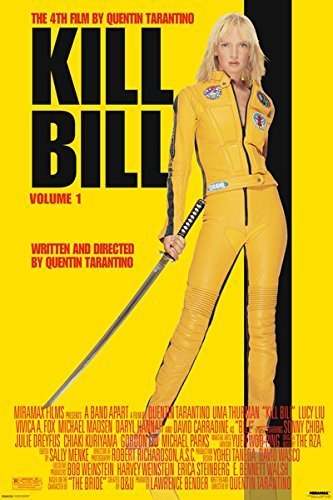
“It’s mercy, compassion, and forgiveness I lack,” The Bride (Uma Thurman) plainly informs one of her assailants before she exacts revenge. “Not rationality.” Uh, really? Right off the bat, Quentin Tarantino’s Kill Bill, Volume 1 (not to be conflated with Kill Bill: Volume 2, which is longer but not quite as good) is an action film packed with snark and coolness. Uma Thurman is The Bride (codeman Black Mamba), who in the sepiatone opening scene is lying on the floor of a chapel in El Paso, Texas. She’s in a wedding dress, bleeding and pleading for her life. “It’s your baby,” she tells Bill (David Carradine, who has a bigger part in the second installment). He shoots her in the head.

Four years later, The Bride wakes up—midfuck, mind you—from a coma in the hospital. There’s no baby. She takes out a would-be rapist, Jasper (Jonathan Loughran), and an orderly named Buck (Michael Bowen), who pimped her out. Incidentally, Buck has a catchphrase that rhymes with his name—you figure it out. The Bride runs off with Buck’s truck, the “Pussy Wagon.” Once she gets her feet and legs moving, she sets out to settle a score—or six. First, though, she has to persuade retired master swordsmith Hattori Hanzō (Sonny Chiba), who runs a sushi bar in Okinawa, to make her a sword.

Kill Bill: Volume 1 is totally far fetched, but that’s not important. Like most Tarantino films, the emphasis here is on the characters and the action, not the plot; otherwise, two hours of not much more than a badass blonde babe methodically killing teammates who double-crossed her when she was a member of something called the Viper Assassination Squad wouldn’t work. Originally intended as one long film (http://killbill.wikia.com/wiki/Kill_Bill:_Vol._1), Kill Bill: Volume 1 depicts two of the paybacks: Vernita Green (Vivica A. Fox), who’s now a housewife and mother in suburban Los Angeles, and O’Ren Ishii (Lucy Liu), the head of the Tokyo Yakuza.

Beautifully staged and shot, the violence is over the top yet perfectly choreographed. The scene at the House of Blue Leaves is eloquent right down to the blood in the snow. Tarantino plays around with the sequence of events and mixes genres including anime. He employs his penchant for sharp dialogue, snazzy settings with memorable names, and sick humor. Plus, he throws in cool music and clothes; Daryl Hannah dressed as a nurse, for example, is fucking fabulous! As a result, Kill Bill: Volume 1 is a dazzling bloodfest. It takes a certain type to love a film like this—and it’s one of my favorites.

With Julie Dreyfus, Chiaki Kuriyama, Gordon Liu, Michael Parks, James Parks, Sakichi Sato, Ambrosia Kelley

Production: A Band Apart

Distribution: Miramax Films

111 minutes
Rated R

(Logan Theatre) A

https://www.miramax.com/movie/kill-bill-volume-1/

Django Unchained

(USA 2012)

“The ‘D’ is silent, hillbilly!”

—Django

If anyone would take a stab at something that sounds as ridiculous and cringeworthy as tackling American slavery in a spaghetti Western, it’s Quentin Tarantino. “I want to do movies that deal with America’s horrible past with slavery and stuff, but do them like spaghetti Westerns, not like big issue movies,” he said, clearly referring to Django Unchained in a 2007 interview—five years before it came out. “I want to do them like they’re genre films, but they deal with everything that America has never dealt with because it’s ashamed of it.” (http://www.telegraph.co.uk/culture/film/starsandstories/3664742/Quentin-Tarantino-Im-proud-of-my-flop.html).

The title here references Sergio Corbucci’s 1966 film Django, an actual spaghetti Western in which the titular hero, a cowboy, is thrust into a row between Southern Klansmen and Mexican revolutionaries. In Django Unchained, the story starts in 1858—just a few years before the American Civil War. Django (Jamie Foxx) is a slave separated from his wife, the curiously named Broomhilda von Shaft (Kerry Washington), after they were caught trying to escape a plantation. He’s shackled to a group of slaves that the Speck brothers (James Remar and James Russo) are driving on foot to be sold.

Enter traveling dentist Dr. King Schultz (Christoph Waltz), a genteel German driving a wagon with a big wooden tooth on top of it. Schultz is actually a bounty hunter looking for the Brittle brothers—Big John (M.C. Gainey), Lil Raj (Cooper Huckabee), and Ellis (Doc Duhame)—who happen to be Django and Broomhilda’s former masters. He makes Django an offer he can’t refuse: help him find and kill the brothers, and Schultz will pay him, set him free, and help him find Broomhilda.

Django Unchained is structured in essentially three “episodes.” The first takes place in a one-horse town near El Paso, where Schultz provokes the ire of the townfolk, the sheriff (Don Stroud), and a U.S. Marshall (Tom Wopat). The second takes place on a plantation owned and operated by Spencer “Big Daddy” Bennett (Don Johnson—um, wow!). The last, longest, and most twisted takes place on another plantation in Mississippi, the bountiful Candie-Land, owned by charming but sadistic Calvin Candie (Leonardo DiCaprio) and operated by his shifty Uncle Tom house-slave, Stephen (Samuel L. Jackson).

Tarantino actually pulls off what he said he wanted to, and he does it quite well. Django Unchained could have been a really dark film like its immediate successor, The Hateful Eight. The two films have a lot in common. The tension—and there’s lots of it—built into the story is deliberately and profoundly slow in reaching a boil. Django Unchained certainly has Tarantino’s trademark violence, revenge theme, and liberal use of the ‘n’ word—116 times, a record for a film according to IMDB (http://www.imdb.com/title/tt1853728/trivia?ref_=tt_trv_trv). A few scenes are difficult to watch, the “Mandingo fight scene” being the worst for me. Unlike The Hateful Eight, though, the violence here is Tarantino’s typical flagrantly graphic cartoonish gore. He also shows a more conspicuous sense of humor—for example, Django and Broomhilda are ancestors of John Shaft of the Shaft franchise (https://www.google.com/amp/deadline.com/2012/07/django-unchained-a-shaft-prequel-so-says-quentin-tarantino-comic-con-301010/amp/).

Django Unchained is an unlikely and uncomfortable pairing of an ugly part of our collective past with absurdity, but it’s entertaining while still getting its point across: we’re still living with the aftermath. It’s the kind of film you mull over for a long time after you see it.

With Laura Cayouette, Jonah Hill, Walton Goggins, Dennis Christopher, Dana Gourrier, Nichole Galicia, Miriam F. Glover, Quentin Tarantino, Franco Nero, Russ Tamblyn, Bruce Dern, Misty Upham, Danièle Watts, Robert Carradine

Produced by The Weinstein Company, Columbia Pictures

Distributed by The Weinstein Company (North America), Sony Pictures Releasing (International)

165 minutes
Rated R

(iTunes rental) A-

http://www.unchainedmovie.com

https://youtu.be/eUdM9vrCbow