Inland Empire [A Woman in Trouble]

(USA/France/Poland 2006)

“What the bloody hell is going on?” asks Kingsley Stewart (Jeremy Irons) at one point during Inland Empire, David Lynch’s last (so far) full length feature film. It’s an excellent question, one that no doubt anyone watching this three-hour nightmare has already wondered by this point.

Laura Dern is Nikki Grace, an elegant actress up for the lead in a new film, On High in Blue Tomorrows, due to start shooting very soon. A strange Polish neighbor (Grace Zabriskie) who lives “just up the way” drops by her California mansion one afternoon and casually but ominously brings up a murder in the film. “That’s not part of the story,” Nikki tells her visitor, who insists she’s wrong and throws a tantrum right there in the sitting room, screaming about “brutal fucking murder” and an unpaid bill. Annoyed and visibly freaked out, Nikki has her butler (Ian Abercrombie) remove her.

Nikki gets the part. Some weirdness happens, and the film’s director (Irons) tells Nikki and her rugged costar Devon Berk (Justin Theroux) that the film is supposedly cursed: it’s a sort of remake of an old Polish movie called 47 that was never completed because of a double murder on the set. The actors are upset but they agree to proceed with production despite the producers’ lack of transparency.

Meanwhile, Nikki is falling for Devon. The narrative gets weird here, ping-ponging back and forth between Nikki and Devon and their characters, Susan and Billy, as well as Susan’s husband, Smithy (Peter J. Lucas), who knows something is going on. Billy’s wife (Julia Ormond) proves to be a character of interest of ever increasing importance, bleeding into another seemingly unrelated subplot about Sue Blue (Dern), a rough and caustic Hollywood chick who finds herself pregnant. The problem is, her husband (Lucas) is sterile. And just who are all these hookers hanging out with Sue, smoking and dancing to “The Loco-Motion” in her living room?

Interspersed between all this is yet another triangular subplot set in 1800s Poland: a cheating wife (Karolina Gruszka) learns that her husband (Krzysztof Majchrzak) plans to kill her lover (Lucas). And just to keep thing interesting, Lynch throws in “The Rabbits,” a spooky sitcom about a family of…rabbits. Actually, actors in rabbit suits (one of them has the voice of Naomi Watts). Later, Sue somehow ends up in their living room.

Probably his most indulgent film, Inland Empire is the kind of thing I imagine most people associate with David Lynch: a surreal trip through the subconscious, the imagination, alternate universes, and time that starts out with a discernible plot but disintegrates into seemingly disjointed events, actors playing multiple characters, bizarre and vivid imagery, random upbeat pop songs, and a creepy score by Marek Zebrowski. Flashes of Lynch’s usual sense of humor pop up here and there, but for the most part this is a dark and somber film about betrayal, loss, and karma. Perhaps its strongest aspect is its overriding sense of dread, and the worst thing about is that it’s impossible to tell whether the scary part is coming or has already arrived.

Inland Empire is surely a horror film. I imagine not many people get into it, and most even being turned off. Length and structure—or lack thereof—aside, it’s not an easy film to watch or understand, and frankly I’m not entirely sure I grasp what the whole thing is about. Indeed, different characters say “I don’t understand” over and over, and Devon/Billy tells Grace/Susan a few times that she isn’t making sense. A common thread that ties the multiple plots together eventually emerges, but I get the impression that this is merely a heap of undeveloped ideas Lynch assembled into one big project.

Still, I found myself mesmerized all the way through. The ending, where Sue’s fate plays out over the stars on the Hollywood Walk of Fame, is dowright distressing. In a way, it’s also beautiful. Lynch offers a lot to chew on here; I’ve gone over it multiple times since I saw it. I have my theory of what really transpires in Inland Empire, and someday I’ll watch again with an eye toward backing it up. It won’t be anytime soon, though.

Post script: I had the pleasure of seeing John Waters speak in the afternoon before I caught Inland Empire. Needless to say, it required a major shift in gears.

With Harry Dean Stanton, Diane Ladd , Mary Steenburgen, Terry Crews, William H. Macy, Leon Niemczyk, Nastassja Kinski, Monique Cash, Latrina Bolger, Fulani Bahati, Ashley Calloway, Erynn Dickerson, Jovonie Leonard, Jennifer Locke, Helena Chase, Nae

Production: Absurda, Studio Canal, Fundacja Kultury, Camerimage Festival

Distribution: Ryko (USA), 518 Media (USA), Absurda (USA), Studio Canal (International), Mars Distribution (International)

180 minutes
Rated R

(Music Box) A

David Lynch: A Complete Retrospective

http://www.inlandempirecinema.com

David Lynch

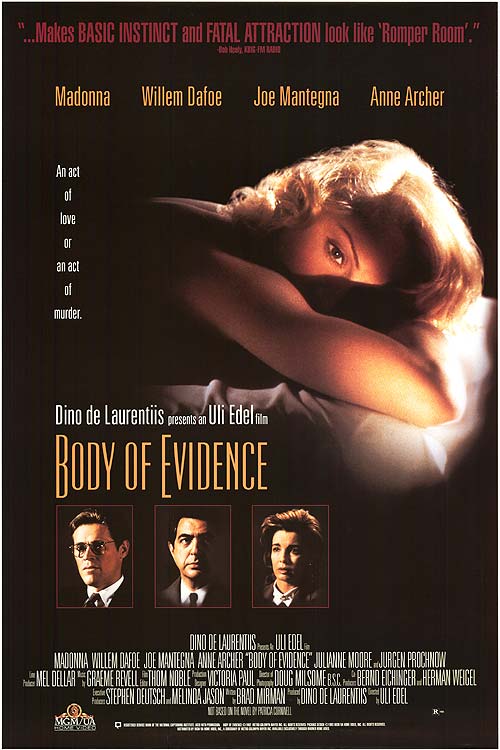
Body of Evidence

(USA 1993)

“That’s what I do. I fuck. And it made me eight million dollars.”

—Rebecca Carlson

As true blue a Madonna fan as I am, I haven’t bothered to see a considerable number of her movies. Uli Edel’s Body of Evidence is one of them (she has top billing here, so yes, it’s a Madonna movie). On a ridiculously cold and rainy Saturday night, I decided to change that when I saw it showing on cable. Now that I’ve seen it, what surprised me most about Body of Evidence is that it’s actually not that bad. To be clear, it’s not good—it’s fluffy erotic fromage designed to be “provocative,” a sort of lame Basic Instinct (as if that’s a good movie)—but it’s not quite the disaster I expected.

Madonna is Rebecca Carlson, a femme fatale accused of slipping cocaine into her older lover’s nasal spray and “fucking him to death”—i.e., arousing him to the point of inducing a fatal heart attack. Willem Dafoe is her defense attorney. Of course, he gets involved with her despite his happy marriage to Julianne Moore.

Brad Mirman’s writing is pretty basic; his script feels a lot like a Law & Order episode, skipping through real life things like discovery and motions in limine to get right to the court stuff. I half-expected to hear that clang sound between scenes. His dialogue is often silly and, as demonstrated above, at times cringeworthy.

The promotional poster for Body of Evidence promises to make Fatal Attraction and the aforementioned Basic Instinct “look like Romper Room;” it doesn’t. The candle wax scene is kinda hot, but that’s it. The cast is impressive, but sadly no one gives a remarkable performance. Moore’s role, one of her first in a major studio release, is so small it’s background. Madonna pretty much plays Dita, her alterego from her Erotica album and Sex book, both of which came out just a few months before Body of Evidence. Her acting isn’t good, but somehow she comes off slightly less wooden than any character from her earlier movies, even A League of Their Own. Her look is exactly the same as in the video for “Bad Girl.” I’m not sure what Dafoe or Joe Mantegna, both good actors, saw in this project.

Body of Evidence is ultimately a forgettable snooze of a film. If it’s offensive at all, it’s because it’s boring.

With Anne Archer, Lillian Lehman, Stan Shaw, Charles Hallahan, Mark Rolston, Jürgen Prochnow, Frank Langella

Production: Dino De Laurentiis Communications, Neue Constantin Films

Distribution: Metro-Goldwyn-Mayer (USA), Guild Film Distribution (UK)

99 minutes
Rated R

(Impact) D+

Blue Velvet

(USA 1986)

Who hasn’t seen Blue Velvet? Even though David Lynch was already established by the time it came out, it’s the film that introduced me to him. I saw it once or twice in late high school or early college, definitely on VHS. The River’s Edge was the only comparison I had, and that was a weird film but…not on the same level. I found Blue Velvet totally watchable because it’s very dark, very sexual, very fucking weird, and very voyeuristic.

That was then, this is now: Blue Velvet is still all of those things, but I don’t remember it having the sense of humor it does. It’s curiously funny. It marks the start of Lynch’s style as we know it: not just surreal (he had already done Eraserhead), but macabre and perverted underneath the innocuous and mundane premise. Lynch sets up his narrative in pieces that refer back and forth, like a moving puzzle. It’s brilliant, and it’s a formula that’s served him well.

Blue Velvet starts with a severed ear on the ground, bugs crawling all over it. A local college kid turned stalker (Kyle MacLachlan) proves a bit too curious when his minor obsession with a night club singer (Isabella Rossellini) leads him into a sadomasochistic nightmare that neither he nor we viewers can turn away from. The whole bizarre and sordid story goes full circle back to where it started: that ear. 

Dennis Hopper as Frank, the gas-huffing sociopath who ends every sentence with the F-word, colors the mood here. None of it would work, though, without Rossellini’s vulnerability, which is crucial. 

Lynch considered Molly Ringwald instead of Laura Dern and Val Kilmer instead of MacLachlan. Thank goodness it happened how it did; what a different film Blue Velvet would have been. For a movie that relies so heavily on nuance, that could’ve ruined Lynch’s career. It didn’t. 

With Hope Lange, Dean Stockwell, George Dickerson, Priscilla Pointer, Frances Bay, Jack Harvey, Ken Stovitz, Brad Dourif, Jack Nance, J. Michael Hunter, Dick Green, Fred Pickler, Philip Markert, Leonard Watkins, Moses Gibson, Selden Smith, Peter Carew, Jon Jon Snipes, Angelo Badalamenti, Jean Pierre Viale, Donald Moore, A. Michelle Depland, Michelle Sasse, Katie Reid, Sparky

Production: De Laurentiis Entertainment Group

Distribution: De Laurentiis Entertainment Group, 20th Century Fox (UK), Transmundo Films (Argentina), AMLF (France), Concorde Film (Netherlands), Concorde Filmverleih (West Germany), Finnkino (Finland), Hoyts Distribution (Australia), Shochiku-Fuji Company (Japan)

120 minutes
Rated R

(Music Box) B+

David Lynch: A Complete Retrospective

Wild at Heart

(USA 1990)

“Man, I had a boner with a capital ‘O.'”

—Sailor Ripley


“And this here’s a story with a lesson about bad ideas.”

—Lula Pace Fortune


“Don’t turn away from love, Sailor.”

—Glinda the Good Witch

Wild at Heart is one of David Lynch’s more maligned films. Roger Ebert hated it to the point of indignation (https://www.google.com/amp/www.rogerebert.com/reviews/amp/wild-at-heart-1990). Vincent Canby seemed perplexed—I can’t tell whether he was bored, annoyed, or just flummoxed (http://www.nytimes.com/movie/review?res=9C0CE5D7123EF934A2575BC0A966958260). Jonathan Rosenbaum called it “appalling,” “inept,” and “debasing” (https://www.jonathanrosenbaum.net/1990/08/bad-ideas/). A host of other critics rolled their eyes and sighed, dismissing it, I suppose, as a violent and exploitive piece of shock fluff.

I never saw Wild at Heart until now. Some of the points raised by its detractors are valid, but I still liked it for the same things that made them hate it. Erratic, vulgar, and really sweet, it’s offputting yet compelling and—surprise!—it has a happy ending.

An atypically straightforward narrative for a Lynch project, Wild at Heart is a decidedly deranged, bloody road movie/romance/thriller based on Barry Gifford’s novel of the same name. Upon his release from a North Carolina prison after serving time for murder—never mind that it was self-defense—Sailor Ripley (Nicolas Cage) exits the jailhouse to find his lover, Lula Pace Fortune (Laura Dern), waiting for him outside in the sunlight with his snakeskin jacket, the symbol of his individuality and his belief in personal freedom. They spend some time catching up in a motel room and at a speedmetal concert before they decide to blow off his parole and take off for California.

Meanwhile, Lula’s mother, Southern lady Marietta (Diane Ladd), is making plans of her own—and they involve her private detective boyfriend (Harry Dean Stanton) and a hit man (J. E. Freeman) who’s got Sailor as his target. A bad omen detours the starcrossed lovers to Big Tuna, Texas, where they unwittingly plant themselves smack in the middle of a bad situation that looks to be turning deadly fast.

OK, I’ve seen versions of this same story before. The plot is familiar and for the most part implausible—not to mention really, really thin at times. Lynch goes overboard with his depiction of sex, violence, and gore—even though they all have a place here. None of this matters, though, because the characters, which are both the focus and the strength of the film, are fantastic.

As usual, the casting is stellar. Cage is at his best here, working that edgy deadpan earnest manic thing he did so well in his early films. Dern is flawless as a sweet Southern girl who’s found her place with bad boy Sailor, everyone else be damned. Willem Dafoe is super creepy as hayseed bad guy Bobby Peru—those teeth! Above them all, however, is Ladd, who’s fucking fabulous even with her face covered in red lipstick. She’s vengeful at times, remorseful at others; but all the while, a perfect lady. She shines here. There’s a reason she was nominated for an Oscar for her performance (https://www.oscars.org/oscars/ceremonies/1991). This film works because the actors give it their all.

Wild at Heart is loaded with Lynch’s trademark what-the-fuck weirdness—a man at a bar quacking like a duck (you read that correctly) and cousin “Jingle Dell” (Crispin Glover) sitting on the floor in the bathroom screaming for Christmas or standing at the counter in the dark making a hundred sandwiches for lunch are bizarre moments even by Lynchian standards. There’s a lot more to it, though. I love the theme of finding a happy place in the midst of horrible things happening. I love all the references to various staples of Americana—cowboys, cars, highways, Elvis Presley, and my favorite, The Wizard of Oz. I love that underneath it all is a touching love story that we can all relate to.

What I find most interesting, though, is that so many things about Wild at Heart scream Quentin Tarantino, yet he had nothing to do with it. In fact, it came out two years before Tarantino’s first major film, Reservoir Dogs. I never thought of David Lynch as an influence on him, but Wild at Heart makes me wonder.

Side note: Wild at Heart is a rated R movie. For the screening I attended, however, I was lucky enough to catch an unreleased rated X version. The X rating was no doubt due to the graphic violence—it wasn’t the sex scenes. The print was in bad shape, all scratchy and beat up, but it was totally worth it to see an X-rated Lynch film.

With W. Morgan Sheppard, Grace Zabriskie, Isabella Rossellini, Sherilyn Fenn, Sheryl Lee

Production: PolyGram Filmed Entertainment, Propaganda Films

Distribution: Manifesto Film Sales, The Samuel Goldwyn Company (USA), Palace Pictures (UK), Bac Films (France), Cineplex Odeon Films (Canada), Finnkino (Finland), Hoyts Distribution (Australia), Háskólabíó (Iceland), Meteor Film Productions (Netherlands), Sandrew Film & Teater (Sweden), Solopan (Poland)

125 minutes
Rated X (alternate version)

(Music Box) B

David Lynch: A Complete Retrospective

http://www.davidlynch.de

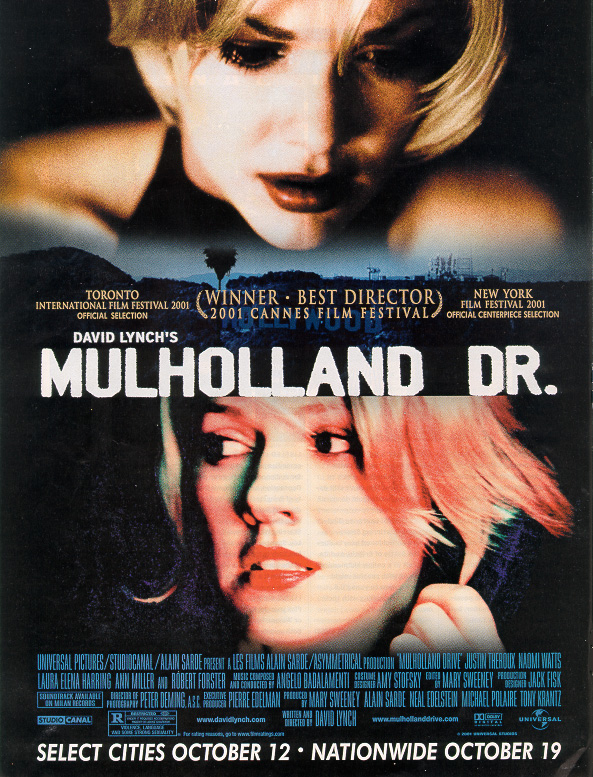
Mulholland Dr.

(USA/France 2001)

“No hay banda, il n’est pas d’orchestra. It is all an illusion.”

—The Magician at Club Silencio

The perfect opener for a retrospective on its director, Mulholland Dr. is an inimitable film that’s really hard to write about. You can look for answers online all you want, but even after seeing it multiple times you still don’t know what happens in it.

Not unless you’re David Lynch. That doesn’t make it any less enjoyable, though.

I’ve seen Mulholland Dr. maybe three times, and I’m not sure. I have my theories. Maybe they’re right, maybe not. Who cares? As with any of Lynch’s best films, the draw to Mulholland Dr. is that it’s a puzzle. He makes you work to solve it, or at least try to. He gives you just enough to go on but leaves the whole thing open to interpretation. At points, he gets you so frustrated, you lose patience and you hate him. But you don’t want him to stop. It’s artistic sadomasochism.

What began as a project for television is a mystery mindfuck tailored to the big screen. Dreamlike, hypnotic, and erotic, Mulholland Dr. is visually demanding and aesthetically worth every minute. The premise is deceptively simple: perky and wide-eyed blond actress Betty (Naomi Watts) arrives in Hollywood and bumps into beautiful young brunette Rita (Laura Harring), who can’t remember who she is after a car accident on Mulholland Drive.

As the two set out looking for clues to Rita’s identity, Lynch throws in a bunch of random characters, muddled subplots, and perplexing events. The narrative arc he puts us on comes to an abrupt halt with a small blue box the girls acquire at a night club. This is where Lynch pulls the rug out from under us.

Mulholland Dr. is definitely a love story—one fraught with competition, petty jealousies, one-upmanship, and ultimately murder. Lynch’s trademark sense of humor flickers here and there, but this is still dark stuff. I see Mulholland Dr. as a denouncement of Hollywood and all its ruthless superficiality. It’s a town that eats you up and spits you out.

Motifs of filmmaking, commerce, ego, vision, and of course the color blue stand out. Rebekah Del Rio’s performance of “Llorando” is beautifully forlorn and eerie. I would be remiss not to mention Peter Deming’s cinematography, which makes Mulholland Dr. shine.

Sadly, Lynch hasn’t done a proper film since 2006. He’s the one living filmmaker whose work I miss the most. Mulholland Dr. is a testament to why: like the street where it takes its name, this film is twisting, treacherous, and ultimately breathtaking.

With Jeanne Bates, Robert Forster, Brent Briscoe, Patrick Fischler, Michael Cooke, Bonnie Aarons, Michael J. Anderson, Ann Miller, Angelo Badalamenti, Dan Hedaya, Daniel Rey, Justin Theroux, David Schroeder, Robert Katims, Marcus Graham, Tom Morris, Melissa George, Mark Pellegrino, Vincent Castellanos, Rena Riffel, Michael Des Barres, Lori Heuring, Billy Ray Cyrus, Tad Horino, Missy Crider, Melissa Crider, Tony Longo, Geno Silva, Katharine Towne, Lee Grant, Lafayette Montgomery, Kate Forster, James Karen, Chad Everett, Wayne Grace, Rita Taggart, Michele Hicks, Michael Weatherred, Michael Fairman, Johanna Stein, Richard Green, Conti Condoli, Lyssie Powell, Scott Coffey

Production: Les Films Alain Sarde, Asymmetrical Productions, Babbo Inc., Canal+, The Picture Factory

Distribution: Universal Pictures

147 minutes
Rated R

(Music Box) A-

David Lynch: A Complete Retrospective

http://www.lynchnet.com/mdrive/

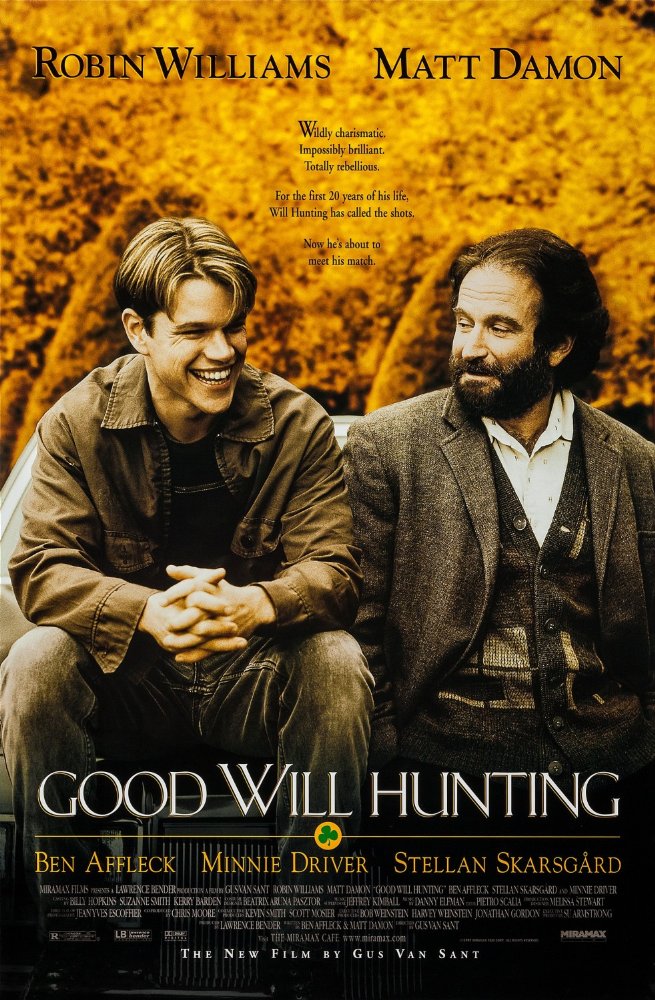
Good Will Hunting

(USA 1997)

“Well, I got her number. How do you like them apples?”

—Will Hunting

Good Will Hunting, the final screening of Chicago International Film Festival’s Totally ’90s series, is not something I associate with its director, Gus Van Sant. Frankly, I didn’t know he directed it until I saw his name in the credits.

No, I associate Good Will Hunting with longtime friends Matt Damon and Ben Affleck, who while they were both still relatively unknown turned the former’s drama class project into the script that would become this film (http://www.eonline.com/news/802830/looking-back-at-the-totally-crazy-story-behind-the-making-of-good-will-hunting). The success of Good Will Hunting seemed to come out of nowhere and established both of them as actors—never mind that they snagged the Oscar for Best Screenplay in 1998 (https://www.oscars.org/oscars/ceremonies/1998). Damon and Affleck have both written since, but none of their screenplays has been as successful as this one.

Gerald Lambeau (Stellan Skarsgård), a professor at MIT, is baffled when someone anonymously solves a wicked hahd math problem he posted on a chalkbaord in the hall as a challenge to his students—he expected it to take the entire semester. No one steps up to claim the work. He posts a second problem, one that took his colleagues two years to figure out. He’s amazed when he catches one of the school’s janitors, Will Hunting (Damon), red-handed. Will won’t have anything to do with Lambeau—until he ends up in jail for assault.

Recognizing Will’s gift, Lambeau makes a deal with him: he’ll pay for bail if Will works with him on math and sees a therapist. The problem is, Will doesn’t make it easy to connect. In fact, five different therapists fail. As a last resort, Lambeau calls former classmate Sean Maguire (Robin Williams), who has a similar Southie background as Will and stands up to his crap. Sean sees that Will is deflecting to hide his self-sabotaging tendencies.

Meanwhile, Will meets Skylar (Minnie Driver), who sweeps him off his feet. It all goes well until she tells him she’s going to medical school at Stanford—and asks him to go with her.

The script here is loaded with good ideas and gorgeous details—that story about Sean ditching a Red Sox game to be with a girl he just met in a bar (she would become his wife) is gold. So is Will’s confrontation with a grad student (Scott William Winters) at a dive. Hearing Damon sing “Afternoon Delight” while he’s faking hypnosis is hilarious. The story, though, is predictable. Good Will Hunting excels because of the acting. The casting—by Kerry Barden, Billy Hopkins, and Suzanne Smith—makes all the difference in the world.

With Ben Affleck, Casey Affleck, John Mighton, Rachel Majorowski, Colleen McCauley, Cole Hauser, Rob Lyons, Steven Kozlowski, Jennifer Deathe, Philip Williams, Patrick O’Donnell, Kevin Rushton, Jimmy Flynn, Joe Cannon, Ann Matacunas, George Plimpton, Francesco Clemente

Production: Lawrence Bender Productions, Be Gentlemen Limited Partnership, Miramax Films

Distribution: Miramax Films (USA), Bac Films (France), Buena Vista International (UK), Cecchi Gori Distribuzione (Italy), Filmes Castello Lopes (Portugal), Intersonic (Czech Republic), Laurenfilm (Spain), Lider Films (Argentina), SF Norge A/S (Norway), Scanbox Entertainment (Sweden), Scotia International Filmverleih (Germany), Shochiku-Fuji Company (Japan), Svensk Filmindustri (SF) (Sweden), Svenska Filminstitutet (SFI) (Sweden), United International Pictures (UIP) (Switzerland)

126 minutes
Rated R

(Public Chicago) B

Chicago International Film Festival

https://www.miramax.com/movie/good-will-hunting/

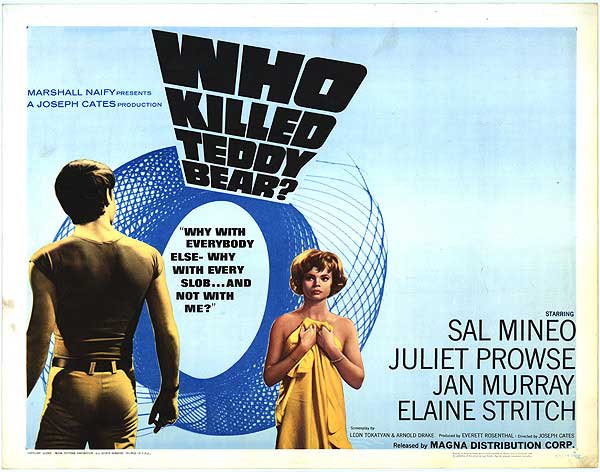
Who Killed Teddy Bear

(USA 1965)

“I don’t think you’re very amusing, Lieutenant…Whatever-Your-Problem-Is.”

—Norah Dain

Who Killed Teddy Bear is so far one of the more interesting films I’ve seen this year, which is odd because it’s more than 50 years old. A surprisingly good story and movie, everything about it shines despite its bleak subject matter and an obviously low budget.

The film opens with a little girl who seems to be getting away from something unsettling she just observed. She falls down a set of stairs in the dark. It’s a curious opening, but she ties into the story later.

Cut to mid-sixties Manhattan: Norah Dain (Juliet Prowse) is an aspiring actress who works as a “disc jockey” at a nightclub. She lives alone in a cute three flat. It’s bad enough that she’s getting obscene phone calls from an unknown weirdo, but what’s worse is that he implies he’s watching her.

Enter detective Lt. Dave Madden (Jan Murray) to investigate Norah’s case. His wife was raped and murdered on the streets of New York City. He comes off as part father and part priest, and he takes a special interest in Norah that verges on disturbing. Indeed, he drops in all the time, he secretly records their conversations, and he keeps telling her that he could be the caller. At home, he’s obsessed with “studying” pornography and perverts, which has a distorting effect on his 10-year-old daughter (Diane Moore).

WARNING: Potential spoilers ahead!

We soon learn that Lt. Madden actually isn’t the caller; Lawrence Sherman (Sal Mineo), who works as a busboy with Norah, is. Lawrence has a lot of issues. Awkward and aloof, he lives in a sad, dank apartment with his younger sister, Edie (Margot Bennett). Edie has brain damage and hasn’t developed beyond a child. Their parents died, leaving Lawrence to take care of her. And he does, but he harbors resentment.

On top of all this, Lawrence is incapable of a normal romantic relationship because of his guilt over his sister. He deals with his sexual frustration at adult bookstores and movie theaters in Times Square, and it apparently works until Norah comes along. His obsession with her takes him down a road of murder and ruin.

Directed by Joseph Cates, Who Killed Teddy Bear has a high creepy-icky factor, and it’s absolutely wonderful. Mineo is brooding and sexy, and Lawrence is compelling in the same fucked up way as Travis Bickle in Taxi Driver. Norah and Lawrence don’t have all that many scenes together, but she’s nice to him when they do. This makes their scenes percolate with tension, particularly one at a pool in a gym. We know the whole thing is not going to end well, and Cates slowly but steadily gets us to a nasty climax. To add to the perversion, screenwriters Arnold Drake and Leon Tokatyan drop in little bombshells like incest and lesbian passes. Joseph Brun’s camerawork is lovely, especially in the night scenes; shooting on location in New York City, he cloaks the actors in shadows and neon light in a way that nicely underscores their solitude.

Interesting trivia: a young Dan Travanty, who plays a small part as a nightclub employee, went on to star in Hill Street Blues.

This film has been cut and recut many times over the years, at least once for British television. I’m pretty sure the screening I attended was the original uncut version.

With Elaine Stritch, Tom Aldredge, Frank Campanella, Rex Everhart, Bruce Glover, Casey Townsend

Production: Phillips Productions

Distribution: Magna Corporation, BijouFlix Releasing

94 minutes
Not rated

(The Auditorium at Northeastern Illinois University) A

Chicago Film Society

Odyssey of a Dropout

(USA 1966)

Odyssey of a Dropout is a black and white educational film shot on 16-millimeter that dramatizes the plight of the American high school dropout. I’ve found only very limited information about it online, and none of it lists the cast or the crew. As far as I can tell, this film is not available anywhere, but you can view other films of the same ilk here:

https://archive.org/details/coronet_instructional_videos?sort=titleSorter

If these films are anything like Odyssey of a Dropout—and perusing the titles suggests they are—it’s worth a diversion. Appropriately, Odyssey of a Dropout follows one teenage boy through his day after he drops out of school. He meanders aimlessly, going from a diner to a park to a pool hall. He hasn’t told his parents or his girlfriend, and it doesn’t appear that he’s having any fun—which is precisely the point.

Melodramatic and totally moralistic, this heavyhanded little number does a great job painting a hopelessly dire picture for those who don’t finish high school. So, it serves its purpose even if it borders on propaganda. Aside from that, it’s a neat time capsule; loaded with exterior street scenes and youngsters clad in clothes of the day, it documents small town America in a visually authentic way. I’d like to find this and see it again.

Production: Coronet Films

Distribution: Coronet Films

18 minutes
Not rated

(The Auditorium at Northeastern Illinois University) B-

Chicago Film Society

Heart Like a Wheel

(USA 1983)

“Trying to make us damned…golf!

—Connie Kalitta

Heart Like a Wheel is the kind of movie you see on late night TV: a mildly amusing true story about someone you’ve never heard of and her struggle to overcome adversity and maybe find herself in the process. In this case, that someone is Shirley Muldowney (Bonnie Bedelia), later known as “Cha Cha,” a 1960s housewife who became the first woman to obtain a license from the National Hot Rod Association (NHRA) and the first person ever to win two and then three Top Fuel titles (https://en.wikipedia.org/wiki/Shirley_Muldowney). Her struggle consists of establishing herself as a serious dragster. The adversity, well, that’s the sexist all-male drag race scene. You might say the whole thing is a drag.

One night, Shirley’s mechanic husband, Jack (Leo Rossi), lets her race his sports car on the street. She beats Jack’s rival and discovers that she digs the thrill of drag racing. Soon, she’s hanging out at the racetrack, where she meets Connie Kalitta (Beau Bridges), a veteran racer and womanizer. Jealous of her success, Jack leaves Shirley to her own devices.

I picked up Heart Like a Wheel for one reason, and one reason only: I read that My Life with the Thrill Kill Kult sampled this movie in a song or two. Overall, it’s a mixed bag, but I was pleasantly surprised to find that it’s better than mediocre. The acting is good. Ken Friedman’s screenplay is competent if not exactly deep, peppered with some snappy dialogue. When a skeezy reporter (Martin Casella) asks Shirley what a beautiful girl like her is doing at a racetrack, for example, her one-word response is casual, bored, and totally fucking awesome: “Winning.” Director Jonathan Kaplan stages realistic fight scenes, particularly between Connie and Shirley’s teenage son, John (played by a young Anthony Edwards). He even throws in a couple of real racers (Steve Evans and Sam Posey) and fire. It was nominated for an Academy Award for costume design (https://www.oscars.org/oscars/ceremonies/1984). The whole thing comes off like a soap opera, but it works. I never did catch those samples, though.

Bonus: the DVD I have includes trailers for four other films, The Turning Point, Kenny & Company, Rhinestone with Dolly Parton and Sylvester Stallone, and Six Pack with Kenny Rogers and Anthony Michael Hall. They all look as awful as “Born to Win” by Jill Michaels, the Heart Like a Wheel theme song.

With Hoyt Axton, Creed Bratton, Tiffany Brissette, Michael Cavanaugh, Diane Delano, Mitzi Hoag, Nora Heflin, Brandon Brent Williams

Production: Aurora Productions

Distribution: 20th Century Fox

113 minutes
Rated PG

(DVD purchase) C

Raw [Grave]

(France/Belgium 2016)

“An animal that has tasted human flesh is not safe.”

—Father

To borrow a phrase from Morrissey, meat is murder, which is a lesson that goody-two-shoes strict vegan Justine (Garance Marillier) learns the hard way when she goes away to join her older sister, Alexia (Ella Rumpf), at veterinary college. Like a lot of young people away from home for the first time, Justine is lost and wants to fit in. She’s she’s got her work cut out for her: she’s nerdy, sheltered, and a total virgin.

Like a lot of other schools, the upperclassmen at this one have a hazing ritual to break in newbies. It’s pretty aggressive. Prompted by her sister, Justine goes along with it without objection—that is, until she’s pushed to eat raw rabbit kidney (never mind the blood splattered all over her and her “fresh meat” first year classmates). Alexia is the one who ultimately cajoles her to eat it; it’s nasty and it makes Justine sick. Not long after, she develops a gross and severely itchy rash brought on from food poisoning.

Soon, Justine finds herself craving meat. Her impulses are irresistible. First, she eats raw chicken. Then her own hair. Eventually, she works up to human flesh—after developing a fetish for car crashes, of course. As she gives in to her carnivorous urges, her lust for her cute and easygoing gay roommate, Adrien (Rabah Naït Oufella), gets stronger—and Alexia appears to be turning into a greater and greater adversary.

Screenwriter/director Julia Ducournau has a lot on her mind here: peer pressure, body image, sexuality, sibling rivalry, the food we eat. She’s gutsy, and for the most part her risks pay off. It’s not the same story, but Raw has something in common with Goat (https://moviebloke.com/2016/09/24/goat/), another histrionic college drama that gets at kids, tribalism, and cruelty. Raw is very Lord of the Flies. Ducournau paces the story well and picks interesting things—a bikini wax, a horse being sedated—to make us squirm.

I love Ducournau’s sense of humor: it’s dry, icky, and sadistic. The indignation of Justine’s parents over a piece of sausage in her mashed potatoes when they’re eating in a cafeteria as the film begins brilliantly sets up what follows. Marillier seems to have some fun with her role, playing Justine as a creepy, awkward junkie who maybe bites off more than she can chew. Rumpf has fun with her role, too, playing Alexia as a Heathers-like mean girl. They do a nice job working the love and the hate in their relationship. Smartly, they’re both restrained, carefully steering clear of camp.

Visually, Raw reminds me a lot of David Cronenberg and David Lynch, but it still has its own unique look and feel. There are a lot well done scenes here—one under Justine’s sheets, another on a campus plaza with a horde of students moving like zombies, and another at a rave in a morgue all stand out in my mind. Cinematographer Ruben Impens uses lots of bright colors that work nicely with all the dim light to make the school look like a nightmare or a drug trip. There’s a definite sense of this not being real.

Raw is bloody and gory, but nothing here made me want to pass out or call an ambulance  (http://www.indiewire.com/2016/09/raw-tiff-2016-toronto-film-festival-pass-out-cannibal-julia-ducournau-1201726575/). I liked it, but I have one beef: I wish it was a little less predictable.

With Laurent Lucas, Joana Preiss, Bouli Lanners, Marion Vernoux, Thomas Mustin, Jean-Louis Sbille

Production: Frakas Productions, Petit Film, Rouge International, Wild Bunch, Canal+, Ciné+, Centre National de la Cinématographie (CNC), La Wallonie, Bruxelles Capitale, Centre du Cinéma et de l’Audiovisuel de la Fédération Wallonie-Bruxelles, Radio Télévision Belge Francophone (RTBF), VOO, BE TV, Arte/Cofinova 12, Torino Film Lab

Distribution: Wild Bunch (France), O’Brother Distribution (Belgium), Focus World (international), Canibal Networks (Mexico), Cinemien (Netherlands), Seven Films (Greece), United International Pictures (UIP) (Singapore), Universal Pictures International (UPI) (UK), Monster Pictures (Australia)

99 Minutes
Rated R

(Music Box) B-

http://focusfeatures.com/raw

http://www.rawthefilm.co.uk