Wonder Woman

(USA 2017)

Director Patty Jenkins aims to do for Wonder Woman what Christopher Nolan—and I suppose to a lesser degree Tim Burton—did for Batman: take an iconic comic book superhero that got campy over the years and return it to its darker roots, producing something dramatic, perhaps weightier, and far more artful. Jenkins doesn’t entirely pull it off with Wonder Woman, but she’s on the right track. I see a sequel or two in the near future, so she’s got time to get there.

To Jenkins’s credit, Wonder Woman is not what I expected. Aside from a nod or two—and that goddamned tiara—all the cut-rate kitsch of the ’70s TV series is gone. This Wonder Woman means business even if she’s still, shall we say, absurd.

Jenkins goes back to the beginning: young Diana (Lilly Aspell and Emily Carey) lives on Themyscira, a hidden island inhabited by war-ready buff goddesses. Queen Hippolyta (Connie Nielsen), Diana’s mother, shields her from the strident ways of her subjects. It all has to do with an old score Ares (David Thewlis) seeks to settle—yes, that Ares, the son of Zeus and the god of war. General Antiope (Robin Wright), Hippolyta’s sister and Diana’s aunt/mentor, isn’t having it: she recognizes Diana’s potential and trains her on the sly. Diana blossoms into a beautiful woman (Gal Gadot) with serious supernatural power.

Diana stumbles upon Steve Trevor (Chris Pine), a drowning American pilot whose plane crashes off the coast of Themyscira. She rescues him, unwittingly exposing the island to an invasion by German forces. Persuaded by the awesome power of Diana’s Lasso of Hestia, Steve confesses that he’s a spy in the “war to end all wars”—World War I. Spider-sensing Ares is behind it, Diana embarks with Steve on a mission filled with romance, adventure, and espionage in an effort to track down the god and stop the madness.

Wonder Woman starts out all Xena: Warrior Princess, silly and weird in a geeky softcore straight guy “lesbian porn” way that no doubt would appeal to the likes of Wayne and Garth. Thankfully, it moves in another direction once Pine shows up about 40 minutes in. I found myself enjoying Wonder Woman more as the story got to Europe—that storyline is more believable even if it too is silly. The battle scenes are decent with some Hollywood excess and humor thrown in. I love how the theme of gender equality is the star of every scene—neither subtle nor heavy-handed, it’s simply a given.

For all its perks, Wonder Woman is ultimately a typical blockbuster that emphasizes form over substance. If nothing else, it surprises, which is always a plus. Frankly, though, I could’ve kept going completely oblivious to the fact that Wonder Woman is more than Lynda Carter. She was more a lot more fun.

With Danny Huston, Saïd Taghmaoui, Ewen Bremner, Eugene Brave Rock, Lucy Davis, Elena Anaya, Doutzen Kroes

Production: DC Entertainment, Atlas Entertainment, Cruel & Unusual Films, Rat-Pac Dune Entertainment LLC, Tencent Pictures, Wanda Pictures

Distribution: Warner Brothers, Karo Premiere (Russia), NOS Audiovisuais (Portugal), Roadshow Entertainment (New Zealand), Roadshow Films (Australia), SF Studios (Norway), Tanweer Alliances (Greece)

141 minutes
Rated PG-13

(ArcLight) C

http://wonderwomanfilm.com

The 400 Blows [Les Quatre-cents coups]

(France 1959)

Childhood is fertile ground for storytelling. Usually, the stories that sell are heavily nostalgic and sweet, but the more interesting ones tend to come from a darker past. French New Wave pioneer François Truffaut’s autobiographical film The 400 Blows is the latter.

Antoine Doinel (Jean-Pierre Léaud) is a prepubescent boy experiencing an existential crisis. At home, something is bubbling between his parents, mother Gilberte (Claire Maurier) and stepfather Julien (Albert Rémy). At school, a contemptible teacher known as “Sourpuss” (Guy Decomble) has him pegged as a troublemaker.

Antoine and his friend René (Patrick Auffay) cut class one day. They walk around, catch a movie, and enjoy a carnival ride—the Rotor, a cylindrical room that spins and the floor drops out, causing the riders to “stick” to the walls due to centrifugal force. While they’re running around, Antoine sees his mother kissing some man on the street. She sees Antoine when it’s too late.

The next day, Antoine makes up an excuse for his absence: he says his mother died. It doesn’t work. After a few incidents involving Balzac, a fire, running away from home, and a stolen typewriter, Antoine winds up at a reform school.

Some New Wave films are hard to follow or just boring to watch. Not so with The 400 Blows, and for quite a few reasons.

The narrative is definitely loose. Like all New Wave films, what happens isn’t as important as what the director is showing us. Here, though, the plot is straightforward and sticks to a more traditional structure even if it doesn’t have a true “climax” or a single moment of reckoning. Truffaut gives us some really great scenes in this movie, not the least of which is this one:

400 Blows paddywagon.jpg

The 400 Blows is realistic and personal; it unfolds like something literally happening right before us. The acting, naturalistic and unscripted, is probably the biggest boon to the film. That said, Henri Decaë’s camerawork is a major contribution as well. He shoots on the streets of Paris using hand-held equipment, which allows him to get right up in front of the action. It’s likely a product of an independent low-budget film, but intentional or not The 400 Blows is so much better as a result; this film would not work the same way without Decaë.

Truffaut makes us empathize with Antoine. He’s not a bad kid; his behavior is no worse than his classmates or the adults around him. He’s made out to be a bad kid, though. The sad part is that he believes it. What’s more, he clearly sees more to life than the little spot he occupies, but he’s no better off after he tries to be. At the end of the film, I want to be on the beach with him to tell him he’ll be okay.

As for the seemingly nonsensical title, I didn’t realize that it’s a literal English translation of the French idiom “faire les quatre cents coups”, which means “to raise hell.” Now that I know that, the title totally makes sense.

Nominated for an Oscar for its screenplay by Truffaut and Marcel Moussy (https://www.oscars.org/oscars/ceremonies/1960), The 400 Blows is a movie that consistently ends up on many “must see” lists. It’s considered a landmark film for good reason. It’s hard to believe that this is Truffaut’s first film.

With Georges Flamant, Pierre Repp, Daniel Couturier, Luc Andrieux, Robert Beauvais, Yvonne Claudie, Marius Laurey, Claude Mansard, Jacques Monod, Henri Virlojeux, Jeanne Moreau, Jean-Claude Brialy, François Nocher, Richard Kanayan, Renaud Fontanarosa, Michel Girard, Henry Moati, Bernard Abbou, Jean-François Bergouignan, Jacques Demy, François Truffaut, Philippe De Broca, Jean-Luc Godard, Jean-Paul Belmondo, Michel Lesignor

Production: Les Films du Carrosse

Distribution: Cocinor, MK2 Films, Janus Films (USA), Criterion (USA)

93 minutes
Not rated

(iTunes rental) A-

Okja

(USA/South Korea 2017)

“We needed a miracle, and then we got one.”

—Lucy Mirando

Bong Joon-ho’s Okja, now streaming on Netflix, is a lot of things; dull is not one of them. A slick, fast-paced, mesmerizing mix of fantasy, sci-fi, comedy, action, satire, and social consciousness, this film has a lot going on—and a lot going for it. I was lucky to see it on the big screen before its official release, and that’s how I recommend seeing it if you can. Sorry, Netflix, Okja is simply too good for TV.

The story begins ten years ago in 2007: in a desperate but brilliant attempt to rebrand a disreputable family business—to make a silk purse out of a sow’s ear, so to speak—Lucy Mirando (Tilda Swinton) announces her master plan to breed an all-natural “superpig” that leaves a minimal footprint, feeds the world, and tastes great (https://superpigproject.com). Her company, Mirando Corporation, devises a competition, sending twenty-some piglets to real farmers across the globe to raise them; the company will monitor each pig over the next ten years and declare a “winner” based on the results. Mirando hires animal television show host Dr. Johnny Wilcox (Jake Gyllenhaal), a zoologist whose star is fading, to lend credibility to the project as well as to generate public interest in it.

Fast forward to 2017: Mirando’s plan is coming to fruition without any hiccups, which makes her happier than a pig in…well, you know. Unfortunately for Mirando, a young South Korean girl named Mija (Ahn Seo-hyun), whose grandfather (Byun Hee-bong) signed onto the project, threatens to derail the entire mission. Mija, you see, essentially raised her grandfather’s pig, Okja. They’ve become dependent on each other. He never explained to her what the deal really is—that Mirando’s silk purse is nothing more than lipstick on a pig.

Dr. Johnny and his television crew show up at their home in the mountains and marvel over Okja, now a magnificently enormous hippopotamus-like creature. He presents her grandfather with an award and takes Okja to Manhattan—actually, New Jersey—for a pig roast sponsored by the Mirando Corporation.

To put it lightly, Mija’s not having it—she takes off after Okja on a chaotic chase through Seoul, where she encounters the Animal Liberation Front, a group of inept animal rights activists led by idealistic but ineffective Jay (Paul Dano). They make a pact, but unfortunately she doesn’t speak English. Mija ends up at the world headquarters of Mirando Corporation in New York City, completely unaware of the cards she holds.

I went into Okja blind—the only thing I knew about it was that its central character is a big pig. I left more than satisfied: the cast is stellar, the effects are flawless, and the script is smart and strong despite its flaws. If that don’t beat a pig a-pecking, I don’t know what does.

In simplest terms, Okja is about our complicated consumerist relationship with food. As one pig farmer put it best, “Okja’s a fake pig in a movie I watched on Netflix. But plenty of real animals are suffering inside a horrific system that don’t have to.” (http://www.huffingtonpost.com/entry/okja-thoughts-from-a-pig-farmer_us_595bd1cde4b0f078efd98cbd). On this point alone, Okja will resonate with anyone who’s ever connected with an animal—pig, dog, cat, bird, horse, aardvark. The story has been compared to E.T. (https://moviebloke.com/2016/03/29/e-t-the-extra-terrestrial-e-t/), and it’s pretty wonderful. The final scene, which takes place in a slaughterhouse, is hard to watch—I got anxious. And queasy. I thought of Morrissey!

Appropriately, the acting is hammy; I love that Swinton plays twins again. She looks like a deranged Uma Thurman in Pulp Fiction. Gyllenhaal teeters on insufferable with his wimpy sniveling, but to his credit he manages to keep it in check. I’m usually unimpressed with computer animation, but here it’s amazingly well done; Okja looks as real as the humans. I think the trick is her eyes. Even with its Hollywood ending, Okja is definitely one of this year’s more interesting movies.

With Steven Yeun, Lily Collins, Yoon Je-moon, Shirley Henderson, Daniel Henshall, Devon Bostick, Choi Woo-shik, Giancarlo Esposito

Production: Kate Street Picture Company, Lewis Pictures, Plan B Entertainment

Distribution: Netflix

118 minutes
Not rated

(AMC River East) B

https://www.netflix.com/title/80091936

Two Men in Manhattan [Deux hommes dans Manhattan]

(France 1959)

In his cool noir mystery Two Men in Manhattan [Deux hommes dans Manhattan], director Jean-Pierre Melville in his only starring role is Moreau, a cheerless and jaded reporter with Agence France-Presse. As he’s leaving work one night, his boss (Jean Lara) asks him to investigate the whereabouts of one Mssr. Fèvre-Berthier, the French United Nations delegate, who curiously has gone M.I.A.

Moreau heads straight to the flat of a frequent collaborator, hardened alcoholic photographer Pierre Delmas (Pierre Grasset), and yanks him out of bed—never mind the girl there with him. Delmas is the archetype paparazzo: cold-blooded and motivated by money. He knows his way around Manhattan.

The two men trail Fèvre-Berthier through a number of female associates: his secretary (Colette Fleury), a two-bit actress (Ginger Hall), a jazz singer (Glenda Leigh), a burlesque stripper (Michèle Bailly), and a high dollar whore in a high class brothel (Monique Hennessy). They find out what happened to him, but the story is scandalous.

Moreau doesn’t want to print it, but Delmas insists otherwise. A strange car following them around may persuade them to do the right thing—whatever that is.

With enough trench coats and fedora hats to clothe a newsroom, Two Men in Manhattan reflects Melville’s characteristic minimalist neo gangster movie style. The personal ethics here are all grey, which fits nicely with the night scenes, especially the exteriors shot on Times Square by cinematographer Nicolas Hayer. Aside from the exteriors, Manhattan never looked more fabulously fake: most of the interiors—the subway, a bar, a club, a theater, a hospital, a diner—were shot in a studio.

Part detective flick and part morality play, the tone shifts quite a bit between drama and waggishness, leading me to conclude that Melville didn’t take Two Men in Manhattan very seriously. It’s a minor work that comes off tongue in cheek, which makes it fun to watch—it compensates for Melville’s rather thin script. Plus, the whole thing sure is pretty.

With Christiane Eudes, Paula Dehelly, Nancy Delorme, Carole Sands, Gloria Kayser, Barbara Hall, Monica Ford, Billy Beck, Deya Kent, Carl Studer, Billy Kearns , Hyman Yanovitz, Ro. Tetelman, Art Simmons, Jerry Mengo

Production: Belfort Films, Alter Films

Distribution: Columbia Films (France), Mercurfin Italiana (Italy), Cable Hogue Co. (Japan), Cohen Media Group (USA)

85 minutes
Not rated

(Gene Siskel Film Center) B-

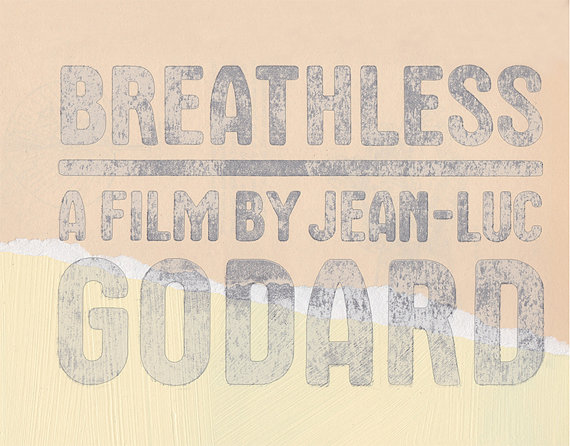
Breathless [Á bout de souffle]

(France 1960)

“After all, I’m an asshole.”

—Michel Poiccard

The third time is a charm: after seeing Jean Luc-Godard’s first full length feature film, Breathless, I now understand the love-meh relationship I have with his work.

On one hand, he’s got a remarkable grasp of human behavior and what motivates it. He’s got a snarky sense of humor. He’s stylish. His technique is gutsy for a lot of reasons. His characters are flawed. His subject matter is cool. He knows how to make a film look pretty, and most of them might as well be deemed official historical documents of the places where they were shot. Seeing a Godard film is like traveling back in time, an incidental bonus he probably never considered. I love all of this.

For all his strengths, on the other hand, a Godard film can be so damned…boring. Merde!

Fortunately, that’s not the case with Breathless, which I enjoyed. Godard and François Truffaut developed the story—I won’t call it a script or a screenplay because they made up much of it as they went along. Plot is always a loose construct with Godard, but there’s enough of one here to follow along fairly easily. Ugly cute guy (or is he a cute ugly guy?) Michel Poiccard (Jean-Paul Belmondo), a drifter car thief who fancies himself a French Humphrey Bogart, steals a car and drives it through the countryside. He shoots a policeman who pursues him and kills him.

With nowhere else to go, he heads straight to his American girl, Patricia (Jean Seberg), an expat student who sells a newspaper, the now defunct New York Herald Tribune, on the Champs-Élysées—that’s kind of weird—and writes articles here and there. She brings Michel to her apartment, where he hides out. He doesn’t mention anything to her about what happened. They get it on, or at least it’s implied that they do. She’s tells him she’s pregnant. One extended scene involves them lying around, talking.

Michel becomes a marked man, which he discovers as soon as he leaves the apartment with Patricia and sees a newspaper with a headline about him. I won’t ruin the ending, but it doesn’t bode well for him—especially after Godard himself sees Michel.

Breathless is a psuedo noir thriller that’s low on action but loaded with morally vacant characters who lack any redeeming qualities. There’s a nihilistic sexiness to it. The narrative moves along in a jazzy free-form way, and the imagery here is every bit a part of the story as the characters. The ending is not a happy one. If nothing else, Breathless is a visual stunner—black and white cinematic candy. The restored digital version I saw literally glowed.

I can handle more films like this one.

With Daniel Boulanger, Henri-Jacques Huet, Roger Hanin, Van Doude, Liliane David, Michel Fabre, Jean-Pierre Melville, Claude Mansard, Jean-Luc Godard, Richard Balducci, Jacques Rivette

Production: Les Films Impéria, Les Productions Georges de Beauregard, Société Nouvelle de Cinématographie (SNC)

Distribution: Films Georges de Beauregard, Les Films Impéria, Société Nouvelle de Cinématographie (SNC), Euro International Film (EIA) (Italy), Pallas Filmverleih (West Germany), British Lion Film Corporation (UK), Cinematográfica Azteca (Mexico), Ciné Vog Films (Belgium), Wivefilm (Sweden), Films Around the World (USA), Rialto Pictures (USA), Criterion Collection (USA)

90 minutes
Not rated

(iTunes rental) B

http://www.jean-lucgodard.com/films.html

https://www.criterion.com/films/268-breathless

Dough

(UK/Hungary 2016)

“Race and religion are irrelevant. If you’re a dickhead, you’re a dickhead.”

—Joanna

I don’t usually bother with “feel good” movies, which tend to be vapid, cheesy affairs. The basic plot summary of Dough caught my attention. Although it teeters dangerously close to full-on “feel good,” to its credit it doesn’t go all the way. Exhale. Still, not great.

Nat Dayan (Jonathan Pryce) has owned and single-handedly operated a Jewish bakery in London. It’s a family business that’s lasted for generations but has definitely seen better days. Nat’s livelihood is threatened by a grocery chain that wants to buy him out. The way things are going, the offer looks like the only way to stay above water.

Enter 20-ish African immgrant Ayyash Habimana (Jerome Holder), a Muslim who recently relocated to the neighborhood. Nat hires him to help bake, not realizing…well, that he gets baked. Like, smoking weed. Ganja. Marijuana. Somehow, Ayyash starts churning out muffins that sell like hotcakes.

Dough is a really cute comedy that works on many levels, at least from a narrative perspective. Director John Goldschmidt steers things in a realistic direction, showing that two disparate generational and cultural ideologies are not really all that far apart. The opening scene—at 4:00 a.m.—illustrates the parallels between Nat and Ayyash’s lives and gets Dough off to a great start. I was hooked. It looked like a winner.

Unfortunately, things go downhill fast. Dough quickly turns into amateur hour, with writing (Jez Freedman and Jonathan Benson) and acting that just doesn’t deliver on the potential here. The story is hamfisted, oversimplified, and predictable. Aside from a few sweet scenes, Dough is kind of a dud.

With Philip Davis, Ian Hart, Pauline Collins, Andrew Ellis, Malachi Kirby, Natasha Gordon, Melanie Freeman, Olivia Dayan

Production: Docler Entertainment, Three Coloured Dog Films, Docler DProd, Dough Film, Viva Films

Distribution: Menemsha Films, Margo Cinema, Rialto Distribution, Vertigo Releasing

94 minutes
Not rated

(iTunes rental) C-

https://www.menemshafilms.com/dough

Didi’s Dreams [Didi’s Dream]

(Taiwan/China 2017)

Just in time for summer, Didi’s Dreams [吃吃的愛] is the cinematic equivalent of a glass of lemonade: cool, refreshing, and sweet with a slightly tart afterburn, it’s a real treat on a hot day. Too bad its North American run is an extremely limited one.

An intentionally fluffy melodrama, the story follows the misadventures of its titular character, Didi (Dee Hsu), a hungry young twenty-something wannabe actress. Determined to catch her big break, she auditions for anything: a probiotic commercial, a model on a QVC-type shopping network, an extra in a zombie flick, a female wrestler. She’s not exactly picky, calculated, or disciplined about getting there—she just wants to be famous. To her credit—and the dismay of many a producer and director—she’s earnest in her efforts.

Didi’s boyfriend, Xiao-kou (Scar Kim), literally rolls along with her, carting her around on his scooter. He proves to be her rock when she receives devastating news from her doctor (Chuan-cheng Tao).

Didi has a sister, Lingling (Lin Chi-lin), who also happens to be an actress—a famous one like Didi aims to be. Some bad blood between them after their mother died, shown mainly through flashbacks, caused a falling out. As a result, they haven’t spoken in years. A scandal, a TV talk show, and a twist of fate (or maybe just a publicity stunt) bring them together—cast as sisters in a major motion picture.

While all this goes on, Didi has a recurring dream about Chunmei (also played by Hsu), her psychic alterego who runs an interplanetary noodle shop in, um, outer space. Her clientele is a creature cantina of sorts. Chunmei can’t seem to get over losing her love, and it’s affecting her broth. One particular customer, an astronaut (Zifeng Li), holds her attention. While not immediately clear, a connection to Didi comes through as the story progresses.

Director Kevin Tsai keeps it mostly light here, serving up a tangy mix of comedy, tragedy, and fantasy in a wink-wink soap opera way—more Telemundo than Dynasty. Tsai and Ming-Yi Liao’s screenplay is not at all deep, but it’s packed with surprises despite a few sappy clichés. I like where the narrative goes.

Visually, Didi’s Dreams is a colorful stunner, loaded with cute faces, vivid imagery, snazzy sets, and cool costumes. Jing-Pin Yu’s cinematography glistens; it’s slick without going overboard. I can’t imagine enjoying this film as much without it. It all looks great on the big screen—my favorite scenes are at the noodle shop and that probiotic commercial.

Yes, there are flaws. However, the whole thing is put together so well, I easily forgave them. I could’ve done without the remake of “Moon River” from Breakfast at Tiffany’s over the closing credits, but the analogy is apt. Didi’s Dreams is a fun little sparkler that caught me off guard.

With Jin Shijia, David Chao, William Shen, Vincent Liang, Bruce Chen, Junior Han, Gigi Lin, Vila Fan, Yu-Lin Shen, Hank Chen, Tender Huang, Riva Chang, Berry Wen-i Kuo

Production: Cheng Cheng Films

Distribution: Le Vision Pictures, Atom Cinema, Kbro HK Limited

91 minutes
Not rated

(ShowPlace ICON) B-

http://www.chengchengfilm.com/didis-dreams-1/

The Godfather

(USA 1972)

“Why did you go to the police? Why didn’t you come to me first? What have I ever done to make you treat me so disrespectfully?”

—Don Vito Corleone


“My father is no different than any powerful man, any man with power. Like a president or a senator.”

—Michael Corleone


“And may their first child be a masculine child.”

—Luca Brasi


“Hey Mikey, why don’cha tell that nice girl you love her? ‘I love you with all a-my heart. If I don’t a-see you again a-soon, I’m a-gonna die!'”

“Leave the gun. Take the cannoli.”

—Peter Clemenza

Pretty much perfect, The Godfather was almost a different movie. Based on Mario Puzo’s insanely popular best selling 1969 novel, studio executives conceived a pulp gangster drama for its film adaptation. Good thing they wanted a “real” Italian-American to direct so it would be so authentic that moviegoers would “smell the spaghetti” (https://www.vanityfair.com/news/2009/03/godfather200903). Several unsuccessful attempts were made to attract a director, including Warren Beatty. Paramount “settled for” unknown Francis Ford Coppola, who took it somewhere else.

The Godfather is universally held in high esteem as one of the greatest films of all time—as it should be. It’s a a movie showered in superlatives—like the bullets that shower, well, most of the characters. It’s impeccable. We caught an anniversary screening.

Coppola’s morality play is a masterpiece, more complex than it seems at first and full of contrast and contradiction. A solemn and ominous mob drama that centers on Don Vito Corleone (Marlon Brando) and his family business, The Godfather boasts one riveting career-defining performance after another—Brando, Al Pacino, James Caan, Richard Castellano, Robert Duvall, and Abe Vigoda, to name a few. The characters are great, and the dialogue—perfect! Not a single second is wasted here, not even that long ass wedding scene.

The observations about human nature are astute, and the spin on assimilation and the American Dream is clever. The dramatic arc involving the descent of younger son Michael (Pacino) into a moral apocalypse is something you can’t shift your eyes away from. Black as its promotional poster, The Godfather leaves so much to chew on. This is what cinema is all about.

In 1990, the United States Library of Congress deemed The Godfather “culturally, historically, or aesthetically significant” and selected it for preservation in the National Film Registry (https://www.loc.gov/programs/national-film-preservation-board/film-registry/complete-national-film-registry-listing/).

With Sterling Hayden, John Marley, Richard Conte, Al Lettieri, Diane Keaton, Talia Shire, Gianni Russo, John Cazale, Rudy Bond, Al Martino , Morgana King, Lenny Montana, John Martino, Salvatore Corsitto, Richard Bright, Alex Rocco, Tony Giorgio, Vito Scotti, Tere Livrano, Victor Rendina, Jeannie Linero, Julie Gregg, Ardell Sheridan, Simonetta Stefanelli, Angelo Infanti, Corrado Gaipa, Franco Citti, Saro Urzì, Sofia Coppola

Production: Paramount Pictures, Alfran Productions

Distribution: Paramount Pictures (USA), Cinema International Corporation (CIC) (International)

175 minutes
Rated R

(AMC River East) A+

Fathom Events

The Adventures of Priscilla, Queen of the Desert

(Australia 1994)

The “road movie” is a subgenre that I think of as an American convention. They tend to involve younger people on a quest for something, perhaps a race (The Cannonball Run), a chase (Convoy), a new life (Alice Doesn’t Live Here Anymore), a vacation (National Lampoon’s Vacation), a mission (Pee-Wee’s Big Adventure), or or just getting laid (Losin’ It). They don’t usually involve gay men or drag performers or Australians for that matter, which makes The Adventures of Priscilla, Queen of the Desert rather compelling for its subversiveness if nothing else.

True, the world had seen a road movie with gay characters before (My Own Private Idaho, which predates this one by three years, comes to mind) and Australians (Roadgames, Backroads). However, The Adventures of Priscilla, Queen of the Desert is different. It’s every bit as fierce as Mad Max, but it’s fabulously fun—as though a team of drag queens tossed a bunch of glitter and disco (and CeCe Peniston) into the mix.

Anthony “Tick” Belrose a.k.a. Mitzi Del Bra (Hugo Weaving) is a drag performer in Sydney who accepts an offer to perform at a casino resort operated by his estranged wife, Marion (Sarah Chadwick), in remote Alice Springs—in the middle of the continent. He gets his buds Bernadette Bassinger (Terence Stamp), a recently widowed transgender woman, and Adam Whitely (Guy Pearce), an obnoxious younger queen whose drag name is Felicia Jollygoodfellow, to join him.

They hit the road in a huge silver tour bus that they christen “Priscilla, Queen of the Desert” and embark on a journey through the desert. A clan of Aboriginals is very welcoming, allowing the three to perform for them. Not everyone is nice, though, which they soon discover when some outbackass bumpkins spraypaint “AIDS Fuckers Go Home” across the side of the bus.

The three contend with the bus breaking down, a homophobic gang, what appears to be an inescapable bar brawl, and secrets—quite a few secrets. Some of the stuff that happens is predictable, but writer and director Stephan Elliott manages to keep the whole thing fresh because he infuses some great conflict and character development into the narrative. Bernadette’s subplot, a soul searching midlife “where do I go from here” kind of existential crisis, is probably the most interesting part of the movie. The acting—Weaving and Pearce (who looks like a cross between Brad Pitt and Mark Wahlberg) for sure, but especially Stamp—is moving for something that appears to be heading toward frivolous and campy territory. It doesn’t quite stop there. What the characters all end up with is something maybe none of us saw coming: acceptance.

What makes The Adventures of Priscilla, Queen of the Desert so great, still, is that it’s full of surprises.

With Rebel Russell, John Casey, June Marie Bennett, Murray Davies, Frank Cornelius, Bob Boyce, Leighton Picken, Maria Kmet, Joseph Kmet, Alan Dargin, Bill Hunter, Julia Cortez, Daniel Kellie, Hannah Corbett, Trevor Barrie, Ken Radley, Mark Holmes

Production: PolyGram Filmed Entertainment, Specific Films

Distribution: Gramercy Pictures, Roadshow Films

104 minutes
Rated R

(DVD purchase) B-

The Wizard of Oz

(USA 1939)

“For twenty-three years, I’ve been dying to tell you what I thought of you! And now… well, being a Christian woman, I can’t say it!”

—Auntie Em


“Toto, I’ve a feeling we’re not in Kansas any more.”

—Dorothy


“I’ll get you, my pretty. And your little dog, too!”

—The Wicked With of the West


“Only bad witches are ugly.”

—Glenda


“Why, anybody can have a brain. That’s a very mediocre commodity. Every pusillanimous creature that crawls on the Earth or slinks through slimy seas has a brain.”

“Hearts will never be practical until they can be made unbreakable.”

“You are under the unfortunate impression that just because you run away you have no courage; you’re confusing courage with wisdom.”

—The Wizard of Oz

Growing up when I did, The Wizard of Oz aired on TV every year, and only once a year. It was a special event. I distinctly remember it being on Thanksgiving, but digging around online contradicts me—while some sources back me up, others say Easter, February, and even Christmas. Whatever. I’ve seen it so many times, I know it by heart. So do many people. Like Willy Wonka and the Chocolate Factory (https://moviebloke.com/2016/03/26/willy-wonka-and-the-chocolate-factory/ ), The Wizard of Oz is a celluloid relic from my childhood that still stirs something in me.

This annual tradition stopped sometime in the ’90s, probably because home video and cable allowed one to see it anytime. So, I was downright thrilled to see a screening near me over a different holiday weekend this year: Memorial Day. I’ve only seen this film on the big screen once or maybe twice before, so I couldn’t resist.

This is where I usually launch into the story, where I might get into some of the details of Dorothy (Judy Garland) and her weird Technicolor odyssey to the Emerald City after a tornado lifts her, Toto (Terry), and her farmhouse out of Kansas and drops her somewhere over the rainbow in Munchkinland—right on top of the unseen Wicked Witch of the East, whose crazy striped socks and shriveled feet are permanently etched in my memory—provoking the ire of the Wicked Witch of the West (Margaret Hamilton) thanks to a pair of ruby slippers.

Let’s be honest, though: we all know the story. Does anything more need to be said about The Wizard of Oz, which is probably the best known and most seen film, ever? Classic and iconic, it set a cinematic benchmark that hasn’t been surpassed nearly a century on, and probably never will be. Loaded with character, song, color, and cool props, it’s a one of a kind spectacle. Its magic continues to inspire.

Harold Rosson’s cinematography is top notch. Seeing it today, I was wowed by the sepiatone Kansas scenes, which were plain old black and white on TV. I always feel a rush when Dorothy opens the door after she crashes, but seeing Munchkinland on the big screen is so much more awesome. So is that scene in the poppy field, and so is the Emerald City with its otherworldy green glow—like paranormal depression glass. Marvelous!

Based on L. Frank Baum’s 1900 children’s book The Wonderful Wizard of Oz, the film’s history behind the camera is every bit as colorful as…well, Munchkinland. Victor Fleming is credited as director, but The Wizard of Oz actually had five: Norman Taurog, Richard Thorpe, George Cukor, Fleming, and King Vidor (https://www.shmoop.com/wizard-of-oz/director.html ). Over a dozen writers contributed to the screenplay (http://oz.wikia.com/wiki/Wizard_of_Oz_Screenwriters ). Although the munchkin suicide is by all accounts nothing more than a rumor, Hamilton was burned badly (https://www.thevintagenews.com/2016/09/06/priority-margaret-hamilton-wicked-witch-west-wizard-oz-suffered-3rd-degree-burns-face-hands-scene-munchkinland-exits-ball-flame/ ). Buddy Ebsen was initially cast as the Tin Man, but he dropped out of the film when he suffered a severe allergic reaction to the aluminum makeup used on his face (http://oz.wikia.com/wiki/Buddy_Ebsen ). However, his voice remains in the scene where Garland, Ray Bolger as the scarecrow, and Jack Haley, Ebsen’s replacement, sing “We’re Off to See the Wizard” after the Tin Man is reanimated with oil.

Legend has it (though it’s probably exaggerated) that the actors who played the munchkins were worse than drunk sailors, holding sex parties and trashing the hotel where they stayed in Culver City (http://www.seeing-stars.com/Hotels/CulverHotel.shtml ) (http://www.mirror.co.uk/tv/tv-news/wizard-oz-mucnhkins-didnt-just-9782402 ) (http://www.independent.co.uk/arts-entertainment/films/features/dogged-by-rumour-the-riddles-of-oz-1766264.html ). Garland allegedly claimed that she was repeatedly accosted by a number of them (http://people.com/celebrity/teenage-judy-garland-was-repeatedly-molested-by-munchkins-on-set-of-wizard-of-oz-says-her-ex-husband/ ). What a world, what a world!

In 1989, the United States Library of Congress deemed The Wizard of Oz “culturally, historically, or aesthetically significant” and selected it for preservation in the National Film Registry (https://www.loc.gov/programs/national-film-preservation-board/film-registry/complete-national-film-registry-listing/).

With Frank Morgan, Bert Lahr, Billie Burke, Charley Grapewin, Clara Blandick, Pat Walshe, Charles Becker, Buster Brodie

Production: Metro-Goldwyn-Mayer/MGM

Distribution: Metro-Goldwyn-Mayer/MGM, Warner Brothers

102 minutes
Not rated

(ArcLight) A+

http://www.thewizardofoz.warnerbros.com