Funeral Parade of Roses [Bara no Sōretsu]

(Japan 1969)

Funeral Parade of Roses [薔薇の葬列] is an intriguing film for a few reasons. Clearly influenced by the French New Wave, writer and director Toshio Matsumoto comes up with something simultaneously ordinary yet avant-garde, very much a product of its time yet years ahead. It’s extraordinarily cool.

Structured as a movie within a movie, Funeral Parade of Roses follows Tokyo “gay boy” Eddie (Pîtâ a.k.a. Peter) through his many exploits as a young transvestite immersed in the underground club scene. He might even be a hooker. Meanwhile, he’s carrying on a secret affair with Jimi (Yoshimi Jô), the boyfriend of club elder statesperson and fellow gay boy Leda (Osamu Ogasawara). Leda is onto them. Oh, the drama it creates!

While all this is going on, a camera crew records Eddie as though this were The Real World or Truth or Dare.

As Eddie ponders who he is — and looks to alcohol, group sex, drugs, and lots of attention from others for answers — Matsumoto explores “queer identity” through him. He intersperses interviews, flashbacks, episodes with Eddie’s mother (Emiko Azuma), and even a musical diversion or two to offer clues. A crazy subplot develops, and it references Oedipus in a tacky and sad but clever way.

Clumsy in its exploration of “gay life” and downright disturbing at points, Funeral Parade of Roses is nonetheless fun to watch. Shot in gorgeous black and white, it has an otherworldly feel. When it’s not nihilistic, it’s kitschy and entertaining — almost in a nascent John Waters way, just not quite as rough. The clothes are mod. The music is heavy on classical. The ending, sudden and bloody, is really messed up.

I’m not sure what exactly Matsumoto is saying here — a lot is open to interpretation — or that I agree with him. Either way, I enjoyed the journey.

With Yoshio Tsuchiya, Toyosaburo Uchiyama, Don Madrid, Koichi Nakamura, Chieko Kobayashi, Shōtarō Akiyama, Kiyoshi Awazu, Flamenco Umeji, Saako Oota, Tarô Manji, Mikio Shibayama, Wataru Hikonagi, Fuchisumi Gomi, Yô Satô, Keiichi Takenaga, Hôsei Komatsu

Production: Art Theatre Guild, Matsumoto Production Company

Distribution: Art Theatre Guild, Image Forum (Japan), Cinelicious Pics (USA)

105 minutes
Not rated

(Gene Siskel Film Center) B+

Swept Away…by an Unusual Destiny in the Blue Sea of August [Travolti da un insolito destino nell’azzurro mare d’agosto]

(Italy 1974)

“Oh, Madonna! This nightmare is finally over. God, do I want some coffee. Fresh, of course.”

— Raffaella Pavone Lanzetti

More than 40 years after the fact, Lina Wertmüller is still an audacious filmmaker. Not only does she incorporate sociopolitical commentary, satire, and crazy sex into her work, but her ’70s films are inherently interesting because they push buttons. She’s the first female nominated for an Oscar for Best Director, and there’s a reason for that: she’s a radical with more balls than just about anyone else working, even today.

Case in point: Swept Away…by an Unusual Destiny in the Blue Sea of August [Travolti da un insolito destino nell’azzurro mare d’agosto] — or simply Swept Away for short — is not a standard comedy. The plot is simple: an insufferable rich bitch, Raffaella (Mariangela Melato), is vacationing in the Mediterranean with her millionare husband (Riccardo Salvino) and their friends on a yacht. Raffaella is thoughtless and demanding, and she relentlessly berates rugged deckhand Gennarino Carunchio (Giancarlo Giannini) because the coffee isn’t fresh, the fish doesn’t taste right, and the pasta isn’t al dente enough.

She insists that Gennarino take her swimming. The two end up stranded in the water, far from the yacht. They eventually spot land, which turns out to be a small uninhabited island. Gennarino, a fisher, has no trouble finding food or shelter. Raffaella isn’t used to doing things herself, and soon finds that she is dependent on Gennarino. He isn’t exactly gracious about his new upper hand. It isn’t long before their relationship takes a sexual turn.

Wertmüller, who wrote the screenplay as well as directed, plays on traditional notions of sex roles. By today’s standards, Swept Away is probably too violent to come off as funny. The many scenes where Gennarino slaps and physically pummels Raffaella are bad enough, but when he rapes her on the beach? It’s disturbing. How is that funny? That’s the point — at first, anyway.

Swept Away isn’t really about sex: it’s about power. Here, the power dynamic shifts once Raffaella and Gennarino are out of the “civilized” world and lost in the wild, where economics and social status no longer define one’s place. Like all of her early films, Wertmüller has a lot to say about class structure; here, she also has a lot to say about male/female relationships. She’s controversial, but her approach works really well. It helps that Melato and Giannini, who starred in earlier films together, have a believable chemistry — and they spend a bit of time here wearing very little.

Swept Away is not a typical film. I call it a comedy, but it doesn’t fit neatly into any category. It’s sharp, subversive, and still pretty potent.

With Isa Danieli, Aldo Puglisi, Anna Melita, Giuseppe Durini, Lucrezia De Domizio, Luis Suárez, Vittorio Fanfoni, Lorenzo Piani, Eros Pagni

Production: Medusa Distribuzione

Distribution: Medusa Distribuzione (Italy), Cinema 5 Distributing (USA)

116 minutes
Rated R

(iTunes rental) B+

http://www.linawertmuller.com/framegeo.htm

https://youtu.be/KahTs5J2pl0

Swept Away

(UK / Italy 2002)

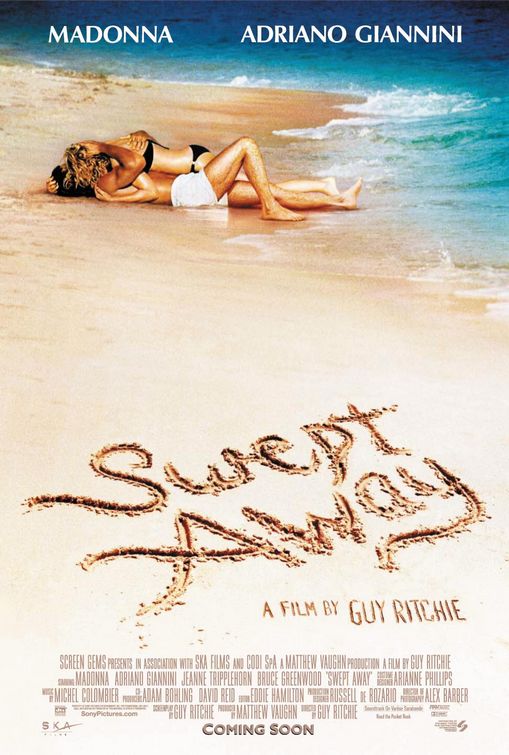
Guy Ritchie’s remake of Lina Wertmüller’s Swept Away, a film that looks like it would be Blue Lagoon but is far from it, was universally panned when it came out. I never saw it, and probably never would have bothered but for my recent discovery of Wertmüller’s work. A two-hour flight from Chicago to New York City and back seemed like the perfect time to get both of them out of the way.

I planned to watch Wertmüller’s original first because…well, that makes sense. Unfortunately, I didn’t start it early enough — the original is 25 minutes longer, and by the time I pulled out my iPad I didn’t have enough time for it. So, I had to settle for backward and watch Ritchie’s version first.

He sticks pretty close to the storyline of the original. Initially, I found Swept Away kind of boring but not offensively awful. Only after seeing Wertmüller’s version did it become painfully clear how lame this remake is; it’s utterly impotent by comparison.

Ritchie retains the critical plot elements of class tension and anticapitalist sentiment that color much of Wertmüller’s work, but here they don’t read the same way; they’re off. Trite, even. Ritchie injects dribs and drabs of his loutish brand of humor into his version, and I found that to be a plus. However, he turns Swept Away into a flaccid, neutered romantic dramedy that the original is not. His version is kinder, gentler, and softer. It has no edge to it whatsoever, which is unusual for him. Yawn.

Stiff and hollow, Madonna’s acting is par for the course. Her character, Amber, is suited to her image. She could’ve had fun with the role. Too bad she seriously overdoes the rich bitch bit and comes off as nasty, hateful, and angry. Not fun. Adriano Giannini, the son of Giancarlo Giannini who played the same role in the original, is nice to look at. That’s it, though; his character, Giuseppe, or as Amber calls him “Pee Pee,” is a turnoff — what a wimp!

The most interesting thing about Swept Away is that David Thornton, Cyndi Lauper’s husband, has a fairly substantial part. I wonder if that was awkward?

With Bruce Greenwood, Elizabeth Banks, Michael Beattie, Jeanne Tripplehorn, Yorgo Voyagis, Ricardo Perna, George Yiasoumi, Beatrice Luzzi, Lorenzo Ciompi, Patrizio Rispo, Francis Pardeilhan, Rosa Pianeta, Andrea Ragatzu

Production: CODI SpA, Ska Films

Distribution: Screen Gems (USA), Columbia TriStar Films (UK), Medusa Distribuzione (Italy)

89 minutes
Rated R

(iTunes rental) D

http://www.sonypictures.com/movies/sweptaway/

https://youtu.be/wv4grEwufV8

Killer of Sheep

(USA 1977)

“Man, I ain’t poor. Look, I give away things to the Salvation Army. You can’t give away nothing to Salvation Army if you poor.”

— Stan

Killer of Sheep has an unusually twisted history that kept it out of daylight — and the spotlight — until recently. His Master’s thesis when he was a film student at UCLA, director Charles Burnett shot it part time over a year’s worth of weekends on 16mm scraps salvaged from production houses. He used equipment borrowed from the university film department. He never intended it to be shown publicly, which is why he didn’t bother to secure licenses for all the music in it (https://mobile.nytimes.com/2007/03/25/movies/25kehr.html?referer=https://www.google.com/).

Relegated to obscurity because of copyright issues surrounding the music, Killer of Sheep was impossible to see for decades — not that that stopped the Library of Congress from adding it to the National Film Registry in just its second year of existence. A grant and a donation led to a restoration that finally placed it into the stream of commerce about ten years ago.

Burnett paints a fluid portrait of the American urban ghetto through the daily life of Stan (Henry G. Sanders), a poor black working class grunt at a slaughterhouse in Watts. His days, monotonous and uneventful, are loaded with small events like fixing the pipes under the kitchen sink, eating dinner at the table with his family, cashing a check at a liquor store, buying a used motor for a car, and getting a flat tire on a “trip to the country” only to find no spare in the truck.

While this is happening, different temptations like a job offer and a part in a crime are presented to Stan. His wife (Kaycee Moore), a weary beauty who waits for him with fresh makeup and a record on the turntable each evening, seems to be the reason he resists. Maybe it’s not her — maybe it’s because Stan simply doesn’t see himself as capable of doing any better.

Not a whole lot happens in Killer of Sheep, but that’s not the point. Like the Italian neorealist films it calls to mind, Burnett’s execution is beautifully simple: he uses non-professional actors (and children who aren’t acting at all), mundane settings and situations, and black and white film to depict the rhythm of poverty. His execution is also really haunting, as if we’re eavesdropping. It’s incredibly effective. For such a quiet and contained film, Burnett’s ultimate statement is pretty jarring.

As stated, the United States Library of Congress deemed Killer of Sheep “culturally, historically, or aesthetically significant” and selected it for preservation in the National Film Registry in 1990 (https://www.loc.gov/programs/national-film-preservation-board/film-registry/complete-national-film-registry-listing/).

With Jack Drummond, Angela Burnett, Charles Bracy,  Eugene Cherry, Delores Farley, Dorothy Stengel , Tobar Mayo, Chris Terrill, Lawrence Pierott, Russell Miles, Homer Jai, Johnny Smoke

Production: Charles Burnett

Distribution: Milestone Films

80 minutes
Not rated

(Gene Siskel Film Center) A-

http://www.killerofsheep.com

A Trip to the Moon [Le Voyage dans la lune]

(France 1902)

I’m guessing that a large number of people recognize a particular still from A Trip to the Moon — the one of the “spaceship” lodged into the moon’s “eye” like a bullet. I’m also guessing that a large number of people have never seen the film. I was one of them — until this afternoon.

Written and directed by French film pioneer Georges Méliès, A Trip to the Moon is a lot cooler than I expected. Imaginative and surprisingly sophisticated, it’s downright cinematic in the way it approaches its subject matter and tells its story. Méliès demonstrates far greater artistic and dramatic flair than his American contemporaries, at least from what I’ve seen.

In a Medieval chamber, a wise old astronomer (Méliès) proposes traveling to the moon, only to be scoffed at by his colleagues (Victor André, Brunnet, Henri Delannoy, Depierre, Farjaut, Kelm). Undeterred, he shows them how it will work. Soon, they’re heading for outer space in a vessel that looks like a big bullet fired with a cannon from the rooftops of Paris.

The astronomers land on the moon and deboard their “space bullet” — no need for space suits, of course. They set up camp. As they sleep, celestial bodies like a comet, the Big Dipper, and Saturn all appear in the night sky. A moon goddess (Bleuette Bernon) makes it snow. They awake and encounter huge mushrooms and insect-like aliens — played by acrobats in tights and a mask — that explode on impact. A mob of aliens captures them and takes them to the leader. The astronomers escape and flee to their capsule, aliens pursuing them. Will they get back to Earth safely?

I found A Trip to the Moon charming. It’s got a nifty surreal Alice in Wonderland meets 20,000 Leagues Under the Sea vibe. It’s theatrical and visually stunning, especially the hand tinted color — yes, color — version. The attention to detail is, in a word, heavenly.

Méliès was a wealthy Paris shoemaker who longed to be an artist. He ultimately sold his share of the family business to his brothers and bought a theater, where he performed magic shows (https://en.wikipedia.org/wiki/Georges_Méliès). A demonstration of a cinematograph, a combination camera/projector/printer (https://en.wikipedia.org/wiki/Cinematograph), in 1895 sparked his interest in film. He’s considered a sci-fi groundbreaker.

With Jeanne d’Alcy, François Lallement, Jules-Eugène Legris

Production: Star Film Company

Distribution: Star Film Company (France), American Mutoscope & Biograph (USA), Edison Manufacturing Company (USA), S. Lubin (USA), Kleine Optical Company (USA), Niels Le Tort (Sweden), The Royal Wonder Bio (Slovenia)

13 minutes
Not rated

(YouTube) A

https://youtu.be/_FrdVdKlxUk

https://youtu.be/s5x_M_vcNVY

The Great Train Robbery

(USA 1903)

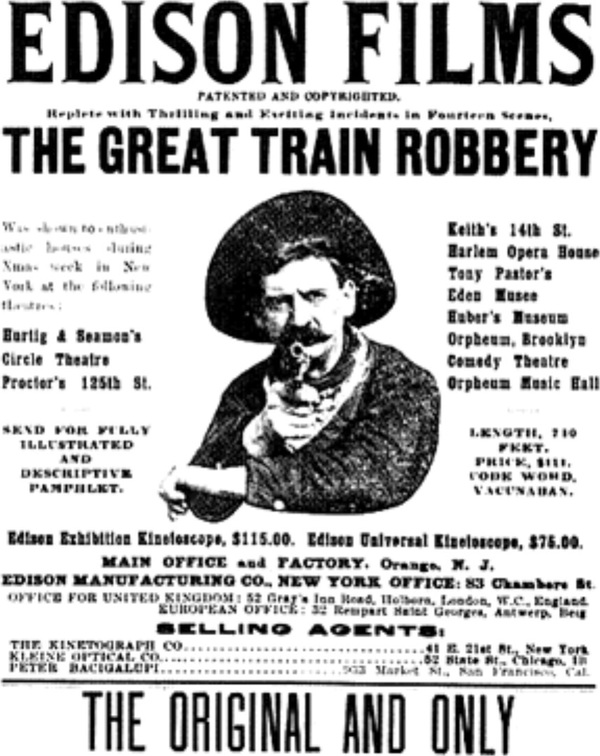
The Great Train Robbery is another early narrative film produced by Thomas Edison and directed by Edwin S. Porter. Unlike Life of an American Fireman earlier the same year, this one looks like a movie: it has a title card, a cast that acts (even if it’s humorously overdramatic), and a more complicated plot — though it’s still pretty simple.

The focus is clearly on telling a story, and on that level it works: a bunch of bandits (Gilbert M. ‘Broncho Billy’ Anderson, Justus D. Barnes, John Manus Dougherty Sr., Frank Hanaway, Adam Charles Hayman) rob a passenger train and are pursued over it. The action is parsed out more thoughtfully, no doubt for dramatic effect. The settings change, and a lot more characters are involved. Plus, the very last scene is clever — it’s a bit Hitchcockian.

In 1990, the United States Library of Congress deemed The Great Train Robbery “culturally, historically, or aesthetically significant” and selected it for preservation in the National Film Registry (https://www.loc.gov/programs/national-film-preservation-board/film-registry/complete-national-film-registry-listing/).

With A.C. Abadie, George Barnes, Walter Cameron, Donald Gallaher, Shadrack E. Graham, Morgan Jones, Tom London, Robert Milasch, Marie Murray, Mary Snow

Production: Edison Manufacturing Company

Distribution: Edison Manufacturing Company, Kleine Optical Company

11 minutes
Not rated

(YouTube) C

https://youtu.be/X59wQsT4mYg

Life of an American Fireman 

(USA 1903)

The National Film Registry has some weird shit on it. Life of an American Fireman is a good example. An early “narrative” film produced by Thomas Edison and directed by George S. Fleming and Edwin S. Porter, who worked on other Edison film projects, this one depicts the dangerous work of firemen.

Life of an American Fireman doesn’t waste time or expense on things life title cards or credits. It begins with a fireman (Arthur White) dreaming about his wife and kids, shown in an onscreen thought bubble. He is awakened by the sound of the bell — not that we hear it — because oh, Lord Jesus, it’s a fire! It’s not entirely clear, but it looks like the fire is at his house.

This film is interesting from a historical perspective, and it shows some nice exterior shots of suburban New York or New Jersey. It’s also neat how the aforementioned thought bubble is composed as well as how the action is depicted from various viewpoints — in and outside the house. The fake smoke is a nice detail. Other than that, Life of an American Fireman is a snooze — about as thrilling as watching a fax go through. Thankfully, programming has come a long way.

In 2016, the United States Library of Congress deemed Life of an American Fireman “culturally, historically, or aesthetically significant” and selected it for preservation in the National Film Registry (https://www.loc.gov/programs/national-film-preservation-board/film-registry/complete-national-film-registry-listing/).

With Vivian Vaughan, James H. White

Production: Edison Manufacturing Company

Distribution: Edison Manufacturing Company, Kleine Optical Company

7 minutes
Not rated

(YouTube) D

https://youtu.be/6ym7-QW_GWo

The Asphalt Jungle

(USA 1950)

I expected crime noir classic The Asphalt Jungle to be something of a cheesefest: stiffly acted, overly melodramatic, and maybe a bit hamfisted in its morality, like The Hardy Boys for adults of the Greatest Generation. Thankfully, John Huston’s film adaptation of W.R. Burnett’s 1949 novel is none of that.

No sooner is Doc Riedenschneider (Sam Jaffe) out of the big house when he hatches a plan to do what he does best: steal. Like, a million bucks or more in jewels from a jewelry store (not Jared’s). Yes, a jewel heist. He pitches his plan to Cobby (Marc Lawrence), a two-bit gambling bookie, who puts him in touch with Alonzo Emmerich (Louis Calhern), a rich but shady attorney. Emmerich buys in, not just providing financial backing but also agreeing to handle disposing the booty for cash.

Doc assembles a crew of petty thieves consisting of a “box man,” or a safecracker (Anthony Caruso), a driver (James Whitmore), and an all-important “hooligan” (Sterling Hayden) to execute the plan. The heist goes off without a hitch, mission accomplished. It’s smooth; uneventful, even. That is, until a stray bullet accidentally hits one of the crew members.

This is where the plot gets really interesting, as human nature and a slew of bad decisions rear their ugly heads. It doesn’t help that at the same time, sundry troubles that have been brewing alongside all the planning are coming to a boil. Soon, it’s every man for himself in a sticky web of deception, doublecrossing, and death.

The Asphalt Jungle is an exquisitely layered and calibrated drama that’s tough to turn away from — and tough not to appreciate. Written by Huston with Ben Maddow, the screenplay is tight. The characters — a collection of urban lowlife thieves, thugs, private detectives, crooked cops, and good looking dames — all have dimension. Interestingly, what would probably be the most intense scene in most movies — the break-in — isn’t; the intensity and the drama come from what happens after that. A manhunt that ends in Cleveland and an attempted swindle serve as the ticking clock here. This is the perfect thriller for a hot summer night in the city. Bonus: The Asphalt Jungle features a young but unmistakable Marilyn Monroe in one of her earliest roles.

In 2008, the United States Library of Congress deemed The Asphalt Jungle “culturally, historically, or aesthetically significant” and selected it for preservation in the National Film Registry (https://www.loc.gov/programs/national-film-preservation-board/film-registry/complete-national-film-registry-listing/).

With Jean Hagen, John McIntire, Barry Kelley, Teresa Celli, William “Wee Willie” Davis, Dorothy Tree, Brad Dexter, Helene Stanley, John Maxwell, Strother Martin, Jack Warden, Tim Ryan

Production: Metro-Goldwyn-Mayer

Distribution: Metro-Goldwyn-Mayer

112 minutes
Not rated

(Music Box) A-

Noir City

https://www.warnerbros.com/asphalt-jungle

Drugstore Cowboy

(USA 1989)

“You won’t fuck me and I always have to drive.”

— Dianne Hughes

“If I ever see a hat on a bed in this house, man, like you’ll never see me again. I’m gone.”

“Show time!”

“Well, to begin with, nobody, and I mean nobody, can talk a junkie out of using. You can talk to ’em for years but sooner or later they’re gonna get ahold of something. Maybe it’s not dope. Maybe it’s booze, maybe it’s glue, maybe it’s gasoline. Maybe it’s a gunshot to the head. But something. Something to relieve the pressures of their everyday life, like having to tie their shoes.”

— Bob Hughes

“Narcotics have been systematically scapegoated and demonized. The idea that anyone can use drugs and escape a horrible fate is anathema to these idiots. I predict in the near future right-wingers will use drug hysteria as a pretext to set up an international police apparatus.”

— Fr. Murphy

I love everything about Drugstore Cowboy, the first film I ever saw by director Gus Van Sant. It’s the one that I view as his gold standard even after nearly 30 years. Funny, touching, and insightful in ways that have to be seen, it speaks to me. It probably always will. It’s a rare film that has it all: flawlessly executed from start to finish, it’s totally absorbing and entertaining yet still makes its points in a way that hits hard even after seeing it dozens of times.

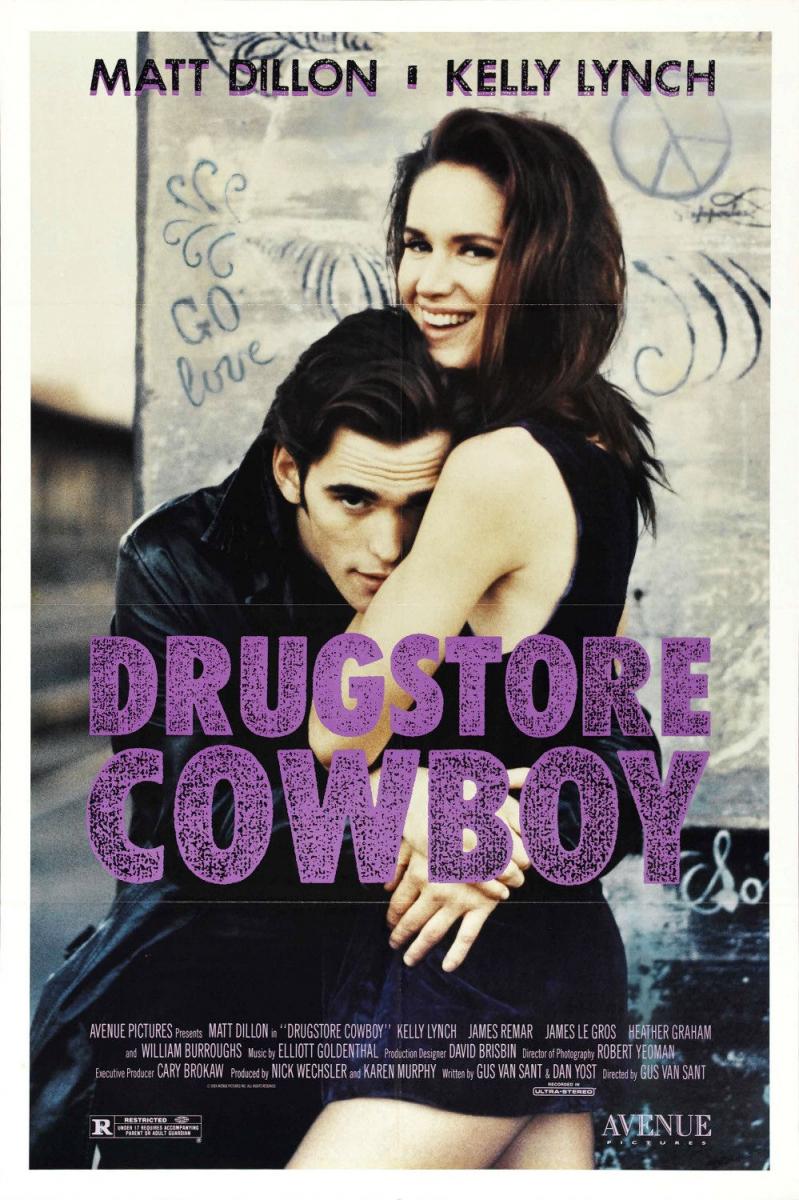
Bad Bobby Hughes (Matt Dillon) — or just “Bob” — is the first one to tell you he’s a junkie. He and his wife, Dianne (Kelly Lynch), lead a small nomadic “crew” that consists of Rick (James LeGros) and his young girlfriend, Nadine (Heather Graham). The four of them spend their days getting high and devising elaborate — and amusing — schemes to rob drugs from pharmacies and hospitals. Then they go out and execute their mission.

Once they’ve made a score, they do the drugs they like, sell the ones they don’t, hang out doing little more than watching TV, and move onto another neighborhood somewhere else in Portland, Oregon, when they’ve either run out or overstayed their welcome, whichever comes first.

They’ve repeated the cycle so many times that cocky Detective Gentry (James Remar) and his men are on their trail. Bob manages to stay a step ahead, but it’s getting tougher. He sees that his luck is running out — and it’s not just because of the hex that Nadine inadvertently put on them by mentioning a dog (one thing about Bob: he’s a bit superstitious).

To outrun one such hex — and more realistically, because Bob runs out of ideas and doesn’t know what to do next — they hit the road, stuffing their drug stash in suitcases, shipping them on Greyhound buses, and following them by car. A string of bad luck and bad outcomes presents Bob with an epiphany — and a choice.

With both humor and compassion, Van Sant — and for his part, Dillon — tells a moving and curiously relatable story about people who aren’t necessarily bad, but they’ve allowed their lives to drift away from them. Here, it’s for drugs. They don’t always do the right thing, and often the members of this little family of outcasts are each other’s worst enemies. But they’re realistic. Dillon makes Bob so likable that I find myself rooting for him even when he’s making bad choices; despite his flaws, I like him enough that I can see myself having fun with him.

Drugstore Cowboy easily could’ve been a very different movie. It works because it’s not preachy or judgmental or hyperbolic. Based on a novel by real-life criminal and addict James Fogle (https://en.m.wikipedia.org/wiki/James_Fogle), Van Sant and Daniel Yost’s screenplay eschews melodrama for a decidedly objective and almost clinical approach, showing the joys of drugs in some visually well constructed sequences as well as the cost of addiction. The film does an excellent job showing how much work it is to maintain a habit. Throughout the movie, Dillon’s narration keeps the story grounded. Van Sant never sells out his characters’ humanity.

It doesn’t hurt that this film is loaded with spectacular performances all around, including those of Grace Zabriskie as Bob’s battleworn mother and William S. Burroughs as disgraced priest and fellow addict Fr. Tom Murphy. Robert Yeoman’s cinematography gives Drugstore Cowboy a drab, threadbare look that works well with Elliot Goldenthal’s moody score. Every element comes together to make this a truly remarkable film, definitely one of my favorites.

With Max Perlich, George Catalano, Janet Baumhover, Stephen Rutledge, Beah Richards, Robert Lee Pitchlynn, Ray Monge, Woody

Production: Avenue Pictures

Distribution: Avenue Pictures Productions (USA), Astral Films (Canada), Forum Distribution (France), Sandrew Film & Teater (Sweden), GAGA Communications (Japan)

102 minutes
Rated R

(MoviePlex) A+

They Live

(USA 1988)

“I’ve come here to chew bubblegum and kick ass…and I’m all out of bubblegum.”

“I’m giving you the choice: either put on these glasses or eat that trashcan.”

“Brother, life’s a bitch. And she’s back in heat.”

— Nada

Director John Carpenter has done a few good pictures that probably will have an audience long after he’s gone; They Live isn’t one of them. At least, not in a good way. B-movie cult fodder all the way, They Live is a somewhat delayed and really heavy-handed reaction to ’80s conspicuous consumption. Based on Ray Nelson’s 1963 short story “Eight O’Clock in the Morning” and subsequent comic strip, Carpenter’s screenplay, written under the pseudonym Frank Armitage, is founded on a decent premise; it just doesn’t go where it could have.

Nada (Roddy Piper), a migrant construction worker who’s seen better days, picks up a job in downtown Los Angeles. He notices some weirdness going on with a television station that seems to be connected to a church across the lot where he and other homeless people have set up camp. His coworker Frank (Keith David) doesn’t want to hear about it. No one does.

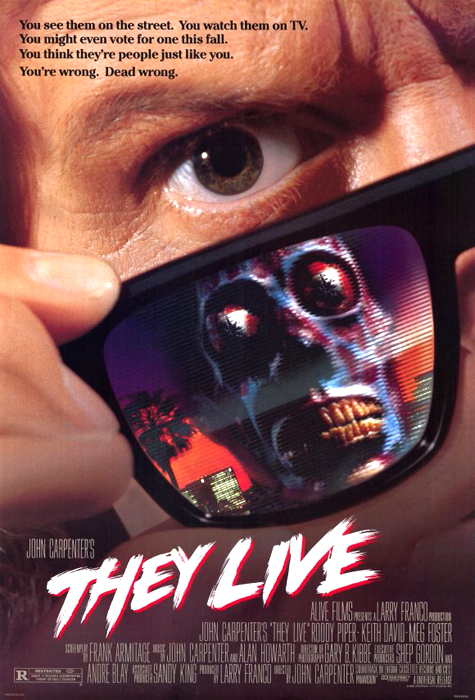
One morning, Nada comes into possession of a pair of sunglasses. When he puts them on, he sees subliminal messages everywhere. A billboard with the tagline “We’re creating the transparent computing environment” says “Obey” with the glasses on. A travel ad beckoning, “Come to the Caribbean” says “Marry and reproduce.” “Men’s apparel” says “No independent thought.” Signs all around him order one to consume, conform, buy, watch TV, submit, sleep, do not question authority:

They Live Obey.jpg

Even the dollar bill has a different message: “This is your god.”

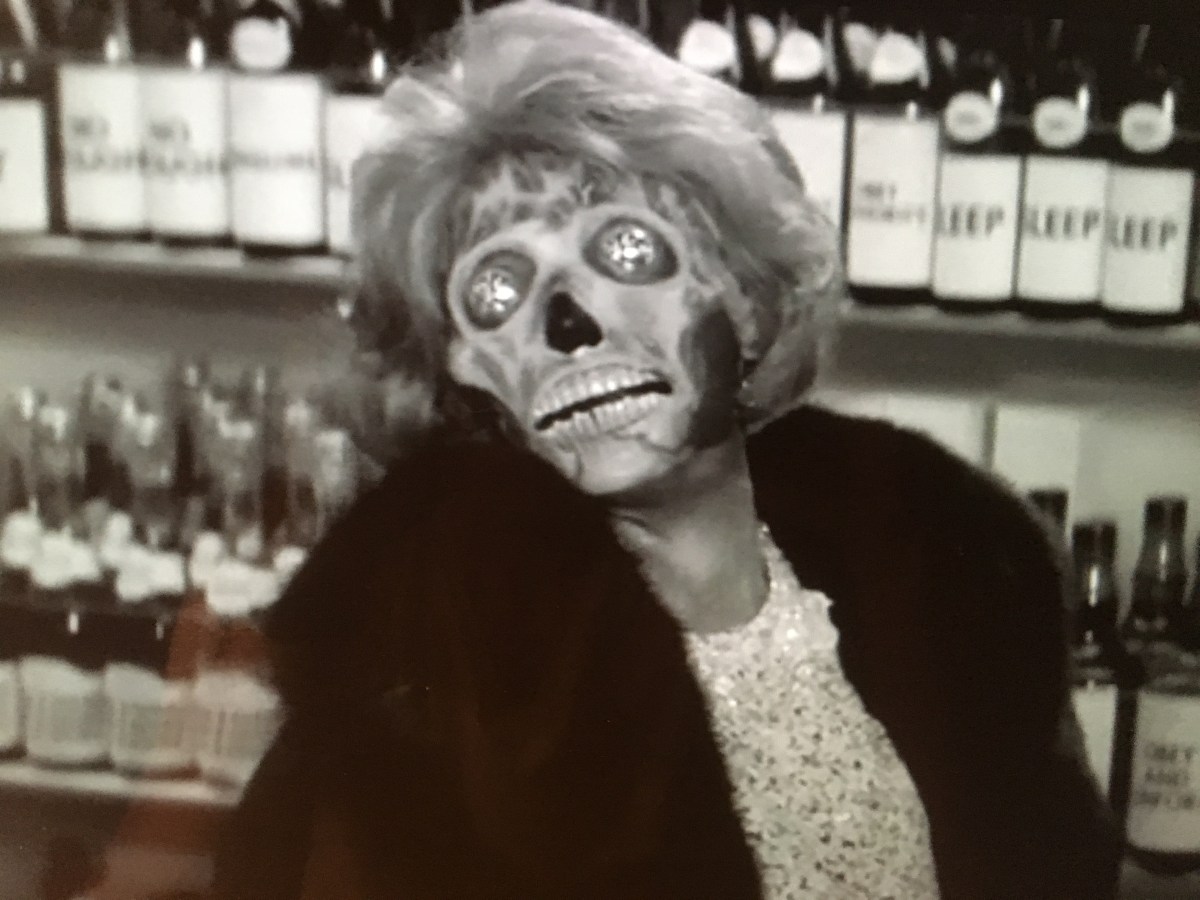
What’s worse, some people are not what they appear to be. At all. They aren’t even human — they’re skeletal reptiles, a kind of mutant species of Sleestaks or something:

They Live.JPG

What the hell is going on? Who are these things? What do they want? As Nada tells Frank, they ain’t from Cleveland.

I remember seeing They Live at the theater when it was new. It was okay. Three decades later, it’s still okay. It’s a lot sillier this time around, though. The whole thing gets off to a good enough start, but the momentum peters out just before midpoint. Carpenter — or anyone, for that matter — can get only so much mileage out of this story. They Live feels like 40 minutes of material stretched into more than twice that amount of time.

The denouement is not just predictable but anticlimactic, and the perspective here is adolescent at best. The lines are cringeworthy, falling painfully short of the Arnold Schwarzenegger zingers they aim to be. The acting is pretty bad, especially David and Meg Foster, both of whom are as stiff and lifeless as a dead gerbil. Surprisingly, Piper and his mullet are the best thing about They Live; Piper isn’t enough to carry it, though. And that wrestling scene in the alley is inane — misplaced, unnecessary, and too long, it adds nothing except maybe ten minutes to the running time.

The worst thing about They Live is that it seems Carpenter was serious — nothing here reads as tongue in cheek to me.

With George “Buck” Flower, Peter Jason, Raymond St. Jacques, Jason Robards III, Lucille Meredith, Norman Alden, Norm Wilson, Thelma Lee, Rezza Shan

Production: Alive Films, Larry Franco Productions

Distribution: Universal Pictures

94 minutes
Rated R

(iTunes rental) D+

http://www.theofficialjohncarpenter.com/they-live/