I, Tonya

(USA 2017)

As crazy at it was, the attack on figure skater Nancy Kerrigan’s knee just before the 1994 Winter Olympic Games and the resulting shit show that plagued her teammate Tonya Harding never occurred to me again after the media frenzy over it died down — like, by spring. Then one day this past autumn, I caught the trailer for I, Tonya. Oh, Lord!

I must confess, Craig Gillespie’s biopic ended the year on a high note — much higher than my expectations. Framed as a documentary with interviews interspersed throughout the story, I misjudged I, Tonya as mere fluff. It’s not. For all its lurid, sensationalist absurdity, it packs some jarring moments that hit…well, like a club.

While not a vital undertaking, I, Tonya is a very well done film. The screenplay by Steven Rogers is sharp, while Gillespie’s pace — cuts and jumps and all — moves nicely. What makes the whole thing fly, though, is the cast. Sebastian Stan as Harding’s sadistic twerp of a husband Jeff Gillooly and Allison Janney as her caustic mother LaVona Golden give performances worthy of gold medals. But the real showstopper is Margot Robbie, who makes Harding something she never was in real life: sympathetic. It’s no small feat.

I’ve heard some grumble that I, Tonya is a mean-spirited film that condescends to its subjects and gets laughs by making them look like fools. I don’t see it that way. Without absolving her, the film presents nasty circumstances that no doubt fueled Harding’s desire to win. The story and characters are culled from actual sources. Harding’s ultimate punishment was harsh. You can’t help but understand and feel for her, just a teeny tiny bit.

With Julianne Nicholson, Paul Walter Hauser, Bobby Cannavale, Bojana Novakovic, Caitlin Carver, Maizie Smith, Mckenna Grace, Jason Davis, Mea Allen, Cory Chapman, Amy Fox, Cara Mantella, Lynne Ashe, Steve Wedan, Brandon O’Dell, Davin Allen Grindstaff, Daniel Thomas May, Anthony Reynolds, Ricky Russert, Miles Mussenden, Jan Harrelson, Luray Cooper, Dan Triandiflou, Kelly O’Neal, Alphie Hyorth

Production: Clubhouse Pictures, LuckyChap Entertainment

Distribution: 30West (USA), Neon (USA), VVS Films (Canada), Cinemex Films S.A. de C.V. (Mexico), California Filmes (Latin America), Mars Distribution (France), Lucky Red (Italy), DCM Film Distribution (Germany), Ascot Elite Entertainment Group (Switzerland), Nos Lusomundo Audiovisuais (Portugal), The Searchers (Belgium / Netherlands), Seven Films (Greece), Myndform (Iceland), Vertigo Média Kft. (Hungary), Fabula Films (Turkey), Gakhal Entertainment (India), Lots Home Entertainment (Taiwan), M Pictures (Thailand), Noori Pictures (South Korea), Shaw Organisation (Singapore), Showgate (Japan), Solar Pictures (Philippines), UA films (Hong Kong), Roadshow Films (Australia / New Zealand), Ster-Kinekor Pictures (South Africa)

120 minutes
Rated R

(AMC River East) B

https://www.itonyamovie.com

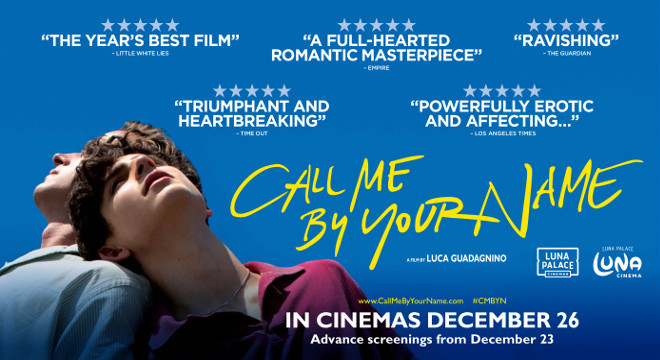
Call Me by Your Name

(Italy / USA / France / Brazil 2017)

“Call me by your name and I’ll call you by mine.”

— Oliver

Very seldom does a film leaves me speechless, but that’s just what Call Me by Your Name did. For me, it’s one of this year’s most unexpected cinematic pleasures.

Set during the summer of 1983, precocious and solitary 17-year-old Elio Perlman (Timothée Chalamet) is spending another summer with his parents at their Italian villa. It looks like business as usual — reading, writing, and playing piano — until ruggedly handsome and tan American graduate student Oliver (Armie Hammer) shows up. Oliver, with his penchant for being overly casual (particularly with his use of “later” to bid farewell) and his love of the Psychedelic Furs, will be staying in Elio’s room for the summer while working as an intern for Elio’s father (Michael Stuhlbarg), a professor who’s finishing up a book.

Wow. Director Luca Guadagnino hits the nail right on the head on so many things he gets at here: the perversity of male adolescence, the confusion of sexual awakening and lost innocence, the single-mindedness of desire, the thrill and frustration of seduction, and the agony of loss, all of it before a gorgeous and sunny Italian backdrop. He’s sensitive to the subject matter, which centers on sexuality, but he doesn’t cheapen the story or its characters. It’s a tricky feat.

The pace may be frustrating at times. However, being an act of seduction itself, Call Me by Your Name is nonetheless erotic, intimate, honest, and ultimately heartbreaking. That’s an awful lot to fit into one film, but Guadagnino does it, and he does it exceptionally well. It helps that he recruits excellent actors, particularly Chalamet, who brings a credible vulnerability to his character. The final scene is beautifully simple, effective, and hard to watch even while the credits roll.

I had a remarkably similar experience as Elio when I was barely 18 years old. Call Me by Your Name is more romantic, but seeing it play out reminded me of someone from my own past. I never go back and read a book after seeing its film adaptation, but I’m compelled to read André Aciman’s novel now.

With Amira Casar, Esther Garrel, Victoire Du Bois, Vanda Capriolo, Antonio Rimoldi, Elena Bucci, Marco Sgrosso, André Aciman, Peter Spears

Production: Frenesy Film Company, La Cinéfacture, RT Features, Water’s End Productions

Distribution: Sony Pictures Classics

132 minutes
Rated R

(Landmark Century) A-

http://sonyclassics.com/callmebyyourname/mobile/

The Last American Virgin

(USA 1982)

“Are you here to interview me or to fuck me?”

— Ruby

It was decades ago, probably the ‘80s, the last time I saw low budget ’80s cable classic The Last American Virgin. I recently noticed it in the “free movies” queue on … where else, cable. I had to know whether it was as good as I remembered.

An odd mix of other teen movies from its day — think of Porky’s and Fast Times at Ridgemont High and Losin’ It and Valley Girl all rolled into one — it isn’t something I imagine being made today, not even as a remake. The Last American Virgin starts out all fun and games — centered on sex, of course — but abruptly takes a dark turn about halfway through. Subject matter aside, it ends on a brutally cynical note that leaves one pondering: what exactly is writer and director Boaz Davidson saying here?

None of this is a gripe; on the contrary, it’s an asset that puts The Last American Virgin in a class of its own. Kudos for that.

Gary (Lawrence Monoson) is a Los Angeles high school student. When he’s not delivering pizzas in a ridiculous pink Grand Prix (or similar late ‘70s car), he and his hornball friends Rick (Steve Antin), the cute one, and David (Joe Rubbo), the fat one, are constantly trying to get laid.

Their antics are pretty funny. They pick up three duds at a hamburger joint and snort Sweet ‘N’ Low with them when a party they promise doesn’t happen and the girls want drugs. They wind up together in the apartment of a horny Mexican woman of a certain age (Louisa Moritz) whose sailor boyfriend (Roberto Rodriquez) is away, and she wants all three of them. Later, they get crabs from a bossy Hollywood hooker (Nancy Brock). A dick measuring contest in the school locker room is, well, uncomfortably hot. Somehow, sex happens easily for Rick and David. Not Gary, though: he’s either too nice or too scared.

At school, Gary meets a new girl, Karen (Diane Franklin). He crushes on her, hard. Too bad she’s into Rick, which causes friction. A bizarre love triangle develops, and it doesn’t end well. In fact, it reaches a boiling point by winter break.

I never knew The Last American Virgin is a remake of Davidson’s 1978 Israeli film Eskimo Limon. He fucking nails it with his depiction of jealousy — better than most films do. It’s hard to watch Gary’s hatred for Rick grow stronger while they’re running around getting into trouble together. Monoson’s acting is good, and so is Franklin’s. Their scenes together are the best this movie has to offer. I would be remiss to mention that for such a minor role, Kimmy Robertson really shines as Karen’s wacky friend Rose, who seems like Katy Perry’s secret inspiration.

The Last American Virgin has its unimpressive moments, but it’s hardly a write-off. Overall, it’s held up well. Sure, it falls into nostalgia, but beyond its soundtrack it’s more memorable for its characters, its plot, and its unexpected turn. It certainly isn’t what it appears to be.

With Brian Peck, Tessa Richarde, Winifred Freedman, Gerri Idol, Sandy Sprung, Paul Keith, Harry Bugin, Phil Rubenstein, Julianna McCarthy, Mel Welles

Production: Golan-Globus Productions

Distribution: Cannon Film Distributors (USA), Citadel Films (Canada)

92 minutes
Rated R

(Impact) B

Wonder Wheel

(USA 2017)

For whatever difference it makes, I had no idea Woody Allen had a new movie coming out, like, now. Being a fan, I didn’t hesitate to sign onto a prerelease screening of his latest, Wonder Wheel. Now that I’ve seen it, I must say that I’m not disappointed.

Set in 1950s Coney Island — in case the title didn’t cue you in — Wonder Wheel is a tawdry story of multifaceted infidelity told by lifeguard Mickey (Justin Timberlake), a hopeful playwright attending school at New York University. An unreliable narrator, he warns us up front that he’s prone to drama. He meets middleaged Ginny (Kate Winslet), a waitress in a clamhouse, on the beach. They commence a summer affair. She takes it for more than it is. Then Mickey meets Ginny’s step-daughter, Carolina (Juno Temple), who’s hiding from her Mafioso husband. He’s smitten. She’s smitten. Ginny senses it, and she’s thrown into blind jealousy. It doesn’t end well.

Wonder Wheel doesn’t feel like a Woody Allen movie, at least not at first. It’s a bit too cute, too hollow, too stiff, and perhaps surprisingly too nostalgic. The acting is forced and hammy, and the writing is…weird. Hang in there — it gets better, and it becomes clear that everything that appears to be a flaw is actually planned.

About a third of the way through, the characters show their true colors. It’s not pretty, but it all comes together nicely, melding seamlessly into a stage play. Plus, the elements of Allen’s best films — characters who are neurotic narcissists, love (or is it lust?) throwing them off, and the unmistakable reference to Alvy Singer’s boyhood home  — become apparent. It’s dark, but it’s engrossing.

Wonder Wheel is Allen’s take 20th Century American playwrights generally, and Eugene O’Neill specifically. The plot involves a fucked up family situation that brings out the worst in everyone involved, except Carolina. Winslet unravels nicely; she’s not as exciting as Cate Blanchett in Blue Jasmine, but she’s really close. Both are strong in their own way.

Jim Belushi evokes John Goodman so much that I wonder if his part was written for Goodman. Curiously, Winslet evokes Susan Sarandon. Ironically, the only good person is the one one who digs her own grave: Carolina. The story is interesting. Vittorio Storaro’s cinematography, which makes the entire film look like it was shot at sunset, is strikingly gorgeous, tinted in dreamy reds, greens, and blues.

I can’t say Wonder Wheel is even close to Allen’s best films, but I rank it in the upper eschelon of his late period work. It’s not as good as Blue Jasmine, but it’s not far off.

With Max Casella , Jack Gore, David Krumholtz, Robert C. Kirk, Tommy Nohilly, Tony Sirico, Stephen R. Schirripa, John Doumanian, Thomas Guiry, Gregory Dann, Bobby Slayton, Michael Zegarski , Geneva Carr, Ed Jewett, Debi Mazar, Danielle Ferland, Maddie Corman, Jacob Berger, Jenna Stern

Production: Amazon Studios, Gravier Productions

Distribution: Amazon Studios

101 minutes
Rated PG-13

(AMC River East) B

Chicago International Film Festival

http://www.wonderwheelmovie.com/home/

Dick Tracy

(USA 1990)

“You better get over here fast. They’re gonna find out we’re not together.”

— Dispatcher (from Dick Tracy’s watch)

Dick, that’s an interesting name.

It took 15 years for Warren Beatty to achieve his vision of Dick Tracy, Chester Gould’s hard-boiled square-chin (and nose) comic strip detective in the hideous yellow trench coat (http://www.newsweek.com/tracymania-206276). I skipped over him in favor of lighter and friendlier (not to mention more current) stuff like Peanuts, Hägar the Horrible, Hi and Lois, Marmaduke, The Far Side, Life in Hell, and later Calvin and Hobbes and, um, Crankshaft. Good times!

I remember the media blitz during the summer of 1990. It included Madonna — I’m Breathless, an album of music from and “inspired by” the film, and a landmark world tour (Blond Ambition). I guess it makes sense coming a year after Tim Burton’s mega successful Batman that the studio would push Dick Tracy to be the next big blockbuster. This one cost more and made less, but it still made a mark at the box office.

Dick Tracy (Beatty) is dying to bring down mob boss “Big Boy” Caprice (Al Pacino), the city’s most notorious criminal. He may have found a way through femme fatale lounge singer Breathless Mahoney (Madonna), Big Boy’s new girlfriend. She knows a thing or three. Now, if only Dick can get her to talk. The problem is, she’s more interested in Dick.

Written by Jim Cash and Jack Epps Jr., the screenplay is adequate: it doesn’t knock your socks off, but it certainly holds your interest. It doesn’t really matter, though, because the story is secondary.

Dick Tracy is a sensory feast. Rick Simpson’s sets are gorgeous and elegant art deco cityscapes punctuated with primary colors and Depression Era practicality. Makeup designers John Caglione Jr. and Doug Drexler concoct memorably grotesque prosthetics that define each villain — there are many — and actually help you keep track of who’s who. Vittorio Storaro’s camera work pulls the whole thing together like an Edward Hopper painting.

Finally, there’s the music. Danny Elfman’s score is cool, but throw in some Stephen Sondheim songs — three of which Madonna performs — and you’ve got a winner. In fact, “Sooner or Later” won the Oscar for Best Original Song (https://www.oscars.org/oscars/ceremonies/1991). Bonus: Dick Tracy is the closest you’ll get, at least up to now, to seeing Madge perform “More,” an overlooked classic from her catalog that to my knowledge she’s never done live. Ever.

Dick Tracy isn’t perfect. A few moments teeter dangerously close to overboard on cuteness and camp, but fortunately Beatty knows when to pull back. This is not an essential film, but it’s an enjoyable one. I like it.

With Glenne Headly, Charlie Korsmo, James Keane, Seymour Cassel, Michael J. Pollard, Charles Durning, Dick Van Dyke, Frank Campanella, Kathy Bates, Dustin Hoffman, William Forsythe, Ed O’Ross, James Tolkan, Mandy Patinkin, R.G. Armstrong, Henry Silva, Paul Sorvino, Lawrence Steven Meyers, James Caan, Catherine O’Hara, Robert Beecher, Mike Mazurki, Ian Wolfe

Production: Touchstone Pictures, Silver Screen Partners IV, Mulholland Productions

Distribution: Buena Vista Pictures

105 minutes
Rated PG

(Music Box) B-

Chicago Film Society

Madonna: Innocence Lost

(USA / Canada 1994)

“I take what I need and I move on. And if people can’t move with me, well then I’m sorry.”

— Madonna

Wow, I completely forgot about this tawdry exposé made for TV — American TV, which is even worse — chronicling Madonna’s early years in New York City. It aired on Fox in the mid-nineties, and it’s actually amazing only for how awful it is. All the stops are pulled out, and it’s a trainwreck: the overriding theme is that Madonna is an ambitious whore. OK, National Enquirer.

Based on Christopher Andersen’s 1991 biography — totally unauthorized, I add — Michael J. Murray’s script is just plain sad. Some of it is remarkably accurate, but some of it…not so much. I recognize every single interview where he culled material to tell the Material Girl’s story — in Time, Rolling Stone, Vanity Fair, Interview, and a few other magazines. He doesn’t just lift background, he lifts dialogue. Verbatim. That opening monologue is straight from a letter to Stephen Jon Lewicki in which she begs to appear in his softcore film A Certain Sacrifice. The characters are all real people even if their names are changed: her donut shop manager (Kenner Ames), Dan Gilroy (Jeff Yagher), Camille Barbone (Wendie Malick), Mark Kamins (Mitch Roth), Seymour Stein (Don Francks), frequent collaborator Steve Bray (Ephraim Hylton), and last but not least her father, Silvio Ciccone (Dean Stockwell).

I’m mildly impressed that her mother (Jenny Parsons), shown entirely in black and white flashbacks, even comes up. And the many guys she slept with, some of them with a purpose. And that gumcracking? Brilliant!

Terumi Matthews plays a young Madonna, and I’ll give her this: she nails the megastar’s ideosynchrocies perfectly! However, the vignettes and Catholic imagery stolen straight from the video for “Oh Father” are so lame that I feel like I should say a rosary after seeing this. So should you. Don’t even get me started on where this story starts — the first MTV Video Music Awards? Really? She was already on her second album by then.

In any event, Madonna: Innocence Lost is not flattering, but it’s still a hoot. It plays on Madonna’s bad side, like “Blond Ambition” is a bad thing. The problem is, this approach fails when you’re dealing with someone who used that very name for one of her biggest tours. Shocking? Fuck no.

With Diana Leblanc, Nigel Bennett, Dominique Briand, Tom Melissis , Christian Vidosa, Dino Bellisario, Kelly Fiddick, Gil Filar, Maia Filar, Diego Fuentes, Matthew Godfrey, Evon Murphy, Stephane Scalia, Chandra West

Production: Fox Television Studios, Jaffe/Braunstein Films

Distribution: Fox Network, RTL Entertainment (Netherlands), True Entertainment (UK)

90 minutes
Rated TV-14

(YouTube) D+

1945

(Hungary 2016)

Ferenc Török’s excellent 1945, which he says took over a decade to finish, doesn’t end up where it looks like it’s going. The story takes place on a hot summer Saturday in August 1945 during a transitional time in Hungary — after the Nazis surrendered but before the Soviets left.

Two men in black, one old (Iván Angelus) and the other young (Marcell Nagy), arrive at the train station of a small rural village. They have two large trunks in tote, which they are bringing into town. They walk in silence behind the wagon as the hired driver (Miklós B. Székely) and his son (György Somhegyi) lead the way.

The stationmaster (István Znamenák) alerts the town clerk, István Szentes (Péter Rudolf), who’s in the midst of preparations for his son’s (Bence Tasnádi) wedding. The two visitors are Orthodox Jews who survived the Holocaust. The villagers are thrown into a state of paranoia, fearing the purpose of this unwanted intrusion.

Based on Gábor T. Szántó’s short story “Homecoming,” Török effectively sets up the narrative using the construct of a Western: an ominous sky, strangers in black, and nervous lawmen and townsfolk all ready for a conflict to erupt.

The conflict in 1945, however, started long before this day: it started when the apparently all Catholic residents betrayed their only Jewish neighbor, the owner of the local drug store. István’s wife, Anna (Eszter Nagy-Kálózy), turned him in to the Nazis. István took over his store and moved his family into his house. Everyone, from the police to the village priest (Béla Gados), looked the other way.

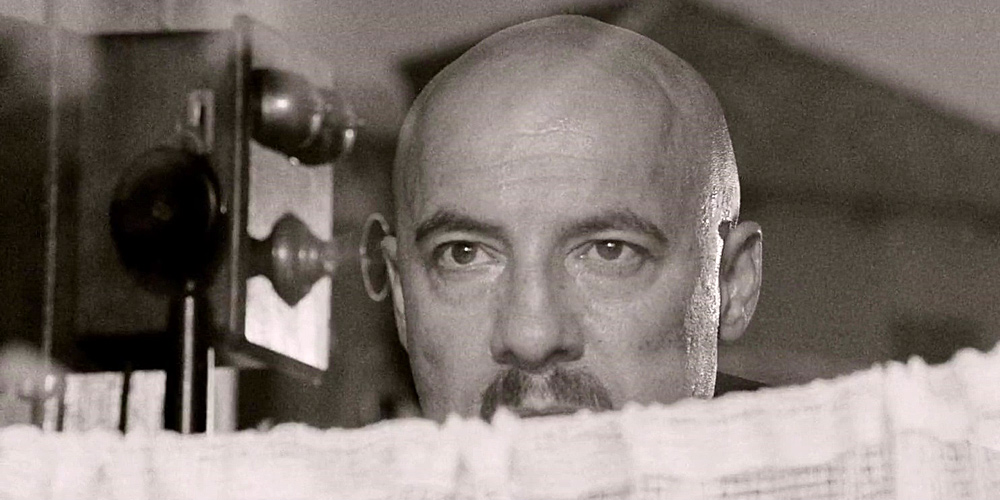
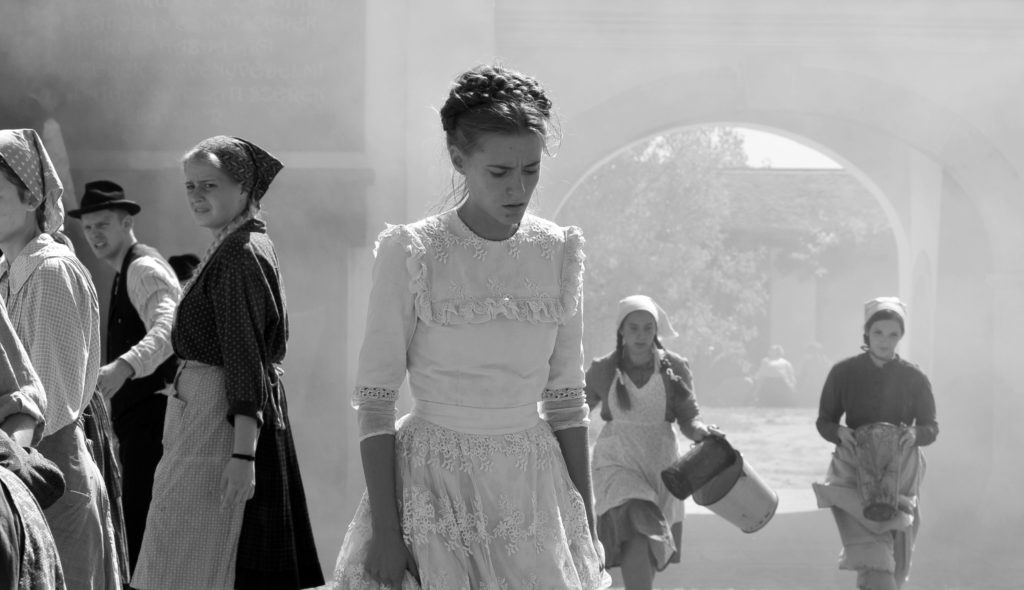
Török shows the conflicted villagers struggling to rectify their personal gain with the dishonorable way they achieved it. Török’s pacing is perfect, unfolding slowly with an ever-increasing sense of unease and doom. It doesn’t hurt that the ensemble case is tops. Elemér Ragályi’s gorgeous black and white cinematography emulates the look of films from the 1930s and 1940s:

1945 Still1.jpg

1945 Still5.jpg

1945 Still2.jpg

1945 Still6.jpg

1945 is one of the more memorable films I caught at this year’s festival.

With Tamás Szabó Kimmel, Dóra Sztarenki, Ági Szirtes, József Szarvas, Sándor Terhes, Tünde Szalontay, Mari Nagy, János Derzsi, Tibor Mertz, Bálint Adorjáni, Vivianne Bánovits, Rita Kerkay, Zsolt Dér, Gergö Mikola, Máté Novkov

Production: Katapult Films

Distribution: Menemsha Films

Screening introduced and followed by a live Q and A with Ferenc Török

91 minutes
Not rated

(AMC River East) B+

Chicago International Film Festival

https://www.menemshafilms.com/1945

The Cakemaker [Der Kuchenmacher]

(Israel / Germany 2017)

During a post screening Q and A, writer and director Ofir Raul Graizer said he “love[s] question marks in cinema.” Well, that shows: with his first feature film The Cakemaker [Der Kuchenmacher], he excels in raising questions that he lets his audience answer. Many people don’t appreciate this approach. I’m not one of them.

Tomas (Tim Kalkhof) is a thirty-something baker who runs his own one-man pastry shop in Berlin. Oren (Roy Miller), a married Israeli man, comes in one morning — maybe he’s really there for breakfast, or maybe he’s cruising.

Turns out, Oren is in Berlin on business, a lot. They begin an affair. Tomas knows about Oren’s wife and son in Jerusalem. Oren has a habit of bringing Tomas’s cinnamon cookies home to his wife as a kind of souvenir. It’s weird.

WARNING: Potential Spoilers Ahead!

After an unsettling visit, all communication with Oren stops. Confused and upset, Tomas tries to reach him at his company’s office in Berlin. A perplexed receptionist (Tagel Eliyahu) informs him that Oren died in a car crash.

Tomas does what any sensible red-blooded German gay guy would do: he closes shop and heads to Jerusalem to find out what happened — and maybe spy on Oren’s family to get an idea of what his life there was like.

He starts by tracking down Oren’s wife, Anet (Sarah Adler), who’s struggling to get a kosher café up and running. More by omission that outright lies, Tomas slowly works his way into her life, getting closer and more entangled without ever letting on that he knew her husband. Anet’s brother-in-law (Zohar Strauss) is dismayed, particularly when Anet hires Tomas, a gentile, as a baker. Things get complicated when his pastries attract a steady clientele to her café.

The Cakemaker isn’t exactly a thriller, but it’s suspenseful. A clear dread hovers over the whole story because it’s apparent that it’s not going to end well. It can’t, not with Tomas’s deceptions. Graizer’s pacing, slow and deliberate, steadily builds to an effective climax that might not be surprising itself but is still more intense than I expected. This is a quiet movie with some real nailbiter moments.

Graizer does a fine job enshrouding Oren in mystery — or maybe it’s shadiness. Anet reveals a zinger or two about their relationship. Sandra Sadeh as Oren’s mother, Hanna, steals each scene she’s in, a total of three. She subtly lets on that she’s wise to her dead gay son — and Tomas.

With Tamir Ben Yehuda, Stephanie Stremler, Iyad Msalma, David Koren, Gal Gonen, Eliezer Shimon, Sagi Shemesh

Production: Film Base Berlin, Laila Films

Distribution: Films Boutique

Screening introduced and followed by a live Q and A with Ofir Raul Graizer

104 minutes
Not rated

(AMC River East) B

Chicago International Film Festival

http://filmsboutique.com/movies/the-cakemaker/

Three Billboards Outside Ebbing, Missouri

(USA 2017)

Justice, like morality, is ambiguous. Accordingly, determining exactly how justice should be meted out is mired in a lot of grey. Translation: life is not black and white.

This old adage makes people uncomfortable, and it’s exactly the concept that colors Three Billboards Outside Ebbing, Missouri. It works so well because it acknowledges that there is no one right answer. Thankfully, as luck would have it, it’s also kind of funny.

Mildred Hayes (Frances McDormand) is pissed off and tired. Seven months ago, her daughter was raped, murdered, and set on fire, though not necessarily in that order. The police have made no arrests, they have no suspect, and they haven’t uncovered a single lead. The case is precariously close to cold.

Driving down a rural road one morning, Mildred spots three abandoned billboards and gets an idea: she’ll shame Chief of Police Willoughby (Woody Harrelson) into action. She rents the billboards for a full year and posts ads that attack him. The problem is, her idea doesn’t pan out as she plans — in fact, it works against her cause.

Not far off from a Coen Brothers venture, Three Billboards Outside Ebbing, Missouri is a twisted and twisting nailbiter. Writer-director Martin McDonagh has a sharp wit, a warped sense of humor, and an impeccable grasp of human nature. The cast is outstanding, with not one subpar performance. At times heartbreaking, this is all around a tightly assembled and enthralling film.

With Caleb Landry Jones, Kerry Condon, Sam Rockwell, Alejandro Barrios, Jason Redford, Darrell Britt-Gibson, Abbie Cornish, Riya May Atwood, Selah Atwood, Lucas Hedges, Zeljko Ivanek, Amanda Warren, Malaya Rivera Drew, Sandy Martin, Peter Dinklage , Christopher Berry, Gregory Nassif St. John, Jerry Winsett, Kathryn Newton, John Hawkes, Charlie Samara Weaving, Clarke Peters, Brendan Sexton III, Eleanor Threatt Hardy, Michael Aaron Milligan

Production: Blueprint Pictures

Distribution: 20th Century Fox, Fox Searchlight Pictures, Warner Brothers

115 minutes
Rated R

(AMC River East) B+

Chicago International Film Festival

http://www.foxsearchlight.com/threebillboardsoutsideebbingmissouri/

Suspiria

(Italy 1977)

“We must get rid of that bitch of an American girl. Vanish! She must vanish! Make her disappear! Understand? Vanish! She must vanish. She must die! Die! Die!”

— Madame Blanc

Dario Argento’s cult classic Suspiria is a perplexing film, and not because it’s scary. It’s pretty ridiculous, tongue and cheekiness aside.

Cowritten by Argento with Daria Nicolodi from Thomas DeQuincey’s 1845 essay “Suspiria de Profundis,” the plot is prosaic: American ballet student Suzy Bannion (Jessica Harper) enrolls at “the most famous school of dance in Europe,” the fictitious Tanz Dance Academy in Freiburg, Germany. Suzy notices immediately that something about the place isn’t quite right — maybe it’s the two students who are murdered the night she arrives. It doesn’t take long for Suzy to discover that the school is a front for something far more nefarious. Except for a few good lines here and there, the writing is terrible. The acting is even worse. The two exceptions are Alida Valli as Miss Tanner and Joan Bennett as Madame Blanc, both of whom deliver fabulously campy performances as women of power at the school.

None of this matters, though, because this isn’t Suspiria’s raison d’être. No, Suspiria is a sensory masterpiece that places style way ahead of substance. In other words, it’s eye candy.

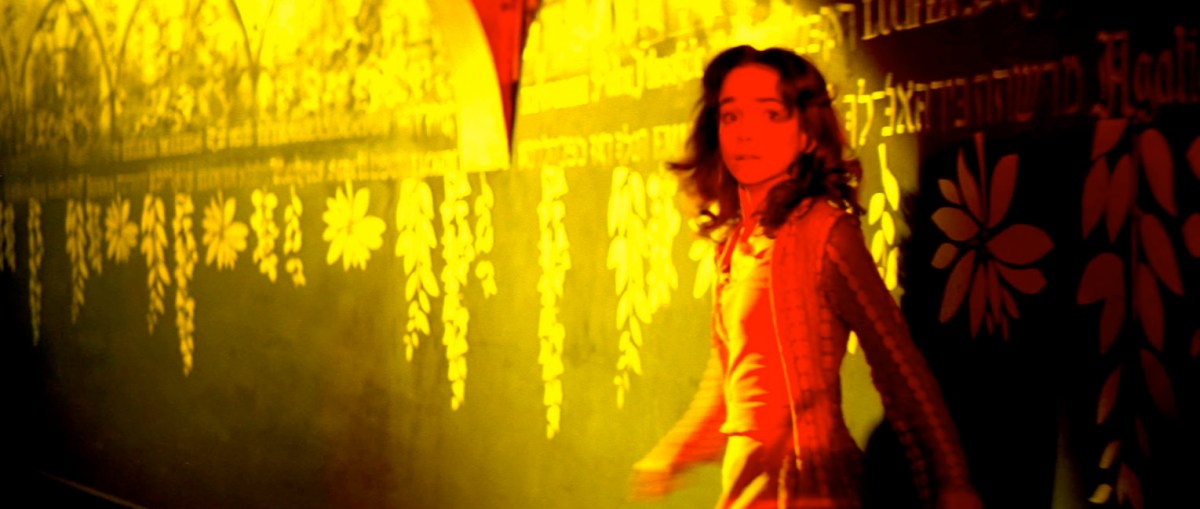
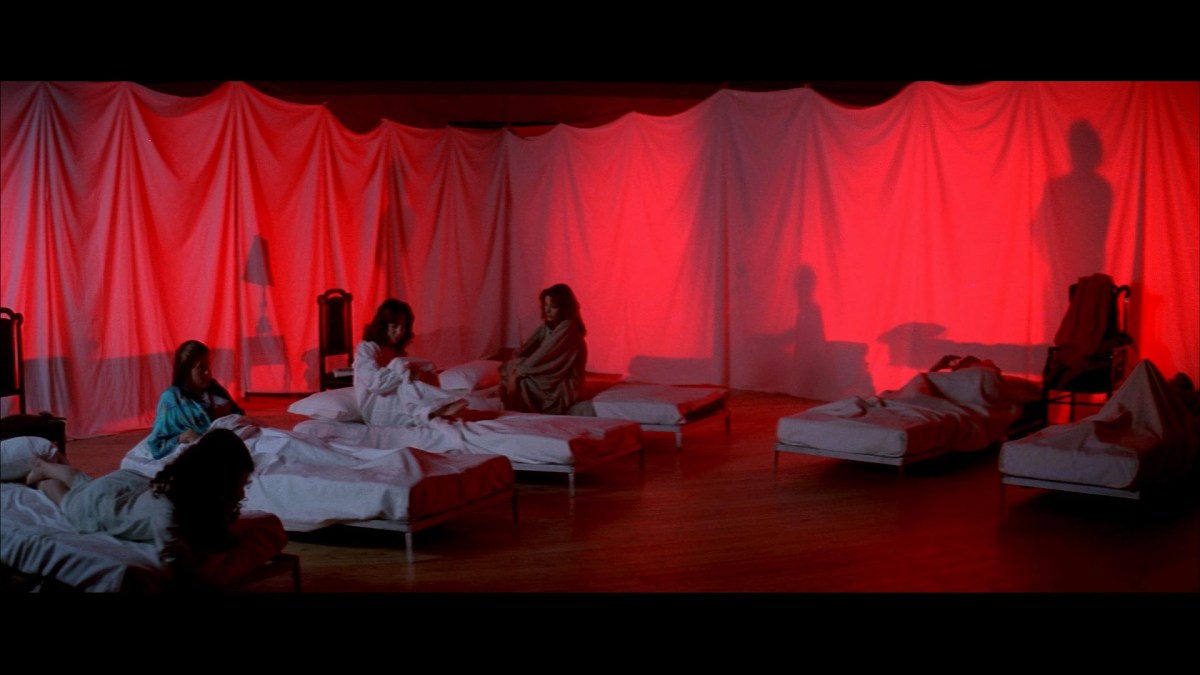
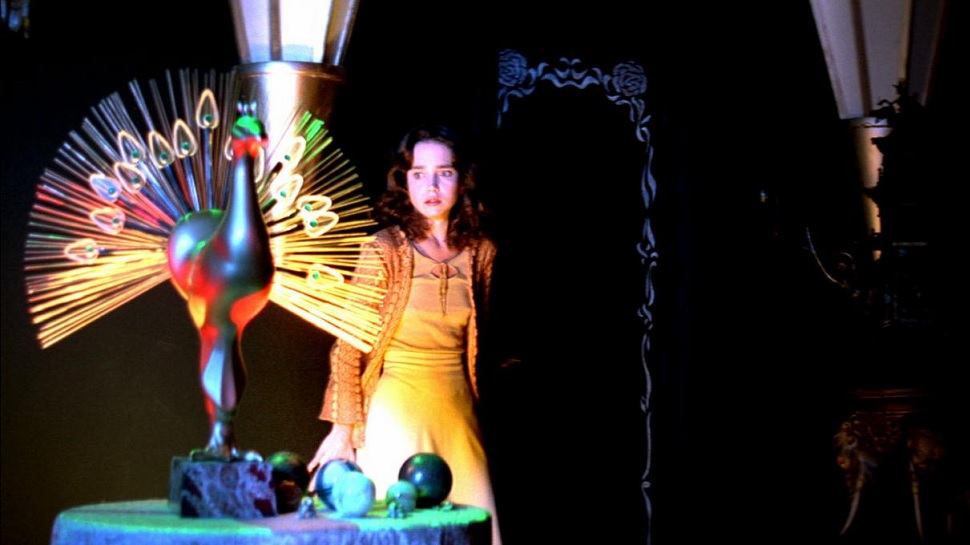
Argento expresses his vision through his imagery, and it’s unforgettably dazzling and unique. From the opening titles to the last scene, Argento shocks, thrills, and seduces with color, light, shadow, and surreal imagery. His sets are elegant and fake, and his blood is even faker. He lights the screen with bright reds and glowing blues (when it’s not all black from night), and he keeps the perspective distorted to create a trippy dissonance. Plus, he throws in a number of creepy psychological menaces, from maggots to a dog attack to a treacherous room-size wire dustbunny. Luciano Tovoli’s camera work perfectly articulates Argento’s vision.

This is what Suspiria is all about:

Suspiria1.jpg

Suspiria2.jpg

Suspiria3.jpg

Suspiria4.jpg

Suspiria5.jpg

Suspiria6.jpg

Suspiria9.jpg

Suspiria7.jpg

Suspiria8.jpg

The soundtrack by Goblin is a nice touch, and it goes far in creating the mood here.

For all its flaws — and there are many — Suspiria is a memorable film. We caught a digital restoration of the original print, which is five or six minutes longer. A zealous audience member engaged us in a discussion as we left the theater. He told us that Suspiria is the first of a trilogy known as “The Three Mothers,” and he enthusiastically recommended the second film, Inferno. I’ll see it someday, but it’s not a priority.

With Stefania Casini, Flavio Bucci, Miguel Bosé, Barbara Magnolfi, Susanna Javicoli, Eva Axén, Rudolf Schündler, Udo Kier, Margherita Horowitz, Jacopo Mariani, Fulvio Mingozzi, Franca Scagnetti, Renato Scarpa, Serafina Scorceletti, Giuseppe Transocchi, Renata Zamengo

Production: Seda Spettacoli

Distribution: Produzioni Atlas Consorziate

98 minutes
Not rated (alternate version)

(ArcLight) C+