The Wizard of Oz

(USA 1939)

“For twenty-three years, I’ve been dying to tell you what I thought of you! And now… well, being a Christian woman, I can’t say it!”

—Auntie Em


“Toto, I’ve a feeling we’re not in Kansas any more.”

—Dorothy


“I’ll get you, my pretty. And your little dog, too!”

—The Wicked With of the West


“Only bad witches are ugly.”

—Glenda


“Why, anybody can have a brain. That’s a very mediocre commodity. Every pusillanimous creature that crawls on the Earth or slinks through slimy seas has a brain.”

“Hearts will never be practical until they can be made unbreakable.”

“You are under the unfortunate impression that just because you run away you have no courage; you’re confusing courage with wisdom.”

—The Wizard of Oz

Growing up when I did, The Wizard of Oz aired on TV every year, and only once a year. It was a special event. I distinctly remember it being on Thanksgiving, but digging around online contradicts me—while some sources back me up, others say Easter, February, and even Christmas. Whatever. I’ve seen it so many times, I know it by heart. So do many people. Like Willy Wonka and the Chocolate Factory (https://moviebloke.com/2016/03/26/willy-wonka-and-the-chocolate-factory/ ), The Wizard of Oz is a celluloid relic from my childhood that still stirs something in me.

This annual tradition stopped sometime in the ’90s, probably because home video and cable allowed one to see it anytime. So, I was downright thrilled to see a screening near me over a different holiday weekend this year: Memorial Day. I’ve only seen this film on the big screen once or maybe twice before, so I couldn’t resist.

This is where I usually launch into the story, where I might get into some of the details of Dorothy (Judy Garland) and her weird Technicolor odyssey to the Emerald City after a tornado lifts her, Toto (Terry), and her farmhouse out of Kansas and drops her somewhere over the rainbow in Munchkinland—right on top of the unseen Wicked Witch of the East, whose crazy striped socks and shriveled feet are permanently etched in my memory—provoking the ire of the Wicked Witch of the West (Margaret Hamilton) thanks to a pair of ruby slippers.

Let’s be honest, though: we all know the story. Does anything more need to be said about The Wizard of Oz, which is probably the best known and most seen film, ever? Classic and iconic, it set a cinematic benchmark that hasn’t been surpassed nearly a century on, and probably never will be. Loaded with character, song, color, and cool props, it’s a one of a kind spectacle. Its magic continues to inspire.

Harold Rosson’s cinematography is top notch. Seeing it today, I was wowed by the sepiatone Kansas scenes, which were plain old black and white on TV. I always feel a rush when Dorothy opens the door after she crashes, but seeing Munchkinland on the big screen is so much more awesome. So is that scene in the poppy field, and so is the Emerald City with its otherworldy green glow—like paranormal depression glass. Marvelous!

Based on L. Frank Baum’s 1900 children’s book The Wonderful Wizard of Oz, the film’s history behind the camera is every bit as colorful as…well, Munchkinland. Victor Fleming is credited as director, but The Wizard of Oz actually had five: Norman Taurog, Richard Thorpe, George Cukor, Fleming, and King Vidor (https://www.shmoop.com/wizard-of-oz/director.html ). Over a dozen writers contributed to the screenplay (http://oz.wikia.com/wiki/Wizard_of_Oz_Screenwriters ). Although the munchkin suicide is by all accounts nothing more than a rumor, Hamilton was burned badly (https://www.thevintagenews.com/2016/09/06/priority-margaret-hamilton-wicked-witch-west-wizard-oz-suffered-3rd-degree-burns-face-hands-scene-munchkinland-exits-ball-flame/ ). Buddy Ebsen was initially cast as the Tin Man, but he dropped out of the film when he suffered a severe allergic reaction to the aluminum makeup used on his face (http://oz.wikia.com/wiki/Buddy_Ebsen ). However, his voice remains in the scene where Garland, Ray Bolger as the scarecrow, and Jack Haley, Ebsen’s replacement, sing “We’re Off to See the Wizard” after the Tin Man is reanimated with oil.

Legend has it (though it’s probably exaggerated) that the actors who played the munchkins were worse than drunk sailors, holding sex parties and trashing the hotel where they stayed in Culver City (http://www.seeing-stars.com/Hotels/CulverHotel.shtml ) (http://www.mirror.co.uk/tv/tv-news/wizard-oz-mucnhkins-didnt-just-9782402 ) (http://www.independent.co.uk/arts-entertainment/films/features/dogged-by-rumour-the-riddles-of-oz-1766264.html ). Garland allegedly claimed that she was repeatedly accosted by a number of them (http://people.com/celebrity/teenage-judy-garland-was-repeatedly-molested-by-munchkins-on-set-of-wizard-of-oz-says-her-ex-husband/ ). What a world, what a world!

In 1989, the United States Library of Congress deemed The Wizard of Oz “culturally, historically, or aesthetically significant” and selected it for preservation in the National Film Registry (https://www.loc.gov/programs/national-film-preservation-board/film-registry/complete-national-film-registry-listing/).

With Frank Morgan, Bert Lahr, Billie Burke, Charley Grapewin, Clara Blandick, Pat Walshe, Charles Becker, Buster Brodie

Production: Metro-Goldwyn-Mayer/MGM

Distribution: Metro-Goldwyn-Mayer/MGM, Warner Brothers

102 minutes
Not rated

(ArcLight) A+

http://www.thewizardofoz.warnerbros.com

Love & Anarchy [Film d’amore e d’anarchia, ovvero ‘stamattina alle 10 in via dei Fiori nella nota casa di tolleranza…’]

(Italy/France 1973)

The premise of Lina Wertmüller’s Love & Anarchy [Film d’amore e d’anarchia, ovvero ‘stamattina alle 10 in via dei Fiori nella nota casa di tolleranza…’] has the ring of something from Federico Fellini or maybe Pedro Almodóvar (though Fellini makes a lot more sense because she actually worked as his assistant for a spell).

Freckly yokel farmer Tunin (Giancarlo Giannini) learns that his friend was murdered. Why? Because he was an anarchist who was plotting to assassinate “ll Duce” Benito Mussolini. What’s more, Mussolini’s fascist police killed him. To avenge his friend’s death, Tunin takes up his cause.

Tunin ends up at a brothel in Rome. He spends a night with Salomè (Mariangela Melato), who reveals that she’s a co-conspirator for her own reasons. As the story progresses, it becomes clear that the coup is a harebrained idea.

Salomè takes Tunin to a rural spot just outside Rome with her and another prostitute, Tripolina (Lina Polito). Salomè distracts Spatoletti (Eros Pagni), the head of Mussolini’s police, while Tunin checks out the area; they then devise a plan to execute the mission.

Meanwhile, Tunin and Tripolina fall in love. Convinced that he isn’t going to make it past the assassination alive, he persuades Tripolina to spend the next two days with him.

The same radical spunk that Wertmüller exhibits in The Seduction of Mimi is just as prevalent in Love & Anarchy; this film is loaded with decadent, sexy hijinks. However, it also its share of some really tender moments—that surprised me. Love & Anarchy turns out devastatingly sad—I left the theater literally bummed out. For all its ridiculous sociopolitical and sexual shenanigans, it’s a far more powerful film.

With Pina Cei, Elena Fiore, Giuliana Calandra, Isa Bellini, Isa Danieli, Enrica Bonaccorti, Anna Bonaiuto, Anita Branzanti, Maria Sciacca, Anna Melato, Gea Linchi, Anna Stivala, Roberto Herlitzka

Production: Euro International Film, Labrador Films

Distribution: Peppercorn-Wormser, Kino Lorber

120 minutes
Not rated

(Gene Siskel Film Center) B

https://www.kinolorber.com/film/view/id/1306

Dolemite

(USA 1975)

Dolemite (Rudy Ray Moore) is his name, and fuckin’ up mutha fuckas is his game!

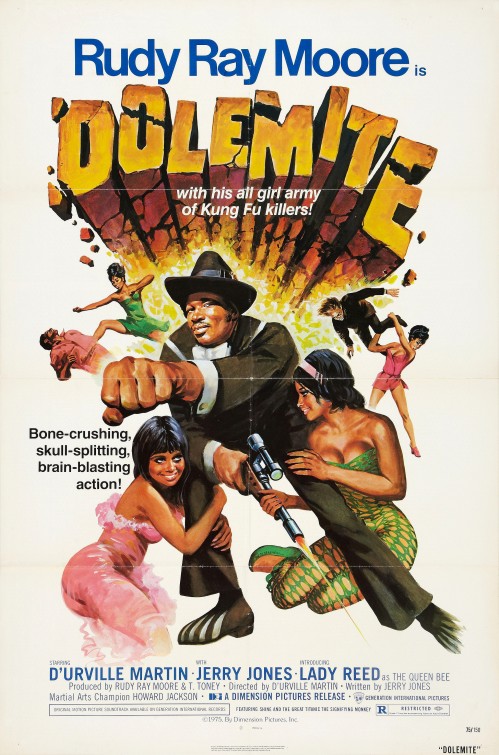
He’s the baddest pimp around—well, around Los Angeles, anyway—and he looks every bit the part. Dolemite owns a nightclub and whorehouse but he’s doing time on a drug beef. Maybe it’s bogus, maybe not. Maybe some bad cops set him up, maybe it was archenemy Willie Green (D’Urville Martin), who took over the club and is running shit now. Either way, mother pimp Queen Bee (Lady Reed) and Dolemite’s army of ass-kickin’ kung fu hookers are none too happy about it.

To get out of the big house, Dolemite makes a deal with the po-po, Agent Blakeley (Jerry Jones), to, I think, help clean up his old hood. Dolemite uses this as an opportunity to exact revenge on Green and reclaim his, um, stature in the community.  Along the way, he kicks a lot of ass, takes on two crooked cokehead cops—Mitchell (John Kerry) and White—and gets laid. A lot. He even cuss raps at the end.

Dolemite is not a movie to see because it’s a work of art. On the contrary, it’s terrible. But that’s what makes it so much fun to watch—that’s why it’s a cult classic. Like a lot of things before the late ’80s, it’s not P.C. (i.e., politically correct)—as if that isn’t obvious from the movie poster. The directing by Martin, which probably explains why he has so little screen time, is sloppy. You can count the number of times boom mics pop in. The fight scenes are laughable—Dolemite knocks people out barely lifting a finger (or here,  leg) and sometimes without even touching them. Don’t even get me going on the martial arts stuff!

The plot is confusing and watered down. Jones wrote the screenplay with Moore, and the writing is just bad. I admit, I watched it drunk this time, but I’ve seen Dolemite before while sober. No difference. The events are scattered and at points seem random. The characters are colorful—shady Reverend Gibbs (West Gale), a possible parody of former Chicago leader Mayor Daley (Monte “Hy” Pike), the clearly trippin’ Hamburger Pimp (Vainus Rackstraw), and the many fox females—wander in and out, often without any reason.

Despite all that, Dolemite unquestionably has a charm of its own. Moore likes to rhyme, and he punctuates pretty much every sentence with “mutha FUCKA!” His crib is rent-to-own fabulous—check it out:

Dolemite set 2.jpg

Dolemite set 1.png

The wardrobe looks like it was borrowed from the Salvation Army. The climax at the nightclub goes on longer than it should but is still a showstopper. The soundtrack is a trip. If nothing else—and there is nothing else—Dolemite is a good time.

With Brenda DeLong, Terri Mosley, Marilyn Shaw, Lynell Smith, Vera Howard, Joy Martin, Jana Bisbing, Brenda Banks, Pat Haywood, René Van Clief, Pat Jones, Lola Mayo, Charlene Soulter, Liz Sample, Karolynn Hill, Dino Washington, Johnny J. Brown, Cardella Di Milo

Production: Comedian International Enterprise Productions (C.I.E.)

Distribution: Dimension Pictures, Xenon Pictures

90 minutes
Rated R

(DVD) C-

http://xenonpictures.com/wp/dolemite/

http://www.shockingimages.com/dolemite/films/dolemite.php

The Seduction of Mimi [Mimì metallurgico ferito nell’onore]

(Italy 1972)

I never heard of Lina Wertmüller until a retrospective of her work showed at a theater near me. The Seduction of Mimi [Mimì metallurgico ferito nell’onore] is an excellent starting point because it’s a textbook example of her style and the themes that inspire her. Plus, it’s an entertaining movie.

Mimi (Giancarlo Giannini) is a laborer in Sicily. His trouble begins after he votes for the communist candidate in a local election—his employer has been pushing its employees to vote for the mafia candidate. The ballot is supposed to be secret, but Mimi learns that it isn’t when he’s fired. Fearing that things will get complicated, he leaves his wife, Rosalia (Agostina Belli), behind and skips town.

Mimi ends up in Turin, where he finds work on an illegal construction site. He witnesses an on-the-job fatality and proves to be a problem when he learns that the mafia bosses running the job plan to dump the body. To keep him quiet, they place him in a union job at a factory.

It isn’t long before Mimi meets the alluring Fiorella (Mariangela Melato) selling sweaters on the street. He’s hooked on her; in fact, he knocks her up and she gives birth to a son. This is where The Seduction of Mimi gets really fun. Mimi is promoted to a management position back in Sicily. Naturally, he brings Fiorella and the baby with him. He’s protective of his new family and paranoid that Rosalia will find out about it, so he leads a thorny double life that…let’s just say doesn’t end well.

The Seduction of Mimi is rough, moving along like an episode of The Benny Hill Show. It’s compelling nonetheless because it has a certain elegance. Wertmüller is known for mixing sex, class, and politics. It’s a tricky feat, but she manages to pull it off while keeping The Seduction of Mimi totally amusing even by today’s standards. The stuff with the mafia and the gay rumor that gets out because Mimi won’t have sex with Rosalia are both hilarious. The whole revenge subplot that involves getting Amalia (Elena Fiore) pregnant is brilliant on so many levels, and that scene at the end where all of Mimi’s children clamor for him calling him “Papa!” is perfect. Giannini with his bug-eyed Chaplinesque faces looks crazy throughout this film, nicely underscoring the insanity of his situation. I smiled a lot during this film.

With Turi Ferro, Luigi Diberti, Tuccio Musumeci, Ignazio Pappalardo, Gianfranco Barra, Livia Giampalmo

Production: Euro International Film

Distribution: New Line Cinema (USA), Kino Lorber

121 minutes
Rated R

(Gene Siskel Film Center) B

https://www.kinolorber.com/film/theseductionofmimi

Restless Blood [Levoton veri]

(Finland 1946)

The third Nitrate Picture Show ended on a high note with an unidentified film (the “blind date”) that turned out to be Finnish director Teuvo Tulio’s gloriously insane melodrama Restless Blood [Levoton veri]. I never heard of the director, the film, or anyone in it. I adore this silly spectacle, which straddles the line between soap opera and Saturday morning cartoon.

The story is a love triangle involving two sisters, elder Sylvi (Regina Linnanheimo) and younger Outi (Toini Vartiainen), and Valter Sora (Eino Katajavuori), a burly doctor in their small town. Outi is his patient—she broke her leg—but Sylvi snags him as a husband. Not that Outi has no chance—she does, which she proves when she returns after disappearing, heartbroken, for a few years. Oh yeah—Sylvi goes blind in the meantime: she drinks poison.

Written by Tulio, Linnanheimo, and Nisse Hirn, the script is prime time dynamite. And fresh even by today’s standards. Forget the Ewings and the Carringtons—loaded with sibling rivalry and drama, Restless Blood is the raw and bitter real deal.

Here’s Sylvi driving like a maniac, “blinded” by rage:

img_9487

Come on! That coat, those glasses, that pissed off vengeful smoke! It’s perfect. When we see that Sylvi gets what’s going on between her husband and her sister, wow. Just…wow. The story is thin, but the actors put a lot into it. Bonus: Pentti Lintonen’s cinematography is brilliant. Seeing it on a nitrate print was the icing on the cake—totally worth the cinematic fat and calories.

Restless Blood is not the best film screened at this year’s Nitrate Picture Show, but I dare say it’s the most interesting. I’m dying to see more by Tulio—too bad his work is not easily (or cheaply) accessible.

With H. Stenroos, Lauri Korpela, Laina Laine, Nora Mäkinen, Lida Salin, Emma Väänänen, Elli Ylimaa

Production: Teuvo Tulio

Distribution: Väinän Filmi

91 minutes
Not rated

(Dryden Theatre) B

Nitrate Picture Show

Anchors Aweigh

(USA 1945)

“What a time we had tonight, mmm!” In his 1945 New York Times review, Bosley Crowther called Anchors Aweigh a “Gay Musical Film” (http://www.nytimes.com/movie/review?res=9F0DE3DC103BEE3BBC4851DFB166838E659EDE). Well, duh!

I doubt Crowther meant “gay” in the current sense of the word, but he certainly wasn’t wrong either way: between all the singing, dancing, handsome sailors in tight pants, and a very young and wide-eyed Frank Sinatra acting out a creepy attachment to Gene Kelly, the only thing that could make Anchors Aweigh any gayer would be an appearance by Judy Garland. Or a raunchy sex scene with all those sailors and the admiral who, in one number (“We Hate to Leave”), said he would beat them with a whip. I half expected and kinda wanted it to happen, but of course it didn’t. Oh well.

As a reward for their bravery, Navy seamen Joe Brady (Kelly) and Clarence Doolittle (Sinatra) are given a four-day leave in Hollywood. Joe plans to hook up with his dame, Lola. After stalking him on the streets of Los Angeles, sweet and naive ex choir boy Clarence asks the apparently more experienced Joe to teach him how to meet girls.

Enter Donald (Dean Stockwell, whom most of us know as a middle-aged man from his many ’80s and ’90s movies), a little tyke who’s running away from home to join the navy. Our boys take him home, where Donald lives with his Aunt Susie (Kathryn Grayson), a nice girl trying to get into the movie industry—if only she could catch a break. Clarence immediately falls head over heels and enlists Joe’s assistance in wooing her, which provides the story here.

Even though (and probably because) the characters, plot, and dialogue are totally corny, Anchors Aweigh is truly a frothy blast—it’s exactly the kind of film that comes to mind when I think of classic Hollywood. A vivacious affair, director George Sidney keeps everything about it big: the sets, the songs, the dance numbers. I was particularly taken by one sequence involving Kelly and various animated figures—it culminates in an awesome song-and-dance with none other than Jerry Mouse of Tom and Jerry cartoons. Flawless!

The whole spectacle is tied up in an amazing Technicolor bow; Charles Boyle and Robert Planck’s color palette is gorgeous, and seeing it on a nitrate print literally left me breathless. From a sensory perspective, Anchors Aweigh was hands down my favorite film at this year’s Nitrate Picture Show.

As a side note, I must confess that one thing threw me for a loop: Kelly and Sinatra (and Grayson, for that matter) are young and beautiful here—not the old timers I’m accustomed to seeing having grown up when I did. They’re actually hot, even by today’s standards. Kelly upstages Sinatra throughout the entire film, which I found bizarre and quite amusing.

With José Iturbi, Pamela Britton, Grady Sutton, Rags Ragland, Billy Gilbert, William Forrest

Production: Metro-Goldwyn-Mayer

Distribution: Metro-Goldwyn-Mayer

143 minutes
Not rated

(Dryden Theatre) A-

Nitrate Picture Show

The Bachelor and the Bobby-Soxer

(USA 1947)

Richard “Dick” Nugent (Cary Grant) is a dashing, self-absorbed playboy charged with inciting a brawl at a nightclub. A self-employed artist, he shows up late for his hearing before priggish Judge Margaret Turner (Myrna Loy), who’s put off by his casual indifference. Nevertheless, she dismisses the case when she sees that the whole thing started with two floozies (Veda Ann Borg and Carol Hughes) fighting over him. With a slam of her gavel and an eyeroll, she sends Dick on his way, warning him to watch himself.

A free man, Dick heads straight to his next appointment: he’s the guest lecturn at a high school where Margaret’s dramatic 17-year-old sister, Susan (Shirley Temple), is a student. She attends the lecture, and is immediately smitten. Susan approaches Dick afterward and offers to, err, model for him. He’s noncommittal, clearly unaware that he’s dealing with a determined gal.

That evening, Susan gets all dolled up and sneaks out to Dick’s apartment, a spacious two-story downtown suite I’d kill to have. He’s not home, but she persuades the young doorman (Ian Bernard?) to let her up so she can wait for him. Naturally, she falls asleep on the davenport.

A big misunderstanding leads to Dick punching Margaret’s date, district attorney Tommy Chamberlain (Rudy Vallee), when they show up at his apartment to rescue Susan soon after he gets home and discovers her there. Dick is sent to the slammer, where court psychiatrist Dr. Matt Beemish (Ray Collins)—Margaret and Susan’s uncle—figures out what’s up. The good doctor proposes a “simple” solution: Dick agrees to date Susan, Margaret agrees to allow Susan to date Dick until her infatuation runs its course, and Tommy agrees to drop the assault charge. All three grudgingly agree to the plan. Hilarity ensues, especially as Dick and Margaret start digging each other—and Susan proves to be a real pain in the ass.

Penned by future TV creator/writer Sidney Sheldon (The Patty Duke Show, I Dream of Jeannie, and Hart to Hart), The Bachelor and the Bobby-Soxer is a solid textbook screwball comedy. It actually feels like a sitcom. Sheldon won an Oscar for Best Original Screenplay for this (https://www.oscars.org/oscars/ceremonies/1948), and I can see why: his script is light and fun, capitalizing on the generation gap between youth culture and, I guess, middle age. I doubt the story would fly today; the whole premise reads as creepy by 21st Century standards. For a more innocent time, though, it totally works. And it’s amusing.

Director Irving Reis straddles the line between silly and ridiculous without going overboard. Grant, Loy, and Temple all have better work under their belt, but each still gives a memorable performance here even if their characters and this fluffy film are forgettable. I heard some grumbling from others in the audience, but I enjoyed this for what it is—and it ain’t Citizen Kane.

One final word about the nitrate print I saw: it was stunning, exceeding my expectations. I had my doubts that black and white film would make me sing the praises of nitrate, but The Bachelor and the Bobby-Soxer made me a believer; the whites were luminescent and the blacks and greys were deep and complex. Lovely!

With Lillian Randolph, Harry Davenport, Johnny Sands, Don Beddoe, Dan Tobin, Ransom Sherman, William Bakewell, Irving Bacon, Dore Schary

Production: RKO Radio Pictures, Vanguard Films

Distribution: RKO Radio Pictures

95 minutes
Not rated

(Dryden Theatre) C+

Nitrate Picture Show

Eraserhead

(USA 1977)

I learned of David Lynch’s Eraserhead, his first feature length film, during my freshman year in college (thank you, U.D.). Somehow, seeing it escaped me until it screened at a recent Lynch retrospective.

The basic premise is easy to follow: Henry Spencer (John Nance, later Jack) is a schlubby factory worker who learns he fathered a mutant baby out of wedlock. At the insistence of her mother (Jeanne Bates), his freaked out girlfriend, Mary (Charlotte Stewart), moves into Henry’s tiny one-room apartment with the baby, who looks like a diseased E.T. wrapped in gauze. The baby cries constantly, driving Mary out of the apartment and leaving Henry to care for it. His neighbor, Beautiful Girl Across the Hall (Judith Anna Roberts), serves as an ever-increasing temptation and torment.

Really, it’s not the plot but Lynch’s presentation that makes Eraserhead unique. To be clear, it’s not his best film—not even close. It isn’t exactly representative of his work, either. Still, it’s interesting to see his trademarks in their infancy: a horrific and surreal atmosphere, bizarre imagery that here includes lots of spermatozoan objects and seemingly random scenes, spooky characters like the Lady in the Radiator (Laurel Near), and of course Lynch’s dry and twisted wit. The sets and costumes are assembled with early 20th Century industrial junk. The soundtrack is essentially white noise in the background. Frederick Elmes and Herbert Cardwell’s cinematography is rich and textured, using black and white to create a look and mood that resembles a silent film. Their camerawork sets up a sense of claustrophobia that lingers for the duration of the film.

Like most of Lynch’s work, Eraserhead is open to interpretation. In simplest terms, it’s a horror story about the demands of the family on the individual, from small talk and dinners with in-laws to appeasing a partner to child rearing to straying from the family unit. In the tradition of great American playwrights like Eugene O’Neill, Tennessee Williams, Arthur Miller, Edward Albee, and August Wilson, Lynch focuses on the pains and dysfunction that often make familial burdens difficult to bear.

I didn’t quite grasp everything here—how pencilmaking fits into the big picture, for example. Regardless, Eraserhead is infinitely interesting. I didn’t find it particularly scary, but it definitely leaves an impression—I guess in that sense it’s a haunting tale. It’s a weird and original film. Here’s the weirdest thing about it: I actually felt something emotional for that mutant baby. Go figure.

In 2004, the United States Library of Congress deemed Eraserhead “culturally, historically, or aesthetically significant” and selected it for preservation in the National Film Registry (https://www.loc.gov/programs/national-film-preservation-board/film-registry/complete-national-film-registry-listing/).

With Allen Joseph, Jack Fisk, Jean Lange, Hal Landon Jr., Gill Dennis, Darwin Joston, Jennifer Lynch, Peggy Lynch

Production: American Film Institute (AFI), Libra Films

Distribution: Libra Films International (USA), Creative Exposure (Canada), Mainline Pictures (UK), Toei Yoga and Comstock (Japan), Chapel Distribution and Umbrella Entertainment (Australia), Eye Film Instituut (Netherlands), Potemkine Films (France)

89 minutes
Not rated

(Music Box) B-

David Lynch: A Complete Retrospective

http://www.davidlynch.de/head.html

Blue Velvet

(USA 1986)

Who hasn’t seen Blue Velvet? Even though David Lynch was already established by the time it came out, it’s the film that introduced me to him. I saw it once or twice in late high school or early college, definitely on VHS. The River’s Edge was the only comparison I had, and that was a weird film but…not on the same level. I found Blue Velvet totally watchable because it’s very dark, very sexual, very fucking weird, and very voyeuristic.

That was then, this is now: Blue Velvet is still all of those things, but I don’t remember it having the sense of humor it does. It’s curiously funny. It marks the start of Lynch’s style as we know it: not just surreal (he had already done Eraserhead), but macabre and perverted underneath the innocuous and mundane premise. Lynch sets up his narrative in pieces that refer back and forth, like a moving puzzle. It’s brilliant, and it’s a formula that’s served him well.

Blue Velvet starts with a severed ear on the ground, bugs crawling all over it. A local college kid turned stalker (Kyle MacLachlan) proves a bit too curious when his minor obsession with a night club singer (Isabella Rossellini) leads him into a sadomasochistic nightmare that neither he nor we viewers can turn away from. The whole bizarre and sordid story goes full circle back to where it started: that ear. 

Dennis Hopper as Frank, the gas-huffing sociopath who ends every sentence with the F-word, colors the mood here. None of it would work, though, without Rossellini’s vulnerability, which is crucial. 

Lynch considered Molly Ringwald instead of Laura Dern and Val Kilmer instead of MacLachlan. Thank goodness it happened how it did; what a different film Blue Velvet would have been. For a movie that relies so heavily on nuance, that could’ve ruined Lynch’s career. It didn’t. 

With Hope Lange, Dean Stockwell, George Dickerson, Priscilla Pointer, Frances Bay, Jack Harvey, Ken Stovitz, Brad Dourif, Jack Nance, J. Michael Hunter, Dick Green, Fred Pickler, Philip Markert, Leonard Watkins, Moses Gibson, Selden Smith, Peter Carew, Jon Jon Snipes, Angelo Badalamenti, Jean Pierre Viale, Donald Moore, A. Michelle Depland, Michelle Sasse, Katie Reid, Sparky

Production: De Laurentiis Entertainment Group

Distribution: De Laurentiis Entertainment Group, 20th Century Fox (UK), Transmundo Films (Argentina), AMLF (France), Concorde Film (Netherlands), Concorde Filmverleih (West Germany), Finnkino (Finland), Hoyts Distribution (Australia), Shochiku-Fuji Company (Japan)

120 minutes
Rated R

(Music Box) B+

David Lynch: A Complete Retrospective

El Revenge [La Vingança]

(Argentina/Brazil 2016)

Sweet but not exactly savvy Brazilian stuntman Caco (Felipe Rocha) finds out the hard way that nice guys finish last. He surprises his girlfriend, Julia (Leandra Leal), at the restaurant where she works: all set to propose, he stumbles upon her and her boss in flagrante delicto in the pantry. Her boss, arrogant macho celebrity chef Facundo (Adrián Navarro), isn’t just hot, rich, and famous—he’s also Argentinian, which adds insult to injury.

Caco’s stunted party boy buddy Vadão (Daniel Furlan) does what any brah would under the circumstances: he takes Caco out to get wasted. While they’re out, Vadão surmises that what Caco needs to forget Julia is a roadtrip to Argentina to bag as many Argentinian babes as possible. It’s a weird way to get back at her and Facundo. Caco emphatically declines—that is, until he sees Julia’s Facebook post saying she’s moving to Buenos Aires with Facundo. He changes his mind but doesn’t tell Vadão why. They take off in a yellow Chevy Opala from the ’70s.

Honestly, I’ve seen this road movie many times before. Even so, I enjoyed El Revenge; director and cowriter Fernando Fraiha has a lot of fun with broken hearts, national pride, and fútbol (a.k.a. soccer) rivalries. The script isn’t the most original but the adventures are still entertaining: a customs agent who looks like Bruce Willis confiscates Vadão’s supply of Viagra, a beautiful woman (Aylin Prandi) walks in on Caco while his pants are in the washer in a motel laundry room, the car breaks down after the guys pick up a hitchhiking bride (Ana Pauls), and they share a competitive ride to the airport with a van full of condescending soccer fans. Raindrops can’t keep falling on Caco’s head forever, can they?

With Sebastián Presti, Gastón Ricaud

Production: Querosene Filmes, Globo Filmes, Bionica Films, Zarlek Producciones, Telecine Productions, Downtown Filmes

Distribution: Paris Filmes

90 minutes
Not rated

(AMC River East) C+

Chicago Latin International Film Festival

http://decimequesesientelavenganza.com

http://www.querosenefilmes.com.br/en/movies/la_vinganca