The Godfather

(USA 1972)

“Why did you go to the police? Why didn’t you come to me first? What have I ever done to make you treat me so disrespectfully?”

—Don Vito Corleone


“My father is no different than any powerful man, any man with power. Like a president or a senator.”

—Michael Corleone


“And may their first child be a masculine child.”

—Luca Brasi


“Hey Mikey, why don’cha tell that nice girl you love her? ‘I love you with all a-my heart. If I don’t a-see you again a-soon, I’m a-gonna die!'”

“Leave the gun. Take the cannoli.”

—Peter Clemenza

Pretty much perfect, The Godfather was almost a different movie. Based on Mario Puzo’s insanely popular best selling 1969 novel, studio executives conceived a pulp gangster drama for its film adaptation. Good thing they wanted a “real” Italian-American to direct so it would be so authentic that moviegoers would “smell the spaghetti” (https://www.vanityfair.com/news/2009/03/godfather200903). Several unsuccessful attempts were made to attract a director, including Warren Beatty. Paramount “settled for” unknown Francis Ford Coppola, who took it somewhere else.

The Godfather is universally held in high esteem as one of the greatest films of all time—as it should be. It’s a a movie showered in superlatives—like the bullets that shower, well, most of the characters. It’s impeccable. We caught an anniversary screening.

Coppola’s morality play is a masterpiece, more complex than it seems at first and full of contrast and contradiction. A solemn and ominous mob drama that centers on Don Vito Corleone (Marlon Brando) and his family business, The Godfather boasts one riveting career-defining performance after another—Brando, Al Pacino, James Caan, Richard Castellano, Robert Duvall, and Abe Vigoda, to name a few. The characters are great, and the dialogue—perfect! Not a single second is wasted here, not even that long ass wedding scene.

The observations about human nature are astute, and the spin on assimilation and the American Dream is clever. The dramatic arc involving the descent of younger son Michael (Pacino) into a moral apocalypse is something you can’t shift your eyes away from. Black as its promotional poster, The Godfather leaves so much to chew on. This is what cinema is all about.

In 1990, the United States Library of Congress deemed The Godfather “culturally, historically, or aesthetically significant” and selected it for preservation in the National Film Registry (https://www.loc.gov/programs/national-film-preservation-board/film-registry/complete-national-film-registry-listing/).

With Sterling Hayden, John Marley, Richard Conte, Al Lettieri, Diane Keaton, Talia Shire, Gianni Russo, John Cazale, Rudy Bond, Al Martino , Morgana King, Lenny Montana, John Martino, Salvatore Corsitto, Richard Bright, Alex Rocco, Tony Giorgio, Vito Scotti, Tere Livrano, Victor Rendina, Jeannie Linero, Julie Gregg, Ardell Sheridan, Simonetta Stefanelli, Angelo Infanti, Corrado Gaipa, Franco Citti, Saro Urzì, Sofia Coppola

Production: Paramount Pictures, Alfran Productions

Distribution: Paramount Pictures (USA), Cinema International Corporation (CIC) (International)

175 minutes
Rated R

(AMC River East) A+

Fathom Events

The Adventures of Priscilla, Queen of the Desert

(Australia 1994)

The “road movie” is a subgenre that I think of as an American convention. They tend to involve younger people on a quest for something, perhaps a race (The Cannonball Run), a chase (Convoy), a new life (Alice Doesn’t Live Here Anymore), a vacation (National Lampoon’s Vacation), a mission (Pee-Wee’s Big Adventure), or or just getting laid (Losin’ It). They don’t usually involve gay men or drag performers or Australians for that matter, which makes The Adventures of Priscilla, Queen of the Desert rather compelling for its subversiveness if nothing else.

True, the world had seen a road movie with gay characters before (My Own Private Idaho, which predates this one by three years, comes to mind) and Australians (Roadgames, Backroads). However, The Adventures of Priscilla, Queen of the Desert is different. It’s every bit as fierce as Mad Max, but it’s fabulously fun—as though a team of drag queens tossed a bunch of glitter and disco (and CeCe Peniston) into the mix.

Anthony “Tick” Belrose a.k.a. Mitzi Del Bra (Hugo Weaving) is a drag performer in Sydney who accepts an offer to perform at a casino resort operated by his estranged wife, Marion (Sarah Chadwick), in remote Alice Springs—in the middle of the continent. He gets his buds Bernadette Bassinger (Terence Stamp), a recently widowed transgender woman, and Adam Whitely (Guy Pearce), an obnoxious younger queen whose drag name is Felicia Jollygoodfellow, to join him.

They hit the road in a huge silver tour bus that they christen “Priscilla, Queen of the Desert” and embark on a journey through the desert. A clan of Aboriginals is very welcoming, allowing the three to perform for them. Not everyone is nice, though, which they soon discover when some outbackass bumpkins spraypaint “AIDS Fuckers Go Home” across the side of the bus.

The three contend with the bus breaking down, a homophobic gang, what appears to be an inescapable bar brawl, and secrets—quite a few secrets. Some of the stuff that happens is predictable, but writer and director Stephan Elliott manages to keep the whole thing fresh because he infuses some great conflict and character development into the narrative. Bernadette’s subplot, a soul searching midlife “where do I go from here” kind of existential crisis, is probably the most interesting part of the movie. The acting—Weaving and Pearce (who looks like a cross between Brad Pitt and Mark Wahlberg) for sure, but especially Stamp—is moving for something that appears to be heading toward frivolous and campy territory. It doesn’t quite stop there. What the characters all end up with is something maybe none of us saw coming: acceptance.

What makes The Adventures of Priscilla, Queen of the Desert so great, still, is that it’s full of surprises.

With Rebel Russell, John Casey, June Marie Bennett, Murray Davies, Frank Cornelius, Bob Boyce, Leighton Picken, Maria Kmet, Joseph Kmet, Alan Dargin, Bill Hunter, Julia Cortez, Daniel Kellie, Hannah Corbett, Trevor Barrie, Ken Radley, Mark Holmes

Production: PolyGram Filmed Entertainment, Specific Films

Distribution: Gramercy Pictures, Roadshow Films

104 minutes
Rated R

(DVD purchase) B-

The Wizard of Oz

(USA 1939)

“For twenty-three years, I’ve been dying to tell you what I thought of you! And now… well, being a Christian woman, I can’t say it!”

—Auntie Em


“Toto, I’ve a feeling we’re not in Kansas any more.”

—Dorothy


“I’ll get you, my pretty. And your little dog, too!”

—The Wicked With of the West


“Only bad witches are ugly.”

—Glenda


“Why, anybody can have a brain. That’s a very mediocre commodity. Every pusillanimous creature that crawls on the Earth or slinks through slimy seas has a brain.”

“Hearts will never be practical until they can be made unbreakable.”

“You are under the unfortunate impression that just because you run away you have no courage; you’re confusing courage with wisdom.”

—The Wizard of Oz

Growing up when I did, The Wizard of Oz aired on TV every year, and only once a year. It was a special event. I distinctly remember it being on Thanksgiving, but digging around online contradicts me—while some sources back me up, others say Easter, February, and even Christmas. Whatever. I’ve seen it so many times, I know it by heart. So do many people. Like Willy Wonka and the Chocolate Factory (https://moviebloke.com/2016/03/26/willy-wonka-and-the-chocolate-factory/ ), The Wizard of Oz is a celluloid relic from my childhood that still stirs something in me.

This annual tradition stopped sometime in the ’90s, probably because home video and cable allowed one to see it anytime. So, I was downright thrilled to see a screening near me over a different holiday weekend this year: Memorial Day. I’ve only seen this film on the big screen once or maybe twice before, so I couldn’t resist.

This is where I usually launch into the story, where I might get into some of the details of Dorothy (Judy Garland) and her weird Technicolor odyssey to the Emerald City after a tornado lifts her, Toto (Terry), and her farmhouse out of Kansas and drops her somewhere over the rainbow in Munchkinland—right on top of the unseen Wicked Witch of the East, whose crazy striped socks and shriveled feet are permanently etched in my memory—provoking the ire of the Wicked Witch of the West (Margaret Hamilton) thanks to a pair of ruby slippers.

Let’s be honest, though: we all know the story. Does anything more need to be said about The Wizard of Oz, which is probably the best known and most seen film, ever? Classic and iconic, it set a cinematic benchmark that hasn’t been surpassed nearly a century on, and probably never will be. Loaded with character, song, color, and cool props, it’s a one of a kind spectacle. Its magic continues to inspire.

Harold Rosson’s cinematography is top notch. Seeing it today, I was wowed by the sepiatone Kansas scenes, which were plain old black and white on TV. I always feel a rush when Dorothy opens the door after she crashes, but seeing Munchkinland on the big screen is so much more awesome. So is that scene in the poppy field, and so is the Emerald City with its otherworldy green glow—like paranormal depression glass. Marvelous!

Based on L. Frank Baum’s 1900 children’s book The Wonderful Wizard of Oz, the film’s history behind the camera is every bit as colorful as…well, Munchkinland. Victor Fleming is credited as director, but The Wizard of Oz actually had five: Norman Taurog, Richard Thorpe, George Cukor, Fleming, and King Vidor (https://www.shmoop.com/wizard-of-oz/director.html ). Over a dozen writers contributed to the screenplay (http://oz.wikia.com/wiki/Wizard_of_Oz_Screenwriters ). Although the munchkin suicide is by all accounts nothing more than a rumor, Hamilton was burned badly (https://www.thevintagenews.com/2016/09/06/priority-margaret-hamilton-wicked-witch-west-wizard-oz-suffered-3rd-degree-burns-face-hands-scene-munchkinland-exits-ball-flame/ ). Buddy Ebsen was initially cast as the Tin Man, but he dropped out of the film when he suffered a severe allergic reaction to the aluminum makeup used on his face (http://oz.wikia.com/wiki/Buddy_Ebsen ). However, his voice remains in the scene where Garland, Ray Bolger as the scarecrow, and Jack Haley, Ebsen’s replacement, sing “We’re Off to See the Wizard” after the Tin Man is reanimated with oil.

Legend has it (though it’s probably exaggerated) that the actors who played the munchkins were worse than drunk sailors, holding sex parties and trashing the hotel where they stayed in Culver City (http://www.seeing-stars.com/Hotels/CulverHotel.shtml ) (http://www.mirror.co.uk/tv/tv-news/wizard-oz-mucnhkins-didnt-just-9782402 ) (http://www.independent.co.uk/arts-entertainment/films/features/dogged-by-rumour-the-riddles-of-oz-1766264.html ). Garland allegedly claimed that she was repeatedly accosted by a number of them (http://people.com/celebrity/teenage-judy-garland-was-repeatedly-molested-by-munchkins-on-set-of-wizard-of-oz-says-her-ex-husband/ ). What a world, what a world!

In 1989, the United States Library of Congress deemed The Wizard of Oz “culturally, historically, or aesthetically significant” and selected it for preservation in the National Film Registry (https://www.loc.gov/programs/national-film-preservation-board/film-registry/complete-national-film-registry-listing/).

With Frank Morgan, Bert Lahr, Billie Burke, Charley Grapewin, Clara Blandick, Pat Walshe, Charles Becker, Buster Brodie

Production: Metro-Goldwyn-Mayer/MGM

Distribution: Metro-Goldwyn-Mayer/MGM, Warner Brothers

102 minutes
Not rated

(ArcLight) A+

http://www.thewizardofoz.warnerbros.com

Love & Anarchy [Film d’amore e d’anarchia, ovvero ‘stamattina alle 10 in via dei Fiori nella nota casa di tolleranza…’]

(Italy/France 1973)

The premise of Lina Wertmüller’s Love & Anarchy [Film d’amore e d’anarchia, ovvero ‘stamattina alle 10 in via dei Fiori nella nota casa di tolleranza…’] has the ring of something from Federico Fellini or maybe Pedro Almodóvar (though Fellini makes a lot more sense because she actually worked as his assistant for a spell).

Freckly yokel farmer Tunin (Giancarlo Giannini) learns that his friend was murdered. Why? Because he was an anarchist who was plotting to assassinate “ll Duce” Benito Mussolini. What’s more, Mussolini’s fascist police killed him. To avenge his friend’s death, Tunin takes up his cause.

Tunin ends up at a brothel in Rome. He spends a night with Salomè (Mariangela Melato), who reveals that she’s a co-conspirator for her own reasons. As the story progresses, it becomes clear that the coup is a harebrained idea.

Salomè takes Tunin to a rural spot just outside Rome with her and another prostitute, Tripolina (Lina Polito). Salomè distracts Spatoletti (Eros Pagni), the head of Mussolini’s police, while Tunin checks out the area; they then devise a plan to execute the mission.

Meanwhile, Tunin and Tripolina fall in love. Convinced that he isn’t going to make it past the assassination alive, he persuades Tripolina to spend the next two days with him.

The same radical spunk that Wertmüller exhibits in The Seduction of Mimi is just as prevalent in Love & Anarchy; this film is loaded with decadent, sexy hijinks. However, it also its share of some really tender moments—that surprised me. Love & Anarchy turns out devastatingly sad—I left the theater literally bummed out. For all its ridiculous sociopolitical and sexual shenanigans, it’s a far more powerful film.

With Pina Cei, Elena Fiore, Giuliana Calandra, Isa Bellini, Isa Danieli, Enrica Bonaccorti, Anna Bonaiuto, Anita Branzanti, Maria Sciacca, Anna Melato, Gea Linchi, Anna Stivala, Roberto Herlitzka

Production: Euro International Film, Labrador Films

Distribution: Peppercorn-Wormser, Kino Lorber

120 minutes
Not rated

(Gene Siskel Film Center) B

https://www.kinolorber.com/film/view/id/1306

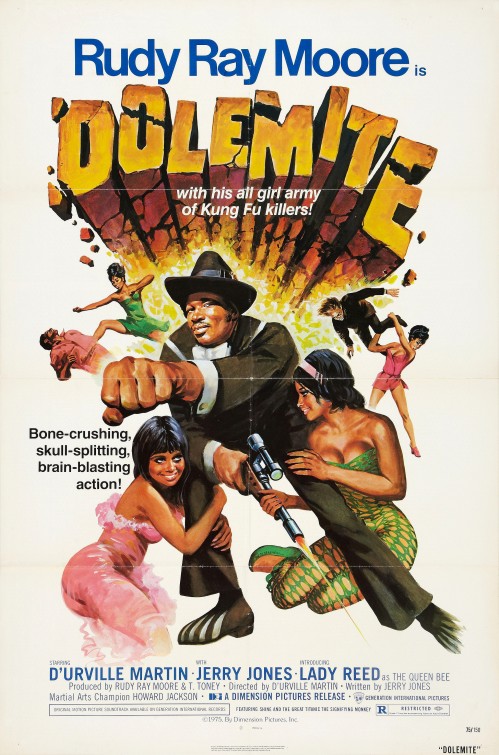
Dolemite

(USA 1975)

Dolemite (Rudy Ray Moore) is his name, and fuckin’ up mutha fuckas is his game!

He’s the baddest pimp around—well, around Los Angeles, anyway—and he looks every bit the part. Dolemite owns a nightclub and whorehouse but he’s doing time on a drug beef. Maybe it’s bogus, maybe not. Maybe some bad cops set him up, maybe it was archenemy Willie Green (D’Urville Martin), who took over the club and is running shit now. Either way, mother pimp Queen Bee (Lady Reed) and Dolemite’s army of ass-kickin’ kung fu hookers are none too happy about it.

To get out of the big house, Dolemite makes a deal with the po-po, Agent Blakeley (Jerry Jones), to, I think, help clean up his old hood. Dolemite uses this as an opportunity to exact revenge on Green and reclaim his, um, stature in the community.  Along the way, he kicks a lot of ass, takes on two crooked cokehead cops—Mitchell (John Kerry) and White—and gets laid. A lot. He even cuss raps at the end.

Dolemite is not a movie to see because it’s a work of art. On the contrary, it’s terrible. But that’s what makes it so much fun to watch—that’s why it’s a cult classic. Like a lot of things before the late ’80s, it’s not P.C. (i.e., politically correct)—as if that isn’t obvious from the movie poster. The directing by Martin, which probably explains why he has so little screen time, is sloppy. You can count the number of times boom mics pop in. The fight scenes are laughable—Dolemite knocks people out barely lifting a finger (or here,  leg) and sometimes without even touching them. Don’t even get me going on the martial arts stuff!

The plot is confusing and watered down. Jones wrote the screenplay with Moore, and the writing is just bad. I admit, I watched it drunk this time, but I’ve seen Dolemite before while sober. No difference. The events are scattered and at points seem random. The characters are colorful—shady Reverend Gibbs (West Gale), a possible parody of former Chicago leader Mayor Daley (Monte “Hy” Pike), the clearly trippin’ Hamburger Pimp (Vainus Rackstraw), and the many fox females—wander in and out, often without any reason.

Despite all that, Dolemite unquestionably has a charm of its own. Moore likes to rhyme, and he punctuates pretty much every sentence with “mutha FUCKA!” His crib is rent-to-own fabulous—check it out:

Dolemite set 2.jpg

Dolemite set 1.png

The wardrobe looks like it was borrowed from the Salvation Army. The climax at the nightclub goes on longer than it should but is still a showstopper. The soundtrack is a trip. If nothing else—and there is nothing else—Dolemite is a good time.

With Brenda DeLong, Terri Mosley, Marilyn Shaw, Lynell Smith, Vera Howard, Joy Martin, Jana Bisbing, Brenda Banks, Pat Haywood, René Van Clief, Pat Jones, Lola Mayo, Charlene Soulter, Liz Sample, Karolynn Hill, Dino Washington, Johnny J. Brown, Cardella Di Milo

Production: Comedian International Enterprise Productions (C.I.E.)

Distribution: Dimension Pictures, Xenon Pictures

90 minutes
Rated R

(DVD) C-

http://xenonpictures.com/wp/dolemite/

http://www.shockingimages.com/dolemite/films/dolemite.php

Night and the City

(UK/USA 1950)

“Harry is an artist without an art.”

—Adam Dunne

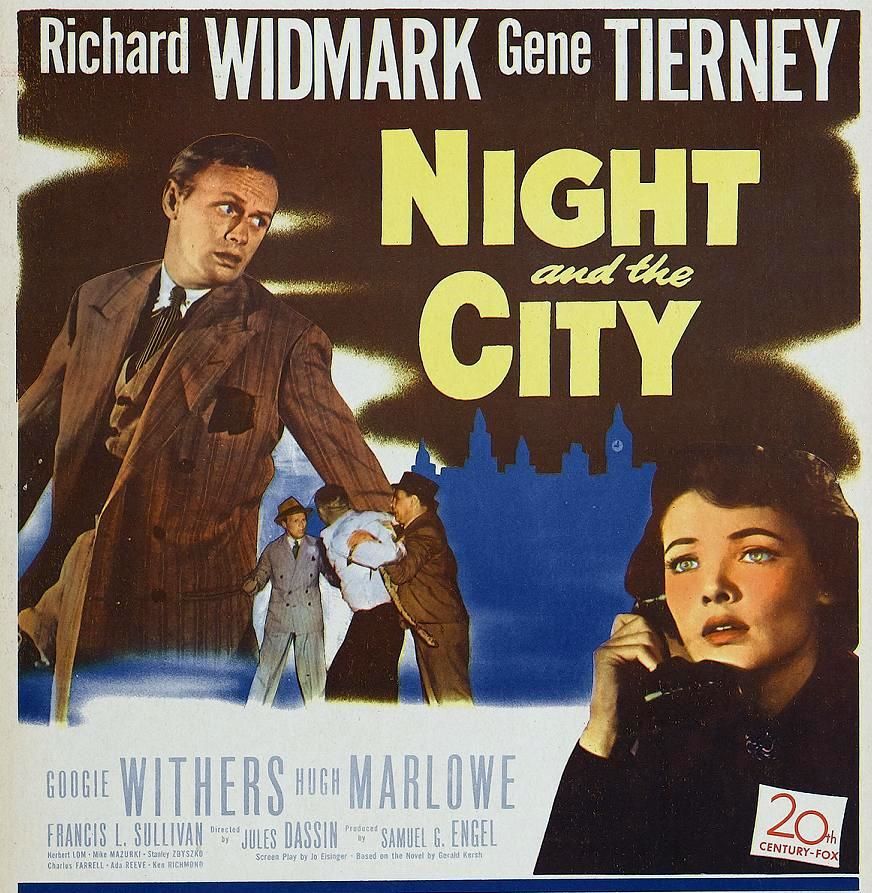
Jules Dassin’s Night and the City is a fine example of classic film noir. Filmed in smoky black and white mostly at nighttime on location in London, Dassin takes us slumming through the seedy underworld of nightlife, wrestling, and organized crime.

Harry Fabian (Richard Widmark) is a hard-bitten, ambitious, streetwise American con artist living in London. Always on the lookout for a quick buck, he can’t seem to catch a break. Ever. Literally running for his life in the opening scene, his latest career endeavor has failed, and his girl, Mary (Gene Tierney), is losing faith in him—stealing from her will do that.

Things brighten one night after a failed hustle at a wrestling match: Harry crosses paths with famous retired Greek wrestler Gregorius the Great (real life professional wrestler Stanislaus Zbyszko) and his prodigy, Nikolas of Athens (Ken Richmond), who both walk out of the arena in a huff. Gregorius is furious with his son, Kristo (Herbert Lom), who organized the fight, a low-end sort of WWE-like affair that he finds tacky.

Harry schmoozes Gregorius and learns that Kristo is a mobster who controls wrestling in all of London. He devises a plan to create a promotion startup, aligning himself with Gregorius to get around Kristo. He secures funding by double dealing with Phil Nosseross (Francis L. Sullivan), the owner of the Silver Fox Club where Mary works, and Phil’s wife, Helen (Googie Withers). She has plans of her own she doesn’t want Phil to know about.

The whole thing looks like it’s actually going to work despite Kristo’s threats, a plot to murder Harry, and Phil pulling his backing from the project. Harry gets so far as setting up a real fight between Nikolas and the Strangler (Mike Mazurki, also a real life professional wrestler). A miscalculation unravels everything—not just for him but everyone involved.

Jo Eisinger’s screenplay, based on Gerald Kersh’s novel Night and the City with contributions from Austin Dempster and William E. Watts, involves morally bankrupt lowlife characters who lack any redeeming qualities. All of them are scamming for one thing or another, and none of them—except maybe Mary—evokes any sympathy. This plays out nicely with the motifs of money, masculinity, and blind ambition that give this story its dark and bitter hue. It’s suspenseful. Ultimately, evil prevails in this dirty little story, which had to be revolutionary if jarring when this came out.

The backstory here is as interesting as the plot: during the production of Night and the City, Dassin was blacklisted for being a Communist. Pushed into exile, he infuses a strong sense of betrayal and fear into this film (https://en.wikipedia.org/wiki/Jules_Dassin).

Night and the City is desperate, chilly, and magnificently bleak—and it looks it thanks to Mutz Greenbaum’s shadowy and dramatic cinematography. Of the nitrate prints that screened this year, this was a standout. According to the festival program, this pre-release print is ten minutes longer than the UK version and 15 minutes longer than the US version.

With Hugh Marlowe, Ada Reeve, Charles Farrell, Edward Chapman, Betty Shale

Production: 20th Century Fox

Distribution: 20th Century Fox, Criterion

111 minutes (pre-release print)
Not rated

(Dryden Theatre) B

Nitrate Picture Show

https://www.criterion.com/films/933-night-and-the-city

Phantom of the Opera

(USA 1943)

I confess, I rolled my eyes when I found out that a print of Phantom of the Opera was chosen for a screening at the Nitrate Picture Show. I was totally unenthusiastic about seeing yet another version of something I’ve already seen more times than I care to admit. The trailer calls it “[a] story the world can never forget,” but that’s only because Gaston Leroux’s damned story won’t go away.

As it turns out, I quite enjoyed Arthur Lubin’s version. He switches gears with Eric Taylor and Samuel Hoffenstein’s screenplay, ditching horror in favor of romance and melodrama. In the process, he brings a really nice camp factor to the whole thing—I didn’t expect that. His version is a sillier, more fun soapy affair than what I’m used to.

Claude Rains is sympathetic as Erique Claudin, the downsized middle-aged composer who becomes the masked phantom after his publisher (Miles Mander) “steals” his new composition. One of my favorite moments of the entire film is the publisher’s exasperated secretary (Renee Carson) throwing acid from a baking pan in Claudin’s face. It’s so bizarre, it’s actually funny. Even with his acid face, Claudin has a crazy plan for making beautiful young soprano Christine Dubois (Susanna Foster) a star, even if she’ll never return his love. Her female rivalry with diva Biancarolli (Jane Farrar) stews while Anatole (Nelson Eddy), the baritone knight in shining armor, combs the Paris Opera House for the malformed monster (that would be Claudin) who murders anyone in his way. Things get dicier the closer Anatole gets to Claudin.

Phantom of the Opera is a treat for the senses, which makes it perfect for a nitrate print. A rich Technicolor dream, it won Oscars for cinematography (W. Howard Greene and Hal Mohr) and art direction (John B. Goodman, Alexander Golitzen, Russell A. Gausman, and Ira S. Webb) (https://www.oscars.org/oscars/ceremonies/1944). Edward Ward’s score is lovely.

With Edgar Barrier, Leo Carrillo, J. Edward Bromberg, Fritz Feld, Frank Puglia, Steven Geray, Barbara Everest, Hume Cronyn, Elvira Curci, Kate Lawson

Production: Universal Pictures

Distribution: Universal Pictures (USA), General Film Distributors (GFD) (UK), Motion Picture Export Association (MPEA) (Netherlands), Realart Pictures Inc. (USA), Universal Filmverleih (West Germany)

92 minutes
Not rated

(Dryden Theatre) B-

Nitrate Picture Show

Anchors Aweigh

(USA 1945)

“What a time we had tonight, mmm!” In his 1945 New York Times review, Bosley Crowther called Anchors Aweigh a “Gay Musical Film” (http://www.nytimes.com/movie/review?res=9F0DE3DC103BEE3BBC4851DFB166838E659EDE). Well, duh!

I doubt Crowther meant “gay” in the current sense of the word, but he certainly wasn’t wrong either way: between all the singing, dancing, handsome sailors in tight pants, and a very young and wide-eyed Frank Sinatra acting out a creepy attachment to Gene Kelly, the only thing that could make Anchors Aweigh any gayer would be an appearance by Judy Garland. Or a raunchy sex scene with all those sailors and the admiral who, in one number (“We Hate to Leave”), said he would beat them with a whip. I half expected and kinda wanted it to happen, but of course it didn’t. Oh well.

As a reward for their bravery, Navy seamen Joe Brady (Kelly) and Clarence Doolittle (Sinatra) are given a four-day leave in Hollywood. Joe plans to hook up with his dame, Lola. After stalking him on the streets of Los Angeles, sweet and naive ex choir boy Clarence asks the apparently more experienced Joe to teach him how to meet girls.

Enter Donald (Dean Stockwell, whom most of us know as a middle-aged man from his many ’80s and ’90s movies), a little tyke who’s running away from home to join the navy. Our boys take him home, where Donald lives with his Aunt Susie (Kathryn Grayson), a nice girl trying to get into the movie industry—if only she could catch a break. Clarence immediately falls head over heels and enlists Joe’s assistance in wooing her, which provides the story here.

Even though (and probably because) the characters, plot, and dialogue are totally corny, Anchors Aweigh is truly a frothy blast—it’s exactly the kind of film that comes to mind when I think of classic Hollywood. A vivacious affair, director George Sidney keeps everything about it big: the sets, the songs, the dance numbers. I was particularly taken by one sequence involving Kelly and various animated figures—it culminates in an awesome song-and-dance with none other than Jerry Mouse of Tom and Jerry cartoons. Flawless!

The whole spectacle is tied up in an amazing Technicolor bow; Charles Boyle and Robert Planck’s color palette is gorgeous, and seeing it on a nitrate print literally left me breathless. From a sensory perspective, Anchors Aweigh was hands down my favorite film at this year’s Nitrate Picture Show.

As a side note, I must confess that one thing threw me for a loop: Kelly and Sinatra (and Grayson, for that matter) are young and beautiful here—not the old timers I’m accustomed to seeing having grown up when I did. They’re actually hot, even by today’s standards. Kelly upstages Sinatra throughout the entire film, which I found bizarre and quite amusing.

With José Iturbi, Pamela Britton, Grady Sutton, Rags Ragland, Billy Gilbert, William Forrest

Production: Metro-Goldwyn-Mayer

Distribution: Metro-Goldwyn-Mayer

143 minutes
Not rated

(Dryden Theatre) A-

Nitrate Picture Show

Bakushū [Early Summer]

(Japan 1951)

After a presentation of shorts, the George Eastman Museum kicked off its third annual Nitrate Picture Show with a Japanese drama, Yasujirō Ozu’s quiet and gracefully understated Bakushū [麦秋]. In the context of midcentury Japan, Ozu explores the generational clash between tradition and progress, and both the possibilities and the casualties brought on by the latter. Opening with something that deals with changing values was an interesting choice on multiple levels.

Noriko (Setsuko Hara) lives in postwar Tokyo with her parents, Shūkichi (Ichirō Sugai) and Shige (Chieko Higashiyama); her older brother, physician Kōichi (Chishū Ryū); his wife, Fumiko (Kuniko Miyake); and their two unruly young sons, Minoru (Zen Murase) and Isamu (Isao Shirosawa). Noriko earns her own living as a secretary and contributes to the household, maintaining her own active social life. She seems happy, or at least content. Still, her more conventional family is concerned because she’s 28 years old and still isn’t married.

Noriko is a good sport about her family members’ not-so-subtle reminders, but the heat intensifies when an elderly uncle (Kokuten Kōdō) stays for a visit. Her chauvinistic boss (Shūji Sano) plays matchmaker, introducing her to Mr. Matanabe, a business associate in his 40s (all of his interactions occur off camera, so we never see him). He proposes. Naturally, Noriko’s family pushes her to accept his offer, which she considers even though the prospect doesn’t excite her.

Enter childhood friend, Kenkichi (Hiroshi Nihon’yanagi), who returns to the neighborhood with his daughter. He’s a widow in between job assignments. Noriko suddenly develops her own idea about which path she wants to take, much to the dismay of her family.

Bakushū is not a kinetic film—it’s slow, and the action centers on mundane routine activities like preparing meals, eating, conversing, working, and getting ready for bed. Some of the plot’s significant events aren’t even shown. Ozu favors low angles and wide, distant shots. He keeps the camera pretty still. He doesn’t use a lot of sets. On top of that, it takes some effort to keep track of the many characters.

Admittedly, I found myself zoning out at the beginning. Once I settled into Ozu’s rhythm, though, I got more interested in Bakushū. Some of the plot elements make the story seem slightly ahead of its time, but the core themes are universal. This is a family drama; the family unit ultimately falls apart, but it’s not necessarily a bad thing. The family portrait at the end closes things on a bittersweet note. I sensed more than a nod to the burgeoning westernization of Japanese society.

Bakushū fits nicely into the midcentury films I’ve developed a taste for. I never heard of it or Ozu, but I’ve already looked him up. I’m interested in seeing more of his work. As for this print, it was in all likelihood the very first feature film I’ve ever seen on nitrate (we’re not counting the shorts). The picture was crisp, but I must confess: its quality didn’t wow me like some others I saw after this.

With Chikage Awashima, Kuniko Igawa, Haruko Sugimura, Seiji Miyaguchi

Production: Takeshi Yamamoto

Distribution: Shochiku Company Limited, The Voyager Company (USA), Janus Films (USA)

124 minutes
Not rated

(Dryden Theatre) B-

Nitrate Picture Show

https://youtu.be/iHhTSRUsGrM

Blue Velvet

(USA 1986)

Who hasn’t seen Blue Velvet? Even though David Lynch was already established by the time it came out, it’s the film that introduced me to him. I saw it once or twice in late high school or early college, definitely on VHS. The River’s Edge was the only comparison I had, and that was a weird film but…not on the same level. I found Blue Velvet totally watchable because it’s very dark, very sexual, very fucking weird, and very voyeuristic.

That was then, this is now: Blue Velvet is still all of those things, but I don’t remember it having the sense of humor it does. It’s curiously funny. It marks the start of Lynch’s style as we know it: not just surreal (he had already done Eraserhead), but macabre and perverted underneath the innocuous and mundane premise. Lynch sets up his narrative in pieces that refer back and forth, like a moving puzzle. It’s brilliant, and it’s a formula that’s served him well.

Blue Velvet starts with a severed ear on the ground, bugs crawling all over it. A local college kid turned stalker (Kyle MacLachlan) proves a bit too curious when his minor obsession with a night club singer (Isabella Rossellini) leads him into a sadomasochistic nightmare that neither he nor we viewers can turn away from. The whole bizarre and sordid story goes full circle back to where it started: that ear. 

Dennis Hopper as Frank, the gas-huffing sociopath who ends every sentence with the F-word, colors the mood here. None of it would work, though, without Rossellini’s vulnerability, which is crucial. 

Lynch considered Molly Ringwald instead of Laura Dern and Val Kilmer instead of MacLachlan. Thank goodness it happened how it did; what a different film Blue Velvet would have been. For a movie that relies so heavily on nuance, that could’ve ruined Lynch’s career. It didn’t. 

With Hope Lange, Dean Stockwell, George Dickerson, Priscilla Pointer, Frances Bay, Jack Harvey, Ken Stovitz, Brad Dourif, Jack Nance, J. Michael Hunter, Dick Green, Fred Pickler, Philip Markert, Leonard Watkins, Moses Gibson, Selden Smith, Peter Carew, Jon Jon Snipes, Angelo Badalamenti, Jean Pierre Viale, Donald Moore, A. Michelle Depland, Michelle Sasse, Katie Reid, Sparky

Production: De Laurentiis Entertainment Group

Distribution: De Laurentiis Entertainment Group, 20th Century Fox (UK), Transmundo Films (Argentina), AMLF (France), Concorde Film (Netherlands), Concorde Filmverleih (West Germany), Finnkino (Finland), Hoyts Distribution (Australia), Shochiku-Fuji Company (Japan)

120 minutes
Rated R

(Music Box) B+

David Lynch: A Complete Retrospective