Manami (Tomite Ami) is a nice girl who shares a tiny apartment with her boyfriend (Saito Takumi) in Tokyo. Just after she arrives for dinner with her friends on the evening of her 22nd birthday, a crazy gun-toting assassin (Shoko Nakagawa) in a fuzzy pink mink shows up and takes out everyone in the restaurant — except Manami, whom she came to kidnap.
Manami flees, only to be picked up by another kidnapper, the mysterious K (Kaho). K in not so may words explains that Manami is a pawn in a war between two vampire clans, the Draculas and the Corvins, who have been enemies for centuries. Unbeknownst to Manami, she’s the target of a worldwide vampire hunt. K takes her to the glamorous Tokyo Vampire Hotel, which is run by a creepy geisha empress (Adachi Yumi) who needs blood.
The end of civilization is coming, but the empress has a plan: use the hotel to trap a healthy supply of humans to serve as food. Things don’t pan out as planned when the humans figure out what’s happening and the Draculas show up to crash the party.
This photo sums up what you’re getting into here:
Tokyo Vampire Hotel is quirky, sexy, lavish, and fun. Sono serves up an imaginative feast of dazzling eye candy and nonstop action. His use of Christian symbols adds a nice touch. The sets are fantastic, and the action moves from the streets of Tokyo at night to inside the hotel to Bran Castle in Transylvania, and back. The editing works to make nine episodes flow seamlessly into a feature length film. However, the story wears thin after a little while, and it can’t sustain the interest I started out with. The gore gets old, too. The length, nearly two and a half hours, is a problem. It demonstrates why Tokyo Vampire Hotel is probably better in smaller doses.
“That’s my sister, baby. And she’s a whole lot of woman.”
— Link
“Death is too easy for you, bitch. I want you to suffer.”
— Foxy
To use a term straight from Willie Hutch’s theme song, director/screenwriter Jack Hill’s Foxy Brown is superbad. It’s definitely not something to see for technical or artistic excellence, but it’s cool nonetheless. A sort of reworking of Coffey, it’s a sexy vigilante revenge tale that doesn’t take itself too seriously.
Pam Grier is Foxy Brown, a bodacious woman on a mission to track down the goons who shot and killed her boyfriend (Terry Carter), a government agent who just had plastic surgery to change his identity, right outside her door. Obviously, this is the work of a Los Angeles drug ring.
Foxy quickly figures out who the rat is: her own brother, Link (Antonio Fargas). He identifies her boyfriend’s killers as affiliates of a “modeling agency.” The agency is run by fixers Miss Kathryn Wall (Kathryn Loder) and Steve Elias (Peter Brown). Their clients are crooked high profile men of the law like judges and politicians who trade favors for girls.
Posing as a prostitute, Foxy gets inside the operation and does some major damage. It gets her in serious hot water when she’s exposed, bringing her into the center of a lesbian bar brawl and then onto a coke ranch as a junky sex slave. Fortunately, she’s tough and resourceful. No one gets the best of Foxy.
Built on sex parties, chase scenes, shoot outs, and boobs, the plot is structured like a sitcom, and it’s about as complicated and predictable. Naturally, Foxy gets what she wants in the end. Except for the very cool opening titles, there are no effects to speak of. The acting is average at best. However, the action is surprisingly steady, leaving very few dull spots. Plus, there’s real sas here, mostly from Grier, that keeps the whole thing interesting.
I wouldn’t go so far as to call Foxy Brown a feminist work, but Foxy is a badass heroine with her heart — and her head — in the right place. It’s a thrill watching her take control, especially in heels and those fabulous frocks. I wouldn’t want to piss her off.
With Harry Holcombe, Sid Haig, Juanita Brown, Sally Ann Stroud, Bob Minor, Tony Giorgio, Fred Lerner, Judy Cassmore, H.B. Haggerty, Boyd ‘Red’ Morgan, Jack Bernardi, Brenda Venus, Kimberly Hyde, Jon Cedar, Ed Knight, Esther Sutherland, Mary Foran, Jeannie Epper, Stephanie Epper, Peaches Jones, Helen Boll, Conrad Bachmann, Russ Grieve, Rodney Grier, Roydon E. Clark, Don Gazzaniga, Jay Fletcher, Gary Wright, Fred Murphy, Edward Cross, Larry Kinley Jr.
Production: American International Pictures (AIP)
Distribution: American International Pictures (AIP) (USA), Sociedade Importadora de Filmes (SIF) (Portugal), Film AB Corona (Sweden), Cinema Mondo (Finland)
“Relax. Your daughter’s perfectly fine in my hands.”
— Moonee
Sean Baker’s Tangerine (https://moviebloke.com/2015/07/28/tangerine/) impressed me. On the surface an offbeat odyssey of castoffs living on the fringe in West Hollywood, it’s one of those films that creeps up and hits you at the end. Comprised largely of small moments and vignettes strung together, its sum is much more — and completely different — than its parts: insightful, powerful, and quietly profound.
I was thrilled to hear that Baker has a new film, The Florida Project, out this fall. The comments I overheard from audience members while walking out of a prerelease screening were amusing but maddening: “That was realism, hard realism. Too hard.” “Well, that didn’t go anywhere.” “I had to force myself to stay awake.” “I wouldn’t recommend that to anyone.” Insert eyeroll here.
I disagree. The Florida Project switches gears, so it doesn’t end up where it seems to be going. The trailer makes it look like a childhood nostalgia movie, and it starts out like one. But it’s not. Often amusing but just as often difficult to watch, it paints a vivid picture that doesn’t criticize, demean, or sentimentalize its characters or their situation. I’ve heard Baker lauded for his humanism; his work definitely shows plenty of that if nothing else. His best attribute may be his willingness to let his characters develop into real people over the course of two hours or so.
To be clear, the impact of The Florida Project is not immediate. Baker’s pace isn’t quick, either. Written by Baker and Chris Bergoch, The Florida Project starts out as a sort of Little Rascals sitcom involving the misadventures of besties Moonee (Brooklynn Prince) and Scooty (Christopher Rivera), two grade school kids growing up in a sketchy roadside motel, the Magic Castle, that sits along a tawdry strip just outside the Magic Kingdon — a.k.a. Disney World in Orlando. A gun shop, a convenience store, a market that sells oranges, and a boarded up clinic dot the strip, which incidentally intersects with Seven Dwarves Lane.
Moonee and Scooty spend their days running around, screaming, and stirring up mischief. They spit all over a motel guest’s car. They drop water balloons on people. They spy on an elderly topless sunbather (Sandy Kane). They scam change to buy ice cream. They set a fire. They recruit a third hellion, Jancey (Valeria Cotto), who lives next door and easily goes along with their antics probably because there’s no one else to play with. Their favorite target is weary motel manager Bobby (Willem Dafoe).
Slowly, a different picture emerges and The Florida Project becomes another film. Moonee’s mother, Halley (Bria Vinaite), can’t get it together. Feral and clearly her own worst enemy, she lives hand to mouth with her young daughter. She’s constantly about to be evicted, and she takes free meals wherever she can get them. When selling stolen amusement park passes and wholesale perfume in the parking lot of a “nicer” motel up the street doesn’t work, she turns tricks in the room.
After Halley has a falling out with Scooty’s mom, Ashley (Mela Murder), Baker literally zooms in on Moonee.
The events here are purposely mundane, and it’s hard to say exactly where the climax is. It doesn’t matter: The Florida Project works because of the way Baker executes the story. He’s just as careful about choosing what he shows as what he doesn’t. The thrill here is watching the characters develop, anyway; that’s what makes The Florida Project soar. It doesn’t hurt that the acting is superb, particularly Vinaite, Prince (who at six years old is a natural — I almost cried when she did), and Dafoe, whom I haven’t seen this good since Mississippi Burning.
Alexis Zabe’s cinematography — alternating long shots and pans with almost uncomfortably close shots — works beautifully with the gorgeously effervescent color palette. The ending is unexpectedly touching and fun. The Florida Project just might be the first Oscar contender I’ve seen this year.
With Josie Olivo, Aiden Malik, Caleb Landry Jones, Shail Kamini Ramcharan, Sonya McCarter, Karren Karagulian, Kelly Fitzgerald, Lauren O’Quinn, Edward Pagan, Cecilia Quinan, Kit Sullivan, Andrew Romano
Production: Cre Film, Freestyle Picture Company, June Pictures, Sweet Tomato Films
Distribution: A24 (USA), Altitude Film Distribution (UK), Elevation Pictures (Canada), Filmcoopi Zürich (Switzerland), September Film (Netherlands), Front Row Filmed Entertainment (United Arab Emirates)
Funeral Parade of Roses [薔薇の葬列] is an intriguing film for a few reasons. Clearly influenced by the French New Wave, writer and director Toshio Matsumoto comes up with something simultaneously ordinary yet avant-garde, very much a product of its time yet years ahead. It’s extraordinarily cool.
Structured as a movie within a movie, Funeral Parade of Roses follows Tokyo “gay boy” Eddie (Pîtâ a.k.a. Peter) through his many exploits as a young transvestite immersed in the underground club scene. He might even be a hooker. Meanwhile, he’s carrying on a secret affair with Jimi (Yoshimi Jô), the boyfriend of club elder statesperson and fellow gay boy Leda (Osamu Ogasawara). Leda is onto them. Oh, the drama it creates!
While all this is going on, a camera crew records Eddie as though this were The Real World or Truth or Dare.
As Eddie ponders who he is — and looks to alcohol, group sex, drugs, and lots of attention from others for answers — Matsumoto explores “queer identity” through him. He intersperses interviews, flashbacks, episodes with Eddie’s mother (Emiko Azuma), and even a musical diversion or two to offer clues. A crazy subplot develops, and it references Oedipus in a tacky and sad but clever way.
Clumsy in its exploration of “gay life” and downright disturbing at points, Funeral Parade of Roses is nonetheless fun to watch. Shot in gorgeous black and white, it has an otherworldly feel. When it’s not nihilistic, it’s kitschy and entertaining — almost in a nascent John Waters way, just not quite as rough. The clothes are mod. The music is heavy on classical. The ending, sudden and bloody, is really messed up.
I’m not sure what exactly Matsumoto is saying here — a lot is open to interpretation — or that I agree with him. Either way, I enjoyed the journey.
“Oh, Madonna! This nightmare is finally over. God, do I want some coffee. Fresh, of course.”
— Raffaella Pavone Lanzetti
More than 40 years after the fact, Lina Wertmüller is still an audacious filmmaker. Not only does she incorporate sociopolitical commentary, satire, and crazy sex into her work, but her ’70s films are inherently interesting because they push buttons. She’s the first female nominated for an Oscar for Best Director, and there’s a reason for that: she’s a radical with more balls than just about anyone else working, even today.
Case in point: Swept Away…by an Unusual Destiny in the Blue Sea of August [Travolti da un insolito destino nell’azzurro mare d’agosto] — or simply Swept Away for short — is not a standard comedy. The plot is simple: an insufferable rich bitch, Raffaella (Mariangela Melato), is vacationing in the Mediterranean with her millionare husband (Riccardo Salvino) and their friends on a yacht. Raffaella is thoughtless and demanding, and she relentlessly berates rugged deckhand Gennarino Carunchio (Giancarlo Giannini) because the coffee isn’t fresh, the fish doesn’t taste right, and the pasta isn’t al dente enough.
She insists that Gennarino take her swimming. The two end up stranded in the water, far from the yacht. They eventually spot land, which turns out to be a small uninhabited island. Gennarino, a fisher, has no trouble finding food or shelter. Raffaella isn’t used to doing things herself, and soon finds that she is dependent on Gennarino. He isn’t exactly gracious about his new upper hand. It isn’t long before their relationship takes a sexual turn.
Wertmüller, who wrote the screenplay as well as directed, plays on traditional notions of sex roles. By today’s standards, Swept Away is probably too violent to come off as funny. The many scenes where Gennarino slaps and physically pummels Raffaella are bad enough, but when he rapes her on the beach? It’s disturbing. How is that funny? That’s the point — at first, anyway.
Swept Away isn’t really about sex: it’s about power. Here, the power dynamic shifts once Raffaella and Gennarino are out of the “civilized” world and lost in the wild, where economics and social status no longer define one’s place. Like all of her early films, Wertmüller has a lot to say about class structure; here, she also has a lot to say about male/female relationships. She’s controversial, but her approach works really well. It helps that Melato and Giannini, who starred in earlier films together, have a believable chemistry — and they spend a bit of time here wearing very little.
Swept Away is not a typical film. I call it a comedy, but it doesn’t fit neatly into any category. It’s sharp, subversive, and still pretty potent.
With Isa Danieli, Aldo Puglisi, Anna Melita, Giuseppe Durini, Lucrezia De Domizio, Luis Suárez, Vittorio Fanfoni, Lorenzo Piani, Eros Pagni
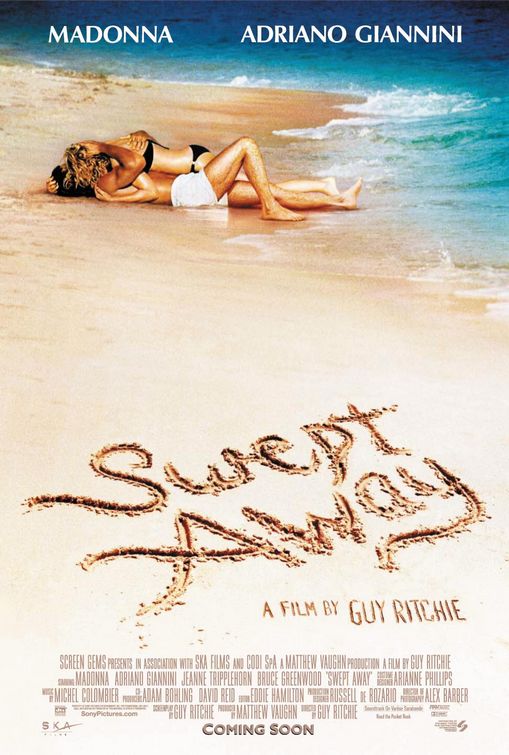
Guy Ritchie’s remake of Lina Wertmüller’s Swept Away, a film that looks like it would be Blue Lagoon but is far from it, was universally panned when it came out. I never saw it, and probably never would have bothered but for my recent discovery of Wertmüller’s work. A two-hour flight from Chicago to New York City and back seemed like the perfect time to get both of them out of the way.
I planned to watch Wertmüller’s original first because…well, that makes sense. Unfortunately, I didn’t start it early enough — the original is 25 minutes longer, and by the time I pulled out my iPad I didn’t have enough time for it. So, I had to settle for backward and watch Ritchie’s version first.
He sticks pretty close to the storyline of the original. Initially, I found Swept Away kind of boring but not offensively awful. Only after seeing Wertmüller’s version did it become painfully clear how lame this remake is; it’s utterly impotent by comparison.
Ritchie retains the critical plot elements of class tension and anticapitalist sentiment that color much of Wertmüller’s work, but here they don’t read the same way; they’re off. Trite, even. Ritchie injects dribs and drabs of his loutish brand of humor into his version, and I found that to be a plus. However, he turns Swept Away into a flaccid, neutered romantic dramedy that the original is not. His version is kinder, gentler, and softer. It has no edge to it whatsoever, which is unusual for him. Yawn.
Stiff and hollow, Madonna’s acting is par for the course. Her character, Amber, is suited to her image. She could’ve had fun with the role. Too bad she seriously overdoes the rich bitch bit and comes off as nasty, hateful, and angry. Not fun. Adriano Giannini, the son of Giancarlo Giannini who played the same role in the original, is nice to look at. That’s it, though; his character, Giuseppe, or as Amber calls him “Pee Pee,” is a turnoff — what a wimp!
The most interesting thing about Swept Away is that David Thornton, Cyndi Lauper’s husband, has a fairly substantial part. I wonder if that was awkward?
With Bruce Greenwood, Elizabeth Banks, Michael Beattie, Jeanne Tripplehorn, Yorgo Voyagis, Ricardo Perna, George Yiasoumi, Beatrice Luzzi, Lorenzo Ciompi, Patrizio Rispo, Francis Pardeilhan, Rosa Pianeta, Andrea Ragatzu
Production: CODI SpA, Ska Films
Distribution: Screen Gems (USA), Columbia TriStar Films (UK), Medusa Distribuzione (Italy)
I’m guessing that a large number of people recognize a particular still from A Trip to the Moon — the one of the “spaceship” lodged into the moon’s “eye” like a bullet. I’m also guessing that a large number of people have never seen the film. I was one of them — until this afternoon.
Written and directed by French film pioneer Georges Méliès, A Trip to the Moon is a lot cooler than I expected. Imaginative and surprisingly sophisticated, it’s downright cinematic in the way it approaches its subject matter and tells its story. Méliès demonstrates far greater artistic and dramatic flair than his American contemporaries, at least from what I’ve seen.
In a Medieval chamber, a wise old astronomer (Méliès) proposes traveling to the moon, only to be scoffed at by his colleagues (Victor André, Brunnet, Henri Delannoy, Depierre, Farjaut, Kelm). Undeterred, he shows them how it will work. Soon, they’re heading for outer space in a vessel that looks like a big bullet fired with a cannon from the rooftops of Paris.
The astronomers land on the moon and deboard their “space bullet” — no need for space suits, of course. They set up camp. As they sleep, celestial bodies like a comet, the Big Dipper, and Saturn all appear in the night sky. A moon goddess (Bleuette Bernon) makes it snow. They awake and encounter huge mushrooms and insect-like aliens — played by acrobats in tights and a mask — that explode on impact. A mob of aliens captures them and takes them to the leader. The astronomers escape and flee to their capsule, aliens pursuing them. Will they get back to Earth safely?
I found A Trip to the Moon charming. It’s got a nifty surreal Alice in Wonderland meets 20,000 Leagues Under the Sea vibe. It’s theatrical and visually stunning, especially the hand tinted color — yes, color — version. The attention to detail is, in a word, heavenly.
Méliès was a wealthy Paris shoemaker who longed to be an artist. He ultimately sold his share of the family business to his brothers and bought a theater, where he performed magic shows (https://en.wikipedia.org/wiki/Georges_Méliès). A demonstration of a cinematograph, a combination camera/projector/printer (https://en.wikipedia.org/wiki/Cinematograph), in 1895 sparked his interest in film. He’s considered a sci-fi groundbreaker.
With Jeanne d’Alcy, François Lallement, Jules-Eugène Legris
Production: Star Film Company
Distribution: Star Film Company (France), American Mutoscope & Biograph (USA), Edison Manufacturing Company (USA), S. Lubin (USA), Kleine Optical Company (USA), Niels Le Tort (Sweden), The Royal Wonder Bio (Slovenia)
“If I ever see a hat on a bed in this house, man, like you’ll never see me again. I’m gone.”
“Show time!”
“Well, to begin with, nobody, and I mean nobody, can talk a junkie out of using. You can talk to ’em for years but sooner or later they’re gonna get ahold of something. Maybe it’s not dope. Maybe it’s booze, maybe it’s glue, maybe it’s gasoline. Maybe it’s a gunshot to the head. But something. Something to relieve the pressures of their everyday life, like having to tie their shoes.”
— Bob Hughes
“Narcotics have been systematically scapegoated and demonized. The idea that anyone can use drugs and escape a horrible fate is anathema to these idiots. I predict in the near future right-wingers will use drug hysteria as a pretext to set up an international police apparatus.”
— Fr. Murphy
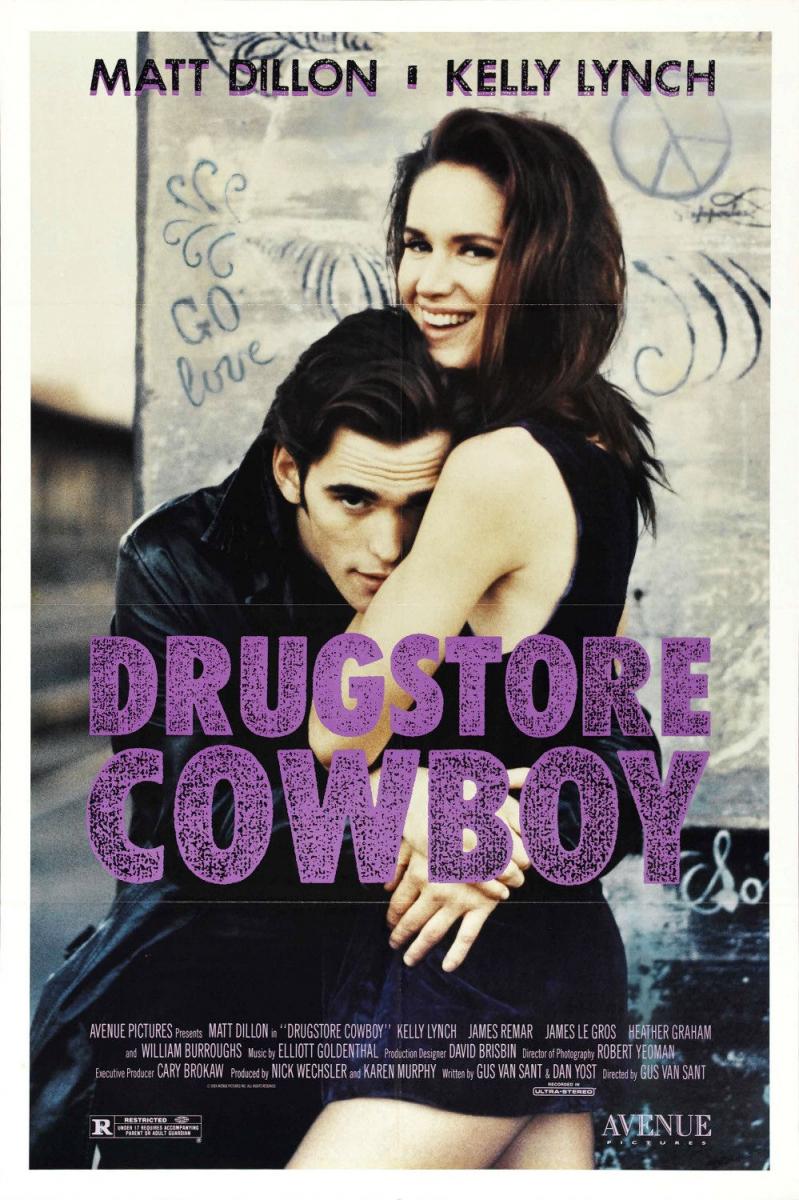
I love everything about Drugstore Cowboy, the first film I ever saw by director Gus Van Sant. It’s the one that I view as his gold standard even after nearly 30 years. Funny, touching, and insightful in ways that have to be seen, it speaks to me. It probably always will. It’s a rare film that has it all: flawlessly executed from start to finish, it’s totally absorbing and entertaining yet still makes its points in a way that hits hard even after seeing it dozens of times.
Bad Bobby Hughes (Matt Dillon) — or just “Bob” — is the first one to tell you he’s a junkie. He and his wife, Dianne (Kelly Lynch), lead a small nomadic “crew” that consists of Rick (James LeGros) and his young girlfriend, Nadine (Heather Graham). The four of them spend their days getting high and devising elaborate — and amusing — schemes to rob drugs from pharmacies and hospitals. Then they go out and execute their mission.
Once they’ve made a score, they do the drugs they like, sell the ones they don’t, hang out doing little more than watching TV, and move onto another neighborhood somewhere else in Portland, Oregon, when they’ve either run out or overstayed their welcome, whichever comes first.
They’ve repeated the cycle so many times that cocky Detective Gentry (James Remar) and his men are on their trail. Bob manages to stay a step ahead, but it’s getting tougher. He sees that his luck is running out — and it’s not just because of the hex that Nadine inadvertently put on them by mentioning a dog (one thing about Bob: he’s a bit superstitious).
To outrun one such hex — and more realistically, because Bob runs out of ideas and doesn’t know what to do next — they hit the road, stuffing their drug stash in suitcases, shipping them on Greyhound buses, and following them by car. A string of bad luck and bad outcomes presents Bob with an epiphany — and a choice.
With both humor and compassion, Van Sant — and for his part, Dillon — tells a moving and curiously relatable story about people who aren’t necessarily bad, but they’ve allowed their lives to drift away from them. Here, it’s for drugs. They don’t always do the right thing, and often the members of this little family of outcasts are each other’s worst enemies. But they’re realistic. Dillon makes Bob so likable that I find myself rooting for him even when he’s making bad choices; despite his flaws, I like him enough that I can see myself having fun with him.
Drugstore Cowboy easily could’ve been a very different movie. It works because it’s not preachy or judgmental or hyperbolic. Based on a novel by real-life criminal and addict James Fogle (https://en.m.wikipedia.org/wiki/James_Fogle), Van Sant and Daniel Yost’s screenplay eschews melodrama for a decidedly objective and almost clinical approach, showing the joys of drugs in some visually well constructed sequences as well as the cost of addiction. The film does an excellent job showing how much work it is to maintain a habit. Throughout the movie, Dillon’s narration keeps the story grounded. Van Sant never sells out his characters’ humanity.
It doesn’t hurt that this film is loaded with spectacular performances all around, including those of Grace Zabriskie as Bob’s battleworn mother and William S. Burroughs as disgraced priest and fellow addict Fr. Tom Murphy. Robert Yeoman’s cinematography gives Drugstore Cowboy a drab, threadbare look that works well with Elliot Goldenthal’s moody score. Every element comes together to make this a truly remarkable film, definitely one of my favorites.
With Max Perlich, George Catalano, Janet Baumhover, Stephen Rutledge, Beah Richards, Robert Lee Pitchlynn, Ray Monge, Woody
Production: Avenue Pictures
Distribution: Avenue Pictures Productions (USA), Astral Films (Canada), Forum Distribution (France), Sandrew Film & Teater (Sweden), GAGA Communications (Japan)
Director Patty Jenkins aims to do for Wonder Woman what Christopher Nolan—and I suppose to a lesser degree Tim Burton—did for Batman: take an iconic comic book superhero that got campy over the years and return it to its darker roots, producing something dramatic, perhaps weightier, and far more artful. Jenkins doesn’t entirely pull it off with Wonder Woman, but she’s on the right track. I see a sequel or two in the near future, so she’s got time to get there.
To Jenkins’s credit, Wonder Woman is not what I expected. Aside from a nod or two—and that goddamned tiara—all the cut-rate kitsch of the ’70s TV series is gone. This Wonder Woman means business even if she’s still, shall we say, absurd.
Jenkins goes back to the beginning: young Diana (Lilly Aspell and Emily Carey) lives on Themyscira, a hidden island inhabited by war-ready buff goddesses. Queen Hippolyta (Connie Nielsen), Diana’s mother, shields her from the strident ways of her subjects. It all has to do with an old score Ares (David Thewlis) seeks to settle—yes, that Ares, the son of Zeus and the god of war. General Antiope (Robin Wright), Hippolyta’s sister and Diana’s aunt/mentor, isn’t having it: she recognizes Diana’s potential and trains her on the sly. Diana blossoms into a beautiful woman (Gal Gadot) with serious supernatural power.
Diana stumbles upon Steve Trevor (Chris Pine), a drowning American pilot whose plane crashes off the coast of Themyscira. She rescues him, unwittingly exposing the island to an invasion by German forces. Persuaded by the awesome power of Diana’s Lasso of Hestia, Steve confesses that he’s a spy in the “war to end all wars”—World War I. Spider-sensing Ares is behind it, Diana embarks with Steve on a mission filled with romance, adventure, and espionage in an effort to track down the god and stop the madness.
Wonder Woman starts out all Xena: Warrior Princess, silly and weird in a geeky softcore straight guy “lesbian porn” way that no doubt would appeal to the likes of Wayne and Garth. Thankfully, it moves in another direction once Pine shows up about 40 minutes in. I found myself enjoying Wonder Woman more as the story got to Europe—that storyline is more believable even if it too is silly. The battle scenes are decent with some Hollywood excess and humor thrown in. I love how the theme of gender equality is the star of every scene—neither subtle nor heavy-handed, it’s simply a given.
For all its perks, Wonder Woman is ultimately a typical blockbuster that emphasizes form over substance. If nothing else, it surprises, which is always a plus. Frankly, though, I could’ve kept going completely oblivious to the fact that Wonder Woman is more than Lynda Carter. She was more a lot more fun.
With Danny Huston, Saïd Taghmaoui, Ewen Bremner, Eugene Brave Rock, Lucy Davis, Elena Anaya, Doutzen Kroes
Production: DC Entertainment, Atlas Entertainment, Cruel & Unusual Films, Rat-Pac Dune Entertainment LLC, Tencent Pictures, Wanda Pictures
Distribution: Warner Brothers, Karo Premiere (Russia), NOS Audiovisuais (Portugal), Roadshow Entertainment (New Zealand), Roadshow Films (Australia), SF Studios (Norway), Tanweer Alliances (Greece)
Bong Joon-ho’s Okja, now streaming on Netflix, is a lot of things; dull is not one of them. A slick, fast-paced, mesmerizing mix of fantasy, sci-fi, comedy, action, satire, and social consciousness, this film has a lot going on—and a lot going for it. I was lucky to see it on the big screen before its official release, and that’s how I recommend seeing it if you can. Sorry, Netflix, Okja is simply too good for TV.
The story begins ten years ago in 2007: in a desperate but brilliant attempt to rebrand a disreputable family business—to make a silk purse out of a sow’s ear, so to speak—Lucy Mirando (Tilda Swinton) announces her master plan to breed an all-natural “superpig” that leaves a minimal footprint, feeds the world, and tastes great (https://superpigproject.com). Her company, Mirando Corporation, devises a competition, sending twenty-some piglets to real farmers across the globe to raise them; the company will monitor each pig over the next ten years and declare a “winner” based on the results. Mirando hires animal television show host Dr. Johnny Wilcox (Jake Gyllenhaal), a zoologist whose star is fading, to lend credibility to the project as well as to generate public interest in it.
Fast forward to 2017: Mirando’s plan is coming to fruition without any hiccups, which makes her happier than a pig in…well, you know. Unfortunately for Mirando, a young South Korean girl named Mija (Ahn Seo-hyun), whose grandfather (Byun Hee-bong) signed onto the project, threatens to derail the entire mission. Mija, you see, essentially raised her grandfather’s pig, Okja. They’ve become dependent on each other. He never explained to her what the deal really is—that Mirando’s silk purse is nothing more than lipstick on a pig.
Dr. Johnny and his television crew show up at their home in the mountains and marvel over Okja, now a magnificently enormous hippopotamus-like creature. He presents her grandfather with an award and takes Okja to Manhattan—actually, New Jersey—for a pig roast sponsored by the Mirando Corporation.
To put it lightly, Mija’s not having it—she takes off after Okja on a chaotic chase through Seoul, where she encounters the Animal Liberation Front, a group of inept animal rights activists led by idealistic but ineffective Jay (Paul Dano). They make a pact, but unfortunately she doesn’t speak English. Mija ends up at the world headquarters of Mirando Corporation in New York City, completely unaware of the cards she holds.
I went into Okja blind—the only thing I knew about it was that its central character is a big pig. I left more than satisfied: the cast is stellar, the effects are flawless, and the script is smart and strong despite its flaws. If that don’t beat a pig a-pecking, I don’t know what does.
In simplest terms, Okja is about our complicated consumerist relationship with food. As one pig farmer put it best, “Okja’s a fake pig in a movie I watched on Netflix. But plenty of real animals are suffering inside a horrific system that don’t have to.” (http://www.huffingtonpost.com/entry/okja-thoughts-from-a-pig-farmer_us_595bd1cde4b0f078efd98cbd). On this point alone, Okja will resonate with anyone who’s ever connected with an animal—pig, dog, cat, bird, horse, aardvark. The story has been compared to E.T. (https://moviebloke.com/2016/03/29/e-t-the-extra-terrestrial-e-t/), and it’s pretty wonderful. The final scene, which takes place in a slaughterhouse, is hard to watch—I got anxious. And queasy. I thought of Morrissey!
Appropriately, the acting is hammy; I love that Swinton plays twins again. She looks like a deranged Uma Thurman in Pulp Fiction. Gyllenhaal teeters on insufferable with his wimpy sniveling, but to his credit he manages to keep it in check. I’m usually unimpressed with computer animation, but here it’s amazingly well done; Okja looks as real as the humans. I think the trick is her eyes. Even with its Hollywood ending, Okja is definitely one of this year’s more interesting movies.
With Steven Yeun, Lily Collins, Yoon Je-moon, Shirley Henderson, Daniel Henshall, Devon Bostick, Choi Woo-shik, Giancarlo Esposito
Production: Kate Street Picture Company, Lewis Pictures, Plan B Entertainment






 moviebloke