Tokyo Vampire Hotel

(Japan 2017)

This theatrical cut of director Sion Sono’s Amazon Prime miniseries Tokyo Vampire Hotel [東京ヴァンパイアホテル] (http://www.indiewire.com/2017/04/tokyo-vampire-hotel-sion-sono-amazon-1201808369/) is a fast-paced stylish and colorful bloodbath, something that wouldn’t be out of place in Quentin Tarantino’s oeuvre.

Manami (Tomite Ami) is a nice girl who shares a tiny apartment with her boyfriend (Saito Takumi) in Tokyo. Just after she arrives for dinner with her friends on the evening of her 22nd birthday, a crazy gun-toting assassin (Shoko Nakagawa) in a fuzzy pink mink shows up and takes out everyone in the restaurant — except Manami, whom she came to kidnap.

Manami flees, only to be picked up by another kidnapper, the mysterious K (Kaho). K in not so may words explains that Manami is a pawn in a war between two vampire clans, the Draculas and the Corvins, who have been enemies for centuries. Unbeknownst to Manami, she’s the target of a worldwide vampire hunt. K takes her to the glamorous Tokyo Vampire Hotel, which is run by a creepy geisha empress (Adachi Yumi) who needs blood.

The end of civilization is coming, but the empress has a plan: use the hotel to trap a healthy supply of humans to serve as food. Things don’t pan out as planned when the humans figure out what’s happening and the Draculas show up to crash the party.

This photo sums up what you’re getting into here:

Tokyo still.jpg

Tokyo Vampire Hotel is quirky, sexy, lavish, and fun. Sono serves up an imaginative feast of dazzling eye candy and nonstop action. His use of Christian symbols adds a nice touch. The sets are fantastic, and the action moves from the streets of Tokyo at night to inside the hotel to Bran Castle in Transylvania, and back. The editing works to make nine episodes flow seamlessly into a feature length film. However, the story wears thin after a little while, and it can’t sustain the interest I started out with. The gore gets old, too. The length, nearly two and a half hours, is a problem. It demonstrates why Tokyo Vampire Hotel is probably better in smaller doses.

With Mitsushima Shinnosuke, Yokoyama Ayumu, Kagurazaka Megumi, Shibukawa Kiyohiko, Takatsuki Sara, Tsutsui Mariko, Sakurai Yuki

Production: Amazon, Django Film, Nikkatsu Pictures

Distribution: Nikkatsu International Sales

142 minutes
Not rated

(AMC River East) C+

Chicago International Film Festival

The Line [Čiara]

(Slovakia / Ukraine 2017)

Director Peter Bebjak’s The Line is an Eastern European testosterone flick, a less cheeky sort of Lock, Stock and Two Smoking Barrels set at the Slovakia–Ukraine border. It’s a genre flick, and a good one: excellent performances all around boost Peter Balko’s tight, vigorous screenplay.

A lot is going on with Adam Krajnak (Tomáš Maštalír), the head of both his household and a gang of organized cigarette smugglers. His oldest daughter, Lucia (Kristiná Konátová), is about to marry a clueless petty thief (Oleksandr Piskunov) he doesn’t care for. His Ukrainian partner (Eugen Libezňuk) is going weird, possibly on the verge of going rogue.

Then there’s ruthless Ukrainian gangster Krull (Stanislav Boklan), who’s co-opted Adam’s crew for a new product, meth. Adam wants no part of it. Things are heating up to a show down that crooked police chief Peter Bernard (Andy Hryc) facilitates. It all comes to a head during Lucia’s engagement party.

With far and few still moments, The Line grows increasingly complicated as its story progresses. This is a quick and constant thriller loaded with curve balls. A scene where the police raid Afghans illegally crossing the “green border,” a wooded area, is a standout. So are a few at a ravine where Krull dumps bodies; Martin Ziaran’s underwater shots are beautifully eerie.

With Emília Vášáryová, Géza Benkõ, Zuzana Fialová, Filip Kankovský, Milan Mikulcík, Veronika Strapková, Rimma Zyubina

Production: Wandal Production, Garnet International Media Group

Distribution: RTVS

Screening introduced by and followed by a live Q and A with Andy Hryc

108 minutes
Not rated

(AMC River East) B+

Chicago International Film Festival

http://www.ciara.sk/en/

Foxy Brown

(USA 1974)

“That’s my sister, baby. And she’s a whole lot of woman.”

— Link


“Death is too easy for you, bitch. I want you to suffer.”

— Foxy

To use a term straight from Willie Hutch’s theme song, director/screenwriter Jack Hill’s Foxy Brown is superbad. It’s definitely not something to see for technical or artistic excellence, but it’s cool nonetheless. A sort of reworking of Coffey, it’s a sexy vigilante revenge tale that doesn’t take itself too seriously.

Pam Grier is Foxy Brown, a bodacious woman on a mission to track down the goons who shot and killed her boyfriend (Terry Carter), a government agent who just had plastic surgery to change his identity, right outside her door. Obviously, this is the work of a Los Angeles drug ring.

Foxy quickly figures out who the rat is: her own brother, Link (Antonio Fargas). He identifies her boyfriend’s killers as affiliates of a “modeling agency.” The agency is run by fixers Miss Kathryn Wall (Kathryn Loder) and Steve Elias (Peter Brown). Their clients are crooked high profile men of the law like judges and politicians who trade favors for girls.

Posing as a prostitute, Foxy gets inside the operation and does some major damage. It gets her in serious hot water when she’s exposed, bringing her into the center of a lesbian bar brawl and then onto a coke ranch as a junky sex slave. Fortunately, she’s tough and resourceful. No one gets the best of Foxy.

Built on sex parties, chase scenes, shoot outs, and boobs, the plot is structured like a sitcom, and it’s about as complicated and predictable. Naturally, Foxy gets what she wants in the end. Except for the very cool opening titles, there are no effects to speak of. The acting is average at best. However, the action is surprisingly steady, leaving very few dull spots. Plus, there’s real sas here, mostly from Grier, that keeps the whole thing interesting.

I wouldn’t go so far as to call Foxy Brown a feminist work, but Foxy is a badass heroine with her heart — and her head — in the right place. It’s a thrill watching her take control, especially in heels and those fabulous frocks. I wouldn’t want to piss her off.

With Harry Holcombe, Sid Haig, Juanita Brown, Sally Ann Stroud, Bob Minor, Tony Giorgio, Fred Lerner, Judy Cassmore, H.B. Haggerty, Boyd ‘Red’ Morgan, Jack Bernardi, Brenda Venus, Kimberly Hyde, Jon Cedar, Ed Knight, Esther Sutherland, Mary Foran, Jeannie Epper, Stephanie Epper, Peaches Jones, Helen Boll, Conrad Bachmann, Russ Grieve, Rodney Grier, Roydon E. Clark, Don Gazzaniga, Jay Fletcher, Gary Wright, Fred Murphy, Edward Cross, Larry Kinley Jr.

Production: American International Pictures (AIP)

Distribution: American International Pictures (AIP) (USA), Sociedade Importadora de Filmes (SIF) (Portugal), Film AB Corona (Sweden), Cinema Mondo (Finland)

92 minutes
Rated R

(Impact) C+

The Great Train Robbery

(USA 1903)

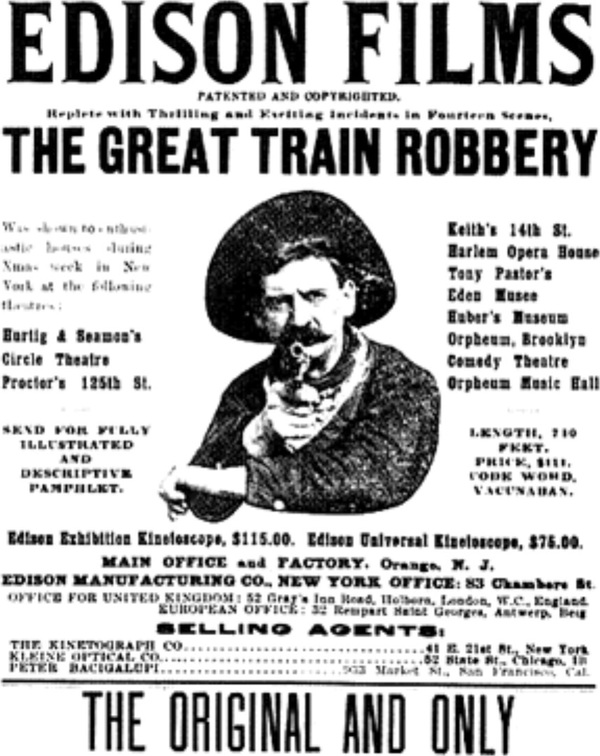
The Great Train Robbery is another early narrative film produced by Thomas Edison and directed by Edwin S. Porter. Unlike Life of an American Fireman earlier the same year, this one looks like a movie: it has a title card, a cast that acts (even if it’s humorously overdramatic), and a more complicated plot — though it’s still pretty simple.

The focus is clearly on telling a story, and on that level it works: a bunch of bandits (Gilbert M. ‘Broncho Billy’ Anderson, Justus D. Barnes, John Manus Dougherty Sr., Frank Hanaway, Adam Charles Hayman) rob a passenger train and are pursued over it. The action is parsed out more thoughtfully, no doubt for dramatic effect. The settings change, and a lot more characters are involved. Plus, the very last scene is clever — it’s a bit Hitchcockian.

In 1990, the United States Library of Congress deemed The Great Train Robbery “culturally, historically, or aesthetically significant” and selected it for preservation in the National Film Registry (https://www.loc.gov/programs/national-film-preservation-board/film-registry/complete-national-film-registry-listing/).

With A.C. Abadie, George Barnes, Walter Cameron, Donald Gallaher, Shadrack E. Graham, Morgan Jones, Tom London, Robert Milasch, Marie Murray, Mary Snow

Production: Edison Manufacturing Company

Distribution: Edison Manufacturing Company, Kleine Optical Company

11 minutes
Not rated

(YouTube) C

Life of an American Fireman 

(USA 1903)

The National Film Registry has some weird shit on it. Life of an American Fireman is a good example. An early “narrative” film produced by Thomas Edison and directed by George S. Fleming and Edwin S. Porter, who worked on other Edison film projects, this one depicts the dangerous work of firemen.

Life of an American Fireman doesn’t waste time or expense on things life title cards or credits. It begins with a fireman (Arthur White) dreaming about his wife and kids, shown in an onscreen thought bubble. He is awakened by the sound of the bell — not that we hear it — because oh, Lord Jesus, it’s a fire! It’s not entirely clear, but it looks like the fire is at his house.

This film is interesting from a historical perspective, and it shows some nice exterior shots of suburban New York or New Jersey. It’s also neat how the aforementioned thought bubble is composed as well as how the action is depicted from various viewpoints — in and outside the house. The fake smoke is a nice detail. Other than that, Life of an American Fireman is a snooze — about as thrilling as watching a fax go through. Thankfully, programming has come a long way.

In 2016, the United States Library of Congress deemed Life of an American Fireman “culturally, historically, or aesthetically significant” and selected it for preservation in the National Film Registry (https://www.loc.gov/programs/national-film-preservation-board/film-registry/complete-national-film-registry-listing/).

With Vivian Vaughan, James H. White

Production: Edison Manufacturing Company

Distribution: Edison Manufacturing Company, Kleine Optical Company

7 minutes
Not rated

(YouTube) D

They Live

(USA 1988)

“I’ve come here to chew bubblegum and kick ass…and I’m all out of bubblegum.”

“I’m giving you the choice: either put on these glasses or eat that trashcan.”

“Brother, life’s a bitch. And she’s back in heat.”

— Nada

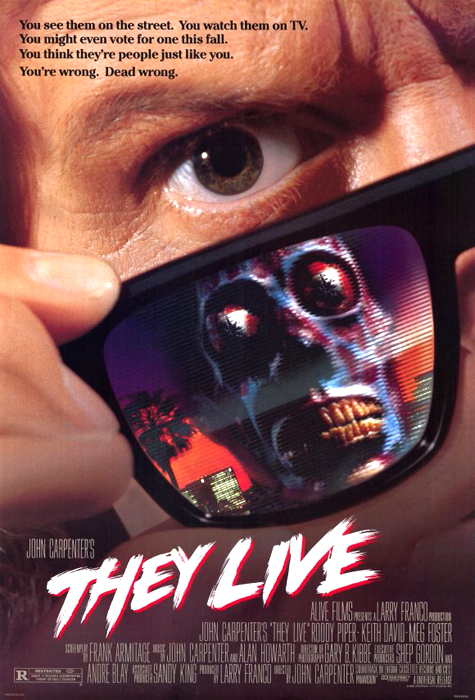
Director John Carpenter has done a few good pictures that probably will have an audience long after he’s gone; They Live isn’t one of them. At least, not in a good way. B-movie cult fodder all the way, They Live is a somewhat delayed and really heavy-handed reaction to ’80s conspicuous consumption. Based on Ray Nelson’s 1963 short story “Eight O’Clock in the Morning” and subsequent comic strip, Carpenter’s screenplay, written under the pseudonym Frank Armitage, is founded on a decent premise; it just doesn’t go where it could have.

Nada (Roddy Piper), a migrant construction worker who’s seen better days, picks up a job in downtown Los Angeles. He notices some weirdness going on with a television station that seems to be connected to a church across the lot where he and other homeless people have set up camp. His coworker Frank (Keith David) doesn’t want to hear about it. No one does.

One morning, Nada comes into possession of a pair of sunglasses. When he puts them on, he sees subliminal messages everywhere. A billboard with the tagline “We’re creating the transparent computing environment” says “Obey” with the glasses on. A travel ad beckoning, “Come to the Caribbean” says “Marry and reproduce.” “Men’s apparel” says “No independent thought.” Signs all around him order one to consume, conform, buy, watch TV, submit, sleep, do not question authority:

They Live Obey.jpg

Even the dollar bill has a different message: “This is your god.”

What’s worse, some people are not what they appear to be. At all. They aren’t even human — they’re skeletal reptiles, a kind of mutant species of Sleestaks or something:

They Live.JPG

What the hell is going on? Who are these things? What do they want? As Nada tells Frank, they ain’t from Cleveland.

I remember seeing They Live at the theater when it was new. It was okay. Three decades later, it’s still okay. It’s a lot sillier this time around, though. The whole thing gets off to a good enough start, but the momentum peters out just before midpoint. Carpenter — or anyone, for that matter — can get only so much mileage out of this story. They Live feels like 40 minutes of material stretched into more than twice that amount of time.

The denouement is not just predictable but anticlimactic, and the perspective here is adolescent at best. The lines are cringeworthy, falling painfully short of the Arnold Schwarzenegger zingers they aim to be. The acting is pretty bad, especially David and Meg Foster, both of whom are as stiff and lifeless as a dead gerbil. Surprisingly, Piper and his mullet are the best thing about They Live; Piper isn’t enough to carry it, though. And that wrestling scene in the alley is inane — misplaced, unnecessary, and too long, it adds nothing except maybe ten minutes to the running time.

The worst thing about They Live is that it seems Carpenter was serious — nothing here reads as tongue in cheek to me.

With George “Buck” Flower, Peter Jason, Raymond St. Jacques, Jason Robards III, Lucille Meredith, Norman Alden, Norm Wilson, Thelma Lee, Rezza Shan

Production: Alive Films, Larry Franco Productions

Distribution: Universal Pictures

94 minutes
Rated R

(iTunes rental) D+

http://www.theofficialjohncarpenter.com/they-live/

Good Time

(USA 2017)

Good Time is not a film to see for the plot. Written by Josh Safdie and Ronald Bronstein, the storyline is not all that novel, complicated, or interesting — in itself. I can sum it up in a single sentence: Queens bad boy Connie Nikas (Robert Pattinson) spends a night fleeing cops while trying to get his mentally handicapped younger brother, Nick (Benny Safdie), out of the mess he put him in after a bank robbery they commit goes sideways. It sounds like a comedy, but it most definitely is not.

Good Time is a movie to see for the mood it creates — and man, is it intense! More or less a character study, this could have been a disaster in someone else’s hands. As it is, the whole thing soars thanks to the directing by brothers Benny and Josh Safdie and the acting, which is all around great. Pattinson is particularly terrific — forget Twilight. I’ve heard comparisons to Al Pacino’s best work in the ’70s, and I’ve got to agree; Pattinson conveys a natural nervous energy just under the surface so well that you feel it watching him. I found myself more and more jittery and paranoid with every move and bad decision Connie makes and every character he encounters. I noticed hints of Dog Day Afternoon, Cruising, The Godfather, and even The Graduate in Pattinson’s performance.

Taking place almost entirely at night, the settings are familiar but eerie: a hospital, the crammed TV-lit apartment of a Jamaican immigrant (Gladys Mathon) and her weed smoking teenage granddaughter (Taliah Webster), an empty amusement park. Add a skittish techno score by Oneohtrix Point Never, a pallet of neon-colored light, and a nonstop chase, and you’ve got Good Time. Roller coaster ride or drug trip, take your pick — either way, this is a film that drags you along for the ride and zaps you, in a really satisfying way. I don’t know if Good Time is Oscar material, but it’s definitely memorable.

I almost missed Good Time, which opened for what appeared to be a very short limited run in Chicago. I made my own bad decision to see it Friday night after dinner with lots of cocktails. The film became a big blur that my drunk brain couldn’t handle. I went back for a Sunday matinee by myself. I left impressed, and actually pissed that I wasn’t present the first time I caught it.

With Jennifer Jason Leigh, Barkhad Abdi, Necro, Buddy Duress, Peter Verby, Saida Mansoor, Eric Paykert

Production: Elara Pictures, Rhea Films

Distribution: A24

99 minutes
Rated R

(AMC River East) B+

http://goodtime.movie

The Hitman’s Bodyguard

(USA 2017)

“Get Triggered,” commands one of the movie posters for Patrick Hughes’s The Hitman’s Bodyguard. I don’t know what that means here, but this film is a bit fluffy to trigger much more than some chuckles — after all the eyerolling, of course. That’s how it went for me.

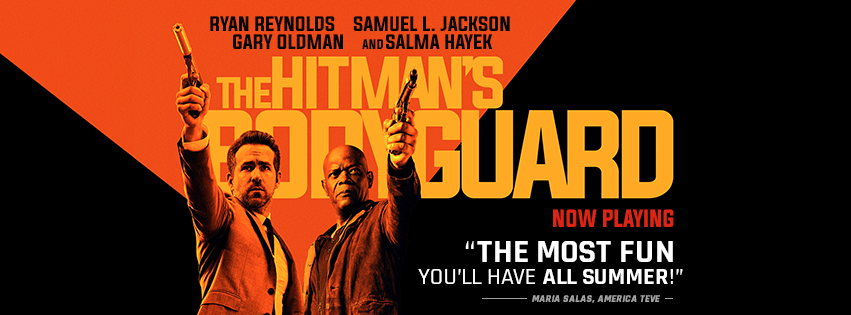
Ryan Reynolds is Michael Bryce, a humiliated professional bodyguard whose career took a hit — get it? — after a client (Tsuwayuki Saotome) was shot and killed right in front of him. Now, he barely ekes out a living guarding low profile corporate executives addicted to speed. He operates out of his run down car, which is where he also lives (as evident from his “bathroom,” an empty water bottle). To make matters worse, Michael is still reeling from a breakup with Amelia (Élodie Yung), an Interpol agent he blames for his sad state.

Amelia is charged with a simple but very consequential mission: to deliver notorious hitman Darius Kincaid (Samuel L. Jackson) to the International Court of Justice at the Hague. Darius has agreed to testify against Vladislav Dukhovich (Gary Oldman), the depraved dictator of Belarus on trial for crimes against humanity. Unfortunately for the prosecution, Dukhovich has a stalwart and invincible army of goons that hunts and kills any witness who has any dirt on him. Darius is the prosecution’s last hope, and the clock is ticking.

When Amelia’s armored car is attacked by Dukhovich’s men, she and Darius go into hiding. She contacts Michael for a favor: to complete the mission and get the star witness to the Hague. She doesn’t tell him who the witness is, and it turns out that Michael and Darius have a history. It ain’t pretty.

Not surprisingly, The Hitman’s Bodyguard is light fare, a stock comedy/action quasi buddy flick. It’s a perfect summer movie; frankly, I’m not sure why it wasn’t released earlier. Tom O’Connor’s screenplay is repetitive, predictable, and loaded with F-bombs, but it’s fun and isn’t at all serious. Reynolds and Jackson have an amusing love/hate relationship filled with banter about everything from murder to love to pop music that wouldn’t be out of place in Pulp Fiction. In between their banter is nonstop action — car chases, explosions, shoot outs in helicopters and boats, cat and mouse games.

Jackson does what he does best: causes grief and cusses with force. Reynolds plays a good square with earnestness. If these two had better chemistry, The Hitman’s Bodyguard would be a more memorable film. Salma Hayek is the best thing about this movie: she’s dramatic and severe and hilarious as Sonia Kincaid, the streetwise but still crazy wife of Darius. Rotting away in an Amsterdam prison, she’s relentless about protesting the grave injustice done to her. She effortlessly steals every scene she’s in.

With Michael Gor, Tine Joustra, Yuri Kolokolnikov, Rod Hallett, Joaquim de Almeida, Kirsty Mitchell, Richard E. Grant

Production: Millennium Films, Cristal Pictures

Distribution: Lionsgate Films

118 minutes
Rated R

(ArcLight) C+

http://www.thehitmansbodyguard.movie/mobile/

Dunkirk

(USA / UK / France / Netherlands 2017)

I have mixed feelings about Christopher Nolan’s spectacular Dunkirk, a World War II military drama that has very little to do with battle. Told from three perspectives — land (“the mole”), sea, and air — the story here centers on an evacuation, that of British and allied soldiers from the beaches of Dunkirk, a fishing village in northern France at the Belgian border, over a ten-day period in late Spring 1940 (https://en.wikipedia.org/wiki/Dunkirk_evacuation).

I have to admit ignorance here: I knew nothing about the Dunkirk evacuation going into this film. Nolan doesn’t spend any time on background or what led to this point; instead, he just picks up with British soldier Tommy (Fionn Whitehead) fleeing German fire outside the beach. I wish I had known ahead of time because I would have done some research. I thought a better job could have been done telling the story.

The structure, jumping between the three perspectives, takes a little work to follow. What exactly is going on is unclear and confusing, and it creates a nice sense of claustrophobia and panic in many scenes — especially that boat scene. This is good. However, keeping track of the characters is a tough task not made any easier by giving all the soldiers the exact same black hair dye. I found it hard to relate to or care much about any of them because I was kept at arm’s length. I couldn’t get invested. While definitely not the same story, Dunkirk is a kind of a big budget Son of Saul — just not as good.

As a spectacle, though, Dunkirk is magnificent. Cinematographer Hoyte van Hoytema shot it on 70 millimeter film, and he packs this picture with gorgeous wide shots of the beach, the sea, and throngs of desperate soldiers. He beautifully captures the hopelessness of the situation with a drab palette of only a few army colors: greens, greys, blues, and cold whites that convey a chill I could see and feel. The sound is over the top loud. If nothing else, Dunkirk is total sensory overload. It’s worth seeing for that alone.

Side note: I’m not sure which is the bigger surprise here — that 1D’s Harry Styles actually isn’t terrible, or that Tom Hardy is hidden under aviator goggles for the entire film. The latter is a bummer. He’s so hot!

With Mark Rylance, Tom Glynn-Carney, Jack Lowden, Aneurin Barnard, James D’Arcy, Barry Keoghan, Kenneth Branagh, Cillian Murphy, Michael Caine

Production: Syncopy, Warner Brothers, Dombey Street Productions, Kaap Holland Film, Canal+, Ciné+, RatPac-Dune Entertainment

Distribution: Warner Brothers, Karo Premiere (Russia), NOS Audiovisuais (Portugal), Roadshow Entertainment (New Zealand), Roadshow Films (Australia)

106 minutes
Rated PG-13

(Music Box) C+

http://www.dunkirkmovie.com

Wonder Woman

(USA 2017)

Director Patty Jenkins aims to do for Wonder Woman what Christopher Nolan—and I suppose to a lesser degree Tim Burton—did for Batman: take an iconic comic book superhero that got campy over the years and return it to its darker roots, producing something dramatic, perhaps weightier, and far more artful. Jenkins doesn’t entirely pull it off with Wonder Woman, but she’s on the right track. I see a sequel or two in the near future, so she’s got time to get there.

To Jenkins’s credit, Wonder Woman is not what I expected. Aside from a nod or two—and that goddamned tiara—all the cut-rate kitsch of the ’70s TV series is gone. This Wonder Woman means business even if she’s still, shall we say, absurd.

Jenkins goes back to the beginning: young Diana (Lilly Aspell and Emily Carey) lives on Themyscira, a hidden island inhabited by war-ready buff goddesses. Queen Hippolyta (Connie Nielsen), Diana’s mother, shields her from the strident ways of her subjects. It all has to do with an old score Ares (David Thewlis) seeks to settle—yes, that Ares, the son of Zeus and the god of war. General Antiope (Robin Wright), Hippolyta’s sister and Diana’s aunt/mentor, isn’t having it: she recognizes Diana’s potential and trains her on the sly. Diana blossoms into a beautiful woman (Gal Gadot) with serious supernatural power.

Diana stumbles upon Steve Trevor (Chris Pine), a drowning American pilot whose plane crashes off the coast of Themyscira. She rescues him, unwittingly exposing the island to an invasion by German forces. Persuaded by the awesome power of Diana’s Lasso of Hestia, Steve confesses that he’s a spy in the “war to end all wars”—World War I. Spider-sensing Ares is behind it, Diana embarks with Steve on a mission filled with romance, adventure, and espionage in an effort to track down the god and stop the madness.

Wonder Woman starts out all Xena: Warrior Princess, silly and weird in a geeky softcore straight guy “lesbian porn” way that no doubt would appeal to the likes of Wayne and Garth. Thankfully, it moves in another direction once Pine shows up about 40 minutes in. I found myself enjoying Wonder Woman more as the story got to Europe—that storyline is more believable even if it too is silly. The battle scenes are decent with some Hollywood excess and humor thrown in. I love how the theme of gender equality is the star of every scene—neither subtle nor heavy-handed, it’s simply a given.

For all its perks, Wonder Woman is ultimately a typical blockbuster that emphasizes form over substance. If nothing else, it surprises, which is always a plus. Frankly, though, I could’ve kept going completely oblivious to the fact that Wonder Woman is more than Lynda Carter. She was more a lot more fun.

With Danny Huston, Saïd Taghmaoui, Ewen Bremner, Eugene Brave Rock, Lucy Davis, Elena Anaya, Doutzen Kroes

Production: DC Entertainment, Atlas Entertainment, Cruel & Unusual Films, Rat-Pac Dune Entertainment LLC, Tencent Pictures, Wanda Pictures

Distribution: Warner Brothers, Karo Premiere (Russia), NOS Audiovisuais (Portugal), Roadshow Entertainment (New Zealand), Roadshow Films (Australia), SF Studios (Norway), Tanweer Alliances (Greece)

141 minutes
Rated PG-13

(ArcLight) C

http://wonderwomanfilm.com