The Cakemaker [Der Kuchenmacher]

(Israel / Germany 2017)

During a post screening Q and A, writer and director Ofir Raul Graizer said he “love[s] question marks in cinema.” Well, that shows: with his first feature film The Cakemaker [Der Kuchenmacher], he excels in raising questions that he lets his audience answer. Many people don’t appreciate this approach. I’m not one of them.

Tomas (Tim Kalkhof) is a thirty-something baker who runs his own one-man pastry shop in Berlin. Oren (Roy Miller), a married Israeli man, comes in one morning — maybe he’s really there for breakfast, or maybe he’s cruising.

Turns out, Oren is in Berlin on business, a lot. They begin an affair. Tomas knows about Oren’s wife and son in Jerusalem. Oren has a habit of bringing Tomas’s cinnamon cookies home to his wife as a kind of souvenir. It’s weird.

WARNING: Potential Spoilers Ahead!

After an unsettling visit, all communication with Oren stops. Confused and upset, Tomas tries to reach him at his company’s office in Berlin. A perplexed receptionist (Tagel Eliyahu) informs him that Oren died in a car crash.

Tomas does what any sensible red-blooded German gay guy would do: he closes shop and heads to Jerusalem to find out what happened — and maybe spy on Oren’s family to get an idea of what his life there was like.

He starts by tracking down Oren’s wife, Anet (Sarah Adler), who’s struggling to get a kosher café up and running. More by omission that outright lies, Tomas slowly works his way into her life, getting closer and more entangled without ever letting on that he knew her husband. Anet’s brother-in-law (Zohar Strauss) is dismayed, particularly when Anet hires Tomas, a gentile, as a baker. Things get complicated when his pastries attract a steady clientele to her café.

The Cakemaker isn’t exactly a thriller, but it’s suspenseful. A clear dread hovers over the whole story because it’s apparent that it’s not going to end well. It can’t, not with Tomas’s deceptions. Graizer’s pacing, slow and deliberate, steadily builds to an effective climax that might not be surprising itself but is still more intense than I expected. This is a quiet movie with some real nailbiter moments.

Graizer does a fine job enshrouding Oren in mystery — or maybe it’s shadiness. Anet reveals a zinger or two about their relationship. Sandra Sadeh as Oren’s mother, Hanna, steals each scene she’s in, a total of three. She subtly lets on that she’s wise to her dead gay son — and Tomas.

With Tamir Ben Yehuda, Stephanie Stremler, Iyad Msalma, David Koren, Gal Gonen, Eliezer Shimon, Sagi Shemesh

Production: Film Base Berlin, Laila Films

Distribution: Films Boutique

Screening introduced and followed by a live Q and A with Ofir Raul Graizer

104 minutes
Not rated

(AMC River East) B

Chicago International Film Festival

http://filmsboutique.com/movies/the-cakemaker/

Three Billboards Outside Ebbing, Missouri

(USA 2017)

Justice, like morality, is ambiguous. Accordingly, determining exactly how justice should be meted out is mired in a lot of grey. Translation: life is not black and white.

This old adage makes people uncomfortable, and it’s exactly the concept that colors Three Billboards Outside Ebbing, Missouri. It works so well because it acknowledges that there is no one right answer. Thankfully, as luck would have it, it’s also kind of funny.

Mildred Hayes (Frances McDormand) is pissed off and tired. Seven months ago, her daughter was raped, murdered, and set on fire, though not necessarily in that order. The police have made no arrests, they have no suspect, and they haven’t uncovered a single lead. The case is precariously close to cold.

Driving down a rural road one morning, Mildred spots three abandoned billboards and gets an idea: she’ll shame Chief of Police Willoughby (Woody Harrelson) into action. She rents the billboards for a full year and posts ads that attack him. The problem is, her idea doesn’t pan out as she plans — in fact, it works against her cause.

Not far off from a Coen Brothers venture, Three Billboards Outside Ebbing, Missouri is a twisted and twisting nailbiter. Writer-director Martin McDonagh has a sharp wit, a warped sense of humor, and an impeccable grasp of human nature. The cast is outstanding, with not one subpar performance. At times heartbreaking, this is all around a tightly assembled and enthralling film.

With Caleb Landry Jones, Kerry Condon, Sam Rockwell, Alejandro Barrios, Jason Redford, Darrell Britt-Gibson, Abbie Cornish, Riya May Atwood, Selah Atwood, Lucas Hedges, Zeljko Ivanek, Amanda Warren, Malaya Rivera Drew, Sandy Martin, Peter Dinklage , Christopher Berry, Gregory Nassif St. John, Jerry Winsett, Kathryn Newton, John Hawkes, Charlie Samara Weaving, Clarke Peters, Brendan Sexton III, Eleanor Threatt Hardy, Michael Aaron Milligan

Production: Blueprint Pictures

Distribution: 20th Century Fox, Fox Searchlight Pictures, Warner Brothers

115 minutes
Rated R

(AMC River East) B+

Chicago International Film Festival

http://www.foxsearchlight.com/threebillboardsoutsideebbingmissouri/

Charleston

(Romania / France 2017)

With the title of his new film Charleston, writer and director Andrei Cretulescu seems to play on late actor Charleton Heston, who comes up during a dinner conversation between recently widowed Alexandru (Serban Pavlu) and his gay brother, Ludovic (Gavril Patru), while the latter’s silent and vacant German boy toy (Vlad Galer) plays a video game. It’s fitting for a movie that explores grief and masculinity.

It’s Alexandru’s birthday. His wife, Ioana (Ana Ularu), was just killed, run down as she crossed the street. A cut to him lounging nonchalantly at her grave, wearing earphones and big sunglasses and smoking a cigarette, raises doubt about how bad he’s taking it.

After his dinner with Ludovic, a surprise knock on the door brings Alexandru face to face with Sebastian (Radu Iacoban), a stuttering hipster metrosexual wimp who introduces himself as Ioana’s lover. A punch in the face starts a strange partnership in which the two men pair up to commiserate separately.

Cretulescu’s premise is promising, and it gets some solid mileage for most of the film. Alexandru’s cynicism and derision contrasts sharply with Sebastian’s unsophisticated neediness and angst. Drinking, stealing, playing records, and constantly bickering, the two lonely men get into some marvelously absurd situations. A certain dance during the “intermission” is out of nowhere. They also learn a few things about the woman who left them behind.

Unfortunately, the story peters out about two thirds of the way through, starting with a plainly weird road trip to a town on the sea that both associate with Ioana. The climax isn’t exactly satisfying. I wish Charleston ended up somewhere as interesting as it seemed to be headed.

With Victor Rebengiuc, Ana Ciontea, Gabriela Popescu, Dorian Boguta, Andreea Vasile, Adrian Titieni, Sergiu Costache, Claudiu Dumitru, Alina Berzunteanu, Letitia Vladescu

Production: ICON, Les Films du Tambour, Kinosseur, Digital Cube, Mille et une Films, WAG Prod, Wearebasca

Distribution: Kinosseur (Romania), Versatile (International)

U.S. Premiere

Screening introduced and followed by a live Q and A with director Andrei Cretulescu

119 minutes
Not rated

(AMC River East) B-

Chicago International Film Festival

https://www.facebook.com/Charleston2017

https://youtu.be/93RazFnyITE

Suspiria

(Italy 1977)

“We must get rid of that bitch of an American girl. Vanish! She must vanish! Make her disappear! Understand? Vanish! She must vanish. She must die! Die! Die!”

— Madame Blanc

Dario Argento’s cult classic Suspiria is a perplexing film, and not because it’s scary. It’s pretty ridiculous, tongue and cheekiness aside.

Cowritten by Argento with Daria Nicolodi from Thomas DeQuincey’s 1845 essay “Suspiria de Profundis,” the plot is prosaic: American ballet student Suzy Bannion (Jessica Harper) enrolls at “the most famous school of dance in Europe,” the fictitious Tanz Dance Academy in Freiburg, Germany. Suzy notices immediately that something about the place isn’t quite right — maybe it’s the two students who are murdered the night she arrives. It doesn’t take long for Suzy to discover that the school is a front for something far more nefarious. Except for a few good lines here and there, the writing is terrible. The acting is even worse. The two exceptions are Alida Valli as Miss Tanner and Joan Bennett as Madame Blanc, both of whom deliver fabulously campy performances as women of power at the school.

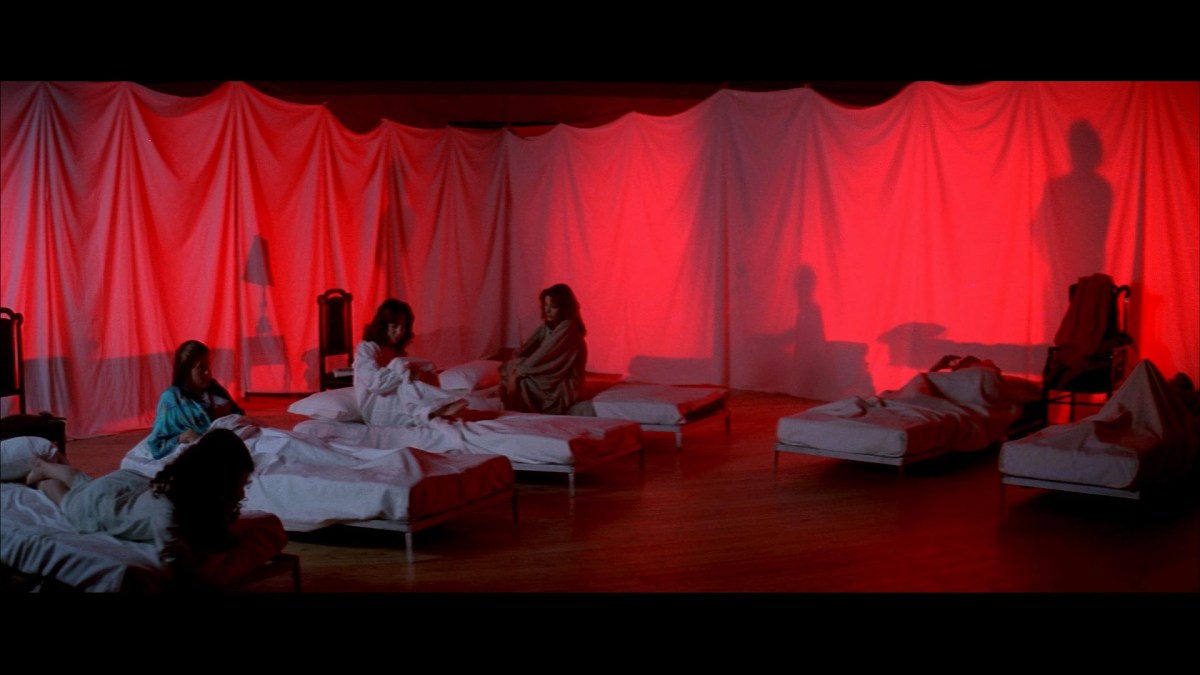
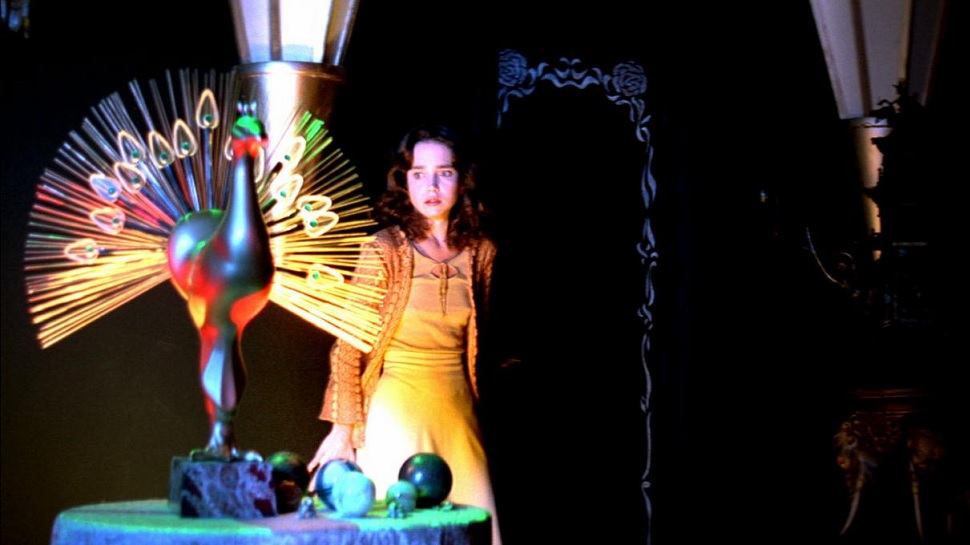
None of this matters, though, because this isn’t Suspiria’s raison d’être. No, Suspiria is a sensory masterpiece that places style way ahead of substance. In other words, it’s eye candy.

Argento expresses his vision through his imagery, and it’s unforgettably dazzling and unique. From the opening titles to the last scene, Argento shocks, thrills, and seduces with color, light, shadow, and surreal imagery. His sets are elegant and fake, and his blood is even faker. He lights the screen with bright reds and glowing blues (when it’s not all black from night), and he keeps the perspective distorted to create a trippy dissonance. Plus, he throws in a number of creepy psychological menaces, from maggots to a dog attack to a treacherous room-size wire dustbunny. Luciano Tovoli’s camera work perfectly articulates Argento’s vision.

This is what Suspiria is all about:

Suspiria1.jpg

Suspiria2.jpg

Suspiria3.jpg

Suspiria4.jpg

Suspiria5.jpg

Suspiria6.jpg

Suspiria9.jpg

Suspiria7.jpg

Suspiria8.jpg

The soundtrack by Goblin is a nice touch, and it goes far in creating the mood here.

For all its flaws — and there are many — Suspiria is a memorable film. We caught a digital restoration of the original print, which is five or six minutes longer. A zealous audience member engaged us in a discussion as we left the theater. He told us that Suspiria is the first of a trilogy known as “The Three Mothers,” and he enthusiastically recommended the second film, Inferno. I’ll see it someday, but it’s not a priority.

With Stefania Casini, Flavio Bucci, Miguel Bosé, Barbara Magnolfi, Susanna Javicoli, Eva Axén, Rudolf Schündler, Udo Kier, Margherita Horowitz, Jacopo Mariani, Fulvio Mingozzi, Franca Scagnetti, Renato Scarpa, Serafina Scorceletti, Giuseppe Transocchi, Renata Zamengo

Production: Seda Spettacoli

Distribution: Produzioni Atlas Consorziate

98 minutes
Not rated (alternate version)

(ArcLight) C+

Starlet

(USA 2012)

After The Florida Project wowed me even more than Tangerine did two years ago (I liked that one a lot, too), I decided to check out what else Sean Baker has done. I didn’t know about Starlet. Written by Baker with frequent collaborator Chris Bergoch, it’s the first of three from them so far. It came out before Tangerine, so it seemed like a good place to start. I’m happy to report that Starlet is another winner.

In Starlet, Baker and Bergoch explore morality and female bonding in the context of a cross generational relationship. Jane (Dree Hemingway) is a nihilistic or simply oblivious 21-year-old aspiring actress who just moved to the Valley — the one on the other side of the hills from Hollywood — with her unnamed chihuahua (Boonee). She’s kind of a slacker, spending her days not unpacking her shit but getting high and playing video games with her housemates Melissa (Stella Maeve) and Mikey (James Ransone), a young couple not exactly in tune with each other. They let her stay with them in an extra bedroom that Mikey occasionally uses for “work.”

Jane is likable: she’s got a lot of idiosyncrasies but she isn’t helpless, she takes care of her pooch, and she seems like a nice person despite her aimlessness, lack of planning (like, anything), and the questionable career path she’s chosen to get her foot in the door of the film industry. I’m not spoiling anything when I reveal that she makes porn under her stage name Tess. One name, like Cher or Madonna (or Prince, for that matter). A few real life porn actors (Manuel Ferrara, Asa Akira, Jules Jordan, Kristina Rose) even appear as themselves.

Jane hits a yard sale at the home of crusty old lady Sadie (Besedka Johnson), who can barely be bothered to answer Jane’s questions about a thermos she spots and wants to buy (she thinks it’s an urn). Jane takes it home and is befuddled when she finds multiple rolls of cash stashed inside it.

Jane tries to return the money — after she spends some of it on a blingy harness for the dog (incidentally, it says “starlet,” which becomes his name). The problem is, Sadie doesn’t give her a chance; she won’t even let Jane talk, dismissing her with a “no returns” shutdown. So, Jane does what any reasonable person would: she stalks Sadie at the grocery store, in the diner, in her garden, and at her bingo games to become her friend and spend the money on her.

Starlet is unique in its pace and its narrative, perhaps even moreso than Tangerine or The Florida Project. It’s offbeat yet warm, and it beautifully captures the tempo of real life: mostly mundane stretches peppered with moments of excitement. Both Hemingway (yes, her great grandfather was the notable author) and Johnson in her only role are both mesmerizing. Radium Cheung’s cinematography is gorgeous; all sunbleached and perfectly framed, it gives Starlet a sunny hue that belies its melancholic sense that this is as good as it gets for these characters, not that anything — fame, fortune, love, a pornstar sex life, retirement, Hollywood itself — is as thrilling as the fantasy.

Starlet lacks the impact of the aformentioned films that follow it — the big reveal at the end is a bit of a dud. However, its real surprise is how damned sweet it is. Hemingway and Johnson interacting with each other are a joy to watch. My big question: what’s in the suitcase?

With Zoe Voss, Krystle Alexander, Jessica Pak, Jackie J. Lee, Dean Andre, Dawn Bianchini, Edmund C. Pokrzywnicki, Dave Bean, Eliezer Ortiz, Andy Mardiroson, Cesar Garcia, Heather Wang, Helen Yeotis, Dale Tanguay, Patrick Cunningham, Karren Karagulian, Michael O’Hagan, Amin Joseph, Cammeron Ellis, Nick Santoro, Joey Rubina, Cassandra Nix, Liz Beebe, Tracey Sweet

Production: Maybach Cunningham, Freestyle Picture Company, Cre Film, Mangusta Productions

Distribution: Music Box Films (USA), Golden Scene (Hong Kong), Rapid Eye Movies (Germany), Tucuman Filmes (Brazil)

103 minutes
Not rated

(iTunes rental) B

http://www.musicboxfilms.com/starlet-movies-44.php

It [It: Chapter One]

(USA 2017)

I’ve started a few Stephen King novels during my life, but I’ve never finished reading any of them. I have, however, seen enough movies based on his books to know what I’m getting into.

It is director Andy Muschietti’s take on King’s 1986 novel, which incidentally came out on my 16th birthday. Scary. It tells the story of a group of bullied junior high outcasts who go after a deranged clown named Pennywise (Bill Skarsgård) one summer, the Summer of 1989, after he kills stuttering Bill Denbrough’s (Jaeden Lieberher) little brother, Georgie (Jackson Robert Scott), the fall before.

Pennywise lives in the sewer of their small town (Derry, Maine) and resurfaces every 27 years to prey on children through their worst fears.

The screenplay, written by Chase Palmer, Cary Fukunaga, and Gary Dauberman, is only part of the book — presumably to allow for a sequel. It starts out well enough in the same sweet nostalgic way as, oh, Stand by Me. Muschietti gets deatils of the time period mostly right: the Cure and New Kids on the Block were big in ’89 (even though the former’s “Six Different Ways” was two albums and a compilation earlier), and the reference to Molly Ringwald fits. He goes full on Steven Spielberg, however, about halfway through, turning It into The Goonies with the kids’ “losers club” and all the action switching to a dark cavernous underground sewer. This is to say, It gets cheesy after awhile.

The kids are all decent actors, and they keep It moving along. Sadly, though, there aren’t any real surprises here. More creepy and icky than outright frightening, Muschietti relies greatly on special effects; they’re good and a lot of work went into them, but they get tiresome after awhile. Plus, some editing would’ve been a good idea; It is too long.

As It is, it’s not a stinker. However, I wasn’t moved by It, either. It is a big budget Hollywood movie aiming to be a blockbuster, and that’s It.

With Jeremy Ray Taylor, Sophia Lillis, Beverly Marsh, Finn Wolfhard, Chosen Jacobs, Jack Dylan Grazer, Wyatt Oleff, Nicholas Hamilton, Jake Sim, Logan Thompson, Owen Teague, Stephen Bogaert, Stuart Hughes, Geoffrey Pounsett, Pip Dwyer, Elizabeth Saunders, Ari Cohen, Anthony Ulc, Javier Botet, Katie Lunman, Carter Musselman, Tatum Lee

Production: New Line Cinema, Ratpac-Dune Entertainment, Vertigo Entertainment, Lin Pictures, KatzSmith Productions

Distribution: Warner Brothers

135 minutes
Rated R

(ArcLight) C

http://itthemovie.com

BPM (Beats per Minute) [120 Beats per Minute] [120 battements par minute]

(France 2017)

Ah, the early ’90s: I was in college, jeans didn’t fit right, George H.W. Bush was president, MTV was relevant, and AIDS was as deadly as ever. In the United States, the number of new cases peaked around 1993 (https://www.cdc.gov/mmwr/preview/mmwrhtml/mm5021a2.htm). During the 1980s, a slew of activist organizations sprung up in response to government indifference and inaction, largely but not exclusively that of the Reagan administration, and Big Pharma shadiness — organizations like the Gay Men’s Health Crisis, Queer Nation, and perhaps most famous (or infamous) ACT UP.

This is the backdrop of Robin Campillo’s BPM (Beats Per Minute), an imperfect yet captivating and rich period piece that portrays the AIDS crisis with accuracy, drama, a little humor, and the slightest bit of nostalgia — ill-fitting jeans be damned. BPM puts us smack in the middle of the Parisian chapter of ACT UP, which seems constantly on the brink of self-destruction with all the debating, infighting, and struggling for control among its members.

Campillo starts with a broad picture, introducing us to the group through hunky Nathan (Arnaud Valois), who joins ACT UP for reasons that he keeps guarded. Right up front, members of the group confront radical Sean (Nahuel Pérez Biscayart), a scrawny firecracker who favors the back of the room. He went off script during a botched protest involving balloons filled with fake blood.

Sean’s motive is soon clear: he’s running out of time and has none to spare for diplomacy. His impatience and prickliness are particularly acute when he’s dealing with the chapter’s leader, Thibault (Antoine Reinartz), and elder comember Sophie (Adèle Haenel), who tends to be the voice of reason.

Those in the group don’t shy away from saying what’s on their mind, and their debates are vigorous to say the least. Interestingly, there’s a lot of flirting and cruising going on. Nathan encounters some attitude, particularly from the poz members — he happens to be HIV negative. He and Sean hit it off, though. Campillo zooms in on them as they get intimate, letting their relationship take center stage. We get their backstories over pillow talk, and it makes for some of the finest moments in this film. They get closer as Sean’s health deteriorates. Campillo brings the group back to the fore by the end, displaying the strong sense of community that has been there all along. It outshines all the bickering and dysfunction.

BPM is an accomplishment on many levels. The historical perspective is solid, giving the whole thing an authentic feel, almost like a documentary. Cinematographer Jeanne Lapoirie’s faded color palette and lighting actually look like the ‘90s. Campillo and Philippe Mangeot’s screenplay is smartly written, loaded with sharp dialogue that engages even when the activity level drops. The narrative arc here is terrific. The end could use some minor editing, but otherwise the long scenes and slow pace work because we’re getting a lot of information. While each actor carries his or her own weight, Pérez Biscayart easily emerges as the star.

Politics, ideology, and HIV status all draw lines in this group, but its members are united by a shared mission. Plus, they’ve got lives to lead, however much time they have left. BPM is a gentle — and somehow very French — reminder that life goes on.

With Felix Maritaud, Médhi Touré, Aloïse Sauvage, Simon Bourgade, Catherine Vinatier, Saadia Ben Taieb, Ariel Borenstein, Théophile Ray, Simon Guélat, Jean-François Auguste, Coralie Russier, Samuel Churin, Yves Heck, Emmanuel Ménard, Pauline Guimard, François Rabette

Production: Les Films de Pierre, France 3 Cinéma, Page 114, Memento Films, FD Production

Distribution: Memento Films

143 Minutes
Not rated

(AMC River East) B+

Chicago International Film Festival

http://bpm.film

Tokyo Vampire Hotel

(Japan 2017)

This theatrical cut of director Sion Sono’s Amazon Prime miniseries Tokyo Vampire Hotel [東京ヴァンパイアホテル] (http://www.indiewire.com/2017/04/tokyo-vampire-hotel-sion-sono-amazon-1201808369/) is a fast-paced stylish and colorful bloodbath, something that wouldn’t be out of place in Quentin Tarantino’s oeuvre.

Manami (Tomite Ami) is a nice girl who shares a tiny apartment with her boyfriend (Saito Takumi) in Tokyo. Just after she arrives for dinner with her friends on the evening of her 22nd birthday, a crazy gun-toting assassin (Shoko Nakagawa) in a fuzzy pink mink shows up and takes out everyone in the restaurant — except Manami, whom she came to kidnap.

Manami flees, only to be picked up by another kidnapper, the mysterious K (Kaho). K in not so may words explains that Manami is a pawn in a war between two vampire clans, the Draculas and the Corvins, who have been enemies for centuries. Unbeknownst to Manami, she’s the target of a worldwide vampire hunt. K takes her to the glamorous Tokyo Vampire Hotel, which is run by a creepy geisha empress (Adachi Yumi) who needs blood.

The end of civilization is coming, but the empress has a plan: use the hotel to trap a healthy supply of humans to serve as food. Things don’t pan out as planned when the humans figure out what’s happening and the Draculas show up to crash the party.

This photo sums up what you’re getting into here:

Tokyo still.jpg

Tokyo Vampire Hotel is quirky, sexy, lavish, and fun. Sono serves up an imaginative feast of dazzling eye candy and nonstop action. His use of Christian symbols adds a nice touch. The sets are fantastic, and the action moves from the streets of Tokyo at night to inside the hotel to Bran Castle in Transylvania, and back. The editing works to make nine episodes flow seamlessly into a feature length film. However, the story wears thin after a little while, and it can’t sustain the interest I started out with. The gore gets old, too. The length, nearly two and a half hours, is a problem. It demonstrates why Tokyo Vampire Hotel is probably better in smaller doses.

With Mitsushima Shinnosuke, Yokoyama Ayumu, Kagurazaka Megumi, Shibukawa Kiyohiko, Takatsuki Sara, Tsutsui Mariko, Sakurai Yuki

Production: Amazon, Django Film, Nikkatsu Pictures

Distribution: Nikkatsu International Sales

142 minutes
Not rated

(AMC River East) C+

Chicago International Film Festival

https://youtu.be/2cJRq73BAhE

The Line [Čiara]

(Slovakia / Ukraine 2017)

Director Peter Bebjak’s The Line is an Eastern European testosterone flick, a less cheeky sort of Lock, Stock and Two Smoking Barrels set at the Slovakia–Ukraine border. It’s a genre flick, and a good one: excellent performances all around boost Peter Balko’s tight, vigorous screenplay.

A lot is going on with Adam Krajnak (Tomáš Maštalír), the head of both his household and a gang of organized cigarette smugglers. His oldest daughter, Lucia (Kristiná Konátová), is about to marry a clueless petty thief (Oleksandr Piskunov) he doesn’t care for. His Ukrainian partner (Eugen Libezňuk) is going weird, possibly on the verge of going rogue.

Then there’s ruthless Ukrainian gangster Krull (Stanislav Boklan), who’s co-opted Adam’s crew for a new product, meth. Adam wants no part of it. Things are heating up to a show down that crooked police chief Peter Bernard (Andy Hryc) facilitates. It all comes to a head during Lucia’s engagement party.

With far and few still moments, The Line grows increasingly complicated as its story progresses. This is a quick and constant thriller loaded with curve balls. A scene where the police raid Afghans illegally crossing the “green border,” a wooded area, is a standout. So are a few at a ravine where Krull dumps bodies; Martin Ziaran’s underwater shots are beautifully eerie.

With Emília Vášáryová, Géza Benkõ, Zuzana Fialová, Filip Kankovský, Milan Mikulcík, Veronika Strapková, Rimma Zyubina

Production: Wandal Production, Garnet International Media Group

Distribution: RTVS

Screening introduced by and followed by a live Q and A with Andy Hryc

108 minutes
Not rated

(AMC River East) B+

Chicago International Film Festival

http://www.ciara.sk/en/

Mon Mon Mon Monsters [Bào Gào Lǎo Shī! Guài Guài Guài Guài Wù!]

(Taiwan 2017)

In his latest film, peer pressure horror comedy Mon Mon Mon Monsters [報告老師! 怪怪怪怪物!] [Bào Gào Lǎo Shī! Guài Guài Guài Guài Wù!], writer/director Giddens Ko takes us on a wild ride that leaves us pondering who the real mosters are. He subtly gives us his answer in the title.

High school student Lin Shu-wei (Deng Yu-kai) is a neo maxi zoom dweebie with a masochistic edge. Why else would he tolerate the constant flying bits of paper, chairs pulled out from under him, and general teenage tomfoolery directed at him?

Lin becomes the target of Bully Ren-hao (Kent Tsai), a closet psychopath who relentlessly dreams up new ways to torment him. Ren-hao has two flunkies, Liao Kuo-feng (James Lai) and Yeh Wei-chu (Tao Meng) who do his bidding. Ren-hao’s girlfriend, Wu Si-hua (Bonnie Liang), contributes to the hell — never removing her star-studded headset as she snaps photos with her iPhone.

A pacificst teacher (Carolyn Chen) has an idea to get the boys on common ground: she assigns the four of them to community service feeding senile elderlies at a decrepit old age home that looks like something straight out of Blade Runner. Lin has a bad feeling about it, and he’s right: in the process of robbing an old man, the boys corner and capture a flesh-eating female beast (Lin Pei-hsin) they find roaming around.

They take her to an abandoned recreation center, where they chain her up and torture her with light, fire, and starvation. Lin reluctantly goes along with it, but he reaches a point where he either has to put up or shut up. Meanwhile, the beast’s protective and pissed off older sister (Eugenie Liu) is looking for her. This is where Lin is put to the test: does he have any character, and can he stay true to it?

Despite inconsistent pacing, Mon Mon Mon Monsters is overall engaging. Ko has something to say about the moral fabric of today’s youth, but he says it in a mostly lighthearted way. The acting is solid all around, which is pretty amazing for a slasher flick. The “monsters” are sweet in their own way. It’s smart to show them right off the bat rather than let us wonder what they look like; they come off as more human than the teenagers in this movie.

The special effects are pretty good, and the way Ko plays with light and color is downright spectacular. Quite a few scenes here are magnificent even if they’re cheesy and gory (that scene on the bus is fabulous, as are the scene where the teacher ignites in the gym and pretty much any of the scenes in the recreation center). Underneath all the blood and hate is a truth about the social ladder.

With Kai Ko, Vivian Sung, Emerson Tsai, Phil Hou, Bruce Hung 

Production: Star Ritz International Entertainment

Distribution: Vie Vision Pictures

113 Minutes
Not rated

(AMC River East) B-

Chicago International Film Festival