The Immigrant

(USA 1917)

The Immigrant is quintessential Charlie Chaplin: funny, cute, and touching, it entertains while criticizing the social conditions of the day — here, the treatment of immigrants in “the Land of Liberty.” You decide whether all that much has changed in a hundred years.

Written and directed by Chaplin, The Immigrant follows his Tramp character on a boat bound for the States. He meets a fellow passenger, a beautiful young woman (Edna Purviance) traveling with her mother (Kitty Bradbury), and he has the perfect “in” when money is stolen from her purse. Sparks fly, but unfortunately the two potential love birds are separated by U.S. Customs agents as soon as they reach New York Harbor.

Once in the New World, the Immigrant has some trouble making ends meet. He finds a quarter on the ground one dreary afternoon and heads to a restaurant where a hostile head waiter (Eric Campbell) gives him a hard time. By chance, he sees the young woman from the boat and invites her to his table for beans and coffee (yuck!). Soon realizing that the quarter slipped through a hole in his pocket, he tries to impress her while stalling on the check to avoid ejectment.

The Immigrant starts off rocky — literally: the boat rocks back and forth, lending itself to some nice physical comedy with passengers sliding across the floor, juggling moves, and dishes sliding across a table. Thankfully, the rocking stops just before it becomes annoying. The scene in the restaurant is fascinating both for the character development and the physical choreography. This is a sweet story, an early romcom with a happy ending — and it’s downright charming a century later.

In 1998, the United States Library of Congress deemed The Immigrant “culturally, historically, or aesthetically significant” and selected it for preservation in the National Film Registry (https://www.loc.gov/programs/national-film-preservation-board/film-registry/complete-national-film-registry-listing/).

With Albert Austin, Henry Bergman, Loyal Underwood, William Gillespie, James T. Kelly, John Rand, Frank J. Coleman, Tom Harrington, Janet Miller Sully, Tom Wilson, Tiny Sandford

Production: The Lone Star Film Corporation

Distribution: Mutual Film Corporation

24 minutes
Not rated

(YouTube) B+

Fatty’s Tintype Tangle

(USA 1915)

Roscoe “Fatty” Arbuckle was a huge (no pun intended) but beleaguered star in the early 20th Century. He had a tough life and he died young (https://en.wikipedia.org/wiki/Roscoe_Arbuckle). After a start in vaudeville, he became one of Hollywood’s first movie stars, quickly negotiating a deal worth a million dollars a year plus a quarter of the profits from his films (https://www.thehairpin.com/2012/02/scandals-of-classic-hollywood-the-destruction-of-fatty-arbuckle/). On top of it, he got total artistic control.

It all came to a screeching halt when a young alcoholic actress died after a hotel party he threw, and he was accused of rape. It was Hollywood’s first big scandal, and it ended his career (http://www.smithsonianmag.com/history/the-skinny-on-the-fatty-arbuckle-trial-131228859/).

Incidentally, that hotel party occurred in San Francisco exactly 96 years ago on the day after this post.

Today, I saw my first Fatty Arbuckle film — and it only took me 108 years (https://en.wikipedia.org/wiki/Roscoe_Arbuckle_filmography). I had a loose idea of what to expect but I wasn’t quite sure. Fatty’s Tintype Tangle is familiar and not too crazy, the cinematic equivalent of something that tastes like chicken.

WARNING: Potential spoilers ahead!

A slapstick farce, Fatty’s Tintype Tangle tells of a husband (Arbuckle) whose mother-in-law (Mai Wells) nags the shit out of him. He and his wife (Norma Nichols) laugh at her behind her back. After getting liquored up in the kitchen while cooking breakfast, Fatty tells off his mother-in-law and either throws her ass out of his house or upsets her to the point that she gets up and goes — it’s hard to say.

Fatty goes to the park, where he sits on a bench next to a woman (Louise Fazenda) whose husband (Edgar Kennedy) momentarily leaves her to go do something — the scene card tells us they’re Alaskan “homeseekers,” whatever that is. They seem down and out, staying at an obviously low rent room and board. A photographer (Glen Cavender) snaps their picture — hence the “tintype” in the title — which isn’t cool because, well, they’re both married. The husband returns, mistakes Fatty for a creep, and threatens to kill him if he doesn’t leave town.

Fatty runs home and packs his bags — including his booze. He tells his wife he’s going on a business trip. Despondent, she answers an ad in the paper from someone seeking an apartment. She rents out the house and apparently moves in with her mother. Turns out, her tenants are the Alaskan couple. Doh!

Fatty misses his train and goes home. Unbeknownst to him, the Alaskan woman is in his bathroom. Hilarity ensues.

Fatty’s Tintype Tangle has all the elements of early comedy, a lot of it cliché now: misunderstandings, the hapless henpecked male, a slip and fall on a banana peel, gunshots to the ass, even Keystone cops. The only thing missing is a pie in the face. A rather cool extended scene features Arbuckle climbing up a pole and running across power lines. I was impressed to see him doing his own stunts; he was surprisingly limber for such a big guy.

Slapstick isn’t my favorite form of entertainment, but this is solid physical comedy even if it’s hard to follow at points. The version I saw had no sound at all, which was a bummer — hearing myself breathe adds nothing to the experience.

In 1995, the United States Library of Congress deemed Fatty’s Tintype Tangle “culturally, historically, or aesthetically significant” and selected it for preservation in the National Film Registry (https://www.loc.gov/programs/national-film-preservation-board/film-registry/complete-national-film-registry-listing/).

With Frank Hayes, Joe Bordeaux, Bobby Dunn, Ted Edwards, Charles Lakin

Production: Keystone Film Company

Distribution: Mutual Film Corporation

27 minutes
Not rated

(YouTube) C+

The Asphalt Jungle

(USA 1950)

I expected crime noir classic The Asphalt Jungle to be something of a cheesefest: stiffly acted, overly melodramatic, and maybe a bit hamfisted in its morality, like The Hardy Boys for adults of the Greatest Generation. Thankfully, John Huston’s film adaptation of W.R. Burnett’s 1949 novel is none of that.

No sooner is Doc Riedenschneider (Sam Jaffe) out of the big house when he hatches a plan to do what he does best: steal. Like, a million bucks or more in jewels from a jewelry store (not Jared’s). Yes, a jewel heist. He pitches his plan to Cobby (Marc Lawrence), a two-bit gambling bookie, who puts him in touch with Alonzo Emmerich (Louis Calhern), a rich but shady attorney. Emmerich buys in, not just providing financial backing but also agreeing to handle disposing the booty for cash.

Doc assembles a crew of petty thieves consisting of a “box man,” or a safecracker (Anthony Caruso), a driver (James Whitmore), and an all-important “hooligan” (Sterling Hayden) to execute the plan. The heist goes off without a hitch, mission accomplished. It’s smooth; uneventful, even. That is, until a stray bullet accidentally hits one of the crew members.

This is where the plot gets really interesting, as human nature and a slew of bad decisions rear their ugly heads. It doesn’t help that at the same time, sundry troubles that have been brewing alongside all the planning are coming to a boil. Soon, it’s every man for himself in a sticky web of deception, doublecrossing, and death.

The Asphalt Jungle is an exquisitely layered and calibrated drama that’s tough to turn away from — and tough not to appreciate. Written by Huston with Ben Maddow, the screenplay is tight. The characters — a collection of urban lowlife thieves, thugs, private detectives, crooked cops, and good looking dames — all have dimension. Interestingly, what would probably be the most intense scene in most movies — the break-in — isn’t; the intensity and the drama come from what happens after that. A manhunt that ends in Cleveland and an attempted swindle serve as the ticking clock here. This is the perfect thriller for a hot summer night in the city. Bonus: The Asphalt Jungle features a young but unmistakable Marilyn Monroe in one of her earliest roles.

In 2008, the United States Library of Congress deemed The Asphalt Jungle “culturally, historically, or aesthetically significant” and selected it for preservation in the National Film Registry (https://www.loc.gov/programs/national-film-preservation-board/film-registry/complete-national-film-registry-listing/).

With Jean Hagen, John McIntire, Barry Kelley, Teresa Celli, William “Wee Willie” Davis, Dorothy Tree, Brad Dexter, Helene Stanley, John Maxwell, Strother Martin, Jack Warden, Tim Ryan

Production: Metro-Goldwyn-Mayer

Distribution: Metro-Goldwyn-Mayer

112 minutes
Not rated

(Music Box) A-

Noir City

https://www.warnerbros.com/asphalt-jungle

The Godfather

(USA 1972)

“Why did you go to the police? Why didn’t you come to me first? What have I ever done to make you treat me so disrespectfully?”

—Don Vito Corleone


“My father is no different than any powerful man, any man with power. Like a president or a senator.”

—Michael Corleone


“And may their first child be a masculine child.”

—Luca Brasi


“Hey Mikey, why don’cha tell that nice girl you love her? ‘I love you with all a-my heart. If I don’t a-see you again a-soon, I’m a-gonna die!'”

“Leave the gun. Take the cannoli.”

—Peter Clemenza

Pretty much perfect, The Godfather was almost a different movie. Based on Mario Puzo’s insanely popular best selling 1969 novel, studio executives conceived a pulp gangster drama for its film adaptation. Good thing they wanted a “real” Italian-American to direct so it would be so authentic that moviegoers would “smell the spaghetti” (https://www.vanityfair.com/news/2009/03/godfather200903). Several unsuccessful attempts were made to attract a director, including Warren Beatty. Paramount “settled for” unknown Francis Ford Coppola, who took it somewhere else.

The Godfather is universally held in high esteem as one of the greatest films of all time—as it should be. It’s a a movie showered in superlatives—like the bullets that shower, well, most of the characters. It’s impeccable. We caught an anniversary screening.

Coppola’s morality play is a masterpiece, more complex than it seems at first and full of contrast and contradiction. A solemn and ominous mob drama that centers on Don Vito Corleone (Marlon Brando) and his family business, The Godfather boasts one riveting career-defining performance after another—Brando, Al Pacino, James Caan, Richard Castellano, Robert Duvall, and Abe Vigoda, to name a few. The characters are great, and the dialogue—perfect! Not a single second is wasted here, not even that long ass wedding scene.

The observations about human nature are astute, and the spin on assimilation and the American Dream is clever. The dramatic arc involving the descent of younger son Michael (Pacino) into a moral apocalypse is something you can’t shift your eyes away from. Black as its promotional poster, The Godfather leaves so much to chew on. This is what cinema is all about.

In 1990, the United States Library of Congress deemed The Godfather “culturally, historically, or aesthetically significant” and selected it for preservation in the National Film Registry (https://www.loc.gov/programs/national-film-preservation-board/film-registry/complete-national-film-registry-listing/).

With Sterling Hayden, John Marley, Richard Conte, Al Lettieri, Diane Keaton, Talia Shire, Gianni Russo, John Cazale, Rudy Bond, Al Martino , Morgana King, Lenny Montana, John Martino, Salvatore Corsitto, Richard Bright, Alex Rocco, Tony Giorgio, Vito Scotti, Tere Livrano, Victor Rendina, Jeannie Linero, Julie Gregg, Ardell Sheridan, Simonetta Stefanelli, Angelo Infanti, Corrado Gaipa, Franco Citti, Saro Urzì, Sofia Coppola

Production: Paramount Pictures, Alfran Productions

Distribution: Paramount Pictures (USA), Cinema International Corporation (CIC) (International)

175 minutes
Rated R

(AMC River East) A+

Fathom Events

The Wizard of Oz

(USA 1939)

“For twenty-three years, I’ve been dying to tell you what I thought of you! And now… well, being a Christian woman, I can’t say it!”

—Auntie Em


“Toto, I’ve a feeling we’re not in Kansas any more.”

—Dorothy


“I’ll get you, my pretty. And your little dog, too!”

—The Wicked With of the West


“Only bad witches are ugly.”

—Glenda


“Why, anybody can have a brain. That’s a very mediocre commodity. Every pusillanimous creature that crawls on the Earth or slinks through slimy seas has a brain.”

“Hearts will never be practical until they can be made unbreakable.”

“You are under the unfortunate impression that just because you run away you have no courage; you’re confusing courage with wisdom.”

—The Wizard of Oz

Growing up when I did, The Wizard of Oz aired on TV every year, and only once a year. It was a special event. I distinctly remember it being on Thanksgiving, but digging around online contradicts me—while some sources back me up, others say Easter, February, and even Christmas. Whatever. I’ve seen it so many times, I know it by heart. So do many people. Like Willy Wonka and the Chocolate Factory (https://moviebloke.com/2016/03/26/willy-wonka-and-the-chocolate-factory/ ), The Wizard of Oz is a celluloid relic from my childhood that still stirs something in me.

This annual tradition stopped sometime in the ’90s, probably because home video and cable allowed one to see it anytime. So, I was downright thrilled to see a screening near me over a different holiday weekend this year: Memorial Day. I’ve only seen this film on the big screen once or maybe twice before, so I couldn’t resist.

This is where I usually launch into the story, where I might get into some of the details of Dorothy (Judy Garland) and her weird Technicolor odyssey to the Emerald City after a tornado lifts her, Toto (Terry), and her farmhouse out of Kansas and drops her somewhere over the rainbow in Munchkinland—right on top of the unseen Wicked Witch of the East, whose crazy striped socks and shriveled feet are permanently etched in my memory—provoking the ire of the Wicked Witch of the West (Margaret Hamilton) thanks to a pair of ruby slippers.

Let’s be honest, though: we all know the story. Does anything more need to be said about The Wizard of Oz, which is probably the best known and most seen film, ever? Classic and iconic, it set a cinematic benchmark that hasn’t been surpassed nearly a century on, and probably never will be. Loaded with character, song, color, and cool props, it’s a one of a kind spectacle. Its magic continues to inspire.

Harold Rosson’s cinematography is top notch. Seeing it today, I was wowed by the sepiatone Kansas scenes, which were plain old black and white on TV. I always feel a rush when Dorothy opens the door after she crashes, but seeing Munchkinland on the big screen is so much more awesome. So is that scene in the poppy field, and so is the Emerald City with its otherworldy green glow—like paranormal depression glass. Marvelous!

Based on L. Frank Baum’s 1900 children’s book The Wonderful Wizard of Oz, the film’s history behind the camera is every bit as colorful as…well, Munchkinland. Victor Fleming is credited as director, but The Wizard of Oz actually had five: Norman Taurog, Richard Thorpe, George Cukor, Fleming, and King Vidor (https://www.shmoop.com/wizard-of-oz/director.html ). Over a dozen writers contributed to the screenplay (http://oz.wikia.com/wiki/Wizard_of_Oz_Screenwriters ). Although the munchkin suicide is by all accounts nothing more than a rumor, Hamilton was burned badly (https://www.thevintagenews.com/2016/09/06/priority-margaret-hamilton-wicked-witch-west-wizard-oz-suffered-3rd-degree-burns-face-hands-scene-munchkinland-exits-ball-flame/ ). Buddy Ebsen was initially cast as the Tin Man, but he dropped out of the film when he suffered a severe allergic reaction to the aluminum makeup used on his face (http://oz.wikia.com/wiki/Buddy_Ebsen ). However, his voice remains in the scene where Garland, Ray Bolger as the scarecrow, and Jack Haley, Ebsen’s replacement, sing “We’re Off to See the Wizard” after the Tin Man is reanimated with oil.

Legend has it (though it’s probably exaggerated) that the actors who played the munchkins were worse than drunk sailors, holding sex parties and trashing the hotel where they stayed in Culver City (http://www.seeing-stars.com/Hotels/CulverHotel.shtml ) (http://www.mirror.co.uk/tv/tv-news/wizard-oz-mucnhkins-didnt-just-9782402 ) (http://www.independent.co.uk/arts-entertainment/films/features/dogged-by-rumour-the-riddles-of-oz-1766264.html ). Garland allegedly claimed that she was repeatedly accosted by a number of them (http://people.com/celebrity/teenage-judy-garland-was-repeatedly-molested-by-munchkins-on-set-of-wizard-of-oz-says-her-ex-husband/ ). What a world, what a world!

In 1989, the United States Library of Congress deemed The Wizard of Oz “culturally, historically, or aesthetically significant” and selected it for preservation in the National Film Registry (https://www.loc.gov/programs/national-film-preservation-board/film-registry/complete-national-film-registry-listing/).

With Frank Morgan, Bert Lahr, Billie Burke, Charley Grapewin, Clara Blandick, Pat Walshe, Charles Becker, Buster Brodie

Production: Metro-Goldwyn-Mayer/MGM

Distribution: Metro-Goldwyn-Mayer/MGM, Warner Brothers

102 minutes
Not rated

(ArcLight) A+

http://www.thewizardofoz.warnerbros.com

Eraserhead

(USA 1977)

I learned of David Lynch’s Eraserhead, his first feature length film, during my freshman year in college (thank you, U.D.). Somehow, seeing it escaped me until it screened at a recent Lynch retrospective.

The basic premise is easy to follow: Henry Spencer (John Nance, later Jack) is a schlubby factory worker who learns he fathered a mutant baby out of wedlock. At the insistence of her mother (Jeanne Bates), his freaked out girlfriend, Mary (Charlotte Stewart), moves into Henry’s tiny one-room apartment with the baby, who looks like a diseased E.T. wrapped in gauze. The baby cries constantly, driving Mary out of the apartment and leaving Henry to care for it. His neighbor, Beautiful Girl Across the Hall (Judith Anna Roberts), serves as an ever-increasing temptation and torment.

Really, it’s not the plot but Lynch’s presentation that makes Eraserhead unique. To be clear, it’s not his best film—not even close. It isn’t exactly representative of his work, either. Still, it’s interesting to see his trademarks in their infancy: a horrific and surreal atmosphere, bizarre imagery that here includes lots of spermatozoan objects and seemingly random scenes, spooky characters like the Lady in the Radiator (Laurel Near), and of course Lynch’s dry and twisted wit. The sets and costumes are assembled with early 20th Century industrial junk. The soundtrack is essentially white noise in the background. Frederick Elmes and Herbert Cardwell’s cinematography is rich and textured, using black and white to create a look and mood that resembles a silent film. Their camerawork sets up a sense of claustrophobia that lingers for the duration of the film.

Like most of Lynch’s work, Eraserhead is open to interpretation. In simplest terms, it’s a horror story about the demands of the family on the individual, from small talk and dinners with in-laws to appeasing a partner to child rearing to straying from the family unit. In the tradition of great American playwrights like Eugene O’Neill, Tennessee Williams, Arthur Miller, Edward Albee, and August Wilson, Lynch focuses on the pains and dysfunction that often make familial burdens difficult to bear.

I didn’t quite grasp everything here—how pencilmaking fits into the big picture, for example. Regardless, Eraserhead is infinitely interesting. I didn’t find it particularly scary, but it definitely leaves an impression—I guess in that sense it’s a haunting tale. It’s a weird and original film. Here’s the weirdest thing about it: I actually felt something emotional for that mutant baby. Go figure.

In 2004, the United States Library of Congress deemed Eraserhead “culturally, historically, or aesthetically significant” and selected it for preservation in the National Film Registry (https://www.loc.gov/programs/national-film-preservation-board/film-registry/complete-national-film-registry-listing/).

With Allen Joseph, Jack Fisk, Jean Lange, Hal Landon Jr., Gill Dennis, Darwin Joston, Jennifer Lynch, Peggy Lynch

Production: American Film Institute (AFI), Libra Films

Distribution: Libra Films International (USA), Creative Exposure (Canada), Mainline Pictures (UK), Toei Yoga and Comstock (Japan), Chapel Distribution and Umbrella Entertainment (Australia), Eye Film Instituut (Netherlands), Potemkine Films (France)

89 minutes
Not rated

(Music Box) B-

David Lynch: A Complete Retrospective

http://www.davidlynch.de/head.html

North by Northwest

(USA 1959)

“I’m an advertising man, not a red herring. I’ve got a job, a secretary, a mother, two ex-wives, and several bartenders that depend upon me, and I don’t intend to disappoint them all by getting myself ‘slightly’ killed.”

—Roger Thornhill


“That’s funny. That plane’s dusting crops where there ain’t no crops.”

—Man at the Prairie Crossing

I expected Alfred Hitchcock’s North by Northwest to be suspenseful, cinematic, and even a bit perverse, peppered with the director’s inimitable wit and dark sense of humor. It certainly is all that. However, I didn’t expect it to be altogether facetious, or as fun as it is. Scene after scene, North by Northwest delivers; not many films give as much bang for your buck as this one.

Cary Grant is Manhattan ad executive Roger O. Thornhill—”The ‘O’ stands for nothing,” he quips at one point. A mild-mannered, stylish middle-aged man in a grey flannel Brooks Brothers suit—think Mad Men—he leads a perfectly predictable straight life serving clients, drinking martinis, and keeping his WASPy mother (Jessie Royce Landis) entertained.

While having cocktails at the Plaza Hotel one afternoon, Thornhill is yanked into a treacherous game of cat-and-mouse when the goons of a smooth and well-spoken spy, baritone Phillip Vandamm (James Mason), mistake him for a government agent named George Kaplan. It’s nothing but trouble from here.

Relentlessly hunted after being framed for an incident at the United Nations, Thornhill flees Manhattan on a passenger train that looks a lot like Amtrak’s Lake Shore Limited. He meets cool, mysterious, and sultry stranger Eve Kendall (Eva Marie Saint), who’s headed to Chicago. Her innuendo is sexy, but she’s not exactly trustworthy—Thornhill senses it, and so do we.

North by Northwest is ultimate Hitchcock, fueled by mistaken identity and packed with psychological drama manifest mostly in the form of dizzying pursuit: a drunken car chase on a windy road, a moving train, an out-of-nowhere crop duster in an Indiana cornfield, a race down Mount Rushmore. Nothing about the plot is believable; it’s more preposterous than a James Bond film. Although it shares the same Cold War sensibility, North by Northwest is much more intriguing and memorable. It’s also more entertaining.

Ernest Lehman’s script is brilliantly put together, but the story isn’t what makes this soar; it’s Hitchcock’s directing and the acting, particularly that of Grant, Saint, and Mason. Grant is a hoot to watch here; he plays Thornhill like a high-style Thurston Howell without his Lovie. He walks a fine line between convincing and cartoonish, always coming off as the former. It’s quite an astounding feat of balance, actually. Saint is the perfect counterpart to Grant. I could listen to Mason talk endlessly. Martin Landau plays a secondary character, but he’s awesome as über creepy (and probably closeted) Leonard, Vandamm’s right hand man.

Ahead of its time in many ways, North by Northwest is consciously silly yet pushes a few boundaries. Exceedingly mischievous, it just might be Hitchcock’s most charming film. It’s definitely more fun than any other film of his that I’ve seen—not that I’ve come close to seeing all of them. It’s truly a dazzler.

Personal geek-out side note: in a film full of thrilling moments, the most thrilling for me was the scene outside The Ambassador Hotel in Chicago. I live two doors down from the hotel, now known as Public. I’ve stood in the exact spot Grant did as he exited the alley to cross Goethe to get to the hotel—I walk my dog there all the time. It’s amusingly weird to see a place you know so well onscreen, let alone in something from almost 60 years ago. It’s different, but not much. Here’s what it looked like when North by Northwest was filmed:

IMG_9083.PNG

And here’s what it looks like today:

Ambassador.jpg

In 1995, the United States Library of Congress deemed North by Northwest “culturally, historically, or aesthetically significant” and selected it for preservation in the National Film Registry (https://www.loc.gov/programs/national-film-preservation-board/film-registry/complete-national-film-registry-listing/).

With Leo G. Carroll, Philip Ober, Josephine Hutchinson, Adam Williams, Robert Ellenstein, Edward Platt, Philip Coolidge, Edward Binns

Production: Metro-Goldwyn-Mayer/MGM

Distribution: Metro-Goldwyn-Mayer/MGM

136 minutes
Not rated

(AMC River East) A

Fathom Events

Blade Runner: The Final Cut

(USA 1982, 2007)

Ridley Scott is hit or miss with me, Harrison Ford bores me, and I tend to eschew science fiction. So, neo-noir sci-fi drama Blade Runner doesn’t seem like something that would appeal to me. It does, though—in fact, I love it.

Like Alien, another gem by Scott, Blade Runner succeeds on so many levels. Executed near flawlessly, its themes and narrative, its structure and pace, its sets and technical aspects are all polished, eloquent, and downright cerebral. It cuts right to the heart of humanity—what’s beautiful about it and what isn’t, and what it is to be human.

Los Angeles, November 2019: six rogue artificial humans known as replicants that were banished to an “off-world” work camp in space return to Earth in a desperate attempt to extend their life. Created by tech behemoth Tyrell Corporation, this particular model, the Nexus-6, is the smartest and strongest replicant. However, it has a lifespan of only four years—and the meter is ticking. Fortunately for them, replicants are indistinguishable from real humans, except for their emotional responses. It takes a lengthy question-and-answer test to positively identify them.

Burned out former cop Rick Deckard (Ford), whose job as a blade runner was to track down replicants and “retire,” or kill them, is persuaded—okay, extorted—out of a self-imposed furlough to find and get rid of these troublemakers. Stat. The job isn’t an easy one, particularly where charmingly weird and conniving Pris (Daryl Hannah) and invincible badass Roy (Rutger Hauer) are involved.

As Deckard searches for his targets, he meets and gets to know the rather severely formal Rachael (Sean Young), assistant to replicant inventor Dr. Eldon Tyrell (Joe Turkel). Rachael doesn’t know she’s a replicant. Tyrell asks Deckard to retire her as well, but there’s a problem: Deckard realizes he’s falling for her.

Adapted from Philip K. Dick’s novel Do Androids Dream of Electric Sheep?—with the title taken from Alan E. Nourse’s novel The Blade Runner, which had nothing to do with Dick (https://www.neondystopia.com/cyberpunk-movies-anime/the-story-behind-blade-runners-title/)—Blade Runner is dark in every sense of the word. Jordan Cronenweth’s cinematography is stunningly bleak. The setting might be Los Angeles, but Scott slyly references Metropolis—only he refits it to Hong Kong or Tokyo. Many of the ideas explored here are eerily relevant today, especially the way morality plays out with corporations, genetic engineering, a police state, the environment, and hierarchy of life and life forms.

Blade Runner is a weighty movie, but seriousness aside—I found myself entertained with a number of things that simply aren’t present today: PanAm, Atari, and TDK. Smoking indoors. Pay phones. Photographs. Even urban decay. I was also floored that one of the replicants was “born” 20 days after this screening. Plus, Roy is a bionic Ken doll and Pris looks like a club kid from Party Monster. Still, Blade Runner is timeless; I’ll see it again in three or 33 years and still swoon over it. Yes, it’s that good. The Final Cut is Scott’s own finetuned version of the original theatrical release. It kills me that after all this time, a sequel that I probably won’t see is coming out later this year.

In 1993, the United States Library of Congress deemed Blade Runner “culturally, historically, or aesthetically significant” and selected it for preservation in the National Film Registry (https://www.loc.gov/programs/national-film-preservation-board/film-registry/complete-national-film-registry-listing/).

With Edward James Olmos, M. Emmet Walsh, William Sanderson, Brion James, Joanna Cassidy, Kevin Thompson, John Edward Allen, Robert Okazaki

Production: Ladd Company, The Shaw Brothers/Sir Run Run Shaw, Warner Brothers

Distribution: Warner Brothers

117 minutes
Rated R

(Music Box) A

https://www.warnerbros.com/blade-runner

Who’s Afraid of Virginia Woolf?

(USA 1966)

Elizabeth Taylor. Richard Burton. Edward Albee. Even George Segal, who was kind of a fixture on NBC during the ’80s and ’90s. Need I say more? Probably not, but I will.

Director Mike Nichols and screenwriter Ernest Lehman stick pretty close to Albee’s 1962 play with their film adaptation of Who’s Afraid of Virginia Woolf?, and it’s hard to watch. Really hard. To be fair, though, it’s supposed to be, and that’s what makes it so good.

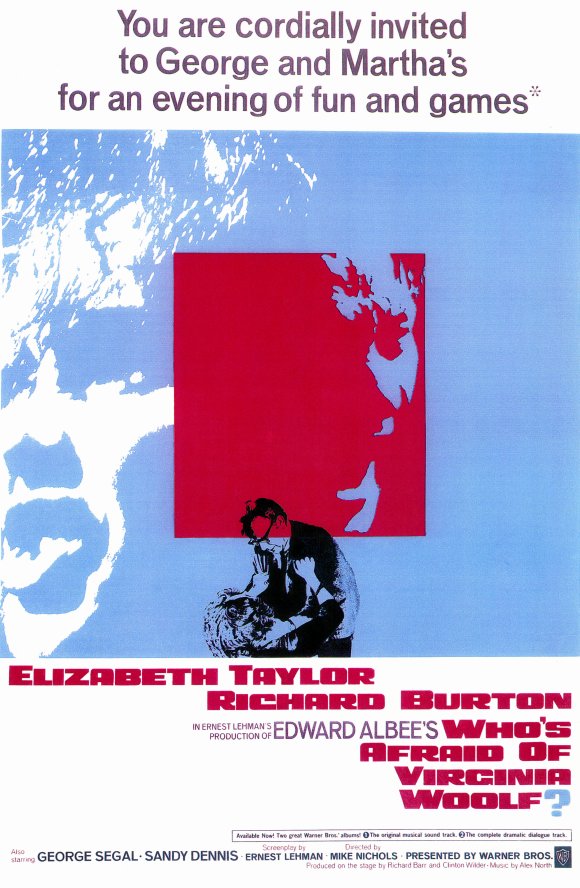
The promotional poster promises an evening of fun and games, but very little joy is to be found here, at least on the surface: all that marital baiting, sniping, and yelling is miserable. Fuck! It took me five or six false starts over a few years before I finally got into the film—and only with the help of a bottle of bourbon. Once I was in, though, I was hooked: watching this disastrous night unfold and all four characters unravel engrossed me desite the buzz I had going.

The oddly but appropriately named George (Burton), a history professor at a small East Coast university, and Martha (Taylor), the daughter of the school’s president, stumble home drunk from a faculty party, neither one listening to the other as they babble about nothing. Martha quotes Bette Davis, which ultimately reveals more about her viewpoint than any other comment she makes—and the woman can talk.

They babble and respond to each other half-heartedly. Martha tells George that she invited a young couple, a professor from another department and his wife, over for a drink. George is miffed, but there’s no time to react.

Enter Nick (Segal) and Honey (Sandy Dennis), a polite, young, good-looking couple that, as we learn, has their own set of problems. Martha and George pour drinks and pick at each other while Nick and Honey watch, uncomfortable at first, thinking maybe they shouldn’t be there. As the drinking continues, though, they’re pulled into the…drama? Turns out, they have more in common with each other than they think.

Here’s the thing about George and Martha: their marriage is dysfunctional, but they seem to operate well inside the confines of their explosive relationship—Martha brays and George stays, responding in a passive aggressive manner as he fixes them both another drink. Over and over and over again. Do they have any limits? It’s hard to say, partly because it’s never clear that we should take anything at face value: what we see is not necessarily what it is. That’s the genius of Who’s Afraid of Virginia Woolf. 

In 2013, the United States Library of Congress deemed Who’s Afraid of Virginia Woolf? “culturally, historically, or aesthetically significant” and selected it for preservation in the National Film Registry (https://www.loc.gov/programs/national-film-preservation-board/film-registry/complete-national-film-registry-listing/).

With Frank Flanagan, Agnes Flanagan

Production: Warner Brothers

Distribution: Warner Brothers

131 minutes
Not rated

(DVD purchase) A

All About Eve

(USA 1950)

“Fasten your seatbelts, it’s going to be a bumpy night.”

—Margo Channing

That iconic line succinctly captures the essence of Joseph L. Mankiewicz’s All About Eve, a sharp commentary on the treacherous relationship between female ambition and the American obsession with youth that still rings—and stings—true nearly 70 years later.

Based on Mary Orr’s short story The Wisdom of Eve, Bette Davis is Broadway legend Margo Channing, who’s turning 40 and sees doors closing in her professional and personal life. One rainy night, Karen Richards (Celeste Holm), Margo’s bestie, happens upon a young starstruck fan waiting backstage to meet Margo after a performance of her latest play, the aptly titled Aged in Wood. The fan, of course, is wide-eyed Eve Harrington (Anne Baxter), a mousy but well-spoken girl in an oversized trenchcoat who says she followed Margo from San Francisco to New York City and has seen every performance of the play—from the back of the house.

Karen, whose husband is none other than playwright Lloyd Richards (Hugh Marlowe), Margo’s frequent collaborator and author of Aged in Wood, brings Eve into Margo’s dressing room to meet her. Lloyd is there, along with Margo’s fiancé, director Bill Simpson (Gary Merrill), and her crusty sharp-tongued maid, Birdie (Thelma Ritter). Eve wins over everyone in the room with her poignant backstory about a poor midwestern upbringing on a farm, a husband killed in the War, and a humble stiff upper lip. Everyone, that is, except Birdie—she smells a rat.

Margo takes Eve under her wing as her personal assistant. Eve quickly proves to be an ace at organizing Margo’s affairs—and sneaking herself squarely into the middle of them. She aligns with caustic theater critic Addison DeWitt (George Sanders), who like Birdie doesn’t buy what Eve puts out there but unlike Birdie sees a mutual opportunity. Things sour all around when Margo learns that her producer, Max Fabian (Gregory Ratoff), designates Eve as her understudy without consulting her first.

Often compared to Sunset Boulevard for a variety of reasons, All About Eve is not as dark or campy but is way bitchier. From a technical standpoint, the script is tighter, the production more sophisticated, and the story a lot wittier. All things considered, it’s way more fun and has held up quite well—sure, the voiceovers are overdramatic, but these are theater people so it fits. I found it particularly interesting to see this film again right around the beginning of the FX series Feud, which not only is half about Davis but elaborates on the same issues that All About Eve raises. It underscores much of what Davis said about the industry in interviews late in her life.

None of the men here have any reason to worry about their age; for all of them, their success has nothing to do with how old they are or even how they look (their thing is power, but that’s another discussion). The women, on the other hand, constantly struggle to secure and then maintain their positions—and they’re ruthless about it. Eve earns the acting award she gets at the end (which is really the beginning): she fools everyone to manipulate them into giving her what she wants. It’s clear that sooner than later, she’ll be right where Margo is, for better but more likely for worse.

In one of her earlier roles, Marilyn Monroe makes an amusingly memorable appearance as dippy starlet Miss Casswell, who’s trying to catch a break. She’s got the best line of all: “I don’t want to make trouble. All I want is a drink.” Amen!

In 1990, the United States Library of Congress deemed All About Eve “culturally, historically, or aesthetically significant” and selected it for preservation in the National Film Registry (https://www.loc.gov/programs/national-film-preservation-board/film-registry/complete-national-film-registry-listing/).

With Barbara Bates, Craig Hill, Helen Mowery, Steven Geray

Production: 20th Century Fox

Distribution: 20th Century Fox

138 minutes
Not rated

(AMC River East) A

Fathom Events