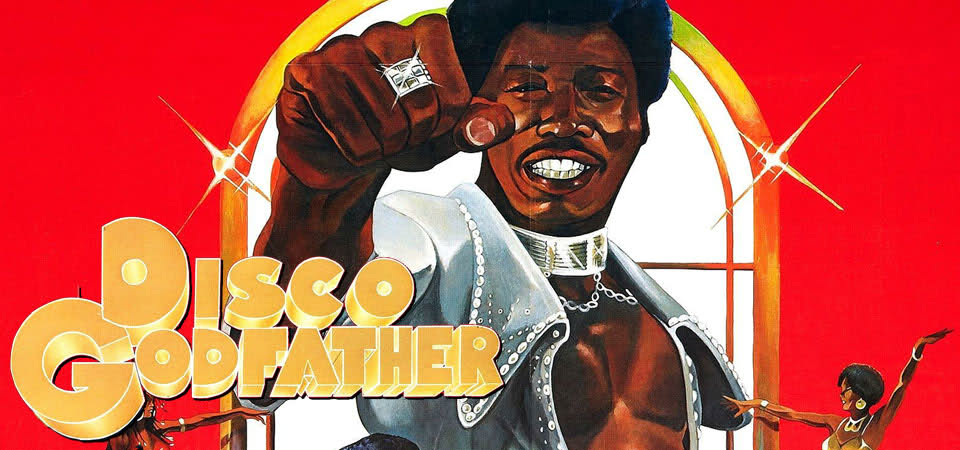
Dear God the Father! Some movies are so terrible, you love them for everything wrong with them—what’s bad is exactly what endears them. Other movies…well, they’re just terrible. It’s a thin line. Sadly, Disco Godfather falls into the latter category.
J. Robert Wagoner and Cliff Roquemore’s screenplay stars Rudy Ray Moore as Tucker Williams, an L.A. cop-turned-DJ at the trashy-ass Blueberry Hill Disco, which looks like a repurposed Denny’s. The plot involves Williams’s nephew, Bucky (Julius J. Carry III), who’s gotten hooked on “angel dust.”
One word: YAWN! What were they thinking? Disco Godfather is so boring, I’d rather watch reruns of 2 Broke Girls. The only thing that saves it from total failure is the wardrobe—Felice Hurtes, Jimmy Lynch, and Kimberly Sizemore deserve major kudos for finding the cool Goodwill stores. Fuck this bullshit: watch Dolemite and call it a day. They could have tried a little harder here.
With Carol Speed, Jimmy Lynch, Jerry Jones, Lady Reed, Hawthorne James, Frank Finn, Julius J. Carry III, Bishop Pat Patterson, Pucci Jhones, Howard Jackson, Yetta Collier, Pat Washington, Doc Watson, Leroy Daniels, Melvin Smith, Ronny Harris, Dolorise Parr, John Casino, Keith David
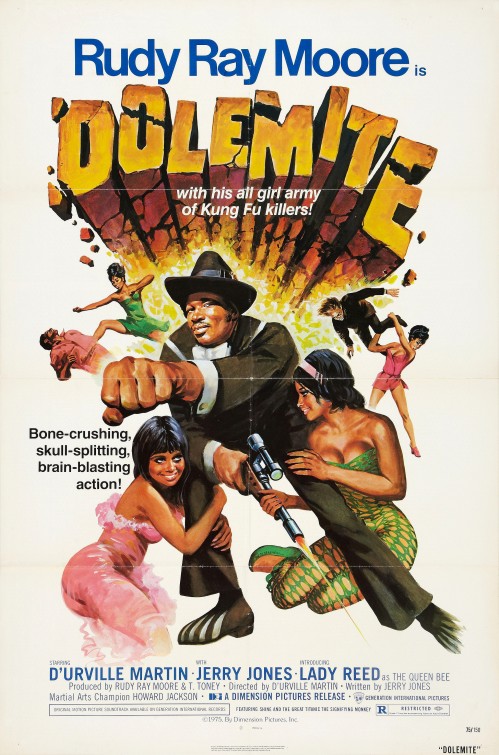
Dolemite (Rudy Ray Moore) is his name, and fuckin’ up mutha fuckas is his game!
He’s the baddest pimp around—well, around Los Angeles, anyway—and he looks every bit the part. Dolemite owns a nightclub and whorehouse but he’s doing time on a drug beef. Maybe it’s bogus, maybe not. Maybe some bad cops set him up, maybe it was archenemy Willie Green (D’Urville Martin), who took over the club and is running shit now. Either way, mother pimp Queen Bee (Lady Reed) and Dolemite’s army of ass-kickin’ kung fu hookers are none too happy about it.
To get out of the big house, Dolemite makes a deal with the po-po, Agent Blakeley (Jerry Jones), to, I think, help clean up his old hood. Dolemite uses this as an opportunity to exact revenge on Green and reclaim his, um, stature in the community. Along the way, he kicks a lot of ass, takes on two crooked cokehead cops—Mitchell (John Kerry) and White—and gets laid. A lot. He even cuss raps at the end.
Dolemite is not a movie to see because it’s a work of art. On the contrary, it’s terrible. But that’s what makes it so much fun to watch—that’s why it’s a cult classic. Like a lot of things before the late ’80s, it’s not P.C. (i.e., politically correct)—as if that isn’t obvious from the movie poster. The directing by Martin, which probably explains why he has so little screen time, is sloppy. You can count the number of times boom mics pop in. The fight scenes are laughable—Dolemite knocks people out barely lifting a finger (or here, leg) and sometimes without even touching them. Don’t even get me going on the martial arts stuff!
The plot is confusing and watered down. Jones wrote the screenplay with Moore, and the writing is just bad. I admit, I watched it drunk this time, but I’ve seen Dolemite before while sober. No difference. The events are scattered and at points seem random. The characters are colorful—shady Reverend Gibbs (West Gale), a possible parody of former Chicago leader Mayor Daley (Monte “Hy” Pike), the clearly trippin’ Hamburger Pimp (Vainus Rackstraw), and the many fox females—wander in and out, often without any reason.
Despite all that, Dolemite unquestionably has a charm of its own. Moore likes to rhyme, and he punctuates pretty much every sentence with “mutha FUCKA!” His crib is rent-to-own fabulous—check it out:
The wardrobe looks like it was borrowed from the Salvation Army. The climax at the nightclub goes on longer than it should but is still a showstopper. The soundtrack is a trip. If nothing else—and there is nothing else—Dolemite is a good time.
With Brenda DeLong, Terri Mosley, Marilyn Shaw, Lynell Smith, Vera Howard, Joy Martin, Jana Bisbing, Brenda Banks, Pat Haywood, René Van Clief, Pat Jones, Lola Mayo, Charlene Soulter, Liz Sample, Karolynn Hill, Dino Washington, Johnny J. Brown, Cardella Di Milo
Production: Comedian International Enterprise Productions (C.I.E.)
I doubt Crowther meant “gay” in the current sense of the word, but he certainly wasn’t wrong either way: between all the singing, dancing, handsome sailors in tight pants, and a very young and wide-eyed Frank Sinatra acting out a creepy attachment to Gene Kelly, the only thing that could make Anchors Aweigh any gayer would be an appearance by Judy Garland. Or a raunchy sex scene with all those sailors and the admiral who, in one number (“We Hate to Leave”), said he would beat them with a whip. I half expected and kinda wanted it to happen, but of course it didn’t. Oh well.
As a reward for their bravery, Navy seamen Joe Brady (Kelly) and Clarence Doolittle (Sinatra) are given a four-day leave in Hollywood. Joe plans to hook up with his dame, Lola. After stalking him on the streets of Los Angeles, sweet and naive ex choir boy Clarence asks the apparently more experienced Joe to teach him how to meet girls.
Enter Donald (Dean Stockwell, whom most of us know as a middle-aged man from his many ’80s and ’90s movies), a little tyke who’s running away from home to join the navy. Our boys take him home, where Donald lives with his Aunt Susie (Kathryn Grayson), a nice girl trying to get into the movie industry—if only she could catch a break. Clarence immediately falls head over heels and enlists Joe’s assistance in wooing her, which provides the story here.
Even though (and probably because) the characters, plot, and dialogue are totally corny, Anchors Aweigh is truly a frothy blast—it’s exactly the kind of film that comes to mind when I think of classic Hollywood. A vivacious affair, director George Sidney keeps everything about it big: the sets, the songs, the dance numbers. I was particularly taken by one sequence involving Kelly and various animated figures—it culminates in an awesome song-and-dance with none other than Jerry Mouse of Tom and Jerry cartoons. Flawless!
The whole spectacle is tied up in an amazing Technicolor bow; Charles Boyle and Robert Planck’s color palette is gorgeous, and seeing it on a nitrate print literally left me breathless. From a sensory perspective, Anchors Aweigh was hands down my favorite film at this year’s Nitrate Picture Show.
As a side note, I must confess that one thing threw me for a loop: Kelly and Sinatra (and Grayson, for that matter) are young and beautiful here—not the old timers I’m accustomed to seeing having grown up when I did. They’re actually hot, even by today’s standards. Kelly upstages Sinatra throughout the entire film, which I found bizarre and quite amusing.
With José Iturbi, Pamela Britton, Grady Sutton, Rags Ragland, Billy Gilbert, William Forrest
“No hay banda, il n’est pas d’orchestra. It is all an illusion.”
—The Magician at Club Silencio
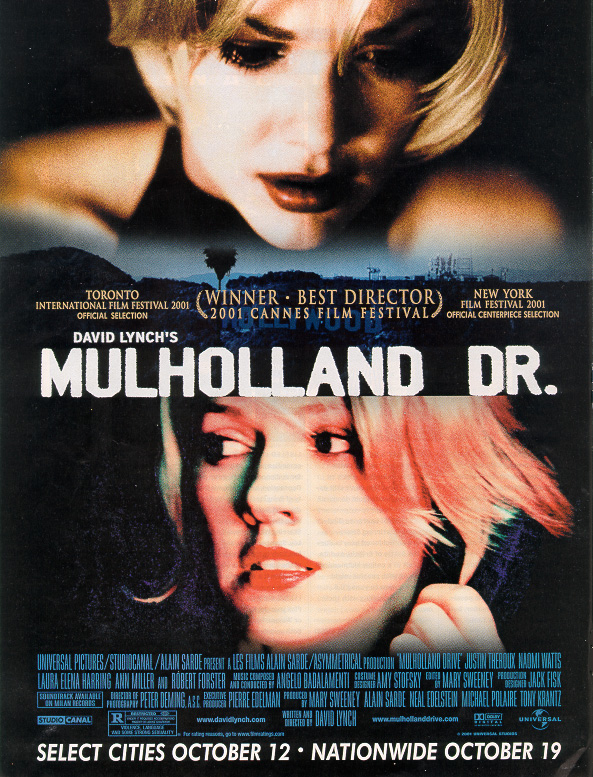
The perfect opener for a retrospective on its director, Mulholland Dr. is an inimitable film that’s really hard to write about. You can look for answers online all you want, but even after seeing it multiple times you still don’t know what happens in it.
Not unless you’re David Lynch. That doesn’t make it any less enjoyable, though.
I’ve seen Mulholland Dr. maybe three times, and I’m not sure. I have my theories. Maybe they’re right, maybe not. Who cares? As with any of Lynch’s best films, the draw to Mulholland Dr. is that it’s a puzzle. He makes you work to solve it, or at least try to. He gives you just enough to go on but leaves the whole thing open to interpretation. At points, he gets you so frustrated, you lose patience and you hate him. But you don’t want him to stop. It’s artistic sadomasochism.
What began as a project for television is a mystery mindfuck tailored to the big screen. Dreamlike, hypnotic, and erotic, Mulholland Dr. is visually demanding and aesthetically worth every minute. The premise is deceptively simple: perky and wide-eyed blond actress Betty (Naomi Watts) arrives in Hollywood and bumps into beautiful young brunette Rita (Laura Harring), who can’t remember who she is after a car accident on Mulholland Drive.
As the two set out looking for clues to Rita’s identity, Lynch throws in a bunch of random characters, muddled subplots, and perplexing events. The narrative arc he puts us on comes to an abrupt halt with a small blue box the girls acquire at a night club. This is where Lynch pulls the rug out from under us.
Mulholland Dr. is definitely a love story—one fraught with competition, petty jealousies, one-upmanship, and ultimately murder. Lynch’s trademark sense of humor flickers here and there, but this is still dark stuff. I see Mulholland Dr. as a denouncement of Hollywood and all its ruthless superficiality. It’s a town that eats you up and spits you out.
Motifs of filmmaking, commerce, ego, vision, and of course the color blue stand out. Rebekah Del Rio’s performance of “Llorando” is beautifully forlorn and eerie. I would be remiss not to mention Peter Deming’s cinematography, which makes Mulholland Dr. shine.
Sadly, Lynch hasn’t done a proper film since 2006. He’s the one living filmmaker whose work I miss the most. Mulholland Dr. is a testament to why: like the street where it takes its name, this film is twisting, treacherous, and ultimately breathtaking.
With Jeanne Bates, Robert Forster, Brent Briscoe, Patrick Fischler, Michael Cooke, Bonnie Aarons, Michael J. Anderson, Ann Miller, Angelo Badalamenti, Dan Hedaya, Daniel Rey, Justin Theroux, David Schroeder, Robert Katims, Marcus Graham, Tom Morris, Melissa George, Mark Pellegrino, Vincent Castellanos, Rena Riffel, Michael Des Barres, Lori Heuring, Billy Ray Cyrus, Tad Horino, Missy Crider, Melissa Crider, Tony Longo, Geno Silva, Katharine Towne, Lee Grant, Lafayette Montgomery, Kate Forster, James Karen, Chad Everett, Wayne Grace, Rita Taggart, Michele Hicks, Michael Weatherred, Michael Fairman, Johanna Stein, Richard Green, Conti Condoli, Lyssie Powell, Scott Coffey
Production: Les Films Alain Sarde, Asymmetrical Productions, Babbo Inc., Canal+, The Picture Factory
Ridley Scott is hit or miss with me, Harrison Ford bores me, and I tend to eschew science fiction. So, neo-noir sci-fi drama Blade Runner doesn’t seem like something that would appeal to me. It does, though—in fact, I love it.
Like Alien, another gem by Scott, Blade Runner succeeds on so many levels. Executed near flawlessly, its themes and narrative, its structure and pace, its sets and technical aspects are all polished, eloquent, and downright cerebral. It cuts right to the heart of humanity—what’s beautiful about it and what isn’t, and what it is to be human.
Los Angeles, November 2019: six rogue artificial humans known as replicants that were banished to an “off-world” work camp in space return to Earth in a desperate attempt to extend their life. Created by tech behemoth Tyrell Corporation, this particular model, the Nexus-6, is the smartest and strongest replicant. However, it has a lifespan of only four years—and the meter is ticking. Fortunately for them, replicants are indistinguishable from real humans, except for their emotional responses. It takes a lengthy question-and-answer test to positively identify them.
Burned out former cop Rick Deckard (Ford), whose job as a blade runner was to track down replicants and “retire,” or kill them, is persuaded—okay, extorted—out of a self-imposed furlough to find and get rid of these troublemakers. Stat. The job isn’t an easy one, particularly where charmingly weird and conniving Pris (Daryl Hannah) and invincible badass Roy (Rutger Hauer) are involved.
As Deckard searches for his targets, he meets and gets to know the rather severely formal Rachael (Sean Young), assistant to replicant inventor Dr. Eldon Tyrell (Joe Turkel). Rachael doesn’t know she’s a replicant. Tyrell asks Deckard to retire her as well, but there’s a problem: Deckard realizes he’s falling for her.
Adapted from Philip K. Dick’s novel Do Androids Dream of Electric Sheep?—with the title taken from Alan E. Nourse’s novel The Blade Runner, which had nothing to do with Dick (https://www.neondystopia.com/cyberpunk-movies-anime/the-story-behind-blade-runners-title/)—Blade Runner is dark in every sense of the word. Jordan Cronenweth’s cinematography is stunningly bleak. The setting might be Los Angeles, but Scott slyly references Metropolis—only he refits it to Hong Kong or Tokyo. Many of the ideas explored here are eerily relevant today, especially the way morality plays out with corporations, genetic engineering, a police state, the environment, and hierarchy of life and life forms.
Blade Runner is a weighty movie, but seriousness aside—I found myself entertained with a number of things that simply aren’t present today: PanAm, Atari, and TDK. Smoking indoors. Pay phones. Photographs. Even urban decay. I was also floored that one of the replicants was “born” 20 days after this screening. Plus, Roy is a bionic Ken doll and Pris looks like a club kid from Party Monster. Still, Blade Runner is timeless; I’ll see it again in three or 33 years and still swoon over it. Yes, it’s that good. The Final Cut is Scott’s own finetuned version of the original theatrical release. It kills me that after all this time, a sequel that I probably won’t see is coming out later this year.
“Revenge is never a straight line. It’s a forest. And like a forest, it’s easy to lose your way. To get lost. To forget where you came in.”
—Hattori Hanzō
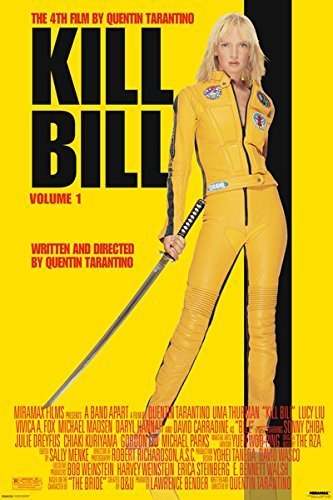
“It’s mercy, compassion, and forgiveness I lack,” The Bride (Uma Thurman) plainly informs one of her assailants before she exacts revenge. “Not rationality.” Uh, really? Right off the bat, Quentin Tarantino’s Kill Bill, Volume 1 (not to be conflated with Kill Bill: Volume 2, which is longer but not quite as good) is an action film packed with snark and coolness. Uma Thurman is The Bride (codeman Black Mamba), who in the sepiatone opening scene is lying on the floor of a chapel in El Paso, Texas. She’s in a wedding dress, bleeding and pleading for her life. “It’s your baby,” she tells Bill (David Carradine, who has a bigger part in the second installment). He shoots her in the head.
Four years later, The Bride wakes up—midfuck, mind you—from a coma in the hospital. There’s no baby. She takes out a would-be rapist, Jasper (Jonathan Loughran), and an orderly named Buck (Michael Bowen), who pimped her out. Incidentally, Buck has a catchphrase that rhymes with his name—you figure it out. The Bride runs off with Buck’s truck, the “Pussy Wagon.” Once she gets her feet and legs moving, she sets out to settle a score—or six. First, though, she has to persuade retired master swordsmith Hattori Hanzō (Sonny Chiba), who runs a sushi bar in Okinawa, to make her a sword.
Kill Bill: Volume 1 is totally far fetched, but that’s not important. Like most Tarantino films, the emphasis here is on the characters and the action, not the plot; otherwise, two hours of not much more than a badass blonde babe methodically killing teammates who double-crossed her when she was a member of something called the Viper Assassination Squad wouldn’t work. Originally intended as one long film (http://killbill.wikia.com/wiki/Kill_Bill:_Vol._1), Kill Bill: Volume 1 depicts two of the paybacks: Vernita Green (Vivica A. Fox), who’s now a housewife and mother in suburban Los Angeles, and O’Ren Ishii (Lucy Liu), the head of the Tokyo Yakuza.
Beautifully staged and shot, the violence is over the top yet perfectly choreographed. The scene at the House of Blue Leaves is eloquent right down to the blood in the snow. Tarantino plays around with the sequence of events and mixes genres including anime. He employs his penchant for sharp dialogue, snazzy settings with memorable names, and sick humor. Plus, he throws in cool music and clothes; Daryl Hannah dressed as a nurse, for example, is fucking fabulous! As a result, Kill Bill: Volume 1 is a dazzling bloodfest. It takes a certain type to love a film like this—and it’s one of my favorites.
With Julie Dreyfus, Chiaki Kuriyama, Gordon Liu, Michael Parks, James Parks, Sakichi Sato, Ambrosia Kelley
As teen comedies go, the ’90s were a teenage wasteland. Sure, there were a few classics: Dazed and Confused, Clueless, Election, and American Pie immediately come to mind. That’s really about it. Can’t Hardly Wait, the second film of Chicago International Film Festival’s Totally ’90s series, is a typical specimen from the decade: it has some moments, but overall it’s either bland or reductive. Frankly, I don’t even remember it in theaters, which probably says all I need to know.
The setting is a huge kegger in a Los Angeles suburb the night of graduation. Leading man Preston Meyers (Ethan Embry), a sensitive dork, has longed for class babe Amanda Beckett (Jennifer Love Hewitt) ever since he first laid eyes on her during freshman year: he knew they were destined to be together when he noticed the same strawberry Pop Tarts in her bag that he had in his. She went for Mike Dexter (Peter Facinelli), a jock, instead; they dated all through high school. Word on the street is, Mike dumped Amanda. Intrigued, Preston persuades his snarky and derisive bestie Denise Fleming (Lauren Ambrose), certainly no woo-woo girl, to accompany him.
Meanwhile, class geek William Lichter (Charles R. Korsmo), who looks like a deranged Harry Potter, shows up to exact revenge against Mike, his lifelong nemesis. Mike, who dumped Amanda so he could be free to sleep around all summer, isn’t having fun—he’s preoccupied reconsidering his decision. While Preston chases after Amanda to give her a letter in which he spills his guts, Denise gets locked into a secluded bathroom with wannabe gangsta/raver Kenny Fisher (Seth Green), who wears big sneakers and goggles and thinks he’s a stud but isn’t.
Co-directors and screenwriters Harry Elfont and Deborah Kaplan clearly watched a ton of ’70s and ’80s teen flicks. They have good ideas, but I’ve seen them done before and done better. The only storyline that really interested me was the one with Denise and Kenny in the bathroom. And I love Seth Green. Other than that, the situations and the dialogue here lack any snap or punch. It’s all pretty flat.
This is not to say I hated Can’t Hardly Wait; I didn’t. I just didn’t love it. It was merely okay. I consider myself a teen movie aficionado, and this did not move me. The soundtrack is way better.
With Michelle Brookhurst, Alexander Martin, Erik Palladino, Channon Roe, Sean Patrick Thomas, Freddy Rodríguez, Joel Michaely, Jay Paulson, Jason Segel (in his first appearance onscreen), Selma Blair, Jerry O’Connell
Production: Columbia Pictures Corporation, A Tall Trees Production
Tom Ford is a Virgo, and everything he does reflects textbook traits of his sign: his products are sharp, observant, and meticulous. He exhibits impeccable style and substance. He’s a perfectionist, and it shows. His films are no exception, and his aesthetic serves them well. I seriously dug A Single Man, but I figured it was a one-off project after a few years passed without a follow up. I’m glad Ford proved me wrong: Nocturnal Animals is great. It’s also different; A Single Man is in essence a gentle and compassionate love story, whereas Nocturnal Animals is a bitter tale about a bad romance, regret, revenge, and closure with a comment on how art mirrors life. Certainly not a breezy endeavor, it offers quite a bit of food for thought.
WARNING: Potential spoilers ahead!
Susan Morrow (Amy Adams), a study in contradictions, has all the material trappings of the glamorous life—too bad none of it brings her happiness. A rich and successful Los Angeles gallery owner, she hates what she does for a living. Her husband (Armie Hammer) is dashing but absent, offering more of an arrangement than a marriage. Part of the problem might be the bankruptcy he alludes to in one of their conversations early on. Or maybe it’s the transcontinental affair he’s carrying on in New York City. Their home is a chic box in the hills; Susan is alone in it—except for the hired help, of course.
A package arrives out of the blue from her ex-husband, Edward Sheffield (Jake Gyllenhaal). They haven’t spoken in years; their relationship did not end well. A simple guy she knew from growing up in Texas, she broke his heart with three horrible things she did—not the least of which was telling him he lacked what it takes to be a writer. Edward sent her the manuscript of his forthcoming novel, Nocturnal Animals, which he dedicates to her. He included a note stating that he will be in town and wants to meet her out.
Susan opens it and starts reading. Immediately, the story seduces her. Edward’s novel, depicted from her imagination as a film within the film, is a tragically violent work of pulp noir. Tony Hastings (Gyllenhaal) is driving down a dark desert highway in Texas with his wife (Isla Fisher) and their daughter (Ellie Bamber) when a band of hicks runs them off the road. Facing a menacing proposal, Tony tries to talk his way out. Sensing weakness, nefarious psychopath ringleader Ray (Aaron Taylor-Johnson) exploits the situation and separates Tony from the girls. With one potential shot at saving his family, Tony blows it and ends up seeking help from the police. Officer Bobby Andes (Michael Shannon), a pithy cowboy with a badge, can’t comprehend why Tony didn’t put up a fight, but he helps track down the bastards so Tony can exact revenge.
Ford adapted his screenplay from Austin Wright’s 1993 novel Tony and Susan. What’s both interesting and distracting about Nocturnal Animals is the way he presents the story: he bounces back and forth between Susan’s present reality, her past, and Edward’s work of fiction that ties both together. It’s a very tricky feat, but he absolutely nails it with smooth transitions and masterful use of imagery and symbolism to connect the three narratives. Like most people (I suspect), I was far more interested in Tony than Susan even though Susan’s past and present are necessary to understand the story: Edward’s novel is a metaphor for his relationship with her. Many have complained about the ending, which is open to interpretation. I found it both realistic and satisfying whether Edward says “fuck you” to Susan or lets her off gently.
Visually, Nocturnal Animals is flawless. Ford’s sets, props, clothes, colors, and staging all work together with Seamus McGarvey’s dark and lovely cinematography to create a striking realm where naked fat ladies, a hick taking a dump, a bloody papercut, and discarded corpses are all things of beauty. The acting is superb all around, but Laura Linney is particularly exquisite in her brief role as Susan’s Lone Star Republican mother. All big-haired and dripping pearls and superiority, she sips her martini at an exclusive restaurant and urges Susan to forget about marrying a weak man like Edward. Fabulous!
I wasn’t sure what to expect from Damien Chazelle’s La La Land, the opening night presentation for the Chicago International Film Festival. I like its stars—Emma Stone and Ryan Gosling are great in just about everything they’re in; in fact, they both have the rare ability to elevate even superb material. I adore Los Angeles, too. I figured at worst, I’d have some decent eye candy and some lovely scenery to take in.
Thankfully, La La Land is far better than the worst case scenario I imagined: it’s glossy, colorful, and pretty, even if it’s not Moulin Rouge. It starts out strong with a vibrant dance number that takes place in a traffic jam on a freeway, probably the 101. The scene reminds me of a more exuberant version of R.E.M.’s “Everybody Hurts” video. Attention grabbed! This is where our heroes meet, one flipping the bird at the other.
We soon learn that both Mia (Stone) and Sebastian (Gosling) are trying to make it, she as an actress and he as a jazz pianist. She puts herself out there; he doesn’t. They cross paths over the course of nearly a year, flirting and pulling back then flirting some more. Some of their interactions are hilarious, like Sebastian’s stint in an ’80s cover band playing at a party that Mia happens to attend. They finally click; it’s exciting to watch them come together. They have a real chemistry. They also have dreams and goals that require sacrifice. Sadly, nothing is what it’s built up be—neither dreams coming true, fame, nor love. At its heart, La La Land is a relationship film, and a tragically decent one at that.
Undeniably well-done, La La Land definitely has a certain magic to it. Linus Sandgren’s cinematography is gorgeously eye popping; of all the films I’ve seen that came out this year, it’s second only to Hell or High Water. Some songs are better than others, but the acting all around makes up for it. John Legend has a role that turns out to be more than a cameo, and he’s actually pretty good. Essentially a love letter to Los Angeles, there’s no shortage of romantic moments here, not the least of which takes place floating midair under the stars at Griffith Observatory after closing time. Or in a movie theater for Mia and Sebastian’s first kiss.
The story is an emotional roller coaster that pulled me along through its ups and downs. The final scene got to me in a way that no film has in awhile—it actually fucking hurt. So in that sense, La La Land surely stands on its own. I question how memorable it will ultimately prove to be, though. I can’t put my finger on exactly what, but it lacks that extra element that would make it a truly great film. Perhaps its story is conventional, or perhaps its execution is too restrained and not over the top enough. I don’t know. As much as I enjoyed it, I can think of other movies the actors have done that are better. Time will tell where this one lands, but for now it’s worth the investment to see it.
“It’s from Casablanca. I’ve waited my whole life to say it!”
—Allan
Play It Again, Sam is a rare Woody Allen film that he wrote and starred in but did not direct; it’s only his second such screenplay (http://www.ibtimes.com/8-films-woody-allen-acted-didnt-direct-video-1386755). Herbert Ross directed this film adaption of Allen’s play of the same name. Interestingly, it’s set in San Francisco, not New York or Los Angeles.
Allan Felix (Allen) is a neurotic film critic whose flaky wife (Susan Anspach) just left him. All on his own in their small apartment crammed with his film memorabilia, he’s understandably out of sorts and depressed; being Woody Allen, though, it’s a hundred times worse than anyone else, which makes it funny. His friends Dick (Tony Roberts) and Linda (Diane Keaton), a married couple, encourage him to meet new women, even going so far as setting him up on a date (Jennifer Salt). It’s not working because, well, his neurotic tendencies undermine his efforts—breaking record albums, spilling drinks, knocking down furniture, getting beat up. Not even the ghost of Humphrey Bogart (Jerry Lacy) popping up here and there to offer advice on babes helps. Allan crosses a line when he falls for Linda—and Dick catches a whiff of something going on.
Play It Again, Sam is typical Woody Allen—need I say more? He’s relatably cringeworthy, which is his gift. I loved Linda’s “I love dick” speech and Allen’s date with hot redhead Jennifer (Viva). All the references to Casablanca are fun. The story is a bit predictable, but the characters here keep the film enjoyable. So do the situations, which are just silly enough to remain believable without going too far.







 moviebloke