Ginger Snaps

(Canada 2000)

“Shit, wrists are for girls. I’m slitting my throat.”

— Ginger Fitzgerald

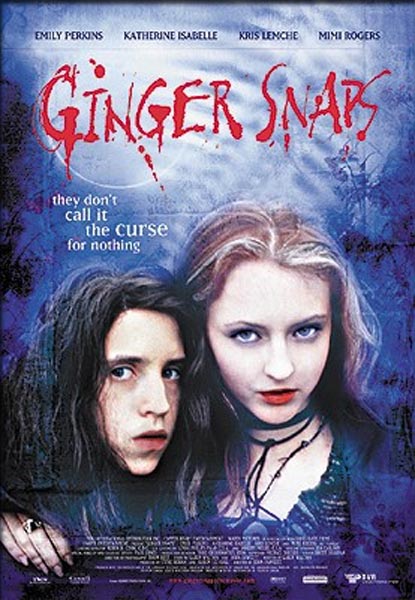
Puberty is tough enough without your older sister turning into a werewolf. Just ask 15-year-old Brigitte Fitzgerald (Emily Perkins), who with her sib, Ginger (Katharine Isabelle), stages gory death scenes and takes pictures of them, like a pair of morose Cindy Shermans. When they were kids, they made a pact to die together. Their classmates think they’re weird.

A run-in with mean girl Trina Sinclair (Danielle Hampton) sparks a war. Walking through the woods on their way to exact revenge one October night with a full moon, Ginger gets her first period. She also gets attacked by a mysterious and savage beast — the same one responsible for eviscerating all the dogs in the neighborhood.

Ginger turns increasingly feral over the next few days, growing more aggressive and sexual. Her wounds, which heal almost immediately, are sprouting hair. Oh yeah, she’s also developing what appears to be…a tail?

Brigitte, or “B,” connects with cute, brooding dope dealer Sam (Kris Lemche), who struck and killed the beast while he was driving his van down the road where it ran after it attacked Gretchen. He’s got a recipe for what might be the cure. The clock is ticking as Gretchen gets farther out of control, and Halloween — with another full moon — approaches.

On paper — all I had going into it because I’d never heard of it — John Fawcett’s Ginger Snaps sounds dubious at best. The premise seems trite. The part about the period sounds stupid, and the analogy to “becoming a lady” is obvious.

Turns out, Ginger Snaps is surprisingly good. Incorporating familiar elements of teen movies and splatter flicks, Fawcett, who wrote the screenplay with Karen Walton, pushes the “suspension of disbelief” envelope. He knows just when to stop, though. There’s quite a bit of gore here. The special effects are dated but effective nonetheless.

What really sells this film, though, is the acting: Perkins and Isabelle evoke a warmth to their relationship despite their offputting personalities and a fierceness to their bond. They’re totally believable as sisters. The final scene, which involves only them, is downright sad. Crushing, even.

With Mimi Rogers, Jesse Moss, John Bourgeois, Peter Keleghan, Christopher Redman, Lindsay Leese, Wendii Fulford, Pak-Kong Ho, Lucy Lawless

Production: Motion International, Copperheart Entertainment, Water Pictures, Lions Gate Films, Oddbod Productions, TVA International

Distribution: Motion International (Canada), Unapix Entertainment Productions (USA), Lions Gate Films

108 minutes
Not rated

(Music Box) B-

Music Box of Horrors

http://www.gingersnapsthemovie.com

Hellraiser

(UK 1987)

“Oh, no tears, please. It’s a waste of good suffering!”

— “Pinhead” (the Lead Cenobite)

Roger Ebert famously derided Clive Barker’s directorial debut, the sadomasochistic horror classic Hellraiser, calling it “without wit, style, or reason” for its “bankruptcy of imagination” (http://www.rogerebert.com/reviews/hellraiser-1987). Well, talk about tearing your soul apart!

Hellraiser isn’t particularly scary, but it is creepy and fucking weird. I certainly don’t find it lacking wit, style, or imagination; quite the opposite. It’s a ridiculous, kinky, and bloody telenovela. Based on Barker’s short novel The Hellbound Heart, Hellraiser takes the idea of something in the attic to a place no one else has.

Larry (Andrew Robinson) and Julia Cotton (Clare Higgins) have a strained marriage. After leaving Manhattan to go live in his abandoned boyhood home somewhere on the Atlantic coast, Julia finds Larry’s brother — who’s her ex lover — Frank (Sean Chapman in the flashbacks and Oliver Smith in the present) reanimated without skin in the attic. The movie doesn’t explain it, but the novel does: Larry cuts his hand and drips blood onto the attic floor, right where Frank’s comeshot dried up in the floorboards. Nice.

An unrelenting hedonist, Frank lost his body and soul to demons in his quest for sexual gratification. It started with an antique puzzle box that opened a portal to hell and summoned the Cenobites, led by “Pinhead” (Doug Bradley), the apparent spokesman for the motley foursome. Now, Frank needs blood, which is where Julia comes in. Too bad Frank’s daughter, Kirsty (Ashley Laurence), keeps getting in the way.

The special effects look cheap and the plot is choppy. It isn’t clear at first whether the cuts to Frank and Julia getting it on are flashbacks or fantasy, so this detail could have been done better. Nonetheless, Hellraiser is totally engrossing (and at points, just gross). Barker makes a silly story bizarre enough to keep you interested in what happens next. Higgins effectively channels a tortured melodramatic ’50s B-movie damsel in distress. And her big ’80s hair and sunglasses are fabulous!

Perhaps the best thing Hellraiser has going for it, though, is its twisted sense of humor: all of this happens — and will happen again — because Frank thinks with his dick. Now that’s funny.

With Nicholas Vince, Simon Bamford, Grace Kirby, Robert Hines, Anthony Allen, Leon Davis, Michael Cassidy, Frank Baker, Kenneth Nelson, Gay Baynes, Dave Atkins, Oliver Parker

Production: Cinemarque Entertainment BV, Film Futures, Rivdel Films

Distribution: New World Pictures (USA), Entertainment Film Distributors (UK), Highlight Film (West Germany), Paraiso Films S.A. (Spain), Prooptiki (Greece), Roadshow Film Distributors (Australia), Toei Classic (Japan), Vestron Benelux (Netherlands)

94 minutes
Rated R

(Music Box) B-

Music Box of Horrors

http://www.clivebarker.info/hellraiser.html

Foxy Brown

(USA 1974)

“That’s my sister, baby. And she’s a whole lot of woman.”

— Link


“Death is too easy for you, bitch. I want you to suffer.”

— Foxy

To use a term straight from Willie Hutch’s theme song, director/screenwriter Jack Hill’s Foxy Brown is superbad. It’s definitely not something to see for technical or artistic excellence, but it’s cool nonetheless. A sort of reworking of Coffey, it’s a sexy vigilante revenge tale that doesn’t take itself too seriously.

Pam Grier is Foxy Brown, a bodacious woman on a mission to track down the goons who shot and killed her boyfriend (Terry Carter), a government agent who just had plastic surgery to change his identity, right outside her door. Obviously, this is the work of a Los Angeles drug ring.

Foxy quickly figures out who the rat is: her own brother, Link (Antonio Fargas). He identifies her boyfriend’s killers as affiliates of a “modeling agency.” The agency is run by fixers Miss Kathryn Wall (Kathryn Loder) and Steve Elias (Peter Brown). Their clients are crooked high profile men of the law like judges and politicians who trade favors for girls.

Posing as a prostitute, Foxy gets inside the operation and does some major damage. It gets her in serious hot water when she’s exposed, bringing her into the center of a lesbian bar brawl and then onto a coke ranch as a junky sex slave. Fortunately, she’s tough and resourceful. No one gets the best of Foxy.

Built on sex parties, chase scenes, shoot outs, and boobs, the plot is structured like a sitcom, and it’s about as complicated and predictable. Naturally, Foxy gets what she wants in the end. Except for the very cool opening titles, there are no effects to speak of. The acting is average at best. However, the action is surprisingly steady, leaving very few dull spots. Plus, there’s real sas here, mostly from Grier, that keeps the whole thing interesting.

I wouldn’t go so far as to call Foxy Brown a feminist work, but Foxy is a badass heroine with her heart — and her head — in the right place. It’s a thrill watching her take control, especially in heels and those fabulous frocks. I wouldn’t want to piss her off.

With Harry Holcombe, Sid Haig, Juanita Brown, Sally Ann Stroud, Bob Minor, Tony Giorgio, Fred Lerner, Judy Cassmore, H.B. Haggerty, Boyd ‘Red’ Morgan, Jack Bernardi, Brenda Venus, Kimberly Hyde, Jon Cedar, Ed Knight, Esther Sutherland, Mary Foran, Jeannie Epper, Stephanie Epper, Peaches Jones, Helen Boll, Conrad Bachmann, Russ Grieve, Rodney Grier, Roydon E. Clark, Don Gazzaniga, Jay Fletcher, Gary Wright, Fred Murphy, Edward Cross, Larry Kinley Jr.

Production: American International Pictures (AIP)

Distribution: American International Pictures (AIP) (USA), Sociedade Importadora de Filmes (SIF) (Portugal), Film AB Corona (Sweden), Cinema Mondo (Finland)

92 minutes
Rated R

(Impact) C+

https://youtu.be/eVDvu28O3WU

Il Boom

(Italy 1964, 2017)

For some reason — I can’t find an answer — Il Boom was not released in the States until this year. Madonne! Better late than never, and I’m glad it made it because it reaffirms my love of midcentury Italian cinema.

Giovanni Alberti (Alberto Sordi) lives large. His fabulously modern apartment in Rome features a gorgeous patio for entertaining. He employs a housekeeper and sometimes a wait staff. His beautiful and frivolous wife, Silvia (Gianna Maria Canale), has expensive taste. Every night, they go out on the town for lavish dinners and fancy cocktails, dancing and partying in the most chic and trendy clubs.

A game of footsie under the table suggests that his bourgeois crowd is into some naughty stuff on the side, but Giovanni loves Sylvia way too much for that.

Life is grand, but that’s the problem: Giovanni lives above his means. Unbeknownst to Sylvia, who continues to spend gleefully, he’s over his head in debt and about to be publicly humiliated on “the registry.” He can’t get another loan because his credit is shot. Desperate, he suggests a simpler lifestyle, which Sylvia simply ignores. He can’t bring himself to tell her why.

Giovanni fails miserably to convince a number of friends and associates to invest in his land development plan, which may or may not be a scam. His last hope is one-eyed real estate mogul Mr. Bausetti (Ettore Geri), who like everyone else turns him down. Mrs. Bausetti (Elena Nicolai), however, makes a proposal behind her husband’s back: she offers to buy Giovanni’s left eye. He can name his price.

Il Boom is a lot of fun. The title refers to the postwar economic boom in Italy and elsewhere. Director Vittorio De Sica and writer Cesare Zavattini are critical of consumerism, and there’s definitely a moral. However, they avoid getting on a soapbox and simply make fun of it. The story moves along breezily, and quite a few scenes — the dinner party, the hospital — are memorably offbeat and funny. Sordi is perfect as the hapless Giovanni, displaying a mercurial energy and general uneasiness that keeps you watching. His reaction to Mrs. Bausetti’s offer is priceless. I left with a smile.

Armando Nannuzzi’s cinematography is beautiful in luminous black and white; I can’t imagine Il Boom in color. Billy Vaughn’s super cool “Wheels” plays throughout the film; man, does it stick in your head. I’m humming it now.

With Alceo Barnabei, Federico Giordano, Antonio Mambretti, Silvio Battistini, Sandro Merli, John Karlsen, Ugo Silvestri, Gloria Cervi, Gino Pasquarelli, Maria Grazia Buccella, Mariolina Bovo, Felicita Tranchina, Franco Abbiana, Rosetta Biondi

Production: Dino de Laurentiis Cinematografica

Distribution: Rialto Pictures, StudioCanal

88 minutes
Not rated

(Gene Siskel Film Center) B+

http://www.rialtopictures.com/catalogue/il-boom

The Florida Project

(USA 2017)

“Relax. Your daughter’s perfectly fine in my hands.”

— Moonee

Sean Baker’s Tangerine (https://moviebloke.com/2015/07/28/tangerine/) impressed me. On the surface an offbeat odyssey of castoffs living on the fringe in West Hollywood, it’s one of those films that creeps up and hits you at the end. Comprised largely of small moments and vignettes strung together, its sum is much more — and completely different — than its parts: insightful, powerful, and quietly profound.

Come to think of it, Barry Jenkins’s Moonlight (https://moviebloke.com/2016/11/19/moonlight/) operates in a similar way even though it’s not the same story.

I was thrilled to hear that Baker has a new film, The Florida Project, out this fall. The comments I overheard from audience members while walking out of a prerelease screening were amusing but maddening: “That was realism, hard realism. Too hard.” “Well, that didn’t go anywhere.” “I had to force myself to stay awake.” “I wouldn’t recommend that to anyone.” Insert eyeroll here.

I disagree. The Florida Project switches gears, so it doesn’t end up where it seems to be going. The trailer makes it look like a childhood nostalgia movie, and it starts out like one. But it’s not. Often amusing but just as often difficult to watch, it paints a vivid picture that doesn’t criticize, demean, or sentimentalize its characters or their situation. I’ve heard Baker lauded for his humanism; his work definitely shows plenty of that if nothing else. His best attribute may be his willingness to let his characters develop into real people over the course of two hours or so.

To be clear, the impact of The Florida Project is not immediate. Baker’s pace isn’t quick, either. Written by Baker and Chris Bergoch, The Florida Project starts out as a sort of Little Rascals sitcom involving the misadventures of besties Moonee (Brooklynn Prince) and Scooty (Christopher Rivera), two grade school kids growing up in a sketchy roadside motel, the Magic Castle, that sits along a tawdry strip just outside the Magic Kingdon — a.k.a. Disney World in Orlando. A gun shop, a convenience store, a market that sells oranges, and a boarded up clinic dot the strip, which incidentally intersects with Seven Dwarves Lane.

Moonee and Scooty spend their days running around, screaming, and stirring up mischief. They spit all over a motel guest’s car. They drop water balloons on people. They spy on an elderly topless sunbather (Sandy Kane). They scam change to buy ice cream. They set a fire. They recruit a third hellion, Jancey (Valeria Cotto), who lives next door and easily goes along with their antics probably because there’s no one else to play with. Their favorite target is weary motel manager Bobby (Willem Dafoe).

Slowly, a different picture emerges and The Florida Project becomes another film. Moonee’s mother, Halley (Bria Vinaite), can’t get it together. Feral and clearly her own worst enemy, she lives hand to mouth with her young daughter. She’s constantly about to be evicted, and she takes free meals wherever she can get them. When selling stolen amusement park passes and wholesale perfume in the parking lot of a “nicer” motel up the street doesn’t work, she turns tricks in the room.

After Halley has a falling out with Scooty’s mom, Ashley (Mela Murder), Baker literally zooms in on Moonee.

The events here are purposely mundane, and it’s hard to say exactly where the climax is. It doesn’t matter: The Florida Project works because of the way Baker executes the story. He’s just as careful about choosing what he shows as what he doesn’t. The thrill here is watching the characters develop, anyway; that’s what makes The Florida Project soar. It doesn’t hurt that the acting is superb, particularly Vinaite, Prince (who at six years old is a natural — I almost cried when she did), and Dafoe, whom I haven’t seen this good since Mississippi Burning.

Alexis Zabe’s cinematography — alternating long shots and pans with almost uncomfortably close shots — works beautifully with the gorgeously effervescent color palette. The ending is unexpectedly touching and fun. The Florida Project just might be the first Oscar contender I’ve seen this year.

With Josie Olivo, Aiden Malik, Caleb Landry Jones, Shail Kamini Ramcharan, Sonya McCarter, Karren Karagulian, Kelly Fitzgerald, Lauren O’Quinn, Edward Pagan, Cecilia Quinan, Kit Sullivan, Andrew Romano

Production: Cre Film, Freestyle Picture Company, June Pictures, Sweet Tomato Films

Distribution: A24 (USA), Altitude Film Distribution (UK), Elevation Pictures (Canada), Filmcoopi Zürich (Switzerland), September Film (Netherlands), Front Row Filmed Entertainment (United Arab Emirates)

115 minutes
Rated R

(AMC River East) A-

Chicago International Film Festival

https://a24films.com/films/the-florida-project

Funeral Parade of Roses [Bara no Sōretsu]

(Japan 1969)

Funeral Parade of Roses [薔薇の葬列] is an intriguing film for a few reasons. Clearly influenced by the French New Wave, writer and director Toshio Matsumoto comes up with something simultaneously ordinary yet avant-garde, very much a product of its time yet years ahead. It’s extraordinarily cool.

Structured as a movie within a movie, Funeral Parade of Roses follows Tokyo “gay boy” Eddie (Pîtâ a.k.a. Peter) through his many exploits as a young transvestite immersed in the underground club scene. He might even be a hooker. Meanwhile, he’s carrying on a secret affair with Jimi (Yoshimi Jô), the boyfriend of club elder statesperson and fellow gay boy Leda (Osamu Ogasawara). Leda is onto them. Oh, the drama it creates!

While all this is going on, a camera crew records Eddie as though this were The Real World or Truth or Dare.

As Eddie ponders who he is — and looks to alcohol, group sex, drugs, and lots of attention from others for answers — Matsumoto explores “queer identity” through him. He intersperses interviews, flashbacks, episodes with Eddie’s mother (Emiko Azuma), and even a musical diversion or two to offer clues. A crazy subplot develops, and it references Oedipus in a tacky and sad but clever way.

Clumsy in its exploration of “gay life” and downright disturbing at points, Funeral Parade of Roses is nonetheless fun to watch. Shot in gorgeous black and white, it has an otherworldly feel. When it’s not nihilistic, it’s kitschy and entertaining — almost in a nascent John Waters way, just not quite as rough. The clothes are mod. The music is heavy on classical. The ending, sudden and bloody, is really messed up.

I’m not sure what exactly Matsumoto is saying here — a lot is open to interpretation — or that I agree with him. Either way, I enjoyed the journey.

With Yoshio Tsuchiya, Toyosaburo Uchiyama, Don Madrid, Koichi Nakamura, Chieko Kobayashi, Shōtarō Akiyama, Kiyoshi Awazu, Flamenco Umeji, Saako Oota, Tarô Manji, Mikio Shibayama, Wataru Hikonagi, Fuchisumi Gomi, Yô Satô, Keiichi Takenaga, Hôsei Komatsu

Production: Art Theatre Guild, Matsumoto Production Company

Distribution: Art Theatre Guild, Image Forum (Japan), Cinelicious Pics (USA)

105 minutes
Not rated

(Gene Siskel Film Center) B+

Swept Away…by an Unusual Destiny in the Blue Sea of August [Travolti da un insolito destino nell’azzurro mare d’agosto]

(Italy 1974)

“Oh, Madonna! This nightmare is finally over. God, do I want some coffee. Fresh, of course.”

— Raffaella Pavone Lanzetti

More than 40 years after the fact, Lina Wertmüller is still an audacious filmmaker. Not only does she incorporate sociopolitical commentary, satire, and crazy sex into her work, but her ’70s films are inherently interesting because they push buttons. She’s the first female nominated for an Oscar for Best Director, and there’s a reason for that: she’s a radical with more balls than just about anyone else working, even today.

Case in point: Swept Away…by an Unusual Destiny in the Blue Sea of August [Travolti da un insolito destino nell’azzurro mare d’agosto] — or simply Swept Away for short — is not a standard comedy. The plot is simple: an insufferable rich bitch, Raffaella (Mariangela Melato), is vacationing in the Mediterranean with her millionare husband (Riccardo Salvino) and their friends on a yacht. Raffaella is thoughtless and demanding, and she relentlessly berates rugged deckhand Gennarino Carunchio (Giancarlo Giannini) because the coffee isn’t fresh, the fish doesn’t taste right, and the pasta isn’t al dente enough.

She insists that Gennarino take her swimming. The two end up stranded in the water, far from the yacht. They eventually spot land, which turns out to be a small uninhabited island. Gennarino, a fisher, has no trouble finding food or shelter. Raffaella isn’t used to doing things herself, and soon finds that she is dependent on Gennarino. He isn’t exactly gracious about his new upper hand. It isn’t long before their relationship takes a sexual turn.

Wertmüller, who wrote the screenplay as well as directed, plays on traditional notions of sex roles. By today’s standards, Swept Away is probably too violent to come off as funny. The many scenes where Gennarino slaps and physically pummels Raffaella are bad enough, but when he rapes her on the beach? It’s disturbing. How is that funny? That’s the point — at first, anyway.

Swept Away isn’t really about sex: it’s about power. Here, the power dynamic shifts once Raffaella and Gennarino are out of the “civilized” world and lost in the wild, where economics and social status no longer define one’s place. Like all of her early films, Wertmüller has a lot to say about class structure; here, she also has a lot to say about male/female relationships. She’s controversial, but her approach works really well. It helps that Melato and Giannini, who starred in earlier films together, have a believable chemistry — and they spend a bit of time here wearing very little.

Swept Away is not a typical film. I call it a comedy, but it doesn’t fit neatly into any category. It’s sharp, subversive, and still pretty potent.

With Isa Danieli, Aldo Puglisi, Anna Melita, Giuseppe Durini, Lucrezia De Domizio, Luis Suárez, Vittorio Fanfoni, Lorenzo Piani, Eros Pagni

Production: Medusa Distribuzione

Distribution: Medusa Distribuzione (Italy), Cinema 5 Distributing (USA)

116 minutes
Rated R

(iTunes rental) B+

http://www.linawertmuller.com/framegeo.htm

https://youtu.be/KahTs5J2pl0

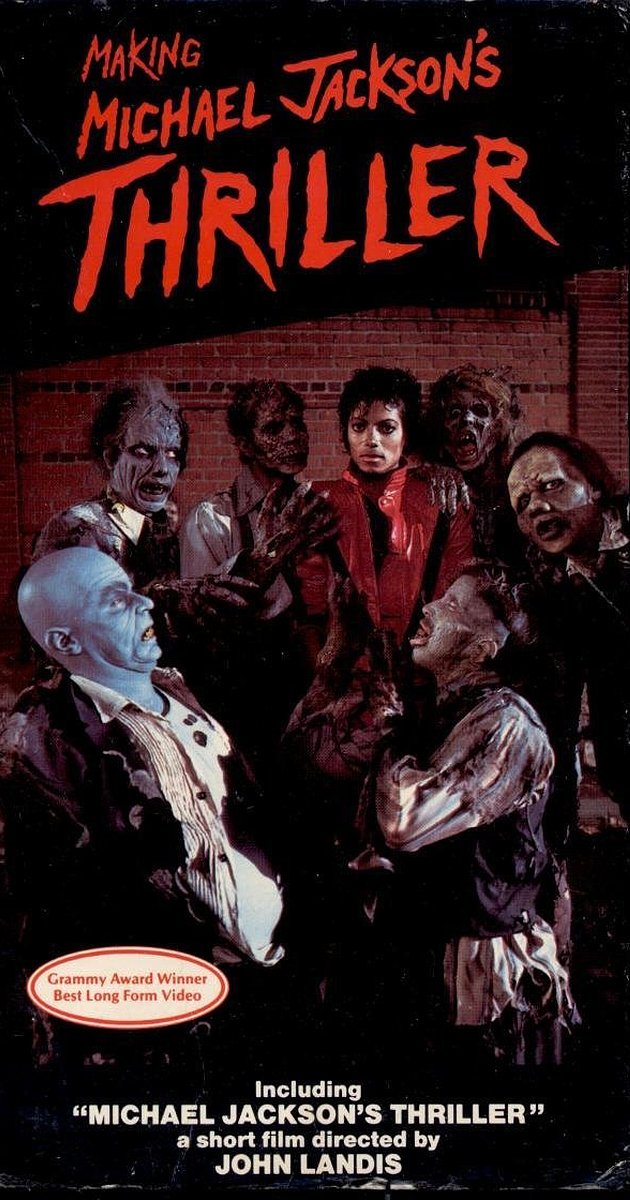
Michael Jackson’s Thriller

(USA 1983)

“Now, I have something to tell you…I’m not like other guys.”

— Michael Jackson

A very young Michael Jackson on a date with…his girlfriend (Ola Ray)? Jackson playing a werewolf, a zombie, and a lizard-eyed creature? Vincent Price reading an outro? Bad ’80s hair? You know it’s thriller, thriller night!

It’s not his best song, but Michael Jackson’s Thriller is a fucking cool video. It features all the showmanship he’s known for — the dancing, the weirdness, the bigness of the whole thing, that red jacket and those white socks, oh and a setting in the midst of seedy urban decay, this time a cemetery apparently somewhere downtown. Directed by John Landis, Thriller is clever: what starts as a cheesy horror movie turns out to be…a cheesy horror movie. Loaded with references to Night of the Living Dead and An American Werewolf in London, Thriller demonstrates that Jackson actually had a sense of humor.

I don’t put a music video on my blog every day. In fact, Michael Jackson’s Thriller is (so far) the only one. Why? In my quest to see as much as possible on the Library of Congress National Film Registry, I am obligated to include the final single and title track from the legendary pop star’s massive blockbuster album Thriller (https://en.m.wikipedia.org/wiki/Thriller_(Michael_Jackson_album) ). The song was not written by Jackson — Rod Temperton came up with it.

This video truly was a “seismic shift” — longer, more dramatic, and reaching beyond the song, it proved that music videos could be more than promotional clips; they literally could be little movies — or as here, bona fide events — that attract a huge audience, and thus worthy of a big budget. I can cite a number of artists who followed the template that Jackson set with Thriller.

In 2009, the United States Library of Congress deemed Michael Jackson’s Thriller “culturally, historically, or aesthetically significant” and selected it for preservation in the National Film Registry (https://www.loc.gov/programs/national-film-preservation-board/film-registry/complete-national-film-registry-listing/).

With Marcea Lane, Kim Blank, Lorraine Fields, Tony Fields, Michele Simmons, Vincent Peters, Michael Peters, Vincent Paterson, Michael De Lorenzo, Ben Lokey, John Command, Richard Gaines, Mark Sellers, Suzan Stadner, Diane Geroni, Suga Pop

Production: MJJ Productions, Optimum Productions

Distribution: Epic Records, Vestron Video

14 minutes
Not rated

(iTunes) A

https://michaeljackson.com

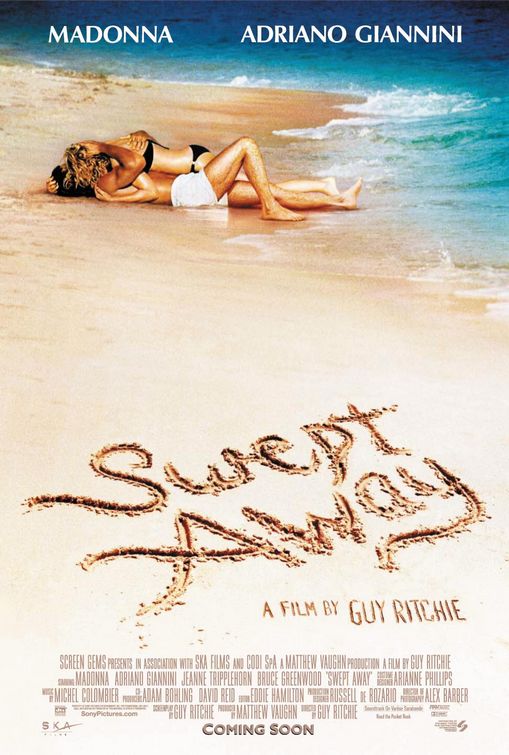
Swept Away

(UK / Italy 2002)

Guy Ritchie’s remake of Lina Wertmüller’s Swept Away, a film that looks like it would be Blue Lagoon but is far from it, was universally panned when it came out. I never saw it, and probably never would have bothered but for my recent discovery of Wertmüller’s work. A two-hour flight from Chicago to New York City and back seemed like the perfect time to get both of them out of the way.

I planned to watch Wertmüller’s original first because…well, that makes sense. Unfortunately, I didn’t start it early enough — the original is 25 minutes longer, and by the time I pulled out my iPad I didn’t have enough time for it. So, I had to settle for backward and watch Ritchie’s version first.

He sticks pretty close to the storyline of the original. Initially, I found Swept Away kind of boring but not offensively awful. Only after seeing Wertmüller’s version did it become painfully clear how lame this remake is; it’s utterly impotent by comparison.

Ritchie retains the critical plot elements of class tension and anticapitalist sentiment that color much of Wertmüller’s work, but here they don’t read the same way; they’re off. Trite, even. Ritchie injects dribs and drabs of his loutish brand of humor into his version, and I found that to be a plus. However, he turns Swept Away into a flaccid, neutered romantic dramedy that the original is not. His version is kinder, gentler, and softer. It has no edge to it whatsoever, which is unusual for him. Yawn.

Stiff and hollow, Madonna’s acting is par for the course. Her character, Amber, is suited to her image. She could’ve had fun with the role. Too bad she seriously overdoes the rich bitch bit and comes off as nasty, hateful, and angry. Not fun. Adriano Giannini, the son of Giancarlo Giannini who played the same role in the original, is nice to look at. That’s it, though; his character, Giuseppe, or as Amber calls him “Pee Pee,” is a turnoff — what a wimp!

The most interesting thing about Swept Away is that David Thornton, Cyndi Lauper’s husband, has a fairly substantial part. I wonder if that was awkward?

With Bruce Greenwood, Elizabeth Banks, Michael Beattie, Jeanne Tripplehorn, Yorgo Voyagis, Ricardo Perna, George Yiasoumi, Beatrice Luzzi, Lorenzo Ciompi, Patrizio Rispo, Francis Pardeilhan, Rosa Pianeta, Andrea Ragatzu

Production: CODI SpA, Ska Films

Distribution: Screen Gems (USA), Columbia TriStar Films (UK), Medusa Distribuzione (Italy)

89 minutes
Rated R

(iTunes rental) D

http://www.sonypictures.com/movies/sweptaway/

https://youtu.be/wv4grEwufV8

Killer of Sheep

(USA 1977)

“Man, I ain’t poor. Look, I give away things to the Salvation Army. You can’t give away nothing to Salvation Army if you poor.”

— Stan

Killer of Sheep has an unusually twisted history that kept it out of daylight — and the spotlight — until recently. His Master’s thesis when he was a film student at UCLA, director Charles Burnett shot it part time over a year’s worth of weekends on 16mm scraps salvaged from production houses. He used equipment borrowed from the university film department. He never intended it to be shown publicly, which is why he didn’t bother to secure licenses for all the music in it (https://mobile.nytimes.com/2007/03/25/movies/25kehr.html?referer=https://www.google.com/).

Relegated to obscurity because of copyright issues surrounding the music, Killer of Sheep was impossible to see for decades — not that that stopped the Library of Congress from adding it to the National Film Registry in just its second year of existence. A grant and a donation led to a restoration that finally placed it into the stream of commerce about ten years ago.

Burnett paints a fluid portrait of the American urban ghetto through the daily life of Stan (Henry G. Sanders), a poor black working class grunt at a slaughterhouse in Watts. His days, monotonous and uneventful, are loaded with small events like fixing the pipes under the kitchen sink, eating dinner at the table with his family, cashing a check at a liquor store, buying a used motor for a car, and getting a flat tire on a “trip to the country” only to find no spare in the truck.

While this is happening, different temptations like a job offer and a part in a crime are presented to Stan. His wife (Kaycee Moore), a weary beauty who waits for him with fresh makeup and a record on the turntable each evening, seems to be the reason he resists. Maybe it’s not her — maybe it’s because Stan simply doesn’t see himself as capable of doing any better.

Not a whole lot happens in Killer of Sheep, but that’s not the point. Like the Italian neorealist films it calls to mind, Burnett’s execution is beautifully simple: he uses non-professional actors (and children who aren’t acting at all), mundane settings and situations, and black and white film to depict the rhythm of poverty. His execution is also really haunting, as if we’re eavesdropping. It’s incredibly effective. For such a quiet and contained film, Burnett’s ultimate statement is pretty jarring.

As stated, the United States Library of Congress deemed Killer of Sheep “culturally, historically, or aesthetically significant” and selected it for preservation in the National Film Registry in 1990 (https://www.loc.gov/programs/national-film-preservation-board/film-registry/complete-national-film-registry-listing/).

With Jack Drummond, Angela Burnett, Charles Bracy,  Eugene Cherry, Delores Farley, Dorothy Stengel , Tobar Mayo, Chris Terrill, Lawrence Pierott, Russell Miles, Homer Jai, Johnny Smoke

Production: Charles Burnett

Distribution: Milestone Films

80 minutes
Not rated

(Gene Siskel Film Center) A-

http://www.killerofsheep.com