I can watch it over and over, and tonight demonstrates that much: I just saw it a few months ago, but I had a hankering for it again. Makes me want to dance to it every time.
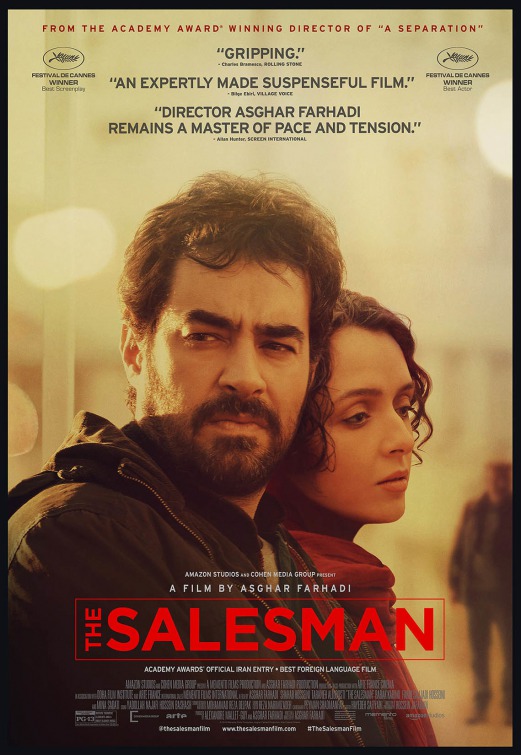
Asghar Farhadi’s The Salesman [Forušande] [فروشنده] is a marvelously dark and brooding study of a married couple that shifts smoothly from a domestic crisis drama to a revenge flick. His approach is a lot more subtle than one an American director might take, but this is precisely what makes The Salesman so satisfying.
While working out the finishing touches of a production of Arthur Miller’s Death of a Salesman in which they play the Lomans, community actors Emad (Shahab Hosseini) and Rana (Taraneh Alidoosti) are forced out of their apartment just days before the play opens when a construction mishap next door weakens the building’s foundation. The cracks in the walls become a metaphor for what’s about to happen to their relatively peaceful marriage.
A fellow cast member, Babak (Babak Karimi), sets them up in temporary digs, a recently and hastily vacated apartment that still contains the previous tenant’s belongings: furniture, bedding, dresses, tons of high heel shoes, a kid’s bike. One night when she’s home alone, a stranger attacks Rana in the shower. She can’t identify him, and she doesn’t want to go to the police. She won’t even say exactly what happened.
Rana starts to go off the deep end; the more unsafe she feels, the less secure Emad is in his own ego. He stews as he pieces together what might have transpired. A set of keys and a delivery truck parked on the street seems like a promising lead to tracking down the stranger, which becomes something of an obsession for Emad.
Farhadi has a straightforward, minimal style. Although he draws a few parallels to Death of a Salesman, he doesn’t beat us over the head with them. He does a nice job dropping us into the story and letting us figure out what he’s getting at. He has a lot to say about male aggression, turning the tables from Rana as the victim to Emad—his masculinity takes a beating as the film progresses.
With Farid Sajadhosseini, Mina Sadati, Mojtaba Pirzadeh
Production: Memento Films Production, Asghar Farhadi Production, Arte France Cinéma
Distribution: Amazon Studios (USA), Cohen Media Group (USA), Filmiran (Iran), Memento Films Distribution (France)
Pedro Almodóvar has his own voice and his own vision, and he’s stayed true to both from the beginnning of his career. He’s an incredible story teller with no shortage of stories to tell; in fact, he once said that he “can make a thousand different movies about the same subject” (https://www.brainyquote.com/quotes/quotes/p/pedroalmod587571.html). His frank treatment of sexuality is as bold as his visual style, and his characters are all memorable. His plots are intricate, loaded with twists and turns and weird things that throw in a wrench that takes the whole thing somewhere you never saw coming. He’s a master of exaggeration—it works just as well in his comedy as it does in his melodrama.
Julieta, Almodóvar’s current film—his twentieth feature—is no exception. Like most of his movies, particularly his post-millennial work, this one centers on women. Inspired by three short stories (“Chance”, “Soon,” and “Silence”) from from Alice Munro’s 2004 book Runaway, Julieta is, in simplest terms, the story of one woman’s search for her estranged daughter. There’s a lot more to it, of course, and Almodóvar slowly reveals it all, layer by layer.
Julieta (Emma Suárez) is a middle-aged woman who lives in Madrid with her boyfriend, Lorenzo (Darío Grandinetti). They’re packing to move to Portugal. Julieta has a secret: she has a daughter, Antiá, who checked out of her life more than a decade ago. She happens to run into Beatriz (Michelle Jenner), an old friend of Antiá, on the street. Beatriz gives Julieta some small information about Antiá, prompting Julieta to drop all plans in the hope of her daughter returning. She begins writing a journal, which turns into a flashback that tells us what happened.
Some 30 years before, young Julieta (Adriana Ugarte) meets scruffy fisherman Xoan (Daniel Grao) on a train. He’s married, but his wife is in a coma. He knocks up Julieta, who receives a letter from him and visits him at his home in a small Spanish fishing town. They decide to raise Antiá together there. When Antiá (Priscilla Delgado) is a teen and away at camp, Julieta and Xoan have a fight that leads to disaster. Julieta doesn’t tell Antiá everything, and it comes back to bite her.
Nothing by Almodóvar ever sucks, but I’ve found his work to be up and down after All About My Mother. It’s to be expected from an artist with a long career, Madonna being a good example. His last project, 2013’s I’m So Excited, was fun but certainly not his most compelling. Julieta, however, is solid—I say it’s his finest hour and a half since Volver. It’s not a light film—it’s an elegant, emotional slow burner that deals with regret, omission, and forgiveness. Ugarte and Grao are both hot, and they have a palpable chemistry. Casting Rossy De Palma as Xoan’s longtime passive-aggressive housekeeper is a nice touch.
With Inma Cuesta, Blanca Parés, Pilar Castro, Tomás del Estal
Production: El Deseo
Distribution: Warner Brothers (Spain), Pathé, 20th Century Fox
“I don’t know how I’m gonna live with myself if I don’t stay true to what I believe.”
—Desmond Doss
Like him or not, Mel Gibson has what it takes to direct a massive Hollywood picture. Hacksaw Ridge, his first directorial job in a decade, demonstrates that much—just in case earlier films like Braveheart, The Passion of the Christ, and Apocalypto didn’t.
Hacksaw Ridge depicts the remarkable and true story of Desmond Doss (Andrew Garfield), the Lynchburg, Virginia, Seventh-day Adventist who served as a medic in the U.S. Army during World War II. His story is unique: he enlisted, but as a conscientous objector for religious reasons. Refusing to kill or carry a gun, he rescued 75 or so wounded soldiers from the field during the Battle of Okinawa (http://www.collegedale-americanlegion.org/Pages/DesmondTDoss.aspx). President Harry S. Truman awarded Doss the Congressional Medal of Honor in 1945, the first time such a high accolade was bestowed upon someone who never even discharged a weapon (https://en.wikipedia.org/wiki/Desmond_Doss).
From a technical standpoint, Hacksaw Ridge is pretty awesome. The story is a good one. The battle scenes are clearly the centerpiece: they’re loud and extremely graphic. The prosthetics are spot on realistic. Cinematographer Simon Duggan starts out with warm, almost sepia tones in the early civilian scenes, but as the setting moves onto the battlefield he ditches color in favor of a washed out black, green, and white palette. Shaky closeups, slow motion shots, blurry pans, and quick cuts create a sense of confusion as gunfire and explosions and human carnage take over the screen. Hacksaw Ridge is no Son of Saul (https://moviebloke.com/2016/02/11/son-of-saul-saul-fia/), but it still overwhelms the senses albeit in a distanced, staged blockbuster way.
Otherwise, Hacksaw Ridge didn’t impress me all that much. At its core, it’s a standard-issue war movie complete with a sugary subplot about the girl, Dorothy Schutte (Teresa Palmer), waiting for Doss to hurry up and get back home so they can get married, and lots of humorous if mawkish male bonding through nicknames, insults, physical attacks, and simply having each other’s back. There’s a military court scene, trite “war is hell, boys” lines, soldiers who freak out once they get on the battlefield, likable characters who perish, and of course the superhuman heroic deeds of Doss.
Most character background is given hurried and superficial treatment: Doss’s alcoholic veteran father (Hugo Weaving) and his bad experience in World War I, Doss and Dorothy’s quick courtship, even the failed attempts of Sgt. Howell (Vince Vaughn) and Cpt. Glover (Sam Worthington) to persuade Doss to leave the Army. Too bad, because a little more insight could have made the film stronger. A particularly glaring example is brother Hal (Nathaniel Buzolic), who simply vanishes once he shows up at the dinner table in uniform. What happens to him? Did I miss it?
I’m conflcited on the message here, but I guess that’s okay because frankly Hacksaw Ridge is a conflicted film. Gibson maintains that it’s an anti-war statement (http://www.christianpost.com/news/mel-gibson-hacksaw-ridge-is-an-anti-war-movie-170318/). Fine, but that’s hard to believe considering the disproportionate amount of time and resources given to overblown battle scenes. I’m not sure the film honors Doss or his pacifist convictions. Moreover, what sure seems like a blatant parallel to the so-called religious liberty movement is, in my view, misguided and hollow, especially when Doss’s faith is treated more or less as incidental. Hacksaw Ridge sustained my interest, but I would have appreciated a little more depth.
With Luke Bracey, Darcy Bryce, Rachel Griffiths, Firass Dirani, Michael Sheasby, Luke Pegler, Nico Cortez, Goran D. Kleut, Harry Greenwood, Damien Thomlinson, Ben O’Toole
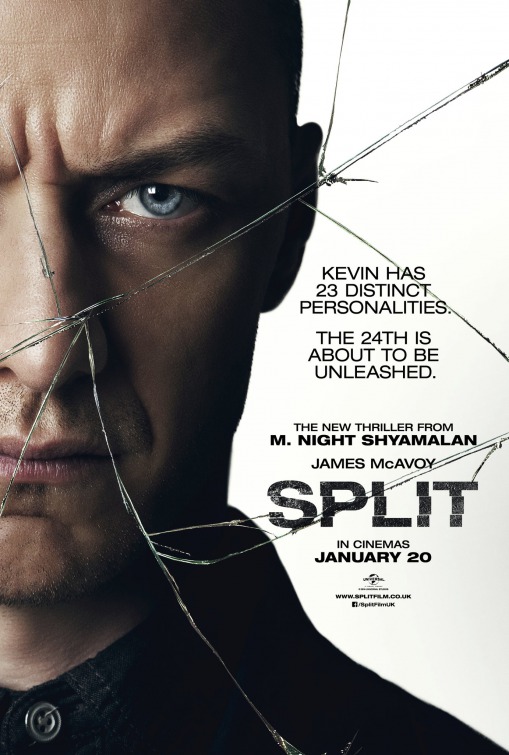
Poor Kevin Wendell Crumb (James McAvoy). His mother (Rosemary Howard) abused him when he was a child, and he developed split personalities to deal with it. Now, he’s got a thing for watching underage girls dance naked. Dennis, the sternest of Kevin’s personalities, has asserted control and drives him to kidnap three teenage girls (Anya Taylor-Joy, Jessica Sula, and Haley Lu Richardson) leaving a birthday party at a lame Chuck E. Cheese place. He locks them up in a dungeon in his underground industrial hideout. Kevin is undergoing psychiatric care, but his doctor (Betty Buckley from Eight is Enough) senses something horribly amiss when she receives email from each of his 23 personalities seeking an urgent appointment. Kevin’s personalities prepare the girls for the arrival of “the Beast,” the last and most powerful personality. Only one of them is poised to survive.
WARNING: Potential spoilers ahead!
M. Night Shyamalan’s Split is, in a word, stupid. The story has potential, but it suffers a major breakdown pretty quickly. It’s more silly than scary. I found myself tracking horror movie clichés like a checklist and asking how many more can fit into the plot. I saw the so-called twists coming before they turned the corner. The reference to another movie at the end is mildly amusing, I guess, but not what I’d call clever. The parallel to one kidnapped girl’s childhood, shown in flashbacks, warrants a great big ‘whatever.’ The only thing Split has going for it is McAvoy, who emulates Jude Law doing an impression of Eminem impersonating Justin Timberlake. His characters are fun, particularly severe schoolmarm type Patricia (for whom McAvoy wears heels) and little boy Hedwig. However, even they get tiresome, coming off as a mishmosh of standup routines after awhile, like sticking all of the characters from Little Britain into one body.
I could make a lame comment about replacing “pl” with “h” in the title and getting a far more accurate name for this film, but I’ll just say I wasn’t impressed and leave it at that.
With Izzie Coffey, Sebastian Arcelus, Brad William Henke, Neal Huff, Bruce Willis
Production: Blinding Edge Pictures and Blumhouse Productions
“If you could see your whole life from start to finish, would you change things?”
—Louise Banks
Denis Villeneuve’s Arrival isn’t exactly what I expected. A sort of updated Close Encounters of the Third Kind, Eric Heisserer’s adaptation of Ted Chiang’s Story of Your Life is a pretty straightforward observation about language. However, it’s a bit more academic than the average alien movie: it examines the theory of linguistic relativity, the idea that the structure of a language shapes the way its speakers relate to their environment (https://en.m.wikipedia.org/wiki/Linguistic_relativity) (http://www.linguisticsociety.org/resource/language-and-thought).
12 mysterious otherworldly spacecrafts land in what appear to be random places all over Earth—including remote Montana. It isn’t clear why they’re here, and people are freaking out. Not surprisingly, world leaders are perplexed—some are handling the so-called invasion better than others.
WARNING: Potential spoilers ahead!
The aliens, octopus-like creatures dubbed “heptapods,” hold visiting hours each day, allowing those who wish to engage them to do so—up close and personal inside their ship. A U.S. Army colonel (totally underused Forest Whitaker) seeks out linguistics professor Louise Banks (Amy Adams) for a mission working with physicist Ian Donnelly (Jeremy Renner) and a team of scientists to figure out how to communicate with the aliens and find out what they want. Banks learns that they have a language—circles and curlycues that they blow into the air. The more of their “words” she learns, the more Banks has visions of her deceased daughter (Jadyn Malone, Abigail Pniowsky, and Julia Scarlett Dan).
Arrival does a nice job showing the limitations of language. A clever plot development involving a mutual misunderstanding of a word demonstrates how things can unravel on a dime. I like the depiction of the aliens in a totally plausible form. Villeneuve slowly builds suspense; he kept my interest almost all the way through. Sadly, Arrival pulls an emotionally manipulative sleight of hand toward the end. The wrap up is insipid; it knocked the film down a few pegs for me.
With Michael Stuhlbarg, Mark O’Brien, Tzi Ma
Production: Lava Bear Films, 21 Laps Entertainment, FilmNation Entertainment
Distribution: Paramount Pictures (USA), Sony Pictures Releasing (International)
“Searching for a boy in high school is as useless as searching for meaning in a Pauly Shore movie.”
—Cher Horowitz
The first screening of Chicago International Film Festival’s Totally ’90s series is Clueless, a sort of link between ’80s classics like Valley Girl and Heathers and later films like Election, 10 Things I Hate About You, Mean Girls, and even Fox’s current television series Scream Queens. Adapted from Jane Austen’s Emma, which I haven’t read and probably never will, Clueless transmits the novel’s heroine across time and space from outside London in the early Nineteenth Century to Beverly Hills in the late Twentieth. It’s a cute idea that works—I didn’t know until this screening that the story is 200 years old. As if!
“Hymenally challenged” (i.e., virgin) 16 year old California girl Cher Horowitz (Alicia Silverstone) is vain, popular, and rich. Perhaps not surprisingly, she’s incredibly superficial, even if she means well. Her mother died in “a freak accident during a routine liposuction,” leaving her father, brass-balled Type A litigator Mel (Dan Hedaya), to raise her. When Cher gets a bad report card, she enlists her bestie Dionne (Stacey Dash), a hip black version of herself, to help fix up two nerdy tough-grading teachers, Mr. Hall (Wallace Shawn) and Miss Geist (Twink Caplan). Her plan is simple: she wants to get them laid so they’ll chill out and be receptive to negotiating her grades. Meanwhile, Cher adopts a new student, “tragically unhip” druggie tomboy Tai (Brittany Murphy) as a pet project: Cher plans to make Tai more like Cher. Duh. Semi-crunchy, socially conscious stepbrother Josh (Paul Rudd) does not approve of Cher’s antics.
Written and directed by Fast Times at Ridgemont High‘s Amy Heckerling, Clueless feels like an ’80s throwback, but it’s still a lot of fun. Loaded with great zingers and one-liners, I laughed a lot. It also has a ton of references to ’90s pop culture that clearly date the film (Luke Perry? Snapple? A Cranberries CD?! Egads!). Clueless lacks a ceratin bite that makes “mean girl” flicks so, well, biting. I guess a large part is because Cher and Dionne aren’t really mean girls; they’re actually pretty naive. After all, it takes Cher awhile to figure out that Christian (Justin Walker), the guy she lusts after, is a friend of Dorothy. Hello?
With Julie Brown, Jeremy Sisto, Breckin Meyer, Donald Faison, Elisa Donovan
“The taste of it on your tongue, the feel of it on your fingers—it’s like a drug.”
—Mike Acosta
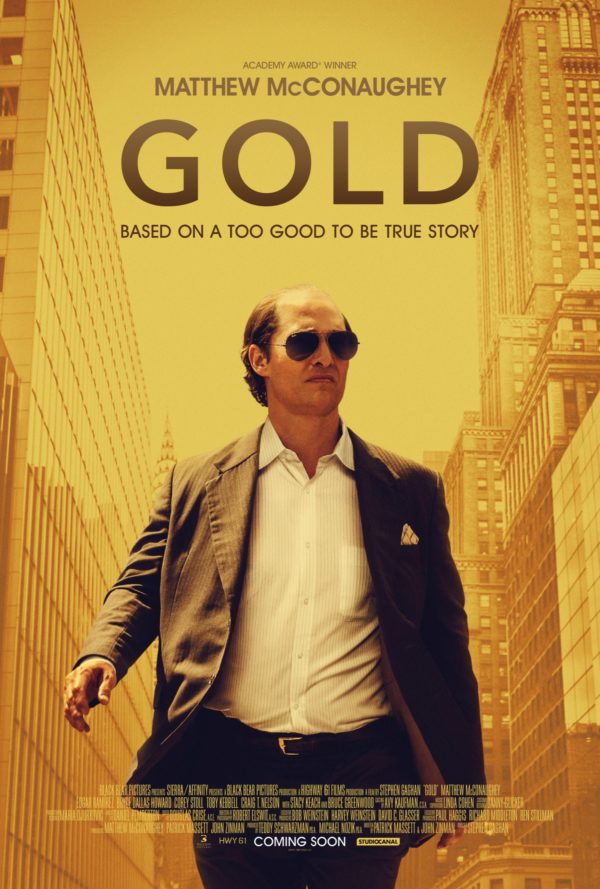
Not everything gold glitters; such is the case with Stephen Gaghan’s Gold, his first film since the acclaimed Syriana over a decade ago. Matthew McConaughey is Kenny Wells, a redneck businessman running his collapsing mining company from a smoke-filled tavern in Reno, Nevada, in 1988. Acting on little more than gut and some pawn shop cash from hocking gifts he gave his girlfriend (Bryce Dallas Howard) in better days shown as the movie opens, he abruptly heads to Indonesia to track down geologist Mike Acosta (Édgar Ramírez) to find a gold mine.
Their first meeting doesn’t go well at all. Looking like he stepped out of Banana Republic when it was a safari store in the ’80s, Acosta is shrewd, rugged, and quite experienced. Balding and sweaty Wells, with his jagged teeth and paunch, is sloppy and desperate. He reads as broke. Unimpressed, Acosta passes when Wells suggests they partner up—until the latter raises $200,000 for the proposed venture. After a series of miscalculations and mishaps (including a bout with malaria), they hit the jackpot in the middle of a jungle. Suddenly, the same banks and big investors that turned up their nose at Wells before want in on the action.
Gold isn’t a bad movie, but it’s not the impressive work it wants to be. The pace is fine, but the plot twists are unsurprising if not downright predictable. The problem is that I’ve seen this story before, and recently: mainstream films like The Big Short (https://moviebloke.wordpress.com/2016/01/03/the-big-short/), The Wolf of Wall Street, and American Hustle deal with the same themes in a similar manner. I’ve seen McConaughey be the same character, too. The curious statement “inspired by a true story” after the opening credits is the cue to something I found disappointing: Gold is a fictionalized account of a true story, changed enough that I guess it can’t claim to be “based on” reality. I’m not sure where that line is drawn, but it turns out much of the story is made up (http://www.financialpost.com/m/search/blog.html?b=business.financialpost.com/news/mining/gold-the-movie-about-the-bre-x-mining-scandal-that-isnt-about-bre-x&q=Bre). Plus, it’s never a good sign when the music in a film—here, artists ranging from Orange Juice to New Order and Joy Division to the Pixies and a new song by Iggy Pop and Danger Mouse—elicits the most enthusiastic response from me. Overall, meh.
Also starring Corey Stoll, Toby Kebbell, Craig T. Nelson, Stacy Keach, Rachael Taylor, Joshua Harto, and Timothy Simons
Produced by Boies/Schiller Films, Black Bear Pictures, and Highway 61 Films
If anyone would take a stab at something that sounds as ridiculous and cringeworthy as tackling American slavery in a spaghetti Western, it’s Quentin Tarantino. “I want to do movies that deal with America’s horrible past with slavery and stuff, but do them like spaghetti Westerns, not like big issue movies,” he said, clearly referring to Django Unchained in a 2007 interview—five years before it came out. “I want to do them like they’re genre films, but they deal with everything that America has never dealt with because it’s ashamed of it.” (http://www.telegraph.co.uk/culture/film/starsandstories/3664742/Quentin-Tarantino-Im-proud-of-my-flop.html).
The title here references Sergio Corbucci’s 1966 film Django, an actual spaghetti Western in which the titular hero, a cowboy, is thrust into a row between Southern Klansmen and Mexican revolutionaries. In Django Unchained, the story starts in 1858—just a few years before the American Civil War. Django (Jamie Foxx) is a slave separated from his wife, the curiously named Broomhilda von Shaft (Kerry Washington), after they were caught trying to escape a plantation. He’s shackled to a group of slaves that the Speck brothers (James Remar and James Russo) are driving on foot to be sold.
Enter traveling dentist Dr. King Schultz (Christoph Waltz), a genteel German driving a wagon with a big wooden tooth on top of it. Schultz is actually a bounty hunter looking for the Brittle brothers—Big John (M.C. Gainey), Lil Raj (Cooper Huckabee), and Ellis (Doc Duhame)—who happen to be Django and Broomhilda’s former masters. He makes Django an offer he can’t refuse: help him find and kill the brothers, and Schultz will pay him, set him free, and help him find Broomhilda.
Django Unchained is structured in essentially three “episodes.” The first takes place in a one-horse town near El Paso, where Schultz provokes the ire of the townfolk, the sheriff (Don Stroud), and a U.S. Marshall (Tom Wopat). The second takes place on a plantation owned and operated by Spencer “Big Daddy” Bennett (Don Johnson—um, wow!). The last, longest, and most twisted takes place on another plantation in Mississippi, the bountiful Candie-Land, owned by charming but sadistic Calvin Candie (Leonardo DiCaprio) and operated by his shifty Uncle Tom house-slave, Stephen (Samuel L. Jackson).
Tarantino actually pulls off what he said he wanted to, and he does it quite well. Django Unchained could have been a really dark film like its immediate successor, The Hateful Eight. The two films have a lot in common. The tension—and there’s lots of it—built into the story is deliberately and profoundly slow in reaching a boil. Django Unchained certainly has Tarantino’s trademark violence, revenge theme, and liberal use of the ‘n’ word—116 times, a record for a film according to IMDB (http://www.imdb.com/title/tt1853728/trivia?ref_=tt_trv_trv). A few scenes are difficult to watch, the “Mandingo fight scene” being the worst for me. Unlike The Hateful Eight, though, the violence here is Tarantino’s typical flagrantly graphic cartoonish gore. He also shows a more conspicuous sense of humor—for example, Django and Broomhilda are ancestors of John Shaft of the Shaft franchise (https://www.google.com/amp/deadline.com/2012/07/django-unchained-a-shaft-prequel-so-says-quentin-tarantino-comic-con-301010/amp/).
Django Unchained is an unlikely and uncomfortable pairing of an ugly part of our collective past with absurdity, but it’s entertaining while still getting its point across: we’re still living with the aftermath. It’s the kind of film you mull over for a long time after you see it.
With Laura Cayouette, Jonah Hill, Walton Goggins, Dennis Christopher, Dana Gourrier, Nichole Galicia, Miriam F. Glover, Quentin Tarantino, Franco Nero, Russ Tamblyn, Bruce Dern, Misty Upham, Danièle Watts, Robert Carradine
Produced by The Weinstein Company, Columbia Pictures
Distributed by The Weinstein Company (North America), Sony Pictures Releasing (International)
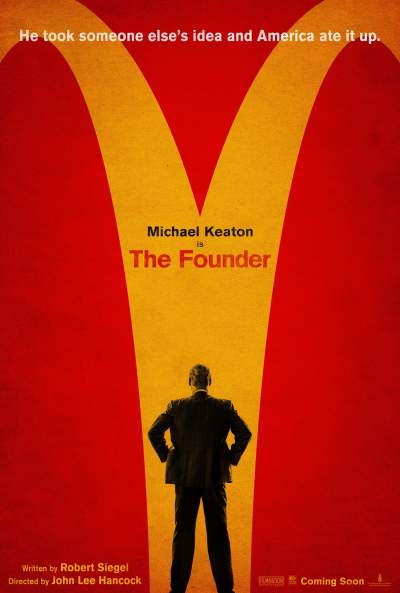
Ray Kroc’s name is synonymous with McDonald’s, the ubiquitous fast food institution that hasn’t needed an introduction for the entire time I’ve been alive. It seems strange that I’ve never known much about him even after living in Chicago for almost 20 years—at least, not until The Founder. Then again, maybe I still don’t.
Kroc (Michael Keaton) is a middle aged traveling salesman who hocks milkshake mixers to restaurants, mainly drive-ins and diners, in the 1950s. Based in Chicago, he has a nice enough home in suburban Arlington Heights, a supportive if not ambitious wife, Ethel (Laura Dern), and the means to afford a country club membership. Nonetheless, Kroc is neither wildly successful nor affluent. He isn’t setting the world on fire selling milkshake mixers, and his business ideas never seem to pan out. He doesn’t fit in with the WASPy professionals Ethel gravitates toward. Being the entrepreneur he is, he yearns for more.
While making cold calls in Missouri, Kroc gets a big order for mixers from San Bernardino, California. He drives out there and finds McDonald’s, an idyllic burger joint owned and operated by two brothers, affable Mac (John Carroll Lynch) and crusty Dick (Nick Offerman). Shiny and clean, the place is a welcoming sight. Mac shows Kroc the kitchen: it’s an intricate and super-efficient assembly line that delivers consistenly appetizing product in minutes. Disposable packaging means customers can take their food with them and eat it wherever they want, keeping the line moving while eliminating the need for clean up (not to mention dishes). Employees work together as a team. The customer service is flawlessly friendly. Dick explains that high-quality food and fast service are the hallmarks of McDonald’s. The brothers have hit something with their formula: the place is slammed with a customer base that overwhelmingly consists of middle class families. Kroc wants to franchise McDonald’s, something the brothers tried before but it didn’t work.
The Founder focuses less on Kroc’s personal life and more on the many problems he overcomes in executing his ambitious plan to make McDonald’s and its Golden Arches a symbol of America that seemlessly fits, as he puts it at one point, right in with the Stars and Stripes and crosses on churches. There’s a lot of dry stuff dealing with the nuts and bolts of business here—business models, contract negotiations, marketing, quality control, real estate, financing, trademarks, cutting costs, and of course double crossing. It’s a timely film—I can’t think of a more fitting movie to see on this particular Inauguration Day: one of the promotional posters for The Founder calls Kroc a rule breaker, a risk taker, and a game changer, and for better or worse that’s what he turned out to be. Michael Keaton is perfect for this role, playing Kroc as a ruthlessly driven goofball who has no good ideas of his own but certainly knows how to capitalize on those of others. American history is rich in such characters.
That said, I must admit that I have no idea how much of this story is accurate—not that I was compelled to find out on my own. The Founder doesn’t make me care. Pieces of the story seem to be missing. Robert Siegel’s script isn’t exactly objective—it borders on propaganda, especially when he overemphasizes the simplicity of the McDonald brothers. John Lee Hancock is a capable director, but he’s so ambiguous about his subject that he doesn’t say what he makes of him. I’m not sure he knows. His treatment lacks a certain nuance the material demands that could’ve made The Founder a lot more than it is. It’s not a terrible film, but I had higher expectations.
Also starring B.J. Novak, Linda Cardellini, Patrick Wilson, Justin Randell Brooke
Produced by FilmNation Entertainment, The Combine, Faliro House Productions S.A.








 moviebloke