Blue Velvet

(USA 1986)

Who hasn’t seen Blue Velvet? Even though David Lynch was already established by the time it came out, it’s the film that introduced me to him. I saw it once or twice in late high school or early college, definitely on VHS. The River’s Edge was the only comparison I had, and that was a weird film but…not on the same level. I found Blue Velvet totally watchable because it’s very dark, very sexual, very fucking weird, and very voyeuristic.

That was then, this is now: Blue Velvet is still all of those things, but I don’t remember it having the sense of humor it does. It’s curiously funny. It marks the start of Lynch’s style as we know it: not just surreal (he had already done Eraserhead), but macabre and perverted underneath the innocuous and mundane premise. Lynch sets up his narrative in pieces that refer back and forth, like a moving puzzle. It’s brilliant, and it’s a formula that’s served him well.

Blue Velvet starts with a severed ear on the ground, bugs crawling all over it. A local college kid turned stalker (Kyle MacLachlan) proves a bit too curious when his minor obsession with a night club singer (Isabella Rossellini) leads him into a sadomasochistic nightmare that neither he nor we viewers can turn away from. The whole bizarre and sordid story goes full circle back to where it started: that ear. 

Dennis Hopper as Frank, the gas-huffing sociopath who ends every sentence with the F-word, colors the mood here. None of it would work, though, without Rossellini’s vulnerability, which is crucial. 

Lynch considered Molly Ringwald instead of Laura Dern and Val Kilmer instead of MacLachlan. Thank goodness it happened how it did; what a different film Blue Velvet would have been. For a movie that relies so heavily on nuance, that could’ve ruined Lynch’s career. It didn’t. 

With Hope Lange, Dean Stockwell, George Dickerson, Priscilla Pointer, Frances Bay, Jack Harvey, Ken Stovitz, Brad Dourif, Jack Nance, J. Michael Hunter, Dick Green, Fred Pickler, Philip Markert, Leonard Watkins, Moses Gibson, Selden Smith, Peter Carew, Jon Jon Snipes, Angelo Badalamenti, Jean Pierre Viale, Donald Moore, A. Michelle Depland, Michelle Sasse, Katie Reid, Sparky

Production: De Laurentiis Entertainment Group

Distribution: De Laurentiis Entertainment Group, 20th Century Fox (UK), Transmundo Films (Argentina), AMLF (France), Concorde Film (Netherlands), Concorde Filmverleih (West Germany), Finnkino (Finland), Hoyts Distribution (Australia), Shochiku-Fuji Company (Japan)

120 minutes
Rated R

(Music Box) B+

David Lynch: A Complete Retrospective

Wild at Heart

(USA 1990)

“Man, I had a boner with a capital ‘O.'”

—Sailor Ripley


“And this here’s a story with a lesson about bad ideas.”

—Lula Pace Fortune


“Don’t turn away from love, Sailor.”

—Glinda the Good Witch

Wild at Heart is one of David Lynch’s more maligned films. Roger Ebert hated it to the point of indignation (https://www.google.com/amp/www.rogerebert.com/reviews/amp/wild-at-heart-1990). Vincent Canby seemed perplexed—I can’t tell whether he was bored, annoyed, or just flummoxed (http://www.nytimes.com/movie/review?res=9C0CE5D7123EF934A2575BC0A966958260). Jonathan Rosenbaum called it “appalling,” “inept,” and “debasing” (https://www.jonathanrosenbaum.net/1990/08/bad-ideas/). A host of other critics rolled their eyes and sighed, dismissing it, I suppose, as a violent and exploitive piece of shock fluff.

I never saw Wild at Heart until now. Some of the points raised by its detractors are valid, but I still liked it for the same things that made them hate it. Erratic, vulgar, and really sweet, it’s offputting yet compelling and—surprise!—it has a happy ending.

An atypically straightforward narrative for a Lynch project, Wild at Heart is a decidedly deranged, bloody road movie/romance/thriller based on Barry Gifford’s novel of the same name. Upon his release from a North Carolina prison after serving time for murder—never mind that it was self-defense—Sailor Ripley (Nicolas Cage) exits the jailhouse to find his lover, Lula Pace Fortune (Laura Dern), waiting for him outside in the sunlight with his snakeskin jacket, the symbol of his individuality and his belief in personal freedom. They spend some time catching up in a motel room and at a speedmetal concert before they decide to blow off his parole and take off for California.

Meanwhile, Lula’s mother, Southern lady Marietta (Diane Ladd), is making plans of her own—and they involve her private detective boyfriend (Harry Dean Stanton) and a hit man (J. E. Freeman) who’s got Sailor as his target. A bad omen detours the starcrossed lovers to Big Tuna, Texas, where they unwittingly plant themselves smack in the middle of a bad situation that looks to be turning deadly fast.

OK, I’ve seen versions of this same story before. The plot is familiar and for the most part implausible—not to mention really, really thin at times. Lynch goes overboard with his depiction of sex, violence, and gore—even though they all have a place here. None of this matters, though, because the characters, which are both the focus and the strength of the film, are fantastic.

As usual, the casting is stellar. Cage is at his best here, working that edgy deadpan earnest manic thing he did so well in his early films. Dern is flawless as a sweet Southern girl who’s found her place with bad boy Sailor, everyone else be damned. Willem Dafoe is super creepy as hayseed bad guy Bobby Peru—those teeth! Above them all, however, is Ladd, who’s fucking fabulous even with her face covered in red lipstick. She’s vengeful at times, remorseful at others; but all the while, a perfect lady. She shines here. There’s a reason she was nominated for an Oscar for her performance (https://www.oscars.org/oscars/ceremonies/1991). This film works because the actors give it their all.

Wild at Heart is loaded with Lynch’s trademark what-the-fuck weirdness—a man at a bar quacking like a duck (you read that correctly) and cousin “Jingle Dell” (Crispin Glover) sitting on the floor in the bathroom screaming for Christmas or standing at the counter in the dark making a hundred sandwiches for lunch are bizarre moments even by Lynchian standards. There’s a lot more to it, though. I love the theme of finding a happy place in the midst of horrible things happening. I love all the references to various staples of Americana—cowboys, cars, highways, Elvis Presley, and my favorite, The Wizard of Oz. I love that underneath it all is a touching love story that we can all relate to.

What I find most interesting, though, is that so many things about Wild at Heart scream Quentin Tarantino, yet he had nothing to do with it. In fact, it came out two years before Tarantino’s first major film, Reservoir Dogs. I never thought of David Lynch as an influence on him, but Wild at Heart makes me wonder.

Side note: Wild at Heart is a rated R movie. For the screening I attended, however, I was lucky enough to catch an unreleased rated X version. The X rating was no doubt due to the graphic violence—it wasn’t the sex scenes. The print was in bad shape, all scratchy and beat up, but it was totally worth it to see an X-rated Lynch film.

With W. Morgan Sheppard, Grace Zabriskie, Isabella Rossellini, Sherilyn Fenn, Sheryl Lee

Production: PolyGram Filmed Entertainment, Propaganda Films

Distribution: Manifesto Film Sales, The Samuel Goldwyn Company (USA), Palace Pictures (UK), Bac Films (France), Cineplex Odeon Films (Canada), Finnkino (Finland), Hoyts Distribution (Australia), Háskólabíó (Iceland), Meteor Film Productions (Netherlands), Sandrew Film & Teater (Sweden), Solopan (Poland)

125 minutes
Rated X (alternate version)

(Music Box) B

David Lynch: A Complete Retrospective

http://www.davidlynch.de

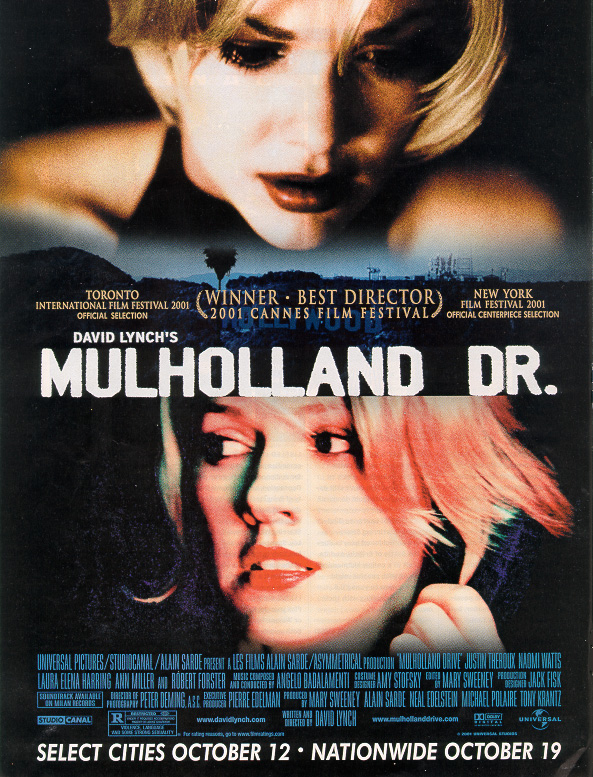
Mulholland Dr.

(USA/France 2001)

“No hay banda, il n’est pas d’orchestra. It is all an illusion.”

—The Magician at Club Silencio

The perfect opener for a retrospective on its director, Mulholland Dr. is an inimitable film that’s really hard to write about. You can look for answers online all you want, but even after seeing it multiple times you still don’t know what happens in it.

Not unless you’re David Lynch. That doesn’t make it any less enjoyable, though.

I’ve seen Mulholland Dr. maybe three times, and I’m not sure. I have my theories. Maybe they’re right, maybe not. Who cares? As with any of Lynch’s best films, the draw to Mulholland Dr. is that it’s a puzzle. He makes you work to solve it, or at least try to. He gives you just enough to go on but leaves the whole thing open to interpretation. At points, he gets you so frustrated, you lose patience and you hate him. But you don’t want him to stop. It’s artistic sadomasochism.

What began as a project for television is a mystery mindfuck tailored to the big screen. Dreamlike, hypnotic, and erotic, Mulholland Dr. is visually demanding and aesthetically worth every minute. The premise is deceptively simple: perky and wide-eyed blond actress Betty (Naomi Watts) arrives in Hollywood and bumps into beautiful young brunette Rita (Laura Harring), who can’t remember who she is after a car accident on Mulholland Drive.

As the two set out looking for clues to Rita’s identity, Lynch throws in a bunch of random characters, muddled subplots, and perplexing events. The narrative arc he puts us on comes to an abrupt halt with a small blue box the girls acquire at a night club. This is where Lynch pulls the rug out from under us.

Mulholland Dr. is definitely a love story—one fraught with competition, petty jealousies, one-upmanship, and ultimately murder. Lynch’s trademark sense of humor flickers here and there, but this is still dark stuff. I see Mulholland Dr. as a denouncement of Hollywood and all its ruthless superficiality. It’s a town that eats you up and spits you out.

Motifs of filmmaking, commerce, ego, vision, and of course the color blue stand out. Rebekah Del Rio’s performance of “Llorando” is beautifully forlorn and eerie. I would be remiss not to mention Peter Deming’s cinematography, which makes Mulholland Dr. shine.

Sadly, Lynch hasn’t done a proper film since 2006. He’s the one living filmmaker whose work I miss the most. Mulholland Dr. is a testament to why: like the street where it takes its name, this film is twisting, treacherous, and ultimately breathtaking.

With Jeanne Bates, Robert Forster, Brent Briscoe, Patrick Fischler, Michael Cooke, Bonnie Aarons, Michael J. Anderson, Ann Miller, Angelo Badalamenti, Dan Hedaya, Daniel Rey, Justin Theroux, David Schroeder, Robert Katims, Marcus Graham, Tom Morris, Melissa George, Mark Pellegrino, Vincent Castellanos, Rena Riffel, Michael Des Barres, Lori Heuring, Billy Ray Cyrus, Tad Horino, Missy Crider, Melissa Crider, Tony Longo, Geno Silva, Katharine Towne, Lee Grant, Lafayette Montgomery, Kate Forster, James Karen, Chad Everett, Wayne Grace, Rita Taggart, Michele Hicks, Michael Weatherred, Michael Fairman, Johanna Stein, Richard Green, Conti Condoli, Lyssie Powell, Scott Coffey

Production: Les Films Alain Sarde, Asymmetrical Productions, Babbo Inc., Canal+, The Picture Factory

Distribution: Universal Pictures

147 minutes
Rated R

(Music Box) A-

David Lynch: A Complete Retrospective

http://www.lynchnet.com/mdrive/

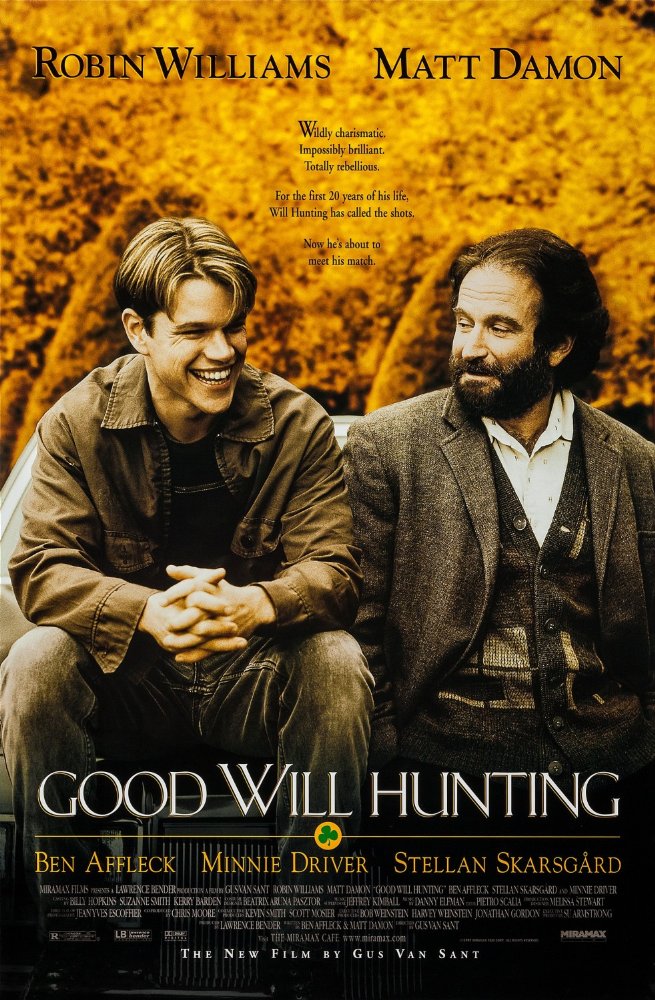
Good Will Hunting

(USA 1997)

“Well, I got her number. How do you like them apples?”

—Will Hunting

Good Will Hunting, the final screening of Chicago International Film Festival’s Totally ’90s series, is not something I associate with its director, Gus Van Sant. Frankly, I didn’t know he directed it until I saw his name in the credits.

No, I associate Good Will Hunting with longtime friends Matt Damon and Ben Affleck, who while they were both still relatively unknown turned the former’s drama class project into the script that would become this film (http://www.eonline.com/news/802830/looking-back-at-the-totally-crazy-story-behind-the-making-of-good-will-hunting). The success of Good Will Hunting seemed to come out of nowhere and established both of them as actors—never mind that they snagged the Oscar for Best Screenplay in 1998 (https://www.oscars.org/oscars/ceremonies/1998). Damon and Affleck have both written since, but none of their screenplays has been as successful as this one.

Gerald Lambeau (Stellan Skarsgård), a professor at MIT, is baffled when someone anonymously solves a wicked hahd math problem he posted on a chalkbaord in the hall as a challenge to his students—he expected it to take the entire semester. No one steps up to claim the work. He posts a second problem, one that took his colleagues two years to figure out. He’s amazed when he catches one of the school’s janitors, Will Hunting (Damon), red-handed. Will won’t have anything to do with Lambeau—until he ends up in jail for assault.

Recognizing Will’s gift, Lambeau makes a deal with him: he’ll pay for bail if Will works with him on math and sees a therapist. The problem is, Will doesn’t make it easy to connect. In fact, five different therapists fail. As a last resort, Lambeau calls former classmate Sean Maguire (Robin Williams), who has a similar Southie background as Will and stands up to his crap. Sean sees that Will is deflecting to hide his self-sabotaging tendencies.

Meanwhile, Will meets Skylar (Minnie Driver), who sweeps him off his feet. It all goes well until she tells him she’s going to medical school at Stanford—and asks him to go with her.

The script here is loaded with good ideas and gorgeous details—that story about Sean ditching a Red Sox game to be with a girl he just met in a bar (she would become his wife) is gold. So is Will’s confrontation with a grad student (Scott William Winters) at a dive. Hearing Damon sing “Afternoon Delight” while he’s faking hypnosis is hilarious. The story, though, is predictable. Good Will Hunting excels because of the acting. The casting—by Kerry Barden, Billy Hopkins, and Suzanne Smith—makes all the difference in the world.

With Ben Affleck, Casey Affleck, John Mighton, Rachel Majorowski, Colleen McCauley, Cole Hauser, Rob Lyons, Steven Kozlowski, Jennifer Deathe, Philip Williams, Patrick O’Donnell, Kevin Rushton, Jimmy Flynn, Joe Cannon, Ann Matacunas, George Plimpton, Francesco Clemente

Production: Lawrence Bender Productions, Be Gentlemen Limited Partnership, Miramax Films

Distribution: Miramax Films (USA), Bac Films (France), Buena Vista International (UK), Cecchi Gori Distribuzione (Italy), Filmes Castello Lopes (Portugal), Intersonic (Czech Republic), Laurenfilm (Spain), Lider Films (Argentina), SF Norge A/S (Norway), Scanbox Entertainment (Sweden), Scotia International Filmverleih (Germany), Shochiku-Fuji Company (Japan), Svensk Filmindustri (SF) (Sweden), Svenska Filminstitutet (SFI) (Sweden), United International Pictures (UIP) (Switzerland)

126 minutes
Rated R

(Public Chicago) B

Chicago International Film Festival

https://www.miramax.com/movie/good-will-hunting/

El Revenge [La Vingança]

(Argentina/Brazil 2016)

Sweet but not exactly savvy Brazilian stuntman Caco (Felipe Rocha) finds out the hard way that nice guys finish last. He surprises his girlfriend, Julia (Leandra Leal), at the restaurant where she works: all set to propose, he stumbles upon her and her boss in flagrante delicto in the pantry. Her boss, arrogant macho celebrity chef Facundo (Adrián Navarro), isn’t just hot, rich, and famous—he’s also Argentinian, which adds insult to injury.

Caco’s stunted party boy buddy Vadão (Daniel Furlan) does what any brah would under the circumstances: he takes Caco out to get wasted. While they’re out, Vadão surmises that what Caco needs to forget Julia is a roadtrip to Argentina to bag as many Argentinian babes as possible. It’s a weird way to get back at her and Facundo. Caco emphatically declines—that is, until he sees Julia’s Facebook post saying she’s moving to Buenos Aires with Facundo. He changes his mind but doesn’t tell Vadão why. They take off in a yellow Chevy Opala from the ’70s.

Honestly, I’ve seen this road movie many times before. Even so, I enjoyed El Revenge; director and cowriter Fernando Fraiha has a lot of fun with broken hearts, national pride, and fútbol (a.k.a. soccer) rivalries. The script isn’t the most original but the adventures are still entertaining: a customs agent who looks like Bruce Willis confiscates Vadão’s supply of Viagra, a beautiful woman (Aylin Prandi) walks in on Caco while his pants are in the washer in a motel laundry room, the car breaks down after the guys pick up a hitchhiking bride (Ana Pauls), and they share a competitive ride to the airport with a van full of condescending soccer fans. Raindrops can’t keep falling on Caco’s head forever, can they?

With Sebastián Presti, Gastón Ricaud

Production: Querosene Filmes, Globo Filmes, Bionica Films, Zarlek Producciones, Telecine Productions, Downtown Filmes

Distribution: Paris Filmes

90 minutes
Not rated

(AMC River East) C+

Chicago Latin International Film Festival

http://decimequesesientelavenganza.com

http://www.querosenefilmes.com.br/en/movies/la_vinganca

Count Us In

(Spain 2015)

After a chance meeting with a former professor, two starving filmmakers (David Pareja and Daniel Pérez Prada) sign on to a mysterious project knowing nothing about it. Imagine their shock and horror when they realize they’re pegged to film an execution for ISIS.

Writer and director Pablo Vara has a wicked, irreverent, witty and actually brave sense of humor that I love. It’s exactly what we need right now.

With: Ignacio Grifol, Juan Aragón

Production: Mavericks Studio

Distribution: Cinequest

17 minutes
Not rated

(AMC River East) B+

Chicago Latin International Film Festival

http://payments.cinequest.org/WebSales/pages/info.aspx?evtinfo=59706~78899376-35a9-4153-8303-e1557be2dc32&#.WbtD763MxUM

Cool World

(USA 1992)

“That one, she’s a waste of ink.”

“What, you got ink for brains? Get down!”

—Det. Frank Harris

Oh boy. Ralph Bakshi’s Cool World is not good. It probably started out with some fun ideas, but man did they get lost in a morass of crap. A jailed cartoonist (Gabriel Byrne) draws a scantily clad floozie, Holli Would (Kim Basinger), whom he fantasizes about and no doubt spills a lot of seed over while he’s locked up. Upon his release from the big house, he gets zapped into Cool World, a fifth dimension where humans (“noids”) interact with cartoons (“scribbles”). They can’t have sex with each other, though—as if that’s the first thing you want to do with a cartoon.

Oh, there’s also a random, inelegantly placed storyline about Detective Frank Harris (Brad Pitt), Cool World’s one-man vice squad, and how he ends up there after a motorcycle accident that kills his mother (Janni Brenn-Lowen).

Where to begin? The plot is full of unexplained holes, and I didn’t care enough to bother trying to fill them in. The jokes are lame, and there’s an awful lot of filler. I’ve never seen Basinger as boring as she is here, with lines like, “Now you can buy me more fries, dickhead.” Whatever. Byrne is an even bigger snooze, unable to feign an ounce of excitement over…anything. Cool World is a blatant ripoff of Who Framed Roger Rabbit, Dick Tracy, and even Tim Burton’s Batman; sadly, the finished product doesn’t come close to any of them.

The animation, however, is cool: a kind of retro-futuristic Ren and Stimpy thing. The soundtrack, which features original songs by the likes of David Bowie, Thompson Twins, and My Life with the Thrill Kill Kult, is great even if it’s so 1992 with its techno-industrial sound. Plus, Pitt is actually decent despite the material, his affected accent and the awful suit and tie combo straight from U Men or Oak Tree aside. It’s strange and sad to see him in something as soulless as Cool World, but he’s nice to look at.

With Michele Abrams, Dierdre O’Connell, Frank Sinatra, Jr.

Production: Rough Draft Studios

Distribution: Paramount Pictures

102 minutes
Rated PG-13

(MoviePlex) D-

Donnie Darko

(USA 2001)

I just saw Donnie Darko a few weeks ago (https://moviebloke.com/2017/03/31/donnie-darko/). It showed for a week in Chicago and Aaron never saw it, so I couldn’t say no. I mean, why deprive him?

I was hoping this would be a screening of the director’s cut, but sadly it was not. Still every bit as thrilling as the first time. Aaron liked it.

113 minutes
Rated R

(Music Box) B+

Finding Joseph I: The HR from Bad Brains Documentary

(USA/Jamaica 2016)

How low can a punk get? Director James Lathos gives a pretty good idea with Finding Joseph I: The HR from Bad Brains Documentary, a sympathetic if sensationalistic picture of the ups and downs of punk/reggae frontman Paul “H.R.” Hudson, also known by his Jamaican name Joseph I. The film is a companion of sorts to Finding Joseph I: An Oral History of H.R. from Bad Brains by Lathos and Howie Abrams.

Lathos lays out essential information about Hudson’s unconventional and rather nomadic upbringing, his path to the limelight via the ’80s D.C. punk scene, and his spiritual journey. That last part sounds wretchedly dull, but it’s not: Hudson became a Rastafarian, and his music reflected it. The problem is, he also started to unravel around the same time, frequently leaving and rejoining Bad Brains like a dreadlocked Ross Perot.

Sure, there are early live performances that are obligatory in a documentary like Finding Joseph I; fortunately, they’re also pretty damned cool. Many of Hudson’s contemporaries offer insightful, astute, and often entertaining commentary. If he doesn’t avoid nostalgia, Lathos at least doesn’t get sappy. Smart.

All that said, I found the whole thing disconcertingly exploitative. I appreciate that somewhere in here is a point about mental health. Frankly, though, it could have been advanced without making Hudson look like such a hopeless freak. I doubt it was intentional, as this really does come off as a labor of love and not mean-spirited. Nonetheless, Finding Joseph I has an insidious ring to it.

With Earl Hudson, Ras Michael, Guy Oseary, Vernon Reid, Corey Glover, Duff McKagan, Ahmir-Khalib Thompson, Sonny Sandoval, Cro-Mags, Chino Moreno, Deftones, Fishbone, Sublime, The Wailers, Englishman, Chuck Treece, Rakaa Iriscience, Alec MacKaye, Ian MacKaye, Saul Williams, Opie Ortiz

Production: Giraffe Productions, Small Axe Films

Distribution: Small Axe Films

Screening followed by a live Q and A with Jay Mohr

92 minutes
Not rated

(The Chop Shop/1st Ward) C+

CIMMfest

http://hrdocumentary.com

Exodus: Sounds of the Great Migration [Sounds of Exodus: An Ode to the Great Migration]

(USA 2016)

Chicago filmmaker Lonnie Edwards made some waves with his 2015 documentary A Ferguson Story, which delved into some of the events following Officer Darren Wilson’s deadly shooting of unarmed black teen Michael Brown in Ferguson, Missouri. The subject of Exodus: Sounds of the Great Migration isn’t as heavy or bleak, but it’s every bit as intriguing.

Exodus: Sounds of the Great Migration is a smooth, flashy short film that honors the music and dance forms that black Americans brought to other parts of the country, mostly industrialized cities, through the Great Migration from the South during the first half of the 20th Century. In just a few minutes, Edwards demonstrates how both assimilated into urban life and continue to shape modern culture. I couldn’t find credits, but the guy tap dancing in the stairwell stood out; his taps are downright melodious.

Production: 11 Dollar Bill

Distribution:

4 minutes
Not rated

(The Chop Shop/1st Ward) B

CIMMfest

https://www.soundsofexodus.com