“We rushed into the business with our usual disregard for a comprehensive political scheme.”
—Gertrude Bell
According to the promotional poster for Sabine Krayenbühl and Zeva Oelbaum’s Letters from Baghdad, the so-called “Queen of the Desert” and “female Lawrence of Arabia” Gertrude Bell “was as controversial as the history she made.” Well, that certainly sounds promising!
Born into a wealthy family, Bell immersed herself in the Middle East in the early 20th Century and used her talents as a writer and a schmoozer to intimately acquaint herself with the area, its people, and their culture (https://en.wikipedia.org/wiki/Gertrude_Bell). Her contacts with influential expats and various Arab leaders combined with her knowledge of the culture led to an appointment as a British officer during World War I and a direct hand in drawing up the borders of modern Iraq.
Tilda Swinton gives Bell her voice, reading off camera Bell’s actual writings about events that occurred on her many trips and the people she met. In Bell’s own words, Swinton offers history, observations, and even some Victorian Era dish. Bell had at least as much influence as T. E. Lawrence a.k.a. Lawrence of Arabia (played here by Eric Loscheider in a staged “talking head” interview made to look like old footage).
Bell’s life and the impact of her deeds a century later make for an interesting story. Painstakingly researched, Krayenbühl and Oelbaum pull from diverse source material—letters, diaries, photos—to show what cities like Baghdad and Damascus were like a hundred years ago. They do a great job humaninzing Bell, getting into personality flaws and personal disappointments. In both respects, Letters to Baghdad works really well.
Not everything works as well as it could, though. Some important items are treated superfically. For example, they mention the tension between the Sunni, Shia, and Kurds even back then, but Krayenbühl and Oelbaum don’t delve into it. They touch on Bell’s reasoning for the borders she devised, but they don’t give much critical assessment to it. I left with the distinct feeling that I didn’t get the whole story. Another problem: the staged interviews give a lot of information, but they’re cheesy.
I found myself glancing at my watch about halfway through Letters from Baghdad. It’s a well made documentary, but it’s not as enthralling as it promises to be.
With Ammar Haj Ahmad, Helen Ryan, Rachael Stirling, Robert Ian Mackenzie, Christopher Villiers, Lucy Robinson, Elizabeth Rider, Michael Higgs, Joanna David, Michelle Eugene, Paul McGann, Pip Torrens
Production: Between the Rivers Productions, Letters From Baghdad, Missing in Action Films
“Race and religion are irrelevant. If you’re a dickhead, you’re a dickhead.”
—Joanna
I don’t usually bother with “feel good” movies, which tend to be vapid, cheesy affairs. The basic plot summary of Dough caught my attention. Although it teeters dangerously close to full-on “feel good,” to its credit it doesn’t go all the way. Exhale. Still, not great.
Nat Dayan (Jonathan Pryce) has owned and single-handedly operated a Jewish bakery in London. It’s a family business that’s lasted for generations but has definitely seen better days. Nat’s livelihood is threatened by a grocery chain that wants to buy him out. The way things are going, the offer looks like the only way to stay above water.
Enter 20-ish African immgrant Ayyash Habimana (Jerome Holder), a Muslim who recently relocated to the neighborhood. Nat hires him to help bake, not realizing…well, that he gets baked. Like, smoking weed. Ganja. Marijuana. Somehow, Ayyash starts churning out muffins that sell like hotcakes.
Dough is a really cute comedy that works on many levels, at least from a narrative perspective. Director John Goldschmidt steers things in a realistic direction, showing that two disparate generational and cultural ideologies are not really all that far apart. The opening scene—at 4:00 a.m.—illustrates the parallels between Nat and Ayyash’s lives and gets Dough off to a great start. I was hooked. It looked like a winner.
Unfortunately, things go downhill fast. Dough quickly turns into amateur hour, with writing (Jez Freedman and Jonathan Benson) and acting that just doesn’t deliver on the potential here. The story is hamfisted, oversimplified, and predictable. Aside from a few sweet scenes, Dough is kind of a dud.
With Philip Davis, Ian Hart, Pauline Collins, Andrew Ellis, Malachi Kirby, Natasha Gordon, Melanie Freeman, Olivia Dayan
Production: Docler Entertainment, Three Coloured Dog Films, Docler DProd, Dough Film, Viva Films
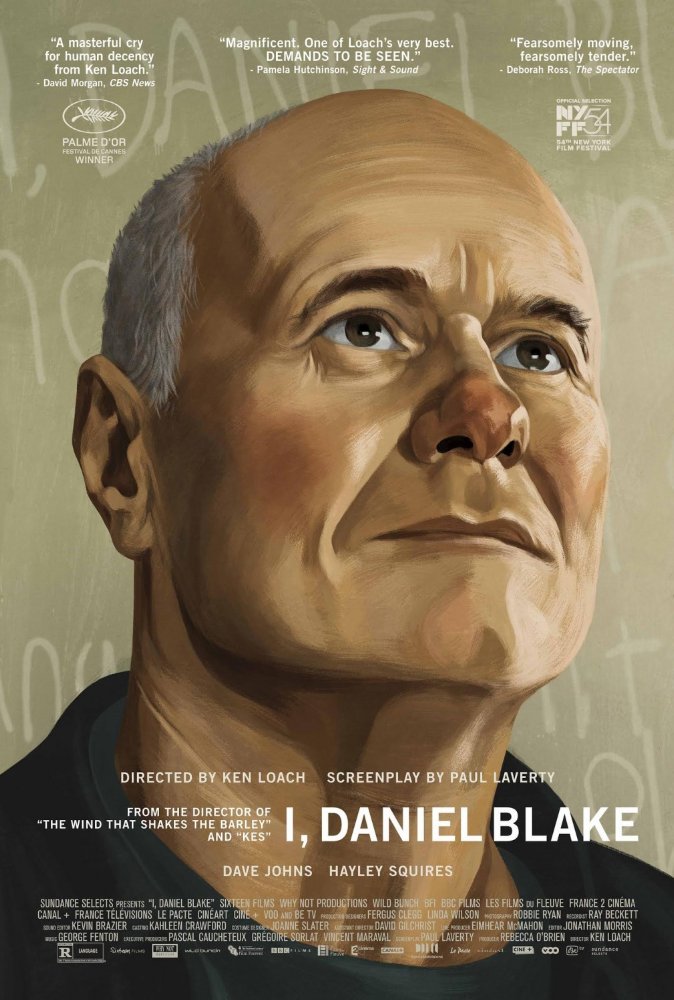
Ken Loach’s I, Daniel Blake has gotten a lot of attention and praise. Good: it wrestles with a topic that’s timely on both sides of the Atlantic—and elsewhere, for that matter. A political and poweful message, Loach has touched many a nerve. Case in point: I, Daniel Blake won the Palm d’Or at the Cannes Film Festival, where it finished with a 15-minute standing ovation (http://variety.com/2016/film/global/palme-dor-ken-loach-rebecca-obrien-1201785482/). 15 whole minutes?! Wow.
Daniel Blake (Dave Johns) is a kind of antihero. He’s gruff, he’s private, he’s not handsome or young. He probably goes to church. A heart attack seems like the thing that would change his life, but what really does is a new neighbor (Hayley Squires) and her two kids (Briana Shann and Dylan McKiernan).
I didn’t stand up, but I get it. Bureaucracy versus common sense is always fertile ground for storytelling. I applaud Loach for what he’s saying here, I really do. I, Daniel Blake is a good film: it’s engaging, brave, and relatable. The acting is good all around. So is the premise.
In my opinion, though, it just isn’t a great film. We’re talking shades of meaning here, so if you have five seconds to spare, I’ll tell you why. First, I’ve seen this device many times before—in the last year, even. A cranky old man meets a character that represents youth and hope, and it totally melts the icy facade and changes his life. Well, OK. This sense of hope is usually personified by the very person society looks down on. Next?
Second, I saw where the plot was going way before I got there. Again and again. Predictability is never groundbreaking.
Third, I can’t help but think that this film takes the easy way out. A heart attack in a movie ends only one way. And it’s only a sad ending. Yeah, I, Daniel Blake is emotionally manipulative.
So, my issues center on Paul Laverty’s writing. I wish I had a better way to tell this story. I don’t. For all its pluses and minuses, though, I’d rather watch something more intense. Overall, I, Daniel Blake is disappointingly soft.
With Kate Rutter, Sharon Percy, Kema Sikazwe, Steven Richens, Amanda Payne, Chris Mcglade, Shaun Prendergast, Gavin Webster, Sammy T. Dobson, Mickey Hutton, Colin Coombs, David Murray, Stephen Clegg, Andy Kidd , Dan Li, Jane Birch, Micky McGregor, Neil Stuart Morton
Production: Sixteen Films, Why Not Productions, Wild Bunch, British Film Institute (BFI), BBC Films, Les Films du Fleuve, Canal+, Ciné+
Distribution: Entertainment One Films (UK), Le Pacte (France), Cinéart (Belgium/Netherlands), Cinema (Italy), Feelgood Entertainment (Greece), Prokino Filmverleih (Germany), Scanbox Entertainment (Denmark), Sundance Selects (USA), Transmission Films (Australia), Vertigo Média Kft. (Hungary), Canibal Networks (Mexico), Cine Canibal (Mexico), Imovision (Brazil), Mont Blanc Cinema (Argentina), Longride (Japan)
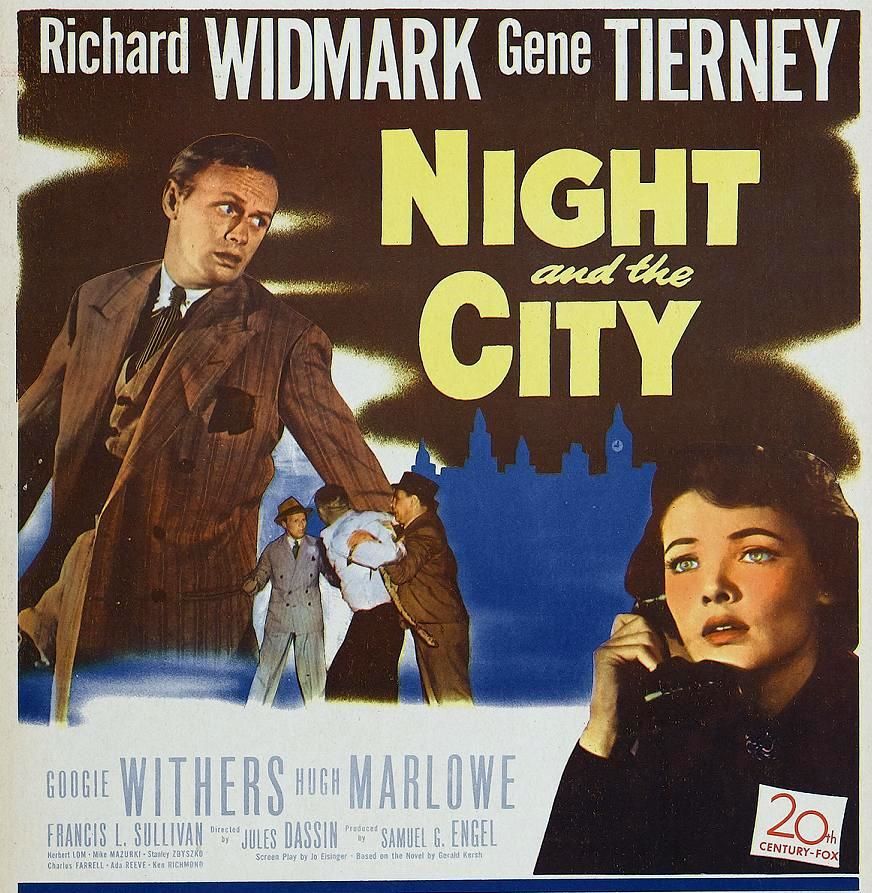
Jules Dassin’s Night and the City is a fine example of classic film noir. Filmed in smoky black and white mostly at nighttime on location in London, Dassin takes us slumming through the seedy underworld of nightlife, wrestling, and organized crime.
Harry Fabian (Richard Widmark) is a hard-bitten, ambitious, streetwise American con artist living in London. Always on the lookout for a quick buck, he can’t seem to catch a break. Ever. Literally running for his life in the opening scene, his latest career endeavor has failed, and his girl, Mary (Gene Tierney), is losing faith in him—stealing from her will do that.
Things brighten one night after a failed hustle at a wrestling match: Harry crosses paths with famous retired Greek wrestler Gregorius the Great (real life professional wrestler Stanislaus Zbyszko) and his prodigy, Nikolas of Athens (Ken Richmond), who both walk out of the arena in a huff. Gregorius is furious with his son, Kristo (Herbert Lom), who organized the fight, a low-end sort of WWE-like affair that he finds tacky.
Harry schmoozes Gregorius and learns that Kristo is a mobster who controls wrestling in all of London. He devises a plan to create a promotion startup, aligning himself with Gregorius to get around Kristo. He secures funding by double dealing with Phil Nosseross (Francis L. Sullivan), the owner of the Silver Fox Club where Mary works, and Phil’s wife, Helen (Googie Withers). She has plans of her own she doesn’t want Phil to know about.
The whole thing looks like it’s actually going to work despite Kristo’s threats, a plot to murder Harry, and Phil pulling his backing from the project. Harry gets so far as setting up a real fight between Nikolas and the Strangler (Mike Mazurki, also a real life professional wrestler). A miscalculation unravels everything—not just for him but everyone involved.
Jo Eisinger’s screenplay, based on Gerald Kersh’s novel Night and the City with contributions from Austin Dempster and William E. Watts, involves morally bankrupt lowlife characters who lack any redeeming qualities. All of them are scamming for one thing or another, and none of them—except maybe Mary—evokes any sympathy. This plays out nicely with the motifs of money, masculinity, and blind ambition that give this story its dark and bitter hue. It’s suspenseful. Ultimately, evil prevails in this dirty little story, which had to be revolutionary if jarring when this came out.
The backstory here is as interesting as the plot: during the production of Night and the City, Dassin was blacklisted for being a Communist. Pushed into exile, he infuses a strong sense of betrayal and fear into this film (https://en.wikipedia.org/wiki/Jules_Dassin).
Night and the City is desperate, chilly, and magnificently bleak—and it looks it thanks to Mutz Greenbaum’s shadowy and dramatic cinematography. Of the nitrate prints that screened this year, this was a standout. According to the festival program, this pre-release print is ten minutes longer than the UK version and 15 minutes longer than the US version.
With Hugh Marlowe, Ada Reeve, Charles Farrell, Edward Chapman, Betty Shale
“Face your past. Choose your future.” That’s what the poster for T2 Trainspotting says. Perhaps it should say, “Paybacks are a bitch,” something Mark Renton (Ewan McGregor) finds out pretty quickly when he returns home to Edinburgh after 20 years in Amsterdam following his little fuckover at the end of Trainspotting. Ostensibly back to make amends and settle his debt, Renton knows that forgiving and forgetting isn’t so easy—or smooth. Truth be told, he probably didn’t expect it to be.
Renton finds Spud (Ewen Bremner) unemployed, still struggling with heroin, and literally killing himself—like, alone with a plastic bag over his head in his dingy apartment. Sick Boy (Jonny Lee Miller) is a full-fledged douche, complete with a failing bar—the Port Sunshine—that he inherited from his aunt, a blackmail sex scam he runs on the side with a Bulgarian partner—Veronika (Anjela Nedyalkova), whom he fancies as his girlfriend—and a seriously unflattering coke habit. Oh yeah, he’s still bleaching what he’s got left of his hair. Neither is stoked about Renton showing up, but Sick Boy is clearly more bitter than Spud. He has a plan to get even.
Soon, however, Renton and Sick Boy are up to their old tricks, nightclubbing, tripping, and yes, thieving. In one of T2‘s best scenes, they head somewhere outside Edinburgh and hit a pub that looks more like an American VFW hall. It’s some weird open mic night for a crowd of Protestant Unionists who are rabidly anti-Catholic because of history. Explaining it all to Veronika in the car before the heist—the plan is to pickpocket as many ATM cards as they can get their hands on—Renton calls them “relics.” After a successful mission, the bouncer won’t let them leave until they perform a number. What they come up with is brilliant.
The fun and games come to a grinding halt when Begbie (Robert Carlyle), who’s serving a 25-year prison sentence and is denied parole because of his anger management problem, breaks out of jail and runs into Renton. He loses his shit in yet another great scene. Renton gets away for the moment but Begbie is on his trail, which leads him to a sketchy business partnership. Will history repeat itself?
I was skeptical when I heard director Danny Boyle was making a sequel; I guess I thought Trainspotting didn’t need a follow up. T2, which is loosely based on Irvine Welsh’s 2002 novel Porno, lacks the youthful vigor of the original and frankly isn’t as cool. How could it be? It wouldn’t exist without Trainspotting; it’s got flashbacks and obligatory references, some more clever than others, throughout. Kelly Macdonald has a fun cameo, Renton’s “Choose Life” monologue is updated, that toilet makes a brief appearance, and there’s a nice remix of Iggy Pop’s “Lust for Life” at the end (and yes, we know it’s coming).
Still, T2 stands on its own. It’s fueled by nostalgia and revenge, which in this case turns out to be a rather interesting combination. T2 has more of a conventional plot, and it’s oddly fascinating. The dialogue is every bit as wickedly sharp as before. These boys have grown up—they’ve turned into sad men because they’ve chosen unfulfilled promise and disappointment (to use Renton’s words). Now they have to deal with it, which isn’t what I imagined them doing in 20 years—if they even lived, which they most definitely have. Surprise! We all know someone like this, right? I would see T2 again.
At a post screening discussion, Boyle said he really made an effort to connect to the original. He succeeded, in a good way. As for the title, he said it’s an homage of sorts to Terminator director James Cameron, whom the characters would simultaneously want to honor and piss off.
With Shirley Henderson, Scot Greenan, Pauline Lynch, James Cosmo, Eileen Nicholas, Irvine Welsh
Production: Film4, Creative Scotland, Cloud Eight Films, DNA Films, Decibel Films
Distribution: TriStar Pictures
Screening followed by a live Q and A with Danny Boyle and Irvine Welsh moderated by Richard Roeper
“People can say I can’t sing, but they can’t say I didn’t sing.”
—Florence Foster Jenkins
A lot of hype surrounded Florence Foster Jenkins before it arrived at a theater near us last fall. We wanted to catch it during its original run, but it came and went before we got around to seeing it. So, inspired by a post earlier in the day, I rented it on a Friday when we had no plans other than dinner at home. The night we watched it just happened to be Friday the 13th, which somehow seems appropriate.
Based on actual events and set during WWII, Florence (Meryl Streep) is a rich Manhattan society lady of a certain age who runs in an arty circle and knows a lot of people, some with money and others who follow it. She operates a private venue dedicated to opera, the Verdi Club, where she stars in a show and has a non-speaking role. Dying of either syphillis or the treatment for it—mercury and arsenic!—her one wish is to perform for an audience at Carnegie Hall. The problem is, she can’t sing; she’s downright awful. Her entrance here, lowered onstage from a rope and pulley while dressed as an angel with a harp, reminds me of Sarah Jessica Parker’s entrance (“I offer you mortals the bird of peace so that you may change your ways and end this destruction”) in Ed Wood, Tim Burton’s 1994 biopic about a similarly talentless film director who came along a decade or so later. The comparison is so apt that I wonder if it was intentional. Here, Florence’s husband, St. Clair Bayfield (Hugh Grant), doesn’t help matters by exaggerating her talent.
Determined to make her dream come true, Florence hires a vocal trainer, Carlo Edwards (David Haig), and a pianist, Cosmé McMoon (Simon Helberg), to put together a show. Established and well-known Carlo is content to take Florence’s money, build her ego, and let her dream on. Budding Cosmé, however, struggles with lying to her about her obvious ineptitude, not to mention her negative impact on his professional reputation. He soon sees that those around Florence stretch the truth about a lot of things when dealing with her.
Nicholas Martin’s script is kind to its characters, going for laughs in a way that doesn’t demean any of them. I never heard of her until this film, but the actual Florence Foster Jenkins was an interesting person. Her singing truly was awful: https://www.youtube.com/watch?v=Hcs9yJjVecs. As always, Streep is spot on with her portrayal. She seems to have fun in this role, and it shows. Grant, who usually bores me but doesn’t here, is well suited for St. Clair: he’s stuffy and straight, but he nicely coveys an underlying deceitfulness that doesn’t come off as sinister. I like the way director Stephen Frears plays with deceit here, ultimately using it to depict a very touching side of St. Clair—who lives with his mistress (Rebecca Ferguson) in Brooklyn in apartment that Florence pays for. Much to my surprise, though, Big Bang Theory‘s Helberg steals practically every scene he’s in: keeping it subtle with Cosmé’s homosexuality (as Cosmé himself no doubt would have done during his day), he plays his character as a spineless, perennially uncomfortable, asexual bundle of nerves. He peppers his performance with grimaces and nervous giggles. Later, he delivers a line to explain his tardiness to Florence (of course, it involves sailors) with perfect and priceless dryness. He outshines everyone here.
Florence Foster Jenkins has some funny moments and some very touching ones. I found it enjoyable enough, but certainly not a knockout. It could have benefitted from a little more quirk and edge, especially considering its title character who showed no shortage of either.
Also starring Nina Arianda, Stanley Townsend, Allan Corduner, John Sessions, John Kavanagh, David Menkin, and Sid Phoenix
Produced by Qwerty Films, Pathé Pictures International, and BBC Films
Like any kid, five-year-old Saroo (Sunny Pawar) is enamored of his older brother, Guddu (Abhishek Bharate). Saroo shadows Guddu everywhere, helping him do things like steal coal from trains to trade for milk for their penurious mother (Priyanka Bose) and little sister (Khushi Solanki) in their tiny village in India. After begging his brother to take him to “work” with him in a nearby city one night, both boys quickly learn that Saroo is too young to hack the late shift. Guddu leaves Saroo on a bench at a train station, promising to be right back. Saroo dozes off, waking up on an empty platform in the middle of the night. Scared and maybe cold, he gets on a vacant train and drifts back to sleep in one of the compartments. He’s jolted up while the train is speeding through terrain he’s never seen before.
The train takes Saroo to Kolkata (formerly Calcutta), where he must fend for himself. He doesn’t know the city, the language, or even his mother’s name. Kolkata is dangerous for a kid: Saroo is nearly abducted at the train station. He meets Noor (Tannishtha Chatterjee), a seemingly nice lady who takes him in. Saroo senses that her creepy friend Rawa (Nawazuddin Siddiqui) has nefarious plans for him, so he bails. A man (Riddhi Sen) eating in a café takes Saroo to the police, who turn him over to an orphanage. They try to find Saroo’s mother, but he’s unable to provide any useful information. Mrs. Sood (Deepti Naval) teaches him English and manners. An Australian couple, John (David Wenham) and Sue Brierley (Nicole Kidman), adopt him.
To use a line from the Beastie Boys, you think this story’s over but it’s ready to begin. Cut to 2008: Saroo (Dev Patel) is grown up, Westernized, and starting school for hospitality management. During introductions, he tells his classmates that he’s from Calcutta but that’s about all he knows. While attending a friend’s party, he goes to the kitchen to get a beer and sees a plate of jalebi, an orange deep-fried Indian pastry. It triggers his memory, and he becomes obsessed with finding his “real” family.
Adapted from Saroo Brierley’s memoir A Long Way Home, Lion plays out as two movies: one about young Saroo, and the other about adult Saroo. On an emotional level, Lion is a beautiful and powerful accomplishment—I defy anyone not to feel something from this film, which deals with identity, family, and home. Even so, it’s flawed. First-time feature director Garth Davis is really heavy-handed with the tears, so much that Lion comes off as trying too hard—manipulative, even. Davis connects the two stories, but he treats them vastly differently. The pace of young Saroo’s story is far superior: it flows naturally, unlike adult Saroo’s, which is choppy and abrupt. Young Saroo’s story is insightful and lyrical, while adult Saroo’s is too often inelegant. I found the unevenness distracting. Plus, the apparitions of Guddu and Saroo’s mother in Australia got silly after awhile. It shouldn’t be difficult to tell from the first three paragraphs of this entry which story I found more engaging.
Even with its flaws, Lion is still a good movie—well worth the two hours it eats of your life. The acting all around is superb, though Lucy (Rooney Mara) is a bit superfluous. Patel is great, but Pawar is the star here; it’s hard to believe this is his first film. Sia’s “Never Give Up,” which plays over the closing credits, will get stuck in your head for days.
Andrea Arnold’s American Honey is not a typical teenage girl movie. It isn’t a comedy. Its protagonist, 18 year old Star (Sasha Lane), isn’t funny, cutsie, bitchy, or crazy. To the contrary, she’s smart, strong, serious, and quite desperate. Star is pursuing a boy, but her agenda extends beyond that, even if she doesn’t realize it. She also seems acutely aware that for better or for worse, she’s in control of her own fate.
American Honey opens with Star and two young kids chained to her side digging out discarded chickens from a dumpster for dinner. They walk aimlessly to K-Mart—a place I had no idea still exists—where they cross paths with a feral band of cracky-looking misfits led by Jake (Shia LaBeouf), a ringleader of sorts for the trailer park set. Star and Jake flirt, but security ejects Jake and his posse from the store when they get rowdy. Star ends up with Jake’s phone, giving her the perfect opportunity to continue their encounter in the parking lot. Smitten, she ditches the kids (it turns out they’re not hers) and takes him up on his offer to join him and his “mag crew” on the road.
A “mag crew” is a nomadic lot of door-to-door sales reps, usually kids, hawking magazine subscriptions (http://mobile.nytimes.com/2007/02/21/us/21magcrew.html). The environment is cutthroat and the crew is often abused and exploited. Jake’s crew sells magazines in small mainly rural towns throughout middle America—places like Oklahoma, Kansas, South Dakota, and Missouri. It doesn’t sound fun or profitable, but it works for Star—for a little while, anyway. Despite unrelenting shade from the crew’s manager, suspicious and bossy queen bee Krystal (Riley Keough), Star finds her stride in this ragtag mess, competing for sales, partying with the group, and getting involved with Jake, the top salesman who takes her under his wing and trains her. As rapper E-40 says in “Choices,” one of the songs used for the soundtrack, “I choose to get money, I’m stuck to this bread.”
American Honey doesn’t feel very structured; it plays out more as improvisation than something planned from a script. At times, the pace is rambling and almost painfully slow, which usually sounds the death knell for a lengthy film such as this. Surprisingly, it works for these characters and this story. Arnold is clearly interested in the geographical, cultural, and economic continental divide of America, and she’s adept at exhibiting this through her artistic choices. The settings—mostly barren highways, shitty little meth towns, cheap roadside motels and truck stops, even an oil field—nicely frame the characters’ collective circumstances. The locations provide precisely the backdrop one would expect in a road movie, but somehow they’re more beautiful here. The music is a hodgepodge of genres from techno to country to rap to folk, and it all fits perfectly. I must confess, I downloaded the soundtrack (Bruce Springsteen is not on it). American Honey paints a lusty, vivid picture of life on the fringe.
Newcomer Lane is intriguing and charismatic; it’s hard to believe this is her first film. The part of Jake seems tailor made for LaBeouf, who brings a volatile, forboding edge to his character. The supporting cast is adequate but for the most part forgettable. A few stand out. One is QT (Veronica Ezell), a friendly and chubby pot smoking hippy. Another is Pagan (Arielle Holmes), a sweet goth chick obsessed with Star Wars. The true scene stealer, though, is Corey (McCaul Lombardi), the tanned, blue-eyed, tattooed, fake blonde horndog party boy with a penchant for whipping out his dick whenever because, well, he can. I hope and expect to see more of him and his chiseled cheekbones in the future.
I doubt American Honey has mainstream appeal; it’s too fluid, subtle, and open-ended. It’s got its flaws, but I loved it. On the surface, it’s a road movie about a girl pursuing a boy. The real narrative, though, is much deeper. Like the character in the Lady Antebellum song that gives this film its title, Star literally grows up on the side of the road, and does so before our eyes. She starts out a kid. In the final scene, she immerses herself in a pond, an event spurred by a turtle Jake gives her and likely by a few hungry, neglected children she encounters on her own while selling magazines earlier that day. Her “baptism” is symbolic: with it, Star resigns herself to the fact that she has a role in the grand sceme of things even if she’s never going to get all she wants. In other words, she’s grown up. It’s a gorgeously demonstrated point, if you can make it all the way to the end.
“Sometimes horrible things happen quite naturally.”
“It’s all so horrible, you know, the nightmare of childhood. And it only gets worse. One day you’ll wake up, and you’ll be past it. Your beautiful skin will wrinkle and shrivel up. You’ll lose your hair, your sight, your memory. Your blood will thicken, teeth turn yellow and loose. You will start to stink and fart, and all your friends will be dead. You’ll succumb to arthritis, angina, senile dementia. You’ll piss yourself, shit yourself, drool at the mouth. Just pray that when this happens, you’ve got someone to love you. Because if you’re loved, you’ll still be young.”
—Dolphin Blue
British playwright and occasional film director Philip Ridley’s first picture, The Reflecting Skin, is a wickedly devious bait and switch. It opens downright beautifully with seemingly precious eight-year-old Seth Dove (Jeremy Cooper) walking through an unnaturally radiant golden field of wheat carrying a huge frog to his friends, Eben (Codie Lucas Wilbee) and Kim (Evan Hall), who are waiting for him on the side of a rural dirt road. The idyllic scene, which could be straight from a Norman Rockwell or Edward Hopper painting or maybe even a Mark Twain novel, immediately takes a seriously twisted turn when one of them sticks a straw in the frog’s butt and inflates it. The tone is set: as Ridley himself admitted, “the opening of the film deliberately dupes you into thinking you’re going to watch Little House on the Prairie, and then it suddenly becomes The Texas Chainsaw Massacre with reptiles” (http://thepeoplesmovies.com/2015/12/the-reflecting-skin-philip-ridley-interview/). Ummm, yeah.
Poor Seth: his name rhymes with death, which is all around him and it’s tearing his world apart—he doesn’t even realize it. The adults in his life seem incapable of explaining any of it to him. He lives in a crumbling old farm house next to the gas station that his henpecked father, Luke (Duncan Fraser), operates in an isolated prairie town somewhere in Idaho (a fact I picked up from a state trooper’s uniform) in the 1950s. Maybe the town has seen better days, but probably not. A group of handsome greasers in a big black Cadillac comes into the station for a fill up. The creepy driver (Jason Wolfe) asks Seth a few weird questions and promises to see him soon before driving away.
WARNING: Potential spoilers ahead!
The aforementioned frog was the unfortunate pawn in an awful prank involving one of the Doves’ neighbors, a glum and taciturn English widow with the spectacular name Dolphin Blue (Lindsay Duncan). Seth’s mother, Ruth (Sheila Moore), a raving termagant obsessed with the smell of gasoline in her house, makes him go apologize to her. It’s a weird exchange: Dolphin relates that she used to burn cats when she was little and shows Seth a box containing her dead husband’s teeth, hair, and cologne before she breaks down, sending Seth running away with a harpoon. Soon after, Eben disappears. Seth blames Dolphin, whom he concludes is a vampire in part because she looks like the one on the cover of a pulp novel his father is reading. The police, particularly cynical Sheriff Ticker (Robert Koons), think otherwise: they blame Luke because of a past transgression. Feeling backed into a corner, Luke eventually immerses himself in gasoline and sets himself on fire.
Seth’s older brother, Cameron (Viggo Mortensen), comes home from the military, where he’s serving on a mission in the Pacific. Cameron meets Dolphin at the cemetery—a spark ignites, and they start spending time together. Seth is horrified when his brother tells him he’s sick: he’s losing weight, his hair is falling out, and something is going on with his teeth. Seth again blames Dolphin, who he thinks is turning Cameron into a vampire (although Cameron reveals what’s really going on when he breaks out a photo of a Japanese baby whose skin turned silver from an atomic bomb). After catching an intimate moment while spying on the budding lovebirds, Seth observes the guys in the Cadillac snatch Kim.
“Innocence can be hell,” is the last thing Dolphin says to Seth before she accepts a ride into town from the black Cadillac.
The Reflecting Skin makes a simple point: children will use their imagination to fill in the blanks of what they don’t understand. The story is told through Seth’s eyes, and his conclusions are often bizzare but he arrives at them using what little he has to work with (that whole deal with the fetus he finds in a barn and rationalizes is Eben—yuck!). As Ridley explained, “it’s a kind of remembered fantasy of childhood; it’s being told by an unreliable, possibly psychotic narrator; objects are used symbolically; there’s this huge kind of nightmare journey through one mythical childhood” (http://thepeoplesmovies.com/2015/12/the-reflecting-skin-philip-ridley-interview/).
The way he illustrates his point is fascinating. Everything about the story is horrible. With an approach worthy of David Lynch, Ridley takes a hodgepodge of characters—vampires, religious zealots, suspicious small town law men—and throws them into this weird mix of the macabre, sexual perversion, punishment, and subtle dark humor. His use of symbolism is liberal to say the least. The story is meticulously plotted: every character, scene, and little event is in here for a reason.
This is all underneath Dick Pope’s gorgeous cinematography, which is loaded with vibrant colors and a beautifully fine-tuned attention to detail: the vastness of the wheat fields, the crazy black hair of both brothers, the flies that are always present. Nearly 30 years on, The Reflecting Skin still looks arresting; in fact, it’s one of the most beautiful looking movies I’ve ever seen. Nick Bicât’s heavy and haunting baroque-inspired score is a perfect fit. The overall result is wonderfully dreamy and surreal, yet we definitely sympathize with Seth—probably because we all know that childhood does in fact suck. He’s grounded in reality.
I would be remiss not to mention the acting, which is all around superb. I doubt this film would work with lesser talent.
A dearly departed old friend of mine introduced me to The Reflecting Skin in 1993 or 1994. I’ve never had an opportunity to see it on the big screen, which is a pity because this is one film clearly meant to be seen in a theater. For years, I had a shitty VHS copy and recently found it on DVD. It’s not an easy film to find, but it’s totally worth the effort.
Barak and Tomer Heymann’s warm documentary, Who’s Gonna Love Me Now?, takes its title from the first thought that crossed subject Saar Maoz’s mind when he received his HIV diagnosis. A likable middle-aged gay guy (he turns 40 during the course of the film), Maoz relocated to London almost two decades ago after he was kicked out his kibbutz in Israel for being gay. It’s been a source of embarrassment for his religious family, whose respect Maoz seems to have lost. He sets out to change that, going back home and confronting his parents and his siblings. He has to get past their fears, their misconceptions about homosexuality and HIV, and worst of all their judgments of him.
Maoz, who sings in the London Gay Men’s Chorus, is oddly charismatic. Relatively unassuming, he leads a seemingly quiet life and doesn’t exactly stand out from the crowd; in fact, he blends in with the other men in virtually every scene with the Chorus (save for one—I won’t say what it’s about). He’s decent, honest, open, and has a good sense of humor with an imperfect past, all of which probably explain his charm. He could be anyone you know, including yourself. I must admit, I related to him on many levels here: his conflicted feelings about his religion, moving away from home and coming out, his sense of distance with some of his family, filling a void with partying in the early 2000s, being alone for a long period of time. He doesn’t come across as regretful or pitiable, just reflective and forward-focused. Filmed over the course of about five years, the best scenes are the ones with his mother, his father, and an argument in a restaurant with his brother. Who’s Gonna Love Me Now? is an often funny and sometimes heavy reminder that home is where you can be yourself, for better or for worse.
Screening followed by a live discussion with Saar Maoz






 moviebloke