Spellbound

(USA 1945)

“The Fault…is Not in Our Stars,
But in Ourselves…”

—William Shakespeare

I’ve read enough online rankings of Alfred Hitchcock’s films to know that Spellbound often ends up in his top 20 or 30—sometimes higher than that—thank you. While certainly impressive considering the number of films he directed (https://en.wikipedia.org/wiki/Alfred_Hitchcock_filmography), I found Spellbound lackluster, comparatively speaking.

It’s not that I didn’t enjoy it. In the grand scheme of all things cinema, Spellbound is a solid work—it’s just not a great Hitchcock film. Ingrid Bergman is psychoanalyst Constance Petersen, the only female doctor at Green Manors, a mental hospital in Vermont. Her male colleagues see her as detached and cold, which doesn’t bode well for her career—particularly for a woman in the 1940s.

The hospital’s director, Dr. Murchison (Leo G. Carroll), is “retiring.” His replacement is young and handsome Dr. Anthony Edwardes (a young Gregory Peck), who catches Dr. Petersen off guard. Truth be told, she’s smitten—and who can blame her? Gregory Peck is gorgeous here. Anyway, Dr. Edwardes has a secret that becomes apparent: he’s not who he says he is. He’s actually John Ballantyne, a.k.a. John Brown, a dude with amnesia who says he killed the real Dr. Edwardes and assumed his identity. Dr. Petersen doesn’t believe him, and she sets out to find the real murderer—through psychoanalysis. It all leads to a fateful ski trip that comes full circle to Green Manors. Gasp!

Angus MacPhail and Ben Hecht based their screenplay on the 1928 novel The House of Dr. Edwardes by John Palmer and Hilary A. Saunders (as Francis Beeding). Clearly obsessed with Sigmund Freud, the story is clunky but cute and oddly entertaining even if it’s kind of stupid. Two things stick out in my mind about this film: one is Salvador Dalí’s cool dream sequence complete with random objects like big bleary eyes, scissors, a faceless figure, and wings; and that final scene where a gun is fired into the camera—I won’t ruin it, but it literally ends Spellbound with a bloody bang. Fucking awesome!

The nitrate print used for this screening was gorgeous, shimmering with rich blacks and luminescent whites. It impressed me. Miklòs Ròzsa’s grand, sweeping score is fierce—no wonder he won an Oscar for it (https://www.oscars.org/oscars/ceremonies/1946).

One extremely personal but annoying detail: the Siouxsie and the Banshees song “Spellbound” played in the back of my mind the entire time I watched this film. Yeah, I’m hearing voices, I guess…but it could be much worse (I’m talking to you, Paula Abdul).

With Michael Chekhov, Rhonda Fleming, John Emery, Steven Geray, Paul Harvey, Donald Curtis, Norman Lloyd, Bill Goodwin, Wallace Ford, Art Baker, Regis Toomey

Production: Selznick International Pictures, Vanguard Films

Distribution: United Artists

111 minutes
Not rated

(Dryden Theatre) B-

Nitrate Picture Show

https://youtu.be/4p6Zho7FLiA

Lost Highway

(USA 1997)

I watched David Lynch’s Lost Highway on my iPad on an Amtrak train from Chicago to Rochester. The one thing I strongly recommend is that it be viewed on the big screen, or at the very least on a flatscreen television. Quite simply, the visuals here are far too beautiful to see in an abridged format. And frankly, the visuals—sets, colors, costumes, actors, props—are the best part of the film.

The second thing I recommend is that it be watched under the influence of something—booze, pot, or better yet, prescription drugs.

This begs a question I’ll just answer: Lost Highway is fucked up—thrillingly so. The whole things starts with a videotape of our unlucky hero, saxophonist Fred Madison (Bill Pullman), murdering his wife (Patricia Arquette), who in an alternate universe is having an affair with Madison’s younger alterego, Pete Dayton (Balthazar Getty). The married couple has no memory of this murder. Neither party seems aware of this wrinkle in time and space, either. The connection lies with two people: demanding gangster Mr. Eddy (Robert Loggia) and creepy-ass flour-faced Robert Blake in what must be his most frightening role as The Mystery Man, a pallid ghost straight from a silent movie or a video by The Cure.

Lost Highway isn’t my favorite David Lynch film. However, it’s intriguing and vague enough to keep me thinking about it. I’m not sure what to make of this one—but I’m also not sure I care enough to do the work to figure it out. Maybe someday, definitely not today. The star cameos are enough for now.

Interesting fact: Lost Highway features the final film performances of Blake, Jack Nance, and Richard Pryor. Who knew?

With Alice Wakefield, John Roselius, Lou Eppolito, Henry Rollins, Mink Stole, Gary Busey, Lucy Butler, Giovanni Ribisi, Marilyn Manson, David Lynch

Production: October Films, CiBy 2000, Asymmetrical Productions, Lost Highway Productions LLC

Distribution: October Films (USA), Polygram Filmed Entertainment (UK), Rialto Film AG (Switzerland), RCV Film Distribution, Cinemussy (Spain), Senator Film (Germany), Atalanta Filmes (Portugal), Edko Films (Hong Kong), NTV-PROFIT (Russia), Artistas Argentinos Asociados (AAA) (Argentina), AmaFilms (Greece), New Star (Greece), Sandrew Film (Sweden), United International Pictures (UIP) (Australia), Warner Brothers (Finland)

134 minutes
Rated R

(iTunes rental) C+

http://www.davidlynch.de

https://youtu.be/1nKjO9QCSic

Body of Evidence

(USA 1993)

“That’s what I do. I fuck. And it made me eight million dollars.”

—Rebecca Carlson

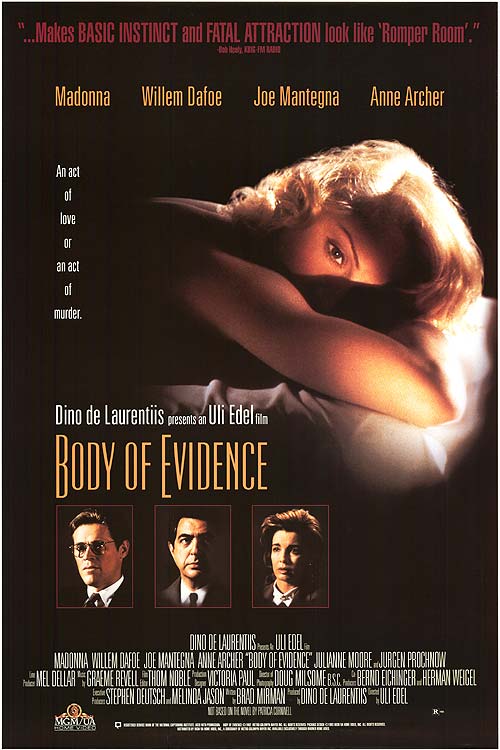
As true blue a Madonna fan as I am, I haven’t bothered to see a considerable number of her movies. Uli Edel’s Body of Evidence is one of them (she has top billing here, so yes, it’s a Madonna movie). On a ridiculously cold and rainy Saturday night, I decided to change that when I saw it showing on cable. Now that I’ve seen it, what surprised me most about Body of Evidence is that it’s actually not that bad. To be clear, it’s not good—it’s fluffy erotic fromage designed to be “provocative,” a sort of lame Basic Instinct (as if that’s a good movie)—but it’s not quite the disaster I expected.

Madonna is Rebecca Carlson, a femme fatale accused of slipping cocaine into her older lover’s nasal spray and “fucking him to death”—i.e., arousing him to the point of inducing a fatal heart attack. Willem Dafoe is her defense attorney. Of course, he gets involved with her despite his happy marriage to Julianne Moore.

Brad Mirman’s writing is pretty basic; his script feels a lot like a Law & Order episode, skipping through real life things like discovery and motions in limine to get right to the court stuff. I half-expected to hear that clang sound between scenes. His dialogue is often silly and, as demonstrated above, at times cringeworthy.

The promotional poster for Body of Evidence promises to make Fatal Attraction and the aforementioned Basic Instinct “look like Romper Room;” it doesn’t. The candle wax scene is kinda hot, but that’s it. The cast is impressive, but sadly no one gives a remarkable performance. Moore’s role, one of her first in a major studio release, is so small it’s background. Madonna pretty much plays Dita, her alterego from her Erotica album and Sex book, both of which came out just a few months before Body of Evidence. Her acting isn’t good, but somehow she comes off slightly less wooden than any character from her earlier movies, even A League of Their Own. Her look is exactly the same as in the video for “Bad Girl.” I’m not sure what Dafoe or Joe Mantegna, both good actors, saw in this project.

Body of Evidence is ultimately a forgettable snooze of a film. If it’s offensive at all, it’s because it’s boring.

With Anne Archer, Lillian Lehman, Stan Shaw, Charles Hallahan, Mark Rolston, Jürgen Prochnow, Frank Langella

Production: Dino De Laurentiis Communications, Neue Constantin Films

Distribution: Metro-Goldwyn-Mayer (USA), Guild Film Distribution (UK)

99 minutes
Rated R

(Impact) D+

Blue Velvet

(USA 1986)

Who hasn’t seen Blue Velvet? Even though David Lynch was already established by the time it came out, it’s the film that introduced me to him. I saw it once or twice in late high school or early college, definitely on VHS. The River’s Edge was the only comparison I had, and that was a weird film but…not on the same level. I found Blue Velvet totally watchable because it’s very dark, very sexual, very fucking weird, and very voyeuristic.

That was then, this is now: Blue Velvet is still all of those things, but I don’t remember it having the sense of humor it does. It’s curiously funny. It marks the start of Lynch’s style as we know it: not just surreal (he had already done Eraserhead), but macabre and perverted underneath the innocuous and mundane premise. Lynch sets up his narrative in pieces that refer back and forth, like a moving puzzle. It’s brilliant, and it’s a formula that’s served him well.

Blue Velvet starts with a severed ear on the ground, bugs crawling all over it. A local college kid turned stalker (Kyle MacLachlan) proves a bit too curious when his minor obsession with a night club singer (Isabella Rossellini) leads him into a sadomasochistic nightmare that neither he nor we viewers can turn away from. The whole bizarre and sordid story goes full circle back to where it started: that ear. 

Dennis Hopper as Frank, the gas-huffing sociopath who ends every sentence with the F-word, colors the mood here. None of it would work, though, without Rossellini’s vulnerability, which is crucial. 

Lynch considered Molly Ringwald instead of Laura Dern and Val Kilmer instead of MacLachlan. Thank goodness it happened how it did; what a different film Blue Velvet would have been. For a movie that relies so heavily on nuance, that could’ve ruined Lynch’s career. It didn’t. 

With Hope Lange, Dean Stockwell, George Dickerson, Priscilla Pointer, Frances Bay, Jack Harvey, Ken Stovitz, Brad Dourif, Jack Nance, J. Michael Hunter, Dick Green, Fred Pickler, Philip Markert, Leonard Watkins, Moses Gibson, Selden Smith, Peter Carew, Jon Jon Snipes, Angelo Badalamenti, Jean Pierre Viale, Donald Moore, A. Michelle Depland, Michelle Sasse, Katie Reid, Sparky

Production: De Laurentiis Entertainment Group

Distribution: De Laurentiis Entertainment Group, 20th Century Fox (UK), Transmundo Films (Argentina), AMLF (France), Concorde Film (Netherlands), Concorde Filmverleih (West Germany), Finnkino (Finland), Hoyts Distribution (Australia), Shochiku-Fuji Company (Japan)

120 minutes
Rated R

(Music Box) B+

David Lynch: A Complete Retrospective

Wild at Heart

(USA 1990)

“Man, I had a boner with a capital ‘O.'”

—Sailor Ripley


“And this here’s a story with a lesson about bad ideas.”

—Lula Pace Fortune


“Don’t turn away from love, Sailor.”

—Glinda the Good Witch

Wild at Heart is one of David Lynch’s more maligned films. Roger Ebert hated it to the point of indignation (https://www.google.com/amp/www.rogerebert.com/reviews/amp/wild-at-heart-1990). Vincent Canby seemed perplexed—I can’t tell whether he was bored, annoyed, or just flummoxed (http://www.nytimes.com/movie/review?res=9C0CE5D7123EF934A2575BC0A966958260). Jonathan Rosenbaum called it “appalling,” “inept,” and “debasing” (https://www.jonathanrosenbaum.net/1990/08/bad-ideas/). A host of other critics rolled their eyes and sighed, dismissing it, I suppose, as a violent and exploitive piece of shock fluff.

I never saw Wild at Heart until now. Some of the points raised by its detractors are valid, but I still liked it for the same things that made them hate it. Erratic, vulgar, and really sweet, it’s offputting yet compelling and—surprise!—it has a happy ending.

An atypically straightforward narrative for a Lynch project, Wild at Heart is a decidedly deranged, bloody road movie/romance/thriller based on Barry Gifford’s novel of the same name. Upon his release from a North Carolina prison after serving time for murder—never mind that it was self-defense—Sailor Ripley (Nicolas Cage) exits the jailhouse to find his lover, Lula Pace Fortune (Laura Dern), waiting for him outside in the sunlight with his snakeskin jacket, the symbol of his individuality and his belief in personal freedom. They spend some time catching up in a motel room and at a speedmetal concert before they decide to blow off his parole and take off for California.

Meanwhile, Lula’s mother, Southern lady Marietta (Diane Ladd), is making plans of her own—and they involve her private detective boyfriend (Harry Dean Stanton) and a hit man (J. E. Freeman) who’s got Sailor as his target. A bad omen detours the starcrossed lovers to Big Tuna, Texas, where they unwittingly plant themselves smack in the middle of a bad situation that looks to be turning deadly fast.

OK, I’ve seen versions of this same story before. The plot is familiar and for the most part implausible—not to mention really, really thin at times. Lynch goes overboard with his depiction of sex, violence, and gore—even though they all have a place here. None of this matters, though, because the characters, which are both the focus and the strength of the film, are fantastic.

As usual, the casting is stellar. Cage is at his best here, working that edgy deadpan earnest manic thing he did so well in his early films. Dern is flawless as a sweet Southern girl who’s found her place with bad boy Sailor, everyone else be damned. Willem Dafoe is super creepy as hayseed bad guy Bobby Peru—those teeth! Above them all, however, is Ladd, who’s fucking fabulous even with her face covered in red lipstick. She’s vengeful at times, remorseful at others; but all the while, a perfect lady. She shines here. There’s a reason she was nominated for an Oscar for her performance (https://www.oscars.org/oscars/ceremonies/1991). This film works because the actors give it their all.

Wild at Heart is loaded with Lynch’s trademark what-the-fuck weirdness—a man at a bar quacking like a duck (you read that correctly) and cousin “Jingle Dell” (Crispin Glover) sitting on the floor in the bathroom screaming for Christmas or standing at the counter in the dark making a hundred sandwiches for lunch are bizarre moments even by Lynchian standards. There’s a lot more to it, though. I love the theme of finding a happy place in the midst of horrible things happening. I love all the references to various staples of Americana—cowboys, cars, highways, Elvis Presley, and my favorite, The Wizard of Oz. I love that underneath it all is a touching love story that we can all relate to.

What I find most interesting, though, is that so many things about Wild at Heart scream Quentin Tarantino, yet he had nothing to do with it. In fact, it came out two years before Tarantino’s first major film, Reservoir Dogs. I never thought of David Lynch as an influence on him, but Wild at Heart makes me wonder.

Side note: Wild at Heart is a rated R movie. For the screening I attended, however, I was lucky enough to catch an unreleased rated X version. The X rating was no doubt due to the graphic violence—it wasn’t the sex scenes. The print was in bad shape, all scratchy and beat up, but it was totally worth it to see an X-rated Lynch film.

With W. Morgan Sheppard, Grace Zabriskie, Isabella Rossellini, Sherilyn Fenn, Sheryl Lee

Production: PolyGram Filmed Entertainment, Propaganda Films

Distribution: Manifesto Film Sales, The Samuel Goldwyn Company (USA), Palace Pictures (UK), Bac Films (France), Cineplex Odeon Films (Canada), Finnkino (Finland), Hoyts Distribution (Australia), Háskólabíó (Iceland), Meteor Film Productions (Netherlands), Sandrew Film & Teater (Sweden), Solopan (Poland)

125 minutes
Rated X (alternate version)

(Music Box) B

David Lynch: A Complete Retrospective

http://www.davidlynch.de

Mulholland Dr.

(USA/France 2001)

“No hay banda, il n’est pas d’orchestra. It is all an illusion.”

—The Magician at Club Silencio

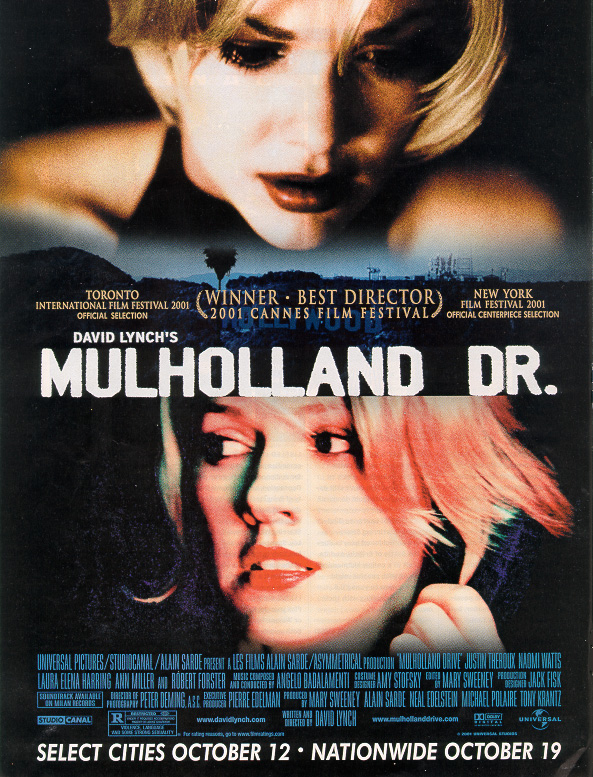
The perfect opener for a retrospective on its director, Mulholland Dr. is an inimitable film that’s really hard to write about. You can look for answers online all you want, but even after seeing it multiple times you still don’t know what happens in it.

Not unless you’re David Lynch. That doesn’t make it any less enjoyable, though.

I’ve seen Mulholland Dr. maybe three times, and I’m not sure. I have my theories. Maybe they’re right, maybe not. Who cares? As with any of Lynch’s best films, the draw to Mulholland Dr. is that it’s a puzzle. He makes you work to solve it, or at least try to. He gives you just enough to go on but leaves the whole thing open to interpretation. At points, he gets you so frustrated, you lose patience and you hate him. But you don’t want him to stop. It’s artistic sadomasochism.

What began as a project for television is a mystery mindfuck tailored to the big screen. Dreamlike, hypnotic, and erotic, Mulholland Dr. is visually demanding and aesthetically worth every minute. The premise is deceptively simple: perky and wide-eyed blond actress Betty (Naomi Watts) arrives in Hollywood and bumps into beautiful young brunette Rita (Laura Harring), who can’t remember who she is after a car accident on Mulholland Drive.

As the two set out looking for clues to Rita’s identity, Lynch throws in a bunch of random characters, muddled subplots, and perplexing events. The narrative arc he puts us on comes to an abrupt halt with a small blue box the girls acquire at a night club. This is where Lynch pulls the rug out from under us.

Mulholland Dr. is definitely a love story—one fraught with competition, petty jealousies, one-upmanship, and ultimately murder. Lynch’s trademark sense of humor flickers here and there, but this is still dark stuff. I see Mulholland Dr. as a denouncement of Hollywood and all its ruthless superficiality. It’s a town that eats you up and spits you out.

Motifs of filmmaking, commerce, ego, vision, and of course the color blue stand out. Rebekah Del Rio’s performance of “Llorando” is beautifully forlorn and eerie. I would be remiss not to mention Peter Deming’s cinematography, which makes Mulholland Dr. shine.

Sadly, Lynch hasn’t done a proper film since 2006. He’s the one living filmmaker whose work I miss the most. Mulholland Dr. is a testament to why: like the street where it takes its name, this film is twisting, treacherous, and ultimately breathtaking.

With Jeanne Bates, Robert Forster, Brent Briscoe, Patrick Fischler, Michael Cooke, Bonnie Aarons, Michael J. Anderson, Ann Miller, Angelo Badalamenti, Dan Hedaya, Daniel Rey, Justin Theroux, David Schroeder, Robert Katims, Marcus Graham, Tom Morris, Melissa George, Mark Pellegrino, Vincent Castellanos, Rena Riffel, Michael Des Barres, Lori Heuring, Billy Ray Cyrus, Tad Horino, Missy Crider, Melissa Crider, Tony Longo, Geno Silva, Katharine Towne, Lee Grant, Lafayette Montgomery, Kate Forster, James Karen, Chad Everett, Wayne Grace, Rita Taggart, Michele Hicks, Michael Weatherred, Michael Fairman, Johanna Stein, Richard Green, Conti Condoli, Lyssie Powell, Scott Coffey

Production: Les Films Alain Sarde, Asymmetrical Productions, Babbo Inc., Canal+, The Picture Factory

Distribution: Universal Pictures

147 minutes
Rated R

(Music Box) A-

David Lynch: A Complete Retrospective

http://www.lynchnet.com/mdrive/

Cool World

(USA 1992)

“That one, she’s a waste of ink.”

“What, you got ink for brains? Get down!”

—Det. Frank Harris

Oh boy. Ralph Bakshi’s Cool World is not good. It probably started out with some fun ideas, but man did they get lost in a morass of crap. A jailed cartoonist (Gabriel Byrne) draws a scantily clad floozie, Holli Would (Kim Basinger), whom he fantasizes about and no doubt spills a lot of seed over while he’s locked up. Upon his release from the big house, he gets zapped into Cool World, a fifth dimension where humans (“noids”) interact with cartoons (“scribbles”). They can’t have sex with each other, though—as if that’s the first thing you want to do with a cartoon.

Oh, there’s also a random, inelegantly placed storyline about Detective Frank Harris (Brad Pitt), Cool World’s one-man vice squad, and how he ends up there after a motorcycle accident that kills his mother (Janni Brenn-Lowen).

Where to begin? The plot is full of unexplained holes, and I didn’t care enough to bother trying to fill them in. The jokes are lame, and there’s an awful lot of filler. I’ve never seen Basinger as boring as she is here, with lines like, “Now you can buy me more fries, dickhead.” Whatever. Byrne is an even bigger snooze, unable to feign an ounce of excitement over…anything. Cool World is a blatant ripoff of Who Framed Roger Rabbit, Dick Tracy, and even Tim Burton’s Batman; sadly, the finished product doesn’t come close to any of them.

The animation, however, is cool: a kind of retro-futuristic Ren and Stimpy thing. The soundtrack, which features original songs by the likes of David Bowie, Thompson Twins, and My Life with the Thrill Kill Kult, is great even if it’s so 1992 with its techno-industrial sound. Plus, Pitt is actually decent despite the material, his affected accent and the awful suit and tie combo straight from U Men or Oak Tree aside. It’s strange and sad to see him in something as soulless as Cool World, but he’s nice to look at.

With Michele Abrams, Dierdre O’Connell, Frank Sinatra, Jr.

Production: Rough Draft Studios

Distribution: Paramount Pictures

102 minutes
Rated PG-13

(MoviePlex) D-

Who Killed Teddy Bear

(USA 1965)

“I don’t think you’re very amusing, Lieutenant…Whatever-Your-Problem-Is.”

—Norah Dain

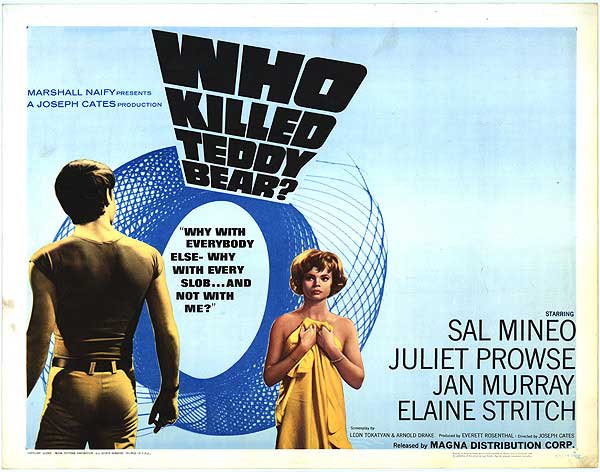
Who Killed Teddy Bear is so far one of the more interesting films I’ve seen this year, which is odd because it’s more than 50 years old. A surprisingly good story and movie, everything about it shines despite its bleak subject matter and an obviously low budget.

The film opens with a little girl who seems to be getting away from something unsettling she just observed. She falls down a set of stairs in the dark. It’s a curious opening, but she ties into the story later.

Cut to mid-sixties Manhattan: Norah Dain (Juliet Prowse) is an aspiring actress who works as a “disc jockey” at a nightclub. She lives alone in a cute three flat. It’s bad enough that she’s getting obscene phone calls from an unknown weirdo, but what’s worse is that he implies he’s watching her.

Enter detective Lt. Dave Madden (Jan Murray) to investigate Norah’s case. His wife was raped and murdered on the streets of New York City. He comes off as part father and part priest, and he takes a special interest in Norah that verges on disturbing. Indeed, he drops in all the time, he secretly records their conversations, and he keeps telling her that he could be the caller. At home, he’s obsessed with “studying” pornography and perverts, which has a distorting effect on his 10-year-old daughter (Diane Moore).

WARNING: Potential spoilers ahead!

We soon learn that Lt. Madden actually isn’t the caller; Lawrence Sherman (Sal Mineo), who works as a busboy with Norah, is. Lawrence has a lot of issues. Awkward and aloof, he lives in a sad, dank apartment with his younger sister, Edie (Margot Bennett). Edie has brain damage and hasn’t developed beyond a child. Their parents died, leaving Lawrence to take care of her. And he does, but he harbors resentment.

On top of all this, Lawrence is incapable of a normal romantic relationship because of his guilt over his sister. He deals with his sexual frustration at adult bookstores and movie theaters in Times Square, and it apparently works until Norah comes along. His obsession with her takes him down a road of murder and ruin.

Directed by Joseph Cates, Who Killed Teddy Bear has a high creepy-icky factor, and it’s absolutely wonderful. Mineo is brooding and sexy, and Lawrence is compelling in the same fucked up way as Travis Bickle in Taxi Driver. Norah and Lawrence don’t have all that many scenes together, but she’s nice to him when they do. This makes their scenes percolate with tension, particularly one at a pool in a gym. We know the whole thing is not going to end well, and Cates slowly but steadily gets us to a nasty climax. To add to the perversion, screenwriters Arnold Drake and Leon Tokatyan drop in little bombshells like incest and lesbian passes. Joseph Brun’s camerawork is lovely, especially in the night scenes; shooting on location in New York City, he cloaks the actors in shadows and neon light in a way that nicely underscores their solitude.

Interesting trivia: a young Dan Travanty, who plays a small part as a nightclub employee, went on to star in Hill Street Blues.

This film has been cut and recut many times over the years, at least once for British television. I’m pretty sure the screening I attended was the original uncut version.

With Elaine Stritch, Tom Aldredge, Frank Campanella, Rex Everhart, Bruce Glover, Casey Townsend

Production: Phillips Productions

Distribution: Magna Corporation, BijouFlix Releasing

94 minutes
Not rated

(The Auditorium at Northeastern Illinois University) A

Chicago Film Society

https://youtu.be/jWr3VMA0DPk

North by Northwest

(USA 1959)

“I’m an advertising man, not a red herring. I’ve got a job, a secretary, a mother, two ex-wives, and several bartenders that depend upon me, and I don’t intend to disappoint them all by getting myself ‘slightly’ killed.”

—Roger Thornhill


“That’s funny. That plane’s dusting crops where there ain’t no crops.”

—Man at the Prairie Crossing

I expected Alfred Hitchcock’s North by Northwest to be suspenseful, cinematic, and even a bit perverse, peppered with the director’s inimitable wit and dark sense of humor. It certainly is all that. However, I didn’t expect it to be altogether facetious, or as fun as it is. Scene after scene, North by Northwest delivers; not many films give as much bang for your buck as this one.

Cary Grant is Manhattan ad executive Roger O. Thornhill—”The ‘O’ stands for nothing,” he quips at one point. A mild-mannered, stylish middle-aged man in a grey flannel Brooks Brothers suit—think Mad Men—he leads a perfectly predictable straight life serving clients, drinking martinis, and keeping his WASPy mother (Jessie Royce Landis) entertained.

While having cocktails at the Plaza Hotel one afternoon, Thornhill is yanked into a treacherous game of cat-and-mouse when the goons of a smooth and well-spoken spy, baritone Phillip Vandamm (James Mason), mistake him for a government agent named George Kaplan. It’s nothing but trouble from here.

Relentlessly hunted after being framed for an incident at the United Nations, Thornhill flees Manhattan on a passenger train that looks a lot like Amtrak’s Lake Shore Limited. He meets cool, mysterious, and sultry stranger Eve Kendall (Eva Marie Saint), who’s headed to Chicago. Her innuendo is sexy, but she’s not exactly trustworthy—Thornhill senses it, and so do we.

North by Northwest is ultimate Hitchcock, fueled by mistaken identity and packed with psychological drama manifest mostly in the form of dizzying pursuit: a drunken car chase on a windy road, a moving train, an out-of-nowhere crop duster in an Indiana cornfield, a race down Mount Rushmore. Nothing about the plot is believable; it’s more preposterous than a James Bond film. Although it shares the same Cold War sensibility, North by Northwest is much more intriguing and memorable. It’s also more entertaining.

Ernest Lehman’s script is brilliantly put together, but the story isn’t what makes this soar; it’s Hitchcock’s directing and the acting, particularly that of Grant, Saint, and Mason. Grant is a hoot to watch here; he plays Thornhill like a high-style Thurston Howell without his Lovie. He walks a fine line between convincing and cartoonish, always coming off as the former. It’s quite an astounding feat of balance, actually. Saint is the perfect counterpart to Grant. I could listen to Mason talk endlessly. Martin Landau plays a secondary character, but he’s awesome as über creepy (and probably closeted) Leonard, Vandamm’s right hand man.

Ahead of its time in many ways, North by Northwest is consciously silly yet pushes a few boundaries. Exceedingly mischievous, it just might be Hitchcock’s most charming film. It’s definitely more fun than any other film of his that I’ve seen—not that I’ve come close to seeing all of them. It’s truly a dazzler.

Personal geek-out side note: in a film full of thrilling moments, the most thrilling for me was the scene outside The Ambassador Hotel in Chicago. I live two doors down from the hotel, now known as Public. I’ve stood in the exact spot Grant did as he exited the alley to cross Goethe to get to the hotel—I walk my dog there all the time. It’s amusingly weird to see a place you know so well onscreen, let alone in something from almost 60 years ago. It’s different, but not much. Here’s what it looked like when North by Northwest was filmed:

IMG_9083.PNG

And here’s what it looks like today:

Ambassador.jpg

In 1995, the United States Library of Congress deemed North by Northwest “culturally, historically, or aesthetically significant” and selected it for preservation in the National Film Registry (https://www.loc.gov/programs/national-film-preservation-board/film-registry/complete-national-film-registry-listing/).

With Leo G. Carroll, Philip Ober, Josephine Hutchinson, Adam Williams, Robert Ellenstein, Edward Platt, Philip Coolidge, Edward Binns

Production: Metro-Goldwyn-Mayer/MGM

Distribution: Metro-Goldwyn-Mayer/MGM

136 minutes
Not rated

(AMC River East) A

Fathom Events

Donnie Darko

(USA 2001)

“Has he ever told you about his friend Frank, the giant bunny rabbit?”

—Dr. Lilian Thurman


“Every living creature on earth dies alone.”

—Grandma Death

Donnie Darko, a period piece set during a time I remember quite well—October 1988, the second full month of my college freshman year and the height of the Bush-Dukakis presidential election—has a great moody soundtrack that includes the likes of Tears for Fears, Joy Division, the Church, Duran Duran, and of course Echo and the Bunnymen. Even if it would have stuck out like a sore thumb, a song more fitting with the theme would have been Cher’s “If I Could Turn Back Time.”

October 2, 1988: troubled and highly medicated loner Donnie Darko (Jake Gyllenhaal), a middle class teen in suburban Middlesex, Virginia, sleepwalks outside of his house and meets Frank (James Duval), a new “friend.” Frank is a guy in a creepy rabbit suit—he looks like he was plucked from the cover of a heavy metal album. Frank tells Donnie that the world is coming to an end—in exactly 28 days, 6 hours, 42 minutes, and 12 seconds.

Thus begins the apocalyptic timewarping adventure of Donnie Darko. After being rudely awakened on a golf course the next morning, Donnie lumbers home in a daze to discover that a jet engine fell from the sky and crashed into his bedroom. His family, obviously already having assumed the worst, is shocked but relieved to see him approaching from the street—except maybe his mother (Mary McDonnell). Federal investigators can’t trace where the engine came from.

At school, a new student, Gretchen (Jena Malone), interrupts Donnie’s English class—taught by the young and snarky Ms. Pomeroy (Drew Barrymore). They’re discussing their reading assignment, Graham Greene’s short story “The Destructors.” Gretchen asks where she should sit, and Ms. Pomeroy directs her “next to the boy you think is the cutest.” Gretchen sits next to Donnie. Duh!

Donnie and Gretchen dig each other, which is a ray of light to his psychiatrist, Dr. Thurman (Katharine Ross). The doctor has been concerned about Donnie’s “hallucinations” of Frank, as well as some of his erratic behavior. Donnie is growing more and more obsessed with a senile elderly neighbor he and his friends nicknamed “Grandma Death” (Patience Cleveland) and a book about time travel. Everything comes to a head at a party Donnie and his sister Elizabeth (Maggie Gyllenhaal) throw while their parents are out of town on Halloween—which is 28 days from where this all started.

Simultaneously funny, foreboding, weird, and utterly thought-provoking, I can see why Donnie Darko has the following it does. Director and screenwriter Richard Kelly comes up with something unlike anything else I’ve ever seen. It’s a winning mix of teen comedy, science fiction, and fantasy. I caught an anniversary screening with my nephew, and this film is as fresh as when I first saw it in 2002. Loaded with indelible imagery, symbolism, ’80s pop cultural references, and clever narrative loopbacks, I find Donnie Darko‘s greatest asset to be its open-ended mystery; what exactly happens is left for the viewer to figure out. A quick Google search pulls up ample musings of the meaning of this film. I’ve seen this a few times, and I’m not sure.

Aside from the plot, the characters and the casting are terrific. Both Gyllenhaals are great, and you can actually see they’re both destined for more. Patrick Swayze is awesome as motivational speaker Jim Cunningham, but Beth Grant takes the cake here as passive-aggressive bitch Kitty Farmer. Oh yeah, this is also Seth Rogen’s first onscreen role—see if you can spot him.

Side note: Frank’s rabbit suit was designed by April Ferry, who went on to work for Game of Thrones (http://ew.com/movies/2017/03/31/donnie-darko-bunny-suit-frank-untold-stories/). I was hoping to catch the director’s cut, but this wasn’t it.

With Holmes Osborne, Daveigh Chase, Noah Wyle, Stuart Stone, Gary Lundy, Alex Greenwald, Jolene Purdy, Ashley Tisdale

Production: Flower Films

Distribution: Pandora Cinema, Newmarket Films

113 minutes
Rated R

(Capitol Theatre) B+

http://archive.hi-res.net/donniedarko/