Michael Jackson’s Thriller

(USA 1983)

“Now, I have something to tell you…I’m not like other guys.”

— Michael Jackson

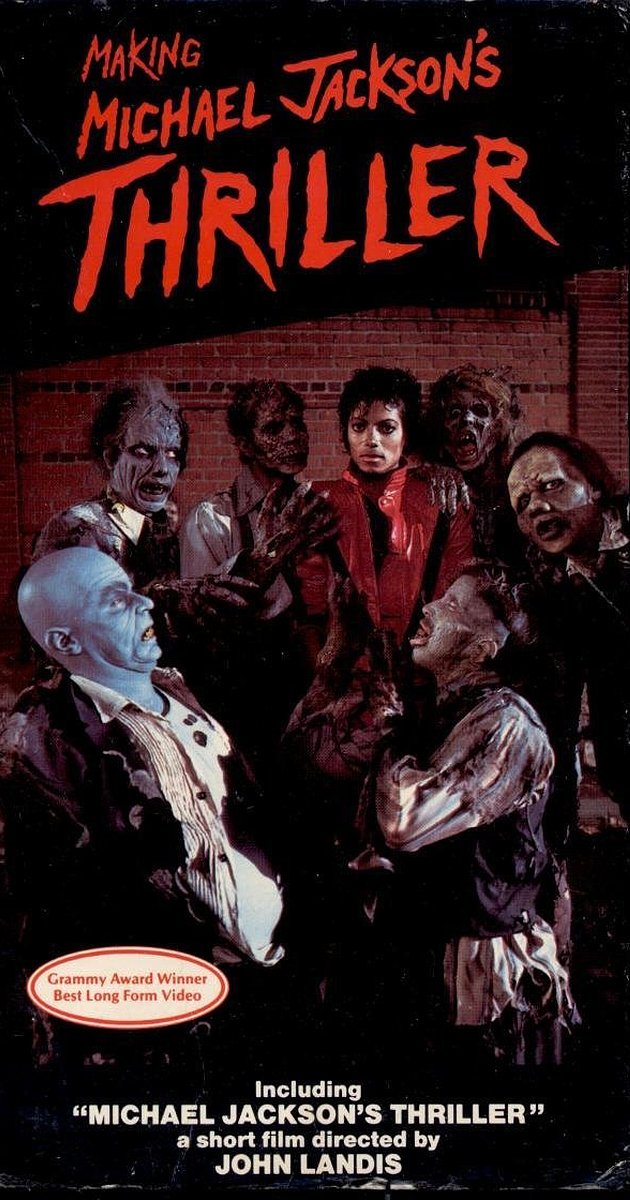
A very young Michael Jackson on a date with…his girlfriend (Ola Ray)? Jackson playing a werewolf, a zombie, and a lizard-eyed creature? Vincent Price reading an outro? Bad ’80s hair? You know it’s thriller, thriller night!

It’s not his best song, but Michael Jackson’s Thriller is a fucking cool video. It features all the showmanship he’s known for — the dancing, the weirdness, the bigness of the whole thing, that red jacket and those white socks, oh and a setting in the midst of seedy urban decay, this time a cemetery apparently somewhere downtown. Directed by John Landis, Thriller is clever: what starts as a cheesy horror movie turns out to be…a cheesy horror movie. Loaded with references to Night of the Living Dead and An American Werewolf in London, Thriller demonstrates that Jackson actually had a sense of humor.

I don’t put a music video on my blog every day. In fact, Michael Jackson’s Thriller is (so far) the only one. Why? In my quest to see as much as possible on the Library of Congress National Film Registry, I am obligated to include the final single and title track from the legendary pop star’s massive blockbuster album Thriller (https://en.m.wikipedia.org/wiki/Thriller_(Michael_Jackson_album) ). The song was not written by Jackson — Rod Temperton came up with it.

This video truly was a “seismic shift” — longer, more dramatic, and reaching beyond the song, it proved that music videos could be more than promotional clips; they literally could be little movies — or as here, bona fide events — that attract a huge audience, and thus worthy of a big budget. I can cite a number of artists who followed the template that Jackson set with Thriller.

In 2009, the United States Library of Congress deemed Michael Jackson’s Thriller “culturally, historically, or aesthetically significant” and selected it for preservation in the National Film Registry (https://www.loc.gov/programs/national-film-preservation-board/film-registry/complete-national-film-registry-listing/).

With Marcea Lane, Kim Blank, Lorraine Fields, Tony Fields, Michele Simmons, Vincent Peters, Michael Peters, Vincent Paterson, Michael De Lorenzo, Ben Lokey, John Command, Richard Gaines, Mark Sellers, Suzan Stadner, Diane Geroni, Suga Pop

Production: MJJ Productions, Optimum Productions

Distribution: Epic Records, Vestron Video

14 minutes
Not rated

(iTunes) A

https://michaeljackson.com

The Great Train Robbery

(USA 1903)

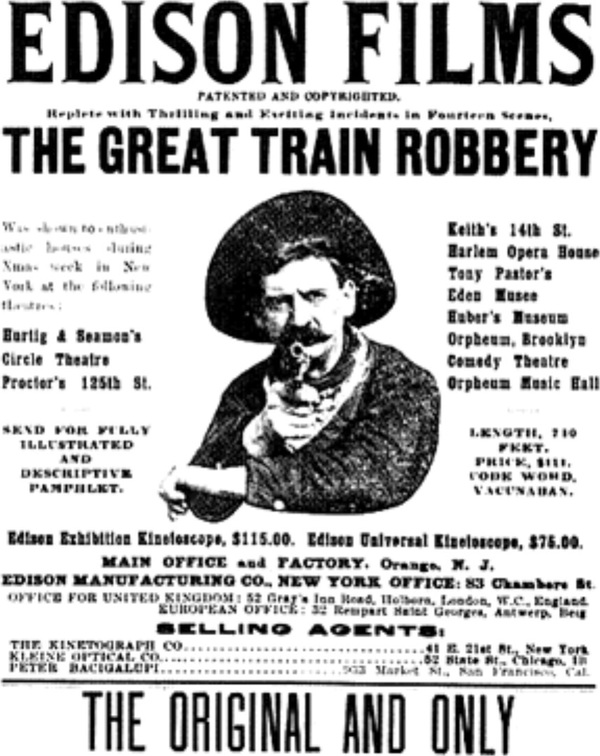
The Great Train Robbery is another early narrative film produced by Thomas Edison and directed by Edwin S. Porter. Unlike Life of an American Fireman earlier the same year, this one looks like a movie: it has a title card, a cast that acts (even if it’s humorously overdramatic), and a more complicated plot — though it’s still pretty simple.

The focus is clearly on telling a story, and on that level it works: a bunch of bandits (Gilbert M. ‘Broncho Billy’ Anderson, Justus D. Barnes, John Manus Dougherty Sr., Frank Hanaway, Adam Charles Hayman) rob a passenger train and are pursued over it. The action is parsed out more thoughtfully, no doubt for dramatic effect. The settings change, and a lot more characters are involved. Plus, the very last scene is clever — it’s a bit Hitchcockian.

In 1990, the United States Library of Congress deemed The Great Train Robbery “culturally, historically, or aesthetically significant” and selected it for preservation in the National Film Registry (https://www.loc.gov/programs/national-film-preservation-board/film-registry/complete-national-film-registry-listing/).

With A.C. Abadie, George Barnes, Walter Cameron, Donald Gallaher, Shadrack E. Graham, Morgan Jones, Tom London, Robert Milasch, Marie Murray, Mary Snow

Production: Edison Manufacturing Company

Distribution: Edison Manufacturing Company, Kleine Optical Company

11 minutes
Not rated

(YouTube) C

https://youtu.be/X59wQsT4mYg

The Asphalt Jungle

(USA 1950)

I expected crime noir classic The Asphalt Jungle to be something of a cheesefest: stiffly acted, overly melodramatic, and maybe a bit hamfisted in its morality, like The Hardy Boys for adults of the Greatest Generation. Thankfully, John Huston’s film adaptation of W.R. Burnett’s 1949 novel is none of that.

No sooner is Doc Riedenschneider (Sam Jaffe) out of the big house when he hatches a plan to do what he does best: steal. Like, a million bucks or more in jewels from a jewelry store (not Jared’s). Yes, a jewel heist. He pitches his plan to Cobby (Marc Lawrence), a two-bit gambling bookie, who puts him in touch with Alonzo Emmerich (Louis Calhern), a rich but shady attorney. Emmerich buys in, not just providing financial backing but also agreeing to handle disposing the booty for cash.

Doc assembles a crew of petty thieves consisting of a “box man,” or a safecracker (Anthony Caruso), a driver (James Whitmore), and an all-important “hooligan” (Sterling Hayden) to execute the plan. The heist goes off without a hitch, mission accomplished. It’s smooth; uneventful, even. That is, until a stray bullet accidentally hits one of the crew members.

This is where the plot gets really interesting, as human nature and a slew of bad decisions rear their ugly heads. It doesn’t help that at the same time, sundry troubles that have been brewing alongside all the planning are coming to a boil. Soon, it’s every man for himself in a sticky web of deception, doublecrossing, and death.

The Asphalt Jungle is an exquisitely layered and calibrated drama that’s tough to turn away from — and tough not to appreciate. Written by Huston with Ben Maddow, the screenplay is tight. The characters — a collection of urban lowlife thieves, thugs, private detectives, crooked cops, and good looking dames — all have dimension. Interestingly, what would probably be the most intense scene in most movies — the break-in — isn’t; the intensity and the drama come from what happens after that. A manhunt that ends in Cleveland and an attempted swindle serve as the ticking clock here. This is the perfect thriller for a hot summer night in the city. Bonus: The Asphalt Jungle features a young but unmistakable Marilyn Monroe in one of her earliest roles.

In 2008, the United States Library of Congress deemed The Asphalt Jungle “culturally, historically, or aesthetically significant” and selected it for preservation in the National Film Registry (https://www.loc.gov/programs/national-film-preservation-board/film-registry/complete-national-film-registry-listing/).

With Jean Hagen, John McIntire, Barry Kelley, Teresa Celli, William “Wee Willie” Davis, Dorothy Tree, Brad Dexter, Helene Stanley, John Maxwell, Strother Martin, Jack Warden, Tim Ryan

Production: Metro-Goldwyn-Mayer

Distribution: Metro-Goldwyn-Mayer

112 minutes
Not rated

(Music Box) A-

Noir City

https://www.warnerbros.com/asphalt-jungle

They Live

(USA 1988)

“I’ve come here to chew bubblegum and kick ass…and I’m all out of bubblegum.”

“I’m giving you the choice: either put on these glasses or eat that trashcan.”

“Brother, life’s a bitch. And she’s back in heat.”

— Nada

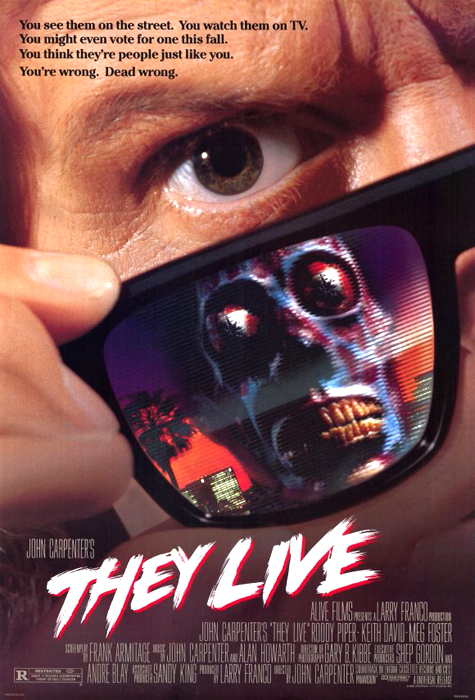
Director John Carpenter has done a few good pictures that probably will have an audience long after he’s gone; They Live isn’t one of them. At least, not in a good way. B-movie cult fodder all the way, They Live is a somewhat delayed and really heavy-handed reaction to ’80s conspicuous consumption. Based on Ray Nelson’s 1963 short story “Eight O’Clock in the Morning” and subsequent comic strip, Carpenter’s screenplay, written under the pseudonym Frank Armitage, is founded on a decent premise; it just doesn’t go where it could have.

Nada (Roddy Piper), a migrant construction worker who’s seen better days, picks up a job in downtown Los Angeles. He notices some weirdness going on with a television station that seems to be connected to a church across the lot where he and other homeless people have set up camp. His coworker Frank (Keith David) doesn’t want to hear about it. No one does.

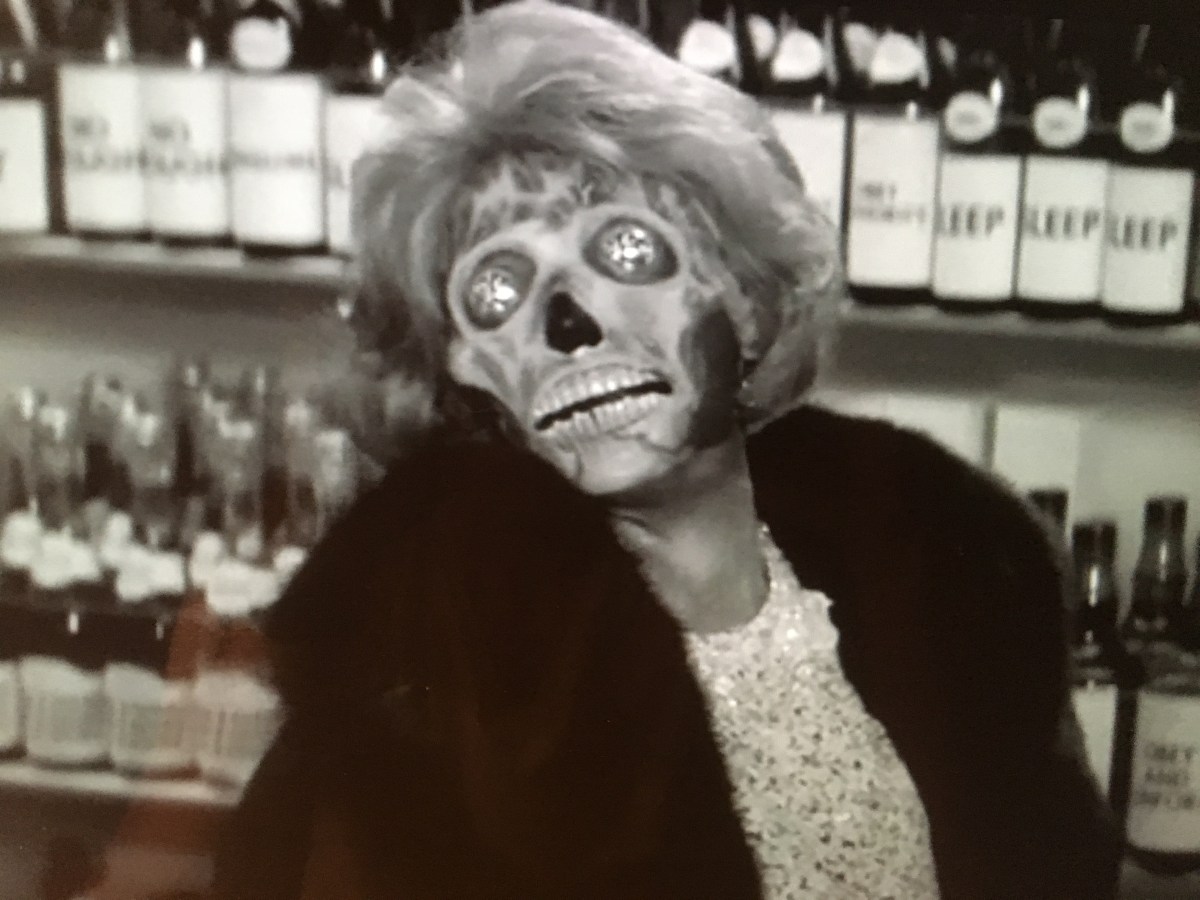
One morning, Nada comes into possession of a pair of sunglasses. When he puts them on, he sees subliminal messages everywhere. A billboard with the tagline “We’re creating the transparent computing environment” says “Obey” with the glasses on. A travel ad beckoning, “Come to the Caribbean” says “Marry and reproduce.” “Men’s apparel” says “No independent thought.” Signs all around him order one to consume, conform, buy, watch TV, submit, sleep, do not question authority:

They Live Obey.jpg

Even the dollar bill has a different message: “This is your god.”

What’s worse, some people are not what they appear to be. At all. They aren’t even human — they’re skeletal reptiles, a kind of mutant species of Sleestaks or something:

They Live.JPG

What the hell is going on? Who are these things? What do they want? As Nada tells Frank, they ain’t from Cleveland.

I remember seeing They Live at the theater when it was new. It was okay. Three decades later, it’s still okay. It’s a lot sillier this time around, though. The whole thing gets off to a good enough start, but the momentum peters out just before midpoint. Carpenter — or anyone, for that matter — can get only so much mileage out of this story. They Live feels like 40 minutes of material stretched into more than twice that amount of time.

The denouement is not just predictable but anticlimactic, and the perspective here is adolescent at best. The lines are cringeworthy, falling painfully short of the Arnold Schwarzenegger zingers they aim to be. The acting is pretty bad, especially David and Meg Foster, both of whom are as stiff and lifeless as a dead gerbil. Surprisingly, Piper and his mullet are the best thing about They Live; Piper isn’t enough to carry it, though. And that wrestling scene in the alley is inane — misplaced, unnecessary, and too long, it adds nothing except maybe ten minutes to the running time.

The worst thing about They Live is that it seems Carpenter was serious — nothing here reads as tongue in cheek to me.

With George “Buck” Flower, Peter Jason, Raymond St. Jacques, Jason Robards III, Lucille Meredith, Norman Alden, Norm Wilson, Thelma Lee, Rezza Shan

Production: Alive Films, Larry Franco Productions

Distribution: Universal Pictures

94 minutes
Rated R

(iTunes rental) D+

http://www.theofficialjohncarpenter.com/they-live/

Good Time

(USA 2017)

Good Time is not a film to see for the plot. Written by Josh Safdie and Ronald Bronstein, the storyline is not all that novel, complicated, or interesting — in itself. I can sum it up in a single sentence: Queens bad boy Connie Nikas (Robert Pattinson) spends a night fleeing cops while trying to get his mentally handicapped younger brother, Nick (Benny Safdie), out of the mess he put him in after a bank robbery they commit goes sideways. It sounds like a comedy, but it most definitely is not.

Good Time is a movie to see for the mood it creates — and man, is it intense! More or less a character study, this could have been a disaster in someone else’s hands. As it is, the whole thing soars thanks to the directing by brothers Benny and Josh Safdie and the acting, which is all around great. Pattinson is particularly terrific — forget Twilight. I’ve heard comparisons to Al Pacino’s best work in the ’70s, and I’ve got to agree; Pattinson conveys a natural nervous energy just under the surface so well that you feel it watching him. I found myself more and more jittery and paranoid with every move and bad decision Connie makes and every character he encounters. I noticed hints of Dog Day Afternoon, Cruising, The Godfather, and even The Graduate in Pattinson’s performance.

Taking place almost entirely at night, the settings are familiar but eerie: a hospital, the crammed TV-lit apartment of a Jamaican immigrant (Gladys Mathon) and her weed smoking teenage granddaughter (Taliah Webster), an empty amusement park. Add a skittish techno score by Oneohtrix Point Never, a pallet of neon-colored light, and a nonstop chase, and you’ve got Good Time. Roller coaster ride or drug trip, take your pick — either way, this is a film that drags you along for the ride and zaps you, in a really satisfying way. I don’t know if Good Time is Oscar material, but it’s definitely memorable.

I almost missed Good Time, which opened for what appeared to be a very short limited run in Chicago. I made my own bad decision to see it Friday night after dinner with lots of cocktails. The film became a big blur that my drunk brain couldn’t handle. I went back for a Sunday matinee by myself. I left impressed, and actually pissed that I wasn’t present the first time I caught it.

With Jennifer Jason Leigh, Barkhad Abdi, Necro, Buddy Duress, Peter Verby, Saida Mansoor, Eric Paykert

Production: Elara Pictures, Rhea Films

Distribution: A24

99 minutes
Rated R

(AMC River East) B+

http://goodtime.movie

Kill, Baby…Kill! [Operation Fear] [Operazione paura]

(Italy 1966)

“Something in this town is supernatural. Tell me, why did they abandon the church? I’m scared. I almost think the devil’s here.”

— Monica

The second offering of a Mario Bava weekend double feature, Kill, Baby…Kill! is one of the director’s more commercially successful films. Many commentators have pointed out its influence on the horror genre and praised Bava’s gothic sensibilities, visuals, and use of irony. All good, I agree. Still, none of these things means Kill, Baby…Kill! is a great — or even a good — film.

In the early 20th Century, a coroner, Dr. Paul Eswai (Giacomo Rossi-Stuart), is en route to a remote village in Transylvania to perform an autopsy on a woman who died under mysterious circumstances. In a church — an abandoned one, no less, no doubt to provide a metaphor. The carriage driver, warning that this place is messed up, will only go to the edge of the village, not inside it.

Dr. Eswai finds the police inspector (Piero Lulli) at a local inn, where he is given instructions. When none of the superstitious and rather wan locals volunteer to help him with the autopsy, Monica Shuftan (Erika Blanc), a nurse of some sort who grew up there and just happens to be visiting the graves of her parents, steps up to assist.

During the autopsy, Dr. Eswai is puzzled to find a silver coin stuck in the woman’s heart. It’s a practice to thwart a local ghost that visits villagers in their sleep and puts a hex on them, making them commit suicide in ghastly ways — like jumping from heights and impaling themselves on iron posts.

Dr. Eswai runs into a creepy young thing in a white dress. He soon learns she’s the ghost of seven-year-old Melissa Graps (Valerio Valeri), who died 20 years before. She’s the little bugger who’s been freaking out everyone in the village for the last two decades. The doctor and Monica sense a spark, but first they must deal with this Melissa situation.

Romano Migliorini, Roberto Natale, and Bava all contributed to the screenplay. The story is unoriginal and silly, complete with cringeworthy dialogue and an actual sorceress (Fabienne Dalì). There’s an odd dub thing going on, too.

This being a Bava picture, though, Kill, Baby…Kill! works on primal instinct, here fear. Plus, it has its share of arresting visuals. The colors are vivid, though the palette is heavy on brown and green. The sets have a grimy, dilapidated medieval appearance to them, giving the look of a ghost story. There’s a cool scene where Dr. Eswai chases after Monica through a series of doors that keep taking him back to the same rooms — it’s delightfully dizzying.

Overall, Kill, Baby…Kill! is okay. It’s got Bava’s unique fingerprint all over it, and it’s fun to watch. It’s just not spectacular. Blood and Black Lace grabbed me; this did not, at least not for long. I hate the title — they should’ve kept Operation Fear.

With Luciano Catenacci (Max Lawrence), Micaela Esdra, Franca Dominici, Giuseppe Addobbati, Mirella Pamphili, Giana Vivaldi

Production: F.U.L. Films

Distribution: Internazionale Nembo, Distribuzione Importazione, Esportazione Film, Alpha (Germany), Europix Consolidated Corp. (USA), Astral Films (Canada), Metro-Goldwyn-Mayer

85 minutes
Rated PG

(Gene Siskel Film Center) C

Wonder Woman

(USA 2017)

Director Patty Jenkins aims to do for Wonder Woman what Christopher Nolan—and I suppose to a lesser degree Tim Burton—did for Batman: take an iconic comic book superhero that got campy over the years and return it to its darker roots, producing something dramatic, perhaps weightier, and far more artful. Jenkins doesn’t entirely pull it off with Wonder Woman, but she’s on the right track. I see a sequel or two in the near future, so she’s got time to get there.

To Jenkins’s credit, Wonder Woman is not what I expected. Aside from a nod or two—and that goddamned tiara—all the cut-rate kitsch of the ’70s TV series is gone. This Wonder Woman means business even if she’s still, shall we say, absurd.

Jenkins goes back to the beginning: young Diana (Lilly Aspell and Emily Carey) lives on Themyscira, a hidden island inhabited by war-ready buff goddesses. Queen Hippolyta (Connie Nielsen), Diana’s mother, shields her from the strident ways of her subjects. It all has to do with an old score Ares (David Thewlis) seeks to settle—yes, that Ares, the son of Zeus and the god of war. General Antiope (Robin Wright), Hippolyta’s sister and Diana’s aunt/mentor, isn’t having it: she recognizes Diana’s potential and trains her on the sly. Diana blossoms into a beautiful woman (Gal Gadot) with serious supernatural power.

Diana stumbles upon Steve Trevor (Chris Pine), a drowning American pilot whose plane crashes off the coast of Themyscira. She rescues him, unwittingly exposing the island to an invasion by German forces. Persuaded by the awesome power of Diana’s Lasso of Hestia, Steve confesses that he’s a spy in the “war to end all wars”—World War I. Spider-sensing Ares is behind it, Diana embarks with Steve on a mission filled with romance, adventure, and espionage in an effort to track down the god and stop the madness.

Wonder Woman starts out all Xena: Warrior Princess, silly and weird in a geeky softcore straight guy “lesbian porn” way that no doubt would appeal to the likes of Wayne and Garth. Thankfully, it moves in another direction once Pine shows up about 40 minutes in. I found myself enjoying Wonder Woman more as the story got to Europe—that storyline is more believable even if it too is silly. The battle scenes are decent with some Hollywood excess and humor thrown in. I love how the theme of gender equality is the star of every scene—neither subtle nor heavy-handed, it’s simply a given.

For all its perks, Wonder Woman is ultimately a typical blockbuster that emphasizes form over substance. If nothing else, it surprises, which is always a plus. Frankly, though, I could’ve kept going completely oblivious to the fact that Wonder Woman is more than Lynda Carter. She was more a lot more fun.

With Danny Huston, Saïd Taghmaoui, Ewen Bremner, Eugene Brave Rock, Lucy Davis, Elena Anaya, Doutzen Kroes

Production: DC Entertainment, Atlas Entertainment, Cruel & Unusual Films, Rat-Pac Dune Entertainment LLC, Tencent Pictures, Wanda Pictures

Distribution: Warner Brothers, Karo Premiere (Russia), NOS Audiovisuais (Portugal), Roadshow Entertainment (New Zealand), Roadshow Films (Australia), SF Studios (Norway), Tanweer Alliances (Greece)

141 minutes
Rated PG-13

(ArcLight) C

http://wonderwomanfilm.com

Okja

(USA/South Korea 2017)

“We needed a miracle, and then we got one.”

—Lucy Mirando

Bong Joon-ho’s Okja, now streaming on Netflix, is a lot of things; dull is not one of them. A slick, fast-paced, mesmerizing mix of fantasy, sci-fi, comedy, action, satire, and social consciousness, this film has a lot going on—and a lot going for it. I was lucky to see it on the big screen before its official release, and that’s how I recommend seeing it if you can. Sorry, Netflix, Okja is simply too good for TV.

The story begins ten years ago in 2007: in a desperate but brilliant attempt to rebrand a disreputable family business—to make a silk purse out of a sow’s ear, so to speak—Lucy Mirando (Tilda Swinton) announces her master plan to breed an all-natural “superpig” that leaves a minimal footprint, feeds the world, and tastes great (https://superpigproject.com). Her company, Mirando Corporation, devises a competition, sending twenty-some piglets to real farmers across the globe to raise them; the company will monitor each pig over the next ten years and declare a “winner” based on the results. Mirando hires animal television show host Dr. Johnny Wilcox (Jake Gyllenhaal), a zoologist whose star is fading, to lend credibility to the project as well as to generate public interest in it.

Fast forward to 2017: Mirando’s plan is coming to fruition without any hiccups, which makes her happier than a pig in…well, you know. Unfortunately for Mirando, a young South Korean girl named Mija (Ahn Seo-hyun), whose grandfather (Byun Hee-bong) signed onto the project, threatens to derail the entire mission. Mija, you see, essentially raised her grandfather’s pig, Okja. They’ve become dependent on each other. He never explained to her what the deal really is—that Mirando’s silk purse is nothing more than lipstick on a pig.

Dr. Johnny and his television crew show up at their home in the mountains and marvel over Okja, now a magnificently enormous hippopotamus-like creature. He presents her grandfather with an award and takes Okja to Manhattan—actually, New Jersey—for a pig roast sponsored by the Mirando Corporation.

To put it lightly, Mija’s not having it—she takes off after Okja on a chaotic chase through Seoul, where she encounters the Animal Liberation Front, a group of inept animal rights activists led by idealistic but ineffective Jay (Paul Dano). They make a pact, but unfortunately she doesn’t speak English. Mija ends up at the world headquarters of Mirando Corporation in New York City, completely unaware of the cards she holds.

I went into Okja blind—the only thing I knew about it was that its central character is a big pig. I left more than satisfied: the cast is stellar, the effects are flawless, and the script is smart and strong despite its flaws. If that don’t beat a pig a-pecking, I don’t know what does.

In simplest terms, Okja is about our complicated consumerist relationship with food. As one pig farmer put it best, “Okja’s a fake pig in a movie I watched on Netflix. But plenty of real animals are suffering inside a horrific system that don’t have to.” (http://www.huffingtonpost.com/entry/okja-thoughts-from-a-pig-farmer_us_595bd1cde4b0f078efd98cbd). On this point alone, Okja will resonate with anyone who’s ever connected with an animal—pig, dog, cat, bird, horse, aardvark. The story has been compared to E.T. (https://moviebloke.com/2016/03/29/e-t-the-extra-terrestrial-e-t/), and it’s pretty wonderful. The final scene, which takes place in a slaughterhouse, is hard to watch—I got anxious. And queasy. I thought of Morrissey!

Appropriately, the acting is hammy; I love that Swinton plays twins again. She looks like a deranged Uma Thurman in Pulp Fiction. Gyllenhaal teeters on insufferable with his wimpy sniveling, but to his credit he manages to keep it in check. I’m usually unimpressed with computer animation, but here it’s amazingly well done; Okja looks as real as the humans. I think the trick is her eyes. Even with its Hollywood ending, Okja is definitely one of this year’s more interesting movies.

With Steven Yeun, Lily Collins, Yoon Je-moon, Shirley Henderson, Daniel Henshall, Devon Bostick, Choi Woo-shik, Giancarlo Esposito

Production: Kate Street Picture Company, Lewis Pictures, Plan B Entertainment

Distribution: Netflix

118 minutes
Not rated

(AMC River East) B

https://www.netflix.com/title/80091936

Two Men in Manhattan [Deux hommes dans Manhattan]

(France 1959)

In his cool noir mystery Two Men in Manhattan [Deux hommes dans Manhattan], director Jean-Pierre Melville in his only starring role is Moreau, a cheerless and jaded reporter with Agence France-Presse. As he’s leaving work one night, his boss (Jean Lara) asks him to investigate the whereabouts of one Mssr. Fèvre-Berthier, the French United Nations delegate, who curiously has gone M.I.A.

Moreau heads straight to the flat of a frequent collaborator, hardened alcoholic photographer Pierre Delmas (Pierre Grasset), and yanks him out of bed—never mind the girl there with him. Delmas is the archetype paparazzo: cold-blooded and motivated by money. He knows his way around Manhattan.

The two men trail Fèvre-Berthier through a number of female associates: his secretary (Colette Fleury), a two-bit actress (Ginger Hall), a jazz singer (Glenda Leigh), a burlesque stripper (Michèle Bailly), and a high dollar whore in a high class brothel (Monique Hennessy). They find out what happened to him, but the story is scandalous.

Moreau doesn’t want to print it, but Delmas insists otherwise. A strange car following them around may persuade them to do the right thing—whatever that is.

With enough trench coats and fedora hats to clothe a newsroom, Two Men in Manhattan reflects Melville’s characteristic minimalist neo gangster movie style. The personal ethics here are all grey, which fits nicely with the night scenes, especially the exteriors shot on Times Square by cinematographer Nicolas Hayer. Aside from the exteriors, Manhattan never looked more fabulously fake: most of the interiors—the subway, a bar, a club, a theater, a hospital, a diner—were shot in a studio.

Part detective flick and part morality play, the tone shifts quite a bit between drama and waggishness, leading me to conclude that Melville didn’t take Two Men in Manhattan very seriously. It’s a minor work that comes off tongue in cheek, which makes it fun to watch—it compensates for Melville’s rather thin script. Plus, the whole thing sure is pretty.

With Christiane Eudes, Paula Dehelly, Nancy Delorme, Carole Sands, Gloria Kayser, Barbara Hall, Monica Ford, Billy Beck, Deya Kent, Carl Studer, Billy Kearns , Hyman Yanovitz, Ro. Tetelman, Art Simmons, Jerry Mengo

Production: Belfort Films, Alter Films

Distribution: Columbia Films (France), Mercurfin Italiana (Italy), Cable Hogue Co. (Japan), Cohen Media Group (USA)

85 minutes
Not rated

(Gene Siskel Film Center) B-

Restless Blood [Levoton veri]

(Finland 1946)

The third Nitrate Picture Show ended on a high note with an unidentified film (the “blind date”) that turned out to be Finnish director Teuvo Tulio’s gloriously insane melodrama Restless Blood [Levoton veri]. I never heard of the director, the film, or anyone in it. I adore this silly spectacle, which straddles the line between soap opera and Saturday morning cartoon.

The story is a love triangle involving two sisters, elder Sylvi (Regina Linnanheimo) and younger Outi (Toini Vartiainen), and Valter Sora (Eino Katajavuori), a burly doctor in their small town. Outi is his patient—she broke her leg—but Sylvi snags him as a husband. Not that Outi has no chance—she does, which she proves when she returns after disappearing, heartbroken, for a few years. Oh yeah—Sylvi goes blind in the meantime: she drinks poison.

Written by Tulio, Linnanheimo, and Nisse Hirn, the script is prime time dynamite. And fresh even by today’s standards. Forget the Ewings and the Carringtons—loaded with sibling rivalry and drama, Restless Blood is the raw and bitter real deal.

Here’s Sylvi driving like a maniac, “blinded” by rage:

img_9487

Come on! That coat, those glasses, that pissed off vengeful smoke! It’s perfect. When we see that Sylvi gets what’s going on between her husband and her sister, wow. Just…wow. The story is thin, but the actors put a lot into it. Bonus: Pentti Lintonen’s cinematography is brilliant. Seeing it on a nitrate print was the icing on the cake—totally worth the cinematic fat and calories.

Restless Blood is not the best film screened at this year’s Nitrate Picture Show, but I dare say it’s the most interesting. I’m dying to see more by Tulio—too bad his work is not easily (or cheaply) accessible.

With H. Stenroos, Lauri Korpela, Laina Laine, Nora Mäkinen, Lida Salin, Emma Väänänen, Elli Ylimaa

Production: Teuvo Tulio

Distribution: Väinän Filmi

91 minutes
Not rated

(Dryden Theatre) B

Nitrate Picture Show