Suburbicon

(USA 2017)

George Clooney’s Suburbicon probably isn’t going to end up on anyone’s “best” list, nor should it. Too bad, because it’s got all the right elements: an experienced director with a strong point of view and his heart in the right place, a story by Joel and Ethan Coen, and a solid cast. The trailer sold me.

I guess I can see where this was headed. Unfortunately, though, some bizarre calls from the director’s chair drive Suburbicon into the ground. What could’ve been a biting and clever comment about race and the postwar American Dream, isn’t. Instead, Suburbicon is a confused jumble of ideas that don’t seem thought out or placed very well.

Suburbicon, which gets its name from the fictional suburban housing development where the film takes place, involves two concurrent stories that play out separately in late ‘50s suburbia. The main story, the one that the Coen brothers developed over 30 years ago, follows the boneheaded attempts of daft Suburbicon resident Gardner Lodge (Matt Damon) at covering his tracks in an insurance scam he perpetrates with his sister-in-law, Margaret (Julianne Moore, who pulls a Patty Duke and does double duty also playing Gardner’s wife, Rose). Gardner is also dodging two amateur hitmen (Glenn Fleshler and Alex Hassell) who are trying to reach him. To make matters worse, his grade school age son, Nicky (Noah Jupe), inadvertently threatens to blow his cover. It isn’t long before it’s clear that Gardner’s in way over his head.

Meanwhile, the Mayers, a black family, move into Suburbicon, right next door to the Lodges. This subplot is based on an actual event that happened in Levittown, Pennsylvania, in 1957 (http://ushistoryscene.com/article/levittown/). In fact, the film uses what appears to be real-life footage from it. The residents don’t want a black family living near them, apparently because they think it will cause the neighborhood to go to hell. So, they stage a protest outside the Mayers’ house, chanting, playing instruments all night, and eventually trespassing and vandalizing. In the midst of this brouhaha, Nicky befriends the son, Andy (Tony Espinosa), who’s about the same age.

The residents get louder and more violent as the Coen plot develops into something darker and more violent.

Suburbicon has a few big problems. First, it clearly wants to make a grand statement or observation. It fails because it doesn’t integrate the two plots. We don’t get much about the Mayers. Whatever point this subplot was supposed to make is completely overshadowed by the main plot, and it comes off as merely an ironic parallel. It’s weird, manipulative, and simply doesn’t work.

Second, I have no idea how all that happens inside the Lodge residence does so with the huge mob next door. How does no one notice what’s going on right outside the door? How does everyone in that huge mob miss the people coming and going from the Lodge residence? Some of them are bloody. Hello?

Third, the plot twists are evident a mile away.

Fourth, neither Damon nor Moore pulls off the sinister vibe their characters call for. Somehow Clooney misses the mark on the sheer weirdness of the plot and the characters despite the sharp, exaggerated dialogue you usually get from the Coen brothers. Oscar Isaac is the only actor who nails it; his small part as an insurance investigator, regrettably short, stands out as the only bright spot here — although both Jupe and Nancy Daly as Gardner’s secretary deserve an honorable mention. Overall, though, the end result here is hopelessly flat and surprisingly lifeless. It’s frustrating to see.

I didn’t hate Suburbicon, but I didn’t love it. Its points are muddled. I expected a lot more, and there was so much to work with here.

With Karimah Westbrook, Leith M. Burke, Megan Ferguson, Jack Conley, Gary Basaraba, Michael D. Cohen, Steven Shaw, Don Baldaramos, Ellen Crawford, Cathy Giannone, Allan Wasserman, Mark Leslie Ford, Richard Kind, Robert Pierce, Pamela Dunlap, Jack Conley, Frank Califano, Lauren Burns

Production: Paramount Pictures, Black Bear Pictures, Silver Pictures, Smoke House Pictures

Distribution: Paramount Pictures

105 minutes
Rated R

(ArcLight) C-

http://www.suburbiconmovie.com

Three Billboards Outside Ebbing, Missouri

(USA 2017)

Justice, like morality, is ambiguous. Accordingly, determining exactly how justice should be meted out is mired in a lot of grey. Translation: life is not black and white.

This old adage makes people uncomfortable, and it’s exactly the concept that colors Three Billboards Outside Ebbing, Missouri. It works so well because it acknowledges that there is no one right answer. Thankfully, as luck would have it, it’s also kind of funny.

Mildred Hayes (Frances McDormand) is pissed off and tired. Seven months ago, her daughter was raped, murdered, and set on fire, though not necessarily in that order. The police have made no arrests, they have no suspect, and they haven’t uncovered a single lead. The case is precariously close to cold.

Driving down a rural road one morning, Mildred spots three abandoned billboards and gets an idea: she’ll shame Chief of Police Willoughby (Woody Harrelson) into action. She rents the billboards for a full year and posts ads that attack him. The problem is, her idea doesn’t pan out as she plans — in fact, it works against her cause.

Not far off from a Coen Brothers venture, Three Billboards Outside Ebbing, Missouri is a twisted and twisting nailbiter. Writer-director Martin McDonagh has a sharp wit, a warped sense of humor, and an impeccable grasp of human nature. The cast is outstanding, with not one subpar performance. At times heartbreaking, this is all around a tightly assembled and enthralling film.

With Caleb Landry Jones, Kerry Condon, Sam Rockwell, Alejandro Barrios, Jason Redford, Darrell Britt-Gibson, Abbie Cornish, Riya May Atwood, Selah Atwood, Lucas Hedges, Zeljko Ivanek, Amanda Warren, Malaya Rivera Drew, Sandy Martin, Peter Dinklage , Christopher Berry, Gregory Nassif St. John, Jerry Winsett, Kathryn Newton, John Hawkes, Charlie Samara Weaving, Clarke Peters, Brendan Sexton III, Eleanor Threatt Hardy, Michael Aaron Milligan

Production: Blueprint Pictures

Distribution: 20th Century Fox, Fox Searchlight Pictures, Warner Brothers

115 minutes
Rated R

(AMC River East) B+

Chicago International Film Festival

http://www.foxsearchlight.com/threebillboardsoutsideebbingmissouri/

Suspiria

(Italy 1977)

“We must get rid of that bitch of an American girl. Vanish! She must vanish! Make her disappear! Understand? Vanish! She must vanish. She must die! Die! Die!”

— Madame Blanc

Dario Argento’s cult classic Suspiria is a perplexing film, and not because it’s scary. It’s pretty ridiculous, tongue and cheekiness aside.

Cowritten by Argento with Daria Nicolodi from Thomas DeQuincey’s 1845 essay “Suspiria de Profundis,” the plot is prosaic: American ballet student Suzy Bannion (Jessica Harper) enrolls at “the most famous school of dance in Europe,” the fictitious Tanz Dance Academy in Freiburg, Germany. Suzy notices immediately that something about the place isn’t quite right — maybe it’s the two students who are murdered the night she arrives. It doesn’t take long for Suzy to discover that the school is a front for something far more nefarious. Except for a few good lines here and there, the writing is terrible. The acting is even worse. The two exceptions are Alida Valli as Miss Tanner and Joan Bennett as Madame Blanc, both of whom deliver fabulously campy performances as women of power at the school.

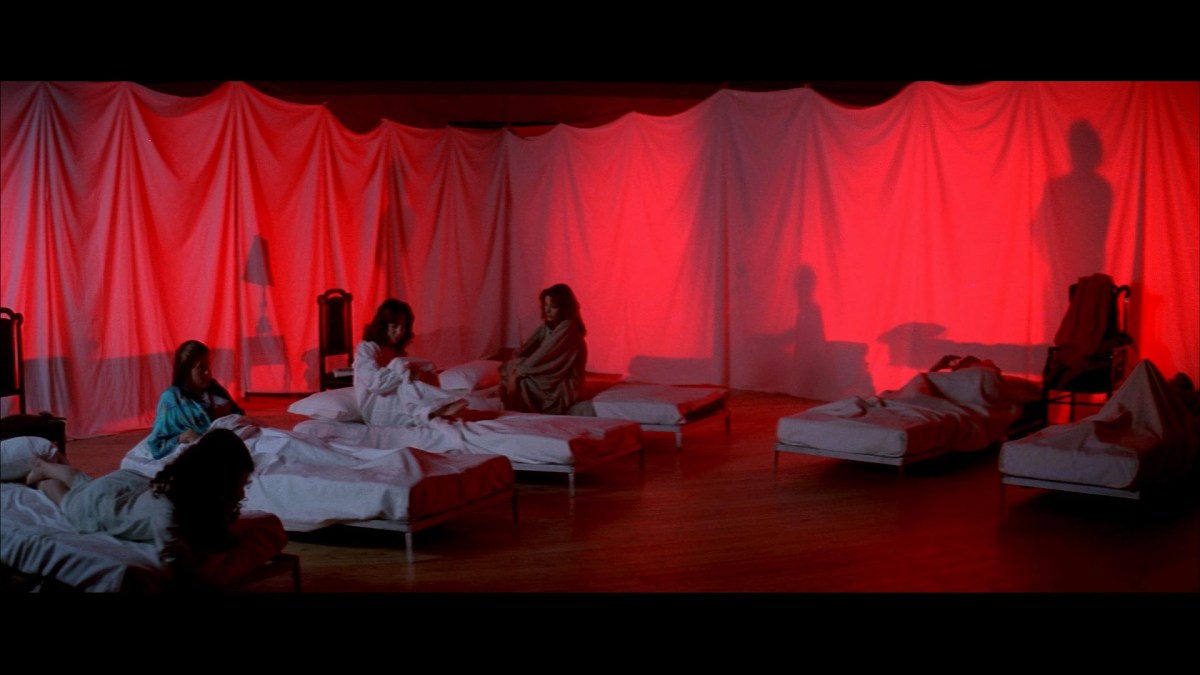
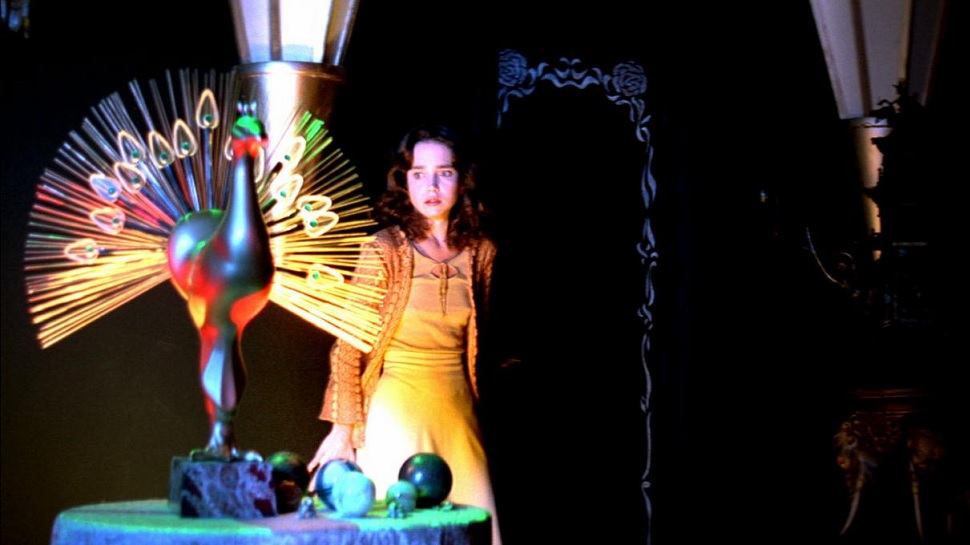
None of this matters, though, because this isn’t Suspiria’s raison d’être. No, Suspiria is a sensory masterpiece that places style way ahead of substance. In other words, it’s eye candy.

Argento expresses his vision through his imagery, and it’s unforgettably dazzling and unique. From the opening titles to the last scene, Argento shocks, thrills, and seduces with color, light, shadow, and surreal imagery. His sets are elegant and fake, and his blood is even faker. He lights the screen with bright reds and glowing blues (when it’s not all black from night), and he keeps the perspective distorted to create a trippy dissonance. Plus, he throws in a number of creepy psychological menaces, from maggots to a dog attack to a treacherous room-size wire dustbunny. Luciano Tovoli’s camera work perfectly articulates Argento’s vision.

This is what Suspiria is all about:

Suspiria1.jpg

Suspiria2.jpg

Suspiria3.jpg

Suspiria4.jpg

Suspiria5.jpg

Suspiria6.jpg

Suspiria9.jpg

Suspiria7.jpg

Suspiria8.jpg

The soundtrack by Goblin is a nice touch, and it goes far in creating the mood here.

For all its flaws — and there are many — Suspiria is a memorable film. We caught a digital restoration of the original print, which is five or six minutes longer. A zealous audience member engaged us in a discussion as we left the theater. He told us that Suspiria is the first of a trilogy known as “The Three Mothers,” and he enthusiastically recommended the second film, Inferno. I’ll see it someday, but it’s not a priority.

With Stefania Casini, Flavio Bucci, Miguel Bosé, Barbara Magnolfi, Susanna Javicoli, Eva Axén, Rudolf Schündler, Udo Kier, Margherita Horowitz, Jacopo Mariani, Fulvio Mingozzi, Franca Scagnetti, Renato Scarpa, Serafina Scorceletti, Giuseppe Transocchi, Renata Zamengo

Production: Seda Spettacoli

Distribution: Produzioni Atlas Consorziate

98 minutes
Not rated (alternate version)

(ArcLight) C+

It [It: Chapter One]

(USA 2017)

I’ve started a few Stephen King novels during my life, but I’ve never finished reading any of them. I have, however, seen enough movies based on his books to know what I’m getting into.

It is director Andy Muschietti’s take on King’s 1986 novel, which incidentally came out on my 16th birthday. Scary. It tells the story of a group of bullied junior high outcasts who go after a deranged clown named Pennywise (Bill Skarsgård) one summer, the Summer of 1989, after he kills stuttering Bill Denbrough’s (Jaeden Lieberher) little brother, Georgie (Jackson Robert Scott), the fall before.

Pennywise lives in the sewer of their small town (Derry, Maine) and resurfaces every 27 years to prey on children through their worst fears.

The screenplay, written by Chase Palmer, Cary Fukunaga, and Gary Dauberman, is only part of the book — presumably to allow for a sequel. It starts out well enough in the same sweet nostalgic way as, oh, Stand by Me. Muschietti gets deatils of the time period mostly right: the Cure and New Kids on the Block were big in ’89 (even though the former’s “Six Different Ways” was two albums and a compilation earlier), and the reference to Molly Ringwald fits. He goes full on Steven Spielberg, however, about halfway through, turning It into The Goonies with the kids’ “losers club” and all the action switching to a dark cavernous underground sewer. This is to say, It gets cheesy after awhile.

The kids are all decent actors, and they keep It moving along. Sadly, though, there aren’t any real surprises here. More creepy and icky than outright frightening, Muschietti relies greatly on special effects; they’re good and a lot of work went into them, but they get tiresome after awhile. Plus, some editing would’ve been a good idea; It is too long.

As It is, it’s not a stinker. However, I wasn’t moved by It, either. It is a big budget Hollywood movie aiming to be a blockbuster, and that’s It.

With Jeremy Ray Taylor, Sophia Lillis, Beverly Marsh, Finn Wolfhard, Chosen Jacobs, Jack Dylan Grazer, Wyatt Oleff, Nicholas Hamilton, Jake Sim, Logan Thompson, Owen Teague, Stephen Bogaert, Stuart Hughes, Geoffrey Pounsett, Pip Dwyer, Elizabeth Saunders, Ari Cohen, Anthony Ulc, Javier Botet, Katie Lunman, Carter Musselman, Tatum Lee

Production: New Line Cinema, Ratpac-Dune Entertainment, Vertigo Entertainment, Lin Pictures, KatzSmith Productions

Distribution: Warner Brothers

135 minutes
Rated R

(ArcLight) C

http://itthemovie.com

Tokyo Vampire Hotel

(Japan 2017)

This theatrical cut of director Sion Sono’s Amazon Prime miniseries Tokyo Vampire Hotel [東京ヴァンパイアホテル] (http://www.indiewire.com/2017/04/tokyo-vampire-hotel-sion-sono-amazon-1201808369/) is a fast-paced stylish and colorful bloodbath, something that wouldn’t be out of place in Quentin Tarantino’s oeuvre.

Manami (Tomite Ami) is a nice girl who shares a tiny apartment with her boyfriend (Saito Takumi) in Tokyo. Just after she arrives for dinner with her friends on the evening of her 22nd birthday, a crazy gun-toting assassin (Shoko Nakagawa) in a fuzzy pink mink shows up and takes out everyone in the restaurant — except Manami, whom she came to kidnap.

Manami flees, only to be picked up by another kidnapper, the mysterious K (Kaho). K in not so may words explains that Manami is a pawn in a war between two vampire clans, the Draculas and the Corvins, who have been enemies for centuries. Unbeknownst to Manami, she’s the target of a worldwide vampire hunt. K takes her to the glamorous Tokyo Vampire Hotel, which is run by a creepy geisha empress (Adachi Yumi) who needs blood.

The end of civilization is coming, but the empress has a plan: use the hotel to trap a healthy supply of humans to serve as food. Things don’t pan out as planned when the humans figure out what’s happening and the Draculas show up to crash the party.

This photo sums up what you’re getting into here:

Tokyo still.jpg

Tokyo Vampire Hotel is quirky, sexy, lavish, and fun. Sono serves up an imaginative feast of dazzling eye candy and nonstop action. His use of Christian symbols adds a nice touch. The sets are fantastic, and the action moves from the streets of Tokyo at night to inside the hotel to Bran Castle in Transylvania, and back. The editing works to make nine episodes flow seamlessly into a feature length film. However, the story wears thin after a little while, and it can’t sustain the interest I started out with. The gore gets old, too. The length, nearly two and a half hours, is a problem. It demonstrates why Tokyo Vampire Hotel is probably better in smaller doses.

With Mitsushima Shinnosuke, Yokoyama Ayumu, Kagurazaka Megumi, Shibukawa Kiyohiko, Takatsuki Sara, Tsutsui Mariko, Sakurai Yuki

Production: Amazon, Django Film, Nikkatsu Pictures

Distribution: Nikkatsu International Sales

142 minutes
Not rated

(AMC River East) C+

Chicago International Film Festival

https://youtu.be/2cJRq73BAhE

The Line [Čiara]

(Slovakia / Ukraine 2017)

Director Peter Bebjak’s The Line is an Eastern European testosterone flick, a less cheeky sort of Lock, Stock and Two Smoking Barrels set at the Slovakia–Ukraine border. It’s a genre flick, and a good one: excellent performances all around boost Peter Balko’s tight, vigorous screenplay.

A lot is going on with Adam Krajnak (Tomáš Maštalír), the head of both his household and a gang of organized cigarette smugglers. His oldest daughter, Lucia (Kristiná Konátová), is about to marry a clueless petty thief (Oleksandr Piskunov) he doesn’t care for. His Ukrainian partner (Eugen Libezňuk) is going weird, possibly on the verge of going rogue.

Then there’s ruthless Ukrainian gangster Krull (Stanislav Boklan), who’s co-opted Adam’s crew for a new product, meth. Adam wants no part of it. Things are heating up to a show down that crooked police chief Peter Bernard (Andy Hryc) facilitates. It all comes to a head during Lucia’s engagement party.

With far and few still moments, The Line grows increasingly complicated as its story progresses. This is a quick and constant thriller loaded with curve balls. A scene where the police raid Afghans illegally crossing the “green border,” a wooded area, is a standout. So are a few at a ravine where Krull dumps bodies; Martin Ziaran’s underwater shots are beautifully eerie.

With Emília Vášáryová, Géza Benkõ, Zuzana Fialová, Filip Kankovský, Milan Mikulcík, Veronika Strapková, Rimma Zyubina

Production: Wandal Production, Garnet International Media Group

Distribution: RTVS

Screening introduced by and followed by a live Q and A with Andy Hryc

108 minutes
Not rated

(AMC River East) B+

Chicago International Film Festival

http://www.ciara.sk/en/

Mon Mon Mon Monsters [Bào Gào Lǎo Shī! Guài Guài Guài Guài Wù!]

(Taiwan 2017)

In his latest film, peer pressure horror comedy Mon Mon Mon Monsters [報告老師! 怪怪怪怪物!] [Bào Gào Lǎo Shī! Guài Guài Guài Guài Wù!], writer/director Giddens Ko takes us on a wild ride that leaves us pondering who the real mosters are. He subtly gives us his answer in the title.

High school student Lin Shu-wei (Deng Yu-kai) is a neo maxi zoom dweebie with a masochistic edge. Why else would he tolerate the constant flying bits of paper, chairs pulled out from under him, and general teenage tomfoolery directed at him?

Lin becomes the target of Bully Ren-hao (Kent Tsai), a closet psychopath who relentlessly dreams up new ways to torment him. Ren-hao has two flunkies, Liao Kuo-feng (James Lai) and Yeh Wei-chu (Tao Meng) who do his bidding. Ren-hao’s girlfriend, Wu Si-hua (Bonnie Liang), contributes to the hell — never removing her star-studded headset as she snaps photos with her iPhone.

A pacificst teacher (Carolyn Chen) has an idea to get the boys on common ground: she assigns the four of them to community service feeding senile elderlies at a decrepit old age home that looks like something straight out of Blade Runner. Lin has a bad feeling about it, and he’s right: in the process of robbing an old man, the boys corner and capture a flesh-eating female beast (Lin Pei-hsin) they find roaming around.

They take her to an abandoned recreation center, where they chain her up and torture her with light, fire, and starvation. Lin reluctantly goes along with it, but he reaches a point where he either has to put up or shut up. Meanwhile, the beast’s protective and pissed off older sister (Eugenie Liu) is looking for her. This is where Lin is put to the test: does he have any character, and can he stay true to it?

Despite inconsistent pacing, Mon Mon Mon Monsters is overall engaging. Ko has something to say about the moral fabric of today’s youth, but he says it in a mostly lighthearted way. The acting is solid all around, which is pretty amazing for a slasher flick. The “monsters” are sweet in their own way. It’s smart to show them right off the bat rather than let us wonder what they look like; they come off as more human than the teenagers in this movie.

The special effects are pretty good, and the way Ko plays with light and color is downright spectacular. Quite a few scenes here are magnificent even if they’re cheesy and gory (that scene on the bus is fabulous, as are the scene where the teacher ignites in the gym and pretty much any of the scenes in the recreation center). Underneath all the blood and hate is a truth about the social ladder.

With Kai Ko, Vivian Sung, Emerson Tsai, Phil Hou, Bruce Hung 

Production: Star Ritz International Entertainment

Distribution: Vie Vision Pictures

113 Minutes
Not rated

(AMC River East) B-

Chicago International Film Festival

Tales from the Hood

(USA 1995)

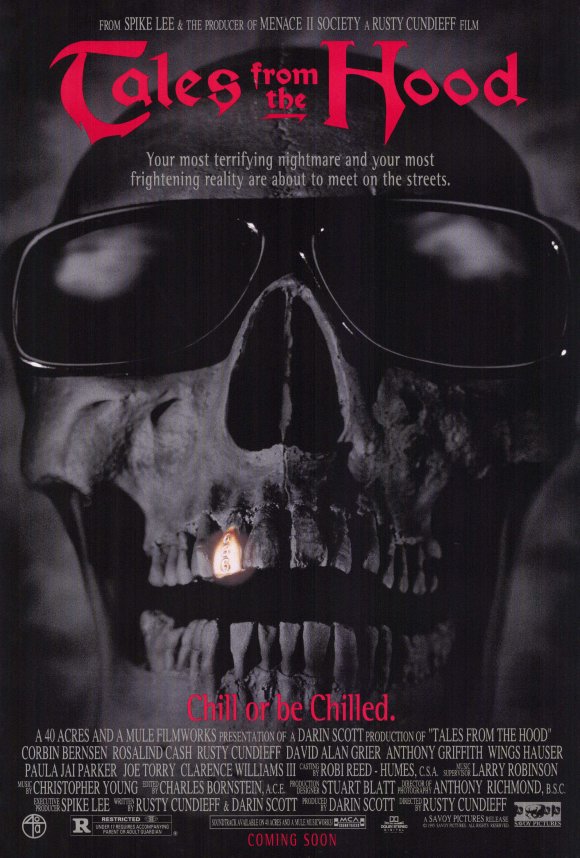
The road to hell is paved with good intentions. Rusty Cundieff’s anthology Tales from the Hood is a good idea: four vignettes of black life presented as horror stories — so, a horror flick with a message, more commentary than a “scary movie.” I see why Spike Lee attached his name to it (as executive producer).

Cundieff and cowriter Darin Scott pick material topics that still resonate more than 20 years later: racism, police brutality, domestic abuse, drugs, and black-on-black violence. The messages are strong, but unfortunately the writing always isn’t.

The best segment is “Hard Core Convert,” which is also the closer. Jerome a.k.a. Crazy K (Lamont Bentley) is a drug dealer shot in a gang hit. He wakes up in a Kafkaesue prison, where a stern nurse (Lira Angel) subjects him to rehabilitation methods straight from A Clockwork Orange. This particular piece and the way it’s executed are both powerful and memorable.

The second segment, “Boys Do Get Bruised,” takes on domestic abuse. It’s not bad, but it’s not great. The other two segments, “Rogue Cop Revelation” and “KKK Comeuppance,” fall flat.

Tales from the Hood targets the right notes, but it misses many of them. For one thing, the approach here is really heavy-handed. Plus, the impact is diluted by the silly bit that frames the stories: a funeral home in South Central Los Angeles run by weirdo Mr. Simms (Clarence Williams III). He tells the four stories to three “gangstas,” Ball (De’aundre Bonds), Bulldog (Samuel Monroe Jr.), and Stack (Joe Torry), who stumble into the home looking for drugs. I could have done without this device — it served as a distraction more than anything.

With Wings Hauser, Tom Wright, Anthony Griffith, Michael Massee, Duane Whitaker, David Alan Grier, Brandon Hammond, Rusty Cundieff, Paula Jai Parker, Corbin Bernsen, Roger Guenveur Smith, Art Evans, Rosalind Cash, Chris Edwards , Troy Cartwright, Brenden Jefferson, Tim Hutchinson, John A. Cundieff, Bobby McGee, Christina Cundieff, Ricky Harris, Darin Scott, Mark Christopher Lawrence, Scotty Brulee, Ryan Williams, Kamau Holloway, Tasha Johnson

Production: 40 Acres and a Mule Filmworks

Distribution: Savoy Pictures Entertainment

98 minutes
Rated R

(Music Box) C-

Music Box of Horrors

Ginger Snaps

(Canada 2000)

“Shit, wrists are for girls. I’m slitting my throat.”

— Ginger Fitzgerald

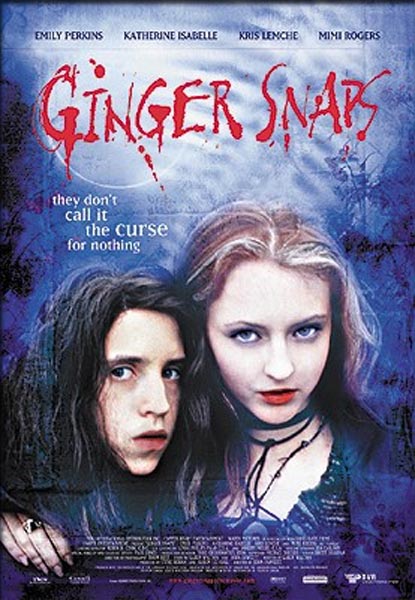
Puberty is tough enough without your older sister turning into a werewolf. Just ask 15-year-old Brigitte Fitzgerald (Emily Perkins), who with her sib, Ginger (Katharine Isabelle), stages gory death scenes and takes pictures of them, like a pair of morose Cindy Shermans. When they were kids, they made a pact to die together. Their classmates think they’re weird.

A run-in with mean girl Trina Sinclair (Danielle Hampton) sparks a war. Walking through the woods on their way to exact revenge one October night with a full moon, Ginger gets her first period. She also gets attacked by a mysterious and savage beast — the same one responsible for eviscerating all the dogs in the neighborhood.

Ginger turns increasingly feral over the next few days, growing more aggressive and sexual. Her wounds, which heal almost immediately, are sprouting hair. Oh yeah, she’s also developing what appears to be…a tail?

Brigitte, or “B,” connects with cute, brooding dope dealer Sam (Kris Lemche), who struck and killed the beast while he was driving his van down the road where it ran after it attacked Gretchen. He’s got a recipe for what might be the cure. The clock is ticking as Gretchen gets farther out of control, and Halloween — with another full moon — approaches.

On paper — all I had going into it because I’d never heard of it — John Fawcett’s Ginger Snaps sounds dubious at best. The premise seems trite. The part about the period sounds stupid, and the analogy to “becoming a lady” is obvious.

Turns out, Ginger Snaps is surprisingly good. Incorporating familiar elements of teen movies and splatter flicks, Fawcett, who wrote the screenplay with Karen Walton, pushes the “suspension of disbelief” envelope. He knows just when to stop, though. There’s quite a bit of gore here. The special effects are dated but effective nonetheless.

What really sells this film, though, is the acting: Perkins and Isabelle evoke a warmth to their relationship despite their offputting personalities and a fierceness to their bond. They’re totally believable as sisters. The final scene, which involves only them, is downright sad. Crushing, even.

With Mimi Rogers, Jesse Moss, John Bourgeois, Peter Keleghan, Christopher Redman, Lindsay Leese, Wendii Fulford, Pak-Kong Ho, Lucy Lawless

Production: Motion International, Copperheart Entertainment, Water Pictures, Lions Gate Films, Oddbod Productions, TVA International

Distribution: Motion International (Canada), Unapix Entertainment Productions (USA), Lions Gate Films

108 minutes
Not rated

(Music Box) B-

Music Box of Horrors

http://www.gingersnapsthemovie.com

Hellraiser

(UK 1987)

“Oh, no tears, please. It’s a waste of good suffering!”

— “Pinhead” (the Lead Cenobite)

Roger Ebert famously derided Clive Barker’s directorial debut, the sadomasochistic horror classic Hellraiser, calling it “without wit, style, or reason” for its “bankruptcy of imagination” (http://www.rogerebert.com/reviews/hellraiser-1987). Well, talk about tearing your soul apart!

Hellraiser isn’t particularly scary, but it is creepy and fucking weird. I certainly don’t find it lacking wit, style, or imagination; quite the opposite. It’s a ridiculous, kinky, and bloody telenovela. Based on Barker’s short novel The Hellbound Heart, Hellraiser takes the idea of something in the attic to a place no one else has.

Larry (Andrew Robinson) and Julia Cotton (Clare Higgins) have a strained marriage. After leaving Manhattan to go live in his abandoned boyhood home somewhere on the Atlantic coast, Julia finds Larry’s brother — who’s her ex lover — Frank (Sean Chapman in the flashbacks and Oliver Smith in the present) reanimated without skin in the attic. The movie doesn’t explain it, but the novel does: Larry cuts his hand and drips blood onto the attic floor, right where Frank’s comeshot dried up in the floorboards. Nice.

An unrelenting hedonist, Frank lost his body and soul to demons in his quest for sexual gratification. It started with an antique puzzle box that opened a portal to hell and summoned the Cenobites, led by “Pinhead” (Doug Bradley), the apparent spokesman for the motley foursome. Now, Frank needs blood, which is where Julia comes in. Too bad Frank’s daughter, Kirsty (Ashley Laurence), keeps getting in the way.

The special effects look cheap and the plot is choppy. It isn’t clear at first whether the cuts to Frank and Julia getting it on are flashbacks or fantasy, so this detail could have been done better. Nonetheless, Hellraiser is totally engrossing (and at points, just gross). Barker makes a silly story bizarre enough to keep you interested in what happens next. Higgins effectively channels a tortured melodramatic ’50s B-movie damsel in distress. And her big ’80s hair and sunglasses are fabulous!

Perhaps the best thing Hellraiser has going for it, though, is its twisted sense of humor: all of this happens — and will happen again — because Frank thinks with his dick. Now that’s funny.

With Nicholas Vince, Simon Bamford, Grace Kirby, Robert Hines, Anthony Allen, Leon Davis, Michael Cassidy, Frank Baker, Kenneth Nelson, Gay Baynes, Dave Atkins, Oliver Parker

Production: Cinemarque Entertainment BV, Film Futures, Rivdel Films

Distribution: New World Pictures (USA), Entertainment Film Distributors (UK), Highlight Film (West Germany), Paraiso Films S.A. (Spain), Prooptiki (Greece), Roadshow Film Distributors (Australia), Toei Classic (Japan), Vestron Benelux (Netherlands)

94 minutes
Rated R

(Music Box) B-

Music Box of Horrors

http://www.clivebarker.info/hellraiser.html