Kill, Baby…Kill! [Operation Fear] [Operazione paura]

(Italy 1966)

“Something in this town is supernatural. Tell me, why did they abandon the church? I’m scared. I almost think the devil’s here.”

— Monica

The second offering of a Mario Bava weekend double feature, Kill, Baby…Kill! is one of the director’s more commercially successful films. Many commentators have pointed out its influence on the horror genre and praised Bava’s gothic sensibilities, visuals, and use of irony. All good, I agree. Still, none of these things means Kill, Baby…Kill! is a great — or even a good — film.

In the early 20th Century, a coroner, Dr. Paul Eswai (Giacomo Rossi-Stuart), is en route to a remote village in Transylvania to perform an autopsy on a woman who died under mysterious circumstances. In a church — an abandoned one, no less, no doubt to provide a metaphor. The carriage driver, warning that this place is messed up, will only go to the edge of the village, not inside it.

Dr. Eswai finds the police inspector (Piero Lulli) at a local inn, where he is given instructions. When none of the superstitious and rather wan locals volunteer to help him with the autopsy, Monica Shuftan (Erika Blanc), a nurse of some sort who grew up there and just happens to be visiting the graves of her parents, steps up to assist.

During the autopsy, Dr. Eswai is puzzled to find a silver coin stuck in the woman’s heart. It’s a practice to thwart a local ghost that visits villagers in their sleep and puts a hex on them, making them commit suicide in ghastly ways — like jumping from heights and impaling themselves on iron posts.

Dr. Eswai runs into a creepy young thing in a white dress. He soon learns she’s the ghost of seven-year-old Melissa Graps (Valerio Valeri), who died 20 years before. She’s the little bugger who’s been freaking out everyone in the village for the last two decades. The doctor and Monica sense a spark, but first they must deal with this Melissa situation.

Romano Migliorini, Roberto Natale, and Bava all contributed to the screenplay. The story is unoriginal and silly, complete with cringeworthy dialogue and an actual sorceress (Fabienne Dalì). There’s an odd dub thing going on, too.

This being a Bava picture, though, Kill, Baby…Kill! works on primal instinct, here fear. Plus, it has its share of arresting visuals. The colors are vivid, though the palette is heavy on brown and green. The sets have a grimy, dilapidated medieval appearance to them, giving the look of a ghost story. There’s a cool scene where Dr. Eswai chases after Monica through a series of doors that keep taking him back to the same rooms — it’s delightfully dizzying.

Overall, Kill, Baby…Kill! is okay. It’s got Bava’s unique fingerprint all over it, and it’s fun to watch. It’s just not spectacular. Blood and Black Lace grabbed me; this did not, at least not for long. I hate the title — they should’ve kept Operation Fear.

With Luciano Catenacci (Max Lawrence), Micaela Esdra, Franca Dominici, Giuseppe Addobbati, Mirella Pamphili, Giana Vivaldi

Production: F.U.L. Films

Distribution: Internazionale Nembo, Distribuzione Importazione, Esportazione Film, Alpha (Germany), Europix Consolidated Corp. (USA), Astral Films (Canada), Metro-Goldwyn-Mayer

85 minutes
Rated PG

(Gene Siskel Film Center) C

Léon Morin, Priest [Léon Morin, prêtre]

(France / Italy 1961)

When young widow Barny (Emmanuelle Riva) bursts into a confessional and tells the priest, Léon Morin (Jean-Paul Belmondo), that “religion is the opiate of the masses,” it’s pretty clear that director Jean-Pierre Melville isn’t going easy on us. For awhile, it’s not clear where he’s going at all with Léon Morin, Priest [Léon Morin, prêtre], a moody work that percolates with repressed sexuality while it dives into religion, philosophy, and politics.

The story, based on Béatrix Beck’s novel and set in a tiny town somewhere in the French Alps during the Italian occupation right before the Nazis took over, centers on Barny as her relationship with Fr. Morin develops and intensifies. She reveals that she’s a communist militant, possibly a lesbian, and Jewish by injection (i.e., her dead husband was a Jew). She tries to provoke him with her jabs at the Catholic Church, but Fr. Morin’s responses are measured and considered. She’s seduced.

It looks like something sexual is going to happen between them: he’s young and handsome, and she’s been without a man for so long that she’s lusting after a female coworker (Nicole Mirel). Once the two are alone behind the closed door of Fr. Morin’s office in a church tower, it happens: they engage in…discourse, discussing the tenets of Catholicism.

Léon Morin, Priest is low on action and heavy on dialogue, and as a result it often feels lethargic. All of the “important” discussions — the ones that advance the plot, anyway — occur in one room, which does nothing to accelerate the pace. The discussions involve dry topics like theology and philosophy and religious dogma.

However, Melville keeps it interesting with what’s going on in the background: he’s brutally frank about the casual and pervasive anti-Semitism, the lackadaisical Italian soldiers, and the callous efficiency of the Nazis. Riva and Belmondo smoulder, though the former’s performance is far more compelling. Amid the hasty baptisms of children and the desperate hiding of neighbors is the curiously amusing subplot about Fr. Morin having all the women of the village spellbound. It’s a light touch in an otherwise heavy film.

With Irène Tunc, Gisèle Grimm, Marco Behar, Monique Bertho, Marc Heyraud, Nina Grégoire, Monique Hennessy, Edith Loria, Micheline Schererre, Renée Liques, Simone Vannier, Lucienne Marchand

Production: Georges de Beauregard, Concordia Compagnia Cinematografica, Carlo Ponti

Distribution: Lux Compagnie Cinématographique de France, Ciné Vog Films (Belgium), Cineriz (Italy), Eurooppalainen Filmi (Finland), Rialto Pictures (USA)

130 minutes (restored version)
Not rated

(Gene Siskel Film Center) B-

Wonder Woman

(USA 2017)

Director Patty Jenkins aims to do for Wonder Woman what Christopher Nolan—and I suppose to a lesser degree Tim Burton—did for Batman: take an iconic comic book superhero that got campy over the years and return it to its darker roots, producing something dramatic, perhaps weightier, and far more artful. Jenkins doesn’t entirely pull it off with Wonder Woman, but she’s on the right track. I see a sequel or two in the near future, so she’s got time to get there.

To Jenkins’s credit, Wonder Woman is not what I expected. Aside from a nod or two—and that goddamned tiara—all the cut-rate kitsch of the ’70s TV series is gone. This Wonder Woman means business even if she’s still, shall we say, absurd.

Jenkins goes back to the beginning: young Diana (Lilly Aspell and Emily Carey) lives on Themyscira, a hidden island inhabited by war-ready buff goddesses. Queen Hippolyta (Connie Nielsen), Diana’s mother, shields her from the strident ways of her subjects. It all has to do with an old score Ares (David Thewlis) seeks to settle—yes, that Ares, the son of Zeus and the god of war. General Antiope (Robin Wright), Hippolyta’s sister and Diana’s aunt/mentor, isn’t having it: she recognizes Diana’s potential and trains her on the sly. Diana blossoms into a beautiful woman (Gal Gadot) with serious supernatural power.

Diana stumbles upon Steve Trevor (Chris Pine), a drowning American pilot whose plane crashes off the coast of Themyscira. She rescues him, unwittingly exposing the island to an invasion by German forces. Persuaded by the awesome power of Diana’s Lasso of Hestia, Steve confesses that he’s a spy in the “war to end all wars”—World War I. Spider-sensing Ares is behind it, Diana embarks with Steve on a mission filled with romance, adventure, and espionage in an effort to track down the god and stop the madness.

Wonder Woman starts out all Xena: Warrior Princess, silly and weird in a geeky softcore straight guy “lesbian porn” way that no doubt would appeal to the likes of Wayne and Garth. Thankfully, it moves in another direction once Pine shows up about 40 minutes in. I found myself enjoying Wonder Woman more as the story got to Europe—that storyline is more believable even if it too is silly. The battle scenes are decent with some Hollywood excess and humor thrown in. I love how the theme of gender equality is the star of every scene—neither subtle nor heavy-handed, it’s simply a given.

For all its perks, Wonder Woman is ultimately a typical blockbuster that emphasizes form over substance. If nothing else, it surprises, which is always a plus. Frankly, though, I could’ve kept going completely oblivious to the fact that Wonder Woman is more than Lynda Carter. She was more a lot more fun.

With Danny Huston, Saïd Taghmaoui, Ewen Bremner, Eugene Brave Rock, Lucy Davis, Elena Anaya, Doutzen Kroes

Production: DC Entertainment, Atlas Entertainment, Cruel & Unusual Films, Rat-Pac Dune Entertainment LLC, Tencent Pictures, Wanda Pictures

Distribution: Warner Brothers, Karo Premiere (Russia), NOS Audiovisuais (Portugal), Roadshow Entertainment (New Zealand), Roadshow Films (Australia), SF Studios (Norway), Tanweer Alliances (Greece)

141 minutes
Rated PG-13

(ArcLight) C

http://wonderwomanfilm.com

Okja

(USA/South Korea 2017)

“We needed a miracle, and then we got one.”

—Lucy Mirando

Bong Joon-ho’s Okja, now streaming on Netflix, is a lot of things; dull is not one of them. A slick, fast-paced, mesmerizing mix of fantasy, sci-fi, comedy, action, satire, and social consciousness, this film has a lot going on—and a lot going for it. I was lucky to see it on the big screen before its official release, and that’s how I recommend seeing it if you can. Sorry, Netflix, Okja is simply too good for TV.

The story begins ten years ago in 2007: in a desperate but brilliant attempt to rebrand a disreputable family business—to make a silk purse out of a sow’s ear, so to speak—Lucy Mirando (Tilda Swinton) announces her master plan to breed an all-natural “superpig” that leaves a minimal footprint, feeds the world, and tastes great (https://superpigproject.com). Her company, Mirando Corporation, devises a competition, sending twenty-some piglets to real farmers across the globe to raise them; the company will monitor each pig over the next ten years and declare a “winner” based on the results. Mirando hires animal television show host Dr. Johnny Wilcox (Jake Gyllenhaal), a zoologist whose star is fading, to lend credibility to the project as well as to generate public interest in it.

Fast forward to 2017: Mirando’s plan is coming to fruition without any hiccups, which makes her happier than a pig in…well, you know. Unfortunately for Mirando, a young South Korean girl named Mija (Ahn Seo-hyun), whose grandfather (Byun Hee-bong) signed onto the project, threatens to derail the entire mission. Mija, you see, essentially raised her grandfather’s pig, Okja. They’ve become dependent on each other. He never explained to her what the deal really is—that Mirando’s silk purse is nothing more than lipstick on a pig.

Dr. Johnny and his television crew show up at their home in the mountains and marvel over Okja, now a magnificently enormous hippopotamus-like creature. He presents her grandfather with an award and takes Okja to Manhattan—actually, New Jersey—for a pig roast sponsored by the Mirando Corporation.

To put it lightly, Mija’s not having it—she takes off after Okja on a chaotic chase through Seoul, where she encounters the Animal Liberation Front, a group of inept animal rights activists led by idealistic but ineffective Jay (Paul Dano). They make a pact, but unfortunately she doesn’t speak English. Mija ends up at the world headquarters of Mirando Corporation in New York City, completely unaware of the cards she holds.

I went into Okja blind—the only thing I knew about it was that its central character is a big pig. I left more than satisfied: the cast is stellar, the effects are flawless, and the script is smart and strong despite its flaws. If that don’t beat a pig a-pecking, I don’t know what does.

In simplest terms, Okja is about our complicated consumerist relationship with food. As one pig farmer put it best, “Okja’s a fake pig in a movie I watched on Netflix. But plenty of real animals are suffering inside a horrific system that don’t have to.” (http://www.huffingtonpost.com/entry/okja-thoughts-from-a-pig-farmer_us_595bd1cde4b0f078efd98cbd). On this point alone, Okja will resonate with anyone who’s ever connected with an animal—pig, dog, cat, bird, horse, aardvark. The story has been compared to E.T. (https://moviebloke.com/2016/03/29/e-t-the-extra-terrestrial-e-t/), and it’s pretty wonderful. The final scene, which takes place in a slaughterhouse, is hard to watch—I got anxious. And queasy. I thought of Morrissey!

Appropriately, the acting is hammy; I love that Swinton plays twins again. She looks like a deranged Uma Thurman in Pulp Fiction. Gyllenhaal teeters on insufferable with his wimpy sniveling, but to his credit he manages to keep it in check. I’m usually unimpressed with computer animation, but here it’s amazingly well done; Okja looks as real as the humans. I think the trick is her eyes. Even with its Hollywood ending, Okja is definitely one of this year’s more interesting movies.

With Steven Yeun, Lily Collins, Yoon Je-moon, Shirley Henderson, Daniel Henshall, Devon Bostick, Choi Woo-shik, Giancarlo Esposito

Production: Kate Street Picture Company, Lewis Pictures, Plan B Entertainment

Distribution: Netflix

118 minutes
Not rated

(AMC River East) B

https://www.netflix.com/title/80091936

Two Men in Manhattan [Deux hommes dans Manhattan]

(France 1959)

In his cool noir mystery Two Men in Manhattan [Deux hommes dans Manhattan], director Jean-Pierre Melville in his only starring role is Moreau, a cheerless and jaded reporter with Agence France-Presse. As he’s leaving work one night, his boss (Jean Lara) asks him to investigate the whereabouts of one Mssr. Fèvre-Berthier, the French United Nations delegate, who curiously has gone M.I.A.

Moreau heads straight to the flat of a frequent collaborator, hardened alcoholic photographer Pierre Delmas (Pierre Grasset), and yanks him out of bed—never mind the girl there with him. Delmas is the archetype paparazzo: cold-blooded and motivated by money. He knows his way around Manhattan.

The two men trail Fèvre-Berthier through a number of female associates: his secretary (Colette Fleury), a two-bit actress (Ginger Hall), a jazz singer (Glenda Leigh), a burlesque stripper (Michèle Bailly), and a high dollar whore in a high class brothel (Monique Hennessy). They find out what happened to him, but the story is scandalous.

Moreau doesn’t want to print it, but Delmas insists otherwise. A strange car following them around may persuade them to do the right thing—whatever that is.

With enough trench coats and fedora hats to clothe a newsroom, Two Men in Manhattan reflects Melville’s characteristic minimalist neo gangster movie style. The personal ethics here are all grey, which fits nicely with the night scenes, especially the exteriors shot on Times Square by cinematographer Nicolas Hayer. Aside from the exteriors, Manhattan never looked more fabulously fake: most of the interiors—the subway, a bar, a club, a theater, a hospital, a diner—were shot in a studio.

Part detective flick and part morality play, the tone shifts quite a bit between drama and waggishness, leading me to conclude that Melville didn’t take Two Men in Manhattan very seriously. It’s a minor work that comes off tongue in cheek, which makes it fun to watch—it compensates for Melville’s rather thin script. Plus, the whole thing sure is pretty.

With Christiane Eudes, Paula Dehelly, Nancy Delorme, Carole Sands, Gloria Kayser, Barbara Hall, Monica Ford, Billy Beck, Deya Kent, Carl Studer, Billy Kearns , Hyman Yanovitz, Ro. Tetelman, Art Simmons, Jerry Mengo

Production: Belfort Films, Alter Films

Distribution: Columbia Films (France), Mercurfin Italiana (Italy), Cable Hogue Co. (Japan), Cohen Media Group (USA)

85 minutes
Not rated

(Gene Siskel Film Center) B-

The Godfather

(USA 1972)

“Why did you go to the police? Why didn’t you come to me first? What have I ever done to make you treat me so disrespectfully?”

—Don Vito Corleone


“My father is no different than any powerful man, any man with power. Like a president or a senator.”

—Michael Corleone


“And may their first child be a masculine child.”

—Luca Brasi


“Hey Mikey, why don’cha tell that nice girl you love her? ‘I love you with all a-my heart. If I don’t a-see you again a-soon, I’m a-gonna die!'”

“Leave the gun. Take the cannoli.”

—Peter Clemenza

Pretty much perfect, The Godfather was almost a different movie. Based on Mario Puzo’s insanely popular best selling 1969 novel, studio executives conceived a pulp gangster drama for its film adaptation. Good thing they wanted a “real” Italian-American to direct so it would be so authentic that moviegoers would “smell the spaghetti” (https://www.vanityfair.com/news/2009/03/godfather200903). Several unsuccessful attempts were made to attract a director, including Warren Beatty. Paramount “settled for” unknown Francis Ford Coppola, who took it somewhere else.

The Godfather is universally held in high esteem as one of the greatest films of all time—as it should be. It’s a a movie showered in superlatives—like the bullets that shower, well, most of the characters. It’s impeccable. We caught an anniversary screening.

Coppola’s morality play is a masterpiece, more complex than it seems at first and full of contrast and contradiction. A solemn and ominous mob drama that centers on Don Vito Corleone (Marlon Brando) and his family business, The Godfather boasts one riveting career-defining performance after another—Brando, Al Pacino, James Caan, Richard Castellano, Robert Duvall, and Abe Vigoda, to name a few. The characters are great, and the dialogue—perfect! Not a single second is wasted here, not even that long ass wedding scene.

The observations about human nature are astute, and the spin on assimilation and the American Dream is clever. The dramatic arc involving the descent of younger son Michael (Pacino) into a moral apocalypse is something you can’t shift your eyes away from. Black as its promotional poster, The Godfather leaves so much to chew on. This is what cinema is all about.

In 1990, the United States Library of Congress deemed The Godfather “culturally, historically, or aesthetically significant” and selected it for preservation in the National Film Registry (https://www.loc.gov/programs/national-film-preservation-board/film-registry/complete-national-film-registry-listing/).

With Sterling Hayden, John Marley, Richard Conte, Al Lettieri, Diane Keaton, Talia Shire, Gianni Russo, John Cazale, Rudy Bond, Al Martino , Morgana King, Lenny Montana, John Martino, Salvatore Corsitto, Richard Bright, Alex Rocco, Tony Giorgio, Vito Scotti, Tere Livrano, Victor Rendina, Jeannie Linero, Julie Gregg, Ardell Sheridan, Simonetta Stefanelli, Angelo Infanti, Corrado Gaipa, Franco Citti, Saro Urzì, Sofia Coppola

Production: Paramount Pictures, Alfran Productions

Distribution: Paramount Pictures (USA), Cinema International Corporation (CIC) (International)

175 minutes
Rated R

(AMC River East) A+

Fathom Events

Love & Anarchy [Film d’amore e d’anarchia, ovvero ‘stamattina alle 10 in via dei Fiori nella nota casa di tolleranza…’]

(Italy/France 1973)

The premise of Lina Wertmüller’s Love & Anarchy [Film d’amore e d’anarchia, ovvero ‘stamattina alle 10 in via dei Fiori nella nota casa di tolleranza…’] has the ring of something from Federico Fellini or maybe Pedro Almodóvar (though Fellini makes a lot more sense because she actually worked as his assistant for a spell).

Freckly yokel farmer Tunin (Giancarlo Giannini) learns that his friend was murdered. Why? Because he was an anarchist who was plotting to assassinate “ll Duce” Benito Mussolini. What’s more, Mussolini’s fascist police killed him. To avenge his friend’s death, Tunin takes up his cause.

Tunin ends up at a brothel in Rome. He spends a night with Salomè (Mariangela Melato), who reveals that she’s a co-conspirator for her own reasons. As the story progresses, it becomes clear that the coup is a harebrained idea.

Salomè takes Tunin to a rural spot just outside Rome with her and another prostitute, Tripolina (Lina Polito). Salomè distracts Spatoletti (Eros Pagni), the head of Mussolini’s police, while Tunin checks out the area; they then devise a plan to execute the mission.

Meanwhile, Tunin and Tripolina fall in love. Convinced that he isn’t going to make it past the assassination alive, he persuades Tripolina to spend the next two days with him.

The same radical spunk that Wertmüller exhibits in The Seduction of Mimi is just as prevalent in Love & Anarchy; this film is loaded with decadent, sexy hijinks. However, it also its share of some really tender moments—that surprised me. Love & Anarchy turns out devastatingly sad—I left the theater literally bummed out. For all its ridiculous sociopolitical and sexual shenanigans, it’s a far more powerful film.

With Pina Cei, Elena Fiore, Giuliana Calandra, Isa Bellini, Isa Danieli, Enrica Bonaccorti, Anna Bonaiuto, Anita Branzanti, Maria Sciacca, Anna Melato, Gea Linchi, Anna Stivala, Roberto Herlitzka

Production: Euro International Film, Labrador Films

Distribution: Peppercorn-Wormser, Kino Lorber

120 minutes
Not rated

(Gene Siskel Film Center) B

https://www.kinolorber.com/film/view/id/1306

Spellbound

(USA 1945)

“The Fault…is Not in Our Stars,
But in Ourselves…”

—William Shakespeare

I’ve read enough online rankings of Alfred Hitchcock’s films to know that Spellbound often ends up in his top 20 or 30—sometimes higher than that—thank you. While certainly impressive considering the number of films he directed (https://en.wikipedia.org/wiki/Alfred_Hitchcock_filmography), I found Spellbound lackluster, comparatively speaking.

It’s not that I didn’t enjoy it. In the grand scheme of all things cinema, Spellbound is a solid work—it’s just not a great Hitchcock film. Ingrid Bergman is psychoanalyst Constance Petersen, the only female doctor at Green Manors, a mental hospital in Vermont. Her male colleagues see her as detached and cold, which doesn’t bode well for her career—particularly for a woman in the 1940s.

The hospital’s director, Dr. Murchison (Leo G. Carroll), is “retiring.” His replacement is young and handsome Dr. Anthony Edwardes (a young Gregory Peck), who catches Dr. Petersen off guard. Truth be told, she’s smitten—and who can blame her? Gregory Peck is gorgeous here. Anyway, Dr. Edwardes has a secret that becomes apparent: he’s not who he says he is. He’s actually John Ballantyne, a.k.a. John Brown, a dude with amnesia who says he killed the real Dr. Edwardes and assumed his identity. Dr. Petersen doesn’t believe him, and she sets out to find the real murderer—through psychoanalysis. It all leads to a fateful ski trip that comes full circle to Green Manors. Gasp!

Angus MacPhail and Ben Hecht based their screenplay on the 1928 novel The House of Dr. Edwardes by John Palmer and Hilary A. Saunders (as Francis Beeding). Clearly obsessed with Sigmund Freud, the story is clunky but cute and oddly entertaining even if it’s kind of stupid. Two things stick out in my mind about this film: one is Salvador Dalí’s cool dream sequence complete with random objects like big bleary eyes, scissors, a faceless figure, and wings; and that final scene where a gun is fired into the camera—I won’t ruin it, but it literally ends Spellbound with a bloody bang. Fucking awesome!

The nitrate print used for this screening was gorgeous, shimmering with rich blacks and luminescent whites. It impressed me. Miklòs Ròzsa’s grand, sweeping score is fierce—no wonder he won an Oscar for it (https://www.oscars.org/oscars/ceremonies/1946).

One extremely personal but annoying detail: the Siouxsie and the Banshees song “Spellbound” played in the back of my mind the entire time I watched this film. Yeah, I’m hearing voices, I guess…but it could be much worse (I’m talking to you, Paula Abdul).

With Michael Chekhov, Rhonda Fleming, John Emery, Steven Geray, Paul Harvey, Donald Curtis, Norman Lloyd, Bill Goodwin, Wallace Ford, Art Baker, Regis Toomey

Production: Selznick International Pictures, Vanguard Films

Distribution: United Artists

111 minutes
Not rated

(Dryden Theatre) B-

Nitrate Picture Show

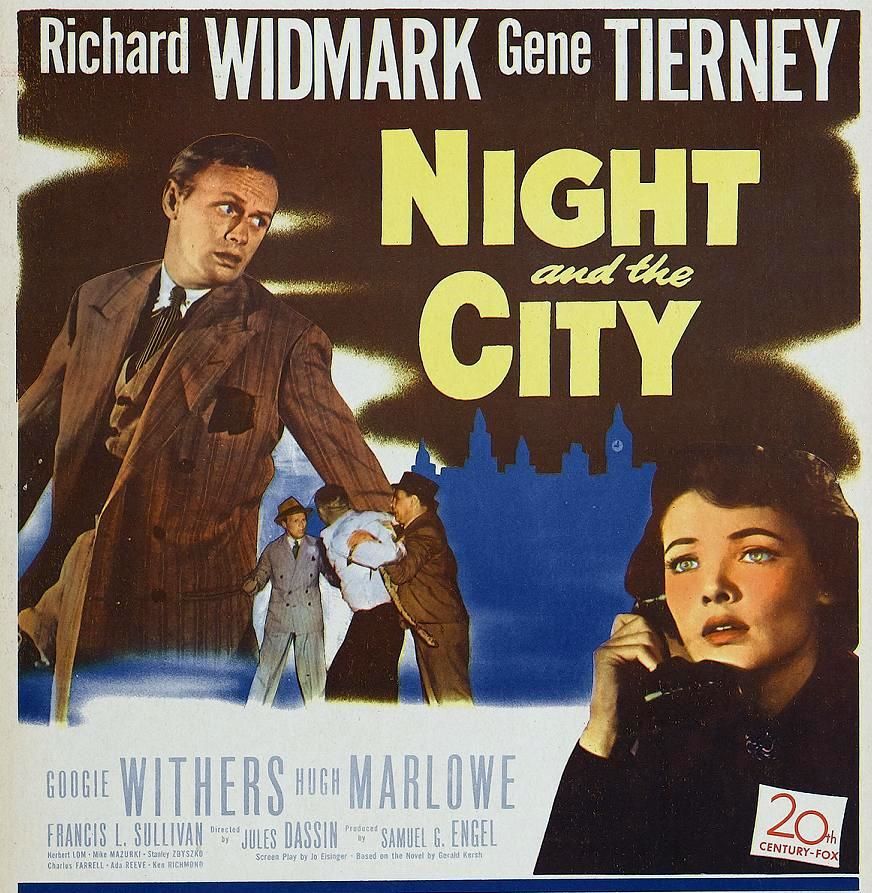
Night and the City

(UK/USA 1950)

“Harry is an artist without an art.”

—Adam Dunne

Jules Dassin’s Night and the City is a fine example of classic film noir. Filmed in smoky black and white mostly at nighttime on location in London, Dassin takes us slumming through the seedy underworld of nightlife, wrestling, and organized crime.

Harry Fabian (Richard Widmark) is a hard-bitten, ambitious, streetwise American con artist living in London. Always on the lookout for a quick buck, he can’t seem to catch a break. Ever. Literally running for his life in the opening scene, his latest career endeavor has failed, and his girl, Mary (Gene Tierney), is losing faith in him—stealing from her will do that.

Things brighten one night after a failed hustle at a wrestling match: Harry crosses paths with famous retired Greek wrestler Gregorius the Great (real life professional wrestler Stanislaus Zbyszko) and his prodigy, Nikolas of Athens (Ken Richmond), who both walk out of the arena in a huff. Gregorius is furious with his son, Kristo (Herbert Lom), who organized the fight, a low-end sort of WWE-like affair that he finds tacky.

Harry schmoozes Gregorius and learns that Kristo is a mobster who controls wrestling in all of London. He devises a plan to create a promotion startup, aligning himself with Gregorius to get around Kristo. He secures funding by double dealing with Phil Nosseross (Francis L. Sullivan), the owner of the Silver Fox Club where Mary works, and Phil’s wife, Helen (Googie Withers). She has plans of her own she doesn’t want Phil to know about.

The whole thing looks like it’s actually going to work despite Kristo’s threats, a plot to murder Harry, and Phil pulling his backing from the project. Harry gets so far as setting up a real fight between Nikolas and the Strangler (Mike Mazurki, also a real life professional wrestler). A miscalculation unravels everything—not just for him but everyone involved.

Jo Eisinger’s screenplay, based on Gerald Kersh’s novel Night and the City with contributions from Austin Dempster and William E. Watts, involves morally bankrupt lowlife characters who lack any redeeming qualities. All of them are scamming for one thing or another, and none of them—except maybe Mary—evokes any sympathy. This plays out nicely with the motifs of money, masculinity, and blind ambition that give this story its dark and bitter hue. It’s suspenseful. Ultimately, evil prevails in this dirty little story, which had to be revolutionary if jarring when this came out.

The backstory here is as interesting as the plot: during the production of Night and the City, Dassin was blacklisted for being a Communist. Pushed into exile, he infuses a strong sense of betrayal and fear into this film (https://en.wikipedia.org/wiki/Jules_Dassin).

Night and the City is desperate, chilly, and magnificently bleak—and it looks it thanks to Mutz Greenbaum’s shadowy and dramatic cinematography. Of the nitrate prints that screened this year, this was a standout. According to the festival program, this pre-release print is ten minutes longer than the UK version and 15 minutes longer than the US version.

With Hugh Marlowe, Ada Reeve, Charles Farrell, Edward Chapman, Betty Shale

Production: 20th Century Fox

Distribution: 20th Century Fox, Criterion

111 minutes (pre-release print)
Not rated

(Dryden Theatre) B

Nitrate Picture Show

https://www.criterion.com/films/933-night-and-the-city

Lost Highway

(USA 1997)

I watched David Lynch’s Lost Highway on my iPad on an Amtrak train from Chicago to Rochester. The one thing I strongly recommend is that it be viewed on the big screen, or at the very least on a flatscreen television. Quite simply, the visuals here are far too beautiful to see in an abridged format. And frankly, the visuals—sets, colors, costumes, actors, props—are the best part of the film.

The second thing I recommend is that it be watched under the influence of something—booze, pot, or better yet, prescription drugs.

This begs a question I’ll just answer: Lost Highway is fucked up—thrillingly so. The whole things starts with a videotape of our unlucky hero, saxophonist Fred Madison (Bill Pullman), murdering his wife (Patricia Arquette), who in an alternate universe is having an affair with Madison’s younger alterego, Pete Dayton (Balthazar Getty). The married couple has no memory of this murder. Neither party seems aware of this wrinkle in time and space, either. The connection lies with two people: demanding gangster Mr. Eddy (Robert Loggia) and creepy-ass flour-faced Robert Blake in what must be his most frightening role as The Mystery Man, a pallid ghost straight from a silent movie or a video by The Cure.

Lost Highway isn’t my favorite David Lynch film. However, it’s intriguing and vague enough to keep me thinking about it. I’m not sure what to make of this one—but I’m also not sure I care enough to do the work to figure it out. Maybe someday, definitely not today. The star cameos are enough for now.

Interesting fact: Lost Highway features the final film performances of Blake, Jack Nance, and Richard Pryor. Who knew?

With Alice Wakefield, John Roselius, Lou Eppolito, Henry Rollins, Mink Stole, Gary Busey, Lucy Butler, Giovanni Ribisi, Marilyn Manson, David Lynch

Production: October Films, CiBy 2000, Asymmetrical Productions, Lost Highway Productions LLC

Distribution: October Films (USA), Polygram Filmed Entertainment (UK), Rialto Film AG (Switzerland), RCV Film Distribution, Cinemussy (Spain), Senator Film (Germany), Atalanta Filmes (Portugal), Edko Films (Hong Kong), NTV-PROFIT (Russia), Artistas Argentinos Asociados (AAA) (Argentina), AmaFilms (Greece), New Star (Greece), Sandrew Film (Sweden), United International Pictures (UIP) (Australia), Warner Brothers (Finland)

134 minutes
Rated R

(iTunes rental) C+

http://www.davidlynch.de