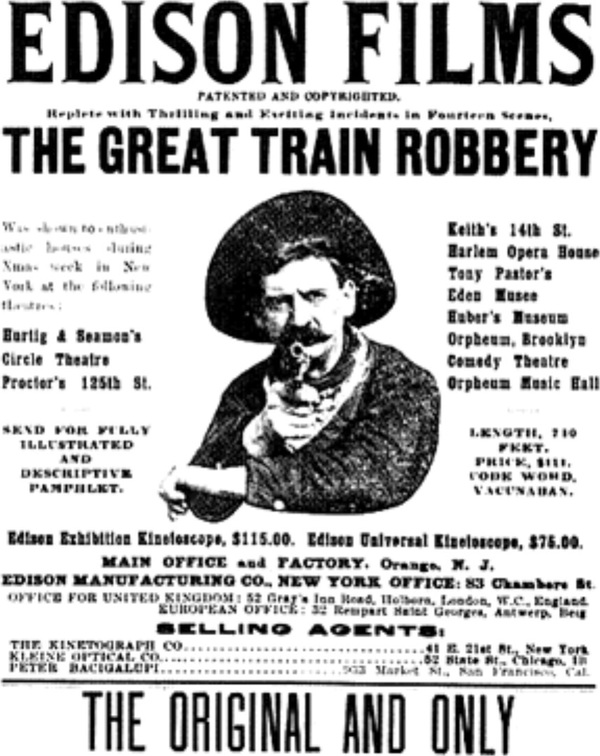
The Great Train Robbery is another early narrative film produced by Thomas Edison and directed by Edwin S. Porter. Unlike Life of an American Fireman earlier the same year, this one looks like a movie: it has a title card, a cast that acts (even if it’s humorously overdramatic), and a more complicated plot — though it’s still pretty simple.
The focus is clearly on telling a story, and on that level it works: a bunch of bandits (Gilbert M. ‘Broncho Billy’ Anderson, Justus D. Barnes, John Manus Dougherty Sr., Frank Hanaway, Adam Charles Hayman) rob a passenger train and are pursued over it. The action is parsed out more thoughtfully, no doubt for dramatic effect. The settings change, and a lot more characters are involved. Plus, the very last scene is clever — it’s a bit Hitchcockian.
With A.C. Abadie, George Barnes, Walter Cameron, Donald Gallaher, Shadrack E. Graham, Morgan Jones, Tom London, Robert Milasch, Marie Murray, Mary Snow
Production: Edison Manufacturing Company
Distribution: Edison Manufacturing Company, Kleine Optical Company
The National Film Registry has some weird shit on it. Life of an American Fireman is a good example. An early “narrative” film produced by Thomas Edison and directed by George S. Fleming and Edwin S. Porter, who worked on other Edison film projects, this one depicts the dangerous work of firemen.
Life of an American Fireman doesn’t waste time or expense on things life title cards or credits. It begins with a fireman (Arthur White) dreaming about his wife and kids, shown in an onscreen thought bubble. He is awakened by the sound of the bell — not that we hear it — because oh, Lord Jesus, it’s a fire! It’s not entirely clear, but it looks like the fire is at his house.
This film is interesting from a historical perspective, and it shows some nice exterior shots of suburban New York or New Jersey. It’s also neat how the aforementioned thought bubble is composed as well as how the action is depicted from various viewpoints — in and outside the house. The fake smoke is a nice detail. Other than that, Life of an American Fireman is a snooze — about as thrilling as watching a fax go through. Thankfully, programming has come a long way.
The Immigrant is quintessential Charlie Chaplin: funny, cute, and touching, it entertains while criticizing the social conditions of the day — here, the treatment of immigrants in “the Land of Liberty.” You decide whether all that much has changed in a hundred years.
Written and directed by Chaplin, The Immigrant follows his Tramp character on a boat bound for the States. He meets a fellow passenger, a beautiful young woman (Edna Purviance) traveling with her mother (Kitty Bradbury), and he has the perfect “in” when money is stolen from her purse. Sparks fly, but unfortunately the two potential love birds are separated by U.S. Customs agents as soon as they reach New York Harbor.
Once in the New World, the Immigrant has some trouble making ends meet. He finds a quarter on the ground one dreary afternoon and heads to a restaurant where a hostile head waiter (Eric Campbell) gives him a hard time. By chance, he sees the young woman from the boat and invites her to his table for beans and coffee (yuck!). Soon realizing that the quarter slipped through a hole in his pocket, he tries to impress her while stalling on the check to avoid ejectment.
The Immigrant starts off rocky — literally: the boat rocks back and forth, lending itself to some nice physical comedy with passengers sliding across the floor, juggling moves, and dishes sliding across a table. Thankfully, the rocking stops just before it becomes annoying. The scene in the restaurant is fascinating both for the character development and the physical choreography. This is a sweet story, an early romcom with a happy ending — and it’s downright charming a century later.
With Albert Austin, Henry Bergman, Loyal Underwood, William Gillespie, James T. Kelly, John Rand, Frank J. Coleman, Tom Harrington, Janet Miller Sully, Tom Wilson, Tiny Sandford
Incidentally, that hotel party occurred in San Francisco exactly 96 years ago on the day after this post.
Today, I saw my first Fatty Arbuckle film — and it only took me 108 years (https://en.wikipedia.org/wiki/Roscoe_Arbuckle_filmography). I had a loose idea of what to expect but I wasn’t quite sure. Fatty’s Tintype Tangle is familiar and not too crazy, the cinematic equivalent of something that tastes like chicken.
WARNING: Potential spoilers ahead!
A slapstick farce, Fatty’s Tintype Tangle tells of a husband (Arbuckle) whose mother-in-law (Mai Wells) nags the shit out of him. He and his wife (Norma Nichols) laugh at her behind her back. After getting liquored up in the kitchen while cooking breakfast, Fatty tells off his mother-in-law and either throws her ass out of his house or upsets her to the point that she gets up and goes — it’s hard to say.
Fatty goes to the park, where he sits on a bench next to a woman (Louise Fazenda) whose husband (Edgar Kennedy) momentarily leaves her to go do something — the scene card tells us they’re Alaskan “homeseekers,” whatever that is. They seem down and out, staying at an obviously low rent room and board. A photographer (Glen Cavender) snaps their picture — hence the “tintype” in the title — which isn’t cool because, well, they’re both married. The husband returns, mistakes Fatty for a creep, and threatens to kill him if he doesn’t leave town.
Fatty runs home and packs his bags — including his booze. He tells his wife he’s going on a business trip. Despondent, she answers an ad in the paper from someone seeking an apartment. She rents out the house and apparently moves in with her mother. Turns out, her tenants are the Alaskan couple. Doh!
Fatty misses his train and goes home. Unbeknownst to him, the Alaskan woman is in his bathroom. Hilarity ensues.
Fatty’s Tintype Tangle has all the elements of early comedy, a lot of it cliché now: misunderstandings, the hapless henpecked male, a slip and fall on a banana peel, gunshots to the ass, even Keystone cops. The only thing missing is a pie in the face. A rather cool extended scene features Arbuckle climbing up a pole and running across power lines. I was impressed to see him doing his own stunts; he was surprisingly limber for such a big guy.
Slapstick isn’t my favorite form of entertainment, but this is solid physical comedy even if it’s hard to follow at points. The version I saw had no sound at all, which was a bummer — hearing myself breathe adds nothing to the experience.


 moviebloke