“I’ll rinse these. I have Woolite in my purse. It’s handy for the road.”
— Doris Mann
Postcards from the Edge is, of course, Carrie Fisher’s semi-autobiographical novel about a floundering actress, Suzanne Vale (Meryl Streep), teetering on has-been status as she puts her life back together after a near fatal overdose. For her film adaptation, Fisher shifts the focus from the rehabilitation process to the relationship between Suzanne and her mother, legendary Hollywood superstar Doris Mann (Shirley MacLaine). It’s a good call: as last year’s documentary Bright Lights: Starring Carrie Fisher and Debbie Reynolds (https://moviebloke.com/tag/bright-lights-starring-carrie-fisher-and-debbie-reynolds/ ) demonstrated, Fisher and Reynolds were a solid and supportive albeit wacky team. Their relationship clearly offers ample fodder for this film.
Ably directed by Mike Nichols, Postcards from the Edge takes on addiction, family relationships, and show biz. In order to continue a film she’s working on, Vale must place herself under the care of a “responsible” adult — strictly for insurance purposes, a producer (Rob Reiner) assures her. That leaves her mother, who’s more than willing to help. In fact, it makes her beam all the more. So, Vale does what she must: she moves into her mother’s mansion in Beverly Hills.
Fisher might embellish a few things or flat out make shit up, like the sleeping pill story and her mother’s closet alcoholism. Maybe not. It doesn’t matter: Streep is excellent here, as is the entire cast. The real fun, though, is watching MacLaine emulate Reynolds. She has every tick and foible down perfectly. The homecoming party Doris throws for Suzanne and the is snarky, hilarious, and illuminating — I have the distinct impression that it really happened exactly the way it plays out here. Genius!
With Dennis Quaid, Gene Hackman, Richard Dreyfuss, Mary Wickes, Conrad Bain, Annette Bening, Simon Callow, Gary Morton, C. C. H. Pounder, Robin Bartlett, Barbara Garrick, Anthony Heald
Production: Columbia Pictures Corporation
Distribution: Columbia Pictures, Columbia TriStar Films
When young widow Barny (Emmanuelle Riva) bursts into a confessional and tells the priest, Léon Morin (Jean-Paul Belmondo), that “religion is the opiate of the masses,” it’s pretty clear that director Jean-Pierre Melville isn’t going easy on us. For awhile, it’s not clear where he’s going at all with Léon Morin, Priest [Léon Morin, prêtre], a moody work that percolates with repressed sexuality while it dives into religion, philosophy, and politics.
The story, based on Béatrix Beck’s novel and set in a tiny town somewhere in the French Alps during the Italian occupation right before the Nazis took over, centers on Barny as her relationship with Fr. Morin develops and intensifies. She reveals that she’s a communist militant, possibly a lesbian, and Jewish by injection (i.e., her dead husband was a Jew). She tries to provoke him with her jabs at the Catholic Church, but Fr. Morin’s responses are measured and considered. She’s seduced.
It looks like something sexual is going to happen between them: he’s young and handsome, and she’s been without a man for so long that she’s lusting after a female coworker (Nicole Mirel). Once the two are alone behind the closed door of Fr. Morin’s office in a church tower, it happens: they engage in…discourse, discussing the tenets of Catholicism.
Léon Morin, Priest is low on action and heavy on dialogue, and as a result it often feels lethargic. All of the “important” discussions — the ones that advance the plot, anyway — occur in one room, which does nothing to accelerate the pace. The discussions involve dry topics like theology and philosophy and religious dogma.
However, Melville keeps it interesting with what’s going on in the background: he’s brutally frank about the casual and pervasive anti-Semitism, the lackadaisical Italian soldiers, and the callous efficiency of the Nazis. Riva and Belmondo smoulder, though the former’s performance is far more compelling. Amid the hasty baptisms of children and the desperate hiding of neighbors is the curiously amusing subplot about Fr. Morin having all the women of the village spellbound. It’s a light touch in an otherwise heavy film.
With Irène Tunc, Gisèle Grimm, Marco Behar, Monique Bertho, Marc Heyraud, Nina Grégoire, Monique Hennessy, Edith Loria, Micheline Schererre, Renée Liques, Simone Vannier, Lucienne Marchand
Production: Georges de Beauregard, Concordia Compagnia Cinematografica, Carlo Ponti
Distribution: Lux Compagnie Cinématographique de France, Ciné Vog Films (Belgium), Cineriz (Italy), Eurooppalainen Filmi (Finland), Rialto Pictures (USA)
“England has always been disinclined to accept human nature.”
— Lasker-Jones
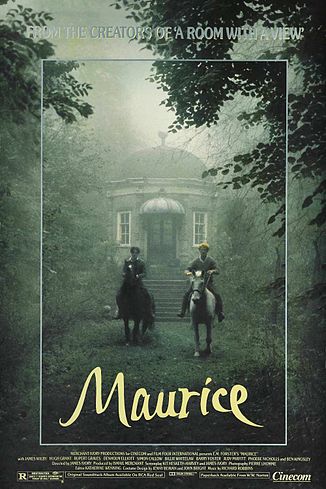
I’m not usually a fan of period pieces, especially those set in Victorian or Edwardian England. Somehow, they tend to be stuffy, grandiloquent affairs that warrant a great big yawn — and they turn me off. James Ivory’s adaptation of E.M. Forster’s novel Maurice, however, is an exception.
I caught a 30th anniversary screening, and something crucial struck me: Ivory and cowriter Kit Hesketh-Harvey’s screenplay is downright daring even for the time when Maurice came out (no pun intended). A sort of forbidden romance that one character sees as the love of his life while the other tosses it aside as the folly of youth, I was moved by the frank depiction of gay love as a tender yet treacherous battlefield, no different than any other love — measured by intensity, law, or social construct. For this, Maurice stands way ahead of its time, even today.
Maurice Hall (James Wilby) is essentially Oscar Wilde at Cambridge circa 1910. He makes a move on social climbing classmate Clive Durham (Hugh Grant), who surprisingly welcomes his advances. They can only go so far, though: Clive doesn’t want to jeopradize his social standing, so the two maintain a platonic relationship. This is the key to Maurice, and the thing that makes it monumental: this is a film that attacks appearances.
Time goes by, shit happens, and Maurice ends up with Clive’s gutter cleaner, Alec Scudder (Rupert Graves, who looks like a plebeian Paul Young). This upsets Clive and sends Maurice to therapy. In the end, Maurice makes a choice that so many of us gays have: to be gay, or not to be.
Maurice operates on a strange platitude, one that isn’t clear at first. Maurice is vulnerable, almost stupid. Clive is chilly, reserved, and completely repressed. Both skirt around their issue. I found myself rooting for and actually admiring Maurice, who stays true to himself — class, law, and sexuality be damned. That last look on Clive’s face in the final scene is devastating…for him.
With Denholm Elliott, Simon Callow, Billie Whitelaw, Barry Foster, Judy Parfitt, Phoebe Nicholls, Ben Kingsley, Patrick Godfrey, Mark Tandy, Kitty Aldridge, Helena Michell, Catherine Rabett, Peter Eyre, Helena Bonham Carter
Production: Merchant Ivory Productions, Film Four International
Distribution: Cinecom Pictures (USA), Enterprise Pictures Limited (UK), Concorde Film (Netherlands), Cohen Media Group (USA)
“Why did you go to the police? Why didn’t you come to me first? What have I ever done to make you treat me so disrespectfully?”
—Don Vito Corleone
“My father is no different than any powerful man, any man with power. Like a president or a senator.”
—Michael Corleone
“And may their first child be a masculine child.”
—Luca Brasi
“Hey Mikey, why don’cha tell that nice girl you love her? ‘I love you with all a-my heart. If I don’t a-see you again a-soon, I’m a-gonna die!'”
“Leave the gun. Take the cannoli.”
—Peter Clemenza
Pretty much perfect, The Godfather was almost a different movie. Based on Mario Puzo’s insanely popular best selling 1969 novel, studio executives conceived a pulp gangster drama for its film adaptation. Good thing they wanted a “real” Italian-American to direct so it would be so authentic that moviegoers would “smell the spaghetti” (https://www.vanityfair.com/news/2009/03/godfather200903). Several unsuccessful attempts were made to attract a director, including Warren Beatty. Paramount “settled for” unknown Francis Ford Coppola, who took it somewhere else.
The Godfather is universally held in high esteem as one of the greatest films of all time—as it should be. It’s a a movie showered in superlatives—like the bullets that shower, well, most of the characters. It’s impeccable. We caught an anniversary screening.
Coppola’s morality play is a masterpiece, more complex than it seems at first and full of contrast and contradiction. A solemn and ominous mob drama that centers on Don Vito Corleone (Marlon Brando) and his family business, The Godfather boasts one riveting career-defining performance after another—Brando, Al Pacino, James Caan, Richard Castellano, Robert Duvall, and Abe Vigoda, to name a few. The characters are great, and the dialogue—perfect! Not a single second is wasted here, not even that long ass wedding scene.
The observations about human nature are astute, and the spin on assimilation and the American Dream is clever. The dramatic arc involving the descent of younger son Michael (Pacino) into a moral apocalypse is something you can’t shift your eyes away from. Black as its promotional poster, The Godfather leaves so much to chew on. This is what cinema is all about.
With Sterling Hayden, John Marley, Richard Conte, Al Lettieri, Diane Keaton, Talia Shire, Gianni Russo, John Cazale, Rudy Bond, Al Martino , Morgana King, Lenny Montana, John Martino, Salvatore Corsitto, Richard Bright, Alex Rocco, Tony Giorgio, Vito Scotti, Tere Livrano, Victor Rendina, Jeannie Linero, Julie Gregg, Ardell Sheridan, Simonetta Stefanelli, Angelo Infanti, Corrado Gaipa, Franco Citti, Saro Urzì, Sofia Coppola
“For twenty-three years, I’ve been dying to tell you what I thought of you! And now… well, being a Christian woman, I can’t say it!”
—Auntie Em
“Toto, I’ve a feeling we’re not in Kansas any more.”
—Dorothy
“I’ll get you, my pretty. And your little dog, too!”
—The Wicked With of the West
“Only bad witches are ugly.”
—Glenda
“Why, anybody can have a brain. That’s a very mediocre commodity. Every pusillanimous creature that crawls on the Earth or slinks through slimy seas has a brain.”
“Hearts will never be practical until they can be made unbreakable.”
“You are under the unfortunate impression that just because you run away you have no courage; you’re confusing courage with wisdom.”
—The Wizard of Oz
Growing up when I did, The Wizard of Oz aired on TV every year, and only once a year. It was a special event. I distinctly remember it being on Thanksgiving, but digging around online contradicts me—while some sources back me up, others say Easter, February, and even Christmas. Whatever. I’ve seen it so many times, I know it by heart. So do many people. Like Willy Wonka and the Chocolate Factory (https://moviebloke.com/2016/03/26/willy-wonka-and-the-chocolate-factory/ ), The Wizard of Oz is a celluloid relic from my childhood that still stirs something in me.
This annual tradition stopped sometime in the ’90s, probably because home video and cable allowed one to see it anytime. So, I was downright thrilled to see a screening near me over a different holiday weekend this year: Memorial Day. I’ve only seen this film on the big screen once or maybe twice before, so I couldn’t resist.
This is where I usually launch into the story, where I might get into some of the details of Dorothy (Judy Garland) and her weird Technicolor odyssey to the Emerald City after a tornado lifts her, Toto (Terry), and her farmhouse out of Kansas and drops her somewhere over the rainbow in Munchkinland—right on top of the unseen Wicked Witch of the East, whose crazy striped socks and shriveled feet are permanently etched in my memory—provoking the ire of the Wicked Witch of the West (Margaret Hamilton) thanks to a pair of ruby slippers.
Let’s be honest, though: we all know the story. Does anything more need to be said about The Wizard of Oz, which is probably the best known and most seen film, ever? Classic and iconic, it set a cinematic benchmark that hasn’t been surpassed nearly a century on, and probably never will be. Loaded with character, song, color, and cool props, it’s a one of a kind spectacle. Its magic continues to inspire.
Harold Rosson’s cinematography is top notch. Seeing it today, I was wowed by the sepiatone Kansas scenes, which were plain old black and white on TV. I always feel a rush when Dorothy opens the door after she crashes, but seeing Munchkinland on the big screen is so much more awesome. So is that scene in the poppy field, and so is the Emerald City with its otherworldy green glow—like paranormal depression glass. Marvelous!
“The Fault…is Not in Our Stars,
But in Ourselves…”
—William Shakespeare
I’ve read enough online rankings of Alfred Hitchcock’s films to know that Spellbound often ends up in his top 20 or 30—sometimes higher than that—thank you. While certainly impressive considering the number of films he directed (https://en.wikipedia.org/wiki/Alfred_Hitchcock_filmography), I found Spellbound lackluster, comparatively speaking.
It’s not that I didn’t enjoy it. In the grand scheme of all things cinema, Spellbound is a solid work—it’s just not a great Hitchcock film. Ingrid Bergman is psychoanalyst Constance Petersen, the only female doctor at Green Manors, a mental hospital in Vermont. Her male colleagues see her as detached and cold, which doesn’t bode well for her career—particularly for a woman in the 1940s.
The hospital’s director, Dr. Murchison (Leo G. Carroll), is “retiring.” His replacement is young and handsome Dr. Anthony Edwardes (a young Gregory Peck), who catches Dr. Petersen off guard. Truth be told, she’s smitten—and who can blame her? Gregory Peck is gorgeous here. Anyway, Dr. Edwardes has a secret that becomes apparent: he’s not who he says he is. He’s actually John Ballantyne, a.k.a. John Brown, a dude with amnesia who says he killed the real Dr. Edwardes and assumed his identity. Dr. Petersen doesn’t believe him, and she sets out to find the real murderer—through psychoanalysis. It all leads to a fateful ski trip that comes full circle to Green Manors. Gasp!
Angus MacPhail and Ben Hecht based their screenplay on the 1928 novel The House of Dr. Edwardes by John Palmer and Hilary A. Saunders (as Francis Beeding). Clearly obsessed with Sigmund Freud, the story is clunky but cute and oddly entertaining even if it’s kind of stupid. Two things stick out in my mind about this film: one is Salvador Dalí’s cool dream sequence complete with random objects like big bleary eyes, scissors, a faceless figure, and wings; and that final scene where a gun is fired into the camera—I won’t ruin it, but it literally ends Spellbound with a bloody bang. Fucking awesome!
The nitrate print used for this screening was gorgeous, shimmering with rich blacks and luminescent whites. It impressed me. Miklòs Ròzsa’s grand, sweeping score is fierce—no wonder he won an Oscar for it (https://www.oscars.org/oscars/ceremonies/1946).
One extremely personal but annoying detail: the Siouxsie and the Banshees song “Spellbound” played in the back of my mind the entire time I watched this film. Yeah, I’m hearing voices, I guess…but it could be much worse (I’m talking to you, Paula Abdul).
With Michael Chekhov, Rhonda Fleming, John Emery, Steven Geray, Paul Harvey, Donald Curtis, Norman Lloyd, Bill Goodwin, Wallace Ford, Art Baker, Regis Toomey
Production: Selznick International Pictures, Vanguard Films
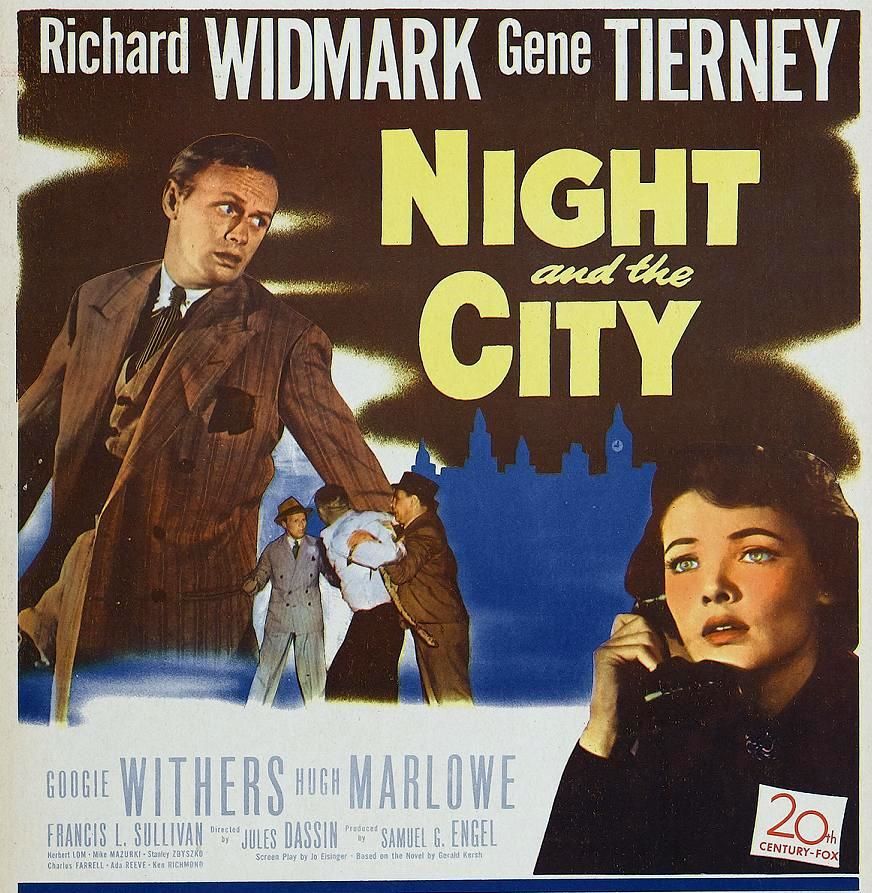
Jules Dassin’s Night and the City is a fine example of classic film noir. Filmed in smoky black and white mostly at nighttime on location in London, Dassin takes us slumming through the seedy underworld of nightlife, wrestling, and organized crime.
Harry Fabian (Richard Widmark) is a hard-bitten, ambitious, streetwise American con artist living in London. Always on the lookout for a quick buck, he can’t seem to catch a break. Ever. Literally running for his life in the opening scene, his latest career endeavor has failed, and his girl, Mary (Gene Tierney), is losing faith in him—stealing from her will do that.
Things brighten one night after a failed hustle at a wrestling match: Harry crosses paths with famous retired Greek wrestler Gregorius the Great (real life professional wrestler Stanislaus Zbyszko) and his prodigy, Nikolas of Athens (Ken Richmond), who both walk out of the arena in a huff. Gregorius is furious with his son, Kristo (Herbert Lom), who organized the fight, a low-end sort of WWE-like affair that he finds tacky.
Harry schmoozes Gregorius and learns that Kristo is a mobster who controls wrestling in all of London. He devises a plan to create a promotion startup, aligning himself with Gregorius to get around Kristo. He secures funding by double dealing with Phil Nosseross (Francis L. Sullivan), the owner of the Silver Fox Club where Mary works, and Phil’s wife, Helen (Googie Withers). She has plans of her own she doesn’t want Phil to know about.
The whole thing looks like it’s actually going to work despite Kristo’s threats, a plot to murder Harry, and Phil pulling his backing from the project. Harry gets so far as setting up a real fight between Nikolas and the Strangler (Mike Mazurki, also a real life professional wrestler). A miscalculation unravels everything—not just for him but everyone involved.
Jo Eisinger’s screenplay, based on Gerald Kersh’s novel Night and the City with contributions from Austin Dempster and William E. Watts, involves morally bankrupt lowlife characters who lack any redeeming qualities. All of them are scamming for one thing or another, and none of them—except maybe Mary—evokes any sympathy. This plays out nicely with the motifs of money, masculinity, and blind ambition that give this story its dark and bitter hue. It’s suspenseful. Ultimately, evil prevails in this dirty little story, which had to be revolutionary if jarring when this came out.
The backstory here is as interesting as the plot: during the production of Night and the City, Dassin was blacklisted for being a Communist. Pushed into exile, he infuses a strong sense of betrayal and fear into this film (https://en.wikipedia.org/wiki/Jules_Dassin).
Night and the City is desperate, chilly, and magnificently bleak—and it looks it thanks to Mutz Greenbaum’s shadowy and dramatic cinematography. Of the nitrate prints that screened this year, this was a standout. According to the festival program, this pre-release print is ten minutes longer than the UK version and 15 minutes longer than the US version.
With Hugh Marlowe, Ada Reeve, Charles Farrell, Edward Chapman, Betty Shale
I confess, I rolled my eyes when I found out that a print of Phantom of the Opera was chosen for a screening at the Nitrate Picture Show. I was totally unenthusiastic about seeing yet another version of something I’ve already seen more times than I care to admit. The trailer calls it “[a] story the world can never forget,” but that’s only because Gaston Leroux’s damned story won’t go away.
As it turns out, I quite enjoyed Arthur Lubin’s version. He switches gears with Eric Taylor and Samuel Hoffenstein’s screenplay, ditching horror in favor of romance and melodrama. In the process, he brings a really nice camp factor to the whole thing—I didn’t expect that. His version is a sillier, more fun soapy affair than what I’m used to.
Claude Rains is sympathetic as Erique Claudin, the downsized middle-aged composer who becomes the masked phantom after his publisher (Miles Mander) “steals” his new composition. One of my favorite moments of the entire film is the publisher’s exasperated secretary (Renee Carson) throwing acid from a baking pan in Claudin’s face. It’s so bizarre, it’s actually funny. Even with his acid face, Claudin has a crazy plan for making beautiful young soprano Christine Dubois (Susanna Foster) a star, even if she’ll never return his love. Her female rivalry with diva Biancarolli (Jane Farrar) stews while Anatole (Nelson Eddy), the baritone knight in shining armor, combs the Paris Opera House for the malformed monster (that would be Claudin) who murders anyone in his way. Things get dicier the closer Anatole gets to Claudin.
Phantom of the Opera is a treat for the senses, which makes it perfect for a nitrate print. A rich Technicolor dream, it won Oscars for cinematography (W. Howard Greene and Hal Mohr) and art direction (John B. Goodman, Alexander Golitzen, Russell A. Gausman, and Ira S. Webb) (https://www.oscars.org/oscars/ceremonies/1944). Edward Ward’s score is lovely.
With Edgar Barrier, Leo Carrillo, J. Edward Bromberg, Fritz Feld, Frank Puglia, Steven Geray, Barbara Everest, Hume Cronyn, Elvira Curci, Kate Lawson
Production: Universal Pictures
Distribution: Universal Pictures (USA), General Film Distributors (GFD) (UK), Motion Picture Export Association (MPEA) (Netherlands), Realart Pictures Inc. (USA), Universal Filmverleih (West Germany)
Based on the novel Sirená by Marie Majerová, a communist and feminist Czech author prolific before World War II (https://en.wikipedia.org/wiki/Marie_Majerová), Karel Steklý’s The Strike follows the Hudcový family during a mine workers’ strike outside Prague in the late 19th Century. Hudec (Ladislav Boháč) is a sort of foreman at a mine. His job makes him miserable, which is apparent from his drinking. He finds himself caught between the mine’s owner and the discontented, sorely underpaid workers that include his son Rudolf (Oleg Reif). Hudec tries to straddle the line between the two but ultimately joins the workers when pushed by his determined wife, Hudcová (Marie Vásová), who seems like she’s always hungry. The cost is devastating, especially for their preteen daughter Emča (Pavla Sucha).
Though not as elegant, The Strike recalls Metropolis (https://moviebloke.com/2015/09/12/metropolis/) both thematically and visually. Jaroslav Tuzar’s stark and grimy cinematography nicely highlights the plight of the workers, and it looks great in black and white. Nothing here is nuanced, though: the narrative is coarse and blunt, the acting is total amateur hour, and the moral is in-your-face. Still, The Strike is remarkable for its earnestness; the workers plotting a revolt, their riot, and the town police and corrupt mayor (Josef Benátský) standing behind the mine over the workers certainly all ring true and timely. It kept my interest all the way through.
I never heard of Steklý or The Strike or anyone involved with this picture until I saw it 70 years after its release. I’m not sure it ever enjoyed international distribution—I can’t find a trailer for it—and I can guess why: a dour postwar propaganda film, it likely would have turned off audiences with its Reefer Madness-like approach to capitalism and communism that seems to argue for the latter. Viewing it today, I saw it as an eerily accidental warning of what happens when the middle class disappears.
With Josef Bek, Josef Dekoj, Nadezda Gajerová, Vera Kalendová Bedrich Karen, Lída Matousková
I never saw Wild at Heart until now. Some of the points raised by its detractors are valid, but I still liked it for the same things that made them hate it. Erratic, vulgar, and really sweet, it’s offputting yet compelling and—surprise!—it has a happy ending.
An atypically straightforward narrative for a Lynch project, Wild at Heart is a decidedly deranged, bloody road movie/romance/thriller based on Barry Gifford’s novel of the same name. Upon his release from a North Carolina prison after serving time for murder—never mind that it was self-defense—Sailor Ripley (Nicolas Cage) exits the jailhouse to find his lover, Lula Pace Fortune (Laura Dern), waiting for him outside in the sunlight with his snakeskin jacket, the symbol of his individuality and his belief in personal freedom. They spend some time catching up in a motel room and at a speedmetal concert before they decide to blow off his parole and take off for California.
Meanwhile, Lula’s mother, Southern lady Marietta (Diane Ladd), is making plans of her own—and they involve her private detective boyfriend (Harry Dean Stanton) and a hit man (J. E. Freeman) who’s got Sailor as his target. A bad omen detours the starcrossed lovers to Big Tuna, Texas, where they unwittingly plant themselves smack in the middle of a bad situation that looks to be turning deadly fast.
OK, I’ve seen versions of this same story before. The plot is familiar and for the most part implausible—not to mention really, really thin at times. Lynch goes overboard with his depiction of sex, violence, and gore—even though they all have a place here. None of this matters, though, because the characters, which are both the focus and the strength of the film, are fantastic.
As usual, the casting is stellar. Cage is at his best here, working that edgy deadpan earnest manic thing he did so well in his early films. Dern is flawless as a sweet Southern girl who’s found her place with bad boy Sailor, everyone else be damned. Willem Dafoe is super creepy as hayseed bad guy Bobby Peru—those teeth! Above them all, however, is Ladd, who’s fucking fabulous even with her face covered in red lipstick. She’s vengeful at times, remorseful at others; but all the while, a perfect lady. She shines here. There’s a reason she was nominated for an Oscar for her performance (https://www.oscars.org/oscars/ceremonies/1991). This film works because the actors give it their all.
Wild at Heart is loaded with Lynch’s trademark what-the-fuck weirdness—a man at a bar quacking like a duck (you read that correctly) and cousin “Jingle Dell” (Crispin Glover) sitting on the floor in the bathroom screaming for Christmas or standing at the counter in the dark making a hundred sandwiches for lunch are bizarre moments even by Lynchian standards. There’s a lot more to it, though. I love the theme of finding a happy place in the midst of horrible things happening. I love all the references to various staples of Americana—cowboys, cars, highways, Elvis Presley, and my favorite, The Wizard of Oz. I love that underneath it all is a touching love story that we can all relate to.
What I find most interesting, though, is that so many things about Wild at Heart scream Quentin Tarantino, yet he had nothing to do with it. In fact, it came out two years before Tarantino’s first major film, Reservoir Dogs. I never thought of David Lynch as an influence on him, but Wild at Heart makes me wonder.
Side note: Wild at Heart is a rated R movie. For the screening I attended, however, I was lucky enough to catch an unreleased rated X version. The X rating was no doubt due to the graphic violence—it wasn’t the sex scenes. The print was in bad shape, all scratchy and beat up, but it was totally worth it to see an X-rated Lynch film.
With W. Morgan Sheppard, Grace Zabriskie, Isabella Rossellini, Sherilyn Fenn, Sheryl Lee
Production: PolyGram Filmed Entertainment, Propaganda Films
Distribution: Manifesto Film Sales, The Samuel Goldwyn Company (USA), Palace Pictures (UK), Bac Films (France), Cineplex Odeon Films (Canada), Finnkino (Finland), Hoyts Distribution (Australia), Háskólabíó (Iceland), Meteor Film Productions (Netherlands), Sandrew Film & Teater (Sweden), Solopan (Poland)






 moviebloke