They Live

(USA 1988)

“I’ve come here to chew bubblegum and kick ass…and I’m all out of bubblegum.”

“I’m giving you the choice: either put on these glasses or eat that trashcan.”

“Brother, life’s a bitch. And she’s back in heat.”

— Nada

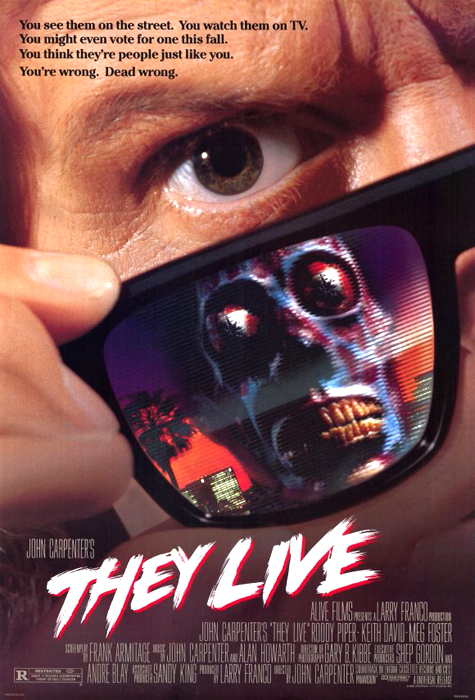
Director John Carpenter has done a few good pictures that probably will have an audience long after he’s gone; They Live isn’t one of them. At least, not in a good way. B-movie cult fodder all the way, They Live is a somewhat delayed and really heavy-handed reaction to ’80s conspicuous consumption. Based on Ray Nelson’s 1963 short story “Eight O’Clock in the Morning” and subsequent comic strip, Carpenter’s screenplay, written under the pseudonym Frank Armitage, is founded on a decent premise; it just doesn’t go where it could have.

Nada (Roddy Piper), a migrant construction worker who’s seen better days, picks up a job in downtown Los Angeles. He notices some weirdness going on with a television station that seems to be connected to a church across the lot where he and other homeless people have set up camp. His coworker Frank (Keith David) doesn’t want to hear about it. No one does.

One morning, Nada comes into possession of a pair of sunglasses. When he puts them on, he sees subliminal messages everywhere. A billboard with the tagline “We’re creating the transparent computing environment” says “Obey” with the glasses on. A travel ad beckoning, “Come to the Caribbean” says “Marry and reproduce.” “Men’s apparel” says “No independent thought.” Signs all around him order one to consume, conform, buy, watch TV, submit, sleep, do not question authority:

They Live Obey.jpg

Even the dollar bill has a different message: “This is your god.”

What’s worse, some people are not what they appear to be. At all. They aren’t even human — they’re skeletal reptiles, a kind of mutant species of Sleestaks or something:
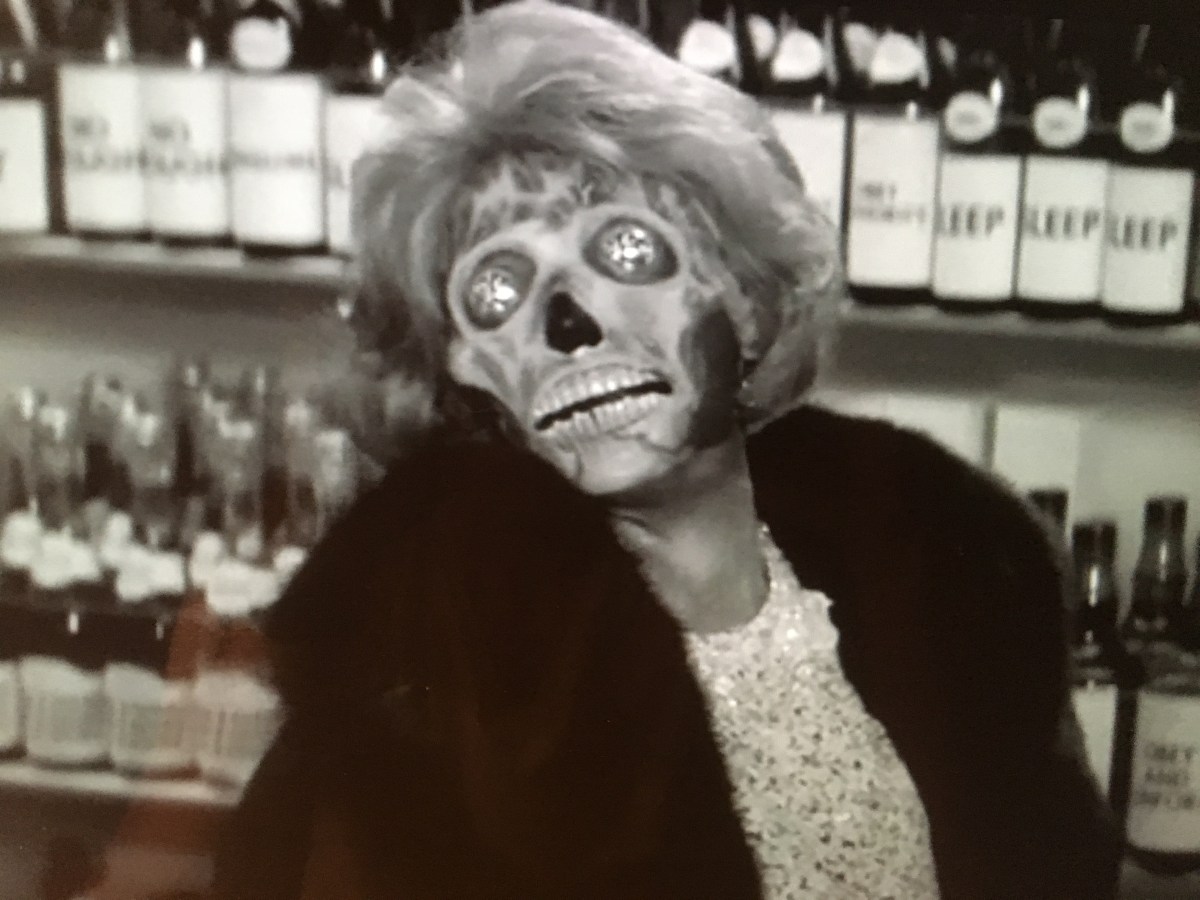
They Live.JPG

What the hell is going on? Who are these things? What do they want? As Nada tells Frank, they ain’t from Cleveland.

I remember seeing They Live at the theater when it was new. It was okay. Three decades later, it’s still okay. It’s a lot sillier this time around, though. The whole thing gets off to a good enough start, but the momentum peters out just before midpoint. Carpenter — or anyone, for that matter — can get only so much mileage out of this story. They Live feels like 40 minutes of material stretched into more than twice that amount of time.

The denouement is not just predictable but anticlimactic, and the perspective here is adolescent at best. The lines are cringeworthy, falling painfully short of the Arnold Schwarzenegger zingers they aim to be. The acting is pretty bad, especially David and Meg Foster, both of whom are as stiff and lifeless as a dead gerbil. Surprisingly, Piper and his mullet are the best thing about They Live; Piper isn’t enough to carry it, though. And that wrestling scene in the alley is inane — misplaced, unnecessary, and too long, it adds nothing except maybe ten minutes to the running time.

The worst thing about They Live is that it seems Carpenter was serious — nothing here reads as tongue in cheek to me.

With George “Buck” Flower, Peter Jason, Raymond St. Jacques, Jason Robards III, Lucille Meredith, Norman Alden, Norm Wilson, Thelma Lee, Rezza Shan

Production: Alive Films, Larry Franco Productions

Distribution: Universal Pictures

94 minutes
Rated R

(iTunes rental) D+

http://www.theofficialjohncarpenter.com/they-live/

Kill, Baby…Kill! [Operation Fear] [Operazione paura]

(Italy 1966)

“Something in this town is supernatural. Tell me, why did they abandon the church? I’m scared. I almost think the devil’s here.”

— Monica

The second offering of a Mario Bava weekend double feature, Kill, Baby…Kill! is one of the director’s more commercially successful films. Many commentators have pointed out its influence on the horror genre and praised Bava’s gothic sensibilities, visuals, and use of irony. All good, I agree. Still, none of these things means Kill, Baby…Kill! is a great — or even a good — film.

In the early 20th Century, a coroner, Dr. Paul Eswai (Giacomo Rossi-Stuart), is en route to a remote village in Transylvania to perform an autopsy on a woman who died under mysterious circumstances. In a church — an abandoned one, no less, no doubt to provide a metaphor. The carriage driver, warning that this place is messed up, will only go to the edge of the village, not inside it.

Dr. Eswai finds the police inspector (Piero Lulli) at a local inn, where he is given instructions. When none of the superstitious and rather wan locals volunteer to help him with the autopsy, Monica Shuftan (Erika Blanc), a nurse of some sort who grew up there and just happens to be visiting the graves of her parents, steps up to assist.

During the autopsy, Dr. Eswai is puzzled to find a silver coin stuck in the woman’s heart. It’s a practice to thwart a local ghost that visits villagers in their sleep and puts a hex on them, making them commit suicide in ghastly ways — like jumping from heights and impaling themselves on iron posts.

Dr. Eswai runs into a creepy young thing in a white dress. He soon learns she’s the ghost of seven-year-old Melissa Graps (Valerio Valeri), who died 20 years before. She’s the little bugger who’s been freaking out everyone in the village for the last two decades. The doctor and Monica sense a spark, but first they must deal with this Melissa situation.

Romano Migliorini, Roberto Natale, and Bava all contributed to the screenplay. The story is unoriginal and silly, complete with cringeworthy dialogue and an actual sorceress (Fabienne Dalì). There’s an odd dub thing going on, too.

This being a Bava picture, though, Kill, Baby…Kill! works on primal instinct, here fear. Plus, it has its share of arresting visuals. The colors are vivid, though the palette is heavy on brown and green. The sets have a grimy, dilapidated medieval appearance to them, giving the look of a ghost story. There’s a cool scene where Dr. Eswai chases after Monica through a series of doors that keep taking him back to the same rooms — it’s delightfully dizzying.

Overall, Kill, Baby…Kill! is okay. It’s got Bava’s unique fingerprint all over it, and it’s fun to watch. It’s just not spectacular. Blood and Black Lace grabbed me; this did not, at least not for long. I hate the title — they should’ve kept Operation Fear.

With Luciano Catenacci (Max Lawrence), Micaela Esdra, Franca Dominici, Giuseppe Addobbati, Mirella Pamphili, Giana Vivaldi

Production: F.U.L. Films

Distribution: Internazionale Nembo, Distribuzione Importazione, Esportazione Film, Alpha (Germany), Europix Consolidated Corp. (USA), Astral Films (Canada), Metro-Goldwyn-Mayer

85 minutes
Rated PG

(Gene Siskel Film Center) C

The Strike [Siréna]

(Czechoslovakia 1947)

Based on the novel Sirená by Marie Majerová, a communist and feminist Czech author prolific before World War II (https://en.wikipedia.org/wiki/Marie_Majerová), Karel Steklý’s The Strike follows the Hudcový family during a mine workers’ strike outside Prague in the late 19th Century. Hudec (Ladislav Boháč) is a sort of foreman at a mine. His job makes him miserable, which is apparent from his drinking. He finds himself caught between the mine’s owner and the discontented, sorely underpaid workers that include his son Rudolf (Oleg Reif). Hudec tries to straddle the line between the two but ultimately joins the workers when pushed by his determined wife, Hudcová (Marie Vásová), who seems like she’s always hungry. The cost is devastating, especially for their preteen daughter Emča (Pavla Sucha).

Though not as elegant, The Strike recalls Metropolis (https://moviebloke.com/2015/09/12/metropolis/) both thematically and visually. Jaroslav Tuzar’s stark and grimy cinematography nicely highlights the plight of the workers, and it looks great in black and white. Nothing here is nuanced, though: the narrative is coarse and blunt, the acting is total amateur hour, and the moral is in-your-face. Still, The Strike is remarkable for its earnestness; the workers plotting a revolt, their riot, and the town police and corrupt mayor (Josef Benátský) standing behind the mine over the workers certainly all ring true and timely. It kept my interest all the way through.

I never heard of Steklý or The Strike or anyone involved with this picture until I saw it 70 years after its release. I’m not sure it ever enjoyed international distribution—I can’t find a trailer for it—and I can guess why: a dour postwar propaganda film, it likely would have turned off audiences with its Reefer Madness-like approach to capitalism and communism that seems to argue for the latter. Viewing it today, I saw it as an eerily accidental warning of what happens when the middle class disappears.

With Josef Bek, Josef Dekoj, Nadezda Gajerová, Vera Kalendová Bedrich Karen, Lída Matousková

Production: Ceskoslovenský Státní Film

Distribution:

77 minutes
Not rated

(Dryden Theatre) C

Nitrate Picture Show

Lost Highway

(USA 1997)

I watched David Lynch’s Lost Highway on my iPad on an Amtrak train from Chicago to Rochester. The one thing I strongly recommend is that it be viewed on the big screen, or at the very least on a flatscreen television. Quite simply, the visuals here are far too beautiful to see in an abridged format. And frankly, the visuals—sets, colors, costumes, actors, props—are the best part of the film.

The second thing I recommend is that it be watched under the influence of something—booze, pot, or better yet, prescription drugs.

This begs a question I’ll just answer: Lost Highway is fucked up—thrillingly so. The whole things starts with a videotape of our unlucky hero, saxophonist Fred Madison (Bill Pullman), murdering his wife (Patricia Arquette), who in an alternate universe is having an affair with Madison’s younger alterego, Pete Dayton (Balthazar Getty). The married couple has no memory of this murder. Neither party seems aware of this wrinkle in time and space, either. The connection lies with two people: demanding gangster Mr. Eddy (Robert Loggia) and creepy-ass flour-faced Robert Blake in what must be his most frightening role as The Mystery Man, a pallid ghost straight from a silent movie or a video by The Cure.

Lost Highway isn’t my favorite David Lynch film. However, it’s intriguing and vague enough to keep me thinking about it. I’m not sure what to make of this one—but I’m also not sure I care enough to do the work to figure it out. Maybe someday, definitely not today. The star cameos are enough for now.

Interesting fact: Lost Highway features the final film performances of Blake, Jack Nance, and Richard Pryor. Who knew?

With Alice Wakefield, John Roselius, Lou Eppolito, Henry Rollins, Mink Stole, Gary Busey, Lucy Butler, Giovanni Ribisi, Marilyn Manson, David Lynch

Production: October Films, CiBy 2000, Asymmetrical Productions, Lost Highway Productions LLC

Distribution: October Films (USA), Polygram Filmed Entertainment (UK), Rialto Film AG (Switzerland), RCV Film Distribution, Cinemussy (Spain), Senator Film (Germany), Atalanta Filmes (Portugal), Edko Films (Hong Kong), NTV-PROFIT (Russia), Artistas Argentinos Asociados (AAA) (Argentina), AmaFilms (Greece), New Star (Greece), Sandrew Film (Sweden), United International Pictures (UIP) (Australia), Warner Brothers (Finland)

134 minutes
Rated R

(iTunes rental) C+

http://www.davidlynch.de

https://youtu.be/1nKjO9QCSic

Eraserhead

(USA 1977)

I learned of David Lynch’s Eraserhead, his first feature length film, during my freshman year in college (thank you, U.D.). Somehow, seeing it escaped me until it screened at a recent Lynch retrospective.

The basic premise is easy to follow: Henry Spencer (John Nance, later Jack) is a schlubby factory worker who learns he fathered a mutant baby out of wedlock. At the insistence of her mother (Jeanne Bates), his freaked out girlfriend, Mary (Charlotte Stewart), moves into Henry’s tiny one-room apartment with the baby, who looks like a diseased E.T. wrapped in gauze. The baby cries constantly, driving Mary out of the apartment and leaving Henry to care for it. His neighbor, Beautiful Girl Across the Hall (Judith Anna Roberts), serves as an ever-increasing temptation and torment.

Really, it’s not the plot but Lynch’s presentation that makes Eraserhead unique. To be clear, it’s not his best film—not even close. It isn’t exactly representative of his work, either. Still, it’s interesting to see his trademarks in their infancy: a horrific and surreal atmosphere, bizarre imagery that here includes lots of spermatozoan objects and seemingly random scenes, spooky characters like the Lady in the Radiator (Laurel Near), and of course Lynch’s dry and twisted wit. The sets and costumes are assembled with early 20th Century industrial junk. The soundtrack is essentially white noise in the background. Frederick Elmes and Herbert Cardwell’s cinematography is rich and textured, using black and white to create a look and mood that resembles a silent film. Their camerawork sets up a sense of claustrophobia that lingers for the duration of the film.

Like most of Lynch’s work, Eraserhead is open to interpretation. In simplest terms, it’s a horror story about the demands of the family on the individual, from small talk and dinners with in-laws to appeasing a partner to child rearing to straying from the family unit. In the tradition of great American playwrights like Eugene O’Neill, Tennessee Williams, Arthur Miller, Edward Albee, and August Wilson, Lynch focuses on the pains and dysfunction that often make familial burdens difficult to bear.

I didn’t quite grasp everything here—how pencilmaking fits into the big picture, for example. Regardless, Eraserhead is infinitely interesting. I didn’t find it particularly scary, but it definitely leaves an impression—I guess in that sense it’s a haunting tale. It’s a weird and original film. Here’s the weirdest thing about it: I actually felt something emotional for that mutant baby. Go figure.

In 2004, the United States Library of Congress deemed Eraserhead “culturally, historically, or aesthetically significant” and selected it for preservation in the National Film Registry (https://www.loc.gov/programs/national-film-preservation-board/film-registry/complete-national-film-registry-listing/).

With Allen Joseph, Jack Fisk, Jean Lange, Hal Landon Jr., Gill Dennis, Darwin Joston, Jennifer Lynch, Peggy Lynch

Production: American Film Institute (AFI), Libra Films

Distribution: Libra Films International (USA), Creative Exposure (Canada), Mainline Pictures (UK), Toei Yoga and Comstock (Japan), Chapel Distribution and Umbrella Entertainment (Australia), Eye Film Instituut (Netherlands), Potemkine Films (France)

89 minutes
Not rated

(Music Box) B-

David Lynch: A Complete Retrospective

http://www.davidlynch.de/head.html

Inland Empire [A Woman in Trouble]

(USA/France/Poland 2006)

“What the bloody hell is going on?” asks Kingsley Stewart (Jeremy Irons) at one point during Inland Empire, David Lynch’s last (so far) full length feature film. It’s an excellent question, one that no doubt anyone watching this three-hour nightmare has already wondered by this point.

Laura Dern is Nikki Grace, an elegant actress up for the lead in a new film, On High in Blue Tomorrows, due to start shooting very soon. A strange Polish neighbor (Grace Zabriskie) who lives “just up the way” drops by her California mansion one afternoon and casually but ominously brings up a murder in the film. “That’s not part of the story,” Nikki tells her visitor, who insists she’s wrong and throws a tantrum right there in the sitting room, screaming about “brutal fucking murder” and an unpaid bill. Annoyed and visibly freaked out, Nikki has her butler (Ian Abercrombie) remove her.

Nikki gets the part. Some weirdness happens, and the film’s director (Irons) tells Nikki and her rugged costar Devon Berk (Justin Theroux) that the film is supposedly cursed: it’s a sort of remake of an old Polish movie called 47 that was never completed because of a double murder on the set. The actors are upset but they agree to proceed with production despite the producers’ lack of transparency.

Meanwhile, Nikki is falling for Devon. The narrative gets weird here, ping-ponging back and forth between Nikki and Devon and their characters, Susan and Billy, as well as Susan’s husband, Smithy (Peter J. Lucas), who knows something is going on. Billy’s wife (Julia Ormond) proves to be a character of interest of ever increasing importance, bleeding into another seemingly unrelated subplot about Sue Blue (Dern), a rough and caustic Hollywood chick who finds herself pregnant. The problem is, her husband (Lucas) is sterile. And just who are all these hookers hanging out with Sue, smoking and dancing to “The Loco-Motion” in her living room?

Interspersed between all this is yet another triangular subplot set in 1800s Poland: a cheating wife (Karolina Gruszka) learns that her husband (Krzysztof Majchrzak) plans to kill her lover (Lucas). And just to keep thing interesting, Lynch throws in “The Rabbits,” a spooky sitcom about a family of…rabbits. Actually, actors in rabbit suits (one of them has the voice of Naomi Watts). Later, Sue somehow ends up in their living room.

Probably his most indulgent film, Inland Empire is the kind of thing I imagine most people associate with David Lynch: a surreal trip through the subconscious, the imagination, alternate universes, and time that starts out with a discernible plot but disintegrates into seemingly disjointed events, actors playing multiple characters, bizarre and vivid imagery, random upbeat pop songs, and a creepy score by Marek Zebrowski. Flashes of Lynch’s usual sense of humor pop up here and there, but for the most part this is a dark and somber film about betrayal, loss, and karma. Perhaps its strongest aspect is its overriding sense of dread, and the worst thing about is that it’s impossible to tell whether the scary part is coming or has already arrived.

Inland Empire is surely a horror film. I imagine not many people get into it, and most even being turned off. Length and structure—or lack thereof—aside, it’s not an easy film to watch or understand, and frankly I’m not entirely sure I grasp what the whole thing is about. Indeed, different characters say “I don’t understand” over and over, and Devon/Billy tells Grace/Susan a few times that she isn’t making sense. A common thread that ties the multiple plots together eventually emerges, but I get the impression that this is merely a heap of undeveloped ideas Lynch assembled into one big project.

Still, I found myself mesmerized all the way through. The ending, where Sue’s fate plays out over the stars on the Hollywood Walk of Fame, is dowright distressing. In a way, it’s also beautiful. Lynch offers a lot to chew on here; I’ve gone over it multiple times since I saw it. I have my theory of what really transpires in Inland Empire, and someday I’ll watch again with an eye toward backing it up. It won’t be anytime soon, though.

Post script: I had the pleasure of seeing John Waters speak in the afternoon before I caught Inland Empire. Needless to say, it required a major shift in gears.

With Harry Dean Stanton, Diane Ladd , Mary Steenburgen, Terry Crews, William H. Macy, Leon Niemczyk, Nastassja Kinski, Monique Cash, Latrina Bolger, Fulani Bahati, Ashley Calloway, Erynn Dickerson, Jovonie Leonard, Jennifer Locke, Helena Chase, Nae

Production: Absurda, Studio Canal, Fundacja Kultury, Camerimage Festival

Distribution: Ryko (USA), 518 Media (USA), Absurda (USA), Studio Canal (International), Mars Distribution (International)

180 minutes
Rated R

(Music Box) A

David Lynch: A Complete Retrospective

http://www.inlandempirecinema.com

David Lynch

Raw [Grave]

(France/Belgium 2016)

“An animal that has tasted human flesh is not safe.”

—Father

To borrow a phrase from Morrissey, meat is murder, which is a lesson that goody-two-shoes strict vegan Justine (Garance Marillier) learns the hard way when she goes away to join her older sister, Alexia (Ella Rumpf), at veterinary college. Like a lot of young people away from home for the first time, Justine is lost and wants to fit in. She’s she’s got her work cut out for her: she’s nerdy, sheltered, and a total virgin.

Like a lot of other schools, the upperclassmen at this one have a hazing ritual to break in newbies. It’s pretty aggressive. Prompted by her sister, Justine goes along with it without objection—that is, until she’s pushed to eat raw rabbit kidney (never mind the blood splattered all over her and her “fresh meat” first year classmates). Alexia is the one who ultimately cajoles her to eat it; it’s nasty and it makes Justine sick. Not long after, she develops a gross and severely itchy rash brought on from food poisoning.

Soon, Justine finds herself craving meat. Her impulses are irresistible. First, she eats raw chicken. Then her own hair. Eventually, she works up to human flesh—after developing a fetish for car crashes, of course. As she gives in to her carnivorous urges, her lust for her cute and easygoing gay roommate, Adrien (Rabah Naït Oufella), gets stronger—and Alexia appears to be turning into a greater and greater adversary.

Screenwriter/director Julia Ducournau has a lot on her mind here: peer pressure, body image, sexuality, sibling rivalry, the food we eat. She’s gutsy, and for the most part her risks pay off. It’s not the same story, but Raw has something in common with Goat (https://moviebloke.com/2016/09/24/goat/), another histrionic college drama that gets at kids, tribalism, and cruelty. Raw is very Lord of the Flies. Ducournau paces the story well and picks interesting things—a bikini wax, a horse being sedated—to make us squirm.

I love Ducournau’s sense of humor: it’s dry, icky, and sadistic. The indignation of Justine’s parents over a piece of sausage in her mashed potatoes when they’re eating in a cafeteria as the film begins brilliantly sets up what follows. Marillier seems to have some fun with her role, playing Justine as a creepy, awkward junkie who maybe bites off more than she can chew. Rumpf has fun with her role, too, playing Alexia as a Heathers-like mean girl. They do a nice job working the love and the hate in their relationship. Smartly, they’re both restrained, carefully steering clear of camp.

Visually, Raw reminds me a lot of David Cronenberg and David Lynch, but it still has its own unique look and feel. There are a lot well done scenes here—one under Justine’s sheets, another on a campus plaza with a horde of students moving like zombies, and another at a rave in a morgue all stand out in my mind. Cinematographer Ruben Impens uses lots of bright colors that work nicely with all the dim light to make the school look like a nightmare or a drug trip. There’s a definite sense of this not being real.

Raw is bloody and gory, but nothing here made me want to pass out or call an ambulance  (http://www.indiewire.com/2016/09/raw-tiff-2016-toronto-film-festival-pass-out-cannibal-julia-ducournau-1201726575/). I liked it, but I have one beef: I wish it was a little less predictable.

With Laurent Lucas, Joana Preiss, Bouli Lanners, Marion Vernoux, Thomas Mustin, Jean-Louis Sbille

Production: Frakas Productions, Petit Film, Rouge International, Wild Bunch, Canal+, Ciné+, Centre National de la Cinématographie (CNC), La Wallonie, Bruxelles Capitale, Centre du Cinéma et de l’Audiovisuel de la Fédération Wallonie-Bruxelles, Radio Télévision Belge Francophone (RTBF), VOO, BE TV, Arte/Cofinova 12, Torino Film Lab

Distribution: Wild Bunch (France), O’Brother Distribution (Belgium), Focus World (international), Canibal Networks (Mexico), Cinemien (Netherlands), Seven Films (Greece), United International Pictures (UIP) (Singapore), Universal Pictures International (UPI) (UK), Monster Pictures (Australia)

99 Minutes
Rated R

(Music Box) B-

http://focusfeatures.com/raw

http://www.rawthefilm.co.uk

Donnie Darko

(USA 2001)

“Has he ever told you about his friend Frank, the giant bunny rabbit?”

—Dr. Lilian Thurman


“Every living creature on earth dies alone.”

—Grandma Death

Donnie Darko, a period piece set during a time I remember quite well—October 1988, the second full month of my college freshman year and the height of the Bush-Dukakis presidential election—has a great moody soundtrack that includes the likes of Tears for Fears, Joy Division, the Church, Duran Duran, and of course Echo and the Bunnymen. Even if it would have stuck out like a sore thumb, a song more fitting with the theme would have been Cher’s “If I Could Turn Back Time.”

October 2, 1988: troubled and highly medicated loner Donnie Darko (Jake Gyllenhaal), a middle class teen in suburban Middlesex, Virginia, sleepwalks outside of his house and meets Frank (James Duval), a new “friend.” Frank is a guy in a creepy rabbit suit—he looks like he was plucked from the cover of a heavy metal album. Frank tells Donnie that the world is coming to an end—in exactly 28 days, 6 hours, 42 minutes, and 12 seconds.

Thus begins the apocalyptic timewarping adventure of Donnie Darko. After being rudely awakened on a golf course the next morning, Donnie lumbers home in a daze to discover that a jet engine fell from the sky and crashed into his bedroom. His family, obviously already having assumed the worst, is shocked but relieved to see him approaching from the street—except maybe his mother (Mary McDonnell). Federal investigators can’t trace where the engine came from.

At school, a new student, Gretchen (Jena Malone), interrupts Donnie’s English class—taught by the young and snarky Ms. Pomeroy (Drew Barrymore). They’re discussing their reading assignment, Graham Greene’s short story “The Destructors.” Gretchen asks where she should sit, and Ms. Pomeroy directs her “next to the boy you think is the cutest.” Gretchen sits next to Donnie. Duh!

Donnie and Gretchen dig each other, which is a ray of light to his psychiatrist, Dr. Thurman (Katharine Ross). The doctor has been concerned about Donnie’s “hallucinations” of Frank, as well as some of his erratic behavior. Donnie is growing more and more obsessed with a senile elderly neighbor he and his friends nicknamed “Grandma Death” (Patience Cleveland) and a book about time travel. Everything comes to a head at a party Donnie and his sister Elizabeth (Maggie Gyllenhaal) throw while their parents are out of town on Halloween—which is 28 days from where this all started.

Simultaneously funny, foreboding, weird, and utterly thought-provoking, I can see why Donnie Darko has the following it does. Director and screenwriter Richard Kelly comes up with something unlike anything else I’ve ever seen. It’s a winning mix of teen comedy, science fiction, and fantasy. I caught an anniversary screening with my nephew, and this film is as fresh as when I first saw it in 2002. Loaded with indelible imagery, symbolism, ’80s pop cultural references, and clever narrative loopbacks, I find Donnie Darko‘s greatest asset to be its open-ended mystery; what exactly happens is left for the viewer to figure out. A quick Google search pulls up ample musings of the meaning of this film. I’ve seen this a few times, and I’m not sure.

Aside from the plot, the characters and the casting are terrific. Both Gyllenhaals are great, and you can actually see they’re both destined for more. Patrick Swayze is awesome as motivational speaker Jim Cunningham, but Beth Grant takes the cake here as passive-aggressive bitch Kitty Farmer. Oh yeah, this is also Seth Rogen’s first onscreen role—see if you can spot him.

Side note: Frank’s rabbit suit was designed by April Ferry, who went on to work for Game of Thrones (http://ew.com/movies/2017/03/31/donnie-darko-bunny-suit-frank-untold-stories/). I was hoping to catch the director’s cut, but this wasn’t it.

With Holmes Osborne, Daveigh Chase, Noah Wyle, Stuart Stone, Gary Lundy, Alex Greenwald, Jolene Purdy, Ashley Tisdale

Production: Flower Films

Distribution: Pandora Cinema, Newmarket Films

113 minutes
Rated R

(Capitol Theatre) B+

http://archive.hi-res.net/donniedarko/

Wait Until Dark

(USA 1967)

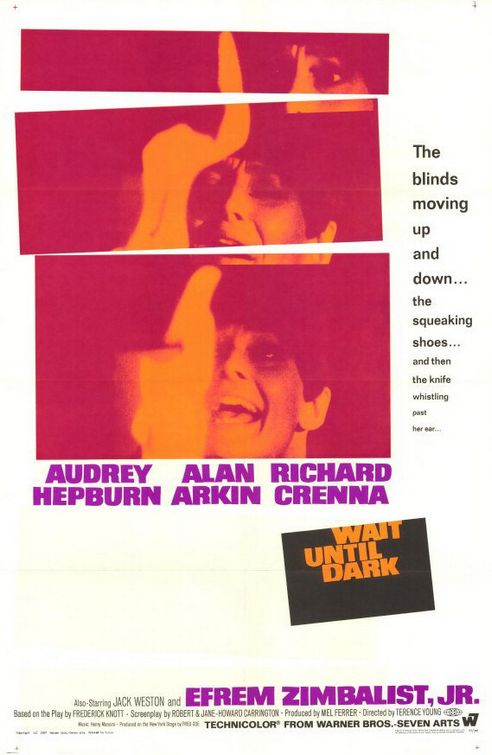
A heroin smuggling ring. A creepy doll. A corpse. A blind woman alone in her basement apartment in the West Village. These are the elements of Wait Until Dark, a quaint and dingy little crime thriller adapted from Frederick Knott’s 1966 play by screenwriters Robert Carrington and Jane-Howard Carrington.

Suzy Hendrix (Audrey Hepburn) is the hapless gudgeon who, being blind, already has the proverbial wool over her eyes. Her husband, Sam (Efrem Zimbalist Jr.), comes home from a business trip with a doll that unbeknownst to him contains a hidden stash of heroin sewn into it. This does not bode well for Lisa (Samantha Jones), the glamorous and sexy stranger who asks him to hold it for her at JFK International Airport.

A case of mistaken identity leads a pair of small time crooks (Richard Crenna and Jack Weston) to Sam and Suzy’s apartment, where psychotic hooligan Harry Roat (Alan Arkin) coerces them into helping him find the doll—as soon as they dispose of a dead body. Nice. They devise an elaborately devious scam to recover the doll when they realize Suzy, who walks in on them, is blind.

Terence Young’s directing is certainly competent. I last saw this movie on some late night UHF station when I was a kid, and two things have stayed with me: a sense of severe claustrophobia as the story unfolds, and that fucking groovy apartment. The plot has flaws that strain credibility. For one thing, Suzy is far too unguarded for a New Yorker. Why doesn’t she lock her door? Roger Ebert pointed out this detail (http://www.rogerebert.com/reviews/wait-until-dark-1968). I didn’t obsess over it like he did, but I noticed it and thought the same thing. When Roat tells her he knows she has the doll, why doesn’t Suzy hand it over? Why does she tell Gloria (Julie Herrod) to meet Sam at the train station instead of going to the police? Why do the guys bother to put on disguises if Suzy can’t see them?

Despite these glaring issues, Young ultimately succeeds in bringing Wait Until Dark to a boil. It lives up to its hype: I saw people jump in their seats at the end. The acting here overcomes any shortcomings in plot. Hepburn is little more than a blind Holly Golightly, but at certain points she reminds me of Barbara Stanwyck screaming that she can’t wake up from a nightmare in, I think, The Night Walker. Weston is a little too bumbling, but Crenna and Arkin are chillingly menacing and foreboding even if they are silly by today’s standards (yeah, sunglasses at night went a long way making Corey Hart look tough). Henry Mancini’s eerie score is the clincher in setting the right mood.

A trivial point of interest: Suzy’s apartment is in the same block of rowhouses as the one used for the Huxtable residence on The Cosby Show (http://www.movie-locations.com/movies/w/Wait_Until_Dark.html#.WRU0W1LMyWY). The small street, St. Luke’s Place, has a bit of literary history, too (http://www.nytimes.com/1996/10/27/realestate/in-a-village-enclave-15-remarkable-rowhouses.html).

With Jean Del Val, Frank O’Brien

Production: Warner Brothers

Distribution: Warner Brothers/Seven Arts

108 minutes
Not rated

(Music Box) B-

Get Out

(USA 2017)

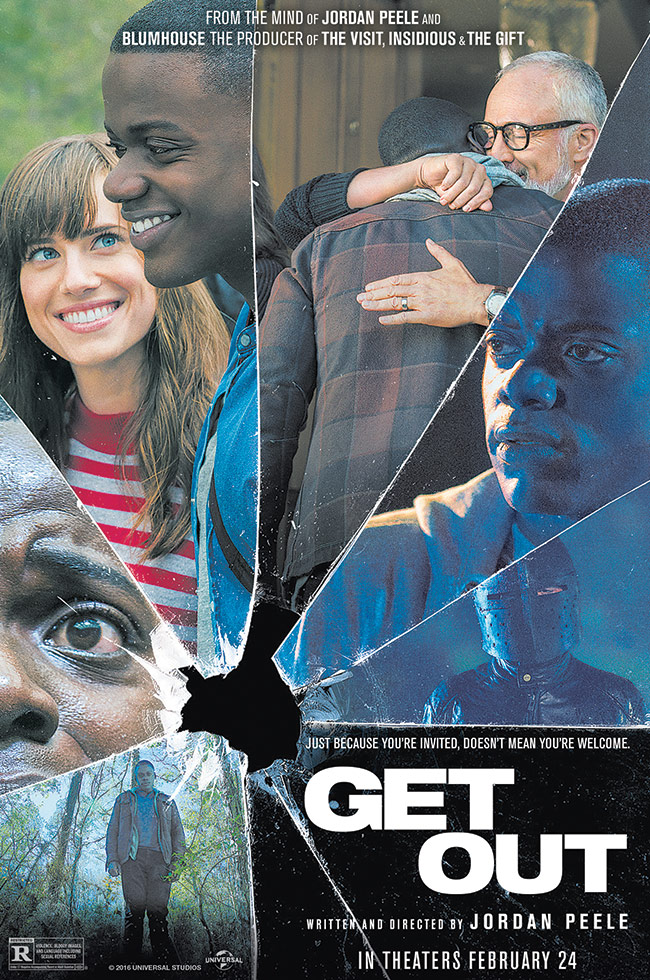
I caught the hype surrounding Jordan Peele’s first feature length film, Get Out, a comedy horror flick that takes on race—specifically, the dynamics of white power and black subordination. He wrote the script and directed the film. I went into Get Out with some doubt and maybe trepidation about how it might come off. The concept is one that seems too easy to go horribly sideways.

I guess if anyone can pull it off, it’s Peele—and I’m relieved to report that he succeeds. With an oddly compelling mix of Guess Who’s Coming To Dinner, Meet the Parents, Nightmare on Elm Street, and The Stepford Wives, he takes on the cultural idiosyncrasies of Caucasian cultural dominance within the constructs of a horror flick. He’s got a lot of points to make, and he gets them across in a sharp but entertaining way. Like the best horror movies, Get Out makes you squirm—but it does so on multiple levels.

New York City photographer Chris (Daniel Kaluuya) is black. His girlfriend, Rose Arlington (Allison Williams), is white. She invites him on a weekend getaway to her parents’ home in upstate New York because, well, it’s time for him to meet the fam. Chris agrees, going into it nervously and not without personal baggage. His hyperactive best bud, Rod (Lil Rel Howery), a TSA agent who always expects the worst, is not helping.

Rose’s parents are, like the quiet town where they live, nice. Or at least welcoming. Dean (Bradley Whitford) drops silly slang, affects a bizarre accent, and praises President Obama. Missy (Catherine Keener) is more direct, asking pointed questions in a weird attempt to get to know Chris. It’s awkward and doesn’t quite break the ice, but it’s harmless. Right?

The family’s two longterm servants, maid Georgina (Betty Gabriel) and gardener Walter (Marcus Henderson), carry themselves like they’ve had lobotomies. Rose’s younger brother, Jeremy (Caleb Landry Jones), is, um, aggressively complimentary to Chris. On top of it, the Armitages’ neighbors are not quite right, obsessed with Chris and his virility.

During the first part of Get Out, Peele keeps things light but lets a sense of creepy unease simmer. The laughs are there, but like all of the characters coming and going from the house, something is off. He makes a major shift in tone once Missy insists on hypnotizing Chris, ostensibly to help him quit smoking. What was innocuous up to now becomes nefarious.

Ultimately, the evil here is not a monster hiding under the bed, but rather something more obvious that exists in broad daylight. I could have done without the bloody finale, but it works in the context of the film; Peele plays with genre, so I see why it’s here. Either way, Get Out is a bold move that pays off.

With Stephen Root, LaKeith Stanfield, Ashley LeConte Campbell, John Wilmot, Caren Larkey, Julie Ann Doan, Rutherford Cravens, Geraldine Singer, Yasuhiko Oyama, Richard Herd, Erika Alexander, Jeronimo Spinx, Ian Casselberry, Trey Burvant, Zailand Adams

Production: Blumhouse Productions, Monkeypaw Productions, QC Entertainment

Distribution: Universal Pictures

104 minutes
Rated R

(ArcLight) B

https://www.uphe.com/movies/get-out

https://youtu.be/A2JbO9lnVLE