Inland Empire [A Woman in Trouble]

(USA/France/Poland 2006)

“What the bloody hell is going on?” asks Kingsley Stewart (Jeremy Irons) at one point during Inland Empire, David Lynch’s last (so far) full length feature film. It’s an excellent question, one that no doubt anyone watching this three-hour nightmare has already wondered by this point.

Laura Dern is Nikki Grace, an elegant actress up for the lead in a new film, On High in Blue Tomorrows, due to start shooting very soon. A strange Polish neighbor (Grace Zabriskie) who lives “just up the way” drops by her California mansion one afternoon and casually but ominously brings up a murder in the film. “That’s not part of the story,” Nikki tells her visitor, who insists she’s wrong and throws a tantrum right there in the sitting room, screaming about “brutal fucking murder” and an unpaid bill. Annoyed and visibly freaked out, Nikki has her butler (Ian Abercrombie) remove her.

Nikki gets the part. Some weirdness happens, and the film’s director (Irons) tells Nikki and her rugged costar Devon Berk (Justin Theroux) that the film is supposedly cursed: it’s a sort of remake of an old Polish movie called 47 that was never completed because of a double murder on the set. The actors are upset but they agree to proceed with production despite the producers’ lack of transparency.

Meanwhile, Nikki is falling for Devon. The narrative gets weird here, ping-ponging back and forth between Nikki and Devon and their characters, Susan and Billy, as well as Susan’s husband, Smithy (Peter J. Lucas), who knows something is going on. Billy’s wife (Julia Ormond) proves to be a character of interest of ever increasing importance, bleeding into another seemingly unrelated subplot about Sue Blue (Dern), a rough and caustic Hollywood chick who finds herself pregnant. The problem is, her husband (Lucas) is sterile. And just who are all these hookers hanging out with Sue, smoking and dancing to “The Loco-Motion” in her living room?

Interspersed between all this is yet another triangular subplot set in 1800s Poland: a cheating wife (Karolina Gruszka) learns that her husband (Krzysztof Majchrzak) plans to kill her lover (Lucas). And just to keep thing interesting, Lynch throws in “The Rabbits,” a spooky sitcom about a family of…rabbits. Actually, actors in rabbit suits (one of them has the voice of Naomi Watts). Later, Sue somehow ends up in their living room.

Probably his most indulgent film, Inland Empire is the kind of thing I imagine most people associate with David Lynch: a surreal trip through the subconscious, the imagination, alternate universes, and time that starts out with a discernible plot but disintegrates into seemingly disjointed events, actors playing multiple characters, bizarre and vivid imagery, random upbeat pop songs, and a creepy score by Marek Zebrowski. Flashes of Lynch’s usual sense of humor pop up here and there, but for the most part this is a dark and somber film about betrayal, loss, and karma. Perhaps its strongest aspect is its overriding sense of dread, and the worst thing about is that it’s impossible to tell whether the scary part is coming or has already arrived.

Inland Empire is surely a horror film. I imagine not many people get into it, and most even being turned off. Length and structure—or lack thereof—aside, it’s not an easy film to watch or understand, and frankly I’m not entirely sure I grasp what the whole thing is about. Indeed, different characters say “I don’t understand” over and over, and Devon/Billy tells Grace/Susan a few times that she isn’t making sense. A common thread that ties the multiple plots together eventually emerges, but I get the impression that this is merely a heap of undeveloped ideas Lynch assembled into one big project.

Still, I found myself mesmerized all the way through. The ending, where Sue’s fate plays out over the stars on the Hollywood Walk of Fame, is dowright distressing. In a way, it’s also beautiful. Lynch offers a lot to chew on here; I’ve gone over it multiple times since I saw it. I have my theory of what really transpires in Inland Empire, and someday I’ll watch again with an eye toward backing it up. It won’t be anytime soon, though.

Post script: I had the pleasure of seeing John Waters speak in the afternoon before I caught Inland Empire. Needless to say, it required a major shift in gears.

With Harry Dean Stanton, Diane Ladd , Mary Steenburgen, Terry Crews, William H. Macy, Leon Niemczyk, Nastassja Kinski, Monique Cash, Latrina Bolger, Fulani Bahati, Ashley Calloway, Erynn Dickerson, Jovonie Leonard, Jennifer Locke, Helena Chase, Nae

Production: Absurda, Studio Canal, Fundacja Kultury, Camerimage Festival

Distribution: Ryko (USA), 518 Media (USA), Absurda (USA), Studio Canal (International), Mars Distribution (International)

180 minutes
Rated R

(Music Box) A

David Lynch: A Complete Retrospective

http://www.inlandempirecinema.com

David Lynch

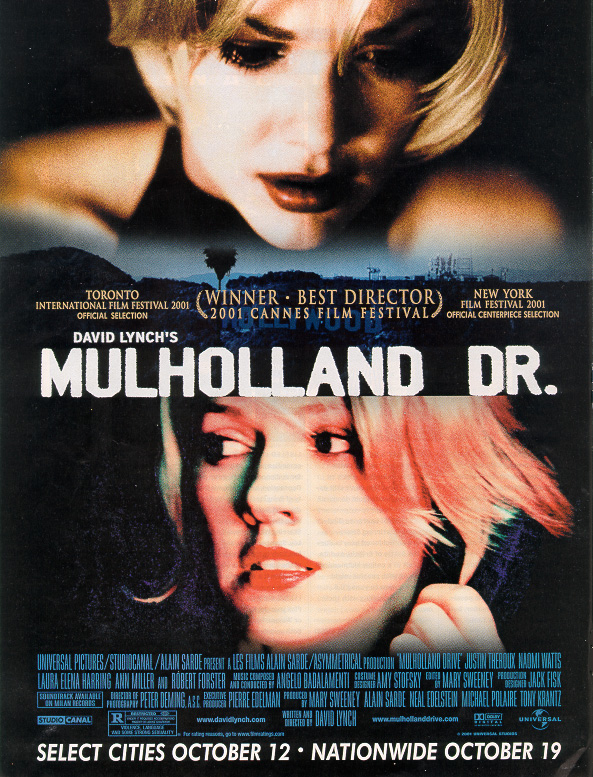
Mulholland Dr.

(USA/France 2001)

“No hay banda, il n’est pas d’orchestra. It is all an illusion.”

—The Magician at Club Silencio

The perfect opener for a retrospective on its director, Mulholland Dr. is an inimitable film that’s really hard to write about. You can look for answers online all you want, but even after seeing it multiple times you still don’t know what happens in it.

Not unless you’re David Lynch. That doesn’t make it any less enjoyable, though.

I’ve seen Mulholland Dr. maybe three times, and I’m not sure. I have my theories. Maybe they’re right, maybe not. Who cares? As with any of Lynch’s best films, the draw to Mulholland Dr. is that it’s a puzzle. He makes you work to solve it, or at least try to. He gives you just enough to go on but leaves the whole thing open to interpretation. At points, he gets you so frustrated, you lose patience and you hate him. But you don’t want him to stop. It’s artistic sadomasochism.

What began as a project for television is a mystery mindfuck tailored to the big screen. Dreamlike, hypnotic, and erotic, Mulholland Dr. is visually demanding and aesthetically worth every minute. The premise is deceptively simple: perky and wide-eyed blond actress Betty (Naomi Watts) arrives in Hollywood and bumps into beautiful young brunette Rita (Laura Harring), who can’t remember who she is after a car accident on Mulholland Drive.

As the two set out looking for clues to Rita’s identity, Lynch throws in a bunch of random characters, muddled subplots, and perplexing events. The narrative arc he puts us on comes to an abrupt halt with a small blue box the girls acquire at a night club. This is where Lynch pulls the rug out from under us.

Mulholland Dr. is definitely a love story—one fraught with competition, petty jealousies, one-upmanship, and ultimately murder. Lynch’s trademark sense of humor flickers here and there, but this is still dark stuff. I see Mulholland Dr. as a denouncement of Hollywood and all its ruthless superficiality. It’s a town that eats you up and spits you out.

Motifs of filmmaking, commerce, ego, vision, and of course the color blue stand out. Rebekah Del Rio’s performance of “Llorando” is beautifully forlorn and eerie. I would be remiss not to mention Peter Deming’s cinematography, which makes Mulholland Dr. shine.

Sadly, Lynch hasn’t done a proper film since 2006. He’s the one living filmmaker whose work I miss the most. Mulholland Dr. is a testament to why: like the street where it takes its name, this film is twisting, treacherous, and ultimately breathtaking.

With Jeanne Bates, Robert Forster, Brent Briscoe, Patrick Fischler, Michael Cooke, Bonnie Aarons, Michael J. Anderson, Ann Miller, Angelo Badalamenti, Dan Hedaya, Daniel Rey, Justin Theroux, David Schroeder, Robert Katims, Marcus Graham, Tom Morris, Melissa George, Mark Pellegrino, Vincent Castellanos, Rena Riffel, Michael Des Barres, Lori Heuring, Billy Ray Cyrus, Tad Horino, Missy Crider, Melissa Crider, Tony Longo, Geno Silva, Katharine Towne, Lee Grant, Lafayette Montgomery, Kate Forster, James Karen, Chad Everett, Wayne Grace, Rita Taggart, Michele Hicks, Michael Weatherred, Michael Fairman, Johanna Stein, Richard Green, Conti Condoli, Lyssie Powell, Scott Coffey

Production: Les Films Alain Sarde, Asymmetrical Productions, Babbo Inc., Canal+, The Picture Factory

Distribution: Universal Pictures

147 minutes
Rated R

(Music Box) A-

David Lynch: A Complete Retrospective

http://www.lynchnet.com/mdrive/

Raw [Grave]

(France/Belgium 2016)

“An animal that has tasted human flesh is not safe.”

—Father

To borrow a phrase from Morrissey, meat is murder, which is a lesson that goody-two-shoes strict vegan Justine (Garance Marillier) learns the hard way when she goes away to join her older sister, Alexia (Ella Rumpf), at veterinary college. Like a lot of young people away from home for the first time, Justine is lost and wants to fit in. She’s she’s got her work cut out for her: she’s nerdy, sheltered, and a total virgin.

Like a lot of other schools, the upperclassmen at this one have a hazing ritual to break in newbies. It’s pretty aggressive. Prompted by her sister, Justine goes along with it without objection—that is, until she’s pushed to eat raw rabbit kidney (never mind the blood splattered all over her and her “fresh meat” first year classmates). Alexia is the one who ultimately cajoles her to eat it; it’s nasty and it makes Justine sick. Not long after, she develops a gross and severely itchy rash brought on from food poisoning.

Soon, Justine finds herself craving meat. Her impulses are irresistible. First, she eats raw chicken. Then her own hair. Eventually, she works up to human flesh—after developing a fetish for car crashes, of course. As she gives in to her carnivorous urges, her lust for her cute and easygoing gay roommate, Adrien (Rabah Naït Oufella), gets stronger—and Alexia appears to be turning into a greater and greater adversary.

Screenwriter/director Julia Ducournau has a lot on her mind here: peer pressure, body image, sexuality, sibling rivalry, the food we eat. She’s gutsy, and for the most part her risks pay off. It’s not the same story, but Raw has something in common with Goat (https://moviebloke.com/2016/09/24/goat/), another histrionic college drama that gets at kids, tribalism, and cruelty. Raw is very Lord of the Flies. Ducournau paces the story well and picks interesting things—a bikini wax, a horse being sedated—to make us squirm.

I love Ducournau’s sense of humor: it’s dry, icky, and sadistic. The indignation of Justine’s parents over a piece of sausage in her mashed potatoes when they’re eating in a cafeteria as the film begins brilliantly sets up what follows. Marillier seems to have some fun with her role, playing Justine as a creepy, awkward junkie who maybe bites off more than she can chew. Rumpf has fun with her role, too, playing Alexia as a Heathers-like mean girl. They do a nice job working the love and the hate in their relationship. Smartly, they’re both restrained, carefully steering clear of camp.

Visually, Raw reminds me a lot of David Cronenberg and David Lynch, but it still has its own unique look and feel. There are a lot well done scenes here—one under Justine’s sheets, another on a campus plaza with a horde of students moving like zombies, and another at a rave in a morgue all stand out in my mind. Cinematographer Ruben Impens uses lots of bright colors that work nicely with all the dim light to make the school look like a nightmare or a drug trip. There’s a definite sense of this not being real.

Raw is bloody and gory, but nothing here made me want to pass out or call an ambulance  (http://www.indiewire.com/2016/09/raw-tiff-2016-toronto-film-festival-pass-out-cannibal-julia-ducournau-1201726575/). I liked it, but I have one beef: I wish it was a little less predictable.

With Laurent Lucas, Joana Preiss, Bouli Lanners, Marion Vernoux, Thomas Mustin, Jean-Louis Sbille

Production: Frakas Productions, Petit Film, Rouge International, Wild Bunch, Canal+, Ciné+, Centre National de la Cinématographie (CNC), La Wallonie, Bruxelles Capitale, Centre du Cinéma et de l’Audiovisuel de la Fédération Wallonie-Bruxelles, Radio Télévision Belge Francophone (RTBF), VOO, BE TV, Arte/Cofinova 12, Torino Film Lab

Distribution: Wild Bunch (France), O’Brother Distribution (Belgium), Focus World (international), Canibal Networks (Mexico), Cinemien (Netherlands), Seven Films (Greece), United International Pictures (UIP) (Singapore), Universal Pictures International (UPI) (UK), Monster Pictures (Australia)

99 Minutes
Rated R

(Music Box) B-

http://focusfeatures.com/raw

http://www.rawthefilm.co.uk

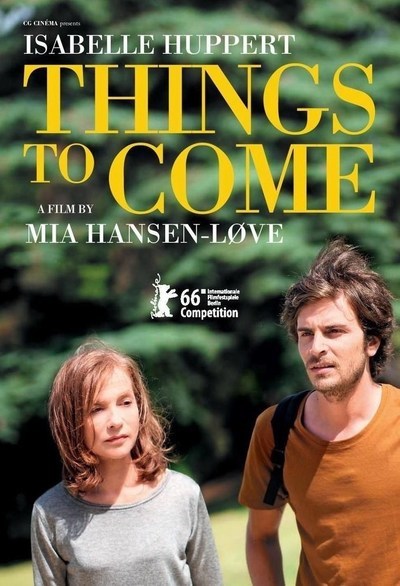
Things to Come [L’avenir]

(France/Germany 2016)

“My life isn’t over. Deep down, I was prepared. I’m lucky to be fulfilled intellectually.”

—Nathalie

A line from Talking Heads’ song “Once in a Lifetime” is apt to describe the root of the dramatic tension in Mia Hansen-Løve’s latest film: “Well, how did I get here?” Things to Come is a character study of Nathalie Chazeaux (Isabelle Huppert), a philosophy professor at an unnamed Paris university, as she navigates and reinvents her place in the world after her bourgeois examined life suddenly transforms into something else and leaves her floundering in the process.

Nathalie’s passion for her work is clear beyond her career: her husband of 25 years, Heinz (André Marcon), is also a philosophy professor; the textbook she wrote is something of a standard; and her apartment is crammed with books. Even her everyday conversation is peppered with references to philosophers, some I know and other I have never heard of. Her two adult children can follow her when she goes on about, oh, say, Plato, as she sets the table. She seems like someone who has always relied on intellect and reason.

The protesters blocking access to campus early in the film hint to something amiss; Nathalie participated in her share of protests back in the day, but this is different. Selfish, perhaps? One day, Heinz announces that he’s leaving her for another woman. “I thought you would love me forever,” Nathalie responds in a way that reads more like examining a problem than expressing surprise or hurt. Soon, her needy mother (Edith Scob) takes a turn for the worst, leaving Nathalie to figure out what to do with the cat. Meanwhile, her publisher informs her that her textbook’s future is uncertain. Then there’s the matter of her reunion with a former student, Fabien (Roman Kolinka), a cute and promising writer living in an anarchists’ commune.

Things to Come is very much about change, both in circumstances and relationships. Hansen-Løve takes a decidedly distant approach, letting us watch things unfold from afar. She’s not detached; she just seems more interested in showing the small events that shape Nathalie’s journey and letting us figure out the big picture. It works really well. Choosing “Unchained Melody” for the background in the final scene is especially clever; it’s clear about where Nathalie is on an emotional level, yet it’s open to interpretation about whether the future holds good things for her. It’s a happy, hopeful ending if you want it to be.

With Sarah Le Picard, Solal Forte, Guy-Patrick Sainderichin, Rachel Arditi, Yves Heck

Production: Arte France Cinéma, CG Cinéma, Detail Film, Rhône-Alpes Cinéma

Distribution: Les Films du Losange, Palace Films

102 minutes
Rated PG-13

(Gene Siskel Film Center) B

http://www.thingstocomefilm.com

Elle

(France 2016)

Director Paul Verhoeven’s Elle doesn’t sound like a comedy: the central event of the film is a rape—a bloody, violent one at that. In fact, it’s the very first scene. Strangely, the opening credits warn us that what we are seeing is “a French comedy.” Really? I guess that explains it!

Michèle Leblanc (Isabelle Huppert) is raped in her dining room by a man in a ski mask while her green-eyed cat watches, detached and seemingly bored. China is smashed, furniture is toppled, blood is shed. After he leaves, Michèle cleans up the mess and resumes her life, ordering sushi delivery—a “holiday roll,” no less.

As the film proceeds, we learn a lot about Michèle. She’s the daughter of a famous mass murderer approaching parole. She’s a ballbusting owner of a video game company. Her staff, entirely young and male, either wants to sleep with her or murder her. Her son, Vincent (Jonas Bloquet), is totally whipped by a shrew (Alice Isaaz) who’s pregnant with a baby that clearly isn’t his. Her ex-husband (Charles Berling) is involved with a younger yoga instructor (Vimala Pons). Her mother (Judith Magre) is a high maintenance piece of work who carries on with men a third her age. Meanwhile, Michèle is having an affair with with Robert (Christian Berkel), the husband of her business partner (Anne Consigny).

Things get dicey when Michèle develops a thing for her neighbor, Patrick (Laurent Lafitte), a handsome banker married to a devout Catholic (Virginie Efira) who apparently won’t fuck him. Their flirtation messes with her head as she tries to figure out who raped her. She’s surrounded by men, and every one of them is suspect.

David Birke’s screen adaption of Philippe Djian’s novel Oh… is, in a word, warped. Elle plays with power, desire, sex, and of all things sympathy. Consistent with its character—a constant switcheroo you don’t know whether to trust or look away from—it’s not a sad affair. To the contrary, it’s daring, thrilling, irreverent, and totally fun. It shouldn’t work—I found myself questioning whether I should enjoy the film as much as I did—but it does. The execution of both the plot and the characters is clever—and Stéphane Fontaine’s cinematography, which nicely illustrates the psychological drama here, is flawless. If nothing else, Elle is a visually stunning film.

Iggy Pop’s “Lust for Life” plays at various points in Elle, suggesting a lot of contradictory things. I took it as ironic more than anything. Elle is not for everyone, but it’s a powerful statement for those who can handle it—the perfect film for Valentine’s Day.

With Lucas Prisor, Raphaël Lenglet, Arthur Mazet, Hugo Conzelmann

Production: SBS Productions, Pallas Film, France 2 Cinéma, Entre Chien et Loup, Canal+, France Télévisions, Orange Cinéma Séries, Casa Kafka Pictures, Proximus, Centre National de la Cinématographie, Filmförderungsanstalt

Distribution: SBS Distribution

130 minutes
Rated R

(Gene Siskel Film Center) B+

http://sonyclassics.com/elle/

The Brand New Testament [Le tout nouveau testament]

(Belgium/France/Luxembourg 2015)

Joan Osborne once posed the question, “What if God was one of us, just a slob like one of us?” In Jaco Van Dormael’s The Brand New Testament, God (Benoît Poelvoorde) is a sloppy, angry middle-aged white guy with a very plain wife (Yolande Moreau). They live in a dark apartment in Brussels, where He works from home (she’s a homemaker with a thing for collecting baseball cards). His job is pretty easy: to heap misery onto the human race, which He watches over on a computer in a room with a card catalog that stretches to the sky. God’s preteen daughter, Ea (Pili Groyne), is not impressed with Him or His arrogant, authoritarian, and sadistic ways. Inspired by her brother “JC” (David Murgia), who tells her how to get out of the apartment through the washing machine, Ea hatches a plan to revise the way things work and hopefully make the world a better place: while Our Father is asleep on the couch, she sends a text message to everyone on Earth that reveals the date and exact time of their death, locks God’s computer, and runs away from home in search of six apostles to tell their stories—the Brand New Testament.

This film could have made a weighty statement, but it doesn’t. Instead, The Brand New Testament, executed with a hefty dose of fantasy and fabulism, is a fluffy affair. While all six apostles lack something—love, passion, an arm—they’re comical despite their sadness. Some of their subplots are better than others, particularly Aurélie (Laura Verlinden), a beautiful woman with a secret, and Willy (Romain Gelin), a young boy with cancer who wants to be a girl. Catherine Deneuve plays a neglected and bored housewife, and it’s truly surreal to see her in a role where she gets fucked by a street gigolo (Bilal Aya) and ends up leaving her husband (Johan Leysen) for a gorilla (Kiko Mirales). That’s right, a gorilla. Clever Biblical references, especially to the numbers 12 and 18, are generously sprinkled throughout the script. There’s even a point in here about gender politics. For all its charms, though, The Brand New Testament is a much better concept than a finished product.

112 minutes
Not rated

(Music Box) C

http://www.musicboxfilms.com/the-brand-new-testament-movies-143.php

Amélie [Le Fabuleux Destin d’Amélie Poulain]

(France/Germany 2001)

“I like to look for things no one else catches.”

—Amélie Poulain

The Associate Board of Chicago International Film Festival presented a special screening of Jean-Pierre Jeunet’s Amélie, a sumptuous, romantic fantasy of a film that looks as good as it feels. I’ve seen it many times. It’s unrealistic, maybe even a bit silly; yet, it always leaves me smiling. I couldn’t pass up the chance to see it again.

Young Amélie Poulain (Flora Guiet) has a lonely childhood: her odd parents are overreactive, overprotective, and emotionally distant, preferring to rearrange the contents of their toolbox and purse than pay much attention to her. It’s so bad that her heart races when her father, Raphaël (Rufus), a physican, touches her during her annual checkup—a narrator (André Dussollier) explains that all she wants is a hug.

Her father misdiagnoses Amélie with a heart condition. As a result, she’s kept inside from the world and homeschooled by her mother, Amandine (Lorella Cravotta), a rather hysterical woman with a nervous tic in her eye. Amélie retreats into her imagination to deal with it all. Her home environment is so stifling, it makes her pet goldfish, Blubber, jump out of its bowl in multiple suicide attempts. A separate suicide at Notre-Dame, this one successful, changes Amélie’s life, leaving her father to raise her alone without any siblings, which her mother apparently wanted for her. C’est la vie.

Fast forward to 1997: grown up Amélie (Audrey Tautou) is a stylish but shy waitress at a café in the 18th Arrondissement of Paris—artsy Montmartre. While home alone (as usual) in her flat one evening—August 31, 1997—a TV news report of Princess Diana and Dodi Fayed’s fatal car accident jolts Amélie, causing a chain reaction that leads her directly to a rusty box of a boy’s trinkets from the 1950s hidden in her bathroom wall. She discerns the identity of the family who lived in her flat back then and devises an elaborate scheme to reunite the boy, now an older man (Maurice Bénichot), with his “treasures” while staying completely anonymous and out of view. It works, bringing happiness to him and in the process to Amélie.

Thrilled with her accomplishment, she decides that her life’s work will be making others happy—in her own amusingly roundabout, always off to the side way. Amélie, you see, prefers to be invisible. She describes what she sees to a blind man (Jean Darie), kidnaps her father’s garden gnome to inspire him to travel, mails a bunch of fake love letters to her landlord (Yolande Moreau) whose husband abandoned her decades ago, and fixes up a hypochondriac coworker (Isabelle Nanty) with a volatile café patron (Dominique Pinon) who just got dumped.

Amélie’s covert approach goes swimmingly for others, but not so much for her own happiness—something she discovers once she encounters Nino Quincampoix (Mathieu Kassovitz), a handsome and quirky stranger who works at a porn shop and collects discarded photos from a photo booth at Gare de l’Est. Amélie can’t bring herself to show herself to Nino, let alone speak to him through a door. Can her neighbor, “the Glass Man” (Serge Merlin), talk some sense into her?

Everything about Amélie dazzles. Just like earlier films Delicatessen and The City of Lost Children, Amélie is a treat, showcasing Jeunet’s distinct buoyantly surreal visual and narrative style. He’s more sophisticated here, though. He throws in offbeat narrative sidebars that tell about his characters. With wide shots, unexpected angles, a pallet of vividly dark colors, and a mix of elements from different decades, he concocts an idealized version of Paris that highlights all that makes it romantic and dreamy. It works well with Bruno Delbonnel’s cinematography, which has a cool sepiatone air to it. My favorite shot is the one of Amélie literally dissolving into a puddle of water.

Tatou is wonderfully mischievous, emulating both Audrey Hepburn in Breakfast at Tiffany’s and Tinkerbell. You can’t help but fall for her as she turns the mundane into magnifique. Kassovitz, who comes off as a weirdo at first, capably metamorphoses Nino into a go-getter who turns out to be a great match for Amélie. Plus, he’s easy on the eyes.

122 minutes
Rated R

(Public Chicago) A

Chicago International Film Festival

http://www.miramax.com/movie/amelie/

Being 17 [Quand on a 17 ans]

(France 2016)

“I don’t know if I’m into guys or just you.”

—Damien

In a pivotal scene in André Téchiné’s astute and poetic sexual awakening drama Being 17, French high school boys Damien (Kacey Mottet Klein) and Thomas (Corentin Fila) throw literary quotes at each other while studying together. As their discussion intensifies, their disparate views toward their strange attraction become clear from the material they cite: Damien is willing—eager, even—to go with his unfamiliar feelings, while Thomas fights his. The scene eloquently brings into focus the essence of the tension between them.

Being 17 takes place over the course of a school year. As the story begins, a serious animosity suddenly develops between classmates Damien, a privileged brainy blonde French teen who wears a big flashy (and probably fake) diamond earring, and Thomas, the quiet, rugged brown adopted son of animal farmers. The whole thing starts when Thomas trips Damien as he walks back to his seat in one of their classes. Their interactions grow increasingly hostile and physical: shoving, slapping, and punching. It isn’t clear why, but the two can’t keep their hands—or eyes—off each other. The plot thickens when Damien’s mother (Sandrine Kiberlain), a physician in the remote mountain town where they live, arranges for Thomas to move in with her and Damien while his mother (Mama Prassinos) works through a difficult pregnancy. In a more intimate setting, the boys play a prickly game of cat and mouse as they gingerly let down their guard—only to an extent.

At times, Being 17 pushes suspension of disbelief to its edge. Still, it’s an achingly moving story that is extremely well executed. Even when the interactions between Damien and Thomas get, um, sultry—and they do—this isn’t so much a “gay” film as it is commentary on the power of desire. Téchiné wrote the script with Céline Sciamma, and they explore how hostility and desire play on each other. It’s a complicated dynamic: suspenseful, exciting, and confusing. Alexis Rault’s haunting score lends a pensive, masculine, almost Old Western touch that fits in perfectly. Julien Hirsch’s hazy cinematography gives the film a dreamy, sensual quality that highlights the natural beauty of the settings: the mountains, the lake, the snow, even the fields in the spring. It works really well showing both characters making it through the wilderness, figuratively and literally.

116 minutes
Not rated

(Gene Siskel Film Center) B

http://www.elledriver.fr/being-17/

Staying Vertical [Rester vertical]

(France 2016)

Writer-director Alain Guiraudie’s Staying Vertical is a strange trip indeed. Traveling through the mountains while writing a script, screenwriter Léo (Damien Bonnard) comes upon Marie (India Hair), a single mother of two and a shepherd who works on her father’s farm. Within the first 20 minutes or so of the film, he knocks her up and sticks around after the baby is born. Without explanation, Marie takes off with her two boys, leaving Léo behind to care for the baby. Marie’s father, Jean-Louis (Raphaël Thiéry), allows him to stay on the farm in exchange for taking care of the sheep.

Meanwhile, Léo develops an obsession with a pretty young buck named Yoan (Basile Meilleurat), who lives down the road with a cantankerous old man, Marcel (Christian Bouillette). Their relationship is ambigous: Yoan seems to do nothing but occasionally clean Marcel’s house—and not very well—while Marcel sits in his chair, blasting Pink Floyd and condemning Yoan with anti-gay rants. While this is going on, Léo seeks assistance for his writer’s block from a spiritual healer (Laure Calamy) while dodging his publisher (Sébastien Novac).

Staying Vertical has some great characters, particularly Marcel and Yoan. It also has a few gorgeous and memorable images, such as a brood of vagrants descending upon Léo and the baby under a bridge and a truly odd final scene involving wolves coming out of the dark onto the farm. Other than that, though, it’s really nothing more than a number of episodes and subplots that don’t exactly connect. A pervading homoeroticism that starts out mildly interesting goes somewhere completely unbelivable. I’m not sure what the point of it is, but I can say that about a lot in this film.

98 minutes
Not rated

(AMC River East) C

Chicago International Film Festival

http://www.wildbunch.biz/movie/staying-vertical/

My King [Mon roi]

(France 2015)

No one makes films about bad relationships better than the French, and Maïwenn’s My King is a fine if not entirely original example. Attorney Tony (Emmanuelle Bercot) and restaurateur Georgio (Vincent Cassel) are two upper middle class Parisians who probably never should have gotten together despite their chemistry and affection for each other.

After crossing paths in a nightclub, Georgio invites Tony (short for Marie-Antoinette) and her entourage—her brother Solal (Louis Garrel) and his fiancée Babeth (Isild Le Besco)—to his apartment for breakfast after last call. Solal and Babeth fall asleep on a couch, but Tony and Georgio hit it off. He’s dashing, smart, and full of ideas for cool things to do. It’s not long before they’re emotionally and carnally involved—and Georgio, the smooth guy that he is, is assuring Tony that her vagina is magnifique. As hooked as Tony is, something isn’t quite right from the outset: Georgio has a penchant for escape, whether through wine, his friends, or his ex, cover model Agnes (Chrystele Saint-Louis Augustin), who is all too present in his life, sometimes summoning him to her place in the middle of the night for emergencies. Things get complicated when Tony gets pregnant.

WARNING: Potential spoilers ahead!

My King is less about the events that occur onscreen than its characters and what makes them tick. Tony’s insecurities don’t mix with Georgio’s restlessness, the latter of which manifests itself in his buying stuff, drug benders, pool parties, and even renting his own apartment down the street from her and the baby. She loves him, but he brings out the worst in her. The story is told through flashbacks as Tony goes through rehabilitation after a skiing accident, ultimately suggesting that maybe she hurt herself on purpose. As Tony gets stronger in rehabilitation, she opens herself to the other patients—most of them younger and more relaxed men who are less sophisticated but nicer than Georgio. It’s not clear where she’s headed, but let’s hope it’s somewhere healthier.

Maïwenn’s directing is competent, but she takes a rather pedestrian approach here. The dramatic tension is a bit uneven, particularly the scenes of Tony in rehabilitation. The screenplay itself is okay but nothing special—I’ve seen this movie before. What really makes My King soar is its players, especially the leads. Bercot and Cassel are expressive, engaging, and raw. They’re totally convincing and sympathetic, and watching them interact is a treat. This would be a forgettable film without them.

124 minutes
Not rated

(Gene Siskel Film Center) B-

Mon Roi