Dunkirk

(USA / UK / France / Netherlands 2017)

I have mixed feelings about Christopher Nolan’s spectacular Dunkirk, a World War II military drama that has very little to do with battle. Told from three perspectives — land (“the mole”), sea, and air — the story here centers on an evacuation, that of British and allied soldiers from the beaches of Dunkirk, a fishing village in northern France at the Belgian border, over a ten-day period in late Spring 1940 (https://en.wikipedia.org/wiki/Dunkirk_evacuation).

I have to admit ignorance here: I knew nothing about the Dunkirk evacuation going into this film. Nolan doesn’t spend any time on background or what led to this point; instead, he just picks up with British soldier Tommy (Fionn Whitehead) fleeing German fire outside the beach. I wish I had known ahead of time because I would have done some research. I thought a better job could have been done telling the story.

The structure, jumping between the three perspectives, takes a little work to follow. What exactly is going on is unclear and confusing, and it creates a nice sense of claustrophobia and panic in many scenes — especially that boat scene. This is good. However, keeping track of the characters is a tough task not made any easier by giving all the soldiers the exact same black hair dye. I found it hard to relate to or care much about any of them because I was kept at arm’s length. I couldn’t get invested. While definitely not the same story, Dunkirk is a kind of a big budget Son of Saul — just not as good.

As a spectacle, though, Dunkirk is magnificent. Cinematographer Hoyte van Hoytema shot it on 70 millimeter film, and he packs this picture with gorgeous wide shots of the beach, the sea, and throngs of desperate soldiers. He beautifully captures the hopelessness of the situation with a drab palette of only a few army colors: greens, greys, blues, and cold whites that convey a chill I could see and feel. The sound is over the top loud. If nothing else, Dunkirk is total sensory overload. It’s worth seeing for that alone.

Side note: I’m not sure which is the bigger surprise here — that 1D’s Harry Styles actually isn’t terrible, or that Tom Hardy is hidden under aviator goggles for the entire film. The latter is a bummer. He’s so hot!

With Mark Rylance, Tom Glynn-Carney, Jack Lowden, Aneurin Barnard, James D’Arcy, Barry Keoghan, Kenneth Branagh, Cillian Murphy, Michael Caine

Production: Syncopy, Warner Brothers, Dombey Street Productions, Kaap Holland Film, Canal+, Ciné+, RatPac-Dune Entertainment

Distribution: Warner Brothers, Karo Premiere (Russia), NOS Audiovisuais (Portugal), Roadshow Entertainment (New Zealand), Roadshow Films (Australia)

106 minutes
Rated PG-13

(Music Box) C+

http://www.dunkirkmovie.com

Marie Antoinette

(USA/France 2006)

“This, Madame, is Versailles.”

—Comtesse de Noailles

If her take on Marie Antoinette is any clue, Sofia Coppola loves postpunk ’80s British bands like Siouxsie and the Banshees, the Cure, New Order, and New Romantic frontrunners Adam and the Ants and Bow Wow Wow. So do I. This in all likelihood is what drew me to Marie Antoinette: with three Bow Wow Wow songs (two remixed by My Bloody Valentine’s Kevin Shields), big hair, and a real MTV sensibility, its appeal to me is, well, a piece of cake.

All that is only part of the story. What really makes me love Marie Antionette is the sympathetic angle Coppola takes with this infamous character. Based on Antonia Fraser’s biography Marie Antoinette: The Journey, the first half of the movie is about the difficulties Marie (Kirsten Dunst) faces adapting to her new French surroundings and getting her new husband, Louis XVI (Jason Schwartzman, Coppola’s cousin), to consummate their marriage. She fails, and of course everyone blames her—even her mother (Marianne Faithfull). When she’s had enough, she says “fuck it” and becomes a full on rock star. This is where things get interesting.

Colorful and elaborate, Marie Antionette is not profound. So what? Lance Acord’s music video cinematography is perfect for what Coppola is going for; bordering on sensory overload, this film is busy, clever, and fun to watch. I know better than to take it as a history lesson.

With Judy Davis, Rip Torn, Rose Byrne, Asia Argento, Molly Shannon, Shirley Henderson, Danny Huston, Mary Nighy, Jamie Dornan, Steve Coogan, Tom Hardy

Production: Pricel, Tohokushinsha Film Corporation (TFC), American Zoetrope, Pathé, Commission du Film France, Commission du Film Île-de-France

Distribution: Columbia Pictures, Sony Pictures

123 minutes
Rated PG-13

(iTunes rental) B-

http://www.sonypictures.com/movies/marieantoinette2006feature/

Letters from Baghdad

(USA/UK/France 2016)

“We rushed into the business with our usual disregard for a comprehensive political scheme.”

—Gertrude Bell

According to the promotional poster for Sabine Krayenbühl and Zeva Oelbaum’s Letters from Baghdad, the so-called “Queen of the Desert” and “female Lawrence of Arabia” Gertrude Bell “was as controversial as the history she made.” Well, that certainly sounds promising!

Born into a wealthy family, Bell immersed herself in the Middle East in the early 20th Century and used her talents as a writer and a schmoozer to intimately acquaint herself with the area, its people, and their culture (https://en.wikipedia.org/wiki/Gertrude_Bell). Her contacts with influential expats and various Arab leaders combined with her knowledge of the culture led to an appointment as a British officer during World War I and a direct hand in drawing up the borders of modern Iraq.

Tilda Swinton gives Bell her voice, reading off camera Bell’s actual writings about events that occurred on her many trips and the people she met. In Bell’s own words, Swinton offers history, observations, and even some Victorian Era dish. Bell had at least as much influence as T. E. Lawrence a.k.a. Lawrence of Arabia (played here by Eric Loscheider in a staged “talking head” interview made to look like old footage).

Bell’s life and the impact of her deeds a century later make for an interesting story. Painstakingly researched, Krayenbühl and Oelbaum pull from diverse source material—letters, diaries, photos—to show what cities like Baghdad and Damascus were like a hundred years ago. They do a great job humaninzing Bell, getting into personality flaws and personal disappointments. In both respects, Letters to Baghdad works really well.

Not everything works as well as it could, though. Some important items are treated superfically. For example, they mention the tension between the Sunni, Shia, and Kurds even back then, but Krayenbühl and Oelbaum don’t delve into it. They touch on Bell’s reasoning for the borders she devised, but they don’t give much critical assessment to it. I left with the distinct feeling that I didn’t get the whole story. Another problem: the staged interviews give a lot of information, but they’re cheesy.

I found myself glancing at my watch about halfway through Letters from Baghdad. It’s a well made documentary, but it’s not as enthralling as it promises to be.

With Ammar Haj Ahmad, Helen Ryan, Rachael Stirling, Robert Ian Mackenzie, Christopher Villiers, Lucy Robinson, Elizabeth Rider, Michael Higgs, Joanna David, Michelle Eugene, Paul McGann, Pip Torrens

Production: Between the Rivers Productions, Letters From Baghdad, Missing in Action Films

Distribution: Vitagraph Films (USA)

95 minutes
Not rated

(Landmark Century) C

http://lettersfrombaghdadthemovie.com/about/

The 400 Blows [Les Quatre-cents coups]

(France 1959)

Childhood is fertile ground for storytelling. Usually, the stories that sell are heavily nostalgic and sweet, but the more interesting ones tend to come from a darker past. French New Wave pioneer François Truffaut’s autobiographical film The 400 Blows is the latter.

Antoine Doinel (Jean-Pierre Léaud) is a prepubescent boy experiencing an existential crisis. At home, something is bubbling between his parents, mother Gilberte (Claire Maurier) and stepfather Julien (Albert Rémy). At school, a contemptible teacher known as “Sourpuss” (Guy Decomble) has him pegged as a troublemaker.

Antoine and his friend René (Patrick Auffay) cut class one day. They walk around, catch a movie, and enjoy a carnival ride—the Rotor, a cylindrical room that spins and the floor drops out, causing the riders to “stick” to the walls due to centrifugal force. While they’re running around, Antoine sees his mother kissing some man on the street. She sees Antoine when it’s too late.

The next day, Antoine makes up an excuse for his absence: he says his mother died. It doesn’t work. After a few incidents involving Balzac, a fire, running away from home, and a stolen typewriter, Antoine winds up at a reform school.

Some New Wave films are hard to follow or just boring to watch. Not so with The 400 Blows, and for quite a few reasons.

The narrative is definitely loose. Like all New Wave films, what happens isn’t as important as what the director is showing us. Here, though, the plot is straightforward and sticks to a more traditional structure even if it doesn’t have a true “climax” or a single moment of reckoning. Truffaut gives us some really great scenes in this movie, not the least of which is this one:

400 Blows paddywagon.jpg

The 400 Blows is realistic and personal; it unfolds like something literally happening right before us. The acting, naturalistic and unscripted, is probably the biggest boon to the film. That said, Henri Decaë’s camerawork is a major contribution as well. He shoots on the streets of Paris using hand-held equipment, which allows him to get right up in front of the action. It’s likely a product of an independent low-budget film, but intentional or not The 400 Blows is so much better as a result; this film would not work the same way without Decaë.

Truffaut makes us empathize with Antoine. He’s not a bad kid; his behavior is no worse than his classmates or the adults around him. He’s made out to be a bad kid, though. The sad part is that he believes it. What’s more, he clearly sees more to life than the little spot he occupies, but he’s no better off after he tries to be. At the end of the film, I want to be on the beach with him to tell him he’ll be okay.

As for the seemingly nonsensical title, I didn’t realize that it’s a literal English translation of the French idiom “faire les quatre cents coups”, which means “to raise hell.” Now that I know that, the title totally makes sense.

Nominated for an Oscar for its screenplay by Truffaut and Marcel Moussy (https://www.oscars.org/oscars/ceremonies/1960), The 400 Blows is a movie that consistently ends up on many “must see” lists. It’s considered a landmark film for good reason. It’s hard to believe that this is Truffaut’s first film.

With Georges Flamant, Pierre Repp, Daniel Couturier, Luc Andrieux, Robert Beauvais, Yvonne Claudie, Marius Laurey, Claude Mansard, Jacques Monod, Henri Virlojeux, Jeanne Moreau, Jean-Claude Brialy, François Nocher, Richard Kanayan, Renaud Fontanarosa, Michel Girard, Henry Moati, Bernard Abbou, Jean-François Bergouignan, Jacques Demy, François Truffaut, Philippe De Broca, Jean-Luc Godard, Jean-Paul Belmondo, Michel Lesignor

Production: Les Films du Carrosse

Distribution: Cocinor, MK2 Films, Janus Films (USA), Criterion (USA)

93 minutes
Not rated

(iTunes rental) A-

Two Men in Manhattan [Deux hommes dans Manhattan]

(France 1959)

In his cool noir mystery Two Men in Manhattan [Deux hommes dans Manhattan], director Jean-Pierre Melville in his only starring role is Moreau, a cheerless and jaded reporter with Agence France-Presse. As he’s leaving work one night, his boss (Jean Lara) asks him to investigate the whereabouts of one Mssr. Fèvre-Berthier, the French United Nations delegate, who curiously has gone M.I.A.

Moreau heads straight to the flat of a frequent collaborator, hardened alcoholic photographer Pierre Delmas (Pierre Grasset), and yanks him out of bed—never mind the girl there with him. Delmas is the archetype paparazzo: cold-blooded and motivated by money. He knows his way around Manhattan.

The two men trail Fèvre-Berthier through a number of female associates: his secretary (Colette Fleury), a two-bit actress (Ginger Hall), a jazz singer (Glenda Leigh), a burlesque stripper (Michèle Bailly), and a high dollar whore in a high class brothel (Monique Hennessy). They find out what happened to him, but the story is scandalous.

Moreau doesn’t want to print it, but Delmas insists otherwise. A strange car following them around may persuade them to do the right thing—whatever that is.

With enough trench coats and fedora hats to clothe a newsroom, Two Men in Manhattan reflects Melville’s characteristic minimalist neo gangster movie style. The personal ethics here are all grey, which fits nicely with the night scenes, especially the exteriors shot on Times Square by cinematographer Nicolas Hayer. Aside from the exteriors, Manhattan never looked more fabulously fake: most of the interiors—the subway, a bar, a club, a theater, a hospital, a diner—were shot in a studio.

Part detective flick and part morality play, the tone shifts quite a bit between drama and waggishness, leading me to conclude that Melville didn’t take Two Men in Manhattan very seriously. It’s a minor work that comes off tongue in cheek, which makes it fun to watch—it compensates for Melville’s rather thin script. Plus, the whole thing sure is pretty.

With Christiane Eudes, Paula Dehelly, Nancy Delorme, Carole Sands, Gloria Kayser, Barbara Hall, Monica Ford, Billy Beck, Deya Kent, Carl Studer, Billy Kearns , Hyman Yanovitz, Ro. Tetelman, Art Simmons, Jerry Mengo

Production: Belfort Films, Alter Films

Distribution: Columbia Films (France), Mercurfin Italiana (Italy), Cable Hogue Co. (Japan), Cohen Media Group (USA)

85 minutes
Not rated

(Gene Siskel Film Center) B-

24 Hours in the Life of a Clown [Vingt-quatre heures de la vie d’un clown]

(France 1946)

But where are the clowns? Send in the clowns. Okay, don’t bother, two of them are in this short by the great French director Jean-Pierre Melville. 24 Hours in the Life of a Clown [Vingt-quatre heures de la vie d’un clown] is just that: a day in the life of Beby, a clown who lives in Montmarte. A multitude of fedoras costar.

In between performances at Circus Medrano, Beby walks the streets of Paris, sleeps with his little dog (but not his wife), reads fan mail, drinks at a café, and puts on makeup with his friend and fellow clown Maïss. Interestingly enough, this is not the only short to feature Maïss, who later appeared in Rodolphe Marcilly’s Centaures et pastiche in 1953.

Who knew clowns pray?

24 Hours in the Life of a Clown holds historical and artistic significance as Melville’s first film. It highlights his style, albeit in its infancy, playing with light and dark. His approach is tongue in cheek, and his “narration” (this is not a “talkie”) strongly suggests Melville knew well that his hoary little film is silly.

Still, it’s interesting if only for the scenery, all 1940s drab and threadbare, and the documentary feel of it. Beby’s apartment reminds me of the one in Eraserhead.

Production: Les Films du Panthéon

18 minutes
Not rated

(Gene Siskel Film Center) C

https://youtu.be/uRZo0M3KCzM

Breathless [Á bout de souffle]

(France 1960)

“After all, I’m an asshole.”

—Michel Poiccard

The third time is a charm: after seeing Jean Luc-Godard’s first full length feature film, Breathless, I now understand the love-meh relationship I have with his work.

On one hand, he’s got a remarkable grasp of human behavior and what motivates it. He’s got a snarky sense of humor. He’s stylish. His technique is gutsy for a lot of reasons. His characters are flawed. His subject matter is cool. He knows how to make a film look pretty, and most of them might as well be deemed official historical documents of the places where they were shot. Seeing a Godard film is like traveling back in time, an incidental bonus he probably never considered. I love all of this.

For all his strengths, on the other hand, a Godard film can be so damned…boring. Merde!

Fortunately, that’s not the case with Breathless, which I enjoyed. Godard and François Truffaut developed the story—I won’t call it a script or a screenplay because they made up much of it as they went along. Plot is always a loose construct with Godard, but there’s enough of one here to follow along fairly easily. Ugly cute guy (or is he a cute ugly guy?) Michel Poiccard (Jean-Paul Belmondo), a drifter car thief who fancies himself a French Humphrey Bogart, steals a car and drives it through the countryside. He shoots a policeman who pursues him and kills him.

With nowhere else to go, he heads straight to his American girl, Patricia (Jean Seberg), an expat student who sells a newspaper, the now defunct New York Herald Tribune, on the Champs-Élysées—that’s kind of weird—and writes articles here and there. She brings Michel to her apartment, where he hides out. He doesn’t mention anything to her about what happened. They get it on, or at least it’s implied that they do. She’s tells him she’s pregnant. One extended scene involves them lying around, talking.

Michel becomes a marked man, which he discovers as soon as he leaves the apartment with Patricia and sees a newspaper with a headline about him. I won’t ruin the ending, but it doesn’t bode well for him—especially after Godard himself sees Michel.

Breathless is a psuedo noir thriller that’s low on action but loaded with morally vacant characters who lack any redeeming qualities. There’s a nihilistic sexiness to it. The narrative moves along in a jazzy free-form way, and the imagery here is every bit a part of the story as the characters. The ending is not a happy one. If nothing else, Breathless is a visual stunner—black and white cinematic candy. The restored digital version I saw literally glowed.

I can handle more films like this one.

With Daniel Boulanger, Henri-Jacques Huet, Roger Hanin, Van Doude, Liliane David, Michel Fabre, Jean-Pierre Melville, Claude Mansard, Jean-Luc Godard, Richard Balducci, Jacques Rivette

Production: Les Films Impéria, Les Productions Georges de Beauregard, Société Nouvelle de Cinématographie (SNC)

Distribution: Films Georges de Beauregard, Les Films Impéria, Société Nouvelle de Cinématographie (SNC), Euro International Film (EIA) (Italy), Pallas Filmverleih (West Germany), British Lion Film Corporation (UK), Cinematográfica Azteca (Mexico), Ciné Vog Films (Belgium), Wivefilm (Sweden), Films Around the World (USA), Rialto Pictures (USA), Criterion Collection (USA)

90 minutes
Not rated

(iTunes rental) B

http://www.jean-lucgodard.com/films.html

https://www.criterion.com/films/268-breathless

I, Daniel Blake

(UK/France/Belgium 2016)

I Daniel Blake.jpg

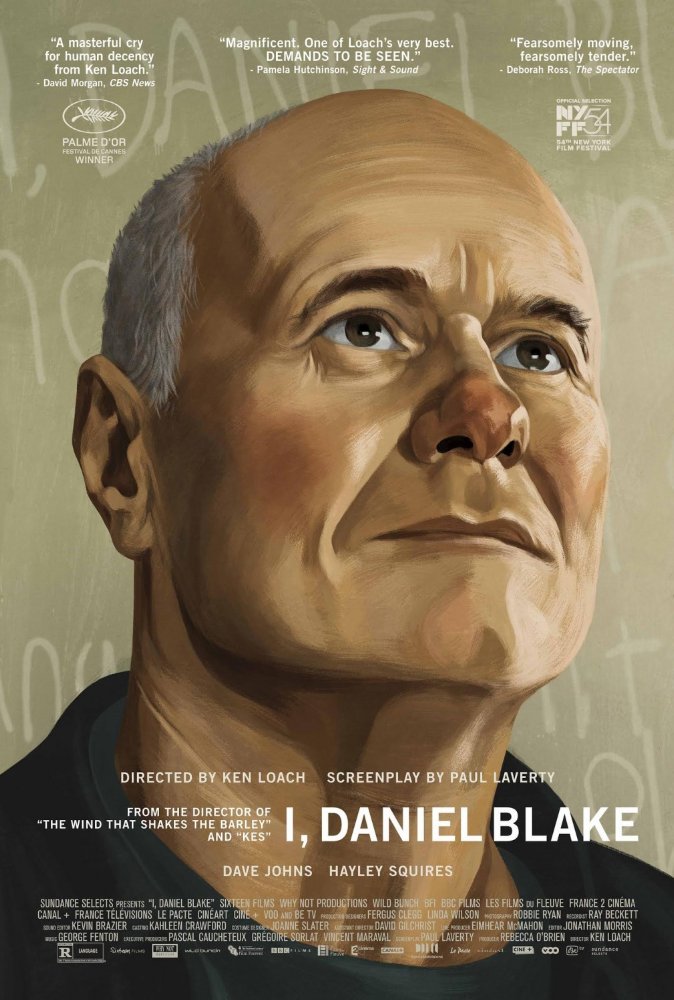
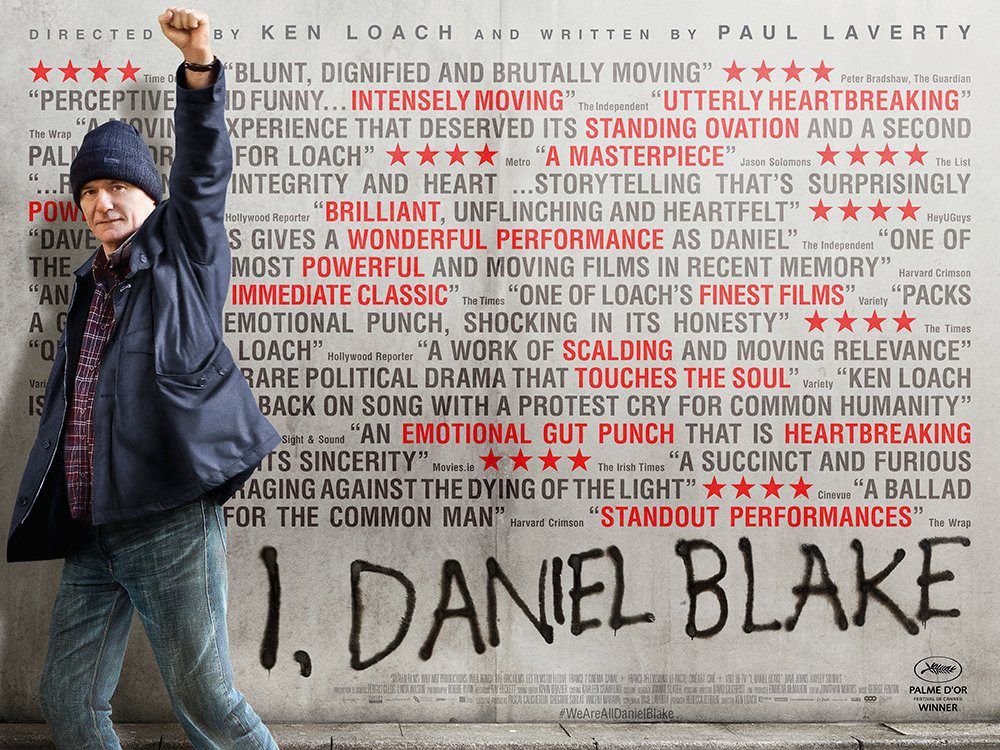
Ken Loach’s I, Daniel Blake has gotten a lot of attention and praise. Good: it wrestles with a topic that’s timely on both sides of the Atlantic—and elsewhere, for that matter. A political and poweful message, Loach has touched many a nerve. Case in point: I, Daniel Blake won the Palm d’Or at the Cannes Film Festival, where it finished with a 15-minute standing ovation (http://variety.com/2016/film/global/palme-dor-ken-loach-rebecca-obrien-1201785482/). 15 whole minutes?! Wow.

Daniel Blake (Dave Johns) is a kind of antihero. He’s gruff, he’s private, he’s not handsome or young. He probably goes to church. A heart attack seems like the thing that would change his life, but what really does is a new neighbor (Hayley Squires) and her two kids (Briana Shann and Dylan McKiernan).

I didn’t stand up, but I get it. Bureaucracy versus common sense is always fertile ground for storytelling. I applaud Loach for what he’s saying here, I really do. I, Daniel Blake is a good film: it’s engaging, brave, and relatable. The acting is good all around. So is the premise.

In my opinion, though, it just isn’t a great film. We’re talking shades of meaning here, so if you have five seconds to spare, I’ll tell you why. First, I’ve seen this device many times before—in the last year, even. A cranky old man meets a character that represents youth and hope, and it totally melts the icy facade and changes his life. Well, OK. This sense of hope is usually personified by the very person society looks down on. Next?

Second, I saw where the plot was going way before I got there. Again and again. Predictability is never groundbreaking.

Third, I can’t help but think that this film takes the easy way out. A heart attack in a movie ends only one way. And it’s only a sad ending. Yeah, I, Daniel Blake is emotionally manipulative.

So, my issues center on Paul Laverty’s writing. I wish I had a better way to tell this story. I don’t. For all its pluses and minuses, though, I’d rather watch something more intense. Overall, I, Daniel Blake is disappointingly soft.

With Kate Rutter, Sharon Percy, Kema Sikazwe, Steven Richens, Amanda Payne, Chris Mcglade, Shaun Prendergast, Gavin Webster, Sammy T. Dobson, Mickey Hutton, Colin Coombs, David Murray, Stephen Clegg, Andy Kidd , Dan Li, Jane Birch, Micky McGregor, Neil Stuart Morton

Production: Sixteen Films, Why Not Productions, Wild Bunch, British Film Institute (BFI), BBC Films, Les Films du Fleuve, Canal+, Ciné+

Distribution: Entertainment One Films (UK), Le Pacte (France), Cinéart (Belgium/Netherlands), Cinema (Italy), Feelgood Entertainment (Greece), Prokino Filmverleih (Germany), Scanbox Entertainment (Denmark), Sundance Selects (USA), Transmission Films (Australia), Vertigo Média Kft. (Hungary), Canibal Networks (Mexico), Cine Canibal (Mexico), Imovision (Brazil), Mont Blanc Cinema (Argentina), Longride (Japan)

100 minutes
Rated R

(Music Box) B

https://www.wildbunch.biz/movie/i-daniel-blake/

Love & Anarchy [Film d’amore e d’anarchia, ovvero ‘stamattina alle 10 in via dei Fiori nella nota casa di tolleranza…’]

(Italy/France 1973)

The premise of Lina Wertmüller’s Love & Anarchy [Film d’amore e d’anarchia, ovvero ‘stamattina alle 10 in via dei Fiori nella nota casa di tolleranza…’] has the ring of something from Federico Fellini or maybe Pedro Almodóvar (though Fellini makes a lot more sense because she actually worked as his assistant for a spell).

Freckly yokel farmer Tunin (Giancarlo Giannini) learns that his friend was murdered. Why? Because he was an anarchist who was plotting to assassinate “ll Duce” Benito Mussolini. What’s more, Mussolini’s fascist police killed him. To avenge his friend’s death, Tunin takes up his cause.

Tunin ends up at a brothel in Rome. He spends a night with Salomè (Mariangela Melato), who reveals that she’s a co-conspirator for her own reasons. As the story progresses, it becomes clear that the coup is a harebrained idea.

Salomè takes Tunin to a rural spot just outside Rome with her and another prostitute, Tripolina (Lina Polito). Salomè distracts Spatoletti (Eros Pagni), the head of Mussolini’s police, while Tunin checks out the area; they then devise a plan to execute the mission.

Meanwhile, Tunin and Tripolina fall in love. Convinced that he isn’t going to make it past the assassination alive, he persuades Tripolina to spend the next two days with him.

The same radical spunk that Wertmüller exhibits in The Seduction of Mimi is just as prevalent in Love & Anarchy; this film is loaded with decadent, sexy hijinks. However, it also its share of some really tender moments—that surprised me. Love & Anarchy turns out devastatingly sad—I left the theater literally bummed out. For all its ridiculous sociopolitical and sexual shenanigans, it’s a far more powerful film.

With Pina Cei, Elena Fiore, Giuliana Calandra, Isa Bellini, Isa Danieli, Enrica Bonaccorti, Anna Bonaiuto, Anita Branzanti, Maria Sciacca, Anna Melato, Gea Linchi, Anna Stivala, Roberto Herlitzka

Production: Euro International Film, Labrador Films

Distribution: Peppercorn-Wormser, Kino Lorber

120 minutes
Not rated

(Gene Siskel Film Center) B

https://www.kinolorber.com/film/view/id/1306

Inland Empire [A Woman in Trouble]

(USA/France/Poland 2006)

“What the bloody hell is going on?” asks Kingsley Stewart (Jeremy Irons) at one point during Inland Empire, David Lynch’s last (so far) full length feature film. It’s an excellent question, one that no doubt anyone watching this three-hour nightmare has already wondered by this point.

Laura Dern is Nikki Grace, an elegant actress up for the lead in a new film, On High in Blue Tomorrows, due to start shooting very soon. A strange Polish neighbor (Grace Zabriskie) who lives “just up the way” drops by her California mansion one afternoon and casually but ominously brings up a murder in the film. “That’s not part of the story,” Nikki tells her visitor, who insists she’s wrong and throws a tantrum right there in the sitting room, screaming about “brutal fucking murder” and an unpaid bill. Annoyed and visibly freaked out, Nikki has her butler (Ian Abercrombie) remove her.

Nikki gets the part. Some weirdness happens, and the film’s director (Irons) tells Nikki and her rugged costar Devon Berk (Justin Theroux) that the film is supposedly cursed: it’s a sort of remake of an old Polish movie called 47 that was never completed because of a double murder on the set. The actors are upset but they agree to proceed with production despite the producers’ lack of transparency.

Meanwhile, Nikki is falling for Devon. The narrative gets weird here, ping-ponging back and forth between Nikki and Devon and their characters, Susan and Billy, as well as Susan’s husband, Smithy (Peter J. Lucas), who knows something is going on. Billy’s wife (Julia Ormond) proves to be a character of interest of ever increasing importance, bleeding into another seemingly unrelated subplot about Sue Blue (Dern), a rough and caustic Hollywood chick who finds herself pregnant. The problem is, her husband (Lucas) is sterile. And just who are all these hookers hanging out with Sue, smoking and dancing to “The Loco-Motion” in her living room?

Interspersed between all this is yet another triangular subplot set in 1800s Poland: a cheating wife (Karolina Gruszka) learns that her husband (Krzysztof Majchrzak) plans to kill her lover (Lucas). And just to keep thing interesting, Lynch throws in “The Rabbits,” a spooky sitcom about a family of…rabbits. Actually, actors in rabbit suits (one of them has the voice of Naomi Watts). Later, Sue somehow ends up in their living room.

Probably his most indulgent film, Inland Empire is the kind of thing I imagine most people associate with David Lynch: a surreal trip through the subconscious, the imagination, alternate universes, and time that starts out with a discernible plot but disintegrates into seemingly disjointed events, actors playing multiple characters, bizarre and vivid imagery, random upbeat pop songs, and a creepy score by Marek Zebrowski. Flashes of Lynch’s usual sense of humor pop up here and there, but for the most part this is a dark and somber film about betrayal, loss, and karma. Perhaps its strongest aspect is its overriding sense of dread, and the worst thing about is that it’s impossible to tell whether the scary part is coming or has already arrived.

Inland Empire is surely a horror film. I imagine not many people get into it, and most even being turned off. Length and structure—or lack thereof—aside, it’s not an easy film to watch or understand, and frankly I’m not entirely sure I grasp what the whole thing is about. Indeed, different characters say “I don’t understand” over and over, and Devon/Billy tells Grace/Susan a few times that she isn’t making sense. A common thread that ties the multiple plots together eventually emerges, but I get the impression that this is merely a heap of undeveloped ideas Lynch assembled into one big project.

Still, I found myself mesmerized all the way through. The ending, where Sue’s fate plays out over the stars on the Hollywood Walk of Fame, is dowright distressing. In a way, it’s also beautiful. Lynch offers a lot to chew on here; I’ve gone over it multiple times since I saw it. I have my theory of what really transpires in Inland Empire, and someday I’ll watch again with an eye toward backing it up. It won’t be anytime soon, though.

Post script: I had the pleasure of seeing John Waters speak in the afternoon before I caught Inland Empire. Needless to say, it required a major shift in gears.

With Harry Dean Stanton, Diane Ladd , Mary Steenburgen, Terry Crews, William H. Macy, Leon Niemczyk, Nastassja Kinski, Monique Cash, Latrina Bolger, Fulani Bahati, Ashley Calloway, Erynn Dickerson, Jovonie Leonard, Jennifer Locke, Helena Chase, Nae

Production: Absurda, Studio Canal, Fundacja Kultury, Camerimage Festival

Distribution: Ryko (USA), 518 Media (USA), Absurda (USA), Studio Canal (International), Mars Distribution (International)

180 minutes
Rated R

(Music Box) A

David Lynch: A Complete Retrospective

http://www.inlandempirecinema.com

David Lynch