Starlet

(USA 2012)

After The Florida Project wowed me even more than Tangerine did two years ago (I liked that one a lot, too), I decided to check out what else Sean Baker has done. I didn’t know about Starlet. Written by Baker with frequent collaborator Chris Bergoch, it’s the first of three from them so far. It came out before Tangerine, so it seemed like a good place to start. I’m happy to report that Starlet is another winner.

In Starlet, Baker and Bergoch explore morality and female bonding in the context of a cross generational relationship. Jane (Dree Hemingway) is a nihilistic or simply oblivious 21-year-old aspiring actress who just moved to the Valley — the one on the other side of the hills from Hollywood — with her unnamed chihuahua (Boonee). She’s kind of a slacker, spending her days not unpacking her shit but getting high and playing video games with her housemates Melissa (Stella Maeve) and Mikey (James Ransone), a young couple not exactly in tune with each other. They let her stay with them in an extra bedroom that Mikey occasionally uses for “work.”

Jane is likable: she’s got a lot of idiosyncrasies but she isn’t helpless, she takes care of her pooch, and she seems like a nice person despite her aimlessness, lack of planning (like, anything), and the questionable career path she’s chosen to get her foot in the door of the film industry. I’m not spoiling anything when I reveal that she makes porn under her stage name Tess. One name, like Cher or Madonna (or Prince, for that matter). A few real life porn actors (Manuel Ferrara, Asa Akira, Jules Jordan, Kristina Rose) even appear as themselves.

Jane hits a yard sale at the home of crusty old lady Sadie (Besedka Johnson), who can barely be bothered to answer Jane’s questions about a thermos she spots and wants to buy (she thinks it’s an urn). Jane takes it home and is befuddled when she finds multiple rolls of cash stashed inside it.

Jane tries to return the money — after she spends some of it on a blingy harness for the dog (incidentally, it says “starlet,” which becomes his name). The problem is, Sadie doesn’t give her a chance; she won’t even let Jane talk, dismissing her with a “no returns” shutdown. So, Jane does what any reasonable person would: she stalks Sadie at the grocery store, in the diner, in her garden, and at her bingo games to become her friend and spend the money on her.

Starlet is unique in its pace and its narrative, perhaps even moreso than Tangerine or The Florida Project. It’s offbeat yet warm, and it beautifully captures the tempo of real life: mostly mundane stretches peppered with moments of excitement. Both Hemingway (yes, her great grandfather was the notable author) and Johnson in her only role are both mesmerizing. Radium Cheung’s cinematography is gorgeous; all sunbleached and perfectly framed, it gives Starlet a sunny hue that belies its melancholic sense that this is as good as it gets for these characters, not that anything — fame, fortune, love, a pornstar sex life, retirement, Hollywood itself — is as thrilling as the fantasy.

Starlet lacks the impact of the aformentioned films that follow it — the big reveal at the end is a bit of a dud. However, its real surprise is how damned sweet it is. Hemingway and Johnson interacting with each other are a joy to watch. My big question: what’s in the suitcase?

With Zoe Voss, Krystle Alexander, Jessica Pak, Jackie J. Lee, Dean Andre, Dawn Bianchini, Edmund C. Pokrzywnicki, Dave Bean, Eliezer Ortiz, Andy Mardiroson, Cesar Garcia, Heather Wang, Helen Yeotis, Dale Tanguay, Patrick Cunningham, Karren Karagulian, Michael O’Hagan, Amin Joseph, Cammeron Ellis, Nick Santoro, Joey Rubina, Cassandra Nix, Liz Beebe, Tracey Sweet

Production: Maybach Cunningham, Freestyle Picture Company, Cre Film, Mangusta Productions

Distribution: Music Box Films (USA), Golden Scene (Hong Kong), Rapid Eye Movies (Germany), Tucuman Filmes (Brazil)

103 minutes
Not rated

(iTunes rental) B

http://www.musicboxfilms.com/starlet-movies-44.php

It [It: Chapter One]

(USA 2017)

I’ve started a few Stephen King novels during my life, but I’ve never finished reading any of them. I have, however, seen enough movies based on his books to know what I’m getting into.

It is director Andy Muschietti’s take on King’s 1986 novel, which incidentally came out on my 16th birthday. Scary. It tells the story of a group of bullied junior high outcasts who go after a deranged clown named Pennywise (Bill Skarsgård) one summer, the Summer of 1989, after he kills stuttering Bill Denbrough’s (Jaeden Lieberher) little brother, Georgie (Jackson Robert Scott), the fall before.

Pennywise lives in the sewer of their small town (Derry, Maine) and resurfaces every 27 years to prey on children through their worst fears.

The screenplay, written by Chase Palmer, Cary Fukunaga, and Gary Dauberman, is only part of the book — presumably to allow for a sequel. It starts out well enough in the same sweet nostalgic way as, oh, Stand by Me. Muschietti gets deatils of the time period mostly right: the Cure and New Kids on the Block were big in ’89 (even though the former’s “Six Different Ways” was two albums and a compilation earlier), and the reference to Molly Ringwald fits. He goes full on Steven Spielberg, however, about halfway through, turning It into The Goonies with the kids’ “losers club” and all the action switching to a dark cavernous underground sewer. This is to say, It gets cheesy after awhile.

The kids are all decent actors, and they keep It moving along. Sadly, though, there aren’t any real surprises here. More creepy and icky than outright frightening, Muschietti relies greatly on special effects; they’re good and a lot of work went into them, but they get tiresome after awhile. Plus, some editing would’ve been a good idea; It is too long.

As It is, it’s not a stinker. However, I wasn’t moved by It, either. It is a big budget Hollywood movie aiming to be a blockbuster, and that’s It.

With Jeremy Ray Taylor, Sophia Lillis, Beverly Marsh, Finn Wolfhard, Chosen Jacobs, Jack Dylan Grazer, Wyatt Oleff, Nicholas Hamilton, Jake Sim, Logan Thompson, Owen Teague, Stephen Bogaert, Stuart Hughes, Geoffrey Pounsett, Pip Dwyer, Elizabeth Saunders, Ari Cohen, Anthony Ulc, Javier Botet, Katie Lunman, Carter Musselman, Tatum Lee

Production: New Line Cinema, Ratpac-Dune Entertainment, Vertigo Entertainment, Lin Pictures, KatzSmith Productions

Distribution: Warner Brothers

135 minutes
Rated R

(ArcLight) C

http://itthemovie.com

BPM (Beats per Minute) [120 Beats per Minute] [120 battements par minute]

(France 2017)

Ah, the early ’90s: I was in college, jeans didn’t fit right, George H.W. Bush was president, MTV was relevant, and AIDS was as deadly as ever. In the United States, the number of new cases peaked around 1993 (https://www.cdc.gov/mmwr/preview/mmwrhtml/mm5021a2.htm). During the 1980s, a slew of activist organizations sprung up in response to government indifference and inaction, largely but not exclusively that of the Reagan administration, and Big Pharma shadiness — organizations like the Gay Men’s Health Crisis, Queer Nation, and perhaps most famous (or infamous) ACT UP.

This is the backdrop of Robin Campillo’s BPM (Beats Per Minute), an imperfect yet captivating and rich period piece that portrays the AIDS crisis with accuracy, drama, a little humor, and the slightest bit of nostalgia — ill-fitting jeans be damned. BPM puts us smack in the middle of the Parisian chapter of ACT UP, which seems constantly on the brink of self-destruction with all the debating, infighting, and struggling for control among its members.

Campillo starts with a broad picture, introducing us to the group through hunky Nathan (Arnaud Valois), who joins ACT UP for reasons that he keeps guarded. Right up front, members of the group confront radical Sean (Nahuel Pérez Biscayart), a scrawny firecracker who favors the back of the room. He went off script during a botched protest involving balloons filled with fake blood.

Sean’s motive is soon clear: he’s running out of time and has none to spare for diplomacy. His impatience and prickliness are particularly acute when he’s dealing with the chapter’s leader, Thibault (Antoine Reinartz), and elder comember Sophie (Adèle Haenel), who tends to be the voice of reason.

Those in the group don’t shy away from saying what’s on their mind, and their debates are vigorous to say the least. Interestingly, there’s a lot of flirting and cruising going on. Nathan encounters some attitude, particularly from the poz members — he happens to be HIV negative. He and Sean hit it off, though. Campillo zooms in on them as they get intimate, letting their relationship take center stage. We get their backstories over pillow talk, and it makes for some of the finest moments in this film. They get closer as Sean’s health deteriorates. Campillo brings the group back to the fore by the end, displaying the strong sense of community that has been there all along. It outshines all the bickering and dysfunction.

BPM is an accomplishment on many levels. The historical perspective is solid, giving the whole thing an authentic feel, almost like a documentary. Cinematographer Jeanne Lapoirie’s faded color palette and lighting actually look like the ‘90s. Campillo and Philippe Mangeot’s screenplay is smartly written, loaded with sharp dialogue that engages even when the activity level drops. The narrative arc here is terrific. The end could use some minor editing, but otherwise the long scenes and slow pace work because we’re getting a lot of information. While each actor carries his or her own weight, Pérez Biscayart easily emerges as the star.

Politics, ideology, and HIV status all draw lines in this group, but its members are united by a shared mission. Plus, they’ve got lives to lead, however much time they have left. BPM is a gentle — and somehow very French — reminder that life goes on.

With Felix Maritaud, Médhi Touré, Aloïse Sauvage, Simon Bourgade, Catherine Vinatier, Saadia Ben Taieb, Ariel Borenstein, Théophile Ray, Simon Guélat, Jean-François Auguste, Coralie Russier, Samuel Churin, Yves Heck, Emmanuel Ménard, Pauline Guimard, François Rabette

Production: Les Films de Pierre, France 3 Cinéma, Page 114, Memento Films, FD Production

Distribution: Memento Films

143 Minutes
Not rated

(AMC River East) B+

Chicago International Film Festival

http://bpm.film

Tokyo Vampire Hotel

(Japan 2017)

This theatrical cut of director Sion Sono’s Amazon Prime miniseries Tokyo Vampire Hotel [東京ヴァンパイアホテル] (http://www.indiewire.com/2017/04/tokyo-vampire-hotel-sion-sono-amazon-1201808369/) is a fast-paced stylish and colorful bloodbath, something that wouldn’t be out of place in Quentin Tarantino’s oeuvre.

Manami (Tomite Ami) is a nice girl who shares a tiny apartment with her boyfriend (Saito Takumi) in Tokyo. Just after she arrives for dinner with her friends on the evening of her 22nd birthday, a crazy gun-toting assassin (Shoko Nakagawa) in a fuzzy pink mink shows up and takes out everyone in the restaurant — except Manami, whom she came to kidnap.

Manami flees, only to be picked up by another kidnapper, the mysterious K (Kaho). K in not so may words explains that Manami is a pawn in a war between two vampire clans, the Draculas and the Corvins, who have been enemies for centuries. Unbeknownst to Manami, she’s the target of a worldwide vampire hunt. K takes her to the glamorous Tokyo Vampire Hotel, which is run by a creepy geisha empress (Adachi Yumi) who needs blood.

The end of civilization is coming, but the empress has a plan: use the hotel to trap a healthy supply of humans to serve as food. Things don’t pan out as planned when the humans figure out what’s happening and the Draculas show up to crash the party.

This photo sums up what you’re getting into here:

Tokyo still.jpg

Tokyo Vampire Hotel is quirky, sexy, lavish, and fun. Sono serves up an imaginative feast of dazzling eye candy and nonstop action. His use of Christian symbols adds a nice touch. The sets are fantastic, and the action moves from the streets of Tokyo at night to inside the hotel to Bran Castle in Transylvania, and back. The editing works to make nine episodes flow seamlessly into a feature length film. However, the story wears thin after a little while, and it can’t sustain the interest I started out with. The gore gets old, too. The length, nearly two and a half hours, is a problem. It demonstrates why Tokyo Vampire Hotel is probably better in smaller doses.

With Mitsushima Shinnosuke, Yokoyama Ayumu, Kagurazaka Megumi, Shibukawa Kiyohiko, Takatsuki Sara, Tsutsui Mariko, Sakurai Yuki

Production: Amazon, Django Film, Nikkatsu Pictures

Distribution: Nikkatsu International Sales

142 minutes
Not rated

(AMC River East) C+

Chicago International Film Festival

https://youtu.be/2cJRq73BAhE

The Line [Čiara]

(Slovakia / Ukraine 2017)

Director Peter Bebjak’s The Line is an Eastern European testosterone flick, a less cheeky sort of Lock, Stock and Two Smoking Barrels set at the Slovakia–Ukraine border. It’s a genre flick, and a good one: excellent performances all around boost Peter Balko’s tight, vigorous screenplay.

A lot is going on with Adam Krajnak (Tomáš Maštalír), the head of both his household and a gang of organized cigarette smugglers. His oldest daughter, Lucia (Kristiná Konátová), is about to marry a clueless petty thief (Oleksandr Piskunov) he doesn’t care for. His Ukrainian partner (Eugen Libezňuk) is going weird, possibly on the verge of going rogue.

Then there’s ruthless Ukrainian gangster Krull (Stanislav Boklan), who’s co-opted Adam’s crew for a new product, meth. Adam wants no part of it. Things are heating up to a show down that crooked police chief Peter Bernard (Andy Hryc) facilitates. It all comes to a head during Lucia’s engagement party.

With far and few still moments, The Line grows increasingly complicated as its story progresses. This is a quick and constant thriller loaded with curve balls. A scene where the police raid Afghans illegally crossing the “green border,” a wooded area, is a standout. So are a few at a ravine where Krull dumps bodies; Martin Ziaran’s underwater shots are beautifully eerie.

With Emília Vášáryová, Géza Benkõ, Zuzana Fialová, Filip Kankovský, Milan Mikulcík, Veronika Strapková, Rimma Zyubina

Production: Wandal Production, Garnet International Media Group

Distribution: RTVS

Screening introduced by and followed by a live Q and A with Andy Hryc

108 minutes
Not rated

(AMC River East) B+

Chicago International Film Festival

http://www.ciara.sk/en/

They

(USA / Qatar 2017)

“You’ll never be a girl. You’re not a boy. So you’re probably nothing.”

— J

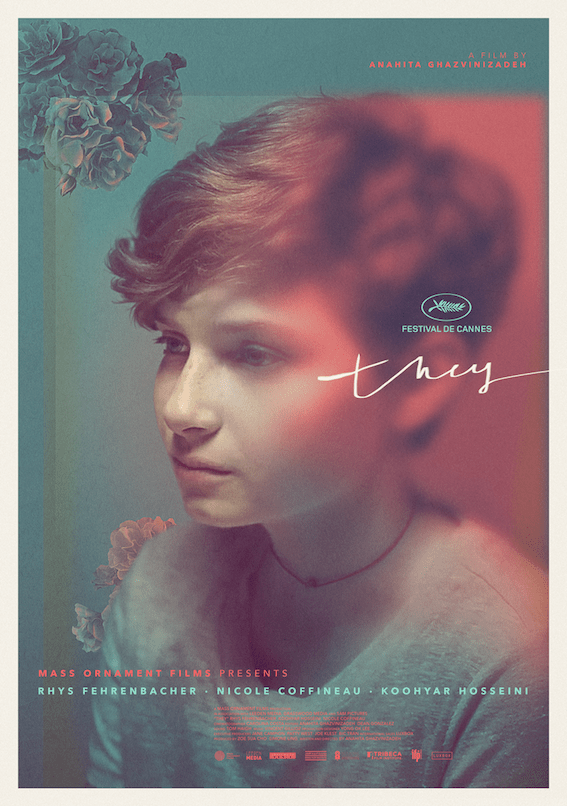
Writer/director Anahita Ghazvinizadeh’s debut feature film They delicately tells the story of J (Rhys Fehrenbacher), a quiet suburban Chicago teen transitioning from male to female. Along with therapy sessions and physician consultations for “puberty blocking” drugs and “bone density” test results, J is processing the social and psychological implications of their change. We know it’s happening, but we see it in action when J puts on a dress and goes outside, or when he explains to others how to make an introduction to a stranger and which pronoun to use (“they,” hence the title).

The process is awkward, particularly when older sister, Lauren (Nicole Coffineau), brings her fiancé, Araz (Koohyar Hosseini), home to meet the family. With mom (Norma Moruzzi) away caring for an aunt who has early onset dimentia, J is left to deal alone. Meeting Araz’s Iranian family in the suburbs seems to be a reckoning for J.

If nothing else, They is visually arresting, artfully shot with georgeous pans and closeups of buildings, walls, plants, and flowers. Ghazvinizadeh plays with reflections on glass and uses a muted color pallet that nicely underscores J’s fluid state of mind. It sets just the right tone: hazy and dreamy.

That said, both the narrative and the character development in They fall short. I’m not sure Lauren and Azaz are necessary, and I certainly don’t have more than a passing sense of who they are or why they’re here. The dinner at Araz’s family is dropped in clumsily, throwing off the trajectory of the story. The focus gradually and inexplicably shifts away from J, which I found strange.

Watching They feels voyeuristic, which isn’t a bad thing in itself. However, it feels like an obstacle — a transparent partition — keeps me from getting too close to the characters. That’s a shame because this is a film that demands an amount of intimacy that simply isn’t accommodated. On top of that, the actors’ naturalistic performances meander quite a bit, which made me zone out at times.

Overall, They could have been a much more powerful statement. Still, it’s a decent effort even with its shortcomings and a few dull parts.

With Diana Torres, Evan Gray, Drew Sheil, Leyla Mofleh, Mohammad Aghebati, Alma Sinai, Arian Naghshineh, Ava Naghshineh, Aerik Jahangiri, Farid Kossari, Kaveh Ehsani, Robert Garofalo, Eric Fehrenbacher, Vicki Sheil

Production: Mass Ornament Films

Distribution: N/A

Screening introduced by Anahita Ghazvinizadeh and followed by a live Q and A with Ghazvinizadeh, Rhys Fehrenbacher, and Rob Garofalo

80 minutes
Not rated

(AMC River East) C-

Chicago International Film Festival

https://www.massornament.com/they

Tales from the Hood

(USA 1995)

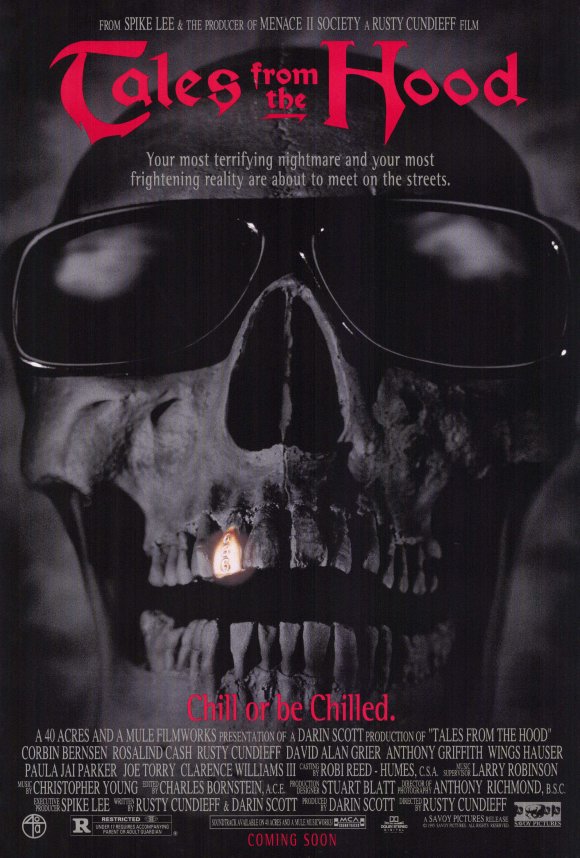
The road to hell is paved with good intentions. Rusty Cundieff’s anthology Tales from the Hood is a good idea: four vignettes of black life presented as horror stories — so, a horror flick with a message, more commentary than a “scary movie.” I see why Spike Lee attached his name to it (as executive producer).

Cundieff and cowriter Darin Scott pick material topics that still resonate more than 20 years later: racism, police brutality, domestic abuse, drugs, and black-on-black violence. The messages are strong, but unfortunately the writing always isn’t.

The best segment is “Hard Core Convert,” which is also the closer. Jerome a.k.a. Crazy K (Lamont Bentley) is a drug dealer shot in a gang hit. He wakes up in a Kafkaesue prison, where a stern nurse (Lira Angel) subjects him to rehabilitation methods straight from A Clockwork Orange. This particular piece and the way it’s executed are both powerful and memorable.

The second segment, “Boys Do Get Bruised,” takes on domestic abuse. It’s not bad, but it’s not great. The other two segments, “Rogue Cop Revelation” and “KKK Comeuppance,” fall flat.

Tales from the Hood targets the right notes, but it misses many of them. For one thing, the approach here is really heavy-handed. Plus, the impact is diluted by the silly bit that frames the stories: a funeral home in South Central Los Angeles run by weirdo Mr. Simms (Clarence Williams III). He tells the four stories to three “gangstas,” Ball (De’aundre Bonds), Bulldog (Samuel Monroe Jr.), and Stack (Joe Torry), who stumble into the home looking for drugs. I could have done without this device — it served as a distraction more than anything.

With Wings Hauser, Tom Wright, Anthony Griffith, Michael Massee, Duane Whitaker, David Alan Grier, Brandon Hammond, Rusty Cundieff, Paula Jai Parker, Corbin Bernsen, Roger Guenveur Smith, Art Evans, Rosalind Cash, Chris Edwards , Troy Cartwright, Brenden Jefferson, Tim Hutchinson, John A. Cundieff, Bobby McGee, Christina Cundieff, Ricky Harris, Darin Scott, Mark Christopher Lawrence, Scotty Brulee, Ryan Williams, Kamau Holloway, Tasha Johnson

Production: 40 Acres and a Mule Filmworks

Distribution: Savoy Pictures Entertainment

98 minutes
Rated R

(Music Box) C-

Music Box of Horrors

Ginger Snaps

(Canada 2000)

“Shit, wrists are for girls. I’m slitting my throat.”

— Ginger Fitzgerald

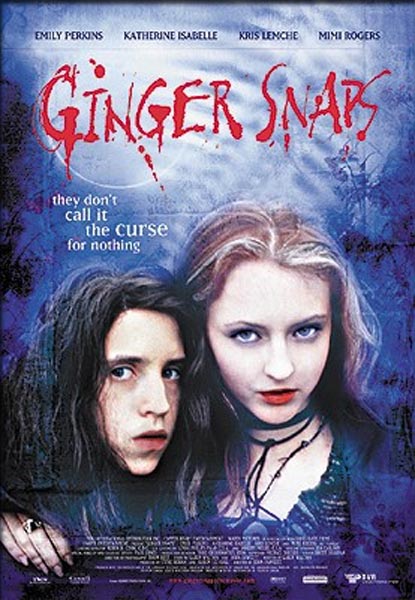
Puberty is tough enough without your older sister turning into a werewolf. Just ask 15-year-old Brigitte Fitzgerald (Emily Perkins), who with her sib, Ginger (Katharine Isabelle), stages gory death scenes and takes pictures of them, like a pair of morose Cindy Shermans. When they were kids, they made a pact to die together. Their classmates think they’re weird.

A run-in with mean girl Trina Sinclair (Danielle Hampton) sparks a war. Walking through the woods on their way to exact revenge one October night with a full moon, Ginger gets her first period. She also gets attacked by a mysterious and savage beast — the same one responsible for eviscerating all the dogs in the neighborhood.

Ginger turns increasingly feral over the next few days, growing more aggressive and sexual. Her wounds, which heal almost immediately, are sprouting hair. Oh yeah, she’s also developing what appears to be…a tail?

Brigitte, or “B,” connects with cute, brooding dope dealer Sam (Kris Lemche), who struck and killed the beast while he was driving his van down the road where it ran after it attacked Gretchen. He’s got a recipe for what might be the cure. The clock is ticking as Gretchen gets farther out of control, and Halloween — with another full moon — approaches.

On paper — all I had going into it because I’d never heard of it — John Fawcett’s Ginger Snaps sounds dubious at best. The premise seems trite. The part about the period sounds stupid, and the analogy to “becoming a lady” is obvious.

Turns out, Ginger Snaps is surprisingly good. Incorporating familiar elements of teen movies and splatter flicks, Fawcett, who wrote the screenplay with Karen Walton, pushes the “suspension of disbelief” envelope. He knows just when to stop, though. There’s quite a bit of gore here. The special effects are dated but effective nonetheless.

What really sells this film, though, is the acting: Perkins and Isabelle evoke a warmth to their relationship despite their offputting personalities and a fierceness to their bond. They’re totally believable as sisters. The final scene, which involves only them, is downright sad. Crushing, even.

With Mimi Rogers, Jesse Moss, John Bourgeois, Peter Keleghan, Christopher Redman, Lindsay Leese, Wendii Fulford, Pak-Kong Ho, Lucy Lawless

Production: Motion International, Copperheart Entertainment, Water Pictures, Lions Gate Films, Oddbod Productions, TVA International

Distribution: Motion International (Canada), Unapix Entertainment Productions (USA), Lions Gate Films

108 minutes
Not rated

(Music Box) B-

Music Box of Horrors

http://www.gingersnapsthemovie.com

Hellraiser

(UK 1987)

“Oh, no tears, please. It’s a waste of good suffering!”

— “Pinhead” (the Lead Cenobite)

Roger Ebert famously derided Clive Barker’s directorial debut, the sadomasochistic horror classic Hellraiser, calling it “without wit, style, or reason” for its “bankruptcy of imagination” (http://www.rogerebert.com/reviews/hellraiser-1987). Well, talk about tearing your soul apart!

Hellraiser isn’t particularly scary, but it is creepy and fucking weird. I certainly don’t find it lacking wit, style, or imagination; quite the opposite. It’s a ridiculous, kinky, and bloody telenovela. Based on Barker’s short novel The Hellbound Heart, Hellraiser takes the idea of something in the attic to a place no one else has.

Larry (Andrew Robinson) and Julia Cotton (Clare Higgins) have a strained marriage. After leaving Manhattan to go live in his abandoned boyhood home somewhere on the Atlantic coast, Julia finds Larry’s brother — who’s her ex lover — Frank (Sean Chapman in the flashbacks and Oliver Smith in the present) reanimated without skin in the attic. The movie doesn’t explain it, but the novel does: Larry cuts his hand and drips blood onto the attic floor, right where Frank’s comeshot dried up in the floorboards. Nice.

An unrelenting hedonist, Frank lost his body and soul to demons in his quest for sexual gratification. It started with an antique puzzle box that opened a portal to hell and summoned the Cenobites, led by “Pinhead” (Doug Bradley), the apparent spokesman for the motley foursome. Now, Frank needs blood, which is where Julia comes in. Too bad Frank’s daughter, Kirsty (Ashley Laurence), keeps getting in the way.

The special effects look cheap and the plot is choppy. It isn’t clear at first whether the cuts to Frank and Julia getting it on are flashbacks or fantasy, so this detail could have been done better. Nonetheless, Hellraiser is totally engrossing (and at points, just gross). Barker makes a silly story bizarre enough to keep you interested in what happens next. Higgins effectively channels a tortured melodramatic ’50s B-movie damsel in distress. And her big ’80s hair and sunglasses are fabulous!

Perhaps the best thing Hellraiser has going for it, though, is its twisted sense of humor: all of this happens — and will happen again — because Frank thinks with his dick. Now that’s funny.

With Nicholas Vince, Simon Bamford, Grace Kirby, Robert Hines, Anthony Allen, Leon Davis, Michael Cassidy, Frank Baker, Kenneth Nelson, Gay Baynes, Dave Atkins, Oliver Parker

Production: Cinemarque Entertainment BV, Film Futures, Rivdel Films

Distribution: New World Pictures (USA), Entertainment Film Distributors (UK), Highlight Film (West Germany), Paraiso Films S.A. (Spain), Prooptiki (Greece), Roadshow Film Distributors (Australia), Toei Classic (Japan), Vestron Benelux (Netherlands)

94 minutes
Rated R

(Music Box) B-

Music Box of Horrors

http://www.clivebarker.info/hellraiser.html

The Florida Project

(USA 2017)

“Relax. Your daughter’s perfectly fine in my hands.”

— Moonee

Sean Baker’s Tangerine (https://moviebloke.com/2015/07/28/tangerine/) impressed me. On the surface an offbeat odyssey of castoffs living on the fringe in West Hollywood, it’s one of those films that creeps up and hits you at the end. Comprised largely of small moments and vignettes strung together, its sum is much more — and completely different — than its parts: insightful, powerful, and quietly profound.

Come to think of it, Barry Jenkins’s Moonlight (https://moviebloke.com/2016/11/19/moonlight/) operates in a similar way even though it’s not the same story.

I was thrilled to hear that Baker has a new film, The Florida Project, out this fall. The comments I overheard from audience members while walking out of a prerelease screening were amusing but maddening: “That was realism, hard realism. Too hard.” “Well, that didn’t go anywhere.” “I had to force myself to stay awake.” “I wouldn’t recommend that to anyone.” Insert eyeroll here.

I disagree. The Florida Project switches gears, so it doesn’t end up where it seems to be going. The trailer makes it look like a childhood nostalgia movie, and it starts out like one. But it’s not. Often amusing but just as often difficult to watch, it paints a vivid picture that doesn’t criticize, demean, or sentimentalize its characters or their situation. I’ve heard Baker lauded for his humanism; his work definitely shows plenty of that if nothing else. His best attribute may be his willingness to let his characters develop into real people over the course of two hours or so.

To be clear, the impact of The Florida Project is not immediate. Baker’s pace isn’t quick, either. Written by Baker and Chris Bergoch, The Florida Project starts out as a sort of Little Rascals sitcom involving the misadventures of besties Moonee (Brooklynn Prince) and Scooty (Christopher Rivera), two grade school kids growing up in a sketchy roadside motel, the Magic Castle, that sits along a tawdry strip just outside the Magic Kingdon — a.k.a. Disney World in Orlando. A gun shop, a convenience store, a market that sells oranges, and a boarded up clinic dot the strip, which incidentally intersects with Seven Dwarves Lane.

Moonee and Scooty spend their days running around, screaming, and stirring up mischief. They spit all over a motel guest’s car. They drop water balloons on people. They spy on an elderly topless sunbather (Sandy Kane). They scam change to buy ice cream. They set a fire. They recruit a third hellion, Jancey (Valeria Cotto), who lives next door and easily goes along with their antics probably because there’s no one else to play with. Their favorite target is weary motel manager Bobby (Willem Dafoe).

Slowly, a different picture emerges and The Florida Project becomes another film. Moonee’s mother, Halley (Bria Vinaite), can’t get it together. Feral and clearly her own worst enemy, she lives hand to mouth with her young daughter. She’s constantly about to be evicted, and she takes free meals wherever she can get them. When selling stolen amusement park passes and wholesale perfume in the parking lot of a “nicer” motel up the street doesn’t work, she turns tricks in the room.

After Halley has a falling out with Scooty’s mom, Ashley (Mela Murder), Baker literally zooms in on Moonee.

The events here are purposely mundane, and it’s hard to say exactly where the climax is. It doesn’t matter: The Florida Project works because of the way Baker executes the story. He’s just as careful about choosing what he shows as what he doesn’t. The thrill here is watching the characters develop, anyway; that’s what makes The Florida Project soar. It doesn’t hurt that the acting is superb, particularly Vinaite, Prince (who at six years old is a natural — I almost cried when she did), and Dafoe, whom I haven’t seen this good since Mississippi Burning.

Alexis Zabe’s cinematography — alternating long shots and pans with almost uncomfortably close shots — works beautifully with the gorgeously effervescent color palette. The ending is unexpectedly touching and fun. The Florida Project just might be the first Oscar contender I’ve seen this year.

With Josie Olivo, Aiden Malik, Caleb Landry Jones, Shail Kamini Ramcharan, Sonya McCarter, Karren Karagulian, Kelly Fitzgerald, Lauren O’Quinn, Edward Pagan, Cecilia Quinan, Kit Sullivan, Andrew Romano

Production: Cre Film, Freestyle Picture Company, June Pictures, Sweet Tomato Films

Distribution: A24 (USA), Altitude Film Distribution (UK), Elevation Pictures (Canada), Filmcoopi Zürich (Switzerland), September Film (Netherlands), Front Row Filmed Entertainment (United Arab Emirates)

115 minutes
Rated R

(AMC River East) A-

Chicago International Film Festival

https://a24films.com/films/the-florida-project