Yeah…this. Hmmm. Herbert Blount (Penn Jillette) is a weird crowdfunding stalker obsessed with actress Missi Pyle, playing herself, who costars in a low budget crime-gore “movie” with Harry Hamlin and a guy named Reed (Hayes MacArthur). Blount, who is given behind-the-scenes access because he used his PayPal account to donate a large sum of money to the project, is seduced by the artistic process and secretly hijacks the film to make his own version: he wants Pyle front and center. He undermines the director (Adam Rifken), steals footage, and kidnaps Pyle to shoot new scenes with her in his basement.
A movie within a fake movie (Knocked Off), Director’s Cut is a satire of the film industry, celebrity, and the changing role of the audience. Directed for real by Rifken, it exhibits some competent technical handiwork: Knocked Off, little more than a CSI episode, looks professional right down to its angles, cuts, and color grade. A slew of cameos—some, like Jillette, former contestants of Celebrity Apprentice (Gilbert Godfrey, Lisa Rinna)—adds a smart lighthearted touch. Jillette’s longtime partner in magic, Raymond Joseph Teller, makes a fun though not exactly unexpected appearance. Pyle’s diva tantrums “off screen” are amusing. The film makes interesting and timely points about the dangers of giving artistic input and access to the general public and obsessed fans: even in an era where the tools of the trade are readily available to virtually anyone, not everyone can (or should attempt to) make a movie.
Director’s Cut just doesn’t cut it. Sadly, Jillette himself is the most disappointing thing about it. He doesn’t pull off creepy; his gentle, dulcet voice bantering lame “commentary”—like in a bonus feature of a DVD (get it?)—undermines that. Worse, his terrible “acting,” the oddly tame scenes he stages with Pyle, and his crude homemade edits of his version of the film paint him as a harmless grandfatherly dolt more than anything. The gimmick here wears out before the movie is even half over. Director’s Cut has good ideas, but it’s just not funny.
Alice Doesn’t Live Here Anymore defies classification: it’s a road movie, a coming-of-age film, a romance, and arguably a feminist statement.
On one hand, it’s a dark study of Alice Hyatt (Ellen Burstyn), a neglected Soccoro housewife thrust into an awful situation: her husband, Donald (Billy Green Bush), is killed in a truck accident, leaving her with nothing. Forced to fend for herself and her 12-year-old son, Tommy (Alfred Lutter), she turns to the only thing she knows: singing. In dark piano bars. Um, in New Mexico and Arizona. It doesn’t pan out, so she takes a job as a waitress in Tuscon, which, we are informed, is the “weird capitol of the world.” Fucking dismal. On the other hand, Alice Doesn’t Live Here Anymore is a marvelously sublime but uncomfortable comedy that exploits for all it’s worth Alice’s cluelessness in her search for the American Dream. Director Martin Scorsese and screenwriter Robert Getchell throw out so much to laugh at, and I do—it’s just not clear that I’m supposed to. Hence the genius of this film, one my absolute favorites.
Like most films you watch over and over, Alice Doesn’t Live Here Anymore is loaded with great lines—far too many to even begin repeating here; this is what keeps me coming back. Early career performances by the likes of Harvey Keitel, Kris Kristofferson, Valerie Curtin, Diane Ladd, and yes, Jodie Foster are a treat! The acting is superb; in fact, Burstyn won an Oscar and Ladd was nominated for one (as was Getchell). Audrey (Foster), clearly a precursor to Taxi Driver‘s Doris, is the smartass trouble girl I always wanted to hang out with: she drinks Ripple, steals guitar cords, and refers to her mother as “Ramada Rose.” Fuck yeah! And how cool to witness the birth of Alice, the TV series? Mel (Vic Tayback) is the exact same character, and Ladd, the original Flo—she doesn’t say “Kiss my grits” but she does say “Mel, you can kiss me where the sun don’t shine!”—was reanimated as Belle after Polly Holliday left.
Alice and Tommy might be pitiful, but they’re not pitiable. For all its tragedy, the film’s ending is a positive if not happy one: Alice and Tommy make peace with where they end up. Who knows whether it ultimately works out? They’re good for now. They can always start over—in Monterey or anywhere else. If there were such a thing as American neorealism, this film qualifies (except maybe for the fact that these are professional actors).
I’ve seen Alice Doesn’t Live Here Anymore hundreds of times, usually edited for late night TV. I can see it a hundred times more. It never gets old. I recommend the unedited original version.
“If you point a gun at someone, you’d better make sure you shoot him. And if you shoot him, you’d better make sure he’s dead. Because if he isn’t, then he’s gonna get up and try to kill you.”
—Ray
“I ain’t done nothing funny.”
—Abby
“Well, ma’am, if I see him, I’ll sure give him the message.”
—Loren Visser
I snagged tickets for the first screening when a theater near me announced a brief summer run of the Coen Brothers’ debut Blood Simple. A sharp 4K digital restoration, I’m not sure whether this is the original version—a few minor edits and cuts have been made over the years, and a song (The Four Tops’ “It’s the Same Old Song,” appropriately enough) was taken out and put back in. It doesn’t matter, though, because whatever changes were made are imperceptible, as least to me. This version is exactly as sordid, labyrinthine, and suspenseful as I remember.
Written by both brothers with Ethan as producer and Joel as director, everything about Blood Simple. is unique and masterful. The story starts out simple: set in rural Texas, bar owner Marty (Dan Hedaya) suspects that his wife, Abby (Frances McDormand), is having an affair and hires a private investigator, Loren Visser (M. Emmet Walsh), to find out whether he’s right. He is: Visser follows Abby and one of Marty’s employees, Ray (John Getz)—a bartender, of course—to a motel and takes photos of them in flagrante delicto. Soon after, Ray quits his job, provoking Marty to reveal that he’s onto Ray and Abby. Marty asks Visser to kill them, and that’s when things get complicated.
WARNING: Potential spoilers ahead!
Visser, you see, is a con man: he takes Marty’s money but doesn’t really kill Ray or Abby—instead, he doctors one of the photos he took at the hotel to look like they’re both dead; he paints on bullet wounds and gives the finished photo to Marty. A brilliant series of events all stemming from misunderstandings—like an episode of a demented Three’s Company—ensues, dragging all four characters into a murderous downward spiral.
Initially shown on the film festival circuit during autumn 1984 before a wide release in January 1985, the Coens’ clever mix of psychology, film noir, and seriously dark humor is unparalleled by anything else from its day—the top three films of 1984 were Beverly Hills Cop, Ghostbusters, and Indiana Jones and the Temple of Doom, if that says anything (http://www.boxofficemojo.com/yearly/chart/?yr=1984). Blood Simple. exhibits the Coens’ distinctive penchant for ridiculously well developed and eccentric characters, perfect dialogue, flawless plot layering and pacing, fierce tension that makes you squirm, misanthropy, and an innovative use of clichés—all hallmarks of their work. This film, which launched not just their careers but also those of McDormand (it’s her first gig in a movie) and cinematographer Barry Sonnenfeld, is done so well it succeeds without a big budget. It’s a solid debut that serves as a blueprint of what was to come from these guys.
With We Monsters, Sebastian Ko examines who’s worse in a tough situation: the transgressive child who caused it, or the parents protecting her. Don’t be quick to call it, because the answer isn’t clear.
Self-absorbed and buffoonish Paul (Mendi Nebbou), an ageing newly-divorced musician, and his sour teenaged daughter, Sarah (Janina Fautz), are en route to summer camp when she asks him to pick up her schoolmate Charlie (Marie Bendig). Curiously, Charlie is already waiting on the road—in the middle of the forest where they’re driving. After a petty bicker in the backseat—over a boy, of course—Paul pulls over for a pit stop. The girls disappear, and Paul soon finds Sarah standing on the edge of a dam. She coolly tells him she pushed Charlie off.
Thus begins the drama as Paul and his ex-wife, Christine (Ulrike C. Tscharre), struggle with handling Sarah’s deed: how do they hide what she did—and how could they? And why is she so indifferent? We Monsters is a morality play oozing psychological dread worthy of a Hitchcock film, especially when Charlie’s volatile alcoholic father (Ronald Kukulies) comes around looking for her. One cover up leads to another, and soon Paul and Christine are in over their parental heads. But is the situation really what it seems?
A few spots are slow, but We Monsters still kept me riveted. The story for the most part is paced well, and the acting is really good. Andreas Köhler’s cinematography is beautifully understated and drab, letting the characters and the drama take center stage. About an hour in, Ko’s tense tone gives way to something decidedly dark, comic, and ironic—and it plays out nicely. Karma’s truly a bitch.
According to Variety, an American remake is in the works (http://variety.com/2016/film/news/we-monsters-remake-veena-sud-broad-green-1201701398/). Let’s hope it’s half as good, but I doubt it will be: We Monsters is not a story I see resonating with a mainstream American audience without some tweaking that changes the story and kills the mood.
“Now the fact that you will turn into an animal if you fail to fall in love with someone during your stay here is not something that should upset you or get you down. Just think, as an animal you’ll have a second chance to find a companion. But, even then, you must be careful; you need to choose a companion that is a similar type of animal to you. A wolf and a penguin could never live together, nor could a camel and a hippopotamus. That would be absurd.”
—Hotel Manager
Every now and then, a film so wonderfully unique comes along that you just don’t know what exactly to make of it until you take some time to digest it (I took all summer to write and post this entry). The Lobster is such a film. It’s not going to appeal to everyone—it’s a dark, subtle, absurd, uncomfortable, irreverent, and totally open-ended satire of the desire to be “in a relationship.” None of this is the stuff of a summer movie, but I loved it precisely because of these qualities. So far, The Lobster is easily my favorite film I’ve seen this year—released in Europe last fall, it crossed the Atlantic just this past spring.
In the not-so-distant future in a not-so-distant society, being single is against the law. Regardless of the reason for their singularity (death of a spouse, divorce, being dumped), unattached adults must check into a certain hotel designated for singles and find a suitable match, verified and approved by the hotel manager (Olivia Colman), within 45 days. Everything is regimented with meal times, active learning exercises, forced social events, and a strict prohibition on masturbation (though one form of sex with the housekeeping staff is required). “Guests” can buy additional time by shooting “loners”—rogue outlaw singles who escaped to the woods—on daily hunting excursions that resemble Hunger Games. Those who fail to find someone before their time runs out are transformed into the animal of their choice, selected during their initial processing, and banished to the woods.
The Lobster’s protagonist, mild-mannered David (Colin Farrell), finds himself at the hotel, his brother, Bob—now a dog—in tow, after the end of his marriage. He chooses a lobster as his animal because “lobsters live for over one hundred years, are blue-blooded like aristocrats, and stay fertile all their lives.” He also likes the sea.
WARNING: Potential spoilers ahead!
The Lobster is essentially divided into two acts: the first in the hotel and the second in the woods. David connects with fellow guests the Lisping Man (John C. Reilly) and the Limping Man (Ben Wishaw). David notices that the guests there tend seek others like themselves—except for Heartless Woman (Angeliki Papoulia), an emotionless femmebot who seeks out no one but has a seemingly infinite amount of time left thanks to her ruthless archery skills. David decides to go for her, which leads him to the woods. There, he meets the Short Sighted Woman (Rachel Weisz), who is near-sighted like he is. They connect, but the militaristic Loner Leader (Léa Seydoux) forbids all romance—punishable by mutilation. “We dance alone,” she tells David as she hands him an iPod. “That’s why we only play electronic music.”
Written by Yorgos Lanthimos and Efthimis Filippou, the screenplay feels like a Chuck Palahniuk novel. The story is so bizarre and far fetched that it seems silly on paper, but proves incredibly powerful once in motion—in the same way that Being John Malkovich, another film I love that requires the same suspension of disbelief, didn’t sound like much to me before I saw it. Lanthimos has a taste for sadness and the macabre, and he liberally infuses The Lobster with both. He doesn’t take a dim view of relationships, but he notices the dim things people do to have one. The cinematography by Thimios Bakatakis is fabulously drab, with a cool, monotonous, faded color palette that creates a sense of distance and evokes a sense of resignation. Classical music plays throughout to add a kind of Clockwork Orange weirdness to the whole thing.
Despite the mood here, the story turns out to be oddly beautiful. Farrell gives one of his best performances—he drops all his rakish charm to become a colorless, big-bellied middle-aged schlub I found myself rooting for with each predicament he gets into. The inability of David and the Short Sighted Girl to express their feelings for each other is damn near heartbreaking. The entire cast is outstanding, and not a single character is superfluous. The second act is noticeably slower than the first, and perhaps could have been shorter than it is. Regardless, the momentum continues to build to a brilliantly ironic ending that comes about through David’s nearsightedness.
The Lobster doesn’t resolve in the end, which is my favorite thing about it. The viewer is left to decide what happens—and I’ve already discussed different opinions others have about whether David did, or didn’t. It’s the kind of film that lingers on in your memory and forces you think about it even though you’ll never know for sure.
Side note: the film’s website has a quiz that determines your suitable animal. Mine were an elephant, a horse (which finds pleasure in carrots, music, and oral sex), and a water bear. I chose a horse, of course.
What would life be like in the 21st Century if humans never evolved beyond apes? How would our human qualities, good and bad, play out? Are humans any different from other animals? Director/screenwriter/actor Steve Oram illustrates his answer to these deep questions with Aaaaaaaah!, a project that sounds fascinating on paper but turns out to be anything but.
Following a group of modern primates (Julian Barratt, Noel Fielding, Lucy Honigman, Tom Meeten, Oram, Julian Rhind-Tutt, and Toyah Willcox), Aaaaaaaah! is an hour and a half of grunting, fighting over food and mates, flashing body parts, openly masturbating and having sex, peeing and pooping on stuff, and generally establishing dominance with gratuitous gore peppered throughout. The plot, flimsy and hard to follow, isn’t funny, witty, engaging, interesting, or thought provoking. It’s terrible, like a bad inside joke I’m not a part of or an even worse art film. I couldn’t wait for this to end.
Aaaaaaaah! very well may be the worst movie I’ve ever seen. EVER. It fails on every single level. Waiting to enter the theater, I overheard someone in line behind me compare Oram to early John Waters and Andy Warhol. Um, no—those guys both had a wit that Oram lacks, at least from what I can tell here. A better title would have been Uuuuuuuugh!
I had the wrong idea walking into Mad; the synopsis in the festival guide painted a picture of a mean-spirited comedy about two fighting sisters and their mother who just had a nervous breakdown. I expected something along the lines of a loud, riotous snarkfest brimming with angry, deranged female humor that someone like Bette Midler might have done. Mad is not that at all—it’s far better.
First-time screenwriter and director Robert G. Putka drops us into the lives of three women: Mel (Maryann Plunkett), a lady starting her sunset years who just had a nervous breakdown following her divorce; her older daughter, Connie (Jennifer Lafleur), who has all the trappings of a yuppie life; and her younger daughter, Casey (Eilis Cahill), who is floundering as she quickly approaches her thirties. Mad explores the dynamics of the relationships between them without judgment or moralty, and gets into mental illness on the side.
The characters here are flawed, which makes the film not just believable but good. Very good. Mel may or may not be “crazy,” but she doesn’t step up to take control of her fate—which is exactly how she ends up committing herself to a psych ward. Connie is caustic—judgmental, condescending, insensitive, and extremely vocal, she can’t keep her malicious comments to herself. For some reason, her mother and her sister bring out her worst. A work situation involving a criminal investigation shows how far from perfect she really is. Casey is sweet but aimless, seemingly lacking any street smarts or ambition. She’s stuck—she tries to find herself in things like webcams, online hookups, and writing groups. It’s not working.
This all might sound heavy, but Mad has a sense of humor. An uncomfortable scene at Casey’s writing club is laugh-out-loud funny, but Putka generally doesn’t go for easy laughs. The humor here for the most part is subtle and has a basis in etiquette and social behavior. A fellow patient, Jerry (Mark Reeb), and the ward counselor, Todd (Conor Casey), both provide comic relief in different ways without becoming caricatures. The acting is quite good, and the whole thing is put together exceedingly well.
Putka doesn’t give much background on his characters, and that’s fine because it really isn’t necessary. He doesn’t treat mental illness like a Lifetime movie; he’s direct, objective, and not all that dramatic about it. He comes off a bit cynical, but I found his presentation refreshing; after all, therapy doesn’t work for everyone. I liked so much about Mad, which has many moments of brilliance. I hope to see more by Putka.
What a great way to get into the Easter spirit: an afternoon screening of Willy Wonka and the Chocolate Factory complete with Rocky Horror-esque audience participation (without the swearing) and a goodie bag filled with bubbles, taffy, a chocolate egg, an exploding popper, and a glow stick—sign me up!
One of the first movies I remember seeing, ever, is Willy Wonka and the Chocolate Factory. I saw it with my sister and my cousins (Billy and Dottie), and I couldn’t have been more than three or four years old. We saw it at the Madison Theatre, which is long gone. Here’s a picture of it: http://cinematreasures.org/theaters/7383
I still remember what it looked like inside: it was a big open theater with a concession stand at the top of the seats divided by a half wall that allowed one to see the screen while purchasing popcorn. Today, it’s a lumberyard as it has been for decades. Sigh.
But I digress.
So how’s the movie? The screenplay isn’t totally true to Roald Dahl’s 1964 novel—he started it but didn’t finish it, and ultimately disowned the final version (https://en.wikipedia.org/wiki/Willy_Wonka_%26_the_Chocolate_Factory)—but it makes no difference. Director Mel Stuart keeps the film, to borrow from one of the songs, pure imagination and good fun. The sets are simple and the “special effects” are really low tech, like that trippy boat scene and the graphics accompanying the Oompa Loompas as they sing. Regardless, a timelessly magic quality that doesn’t need much comes through. Clearly, this is not the United States even if Charlie (Peter Ostrum) and Grandpa Joe (Jack Albertson) speak in an American dialect. One of my favorite scenes from any movie is the one in which Violet (Denise Nickerson) turns into a blueberry. And who doesn’t love watching all these shitheads meet their fate: Augustus (Michael Bollner) sucked into a tube, Veruca (Julie Dawn Cole) falling down a trash chute to be incinerated, and Mike Teevee (Paris Themmen) shrunk down to size? The color pallette is an awesome late 60s drab, and the clothes are amazingly gaudy. Everyone’s hair is stiff. The whole thing is wonderfully weird.
I love Wonka’s (Gene Wilder) deadpan disdain for, like, everything. The Oompa Loompas’ moralistic nursery rhymes against eating too much, chewing gum, being a brat, and watching too much TV are awesome. Some scenes are thin and quicker than I remember, but it’s a perfect movie for kids. It even has a happy ending. I never found it scary.
Willy Wonka and the Chocolate Factory still brings a smile to my face after all these years. Although I didn’t mind Tim Burton’s remake, I’ll take the original any day. Oh yeah—a trip to the candy store after the film (like I had) is obligatory.
In 2014, the United States Library of Congress deemed Willie Wonka and the Chocolate Factory “culturally, historically, or aesthetically significant” and selected it for preservation in the National Film Registry.
I’m no economist, and, well…math is hard. I get that lax lending practices led to the housing market collapse in 2008, but I sure as hell don’t have a firm grasp on what else contributed to the financial meltdown. With The Big Short, writer and director Adam McKay takes on the courageous and potentially suicidal task of explaining it all, Schoolhouse Rock style—only hopped up on Adderall.
Based on the nonfiction exposé The Big Short: Inside the Doomsday Machine by Michael Lewis, The Big Short follows the intertwined stories of Michael Burry (Christian Bale), a socially inept Metallica-blaring doctor-turned-hedge fund-manager with Asperger’s, a glass eye, and a cyst on his face that bummed me out every time I saw him; douchebag Wall Street trader Jared Vennett (Ryan Gosling), who doubles as narrator; cynical, boorish, and fictitious Chicken Little hedge fund manager Mark Baum (Steve Carell) and his team; newbie investors Charlie Geller (John Magaro) and Jamie Shipley (Finn Wittrock); and retired banker Ben Rickert (Brad Pitt), who’s got no love for the business. In one way or another, they all aim to profit from mass calamity—and they succeed. The standouts here easily are Gosling and Carell, who have a natural chemistry and seem to have fun with their parts. Pitt, who plays psychos and goofballs better than anyone (e.g., True Romance, 12 Monkeys, Fight Club, Snatch—need I say more?), has a secondary role, but he’s awesome; I didn’t recognize him right away. Bale, on the other hand, is a bit much—to the point of being a downer.
The story involves dry, technical, and boring financial concepts, usually abbreviations: credit default swaps (CDS), collateralized debt obligations (CDOs), NINJA loans—not the stuff that typically generates emotion or drama. McKay uses a number of offbeat but smart gimmicks to explain the basics: celebrity cameos (Selena Gomez and Anthony Bourdain, to name two), demonstrations (a la Jenga), breaking character, songs and graphics. His approach does the trick, and it’s entertaining. Very much so. However, it’s not perfect: the pacing, though not as frenetic as Wolves of Wall Street, still wore me out by the end. Some questions remain in my mind—like how you can bet against something like the economy. It’s also still unclear how it all happened. To quote the movie, though, “[t]he truth is like poetry, and most people fucking hate poetry;” I think that’s the essence. One thing is certain: McKay is outraged; by showing us that the nonsense continues, he wants us to be, too.
The trailers piqued my interest but didn’t totally sell me, so I wasn’t sure about The Hateful Eight. My apprehension was unfounded: it’s gotdamn motherfucking Quentin Tarantino, all the motherfucking way, motherfucker. If that last sentence sounds good to you—and you read it how Jules Winnfield might say it—well, you’re in for a treat. I said, goddamn, goddamn!
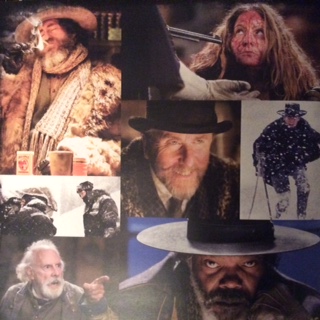
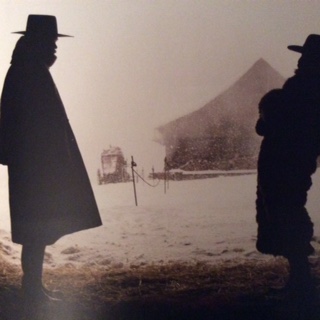
Traveling through Wyoming on the way to Red Rock not long after the Civil War, bounty hunter Major Marquis Warren (Samuel L. Jackson) is caught in the mountains just as a blizzard is a-brewing. He stops a stagecoach that happens to be carrying another bounty hunter, John “The Hangman” Ruth (Kurt Russell), and his captive, the lovely Daisy Domergue (Jennifer Jason Leigh)—who has blood on her face for nearly the entire film—and finagles a ride. Another guy, Chris Mannix (Walton Goggins), who claims to be en route to Red Rock to become sheriff, is thrown into the mix. The blizzard forces them to seek shelter at Minnie’s Haberdashery, where they join four strangers: “Mexican Bob” (Demian Bichir), smarmy Oswaldo Mobray (Tim Roth), quiet cowboy Joe Gage (Michael Madsen), and “The General” (Bruce Dern), a frail former Confederate soldier. Niceties, banter, and then expletives are exchanged until characters are killed off, Ten Little Indians style but with twists—Agatha Christie never blew anyone’s nuts off. Then again, Tarantino’s way of telling a story is completely his own.
True to form, Tarantino jams The Hateful Eight with memorable miscreants, snappy dialogue, and impossibly crazy cutthroat situations. The action here is intense and suspenseful, unfolding gradually and teasingly. The timing is out of sequence—no shock there. The plot gets thicker with each character that falls off, leaving questions begging for answers. Best of all, not a single performance is subpar and not a single character—except maybe Minnie’s helper—is superfluous. Russell and Dern stand out, but Jackson is a master scene-stealer—his delivery is so strong that you simply cannot turn away when he speaks. Channing Tatum makes a surprise appearance and gives an even more surprisingly impressive performance.
Well, let’s not start sucking each other’s dicks quite yet. The story has a hole or two, and the gore is so over the top it loses its impact at points. There’s the use of the ‘n’ word like a mere conjunction. Jason Leigh sounds annoyingly like Roseanne Barr. Oh yeah—more than eight characters actually appear, which a couple of times—namely when everyone is in the same small room—requires extra concentration to follow along. All that said, though, none of it detracts from enjoying the film. Yes, it lacks the elegance and grace of Kill Bill, my personal favorite, but The Hateful Eight is toward the top of Tarantino’s resume. I loved every minute—which did not seem like three hours.
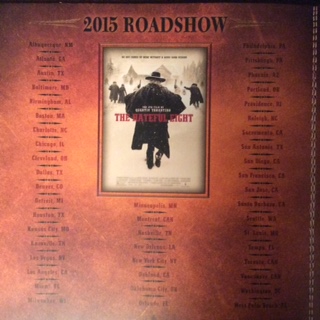
Side note: the overall experience was one I’ve never had at a movie theater. Truly a bona fide “event,” the atmosphere was like a rock concert: the screening was sold out ahead of time, and the crowd was abuzz with excited fans taking pictures and chattering about other Tarantino films. Some had on Reservoir Dogs and Kill Bill tee shirts. The line to get in was all the way to the next block. Programs were provided. Shot on decadent 70-millimeter film, the Music Box showed The Hateful Eight on a brand spanking new screen it acquired for this special “roadshow engagement.” The price was double a normal ticket but oh so worth it.
The Hateful Eight ended my year of movies on a high note—I can’t think of a better director to release a new film to close out the year. To borrow from it, “Old Mary Todd is calling, so it must be time for bed.” Time will tell for sure, but I think this one belongs to the ages.





 moviebloke