Valley Girl

(USA 1983)

“Girls, we must fuck him.”

— Loryn


“Man, he’s like tripendicular, ya know?”

— Julie Richman


“Kings and queens, they don’t grow on trees.”

— Prom Teacher


“Well, fuck you, for sure, like totally!”

— Randy

“Bitchin’! Is this in 3D?” asks Tommy (Michael Bowen), whom no other Val dude can touch. It’s a fair question for a ticket taker wearing 3D glasses, I guess. “No,” responds Randy (Nicolas Cage) nonchalantly as he rips his ticket. “But your face is.” Burn!

I don’t know why Deborah Foreman isn’t on the poster, but I can’t help love Valley Girl. Directed by Martha Coolidge and written by Andrew Lane and Wayne Crawford, it’s a classic that always makes me smile. It’s not because it’s Nicolas Cage’s debut as Nicolas Cage (before Valley Girl, he was Nicolas Coppola). It’s not because it comes straight from the early ‘80s, or because it’s got a totally narly-ass soundtrack, or because of its awesome lines, or because it resonates, like, totally. It’s all of that. And more.

Well, like, it’s sushi, don’t you know? No one will mistake Valley Girl for anything but a product of its time. However, anyone can identify with the dilemma of Julie Richman (Foreman), who’s into Randy (Cage) because he’s not like all the other guys at school, but her friends don’t approve because, well, he’s not like all the other guys at school. He’s from the city — Hollywood, to be exact — and he’s new wave. Oh, the horror!

Randy sweeps Julie off her feet, taking her on a wild ride and introducing her to things you don’t get in the Valley. Her friends, shallow as they are, pressure her to drop Randy for Val dude Tommy (Bowen), who fits their idea of the right guy for Julie — never mind that they already dated and she broke it off because he made her feel “like an old chair or something.” Julie’s heart tells her not to do it. When her friends all but blacklist her, she capitulates. Spoiler alert: she’s not happy.

Randy’s heart is broken, but he won’t give up. He goes undercover, showing up literally everywhere Julie goes — drive-through diners, movie theaters, even camping out on her front lawn. Thanks to Randy’s bestie Fred (Cameron Dye), a plan to win Julie back comes together at her prom — which, incidentally, features Josie Cotton performing.

Part Rebel Without a CauseFast Times at Ridgemont HighGrease, and even The Graduate (Lee Purcell as Stacey’s mother is fantastic), Valley Girl is definitely romantic. It’s also fun and full of heart. The ending is predictable, but I wouldn’t have it any other way.

With Elizabeth Daily, Heidi Holicker, Michelle Meyrink, Tina Theberge, Richard Sanders, Colleen Camp, Frederic Forrest, David Ensor, Joanne Baron, Tony Markes, Camille Calvet, The Plimsouls

Production: Valley 9000

Distribution: Atlantic Releasing

99 minutes
Rated R

(Impact) B

Saturday Church

(USA 2017)

Ulysses (Luka Kain) is a quiet, delicate teen who lives in Queens and is just starting to figure out his sexual identity — it involves wearing panty hose under his jeans. When his father dies, he becomes the “man of the house.” Unfortunately, his mother (Margot Bingham), who works all the time, is already on edge because she caught him wearing her clothes. Ulysses shares a bedroom with his younger brother, Abe (Jaylin Fletcher), who knows that he’s still rummaging through mom’s closet on the sly and gives him shit for it. School is no respite because Ulysses’s classmates are jerks.

Enter stern Aunt Rose (Regina Taylor) to help at home while mom is away at work. She takes charge, usurping Ulysses and his mother as the master of the domain. She’s not about to have a dress-wearing freak around, so she pushes Ulysses toward the one cure she knows: the Lord.

Ulysses escapes to the Christopher Street Pier, where he meets a gang of “drag queens”: Ebony (MJ Rodriguez), Dijon (Indya Moore), and Heaven (Alexia Garcia). They take him to “Saturday Church,” a space in Greenwich Village where one night a week trans mother hen Joan (Kate Bornstein) offers a meal, a shower, clothes, perhaps a spot to vogue, and companionship to homeless LGBTQ kids. This is where Ulysses finds his groove.

Too bad mean Aunt Rose is waiting for him to come home.

Damon Cardasis’s first feature length film is a winning mix of Moonlight (https://moviebloke.com/2016/11/19/moonlight/ ), La La Land (https://moviebloke.com/2016/10/13/la-la-land/ ), and Tangerine (https://moviebloke.com/2015/07/28/tangerine/ ) with just the right splash of Paris is Burning (https://moviebloke.com/2016/08/26/paris-is-burning/ ). Saturday Church has some shortcomings, but the film oozes so much charm and warmth that I found it easy to forgive its flaws. Some of the songs and dance numbers are better than others — the song in the locker room and the other with Ulysses singing to his new boyfriend (Marquis Rodriguez) as they walk to the train stand out, especially when flower petals start falling. It’s really cool.

The acting is really good all around, but Kain is particularly awesome. He gives palpable tenderness and vulnerability to his character. The so called “drag queens” are not just fierce but downright touching. The way they save Ulysses is sweet. They make you long for a friend who has your back like they do. The story here totally sold me. I look forward to what’s next from Cardasis.

With Stephen Conrad Moore, Peter Y. Kim, Evander Duck Jr.

Production: Spring Pictures, Round Films

Distribution: Samuel Goldwyn Films

Screening introduced and followed by a live Q and A with Damen Cardasis

82 minutes
Not rated

(Directors Guild of America) B-

Outfest Los Angeles LGBT Film Festival

http://www.samuelgoldwynfilms.com/saturday-church/

The 400 Blows [Les Quatre-cents coups]

(France 1959)

Childhood is fertile ground for storytelling. Usually, the stories that sell are heavily nostalgic and sweet, but the more interesting ones tend to come from a darker past. French New Wave pioneer François Truffaut’s autobiographical film The 400 Blows is the latter.

Antoine Doinel (Jean-Pierre Léaud) is a prepubescent boy experiencing an existential crisis. At home, something is bubbling between his parents, mother Gilberte (Claire Maurier) and stepfather Julien (Albert Rémy). At school, a contemptible teacher known as “Sourpuss” (Guy Decomble) has him pegged as a troublemaker.

Antoine and his friend René (Patrick Auffay) cut class one day. They walk around, catch a movie, and enjoy a carnival ride—the Rotor, a cylindrical room that spins and the floor drops out, causing the riders to “stick” to the walls due to centrifugal force. While they’re running around, Antoine sees his mother kissing some man on the street. She sees Antoine when it’s too late.

The next day, Antoine makes up an excuse for his absence: he says his mother died. It doesn’t work. After a few incidents involving Balzac, a fire, running away from home, and a stolen typewriter, Antoine winds up at a reform school.

Some New Wave films are hard to follow or just boring to watch. Not so with The 400 Blows, and for quite a few reasons.

The narrative is definitely loose. Like all New Wave films, what happens isn’t as important as what the director is showing us. Here, though, the plot is straightforward and sticks to a more traditional structure even if it doesn’t have a true “climax” or a single moment of reckoning. Truffaut gives us some really great scenes in this movie, not the least of which is this one:

400 Blows paddywagon.jpg

The 400 Blows is realistic and personal; it unfolds like something literally happening right before us. The acting, naturalistic and unscripted, is probably the biggest boon to the film. That said, Henri Decaë’s camerawork is a major contribution as well. He shoots on the streets of Paris using hand-held equipment, which allows him to get right up in front of the action. It’s likely a product of an independent low-budget film, but intentional or not The 400 Blows is so much better as a result; this film would not work the same way without Decaë.

Truffaut makes us empathize with Antoine. He’s not a bad kid; his behavior is no worse than his classmates or the adults around him. He’s made out to be a bad kid, though. The sad part is that he believes it. What’s more, he clearly sees more to life than the little spot he occupies, but he’s no better off after he tries to be. At the end of the film, I want to be on the beach with him to tell him he’ll be okay.

As for the seemingly nonsensical title, I didn’t realize that it’s a literal English translation of the French idiom “faire les quatre cents coups”, which means “to raise hell.” Now that I know that, the title totally makes sense.

Nominated for an Oscar for its screenplay by Truffaut and Marcel Moussy (https://www.oscars.org/oscars/ceremonies/1960), The 400 Blows is a movie that consistently ends up on many “must see” lists. It’s considered a landmark film for good reason. It’s hard to believe that this is Truffaut’s first film.

With Georges Flamant, Pierre Repp, Daniel Couturier, Luc Andrieux, Robert Beauvais, Yvonne Claudie, Marius Laurey, Claude Mansard, Jacques Monod, Henri Virlojeux, Jeanne Moreau, Jean-Claude Brialy, François Nocher, Richard Kanayan, Renaud Fontanarosa, Michel Girard, Henry Moati, Bernard Abbou, Jean-François Bergouignan, Jacques Demy, François Truffaut, Philippe De Broca, Jean-Luc Godard, Jean-Paul Belmondo, Michel Lesignor

Production: Les Films du Carrosse

Distribution: Cocinor, MK2 Films, Janus Films (USA), Criterion (USA)

93 minutes
Not rated

(iTunes rental) A-

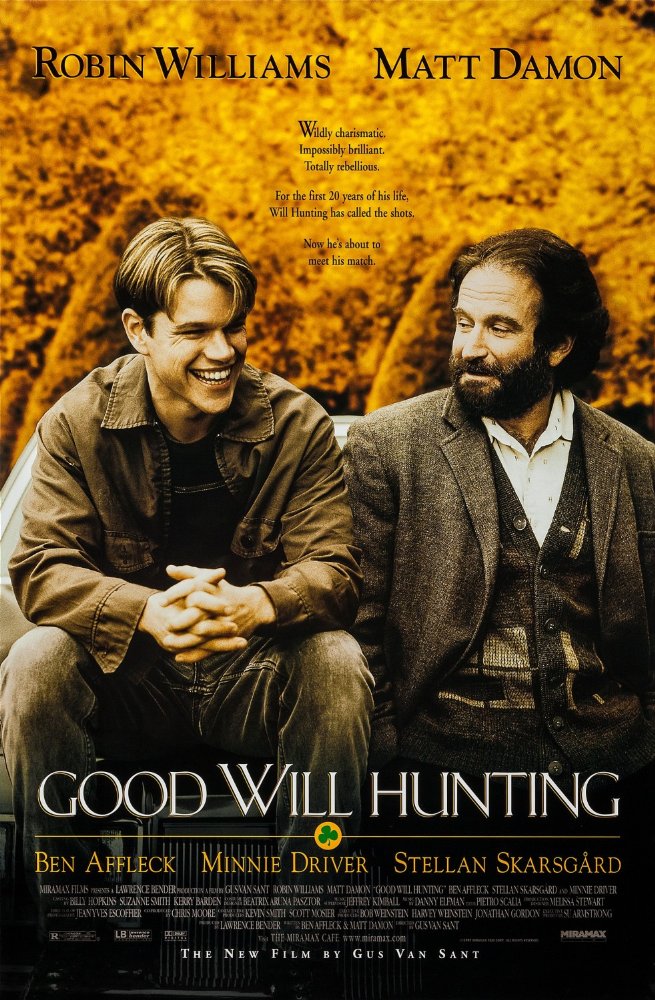
Good Will Hunting

(USA 1997)

“Well, I got her number. How do you like them apples?”

—Will Hunting

Good Will Hunting, the final screening of Chicago International Film Festival’s Totally ’90s series, is not something I associate with its director, Gus Van Sant. Frankly, I didn’t know he directed it until I saw his name in the credits.

No, I associate Good Will Hunting with longtime friends Matt Damon and Ben Affleck, who while they were both still relatively unknown turned the former’s drama class project into the script that would become this film (http://www.eonline.com/news/802830/looking-back-at-the-totally-crazy-story-behind-the-making-of-good-will-hunting). The success of Good Will Hunting seemed to come out of nowhere and established both of them as actors—never mind that they snagged the Oscar for Best Screenplay in 1998 (https://www.oscars.org/oscars/ceremonies/1998). Damon and Affleck have both written since, but none of their screenplays has been as successful as this one.

Gerald Lambeau (Stellan Skarsgård), a professor at MIT, is baffled when someone anonymously solves a wicked hahd math problem he posted on a chalkbaord in the hall as a challenge to his students—he expected it to take the entire semester. No one steps up to claim the work. He posts a second problem, one that took his colleagues two years to figure out. He’s amazed when he catches one of the school’s janitors, Will Hunting (Damon), red-handed. Will won’t have anything to do with Lambeau—until he ends up in jail for assault.

Recognizing Will’s gift, Lambeau makes a deal with him: he’ll pay for bail if Will works with him on math and sees a therapist. The problem is, Will doesn’t make it easy to connect. In fact, five different therapists fail. As a last resort, Lambeau calls former classmate Sean Maguire (Robin Williams), who has a similar Southie background as Will and stands up to his crap. Sean sees that Will is deflecting to hide his self-sabotaging tendencies.

Meanwhile, Will meets Skylar (Minnie Driver), who sweeps him off his feet. It all goes well until she tells him she’s going to medical school at Stanford—and asks him to go with her.

The script here is loaded with good ideas and gorgeous details—that story about Sean ditching a Red Sox game to be with a girl he just met in a bar (she would become his wife) is gold. So is Will’s confrontation with a grad student (Scott William Winters) at a dive. Hearing Damon sing “Afternoon Delight” while he’s faking hypnosis is hilarious. The story, though, is predictable. Good Will Hunting excels because of the acting. The casting—by Kerry Barden, Billy Hopkins, and Suzanne Smith—makes all the difference in the world.

With Ben Affleck, Casey Affleck, John Mighton, Rachel Majorowski, Colleen McCauley, Cole Hauser, Rob Lyons, Steven Kozlowski, Jennifer Deathe, Philip Williams, Patrick O’Donnell, Kevin Rushton, Jimmy Flynn, Joe Cannon, Ann Matacunas, George Plimpton, Francesco Clemente

Production: Lawrence Bender Productions, Be Gentlemen Limited Partnership, Miramax Films

Distribution: Miramax Films (USA), Bac Films (France), Buena Vista International (UK), Cecchi Gori Distribuzione (Italy), Filmes Castello Lopes (Portugal), Intersonic (Czech Republic), Laurenfilm (Spain), Lider Films (Argentina), SF Norge A/S (Norway), Scanbox Entertainment (Sweden), Scotia International Filmverleih (Germany), Shochiku-Fuji Company (Japan), Svensk Filmindustri (SF) (Sweden), Svenska Filminstitutet (SFI) (Sweden), United International Pictures (UIP) (Switzerland)

126 minutes
Rated R

(Public Chicago) B

Chicago International Film Festival

https://www.miramax.com/movie/good-will-hunting/

Raw [Grave]

(France/Belgium 2016)

“An animal that has tasted human flesh is not safe.”

—Father

To borrow a phrase from Morrissey, meat is murder, which is a lesson that goody-two-shoes strict vegan Justine (Garance Marillier) learns the hard way when she goes away to join her older sister, Alexia (Ella Rumpf), at veterinary college. Like a lot of young people away from home for the first time, Justine is lost and wants to fit in. She’s she’s got her work cut out for her: she’s nerdy, sheltered, and a total virgin.

Like a lot of other schools, the upperclassmen at this one have a hazing ritual to break in newbies. It’s pretty aggressive. Prompted by her sister, Justine goes along with it without objection—that is, until she’s pushed to eat raw rabbit kidney (never mind the blood splattered all over her and her “fresh meat” first year classmates). Alexia is the one who ultimately cajoles her to eat it; it’s nasty and it makes Justine sick. Not long after, she develops a gross and severely itchy rash brought on from food poisoning.

Soon, Justine finds herself craving meat. Her impulses are irresistible. First, she eats raw chicken. Then her own hair. Eventually, she works up to human flesh—after developing a fetish for car crashes, of course. As she gives in to her carnivorous urges, her lust for her cute and easygoing gay roommate, Adrien (Rabah Naït Oufella), gets stronger—and Alexia appears to be turning into a greater and greater adversary.

Screenwriter/director Julia Ducournau has a lot on her mind here: peer pressure, body image, sexuality, sibling rivalry, the food we eat. She’s gutsy, and for the most part her risks pay off. It’s not the same story, but Raw has something in common with Goat (https://moviebloke.com/2016/09/24/goat/), another histrionic college drama that gets at kids, tribalism, and cruelty. Raw is very Lord of the Flies. Ducournau paces the story well and picks interesting things—a bikini wax, a horse being sedated—to make us squirm.

I love Ducournau’s sense of humor: it’s dry, icky, and sadistic. The indignation of Justine’s parents over a piece of sausage in her mashed potatoes when they’re eating in a cafeteria as the film begins brilliantly sets up what follows. Marillier seems to have some fun with her role, playing Justine as a creepy, awkward junkie who maybe bites off more than she can chew. Rumpf has fun with her role, too, playing Alexia as a Heathers-like mean girl. They do a nice job working the love and the hate in their relationship. Smartly, they’re both restrained, carefully steering clear of camp.

Visually, Raw reminds me a lot of David Cronenberg and David Lynch, but it still has its own unique look and feel. There are a lot well done scenes here—one under Justine’s sheets, another on a campus plaza with a horde of students moving like zombies, and another at a rave in a morgue all stand out in my mind. Cinematographer Ruben Impens uses lots of bright colors that work nicely with all the dim light to make the school look like a nightmare or a drug trip. There’s a definite sense of this not being real.

Raw is bloody and gory, but nothing here made me want to pass out or call an ambulance  (http://www.indiewire.com/2016/09/raw-tiff-2016-toronto-film-festival-pass-out-cannibal-julia-ducournau-1201726575/). I liked it, but I have one beef: I wish it was a little less predictable.

With Laurent Lucas, Joana Preiss, Bouli Lanners, Marion Vernoux, Thomas Mustin, Jean-Louis Sbille

Production: Frakas Productions, Petit Film, Rouge International, Wild Bunch, Canal+, Ciné+, Centre National de la Cinématographie (CNC), La Wallonie, Bruxelles Capitale, Centre du Cinéma et de l’Audiovisuel de la Fédération Wallonie-Bruxelles, Radio Télévision Belge Francophone (RTBF), VOO, BE TV, Arte/Cofinova 12, Torino Film Lab

Distribution: Wild Bunch (France), O’Brother Distribution (Belgium), Focus World (international), Canibal Networks (Mexico), Cinemien (Netherlands), Seven Films (Greece), United International Pictures (UIP) (Singapore), Universal Pictures International (UPI) (UK), Monster Pictures (Australia)

99 Minutes
Rated R

(Music Box) B-

http://focusfeatures.com/raw

http://www.rawthefilm.co.uk

1 Mile to You

(USA 2017)

High school senior track star Kevin (Graham Rogers) is livin’ the dream in his Mississippi small town: he’s handsome, athletic, and setting records in the state. He and his girlfriend, sweet Ellie (Stefanie Scott), are working on a way to end up in the same city for college next year so they can be together.

Kevin’s happiness implodes after a track meet one Saturday in the fall: his coach (Tim Roth) loses control of the bus carrying his entire team, which leads to an accident that kills everyone on board—including Ellie, who happens to be his coach’s daughter. The only reason Kevin isn’t on the bus is because he has to go somewhere with his parents after the meet.

Kevin deals with his grief and his guilt by running—a lot. And hard. He quickly discovers that he can “communicate” with Ellie during the runner’s high he gets toward the end of a sustained, hard run. The chance to be with her again makes him run faster and faster, more and more.

For some reason—maybe his whole class was on the track team, I don’t know—Kevin switches schools. His new principal (Peter Coyote) coerces him into joining the track team, and he participates grudgingly. Kevin doesn’t like his new school, his new coach (Billy Crudup), or Henny (Liana Liberato), the girl who follows him everywhere. On top of that, a running rival (Thomas Cocquerel) is giving him shit. It’s all getting in the way of his time with Ellie.

Based on Jeremy Jackson’s Life at These Speeds: A Novel, 1 Mile to You is not what I expected. It’s an underwhelming melodrama disguised as a sports tragedy. The plot is somewhat promising and the film has a few good scenes, but the story lacks intensity. I’m not sure whether the problem is Marc Novak’s screenplay or Leif Tilden’s directing, but the characters don’t fully develop and Kevin’s catharsis is given shallow treatment. The whole thing is dull. Plus, the special effects that tell us Kevin is in his trance are, in a word, cheesy.

Tilden has a lot of talent to work with, but he underutilizes everyone except Rogers and maybe Crudup. While I won’t be surprised to see Rogers in bigger and better things in the future, 1 Mile to You did not impress me.

With Melanie Lynskey, Ty Parker, Peter Holden, Elizabeth Canavan, Jaren Mitchell, Casey Groves

Production: Cinema Revival, Culmination Productions, Ingenious Media, LATS Productions, WeatherVane Productions

Distribution: Paseo Miramar Pictures, Gravitas Ventures

104 minutes
Not rated

(Facets) C-

https://m.facebook.com/1MILETOYOU/

Some Freaks

(USA 2016)

A line from an old Billy Idol song (“Hole in the Wall”) appropriately sums up the plot of playwright Ian MacAllister-McDonald’s charming and touching debut feature film Some Freaks:

“We were such an ugly pair,
The chameleon twins they’d stop and stare.
Lovers know when love has gone.
A black hole there where love was once the end.”

Rhode Island high school senior Matt Ledbetter (Thomas Mann), who has the unflattering nickname “Cyclops” because of the patch he wears over his fucked up eye, doesn’t fit in with his classmates. Awkward and unpopular and literally a freak, his only friend is schlubby neo-maxi-zoom-dweebie gay motormouth Elmo (Ely Henry), who seems eager to blow just about any guy—not that any guy is ever going to let him. Lucky Matt gets to hear all of Elmo’s fantasies in graphic detail as they play video games. Yipee.

A chubby new girl (Lily Mae Harrington) in thrift store clothes and green-streaked hair flirts with Matt in biology class. Matt doesn’t know what to make of her, but he’s obviously intrigued even though he’s all shy about it. She turns out to be Elmo’s cousin Jill, who’s staying with his family for the school year after some trouble at home in Oregon.

Jill and Matt get off to a rocky start when she overhears him crack a fat joke about her to Elmo. Despite her tough facade, cynical and insecure Jill is forgiving—she has no choice because she has a thing for Matt. The three of them start hanging out. To Elmo’s dismay, Matt and Jill fall for each other and start dating.

WARNING: Potential spoilers ahead!

The end of high school brings about a quandary neither starcrossed lover anticipated. Jill gets into college out West, leaving Matt behind on the East Coast. Thus begins their long distance relationship. They lead separate lives and make similar changes without telling each other: Matt gets a glass eye and starts working out while Jill gets a new wardrobe and goes on a diet. Suddenly normalized, Matt goes to a party and hits on chicks while Jill attracts the attention of frat boy hottie Patrick (Lachlan Buchanan), who went to high school with her. His mean girl pals were not very nice.

Matt and Jill’s metamorphoses clash when he visits her six months later and they discover that their natural connection is now strained and forced. What’s worse, they bring out something ugly in each other. Is this the death knell for their relationship?

Written and directed by MacAllister-McDonald, Some Freaks is impressive even with its flaws, especially for a first time full length feature. The story and the characters recall John Hughes and Todd Solondz, but this is by no means mere imitation or an update of either. I like MacAllister-McDonald’s straightforward and unsentimental view. Yes, much of what happens here is predictable; however, there are enough twists that I didn’t see coming to keep it interesting if not fresh. The actors put a lot of heart into their characters, and it shows—even Buchanan, whose Patrick is underdeveloped and not entirely believable.

I happened to see Some Freaks on April Fool’s Day with my teenage nephew. All things considered, I couldn’t have planned it better.

With Marin Ireland, John Thorsen, Sylvia Kates, Devon Caraway, Brian Semel, Nikki Massoud, Stephen Thorne, Shannon Hartman

Production: Half Jack Productions, Mountview Creative

Distribution: Good Deed Entertainment

Screening followed by a live Q and A with Ian MacAllister-McDonald, Lily Mae Harrington, and Ely Henry

97 minutes
Not rated

(Tower City Cinemas) B

Cleveland International Film Festival

http://www.somefreaksthemovie.com

Center of My World [Die Mitte der Welt]

(Germany 2016)

Center of My World, director/screenwriter Jakob M. Erwa’s adaptation of German author Andreas Steinhöfel’s 1998 novel for young adults, is not a home run. Fortunately, though, Erwa knows how to extract enough charm, particularly from its two main actors, to downplay its shortcomings and proffer a respectable and enjoyable film.

17-year-old Phil (Louis Hofmann) lives with his mercurial, flighty mother, Glass (Sabine Timoteo), and his twin sister, Dianne (Ada Philine Stappenbeck), in a gorgeous house on the outskirts of town. This family isn’t exactly The Brady Bunch: Phil is gay, Dianne supposedly communicates with animals, and Glass can’t commit to a partner for very long. She won’t even tell her kids who their father is.

Phil notices some friction between the women of the house after he returns from summer camp. When school starts, his best friend, Kat (Svenja Jung), encourages him to go after mysterious new guy Nicholas (Jannik Schümann), a dreamy transfer student who looks like a cuter blue-eyed version of Lance Bass with his chiseled cheeks, luscious lips, and perfect hair. Supposedly, he likes boys. Phil finds out for sure in the locker room one afternoon—and it leads to a passionate affair, insecurity, and a weird bout of jealous competition with Kat.

Center of My World is a cute and engaging story. Erwa does a nice job showing how any kid, gay or otherwise, has a lot to deal with when it comes to sexuality. The Chaun Ngo’s cinematography is well done, employing a bright color pallette verging on artificial that plays really well against the small town setting with all its gardens and summer greenery. The acting is generally good. Schümann is really easy to just…gaze upon, I guess, but in a harmless Teen Beat way.

All that said, Center of My World would have been a much gutsier film, say, 15 years ago. It probably would have made a bigger impact then, too. It contains hints and echoes of things I’ve seen before. The characters are a bit hollow; some of them come off as half-baked, rendering their importance to the story tenuous or questionable. These two boys have sex a lot, which is great. However, the sex scenes here need work even with the full frontal we get. More in-your-face than sexy, they come off as gratuitous. I don’t know if Erwa was trying to be shocking, but it didn’t work if he was. It’s like watching two puppies go at it. I hope that’s not the intended result.

With Inka Friedrich, Sascha Alexander Geršak, Thomas Goritzki, Nina Proll, Clemens Rehbein

Production: Neue Schönhauser Filmproduktion, Prisma Film, Universum Film, mojo:pictures, Westdeutscher Rundfunk, Bayerischer Rundfunk, ARTE, Österreichischer Rundfunk

Distribution: Constantin-Film, Universum Film

115 minutes
Not rated

(Tower City Cinemas) B-

Cleveland International Film Festival

http://mitte-der-welt-film.de

https://www.facebook.com/diemittederwelt.film

Donnie Darko

(USA 2001)

“Has he ever told you about his friend Frank, the giant bunny rabbit?”

—Dr. Lilian Thurman


“Every living creature on earth dies alone.”

—Grandma Death

Donnie Darko, a period piece set during a time I remember quite well—October 1988, the second full month of my college freshman year and the height of the Bush-Dukakis presidential election—has a great moody soundtrack that includes the likes of Tears for Fears, Joy Division, the Church, Duran Duran, and of course Echo and the Bunnymen. Even if it would have stuck out like a sore thumb, a song more fitting with the theme would have been Cher’s “If I Could Turn Back Time.”

October 2, 1988: troubled and highly medicated loner Donnie Darko (Jake Gyllenhaal), a middle class teen in suburban Middlesex, Virginia, sleepwalks outside of his house and meets Frank (James Duval), a new “friend.” Frank is a guy in a creepy rabbit suit—he looks like he was plucked from the cover of a heavy metal album. Frank tells Donnie that the world is coming to an end—in exactly 28 days, 6 hours, 42 minutes, and 12 seconds.

Thus begins the apocalyptic timewarping adventure of Donnie Darko. After being rudely awakened on a golf course the next morning, Donnie lumbers home in a daze to discover that a jet engine fell from the sky and crashed into his bedroom. His family, obviously already having assumed the worst, is shocked but relieved to see him approaching from the street—except maybe his mother (Mary McDonnell). Federal investigators can’t trace where the engine came from.

At school, a new student, Gretchen (Jena Malone), interrupts Donnie’s English class—taught by the young and snarky Ms. Pomeroy (Drew Barrymore). They’re discussing their reading assignment, Graham Greene’s short story “The Destructors.” Gretchen asks where she should sit, and Ms. Pomeroy directs her “next to the boy you think is the cutest.” Gretchen sits next to Donnie. Duh!

Donnie and Gretchen dig each other, which is a ray of light to his psychiatrist, Dr. Thurman (Katharine Ross). The doctor has been concerned about Donnie’s “hallucinations” of Frank, as well as some of his erratic behavior. Donnie is growing more and more obsessed with a senile elderly neighbor he and his friends nicknamed “Grandma Death” (Patience Cleveland) and a book about time travel. Everything comes to a head at a party Donnie and his sister Elizabeth (Maggie Gyllenhaal) throw while their parents are out of town on Halloween—which is 28 days from where this all started.

Simultaneously funny, foreboding, weird, and utterly thought-provoking, I can see why Donnie Darko has the following it does. Director and screenwriter Richard Kelly comes up with something unlike anything else I’ve ever seen. It’s a winning mix of teen comedy, science fiction, and fantasy. I caught an anniversary screening with my nephew, and this film is as fresh as when I first saw it in 2002. Loaded with indelible imagery, symbolism, ’80s pop cultural references, and clever narrative loopbacks, I find Donnie Darko‘s greatest asset to be its open-ended mystery; what exactly happens is left for the viewer to figure out. A quick Google search pulls up ample musings of the meaning of this film. I’ve seen this a few times, and I’m not sure.

Aside from the plot, the characters and the casting are terrific. Both Gyllenhaals are great, and you can actually see they’re both destined for more. Patrick Swayze is awesome as motivational speaker Jim Cunningham, but Beth Grant takes the cake here as passive-aggressive bitch Kitty Farmer. Oh yeah, this is also Seth Rogen’s first onscreen role—see if you can spot him.

Side note: Frank’s rabbit suit was designed by April Ferry, who went on to work for Game of Thrones (http://ew.com/movies/2017/03/31/donnie-darko-bunny-suit-frank-untold-stories/). I was hoping to catch the director’s cut, but this wasn’t it.

With Holmes Osborne, Daveigh Chase, Noah Wyle, Stuart Stone, Gary Lundy, Alex Greenwald, Jolene Purdy, Ashley Tisdale

Production: Flower Films

Distribution: Pandora Cinema, Newmarket Films

113 minutes
Rated R

(Capitol Theatre) B+

http://archive.hi-res.net/donniedarko/

Empire Records

(USA 1995)

“I’m the idiot, you’re the screw up, and we are all losers,” sums up Empire Records general manager Joe (Anthony LaPaglia) when he realizes that clerk Lucas (Rory Cochrane) blew the store’s receipts in Atlantic City the night before, which incidentally was the first time Joe let him close shop. His heart was in the right place: Lucas wanted to raise capital to buy the store before owner Mitchell (Ben Bode) sells it to a lame corporate chain called Music Town. Empire Records, you see, is more than a retail outlet: it’s a haven for floundering misfits, including a young shoplifter (Brendon Sexton) who goes by “Warren Beatty.”

Empire Records was a box office bomb (http://www.boxofficemojo.com/movies/?id=empirerecords.htm). Carol Heikkinen’s script is earnest in its desire to (I guess) reveal some revelation about ’90s youth, but the plot is all too predictable, coming off as a third-rate The Breakfast Club. The cast, though, is impressive; loaded with professionals (Debi Mazar and Maxwell Caulfield) and future stars like Renée Zellweger and Liv Tyler, the actors collectively ooze a credible chemistry. Director Allan Moyle pulls some decent performances out of them. A playfully snarky sense of humor about American culture pervades this film, evident in such nifty devices as “Rex Manning Day” and a dream sequence involving Gwar.

Empire Records is very much a product of its time, but that’s what makes it interesting to watch now. This no doubt is why it was selected as the third screening of Chicago International Film Festival’s Totally ’90s series.

With Robin Tunney, Johnny Whitworth, James “Kimo” Wills, Ethan Embry, Coyote Shivers

Production: Monarchy Enterprises B.V., New Regency Pictures, Regency Entertainment, Warner Brothers

Distribution: Warner Brothers

90 minutes
Rated PG-13

(Public Chicago) C+

Chicago International Film Festival