Il Boom

(Italy 1964, 2017)

For some reason — I can’t find an answer — Il Boom was not released in the States until this year. Madonne! Better late than never, and I’m glad it made it because it reaffirms my love of midcentury Italian cinema.

Giovanni Alberti (Alberto Sordi) lives large. His fabulously modern apartment in Rome features a gorgeous patio for entertaining. He employs a housekeeper and sometimes a wait staff. His beautiful and frivolous wife, Silvia (Gianna Maria Canale), has expensive taste. Every night, they go out on the town for lavish dinners and fancy cocktails, dancing and partying in the most chic and trendy clubs.

A game of footsie under the table suggests that his bourgeois crowd is into some naughty stuff on the side, but Giovanni loves Sylvia way too much for that.

Life is grand, but that’s the problem: Giovanni lives above his means. Unbeknownst to Sylvia, who continues to spend gleefully, he’s over his head in debt and about to be publicly humiliated on “the registry.” He can’t get another loan because his credit is shot. Desperate, he suggests a simpler lifestyle, which Sylvia simply ignores. He can’t bring himself to tell her why.

Giovanni fails miserably to convince a number of friends and associates to invest in his land development plan, which may or may not be a scam. His last hope is one-eyed real estate mogul Mr. Bausetti (Ettore Geri), who like everyone else turns him down. Mrs. Bausetti (Elena Nicolai), however, makes a proposal behind her husband’s back: she offers to buy Giovanni’s left eye. He can name his price.

Il Boom is a lot of fun. The title refers to the postwar economic boom in Italy and elsewhere. Director Vittorio De Sica and writer Cesare Zavattini are critical of consumerism, and there’s definitely a moral. However, they avoid getting on a soapbox and simply make fun of it. The story moves along breezily, and quite a few scenes — the dinner party, the hospital — are memorably offbeat and funny. Sordi is perfect as the hapless Giovanni, displaying a mercurial energy and general uneasiness that keeps you watching. His reaction to Mrs. Bausetti’s offer is priceless. I left with a smile.

Armando Nannuzzi’s cinematography is beautiful in luminous black and white; I can’t imagine Il Boom in color. Billy Vaughn’s super cool “Wheels” plays throughout the film; man, does it stick in your head. I’m humming it now.

With Alceo Barnabei, Federico Giordano, Antonio Mambretti, Silvio Battistini, Sandro Merli, John Karlsen, Ugo Silvestri, Gloria Cervi, Gino Pasquarelli, Maria Grazia Buccella, Mariolina Bovo, Felicita Tranchina, Franco Abbiana, Rosetta Biondi

Production: Dino de Laurentiis Cinematografica

Distribution: Rialto Pictures, StudioCanal

88 minutes
Not rated

(Gene Siskel Film Center) B+

http://www.rialtopictures.com/catalogue/il-boom

Funeral Parade of Roses [Bara no Sōretsu]

(Japan 1969)

Funeral Parade of Roses [薔薇の葬列] is an intriguing film for a few reasons. Clearly influenced by the French New Wave, writer and director Toshio Matsumoto comes up with something simultaneously ordinary yet avant-garde, very much a product of its time yet years ahead. It’s extraordinarily cool.

Structured as a movie within a movie, Funeral Parade of Roses follows Tokyo “gay boy” Eddie (Pîtâ a.k.a. Peter) through his many exploits as a young transvestite immersed in the underground club scene. He might even be a hooker. Meanwhile, he’s carrying on a secret affair with Jimi (Yoshimi Jô), the boyfriend of club elder statesperson and fellow gay boy Leda (Osamu Ogasawara). Leda is onto them. Oh, the drama it creates!

While all this is going on, a camera crew records Eddie as though this were The Real World or Truth or Dare.

As Eddie ponders who he is — and looks to alcohol, group sex, drugs, and lots of attention from others for answers — Matsumoto explores “queer identity” through him. He intersperses interviews, flashbacks, episodes with Eddie’s mother (Emiko Azuma), and even a musical diversion or two to offer clues. A crazy subplot develops, and it references Oedipus in a tacky and sad but clever way.

Clumsy in its exploration of “gay life” and downright disturbing at points, Funeral Parade of Roses is nonetheless fun to watch. Shot in gorgeous black and white, it has an otherworldly feel. When it’s not nihilistic, it’s kitschy and entertaining — almost in a nascent John Waters way, just not quite as rough. The clothes are mod. The music is heavy on classical. The ending, sudden and bloody, is really messed up.

I’m not sure what exactly Matsumoto is saying here — a lot is open to interpretation — or that I agree with him. Either way, I enjoyed the journey.

With Yoshio Tsuchiya, Toyosaburo Uchiyama, Don Madrid, Koichi Nakamura, Chieko Kobayashi, Shōtarō Akiyama, Kiyoshi Awazu, Flamenco Umeji, Saako Oota, Tarô Manji, Mikio Shibayama, Wataru Hikonagi, Fuchisumi Gomi, Yô Satô, Keiichi Takenaga, Hôsei Komatsu

Production: Art Theatre Guild, Matsumoto Production Company

Distribution: Art Theatre Guild, Image Forum (Japan), Cinelicious Pics (USA)

105 minutes
Not rated

(Gene Siskel Film Center) B+

Swept Away…by an Unusual Destiny in the Blue Sea of August [Travolti da un insolito destino nell’azzurro mare d’agosto]

(Italy 1974)

“Oh, Madonna! This nightmare is finally over. God, do I want some coffee. Fresh, of course.”

— Raffaella Pavone Lanzetti

More than 40 years after the fact, Lina Wertmüller is still an audacious filmmaker. Not only does she incorporate sociopolitical commentary, satire, and crazy sex into her work, but her ’70s films are inherently interesting because they push buttons. She’s the first female nominated for an Oscar for Best Director, and there’s a reason for that: she’s a radical with more balls than just about anyone else working, even today.

Case in point: Swept Away…by an Unusual Destiny in the Blue Sea of August [Travolti da un insolito destino nell’azzurro mare d’agosto] — or simply Swept Away for short — is not a standard comedy. The plot is simple: an insufferable rich bitch, Raffaella (Mariangela Melato), is vacationing in the Mediterranean with her millionare husband (Riccardo Salvino) and their friends on a yacht. Raffaella is thoughtless and demanding, and she relentlessly berates rugged deckhand Gennarino Carunchio (Giancarlo Giannini) because the coffee isn’t fresh, the fish doesn’t taste right, and the pasta isn’t al dente enough.

She insists that Gennarino take her swimming. The two end up stranded in the water, far from the yacht. They eventually spot land, which turns out to be a small uninhabited island. Gennarino, a fisher, has no trouble finding food or shelter. Raffaella isn’t used to doing things herself, and soon finds that she is dependent on Gennarino. He isn’t exactly gracious about his new upper hand. It isn’t long before their relationship takes a sexual turn.

Wertmüller, who wrote the screenplay as well as directed, plays on traditional notions of sex roles. By today’s standards, Swept Away is probably too violent to come off as funny. The many scenes where Gennarino slaps and physically pummels Raffaella are bad enough, but when he rapes her on the beach? It’s disturbing. How is that funny? That’s the point — at first, anyway.

Swept Away isn’t really about sex: it’s about power. Here, the power dynamic shifts once Raffaella and Gennarino are out of the “civilized” world and lost in the wild, where economics and social status no longer define one’s place. Like all of her early films, Wertmüller has a lot to say about class structure; here, she also has a lot to say about male/female relationships. She’s controversial, but her approach works really well. It helps that Melato and Giannini, who starred in earlier films together, have a believable chemistry — and they spend a bit of time here wearing very little.

Swept Away is not a typical film. I call it a comedy, but it doesn’t fit neatly into any category. It’s sharp, subversive, and still pretty potent.

With Isa Danieli, Aldo Puglisi, Anna Melita, Giuseppe Durini, Lucrezia De Domizio, Luis Suárez, Vittorio Fanfoni, Lorenzo Piani, Eros Pagni

Production: Medusa Distribuzione

Distribution: Medusa Distribuzione (Italy), Cinema 5 Distributing (USA)

116 minutes
Rated R

(iTunes rental) B+

http://www.linawertmuller.com/framegeo.htm

https://youtu.be/KahTs5J2pl0

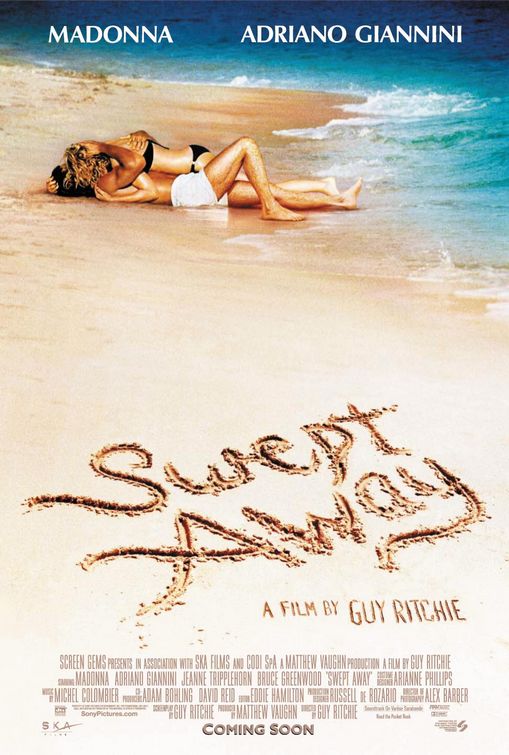
Swept Away

(UK / Italy 2002)

Guy Ritchie’s remake of Lina Wertmüller’s Swept Away, a film that looks like it would be Blue Lagoon but is far from it, was universally panned when it came out. I never saw it, and probably never would have bothered but for my recent discovery of Wertmüller’s work. A two-hour flight from Chicago to New York City and back seemed like the perfect time to get both of them out of the way.

I planned to watch Wertmüller’s original first because…well, that makes sense. Unfortunately, I didn’t start it early enough — the original is 25 minutes longer, and by the time I pulled out my iPad I didn’t have enough time for it. So, I had to settle for backward and watch Ritchie’s version first.

He sticks pretty close to the storyline of the original. Initially, I found Swept Away kind of boring but not offensively awful. Only after seeing Wertmüller’s version did it become painfully clear how lame this remake is; it’s utterly impotent by comparison.

Ritchie retains the critical plot elements of class tension and anticapitalist sentiment that color much of Wertmüller’s work, but here they don’t read the same way; they’re off. Trite, even. Ritchie injects dribs and drabs of his loutish brand of humor into his version, and I found that to be a plus. However, he turns Swept Away into a flaccid, neutered romantic dramedy that the original is not. His version is kinder, gentler, and softer. It has no edge to it whatsoever, which is unusual for him. Yawn.

Stiff and hollow, Madonna’s acting is par for the course. Her character, Amber, is suited to her image. She could’ve had fun with the role. Too bad she seriously overdoes the rich bitch bit and comes off as nasty, hateful, and angry. Not fun. Adriano Giannini, the son of Giancarlo Giannini who played the same role in the original, is nice to look at. That’s it, though; his character, Giuseppe, or as Amber calls him “Pee Pee,” is a turnoff — what a wimp!

The most interesting thing about Swept Away is that David Thornton, Cyndi Lauper’s husband, has a fairly substantial part. I wonder if that was awkward?

With Bruce Greenwood, Elizabeth Banks, Michael Beattie, Jeanne Tripplehorn, Yorgo Voyagis, Ricardo Perna, George Yiasoumi, Beatrice Luzzi, Lorenzo Ciompi, Patrizio Rispo, Francis Pardeilhan, Rosa Pianeta, Andrea Ragatzu

Production: CODI SpA, Ska Films

Distribution: Screen Gems (USA), Columbia TriStar Films (UK), Medusa Distribuzione (Italy)

89 minutes
Rated R

(iTunes rental) D

http://www.sonypictures.com/movies/sweptaway/

https://youtu.be/wv4grEwufV8

Pass the Gravy

(USA 1928)

Every now and then, I come across a literary or artistic work from the past that makes me reevaluate its day as maybe a little cooler than I gave it credit for. The silent gem Pass the Gravy is one such work. It’s longer than it needs to be, but it exhibits a twisted sense of humor that I love.

Schultz (Bert Sprotte) and Davidson (Max Davidson) are next door neighbors who don’t get along. Schultz, a well-dressed pompous ass, raises chickens that constantly eat the seeds Davidson, a far less dapper man, plants in his backyard. Schultz’s prize-winning pet rooster, Brigham, makes him, shall we say, cockproud.

When Schultz’s son (Gene Morgan) and Davidson’s daughter (Martha Sleeper) announce their engagement, the two older gentlemen reluctantly agree to set aside their differences and celebrate the occasion with a fine feast. Davidson gives his conniving son, Ignatz (Spec O’Donnell), two bucks to go buy a chicken. Instead, Ignatz pockets the money and steals a bird from Schultz’s yard — it’s Brigham.

The two families sit down at the table. Ignatz realizes what he’s done when he notices a tag that says “1st Prize” hanging off one of the roasted bird’s drumsticks. Hilarity ensues as one by one, each guest at the table realizes what Ignatz did and tries to hide it from Schultz.

Produced by Hal Roach (Our Gang, Laurel and Hardy) and directed by Fred Guiol with Leo McCarey, Pass the Gravy sounds like something Family Guy made up. It’s not: it’s real, and it’s actually pretty funny — if only for Davidson’s well played reaction that has to be seen to be appreciated and Schultz’s morbidly ironic quips (“They act like it’s a funeral” and “It’s my chicken and I’m going to eat it!”).

A football pantomime toward the end is shaky, and the joke here wears thin before the whole thing is over. Still, even with its antiquated slapstick silliness, Pass the Gravy is solid humor.

In 1998, the United States Library of Congress deemed Pass the Gravy “culturally, historically, or aesthetically significant” and selected it for preservation in the National Film Registry (https://www.loc.gov/programs/national-film-preservation-board/film-registry/complete-national-film-registry-listing/).

Production: Metro-Goldwyn-Mayer

Distribution: Metro-Goldwyn-Mayer

27 minutes
Not rated

(YouTube) B-

Snow-White

(USA 1933)

Max Fleischer’s Snow-White is nothing like Walt Disney’s — and that’s good. Fleischer offers a dark, edgy, and weirdly trippy death-focused version of the story most know from Disney. He “staffs” this short with characters from his Betty Boop cartoons.

Betty Boop (Mae Questel) — as Snow White — is off to a bad start when a magic mirror with Cab Calloway in it tells the Evil Queen (Questel), who looks and acts a lot like Olive Oyl, that Betty is “the fairest in the land.” The Queen orders her flunkies, Bimbo and Ko-Ko the Clown, to kill Betty — off with her head!

Bimbo and Ko-Ko don’t really want to hurt Betty. They take her to the forest, where she escapes by jumping into a river that freezes her into a box that looks like a coffin and carries her down a hill to the seven dwarves. Meanwhile, Bimbo and Ko-Ko fall into a hole and land in a cave where the Queen is. She turns them into monsters as they sing a blues number.

The Queen asks the mirror again who the fairest in the land is, and this time the mirror explodes into a puff of smoke that puts her face to face with Betty. Things don’t end well for the Queen.

Roland C. Crandall’s animation is rough and jagged and kind of jumpy, giving the whole thing a nervous energy and a sketchy vibe. He loads this cartoon with ghosts, skeletons, armored executioners, and other creepy goblins. Ko-Ko dancing to “St. James Infirmary Blues” is rotoscoped from footage of Calloway performing the song. This Snow-White has a Cajun flavor to it. It’s an interesting approach.

In 1994, the United States Library of Congress deemed Snow-White “culturally, historically, or aesthetically significant” and selected it for preservation in the National Film Registry (https://www.loc.gov/programs/national-film-preservation-board/film-registry/complete-national-film-registry-listing/).

With Billy Murray

Production: Fleischer Studios

Distribution: Paramount Pictures

7 minutes
Not rated

(YouTube) C+

Footnotes [Sue quell pied danser]

(France 2016)

The second film of a holiday double feature date, Footnotes [Sue quell pied danser], is a cute little Marxist musical about the trials and tribulations of the working class in rural France. The story follows millennial Julie (Pauline Etienne), who snags a job at a factory for a high end shoe designer, Jacques Couture. The job has potential to become permanent, which sounds good to her — she was “downsized” from her job at a shoe store before that, and it took awhile to find another one.

Unbeknownst to Julie — or anyone else in the factory for that matter — the company’s ruthlessly corporate CEO, Xavier (Loïc Corbery), plans to move production to China because it’s cheaper. The factory manager, Félicien (François Morel), is trying to dissuade him. The gals on the production line read about it in the paper, though, and plan a strike. In her first week on the job, Julie finds herself pushed to pick sides, which gets in the way of her budding romance with charming and strapping delivery driver Samy (Olivier Chantreau).

More London Road (https://moviebloke.com/2016/09/21/london-road/) than La La Land (https://moviebloke.com/2016/10/13/la-la-land/), Footnotes is pleasant and entertaining even if it doesn’t quite take off. Cowriters-directors Paul Calori and Kostia Testut keep it light, obviously borrowing from classic Hollywood musicals of the ’40s and ’50s. The songs are about crappy jobs, taking pride in one’s work, making ends meet, organizing into collective bargaining unit, and striving for a better life. The lyrics are fun, but the samba-flavored tunes are otherwise bland and forgettable. So is the choreography, which except for one scene (it involves bright Kinky Boots red shoes) is clumsy and lackluster.

Come to think of it, so are the sets. As would be expected, much of the action takes place in big industrial spaces. Nothing is done to emphasize anything about them; they stay in the background. It’s a huge contrast to a movie like Office (https://moviebloke.com/2015/12/09/office-hua-li-shang-ban-zu/), which went over the top highlighting the size and scope and efficiency of the office building where it took place, and even had at its center a huge clock as if to say “time is money.” Nothing like that here. Frustratingly, the decision Julie makes at the end totally throws off what the story gets at and seems to build toward the entire time.

I wanted to love Footnotes. I didn’t. A little more pizzazz would’ve been a huge improvement.

With Julie Victor, Clémentine Yelnik, Vladimir Granov, Laure Crochet-Sernieclaes, Elodie Escarmelle, Nuch Grenet, Eve Hanus, Valérie Layani, Valérie Masset, Michèle Prélonge, Sophie Tabakov, Yasmine Youcef, Jazmin Londoño Castañeda, Paul Laffont

Production: Loin Derrière L’Oural, France 3 Cinéma, Région Rhône-Alpes, La Banque Postale Image 9

Distribution: Rézo Films (France), Monument Releasing (USA / Canada), Longride (Japan)

85 minutes
Not rated

(Gene Siskel Film Center) C

https://www.footnotesfilm.com

The Little Hours

(USA / Canada 2017)

“Eating blood? Do you think I’ve ever written down ‘eating blood’ before? Where am I?”

— Bishop Bartolomeo

From what I remember in my English lit classes, Geoffrey Chaucer called it as he saw it. He took a dim view of piousness and devotion because he knew that neither makes someone a good person. Hold that thought.

Some people take religion very seriously. Others reach such a high level of intellectual refinement or maturity that it puts them beyond crass, juvenile humor. Good for them — I’m not one of those people. I adore a snarky, irreverent story; it’s even better when it involves absurdism or sacrilege and still has something to say. The Little Hours is exactly that: a farce with a point.

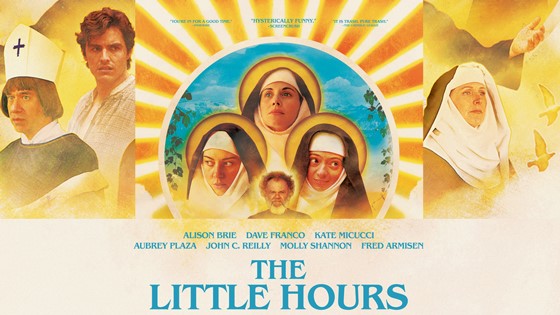
Set during the Middle Ages, hapless Fr. Tommasso (John C. Reilly) has the unenviable job of overseeing a convent. Yipee. He finds himself without a gardner when Lurco (Paul Weitz) quits after three hateful young nuns — vain Sr. Alessandra (Alison Brie), nerdy gossipry Sr. Ginerva (Kate Micucci), and belligerent Sr. Fernanda (Aubrey Plaza) — physically attack him one too many times.

While on a mission selling embroidery to raise funds for the convent, Fr. Tommasso, lost and drunk, crosses paths with Massetto (Dave Franco), a servant running from his master, obnoxious douchebag Lord Bruno (Nick Offerman). Bruno is out for blood (not to mention balls) after he discovers Massetto has been carrying on with his wife (Lauren Weedman) for some time.

Fr. Tommasso learns of Massetto’s dilemma and makes a proposal: Massetto can work in the garden at the convent, but he must pose as a deaf-mute to avoid stirring the ire of the nuns. Massetto accepts, but things don’t pan out quite as intended. The young nuns are, well, horny. Not long after he arrives at the convent, Massetto is getting it on with both Alessandra and Fernanda. All hell breaks loose when they find out.

Written and directed by Jeff Baena, The Little Hours is loosely based on — or a spoof of — a novella from Giovanni Boccaccio’s The Decameron, a 14th Century epic. If this sounds highbrow, don’t fret — it’s the only sophisticated thing about this film, which is fine because it is above all else a comedy.

Loaded with f-bombs, sex, and general malice, The Little Hours is an amusing mix of Mean Girls and Monty Python. The cast works well as an ensemble, bringing out and playing off of each other’s goofiness in an endearing way. I see hints of improvisation, which brings even more energy to the whole thing. Although the story peters out toward the end, Baena keeps the momentum going strong for most of it. What could have been a thin joke stretched out too long and too far stays fresh and fun with this vibrant and funny cast.

For all its silliness and flippancy — pretty much all seven deadly sins make an appearance here — Baena raises an interesting point. The Little Hours is very much a comedy about desire, and it get its laughs from the conflict between desire and appearance. Without getting preachy, The Little Hours shows that piousness and devotion don’t douse the flames of desire; sometimes, they fan them. After all, we’re all merely human. I can’t help thinking that Chaucer would approve.

With Molly Shannon, Fred Armisen, Jon Gabrus, Jemima Kirke, Adam Pally, Paul Reiser

Production: StarStream Media, Bow and Arrow Entertainment, Destro Films, Dublab Media, Productivity Media, Concourse Media, Exhibit Entertainment, Foton Pictures

Distribution: Gunpowder & Sky (USA), Mongrel Media (Canada), GEM Entertainment (International)

90 minutes
Rated R

(Gene Siskel Film Center) B

http://www.thelittlehoursmovie.com

The Immigrant

(USA 1917)

The Immigrant is quintessential Charlie Chaplin: funny, cute, and touching, it entertains while criticizing the social conditions of the day — here, the treatment of immigrants in “the Land of Liberty.” You decide whether all that much has changed in a hundred years.

Written and directed by Chaplin, The Immigrant follows his Tramp character on a boat bound for the States. He meets a fellow passenger, a beautiful young woman (Edna Purviance) traveling with her mother (Kitty Bradbury), and he has the perfect “in” when money is stolen from her purse. Sparks fly, but unfortunately the two potential love birds are separated by U.S. Customs agents as soon as they reach New York Harbor.

Once in the New World, the Immigrant has some trouble making ends meet. He finds a quarter on the ground one dreary afternoon and heads to a restaurant where a hostile head waiter (Eric Campbell) gives him a hard time. By chance, he sees the young woman from the boat and invites her to his table for beans and coffee (yuck!). Soon realizing that the quarter slipped through a hole in his pocket, he tries to impress her while stalling on the check to avoid ejectment.

The Immigrant starts off rocky — literally: the boat rocks back and forth, lending itself to some nice physical comedy with passengers sliding across the floor, juggling moves, and dishes sliding across a table. Thankfully, the rocking stops just before it becomes annoying. The scene in the restaurant is fascinating both for the character development and the physical choreography. This is a sweet story, an early romcom with a happy ending — and it’s downright charming a century later.

In 1998, the United States Library of Congress deemed The Immigrant “culturally, historically, or aesthetically significant” and selected it for preservation in the National Film Registry (https://www.loc.gov/programs/national-film-preservation-board/film-registry/complete-national-film-registry-listing/).

With Albert Austin, Henry Bergman, Loyal Underwood, William Gillespie, James T. Kelly, John Rand, Frank J. Coleman, Tom Harrington, Janet Miller Sully, Tom Wilson, Tiny Sandford

Production: The Lone Star Film Corporation

Distribution: Mutual Film Corporation

24 minutes
Not rated

(YouTube) B+

Fatty’s Tintype Tangle

(USA 1915)

Roscoe “Fatty” Arbuckle was a huge (no pun intended) but beleaguered star in the early 20th Century. He had a tough life and he died young (https://en.wikipedia.org/wiki/Roscoe_Arbuckle). After a start in vaudeville, he became one of Hollywood’s first movie stars, quickly negotiating a deal worth a million dollars a year plus a quarter of the profits from his films (https://www.thehairpin.com/2012/02/scandals-of-classic-hollywood-the-destruction-of-fatty-arbuckle/). On top of it, he got total artistic control.

It all came to a screeching halt when a young alcoholic actress died after a hotel party he threw, and he was accused of rape. It was Hollywood’s first big scandal, and it ended his career (http://www.smithsonianmag.com/history/the-skinny-on-the-fatty-arbuckle-trial-131228859/).

Incidentally, that hotel party occurred in San Francisco exactly 96 years ago on the day after this post.

Today, I saw my first Fatty Arbuckle film — and it only took me 108 years (https://en.wikipedia.org/wiki/Roscoe_Arbuckle_filmography). I had a loose idea of what to expect but I wasn’t quite sure. Fatty’s Tintype Tangle is familiar and not too crazy, the cinematic equivalent of something that tastes like chicken.

WARNING: Potential spoilers ahead!

A slapstick farce, Fatty’s Tintype Tangle tells of a husband (Arbuckle) whose mother-in-law (Mai Wells) nags the shit out of him. He and his wife (Norma Nichols) laugh at her behind her back. After getting liquored up in the kitchen while cooking breakfast, Fatty tells off his mother-in-law and either throws her ass out of his house or upsets her to the point that she gets up and goes — it’s hard to say.

Fatty goes to the park, where he sits on a bench next to a woman (Louise Fazenda) whose husband (Edgar Kennedy) momentarily leaves her to go do something — the scene card tells us they’re Alaskan “homeseekers,” whatever that is. They seem down and out, staying at an obviously low rent room and board. A photographer (Glen Cavender) snaps their picture — hence the “tintype” in the title — which isn’t cool because, well, they’re both married. The husband returns, mistakes Fatty for a creep, and threatens to kill him if he doesn’t leave town.

Fatty runs home and packs his bags — including his booze. He tells his wife he’s going on a business trip. Despondent, she answers an ad in the paper from someone seeking an apartment. She rents out the house and apparently moves in with her mother. Turns out, her tenants are the Alaskan couple. Doh!

Fatty misses his train and goes home. Unbeknownst to him, the Alaskan woman is in his bathroom. Hilarity ensues.

Fatty’s Tintype Tangle has all the elements of early comedy, a lot of it cliché now: misunderstandings, the hapless henpecked male, a slip and fall on a banana peel, gunshots to the ass, even Keystone cops. The only thing missing is a pie in the face. A rather cool extended scene features Arbuckle climbing up a pole and running across power lines. I was impressed to see him doing his own stunts; he was surprisingly limber for such a big guy.

Slapstick isn’t my favorite form of entertainment, but this is solid physical comedy even if it’s hard to follow at points. The version I saw had no sound at all, which was a bummer — hearing myself breathe adds nothing to the experience.

In 1995, the United States Library of Congress deemed Fatty’s Tintype Tangle “culturally, historically, or aesthetically significant” and selected it for preservation in the National Film Registry (https://www.loc.gov/programs/national-film-preservation-board/film-registry/complete-national-film-registry-listing/).

With Frank Hayes, Joe Bordeaux, Bobby Dunn, Ted Edwards, Charles Lakin

Production: Keystone Film Company

Distribution: Mutual Film Corporation

27 minutes
Not rated

(YouTube) C+

https://youtu.be/a1VROYs1D6Y