The Strike [Siréna]

(Czechoslovakia 1947)

Based on the novel Sirená by Marie Majerová, a communist and feminist Czech author prolific before World War II (https://en.wikipedia.org/wiki/Marie_Majerová), Karel Steklý’s The Strike follows the Hudcový family during a mine workers’ strike outside Prague in the late 19th Century. Hudec (Ladislav Boháč) is a sort of foreman at a mine. His job makes him miserable, which is apparent from his drinking. He finds himself caught between the mine’s owner and the discontented, sorely underpaid workers that include his son Rudolf (Oleg Reif). Hudec tries to straddle the line between the two but ultimately joins the workers when pushed by his determined wife, Hudcová (Marie Vásová), who seems like she’s always hungry. The cost is devastating, especially for their preteen daughter Emča (Pavla Sucha).

Though not as elegant, The Strike recalls Metropolis (https://moviebloke.com/2015/09/12/metropolis/) both thematically and visually. Jaroslav Tuzar’s stark and grimy cinematography nicely highlights the plight of the workers, and it looks great in black and white. Nothing here is nuanced, though: the narrative is coarse and blunt, the acting is total amateur hour, and the moral is in-your-face. Still, The Strike is remarkable for its earnestness; the workers plotting a revolt, their riot, and the town police and corrupt mayor (Josef Benátský) standing behind the mine over the workers certainly all ring true and timely. It kept my interest all the way through.

I never heard of Steklý or The Strike or anyone involved with this picture until I saw it 70 years after its release. I’m not sure it ever enjoyed international distribution—I can’t find a trailer for it—and I can guess why: a dour postwar propaganda film, it likely would have turned off audiences with its Reefer Madness-like approach to capitalism and communism that seems to argue for the latter. Viewing it today, I saw it as an eerily accidental warning of what happens when the middle class disappears.

With Josef Bek, Josef Dekoj, Nadezda Gajerová, Vera Kalendová Bedrich Karen, Lída Matousková

Production: Ceskoslovenský Státní Film

Distribution:

77 minutes
Not rated

(Dryden Theatre) C

Nitrate Picture Show

Heart Like a Wheel

(USA 1983)

“Trying to make us damned…golf!

—Connie Kalitta

Heart Like a Wheel is the kind of movie you see on late night TV: a mildly amusing true story about someone you’ve never heard of and her struggle to overcome adversity and maybe find herself in the process. In this case, that someone is Shirley Muldowney (Bonnie Bedelia), later known as “Cha Cha,” a 1960s housewife who became the first woman to obtain a license from the National Hot Rod Association (NHRA) and the first person ever to win two and then three Top Fuel titles (https://en.wikipedia.org/wiki/Shirley_Muldowney). Her struggle consists of establishing herself as a serious dragster. The adversity, well, that’s the sexist all-male drag race scene. You might say the whole thing is a drag.

One night, Shirley’s mechanic husband, Jack (Leo Rossi), lets her race his sports car on the street. She beats Jack’s rival and discovers that she digs the thrill of drag racing. Soon, she’s hanging out at the racetrack, where she meets Connie Kalitta (Beau Bridges), a veteran racer and womanizer. Jealous of her success, Jack leaves Shirley to her own devices.

I picked up Heart Like a Wheel for one reason, and one reason only: I read that My Life with the Thrill Kill Kult sampled this movie in a song or two. Overall, it’s a mixed bag, but I was pleasantly surprised to find that it’s better than mediocre. The acting is good. Ken Friedman’s screenplay is competent if not exactly deep, peppered with some snappy dialogue. When a skeezy reporter (Martin Casella) asks Shirley what a beautiful girl like her is doing at a racetrack, for example, her one-word response is casual, bored, and totally fucking awesome: “Winning.” Director Jonathan Kaplan stages realistic fight scenes, particularly between Connie and Shirley’s teenage son, John (played by a young Anthony Edwards). He even throws in a couple of real racers (Steve Evans and Sam Posey) and fire. It was nominated for an Academy Award for costume design (https://www.oscars.org/oscars/ceremonies/1984). The whole thing comes off like a soap opera, but it works. I never did catch those samples, though.

Bonus: the DVD I have includes trailers for four other films, The Turning Point, Kenny & Company, Rhinestone with Dolly Parton and Sylvester Stallone, and Six Pack with Kenny Rogers and Anthony Michael Hall. They all look as awful as “Born to Win” by Jill Michaels, the Heart Like a Wheel theme song.

With Hoyt Axton, Creed Bratton, Tiffany Brissette, Michael Cavanaugh, Diane Delano, Mitzi Hoag, Nora Heflin, Brandon Brent Williams

Production: Aurora Productions

Distribution: 20th Century Fox

113 minutes
Rated PG

(DVD purchase) C

Captain Fantastic

(USA 2016)

Captain Fantastic came out last summer, and I wanted to see it then. I must confess, the cast interested me more than the plot.

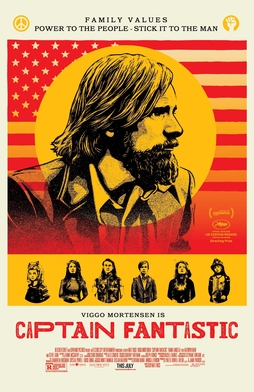
Viggo Mortensen is the aptly named Ben Cash, a long disenfranchised survivalist who is, like, so over American capitalism and politics. He and his wife, Leslie (Trin Miller), shown almost entirely in flashback, decide to raise their six kids—three boys and three girls—off the grid in the mountain wilderness of Washington State. Removed from society, Ben and Leslie teach their kids everything from logic and philosophy to hunting and gathering to Norman Mailer and Guns ‘n’ Roses. They do it all without iPhones or religion. Kudos to that!

Nothing is perfect: Leslie suddenly dies, forcing Ben to take his feral kids into the outside 21st Century world for the first time, ever—which calls everything they planned for their family into question.

Director and screenwriter Matt Ross poses some interesting questions about society, conformity, and the social contract in a provocative and often lighthearted way. However, Captain Fantastic is not terribly surprising, which is why it doesn’t work as well as it could. At heart, it’s a standard fish out of water dramedy. Frankly, I spotted every “twist” coming before it got to me: the cop (Rex Young) who pulls over their Partridge Family van, the mildly blasphemous excuse that saves the day, the family’s visit to the supermarket, their reaction to their extended family (and vice versa), that lame scene in which Ben’s sister-in-law (Kathryn Hahn) calls him out onto the carpet for his choices and his youngest daughter (Shree Crooks) recites the Constitution to prove her wrong, eldest son Bo (George MacKay) proposing to the first girl who gives him attention—a trailer park teen queen (Erin Moriarty)—and the colleges he manages to get into, the “situation” that requires modern medical attention. Meh.

For all its grandiose intentions to take on the establishment, Captain Fantastic actually relies on a rather orthodox and pedestrian approach to make its point. Maybe that is its point, that you can’t escape society. It doesn’t mater: this story is predictable and sentimental, two things that never bode well. I expected more than Spokane Swiss Family Brady Bunch, which is essentially what this is. The one thing that saves this film from total mediocrity is the acting, which is great all around.

With Frank Langella, Ann Dowd, Samantha Isler, Annalise Basso, Nicholas Hamilton, Charlie Shotwell, Steve Zahn, Elijah Stevenson, Teddy Van Ee

Production: Electric City Entertainment, ShivHans Pictures

Distribution: Bleecker Street, Universal Pictures

118 minutes
Rated R

(iTunes rental) C

http://www.bleeckerstreetmedia.com/captainfantastic

Can’t Hardly Wait

(USA 1998)

As teen comedies go, the ’90s were a teenage wasteland. Sure, there were a few classics: Dazed and Confused, Clueless, Election, and American Pie immediately come to mind. That’s really about it. Can’t Hardly Wait, the second film of Chicago International Film Festival’s Totally ’90s series, is a typical specimen from the decade: it has some moments, but overall it’s either bland or reductive. Frankly, I don’t even remember it in theaters, which probably says all I need to know.

The setting is a huge kegger in a Los Angeles suburb the night of graduation. Leading man Preston Meyers (Ethan Embry), a sensitive dork, has longed for class babe Amanda Beckett (Jennifer Love Hewitt) ever since he first laid eyes on her during freshman year: he knew they were destined to be together when he noticed the same strawberry Pop Tarts in her bag that he had in his. She went for Mike Dexter (Peter Facinelli), a jock, instead; they dated all through high school. Word on the street is, Mike dumped Amanda. Intrigued, Preston persuades his snarky and derisive bestie Denise Fleming (Lauren Ambrose), certainly no woo-woo girl, to accompany him.

Meanwhile, class geek William Lichter (Charles R. Korsmo), who looks like a deranged Harry Potter, shows up to exact revenge against Mike, his lifelong nemesis. Mike, who dumped Amanda so he could be free to sleep around all summer, isn’t having fun—he’s preoccupied reconsidering his decision. While Preston chases after Amanda to give her a letter in which he spills his guts, Denise gets locked into a secluded bathroom with wannabe gangsta/raver Kenny Fisher (Seth Green), who wears big sneakers and goggles and thinks he’s a stud but isn’t.

Co-directors and screenwriters Harry Elfont and Deborah Kaplan clearly watched a ton of ’70s and ’80s teen flicks. They have good ideas, but I’ve seen them done before and done better. The only storyline that really interested me was the one with Denise and Kenny in the bathroom. And I love Seth Green. Other than that, the situations and the dialogue here lack any snap or punch. It’s all pretty flat.

This is not to say I hated Can’t Hardly Wait; I didn’t. I just didn’t love it. It was merely okay. I consider myself a teen movie aficionado, and this did not move me. The soundtrack is way better.

With Michelle Brookhurst, Alexander Martin, Erik Palladino, Channon Roe, Sean Patrick Thomas, Freddy Rodríguez, Joel Michaely, Jay Paulson, Jason Segel (in his first appearance onscreen), Selma Blair, Jerry O’Connell

Production: Columbia Pictures Corporation, A Tall Trees Production

Distribution: Columbia Pictures

101 minutes
Rated PG-13

(Public Chicago) C

Chicago International Film Festival

Gold

(USA 2016)

“The taste of it on your tongue, the feel of it on your fingers—it’s like a drug.”

—Mike Acosta

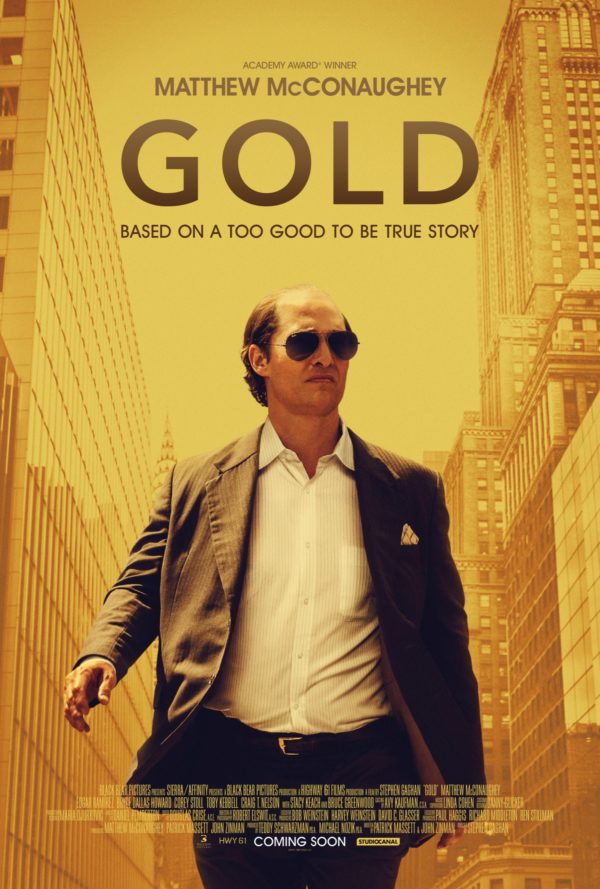
Not everything gold glitters; such is the case with Stephen Gaghan’s Gold, his first film since the acclaimed Syriana over a decade ago. Matthew McConaughey is Kenny Wells, a redneck businessman running his collapsing mining company from a smoke-filled tavern in Reno, Nevada, in 1988. Acting on little more than gut and some pawn shop cash from hocking gifts he gave his girlfriend (Bryce Dallas Howard) in better days shown as the movie opens, he abruptly heads to Indonesia to track down geologist Mike Acosta (Édgar Ramírez) to find a gold mine.

Their first meeting doesn’t go well at all. Looking like he stepped out of Banana Republic when it was a safari store in the ’80s, Acosta is shrewd, rugged, and quite experienced. Balding and sweaty Wells, with his jagged teeth and paunch, is sloppy and desperate. He reads as broke. Unimpressed, Acosta passes when Wells suggests they partner up—until the latter raises $200,000 for the proposed venture. After a series of miscalculations and mishaps (including a bout with malaria), they hit the jackpot in the middle of a jungle. Suddenly, the same banks and big investors that turned up their nose at Wells before want in on the action.

Gold isn’t a bad movie, but it’s not the impressive work it wants to be. The pace is fine, but the plot twists are unsurprising if not downright predictable. The problem is that I’ve seen this story before, and recently: mainstream films like The Big Short (https://moviebloke.wordpress.com/2016/01/03/the-big-short/), The Wolf of Wall Street, and American Hustle deal with the same themes in a similar manner. I’ve seen McConaughey be the same character, too. The curious statement “inspired by a true story” after the opening credits is the cue to something I found disappointing: Gold is a fictionalized account of a true story, changed enough that I guess it can’t claim to be “based on” reality. I’m not sure where that line is drawn, but it turns out much of the story is made up (http://www.financialpost.com/m/search/blog.html?b=business.financialpost.com/news/mining/gold-the-movie-about-the-bre-x-mining-scandal-that-isnt-about-bre-x&q=Bre). Plus, it’s never a good sign when the music in a film—here, artists ranging from Orange Juice to New Order and Joy Division to the Pixies and a new song by Iggy Pop and Danger Mouse—elicits the most enthusiastic response from me. Overall, meh.

Also starring Corey Stoll, Toby Kebbell, Craig T. Nelson, Stacy Keach, Rachael Taylor, Joshua Harto, and Timothy Simons

Produced by Boies/Schiller Films, Black Bear Pictures, and Highway 61 Films

Distributed by TWC-Dimension

121 minutes
Rated R

(AMC River East) C

http://gold-film.com


The Founder

(USA 2016)

Ray Kroc’s name is synonymous with McDonald’s, the ubiquitous fast food institution that hasn’t needed an introduction for the entire time I’ve been alive. It seems strange that I’ve never known much about him even after living in Chicago for almost 20 years—at least, not until The Founder. Then again, maybe I still don’t.

Kroc (Michael Keaton) is a middle aged traveling salesman who hocks milkshake mixers to restaurants, mainly drive-ins and diners, in the 1950s. Based in Chicago, he has a nice enough home in suburban Arlington Heights, a supportive if not ambitious wife, Ethel (Laura Dern), and the means to afford a country club membership. Nonetheless, Kroc is neither wildly successful nor affluent. He isn’t setting the world on fire selling milkshake mixers, and his business ideas never seem to pan out. He doesn’t fit in with the WASPy professionals Ethel gravitates toward. Being the entrepreneur he is, he yearns for more.

While making cold calls in Missouri, Kroc gets a big order for mixers from San Bernardino, California. He drives out there and finds McDonald’s, an idyllic burger joint owned and operated by two brothers, affable Mac (John Carroll Lynch) and crusty Dick (Nick Offerman). Shiny and clean, the place is a welcoming sight. Mac shows Kroc the kitchen: it’s an intricate and super-efficient assembly line that delivers consistenly appetizing product in minutes. Disposable packaging means customers can take their food with them and eat it wherever they want, keeping the line moving while eliminating the need for clean up (not to mention dishes). Employees work together as a team. The customer service is flawlessly friendly. Dick explains that high-quality food and fast service are the hallmarks of McDonald’s. The brothers have hit something with their formula: the place is slammed with a customer base that overwhelmingly consists of middle class families. Kroc wants to franchise McDonald’s, something the brothers tried before but it didn’t work.

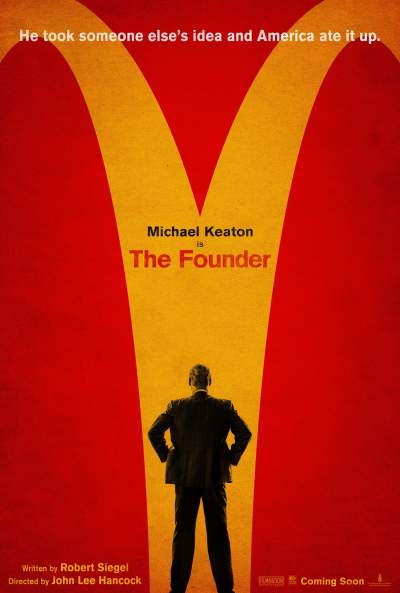
The Founder focuses less on Kroc’s personal life and more on the many problems he overcomes in executing his ambitious plan to make McDonald’s and its Golden Arches a symbol of America that seemlessly fits, as he puts it at one point, right in with the Stars and Stripes and crosses on churches. There’s a lot of dry stuff dealing with the nuts and bolts of business here—business models, contract negotiations, marketing, quality control, real estate, financing, trademarks, cutting costs, and of course double crossing. It’s a timely film—I can’t think of a more fitting movie to see on this particular Inauguration Day: one of the promotional posters for The Founder calls Kroc a rule breaker, a risk taker, and a game changer, and for better or worse that’s what he turned out to be. Michael Keaton is perfect for this role, playing Kroc as a ruthlessly driven goofball who has no good ideas of his own but certainly knows how to capitalize on those of others. American history is rich in such characters.

That said, I must admit that I have no idea how much of this story is accurate—not that I was compelled to find out on my own. The Founder doesn’t make me care. Pieces of the story seem to be missing. Robert Siegel’s script isn’t exactly objective—it borders on propaganda, especially when he overemphasizes the simplicity of the McDonald brothers. John Lee Hancock is a capable director, but he’s so ambiguous about his subject that he doesn’t say what he makes of him. I’m not sure he knows. His treatment lacks a certain nuance the material demands that could’ve made The Founder a lot more than it is. It’s not a terrible film, but I had higher expectations.

Also starring B.J. Novak, Linda Cardellini, Patrick Wilson, Justin Randell Brooke

Produced by FilmNation Entertainment, The Combine, Faliro House Productions S.A.

Distributed by The Weinstein Company

115 minutes
Rated PG-13

(ArcLight) C

http://thefounderfilm.com

20th Century Women

(USA 2016)

“We are at a turning point in our history.”

—President Jimmy Carter

I was a little kid in the Seventies, but I have many indelibly vivid memories of the decade: huge cars, gas lines, expensive meat, hijacked planes, Sanka and Sweet’N Low, smoking everywhere, hard rock, punk rock, disco, macrame, spider plants, the Bicentennial, Sky Lab, Victoriana (we had Mucha posters in our mustard-colored kitchen), that strange Holly Hobby aesthetic. It seems like it all changed immediately when Reagan took office in 1981.

20th Century Women captures a slice of American life on that unique, unremembered and largely disowned cusp. Set as a flashback to 1979 with voiceovers that repeatedly remind us that we’re looking backward, the film is a rather remarkable time capsule. The story is simple: Dorothea (Annette Bening) is my grandparents’ age (born in 1924). She had her only son, Jamie (Lucas Jade Zumann), late in life—i.e., over age 40. She’s been divorecd for a few years, which was fine until Jamie hit puberty. Now, she needs help understanding him. She enlists his two closest allies—Julie (Elle Fanning), whose pants he wants to get into, and Abbie (Greta Gerwig), a postpunk fuckup—to help her figure him out.

Loosely based on actual events from director and writer Mike Mills’s childhood, 20th Century Women is fun to watch. Growing up in a house of females myself, I relate to a lot of his experiences. I loved all the Talking Heads, too. Oh!—and Siouxsie and the Banshees! That said, this film borders on overbearing with its nostalgia. It could’ve been so much better—the material and the talent are both there, but Mills goes for easy returns that don’t pay off. The story falls flat. Perhaps a quote from Bening in an earlier film, the superior and far more interesting Running with Scissors, succinctly sums up my problem here: “It’s shit, Fern. It’s sentimental. It’s emotionally dishonest. It implodes into nothingness.”

I wasn’t bored, and I didn’t hate 20th Century Women. But I’m never going to see this movie again. Too bad, because the acting is great. It’s a misfire due to its execution. It seemed like a good idea at the time.

Also starring Billy Crudup, Vitaly Andrew LeBeau, Curran Walters, Toni Christopher, Jimmy Carter (public domain footage)

Produced by Annapurna Pictures, Archer Gray, and Modern People

Distributed by A24

119 minutes
Rated R

(Landmark Century) C

http://20thcenturywomen-movie.com

Florence Foster Jenkins

(UK 2016)

“People can say I can’t sing, but they can’t say I didn’t sing.”

—Florence Foster Jenkins

A lot of hype surrounded Florence Foster Jenkins before it arrived at a theater near us last fall. We wanted to catch it during its original run, but it came and went before we got around to seeing it. So, inspired by a post earlier in the day, I rented it on a Friday when we had no plans other than dinner at home. The night we watched it just happened to be Friday the 13th, which somehow seems appropriate.

Based on actual events and set during WWII, Florence (Meryl Streep) is a rich Manhattan society lady of a certain age who runs in an arty circle and knows a lot of people, some with money and others who follow it. She operates a private venue dedicated to opera, the Verdi Club, where she stars in a show and has a non-speaking role. Dying of either syphillis or the treatment for it—mercury and arsenic!—her one wish is to perform for an audience at Carnegie Hall. The problem is, she can’t sing; she’s downright awful. Her entrance here, lowered onstage from a rope and pulley while dressed as an angel with a harp, reminds me of Sarah Jessica Parker’s entrance (“I offer you mortals the bird of peace so that you may change your ways and end this destruction”) in Ed Wood, Tim Burton’s 1994 biopic about a similarly talentless film director who came along a decade or so later. The comparison is so apt that I wonder if it was intentional. Here, Florence’s husband, St. Clair Bayfield (Hugh Grant), doesn’t help matters by exaggerating her talent.

Determined to make her dream come true, Florence hires a vocal trainer, Carlo Edwards (David Haig), and a pianist, Cosmé McMoon (Simon Helberg), to put together a show. Established and well-known Carlo is content to take Florence’s money, build her ego, and let her dream on. Budding Cosmé, however, struggles with lying to her about her obvious ineptitude, not to mention her negative impact on his professional reputation. He soon sees that those around Florence stretch the truth about a lot of things when dealing with her.

Nicholas Martin’s script is kind to its characters, going for laughs in a way that doesn’t demean any of them. I never heard of her until this film, but the actual Florence Foster Jenkins was an interesting person. Her singing truly was awful:
https://www.youtube.com/watch?v=Hcs9yJjVecs. As always, Streep is spot on with her portrayal. She seems to have fun in this role, and it shows. Grant, who usually bores me but doesn’t here, is well suited for St. Clair: he’s stuffy and straight, but he nicely coveys an underlying deceitfulness that doesn’t come off as sinister. I like the way director Stephen Frears plays with deceit here, ultimately using it to depict a very touching side of St. Clair—who lives with his mistress (Rebecca Ferguson) in Brooklyn in apartment that Florence pays for. Much to my surprise, though, Big Bang Theory‘s Helberg steals practically every scene he’s in: keeping it subtle with Cosmé’s homosexuality (as Cosmé himself no doubt would have done during his day), he plays his character as a spineless, perennially uncomfortable, asexual bundle of nerves. He peppers his performance with grimaces and nervous giggles. Later, he delivers a line to explain his tardiness to Florence (of course, it involves sailors) with perfect and priceless dryness. He outshines everyone here.

Florence Foster Jenkins has some funny moments and some very touching ones. I found it enjoyable enough, but certainly not a knockout. It could have benefitted from a little more quirk and edge, especially considering its title character who showed no shortage of either.

Also starring Nina Arianda, Stanley Townsend, Allan Corduner, John Sessions, John Kavanagh, David Menkin, and Sid Phoenix

Produced by Qwerty Films, Pathé Pictures International, and BBC Films

Distributed by Paramount Pictures (USA)

111 minutes
Rated PG-13

(iTunes rental) C

http://www.florencefosterjenkinsmovie.com

The Brand New Testament [Le tout nouveau testament]

(Belgium/France/Luxembourg 2015)

Joan Osborne once posed the question, “What if God was one of us, just a slob like one of us?” In Jaco Van Dormael’s The Brand New Testament, God (Benoît Poelvoorde) is a sloppy, angry middle-aged white guy with a very plain wife (Yolande Moreau). They live in a dark apartment in Brussels, where He works from home (she’s a homemaker with a thing for collecting baseball cards). His job is pretty easy: to heap misery onto the human race, which He watches over on a computer in a room with a card catalog that stretches to the sky. God’s preteen daughter, Ea (Pili Groyne), is not impressed with Him or His arrogant, authoritarian, and sadistic ways. Inspired by her brother “JC” (David Murgia), who tells her how to get out of the apartment through the washing machine, Ea hatches a plan to revise the way things work and hopefully make the world a better place: while Our Father is asleep on the couch, she sends a text message to everyone on Earth that reveals the date and exact time of their death, locks God’s computer, and runs away from home in search of six apostles to tell their stories—the Brand New Testament.

This film could have made a weighty statement, but it doesn’t. Instead, The Brand New Testament, executed with a hefty dose of fantasy and fabulism, is a fluffy affair. While all six apostles lack something—love, passion, an arm—they’re comical despite their sadness. Some of their subplots are better than others, particularly Aurélie (Laura Verlinden), a beautiful woman with a secret, and Willy (Romain Gelin), a young boy with cancer who wants to be a girl. Catherine Deneuve plays a neglected and bored housewife, and it’s truly surreal to see her in a role where she gets fucked by a street gigolo (Bilal Aya) and ends up leaving her husband (Johan Leysen) for a gorilla (Kiko Mirales). That’s right, a gorilla. Clever Biblical references, especially to the numbers 12 and 18, are generously sprinkled throughout the script. There’s even a point in here about gender politics. For all its charms, though, The Brand New Testament is a much better concept than a finished product.

112 minutes
Not rated

(Music Box) C

http://www.musicboxfilms.com/the-brand-new-testament-movies-143.php

Sad Vacation: the Last Days of Sid and Nancy

(USA 2016)

It doesn’t get more P.R. (“punk rock”) than the final days of Sid Vicious and Nancy Spungen, the notorious and dysfunctional so-called “Romeo and Juliet of punk”—frankly, I’ve always viewed them as not too far off from John and Yoko, but I digress. Two messy heroin junkies, they bounced around for most of 1978 after the Sex Pistols disbanded. In September, they landed in Manhattan, where they rented a room at the Chelsea Hotel and Nancy appointed herself Sid’s manager. A month later, she ended up slumped next to the toilet in their room, dead from a stab wound to the abdomen (though she had multiple shallow stabs all over). Sid was arrested and allegedly confessed to her murder. While out of prison on bail, he died of a heroin overdose—some claim accidentally administered by his mother, others claim suicide—just four months later.

Danny Garcia’s Sad Vacation, a straight-to-video release coming out almost exactly 30 years after Alex Cox’s biopic Sid and Nancy, revisits these legendary rock and roll deaths. Interviewing many a soul who was there—Steve “Roadent” Conolly, Kenny “Stinker” Gordon, Hellin Killer, Walter Lure, Howie Pyro, Cynthia Ross, Gaye Black, Phyllis Stein, and Sylvain Sylvain to name a few—Garcia presents the facts, which are conflicting and not at all clear. Although Sad Vacation covers a little history of the punk movement, Malcolm McLaren, and the Sex Pistols, the focus is assiduously on what happened at the Chelsea. Narrated by Fun Lovin’ Criminals front man Huey Morgan, Sad Vacation takes on the tone of a crime documentary, laying out evidence and showing the holes in it. Not surprisingly, Garcia reveals some of the “eight thousand or so” conspiracy theories surrounding the murder, with those who knew the couple speculating on who really killed Nancy. Many point to Rockets Redglare, a drug dealer and bodyguard who worked for them. Redglare, who went on to appear in a number of films you’ve actually seen, died in 2001 (https://en.m.wikipedia.org/wiki/Rockets_Redglare).

Sad Vacation is not essential viewing; it doesn’t uncover anything new, raise any points that haven’t been raised before, or even pick a theory to endorse. It concludes that no one will ever know what happened. Big wow. That said, Garcia succeeds in showing that Sid and Nancy were kids—flawed ones, but still. After hearing words like “mess,” “dysfunctional,” and “destructive” to describe their relationship, it’s sweet to learn that his ashes were spread on her grave because they couldn’t be buried together. Now that’s P.R.

94 minutes
Not rated

(Home via iTunes) C

https://m.facebook.com/sadvacationdocumentary/

http://www.chipbakerfilms.com