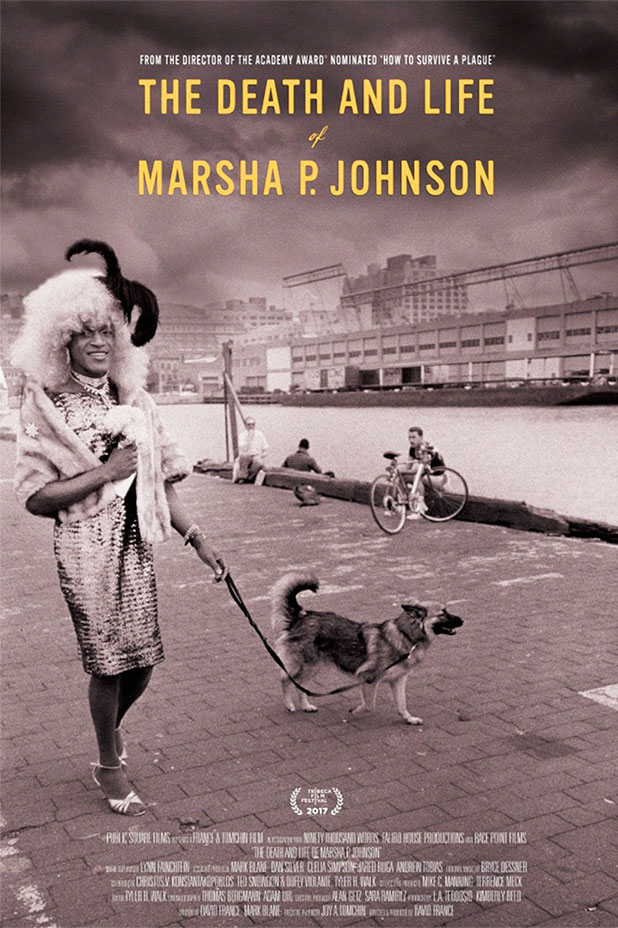
Marsha, Marsha, MARSHA! I’ll say this: David France’s new documentary has a lot going on in it. The center of the film, obviously, is legendary Greenwich Village “street queen” Marsha P. Johnson, a trans LGBT activist who hit the streets and stood at the front line when the fight was just about the “gay rights” movement. In the ’60s. Marsha, a figure at the Stonewall riots, founded Street Transvestites Action Revolutionaries, or S.T.A.R., with Sylvia Rivera in the early ’70s — 1970 to be exact. Her fight continued onto AIDS and transgender issues. She clearly was ahead of her time.
Sadly, Marsha ended up in the Hudson River in 1992, an apparent murder victim. It was almost 25 years to the date that I saw this film. The New York City Police Department called it a “suicide” — then called it a day. It remains an unsolved case.
The Death and Life of Marsha P. Johnson wants to honor Marsha, and it kind of does. At the very least, it sings her praises and puts her in a positive light. Ultimately, though, it fails. Told through the eyes of friend and surrogate Victoria Cruz, it unfortunately lets other things — mainly other people’s egos — get in the way. Part history and part true crime, Marsha’s story is watered down because French crams in more than what’s necessary to tell it, and he loses her in the process.
The Death and Life of Marsha P. Johnson succeeds in showing Marsha’s determination and influence. Perhaps unintentionally, it also shows a wonderfully colorful version of New York City in its cultural — or countercultural — prime, a place that simply doesn’t exist anymore. The hardest part of watching this film, though, is the attitude against trans people — even from gay men. It’s something you might not expect, but there it is.
From a historical or social standpoint, this is a winner. As far as Marsha is concerned, it could have been better. Still, it’s worth the time it takes to see it.
With Michael Baden, Frances Baugh, Pat Bumgardner, Jimmy Camicia, Eddie DeGrand, Matt Foreman, Jacques Garon, Chelsea Goodwin, Xena Grandichelli, Jennifer Louise Lopez, Agosto Machado, Marcus Maier, Ted Mcguire, Jean Michaels, Robert Michaels, Rusty Mae Moore, Candida Scott Piel, Coco Rodriguez, Kitty Rotolo, Vito Russo, Mark Segal, Beverly Tillery, Randy Wicker, Brian R. Wills, Sue Yacka
Production: Public Square Films, Faliro House Productions, Ninety Thousand Words, Race Point Films, Terasem Media & Films
Distribution: The Film Collaborative, Netflix
Screening introduced by David France and followed by a live Q and A with France, Mark Blane, and someone whose name I didn’t catch moderated by Alonso Duralde
If her take on Marie Antoinette is any clue, Sofia Coppola loves postpunk ’80s British bands like Siouxsie and the Banshees, the Cure, New Order, and New Romantic frontrunners Adam and the Ants and Bow Wow Wow. So do I. This in all likelihood is what drew me to Marie Antoinette: with three Bow Wow Wow songs (two remixed by My Bloody Valentine’s Kevin Shields), big hair, and a real MTV sensibility, its appeal to me is, well, a piece of cake.
All that is only part of the story. What really makes me love Marie Antionette is the sympathetic angle Coppola takes with this infamous character. Based on Antonia Fraser’s biography Marie Antoinette: The Journey, the first half of the movie is about the difficulties Marie (Kirsten Dunst) faces adapting to her new French surroundings and getting her new husband, Louis XVI (Jason Schwartzman, Coppola’s cousin), to consummate their marriage. She fails, and of course everyone blames her—even her mother (Marianne Faithfull). When she’s had enough, she says “fuck it” and becomes a full on rock star. This is where things get interesting.
Colorful and elaborate, Marie Antionette is not profound. So what? Lance Acord’s music video cinematography is perfect for what Coppola is going for; bordering on sensory overload, this film is busy, clever, and fun to watch. I know better than to take it as a history lesson.
With Judy Davis, Rip Torn, Rose Byrne, Asia Argento, Molly Shannon, Shirley Henderson, Danny Huston, Mary Nighy, Jamie Dornan, Steve Coogan, Tom Hardy
Production: Pricel, Tohokushinsha Film Corporation (TFC), American Zoetrope, Pathé, Commission du Film France, Commission du Film Île-de-France
Sergei Eisenstein and Dmitriy Vasilev’s Alexander Nevsky [Алекса́ндр Не́вский] is an oddball film. An historical drama with major propagandist and nationalistic overtones, it depicts Prince Alexander a.k.a. Nevsky (Nikolay Cherkasov) in his battle against the Teutonics as they try to invade the medieval city of Novgorod. Spoiler alert: Nevsky defeats them.
Alexander Nevsky tried my patience; of all the films at this year’s Nitrate Picture Show, it’s the only one I can say bored me. The plot is dull and the execution of the narrative is boring. The acting is stiff and the dialogue, even translated with subtitles, is…severe? I got through it without hating it thanks to a tiny amount of lightheartedness spinkled throughout that makes the whole thing bearable.
One subplot in particular kept me engaged and amused: it involves Vasili Buslai (Nikolai Okhlopkov) and Gavrilo Oleksich (Andrei Abrikosov), two warriors competing for the affection of the same woman, Olga Danilovna, a Maid of Novgorod (Valentina Ivashova, and that’s her character’s name). The two men relentlessly try to outdo each other in courage and skill on the battlefield, as she’s the big prize waiting for the winner. It doesn’t turn out how I expected.
That said, Alexander Nevsky is definitely a worthwhile experience for its visuals. It has a cool neoclassical atomic age sensibility, mixing elements of mythology with a kind of futuristic sci-fi minimalism. The battlefield scenes are beautifully shot, evoking a sense of vast otherworldly shock and awe. Eduard Tisse’s cinematography shimmers, and he contrasts light and dark really nicely here. The nitrate print we saw was sharp. I see why this was included in the festival:
With Dmitriy Orlov, Vasili Novikov, Nikolai Arsky, Varvara Massalitinova , Amelfa Timoferevna, Valentina Ivashova, Aleksandra Danilova, Vladimir Yershov, Sergei Blinnikov, Ivan Lagutin, Lev Fenin, Naum Rogozhin
Production: Mosfilm
Distribution: Artkino Pictures, Progressive Film Institute (UK), Amkino Corporation (USA), Panthéon Distribution (France)
Heart Like a Wheel is the kind of movie you see on late night TV: a mildly amusing true story about someone you’ve never heard of and her struggle to overcome adversity and maybe find herself in the process. In this case, that someone is Shirley Muldowney (Bonnie Bedelia), later known as “Cha Cha,” a 1960s housewife who became the first woman to obtain a license from the National Hot Rod Association (NHRA) and the first person ever to win two and then three Top Fuel titles (https://en.wikipedia.org/wiki/Shirley_Muldowney). Her struggle consists of establishing herself as a serious dragster. The adversity, well, that’s the sexist all-male drag race scene. You might say the whole thing is a drag.
One night, Shirley’s mechanic husband, Jack (Leo Rossi), lets her race his sports car on the street. She beats Jack’s rival and discovers that she digs the thrill of drag racing. Soon, she’s hanging out at the racetrack, where she meets Connie Kalitta (Beau Bridges), a veteran racer and womanizer. Jealous of her success, Jack leaves Shirley to her own devices.
I picked up Heart Like a Wheel for one reason, and one reason only: I read that My Life with the Thrill Kill Kult sampled this movie in a song or two. Overall, it’s a mixed bag, but I was pleasantly surprised to find that it’s better than mediocre. The acting is good. Ken Friedman’s screenplay is competent if not exactly deep, peppered with some snappy dialogue. When a skeezy reporter (Martin Casella) asks Shirley what a beautiful girl like her is doing at a racetrack, for example, her one-word response is casual, bored, and totally fucking awesome: “Winning.” Director Jonathan Kaplan stages realistic fight scenes, particularly between Connie and Shirley’s teenage son, John (played by a young Anthony Edwards). He even throws in a couple of real racers (Steve Evans and Sam Posey) and fire. It was nominated for an Academy Award for costume design (https://www.oscars.org/oscars/ceremonies/1984). The whole thing comes off like a soap opera, but it works. I never did catch those samples, though.
Bonus: the DVD I have includes trailers for four other films, The Turning Point, Kenny & Company, Rhinestone with Dolly Parton and Sylvester Stallone, and Six Pack with Kenny Rogers and Anthony Michael Hall. They all look as awful as “Born to Win” by Jill Michaels, the Heart Like a Wheel theme song.
With Hoyt Axton, Creed Bratton, Tiffany Brissette, Michael Cavanaugh, Diane Delano, Mitzi Hoag, Nora Heflin, Brandon Brent Williams
“Cheating on a quiz show? That’s sort of like plagiarizing a comic strip.”
—Mark Van Doren
The quiz show scandal of the late 1950s doesn’t sound like a riveting topic for a film, but that’s exactly what it is in Quiz Show, Robert Redford’s fourth directing gig. Every aspect of this film is spectacularly elegant, starting with Bobby Darin crooning “Mack the Knife” as the opening credits roll over shots of armored security guards transferring sealed questions and answers from a bank vault to a studio. Quiz Show is a modern morality play with lots of style.
It’s 1958, and NBC’s Twenty-One is the biggest game show in America. Homely goofball Herbert Stempel (John Turturro) of Queens is a surprise celebrity after an unprecedented winning streak, but the show’s ratings have “plateaued.” The show’s sponsor, Geritol, is ready for a change. So are producers Dan Enright (David Paymer) and Albert Freedman (Hank Azaria), who decide that a charismatic, television-ready new contestant is what the show needs.
WASPy college professor Charles Van Doren (Ralph Fiennes) happens to audition for another NBC game show, the less popular Tic Tac Dough. Handsome, polished, and hailing from an eminent intellectual family, “Charlie” fits the bill for Enright and Freedman’s vision.
Enright takes Stempel out for a steak dinner and asks him to “take a dive,” or purposely lose to Van Doren, on an upcoming show. Predictably, this isn’t something Stempel wants to do—at least, not without something in return. Enright fails to deliver on purposely vague promises, and Stempel publicly calls Twenty-One a fraud, saying it’s rigged. A judge seals the findings of a grand jury investigation, which gets some very minor press: a blurb in the paper. It catches the attention of ladder climbing Richard “Dick” Goodwin (Rob Morrow), a lawyer with the House Legislative Oversight Subcommittee in Washington, D.C., who plans to “put TV on trial.”
Quiz Show didn’t set the box office on fire during its original run, which is really odd (http://www.boxofficemojo.com/yearly/chart/?yr=1994). No matter, because it’s a fine drama. Based on the book Remembering America: A Voice From the Sixties by the real Richard Goodwin, Paul Attanasio’s screenplay is meticulously calibrated and cerebral, rich with strong characters, intertwined dilemmas, a fascinating plot, and a plethora of Fifties pop cultural references without nostalgia. Redford’s pacing is excellent: he sets up the story slowly then knocks down each character one after another. He draws superb performances out of the actors, too. The literary repartee between Van Doren and his genteel father, Mark (Paul Scofield), is one of the best things about this film. A wry and subtle sense of humor keeps the story exuberant: Martin Scorsese is great as fast talking Geritol CEO Martin Rittenhome, and Christopher McDonald makes an awesome Jack Barry.
Sure, Quiz Show isn’t an “exact word” historical documentary; Redford and Attanasio took some license. However, the result is an excellent depiction of good versus evil, not just in the television industry but in corporate America altogether. There’s not a lull or a dull moment here. The only criticism I have is Morrow’s unconvincing Boston accent; that can go. Everything else, though, is brilliant. Enright’s son, Don, wrote a piece about Quiz Show for the L.A. Times (http://articles.latimes.com/1994-09-19/entertainment/ca-40429_1_quiz-show); it’s another view worth considering.
With Mira Sorvino, Johann Carlo, Elizabeth Wilson, Allan Rich, Griffin Dunne
“All the best people have bad chests and bone diseases. It’s all frightfully romantic!”
—Juliet Hulme
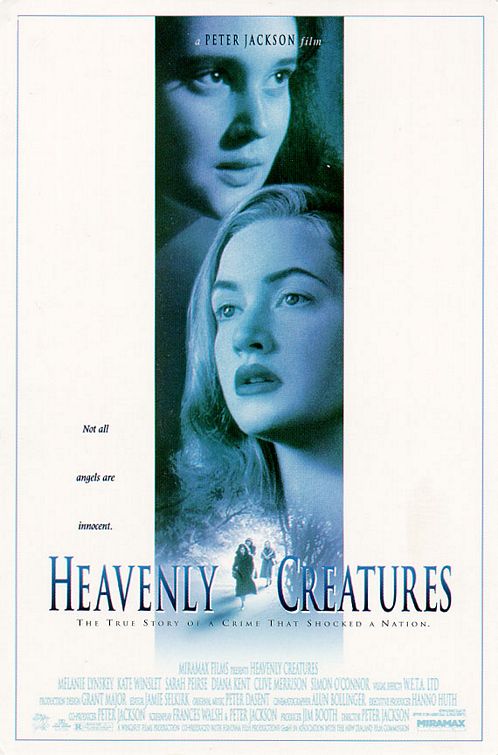
Forget Lord of the Rings—Heavenly Creatures is Peter Jackson’s coolest film. Before big budget Hollywood blockbuster fantasy franchises, the New Zealand filmmaker wrote, produced, and directed offbeat small-scale gore and porn comedies like Bad Taste (1987), Meet the Feebles (1989), and Dead Alive (1993). I’d already seen that last one by the time Heavenly Creatures came out for a limited run (in the States, anyway) in the fall of 1994. I assumed it would be another messy splatterfest—described to me as a “lesbian murder flick,” what would you think? Turns out, that’s not quite what it is.
Far more than a “lesbian murder flick” or even a brilliant stepping stone to bigger and better things, Heavenly Creatures represents a turning point in Jackson’s career. It’s a rare example of flawless execution across the board. He brings together every element—narrative, character development, casting, visuals, special effects, dialogue, period costumes and sets—to create a real humdinger.
Christchurch, New Zealand, 1952: 14-year-old Yvonne Reiper (Melanie Lynskey), who goes by “Pauline,” is a messy-haired, brooding loner at an all-girl high school. In her first scene, she’s wearing a big scowl on her face at an assembly, not singing along with the rest of her classmates—not until the school’s headmaster (Darien Takle) catches her gaze and snaps her into line with a widening of her eyes. Pauline’s father (Simon O’Connor) manages a grocery market and her mother (Sarah Pierse) runs a room and board for college students out of their home.
WARNING: Potential spoilers ahead!
A new student is introduced during French class: Juliet Hulme (Kate Winslet), the privileged daughter of a reknown college professor (Clive Merrison) and a psychologist (Diana Kent). Juliet, who proclaims she’s “actually from England” and chooses the French name “Antoinette,” captures Pauline’s attention when she insults the teacher, Miss Waller (Elizabeth Moody), unleashing a hilarious hissy fit. The scene is, in a word, awesome to watch play out. Right after that, their art teacher, Mrs. Collins (Liz Mullane), pairs the girls for an assignment that Julia disregards; instead, she draws dragon-slaying St. George, depicting him in the likeness of Mario Lanza, “the world’s greatest tenor!” She doesn’t get around to drawing Pauline, her model. Mrs. Collins isn’t impressed, but Pauline is.
Thus begins the girls’ friendship. They bond over their similar pasts involving childhood disease and extended hospital stays, a penchant for drama, and a mutual distaste for their peers (and perhaps social issues that leave a void). Juliet is mischievous and romantic, which softens Pauline and gets her to open up. Sitting out gym, they giggle over sexy WWII pulp novels. They bike through the woods and strip to their underwear, dancing and singing. They hug a bum (played by Jackson himself) on the street. They hold weird rituals for celebrities they like. They make Plasticine models, write stories, and devise an elaborate royal family tree, building around themselves a fantasy medievalesque kingdom called Borovnia where all its inhabitants worship them. Their imaginary world blurs the bounds of reality as their friendship intensifies.
A string of troubles arises that threatens to separate Pauline and Juliet: tuberculosis, an extramarital affair, a divorce, South Africa, and a medical diagnosis of incurable homosexuality. The girls decide to run away to America, but they can’t secure a passport for Pauline. They devise another scheme to stay together, but it’s a risky one: kill Pauline’s mother.
Heavenly Creatures starts out sweet—it’s something of a typical teen movie at first—but it does a complete turnaround. Based on actual events, Jackson wrote the screenplay with Frances Walsh; the real story is sad but compelling, and the script is tight. The casting—married couple John and Ros Hubbard and the aforementioned Mullane—is genius: every single actor is terrific in his or her part, even the minor ones, and it makes Heavenly Creatures all the richer. Many of them turn up in Jackson’s later projects.
Lynskey and Winslet own their characters; I can’t imagine anyone else in their roles. They’re charming, silly, histrionic, desperate, deranged, and ultimately “stark raving mad”—and they portray all of it exceptionally well. They manage to keep the homosexual subtext from getting out of hand. You can tell from Winslet’s first scene—she walks in with that crazy look on her face—that she’s destined for more. She became a star after Heavenly Creatures in a way that Lynskey didn’t, but both are mesmerizing.
The scenes in Borovnia and the Fourth World are nothing short of spectacular. Actually, many of the visuals here are burned into my memory. Alun Bollinger’s camerawork and bleached palette lends a lovely dreamlike quality. Once things start to unravel for these “nice” girls, the whole thing shifts to a darker, more sinister tone. It’s an emotional downward spiral to the end—those splatter films serve Jackson well.
Heavenly Creatures hasn’t lost its luster after nearly 25 years. I lost track of how many times I’ve seen it, yet it continues to suck me in every single time. It’s one of my favorites.
With Gilbert Goldie, Jed Brophy, Peter Elliott, Kirsti Ferry, Ben Skjellerup, Jean Guérin, Stephen Reilly, Jessica Bradley, Alex Shirtcliffe-Scott
Production: WingNut Films, New Zealand Film Commission
“I don’t know how I’m gonna live with myself if I don’t stay true to what I believe.”
—Desmond Doss
Like him or not, Mel Gibson has what it takes to direct a massive Hollywood picture. Hacksaw Ridge, his first directorial job in a decade, demonstrates that much—just in case earlier films like Braveheart, The Passion of the Christ, and Apocalypto didn’t.
Hacksaw Ridge depicts the remarkable and true story of Desmond Doss (Andrew Garfield), the Lynchburg, Virginia, Seventh-day Adventist who served as a medic in the U.S. Army during World War II. His story is unique: he enlisted, but as a conscientous objector for religious reasons. Refusing to kill or carry a gun, he rescued 75 or so wounded soldiers from the field during the Battle of Okinawa (http://www.collegedale-americanlegion.org/Pages/DesmondTDoss.aspx). President Harry S. Truman awarded Doss the Congressional Medal of Honor in 1945, the first time such a high accolade was bestowed upon someone who never even discharged a weapon (https://en.wikipedia.org/wiki/Desmond_Doss).
From a technical standpoint, Hacksaw Ridge is pretty awesome. The story is a good one. The battle scenes are clearly the centerpiece: they’re loud and extremely graphic. The prosthetics are spot on realistic. Cinematographer Simon Duggan starts out with warm, almost sepia tones in the early civilian scenes, but as the setting moves onto the battlefield he ditches color in favor of a washed out black, green, and white palette. Shaky closeups, slow motion shots, blurry pans, and quick cuts create a sense of confusion as gunfire and explosions and human carnage take over the screen. Hacksaw Ridge is no Son of Saul (https://moviebloke.com/2016/02/11/son-of-saul-saul-fia/), but it still overwhelms the senses albeit in a distanced, staged blockbuster way.
Otherwise, Hacksaw Ridge didn’t impress me all that much. At its core, it’s a standard-issue war movie complete with a sugary subplot about the girl, Dorothy Schutte (Teresa Palmer), waiting for Doss to hurry up and get back home so they can get married, and lots of humorous if mawkish male bonding through nicknames, insults, physical attacks, and simply having each other’s back. There’s a military court scene, trite “war is hell, boys” lines, soldiers who freak out once they get on the battlefield, likable characters who perish, and of course the superhuman heroic deeds of Doss.
Most character background is given hurried and superficial treatment: Doss’s alcoholic veteran father (Hugo Weaving) and his bad experience in World War I, Doss and Dorothy’s quick courtship, even the failed attempts of Sgt. Howell (Vince Vaughn) and Cpt. Glover (Sam Worthington) to persuade Doss to leave the Army. Too bad, because a little more insight could have made the film stronger. A particularly glaring example is brother Hal (Nathaniel Buzolic), who simply vanishes once he shows up at the dinner table in uniform. What happens to him? Did I miss it?
I’m conflcited on the message here, but I guess that’s okay because frankly Hacksaw Ridge is a conflicted film. Gibson maintains that it’s an anti-war statement (http://www.christianpost.com/news/mel-gibson-hacksaw-ridge-is-an-anti-war-movie-170318/). Fine, but that’s hard to believe considering the disproportionate amount of time and resources given to overblown battle scenes. I’m not sure the film honors Doss or his pacifist convictions. Moreover, what sure seems like a blatant parallel to the so-called religious liberty movement is, in my view, misguided and hollow, especially when Doss’s faith is treated more or less as incidental. Hacksaw Ridge sustained my interest, but I would have appreciated a little more depth.
With Luke Bracey, Darcy Bryce, Rachel Griffiths, Firass Dirani, Michael Sheasby, Luke Pegler, Nico Cortez, Goran D. Kleut, Harry Greenwood, Damien Thomlinson, Ben O’Toole
Ray Kroc’s name is synonymous with McDonald’s, the ubiquitous fast food institution that hasn’t needed an introduction for the entire time I’ve been alive. It seems strange that I’ve never known much about him even after living in Chicago for almost 20 years—at least, not until The Founder. Then again, maybe I still don’t.
Kroc (Michael Keaton) is a middle aged traveling salesman who hocks milkshake mixers to restaurants, mainly drive-ins and diners, in the 1950s. Based in Chicago, he has a nice enough home in suburban Arlington Heights, a supportive if not ambitious wife, Ethel (Laura Dern), and the means to afford a country club membership. Nonetheless, Kroc is neither wildly successful nor affluent. He isn’t setting the world on fire selling milkshake mixers, and his business ideas never seem to pan out. He doesn’t fit in with the WASPy professionals Ethel gravitates toward. Being the entrepreneur he is, he yearns for more.
While making cold calls in Missouri, Kroc gets a big order for mixers from San Bernardino, California. He drives out there and finds McDonald’s, an idyllic burger joint owned and operated by two brothers, affable Mac (John Carroll Lynch) and crusty Dick (Nick Offerman). Shiny and clean, the place is a welcoming sight. Mac shows Kroc the kitchen: it’s an intricate and super-efficient assembly line that delivers consistenly appetizing product in minutes. Disposable packaging means customers can take their food with them and eat it wherever they want, keeping the line moving while eliminating the need for clean up (not to mention dishes). Employees work together as a team. The customer service is flawlessly friendly. Dick explains that high-quality food and fast service are the hallmarks of McDonald’s. The brothers have hit something with their formula: the place is slammed with a customer base that overwhelmingly consists of middle class families. Kroc wants to franchise McDonald’s, something the brothers tried before but it didn’t work.
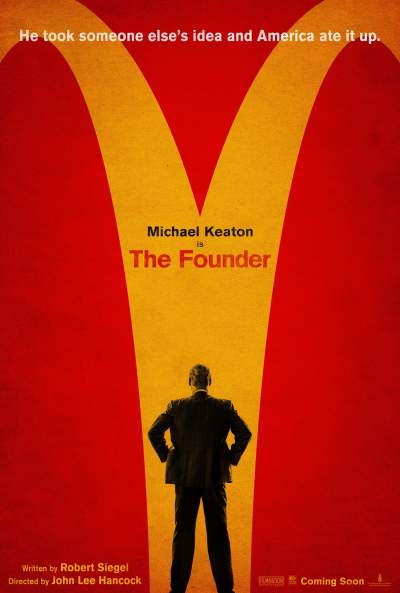
The Founder focuses less on Kroc’s personal life and more on the many problems he overcomes in executing his ambitious plan to make McDonald’s and its Golden Arches a symbol of America that seemlessly fits, as he puts it at one point, right in with the Stars and Stripes and crosses on churches. There’s a lot of dry stuff dealing with the nuts and bolts of business here—business models, contract negotiations, marketing, quality control, real estate, financing, trademarks, cutting costs, and of course double crossing. It’s a timely film—I can’t think of a more fitting movie to see on this particular Inauguration Day: one of the promotional posters for The Founder calls Kroc a rule breaker, a risk taker, and a game changer, and for better or worse that’s what he turned out to be. Michael Keaton is perfect for this role, playing Kroc as a ruthlessly driven goofball who has no good ideas of his own but certainly knows how to capitalize on those of others. American history is rich in such characters.
That said, I must admit that I have no idea how much of this story is accurate—not that I was compelled to find out on my own. The Founder doesn’t make me care. Pieces of the story seem to be missing. Robert Siegel’s script isn’t exactly objective—it borders on propaganda, especially when he overemphasizes the simplicity of the McDonald brothers. John Lee Hancock is a capable director, but he’s so ambiguous about his subject that he doesn’t say what he makes of him. I’m not sure he knows. His treatment lacks a certain nuance the material demands that could’ve made The Founder a lot more than it is. It’s not a terrible film, but I had higher expectations.
Also starring B.J. Novak, Linda Cardellini, Patrick Wilson, Justin Randell Brooke
Produced by FilmNation Entertainment, The Combine, Faliro House Productions S.A.
“You’re wasting your lives making shit. Nobody cares. These movies are terrible!”
—Dolores Fuller
“How do you do it? How do you get all your friends to get baptized just so you can make a monster movie?”
—Bunny Breckinridge
“Can your heart stand the shocking facts of the true story of Edward D. Wood, Jr?”
—Criswell
“Confidentially, I even paratrooped wearing a brassier and panties. I wasn’t afraid of being killed, but I was terrified of being wounded and having the medics discover my secret.”
—Ed Wood
Edward D. Wood, Jr., or simply Ed Wood, is widely regarded as the worst director of all time. In fact, he received posthumous recognition—the Golden Turkey Award—designating him as such (http://www.legacy.com/news/celebrity-deaths/article/ed-wood-the-best-of-the-worst). His silly low-budget DIY pulp/science fiction/horror flicks from the 1950s—low on plot, technique, and talent—are beloved by many because they’re so bad. Monumentally bad. Okay, maybe ridiculous is a better word. You decide from this trailer:
Based on Rudolph Grey’s book Nightmare of Ecstasy and adapted for the screen by Scott Alexander and Larry Karaszewski, Tim Burton’s labor of love, Ed Wood, is a period-piece biopic about the eccentric angora-loving filmmaker responsible for such gems as Jail Bait, Glen or Glenda, Bride of the Monster, and of course Plan 9 from Outer Space—Wood’s Citizen Kane (as Burton likens it here). This film rocks; I never get sick of it. Not ever. And for a few reasons.
The characters and performances are fantastic. Leading man Ed Wood is one of Johnny Depp’s most endearing roles; he plays Wood with an affectionate and demonstrative earnestness he’s never quite duplicated. Burton has always held sympathetic misfits in high regard—Edward Scissorhands, also played by Depp, immediately comes to mind. Here, he has a field day, bringing in an entire cast of warm and colorful weirdos that flock to Wood. Consider: best bud Bunny Breckinridge (Bill Murray), a boozy grand queen with a penchant for drama and glitter. “The Amazing Criswell” (Jeffrey Jones), an androgynous self-proclaimed psychic/horse shit artist. Max (Max Casella), the president of Wood’s fan club—and his errand boy. Overzealous, chatty crew member Conrad (Brent Hinkley). Later, Vampira (Lisa Marie), a gothic midnight movie hostess with lots of bosom, and TV wrestler Tor Johnson (George “The Animal” Steele) become regulars in Wood’s films.
The most important relationship, though, is the one between Wood and has-been Dracula star Bela Lugosi (Martin Landau), whom he meets in a coffin store. Lugosi’s life is far from glamorous: he lives alone in obscurity in a tiny tract house in a nondescript suburban neighborhood. He’s also a junkie. Wood moves from starstruck fan to employer to custodian and confidant. Landau gives a flawless performance; he earned an Academy Award for Best Supporting Actor for it. Every scene is inspired, but one of my favorites is his dramatic reading of that hackneyed “home” speech; it is, to use Wood’s word, “perfect.” Their friendship gives Ed Wood much of its warmth and humanity.
Despite the laughably amateur quality of Wood’s films—and his unorthodox way of shooting them—he gets them made. And no matter how poorly received they are, he doesn’t give up. In this sense, Ed Wood is uplifting and inspiring. He embraces his flaws, sticks to his guns, and believes in himself. Orson Welles himself (Vincent D’Onofrio) backs him up in one great scene at a bar.
Some might find the pace a bit slow. I don’t—the whole film is fun and jammed with quotable material that keeps it moving. Line after line is memorable—I could string together a bunch of quotes I know by heart and leave it at that (I’ve seen this film quite a few times). From a technical standpoint, Ed Wood is exceedingly well done. Filmed in shimmering black and white, Stefan Czapsky’s camerawork is beautiful. The cleverly composed, shadowy shots of Lugosi “fixing” in the bathroom and later tied to a bed in rehab, and Wood and future wife Kathy (Patricia Arquette) inside the carnival ride are especially remarkable. Howard Shore’s score—a rich mix of jazz, Cuban orchestration that wouldn’t sound out of place on I Love Lucy, and monster madness—is awesome.
Burton easily could have made this a snarkfest. Instead, he shows his idol in a respectful and positive light. His spirited take makes Ed Wood exceptional.
With Sarah Jessica Parker, Mike Starr, Juliet Landau, Stanley Desantis, Ned Bellamy, Norman Alden, G.D. Spradlin
“People can say I can’t sing, but they can’t say I didn’t sing.”
—Florence Foster Jenkins
A lot of hype surrounded Florence Foster Jenkins before it arrived at a theater near us last fall. We wanted to catch it during its original run, but it came and went before we got around to seeing it. So, inspired by a post earlier in the day, I rented it on a Friday when we had no plans other than dinner at home. The night we watched it just happened to be Friday the 13th, which somehow seems appropriate.
Based on actual events and set during WWII, Florence (Meryl Streep) is a rich Manhattan society lady of a certain age who runs in an arty circle and knows a lot of people, some with money and others who follow it. She operates a private venue dedicated to opera, the Verdi Club, where she stars in a show and has a non-speaking role. Dying of either syphillis or the treatment for it—mercury and arsenic!—her one wish is to perform for an audience at Carnegie Hall. The problem is, she can’t sing; she’s downright awful. Her entrance here, lowered onstage from a rope and pulley while dressed as an angel with a harp, reminds me of Sarah Jessica Parker’s entrance (“I offer you mortals the bird of peace so that you may change your ways and end this destruction”) in Ed Wood, Tim Burton’s 1994 biopic about a similarly talentless film director who came along a decade or so later. The comparison is so apt that I wonder if it was intentional. Here, Florence’s husband, St. Clair Bayfield (Hugh Grant), doesn’t help matters by exaggerating her talent.
Determined to make her dream come true, Florence hires a vocal trainer, Carlo Edwards (David Haig), and a pianist, Cosmé McMoon (Simon Helberg), to put together a show. Established and well-known Carlo is content to take Florence’s money, build her ego, and let her dream on. Budding Cosmé, however, struggles with lying to her about her obvious ineptitude, not to mention her negative impact on his professional reputation. He soon sees that those around Florence stretch the truth about a lot of things when dealing with her.
Nicholas Martin’s script is kind to its characters, going for laughs in a way that doesn’t demean any of them. I never heard of her until this film, but the actual Florence Foster Jenkins was an interesting person. Her singing truly was awful: https://www.youtube.com/watch?v=Hcs9yJjVecs. As always, Streep is spot on with her portrayal. She seems to have fun in this role, and it shows. Grant, who usually bores me but doesn’t here, is well suited for St. Clair: he’s stuffy and straight, but he nicely coveys an underlying deceitfulness that doesn’t come off as sinister. I like the way director Stephen Frears plays with deceit here, ultimately using it to depict a very touching side of St. Clair—who lives with his mistress (Rebecca Ferguson) in Brooklyn in apartment that Florence pays for. Much to my surprise, though, Big Bang Theory‘s Helberg steals practically every scene he’s in: keeping it subtle with Cosmé’s homosexuality (as Cosmé himself no doubt would have done during his day), he plays his character as a spineless, perennially uncomfortable, asexual bundle of nerves. He peppers his performance with grimaces and nervous giggles. Later, he delivers a line to explain his tardiness to Florence (of course, it involves sailors) with perfect and priceless dryness. He outshines everyone here.
Florence Foster Jenkins has some funny moments and some very touching ones. I found it enjoyable enough, but certainly not a knockout. It could have benefitted from a little more quirk and edge, especially considering its title character who showed no shortage of either.
Also starring Nina Arianda, Stanley Townsend, Allan Corduner, John Sessions, John Kavanagh, David Menkin, and Sid Phoenix
Produced by Qwerty Films, Pathé Pictures International, and BBC Films







 moviebloke