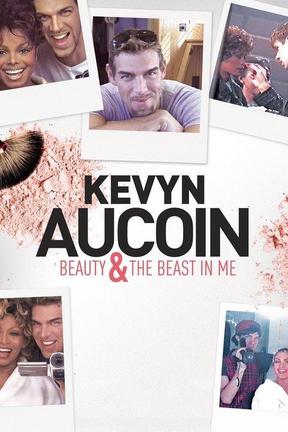
Kevyn Aucoin Beauty & the Beast in Me

(USA 2017)

“He was way ahead of his time. Just the way we do now with selfies and Snapchat and Facebook — he would have put the little Instagram kids to shame!”

— Amber Valletta


“Kevyn’s biggest motivation to succeed was his abandonment issues. He had this thought that, if I work with you and you become my friend, and I make you pretty, then you won’t abandon me. I absolutely think he was looking for a mother figure in the people that he worked with.”

— Eric Sakas

Superstar makeup artist Kevyn Aucoin lived an enviable life. He was successful doing what he loved — his work was on runways, in music videos, on award shows, and on magazine covers, at one point nine consecutive issues of Vogue. He wrote books and started a line of cosmetics.

On top of that, he hung out with models, legends, and his own idols: Kate Moss, Cindy Crawford, Naomi Campbell, Linda Evangelista, Christy Turlington, Paulina Porizkova, Susan Sarandon, Gwyneth Paltrow, Winona Ryder, Liza Minnelli, Tina Turner, Whitney Houston, Janet Jackson, Madonna, Cher, and Jennifer Lopez to name a few. Some of them were actual friends (I can only imagine Liza leaving voicemail for me).

Judging from the fact that they all let Aucoin record him with them backstage — on videotape, and not always made up — they must have felt something for him. An affinity? Safety? A debt? Whatever it was, it endeared him. Even in his home videos, he made them look good.

So it’s odd and downright tragic that someone who brought so much beauty to the world, never felt beautiful himself. Perhaps it had to do with his birth mother, Nelda Mae Williams, giving him up for adoption, or all the bullying he got as a teenager. He didn’t like his physical features, which were exaggerated by a condition that went undiagnosed for most of his life: acromegaly, a tumour on the pituitary gland that keeps the brain secreting growth hormones. It’s a painful condition that causes headaches and joint pain, and it got Aucoin addicted to prescription drugs.

A trove of home videos found after his death in 2002 forms the basis for Lori Kaye’s documentary, Kevyn Aucoin Beauty & the Beast in Me. He recorded everything — the aforementioned videos with celebrities, with family members and boyfriends, and even when he was alone. Kaye interviews different people from Aucoin’s life to tell his story, and the interviews range from funny (Andie MacDowell) to sad (ex boyfriend Eric Sakas discusses Aucoin’s downward spiral) to eyeroll-inducing (Williams claims Aucoin would not have been gay had she raised him).

His adoptive parents, Isidore and Thelma Aucoin, accepted him and even dropped out of their church because of its stance on homosexuality. He moved to New York City, and the rest is history.

The celebrity interviews are fun, and some are gushy. Some of the interviewees even cry. They all provide insight into the kind of guy Aucoin was. What Kaye has that makes her documentary special, though, is Aucoin’s tapes, and she incorporates footage from them into the project in a way that lets him tell his own story. It’s an often amusing one with a sad undertone. It also serves, as Cindy Crawford points out, as a time capsule — a really good one. I confess, a few scenes gave me chills.

With Andie MacDowell, Cindy Crawford, Naomi Campbell, Paulina Porizkova, Gwyneth Paltrow, Amber Valletta, Isidore Aucoin, Nelda Mae Williams, Jed Root, Eric Sakas, Tina Turner, Cher, Liza Minnelli, Whitney Houston, Jennifer Lopez, Janet Jackson

Production: Putti Media

Distribution: Logo Documentary Films (USA), Dogwoof (International)

World Premiere

Screening introduced by director Lori Kaye

90 minutes
Not rated

(Directors Guild of America) B-

Outfest Los Angeles LGBT Film Festival

https://www.kevynaucoindocumentary.com

Marie Antoinette

(USA/France 2006)

“This, Madame, is Versailles.”

—Comtesse de Noailles

If her take on Marie Antoinette is any clue, Sofia Coppola loves postpunk ’80s British bands like Siouxsie and the Banshees, the Cure, New Order, and New Romantic frontrunners Adam and the Ants and Bow Wow Wow. So do I. This in all likelihood is what drew me to Marie Antoinette: with three Bow Wow Wow songs (two remixed by My Bloody Valentine’s Kevin Shields), big hair, and a real MTV sensibility, its appeal to me is, well, a piece of cake.

All that is only part of the story. What really makes me love Marie Antionette is the sympathetic angle Coppola takes with this infamous character. Based on Antonia Fraser’s biography Marie Antoinette: The Journey, the first half of the movie is about the difficulties Marie (Kirsten Dunst) faces adapting to her new French surroundings and getting her new husband, Louis XVI (Jason Schwartzman, Coppola’s cousin), to consummate their marriage. She fails, and of course everyone blames her—even her mother (Marianne Faithfull). When she’s had enough, she says “fuck it” and becomes a full on rock star. This is where things get interesting.

Colorful and elaborate, Marie Antionette is not profound. So what? Lance Acord’s music video cinematography is perfect for what Coppola is going for; bordering on sensory overload, this film is busy, clever, and fun to watch. I know better than to take it as a history lesson.

With Judy Davis, Rip Torn, Rose Byrne, Asia Argento, Molly Shannon, Shirley Henderson, Danny Huston, Mary Nighy, Jamie Dornan, Steve Coogan, Tom Hardy

Production: Pricel, Tohokushinsha Film Corporation (TFC), American Zoetrope, Pathé, Commission du Film France, Commission du Film Île-de-France

Distribution: Columbia Pictures, Sony Pictures

123 minutes
Rated PG-13

(iTunes rental) B-

http://www.sonypictures.com/movies/marieantoinette2006feature/

Letters from Baghdad

(USA/UK/France 2016)

“We rushed into the business with our usual disregard for a comprehensive political scheme.”

—Gertrude Bell

According to the promotional poster for Sabine Krayenbühl and Zeva Oelbaum’s Letters from Baghdad, the so-called “Queen of the Desert” and “female Lawrence of Arabia” Gertrude Bell “was as controversial as the history she made.” Well, that certainly sounds promising!

Born into a wealthy family, Bell immersed herself in the Middle East in the early 20th Century and used her talents as a writer and a schmoozer to intimately acquaint herself with the area, its people, and their culture (https://en.wikipedia.org/wiki/Gertrude_Bell). Her contacts with influential expats and various Arab leaders combined with her knowledge of the culture led to an appointment as a British officer during World War I and a direct hand in drawing up the borders of modern Iraq.

Tilda Swinton gives Bell her voice, reading off camera Bell’s actual writings about events that occurred on her many trips and the people she met. In Bell’s own words, Swinton offers history, observations, and even some Victorian Era dish. Bell had at least as much influence as T. E. Lawrence a.k.a. Lawrence of Arabia (played here by Eric Loscheider in a staged “talking head” interview made to look like old footage).

Bell’s life and the impact of her deeds a century later make for an interesting story. Painstakingly researched, Krayenbühl and Oelbaum pull from diverse source material—letters, diaries, photos—to show what cities like Baghdad and Damascus were like a hundred years ago. They do a great job humaninzing Bell, getting into personality flaws and personal disappointments. In both respects, Letters to Baghdad works really well.

Not everything works as well as it could, though. Some important items are treated superfically. For example, they mention the tension between the Sunni, Shia, and Kurds even back then, but Krayenbühl and Oelbaum don’t delve into it. They touch on Bell’s reasoning for the borders she devised, but they don’t give much critical assessment to it. I left with the distinct feeling that I didn’t get the whole story. Another problem: the staged interviews give a lot of information, but they’re cheesy.

I found myself glancing at my watch about halfway through Letters from Baghdad. It’s a well made documentary, but it’s not as enthralling as it promises to be.

With Ammar Haj Ahmad, Helen Ryan, Rachael Stirling, Robert Ian Mackenzie, Christopher Villiers, Lucy Robinson, Elizabeth Rider, Michael Higgs, Joanna David, Michelle Eugene, Paul McGann, Pip Torrens

Production: Between the Rivers Productions, Letters From Baghdad, Missing in Action Films

Distribution: Vitagraph Films (USA)

95 minutes
Not rated

(Landmark Century) C

http://lettersfrombaghdadthemovie.com/about/

24 Hours in the Life of a Clown [Vingt-quatre heures de la vie d’un clown]

(France 1946)

But where are the clowns? Send in the clowns. Okay, don’t bother, two of them are in this short by the great French director Jean-Pierre Melville. 24 Hours in the Life of a Clown [Vingt-quatre heures de la vie d’un clown] is just that: a day in the life of Beby, a clown who lives in Montmarte. A multitude of fedoras costar.

In between performances at Circus Medrano, Beby walks the streets of Paris, sleeps with his little dog (but not his wife), reads fan mail, drinks at a café, and puts on makeup with his friend and fellow clown Maïss. Interestingly enough, this is not the only short to feature Maïss, who later appeared in Rodolphe Marcilly’s Centaures et pastiche in 1953.

Who knew clowns pray?

24 Hours in the Life of a Clown holds historical and artistic significance as Melville’s first film. It highlights his style, albeit in its infancy, playing with light and dark. His approach is tongue in cheek, and his “narration” (this is not a “talkie”) strongly suggests Melville knew well that his hoary little film is silly.

Still, it’s interesting if only for the scenery, all 1940s drab and threadbare, and the documentary feel of it. Beby’s apartment reminds me of the one in Eraserhead.

Production: Les Films du Panthéon

18 minutes
Not rated

(Gene Siskel Film Center) C

https://youtu.be/uRZo0M3KCzM

Finding Joseph I: The HR from Bad Brains Documentary

(USA/Jamaica 2016)

How low can a punk get? Director James Lathos gives a pretty good idea with Finding Joseph I: The HR from Bad Brains Documentary, a sympathetic if sensationalistic picture of the ups and downs of punk/reggae frontman Paul “H.R.” Hudson, also known by his Jamaican name Joseph I. The film is a companion of sorts to Finding Joseph I: An Oral History of H.R. from Bad Brains by Lathos and Howie Abrams.

Lathos lays out essential information about Hudson’s unconventional and rather nomadic upbringing, his path to the limelight via the ’80s D.C. punk scene, and his spiritual journey. That last part sounds wretchedly dull, but it’s not: Hudson became a Rastafarian, and his music reflected it. The problem is, he also started to unravel around the same time, frequently leaving and rejoining Bad Brains like a dreadlocked Ross Perot.

Sure, there are early live performances that are obligatory in a documentary like Finding Joseph I; fortunately, they’re also pretty damned cool. Many of Hudson’s contemporaries offer insightful, astute, and often entertaining commentary. If he doesn’t avoid nostalgia, Lathos at least doesn’t get sappy. Smart.

All that said, I found the whole thing disconcertingly exploitative. I appreciate that somewhere in here is a point about mental health. Frankly, though, it could have been advanced without making Hudson look like such a hopeless freak. I doubt it was intentional, as this really does come off as a labor of love and not mean-spirited. Nonetheless, Finding Joseph I has an insidious ring to it.

With Earl Hudson, Ras Michael, Guy Oseary, Vernon Reid, Corey Glover, Duff McKagan, Ahmir-Khalib Thompson, Sonny Sandoval, Cro-Mags, Chino Moreno, Deftones, Fishbone, Sublime, The Wailers, Englishman, Chuck Treece, Rakaa Iriscience, Alec MacKaye, Ian MacKaye, Saul Williams, Opie Ortiz

Production: Giraffe Productions, Small Axe Films

Distribution: Small Axe Films

Screening followed by a live Q and A with Jay Mohr

92 minutes
Not rated

(The Chop Shop/1st Ward) C+

CIMMfest

http://hrdocumentary.com

Ed Wood

(USA 1994)

“You’re wasting your lives making shit. Nobody cares. These movies are terrible!”

—Dolores Fuller


“How do you do it? How do you get all your friends to get baptized just so you can make a monster movie?”

—Bunny Breckinridge


“Can your heart stand the shocking facts of the true story of Edward D. Wood, Jr?”

—Criswell


“Confidentially, I even paratrooped wearing a brassier and panties. I wasn’t afraid of being killed, but I was terrified of being wounded and having the medics discover my secret.”

—Ed Wood

Edward D. Wood, Jr., or simply Ed Wood, is widely regarded as the worst director of all time. In fact, he received posthumous recognition—the Golden Turkey Award—designating him as such (http://www.legacy.com/news/celebrity-deaths/article/ed-wood-the-best-of-the-worst). His silly low-budget DIY pulp/science fiction/horror flicks from the 1950s—low on plot, technique, and talent—are beloved by many because they’re so bad. Monumentally bad. Okay, maybe ridiculous is a better word. You decide from this trailer:

https://youtu.be/2i1xhEm5ER8

Based on Rudolph Grey’s book Nightmare of Ecstasy and adapted for the screen by Scott Alexander and Larry Karaszewski, Tim Burton’s labor of love, Ed Wood, is a period-piece biopic about the eccentric angora-loving filmmaker responsible for such gems as Jail Bait, Glen or Glenda, Bride of the Monster, and of course Plan 9 from Outer Space—Wood’s Citizen Kane (as Burton likens it here). This film rocks; I never get sick of it. Not ever. And for a few reasons.

The characters and performances are fantastic. Leading man Ed Wood is one of Johnny Depp’s most endearing roles; he plays Wood with an affectionate and demonstrative earnestness he’s never quite duplicated. Burton has always held sympathetic misfits in high regard—Edward Scissorhands, also played by Depp, immediately comes to mind. Here, he has a field day, bringing in an entire cast of warm and colorful weirdos that flock to Wood. Consider: best bud Bunny Breckinridge (Bill Murray), a boozy grand queen with a penchant for drama and glitter. “The Amazing Criswell” (Jeffrey Jones), an androgynous self-proclaimed psychic/horse shit artist. Max (Max Casella), the president of Wood’s fan club—and his errand boy. Overzealous, chatty crew member Conrad (Brent Hinkley). Later, Vampira (Lisa Marie), a gothic midnight movie hostess with lots of bosom, and TV wrestler Tor Johnson (George “The Animal” Steele) become regulars in Wood’s films.

The most important relationship, though, is the one between Wood and has-been Dracula star Bela Lugosi (Martin Landau), whom he meets in a coffin store. Lugosi’s life is far from glamorous: he lives alone in obscurity in a tiny tract house in a nondescript suburban neighborhood. He’s also a junkie. Wood moves from starstruck fan to employer to custodian and confidant. Landau gives a flawless performance; he earned an Academy Award for Best Supporting Actor for it. Every scene is inspired, but one of my favorites is his dramatic reading of that hackneyed “home” speech; it is, to use Wood’s word, “perfect.” Their friendship gives Ed Wood much of its warmth and humanity.

Despite the laughably amateur quality of Wood’s films—and his unorthodox way of shooting them—he gets them made. And no matter how poorly received they are, he doesn’t give up. In this sense, Ed Wood is uplifting and inspiring. He embraces his flaws, sticks to his guns, and believes in himself. Orson Welles himself (Vincent D’Onofrio) backs him up in one great scene at a bar.

Some might find the pace a bit slow. I don’t—the whole film is fun and jammed with quotable material that keeps it moving. Line after line is memorable—I could string together a bunch of quotes I know by heart and leave it at that (I’ve seen this film quite a few times). From a technical standpoint, Ed Wood is exceedingly well done. Filmed in shimmering black and white, Stefan Czapsky’s camerawork is beautiful. The cleverly composed, shadowy shots of Lugosi “fixing” in the bathroom and later tied to a bed in rehab, and Wood and future wife Kathy (Patricia Arquette) inside the carnival ride are especially remarkable. Howard Shore’s score—a rich mix of jazz, Cuban orchestration that wouldn’t sound out of place on I Love Lucy, and monster madness—is awesome.

Burton easily could have made this a snarkfest. Instead, he shows his idol in a respectful and positive light. His spirited take makes Ed Wood exceptional.

With Sarah Jessica Parker, Mike Starr, Juliet Landau, Stanley Desantis, Ned Bellamy, Norman Alden, G.D. Spradlin

Produced by Touchstone Pictures

Distributed by Buena Vista Pictures Distribution

127 minutes
Rated R

(iTunes purchase) A

Florence Foster Jenkins

(UK 2016)

“People can say I can’t sing, but they can’t say I didn’t sing.”

—Florence Foster Jenkins

A lot of hype surrounded Florence Foster Jenkins before it arrived at a theater near us last fall. We wanted to catch it during its original run, but it came and went before we got around to seeing it. So, inspired by a post earlier in the day, I rented it on a Friday when we had no plans other than dinner at home. The night we watched it just happened to be Friday the 13th, which somehow seems appropriate.

Based on actual events and set during WWII, Florence (Meryl Streep) is a rich Manhattan society lady of a certain age who runs in an arty circle and knows a lot of people, some with money and others who follow it. She operates a private venue dedicated to opera, the Verdi Club, where she stars in a show and has a non-speaking role. Dying of either syphillis or the treatment for it—mercury and arsenic!—her one wish is to perform for an audience at Carnegie Hall. The problem is, she can’t sing; she’s downright awful. Her entrance here, lowered onstage from a rope and pulley while dressed as an angel with a harp, reminds me of Sarah Jessica Parker’s entrance (“I offer you mortals the bird of peace so that you may change your ways and end this destruction”) in Ed Wood, Tim Burton’s 1994 biopic about a similarly talentless film director who came along a decade or so later. The comparison is so apt that I wonder if it was intentional. Here, Florence’s husband, St. Clair Bayfield (Hugh Grant), doesn’t help matters by exaggerating her talent.

Determined to make her dream come true, Florence hires a vocal trainer, Carlo Edwards (David Haig), and a pianist, Cosmé McMoon (Simon Helberg), to put together a show. Established and well-known Carlo is content to take Florence’s money, build her ego, and let her dream on. Budding Cosmé, however, struggles with lying to her about her obvious ineptitude, not to mention her negative impact on his professional reputation. He soon sees that those around Florence stretch the truth about a lot of things when dealing with her.

Nicholas Martin’s script is kind to its characters, going for laughs in a way that doesn’t demean any of them. I never heard of her until this film, but the actual Florence Foster Jenkins was an interesting person. Her singing truly was awful:
https://www.youtube.com/watch?v=Hcs9yJjVecs. As always, Streep is spot on with her portrayal. She seems to have fun in this role, and it shows. Grant, who usually bores me but doesn’t here, is well suited for St. Clair: he’s stuffy and straight, but he nicely coveys an underlying deceitfulness that doesn’t come off as sinister. I like the way director Stephen Frears plays with deceit here, ultimately using it to depict a very touching side of St. Clair—who lives with his mistress (Rebecca Ferguson) in Brooklyn in apartment that Florence pays for. Much to my surprise, though, Big Bang Theory‘s Helberg steals practically every scene he’s in: keeping it subtle with Cosmé’s homosexuality (as Cosmé himself no doubt would have done during his day), he plays his character as a spineless, perennially uncomfortable, asexual bundle of nerves. He peppers his performance with grimaces and nervous giggles. Later, he delivers a line to explain his tardiness to Florence (of course, it involves sailors) with perfect and priceless dryness. He outshines everyone here.

Florence Foster Jenkins has some funny moments and some very touching ones. I found it enjoyable enough, but certainly not a knockout. It could have benefitted from a little more quirk and edge, especially considering its title character who showed no shortage of either.

Also starring Nina Arianda, Stanley Townsend, Allan Corduner, John Sessions, John Kavanagh, David Menkin, and Sid Phoenix

Produced by Qwerty Films, Pathé Pictures International, and BBC Films

Distributed by Paramount Pictures (USA)

111 minutes
Rated PG-13

(iTunes rental) C

http://www.florencefosterjenkinsmovie.com

Strike a Pose

(Belgium/Netherlands 2016)

It’s no secret that Madonna’s Truth or Dare occupies a special place in my heart (https://moviebloke.wordpress.com/2016/08/26/truth-or-dare-in-bed-with-madonna/ ). As ladies with an attitude or fellas that were in the mood, the dancers are a big reason why; all seven young guys proved to be more than incidental eye candy, each adding considerable spirit not just to the film but to the tour—and arguably Madonna’s persona. Strike a Pose shows where they are now, which isn’t necessarily pretty but certainly isn’t all that bad.

Directors Ester Gould and Reijer Zwaan get into the past and even dig up a little dirt, like the lawsuits some of the dancers filed after Truth or Dare came out. Thankfully, they don’t spend a lot of time on either. Instead, they focus on what exactly working with Madonna during such a pivotal time in her career brought to each of their lives, for better or for worse. What each dancer ultimately ended up doing isn’t as interesting as the subtext, which suggests that it was all an illusion.

As one might expect, some of the dancers at least on the surface have done better than others. Salim “Slam” Gauwloos, Luis Camacho, and Kevin Stea are working choreographers (Stea also got into deejaying and recently even recorded an album). Carlton Wilborn, the only one who toured with Madonna again after Blond Ambition, published a biography and is now a life coach. Jose Gutierez Xtravaganza lives with his mother in her apartment in New York. Oliver Crumes is married and possibly disabled—it’s not entirely clear, but that’s what I deduced. Sadly, Gabriel Trupin died in 1995 (which I already knew). His mother, Sue, has a lot to say about his role in Truth or Dare.

As a huge Madonna fan, Strike a Pose did not reveal much that I didn’t already know. That said, one thing that blew me away was that three of the dancers knew they were HIV-positive during the tour, yet none of them said anything about it. I’m not judging—anyone who made it through the “crisis years” of AIDS understands why. Still, it’s sad that not even someone as big and unfazed as Madonna, who gave a poignant speech about Keith Haring and featured a gay kiss in her tour documentary, was capable of creating a safe space then. Things have changed.

It’s easy to write off Strike a Pose as a lame attempt by minor players to milk their 15 minutes of fame, but I didn’t find them to come off that way. Not at all. Each seems sincerely okay with where he is, which is great. None of them plug any current projects. If anything, the focus is on what one does after the lights dim. Each of them has faced demons—drugs, disease, career obstacles. In fact, Camacho suggests that they are all responsible in one way or another for forcing Madonna to back away from them.

None of the dancers are as fierce as they were 25 years ago; this didn’t bother me because frankly I’m not, either. Watching Strike a Pose feels like meeting up with some friends you haven’t seen in a long time. If there’s one thing I learned from this documentary, it’s that Truth or Dare touched a lot more people than I thought. The one thing that would’ve been nice: Madonna showing up.

Screening followed by a live Q and A with Carlton Wilborn.

83 minutes
Not rated

(AMC River East) B-

Chicago International Film Festival

http://www.strikeaposefilm.com

https://youtu.be/7Hqh7lwaNKw

Who’s Gonna Love Me Now? [Mi yohav otti akhshav?]

(Israel/UK 2016)

Barak and Tomer Heymann’s warm documentary, Who’s Gonna Love Me Now?, takes its title from the first thought that crossed subject Saar Maoz’s mind when he received his HIV diagnosis. A likable middle-aged gay guy (he turns 40 during the course of the film), Maoz relocated to London almost two decades ago after he was kicked out his kibbutz in Israel for being gay. It’s been a source of embarrassment for his religious family, whose respect Maoz seems to have lost. He sets out to change that, going back home and confronting his parents and his siblings. He has to get past their fears, their misconceptions about homosexuality and HIV, and worst of all their judgments of him.

Maoz, who sings in the London Gay Men’s Chorus, is oddly charismatic. Relatively unassuming, he leads a seemingly quiet life and doesn’t exactly stand out from the crowd; in fact, he blends in with the other men in virtually every scene with the Chorus (save for one—I won’t say what it’s about). He’s decent, honest, open, and has a good sense of humor with an imperfect past, all of which probably explain his charm. He could be anyone you know, including yourself. I must admit, I related to him on many levels here: his conflicted feelings about his religion, moving away from home and coming out, his sense of distance with some of his family, filling a void with partying in the early 2000s, being alone for a long period of time. He doesn’t come across as regretful or pitiable, just reflective and forward-focused. Filmed over the course of about five years, the best scenes are the ones with his mother, his father, and an argument in a restaurant with his brother. Who’s Gonna Love Me Now? is an often funny and sometimes heavy reminder that home is where you can be yourself, for better or for worse.

Screening followed by a live discussion with Saar Maoz

84 minutes
Not rated

(AMC River East) B-

Chicago International Film Festival

http://heymannfilms.com/film/whos-gonna-love-me-now/

Paris Is Burning

(USA 1991)

“Opulence. O, P, U, L, E, N, C, E, opulence. You own everything. Everything is yours!”

—Junior LaBeija

Before The Crying Game and Transamerica, RuPaul’s Drag Race, Bruce/Caitlyn Jenner, and Scissor Sisters’ “Let’s Have a Kiki,” there was Paris Is Burning. I first saw it at a screening on my college campus, I think, when it was fairly new—I remember a double feature with Madonna’s Truth or Dare, so it had to be summer or fall 1991. I’ve since seen it countless times. It’s one of the films I quote most. I love it, even as it turns 25 years old. It is, in two words, fucking fabulous!

Shot in 1987 with a short check in three years later, Paris Is Burning is ostensibly a documentary about the Harlem nightlife ball culture (pronounced “boo-wall” by most here). The film takes its name from one said ball, a rather clandestine affair held in a shabby party hall somewhere near Lexington/125. A world unto itself, ball culture was loaded with costumes, wild dancing, attitude, hierarchy, and tons of rules. There was blood, sweat, tears, and fighting—but there was also community and (for some) glory. As one subject, Willie Ninja, informs us, the balls may have been long and drawn out, but they were never boring. Amen! This is clear.

Much to her credit, director Jennie Livingston goes—excuse how this sounds—beyond the balls, getting into the daily challenges not only gay men and drag queens faced, but also actual bona fide transgender women. This was probably the first exposure I had to that. I mean, being gay in the Reagan Era was bad enough: if you weren’t destined to live a long and lonely life in the closet, you were going to get AIDS. Either way, the only thing straight about you was your road to hell. Transgender was…something else altogether. America was not ready for it when Paris is Burning came out, which makes it all the more remarkable.

Paris Is Burning is a big middle finger to all that thinking. While not everyone subscribed to that view, Paris Is Burning was the first film to show a lifestyle like this in a positive light. It was effective; it showed how fun and liberating it could be to walk a ball, fake tits or not. Hey babe, take a walk on the wild side. Damned fun! No wonder Madonna co-opted vogueing and snagged two Xtravaganzas for her tour.

Although there are undertones of sadness throughout, every person in this film is a hero. They were courageous simply living their lives how they did, when they did. The key was a mix of self confidence and major guts. Dorian Corey gave me a crash course on reading and shade. Pepper LaBeija showed me that living the good life takes more than money. Venus Xtravaganza showed me that life is a negotiation. Whatever category you choose, you better work it!

Sadly, the era and the players of Paris Is Burning are long gone, but their spirit doesn’t just live on—it thrives. Paris Is Burning and its subjects are legendary.

Side note: everything has its dark side. This is a perfect example: http://dangerousminds.net/comments/dorian_corey_the_drag_queen_had_a_mummy_in_her_closet

In 2016, the United States Library of Congress deemed Paris Is Burning “culturally, historically, or aesthetically significant” and selected it for preservation in the National Film Registry.

71 minutes
Rated R

(Home via iTunes) A

http://www.jennielivingston.com/paris-is-burning