Good Time

(USA 2017)

Good Time is not a film to see for the plot. Written by Josh Safdie and Ronald Bronstein, the storyline is not all that novel, complicated, or interesting — in itself. I can sum it up in a single sentence: Queens bad boy Connie Nikas (Robert Pattinson) spends a night fleeing cops while trying to get his mentally handicapped younger brother, Nick (Benny Safdie), out of the mess he put him in after a bank robbery they commit goes sideways. It sounds like a comedy, but it most definitely is not.

Good Time is a movie to see for the mood it creates — and man, is it intense! More or less a character study, this could have been a disaster in someone else’s hands. As it is, the whole thing soars thanks to the directing by brothers Benny and Josh Safdie and the acting, which is all around great. Pattinson is particularly terrific — forget Twilight. I’ve heard comparisons to Al Pacino’s best work in the ’70s, and I’ve got to agree; Pattinson conveys a natural nervous energy just under the surface so well that you feel it watching him. I found myself more and more jittery and paranoid with every move and bad decision Connie makes and every character he encounters. I noticed hints of Dog Day Afternoon, Cruising, The Godfather, and even The Graduate in Pattinson’s performance.

Taking place almost entirely at night, the settings are familiar but eerie: a hospital, the crammed TV-lit apartment of a Jamaican immigrant (Gladys Mathon) and her weed smoking teenage granddaughter (Taliah Webster), an empty amusement park. Add a skittish techno score by Oneohtrix Point Never, a pallet of neon-colored light, and a nonstop chase, and you’ve got Good Time. Roller coaster ride or drug trip, take your pick — either way, this is a film that drags you along for the ride and zaps you, in a really satisfying way. I don’t know if Good Time is Oscar material, but it’s definitely memorable.

I almost missed Good Time, which opened for what appeared to be a very short limited run in Chicago. I made my own bad decision to see it Friday night after dinner with lots of cocktails. The film became a big blur that my drunk brain couldn’t handle. I went back for a Sunday matinee by myself. I left impressed, and actually pissed that I wasn’t present the first time I caught it.

With Jennifer Jason Leigh, Barkhad Abdi, Necro, Buddy Duress, Peter Verby, Saida Mansoor, Eric Paykert

Production: Elara Pictures, Rhea Films

Distribution: A24

99 minutes
Rated R

(AMC River East) B+

http://goodtime.movie

God’s Own Country

(UK 2017)

Francis Lee’s first feature God’s Own Country isn’t something I’d expect to open a film festival, but already it’s opened two: the 71st Edinburgh International Film Festival and the 35th Outfest Los Angeles LGBT Film Festival. I caught it at the latter.

God’s Own Country is a slow burner about a romance between a frustrated young farmer and a migrant Romanian worker. It doesn’t start out like a typical love story, it doesn’t develop like one, and it certainly doesn’t end like one. Kudos to Lee for that. In the end, it succeeds on multiple levels.

Set in rural Yorkshire, Johnny Saxby (Josh O’Connor) is the isolated 20-something son of a middle-aged sheep farmer (Ian Hart) whose days are numbered. While his father is dying, Johnny plugs away caring for calves and sheep, obviously resenting every minute of it. Something is amiss, something that has nothing to do with the farm.

Why are you so weird, boy? Johnny are you queer, boy? Turns out, yes: we learn this early on in the film at a cattle market, where Johnny picks up a trick (John McCrea) and fucks him in the back of a trailer. This small scene tells us all we need to know about where Johnny is with his sexuality through his terse response at the end of this tryst: his trick invites him for a pint, which Johnny coldly, emphatically, and violently declines.

Enter Gheorghe (Alec Secareanu), a hot Romanian farmhand who shows up just in time for “lambing,” or birthing lambs. He’s not a talker, but his eyes and his hands say everything. Johnny is intrigued. So are we in the audience.

Deliberately paced, God’s Own Country is a big statement composed of small, seemingly inconsequential moments. Each one is anything but. Like a horror movie, a few scenes literally make me call out to Johnny to ask him, “What are you doing?” Comparisons to Ang Lee’s Brokeback Mountain are inevitable, but this is not the same story. First of all, there’s no “I can’t quit you” moment. Second, I like to think the ending is much happier even if it leaves a lot to the imagination. I can’t wait to see what Lee does next.

With Gemma Jones, Harry Lister Smith, Melanie Kilburn, Liam Thomas , Patsy Ferran, Sarah White, Alexander Suvandjiev, Stefan Dermendjiev

Production: Inflammable Films, Magic Bear Productions, Shudder Films

Distribution: Picturehouse Entertainment (UK), Orion Pictures (USA), Samuel Goldwyn Films (USA)

Screening introduced and followed by a live Q and A with director Francis Lee and actor Alec Secareanu

104 minutes
Not rated

(Orpheum Theatre) B+

Outfest Los Angeles LGBT Film Festival 

http://www.godsowncountryfilm.com

Blue Velvet

(USA 1986)

Who hasn’t seen Blue Velvet? Even though David Lynch was already established by the time it came out, it’s the film that introduced me to him. I saw it once or twice in late high school or early college, definitely on VHS. The River’s Edge was the only comparison I had, and that was a weird film but…not on the same level. I found Blue Velvet totally watchable because it’s very dark, very sexual, very fucking weird, and very voyeuristic.

That was then, this is now: Blue Velvet is still all of those things, but I don’t remember it having the sense of humor it does. It’s curiously funny. It marks the start of Lynch’s style as we know it: not just surreal (he had already done Eraserhead), but macabre and perverted underneath the innocuous and mundane premise. Lynch sets up his narrative in pieces that refer back and forth, like a moving puzzle. It’s brilliant, and it’s a formula that’s served him well.

Blue Velvet starts with a severed ear on the ground, bugs crawling all over it. A local college kid turned stalker (Kyle MacLachlan) proves a bit too curious when his minor obsession with a night club singer (Isabella Rossellini) leads him into a sadomasochistic nightmare that neither he nor we viewers can turn away from. The whole bizarre and sordid story goes full circle back to where it started: that ear. 

Dennis Hopper as Frank, the gas-huffing sociopath who ends every sentence with the F-word, colors the mood here. None of it would work, though, without Rossellini’s vulnerability, which is crucial. 

Lynch considered Molly Ringwald instead of Laura Dern and Val Kilmer instead of MacLachlan. Thank goodness it happened how it did; what a different film Blue Velvet would have been. For a movie that relies so heavily on nuance, that could’ve ruined Lynch’s career. It didn’t. 

With Hope Lange, Dean Stockwell, George Dickerson, Priscilla Pointer, Frances Bay, Jack Harvey, Ken Stovitz, Brad Dourif, Jack Nance, J. Michael Hunter, Dick Green, Fred Pickler, Philip Markert, Leonard Watkins, Moses Gibson, Selden Smith, Peter Carew, Jon Jon Snipes, Angelo Badalamenti, Jean Pierre Viale, Donald Moore, A. Michelle Depland, Michelle Sasse, Katie Reid, Sparky

Production: De Laurentiis Entertainment Group

Distribution: De Laurentiis Entertainment Group, 20th Century Fox (UK), Transmundo Films (Argentina), AMLF (France), Concorde Film (Netherlands), Concorde Filmverleih (West Germany), Finnkino (Finland), Hoyts Distribution (Australia), Shochiku-Fuji Company (Japan)

120 minutes
Rated R

(Music Box) B+

David Lynch: A Complete Retrospective

Count Us In

(Spain 2015)

After a chance meeting with a former professor, two starving filmmakers (David Pareja and Daniel Pérez Prada) sign on to a mysterious project knowing nothing about it. Imagine their shock and horror when they realize they’re pegged to film an execution for ISIS.

Writer and director Pablo Vara has a wicked, irreverent, witty and actually brave sense of humor that I love. It’s exactly what we need right now.

With: Ignacio Grifol, Juan Aragón

Production: Mavericks Studio

Distribution: Cinequest

17 minutes
Not rated

(AMC River East) B+

Chicago Latin International Film Festival

http://payments.cinequest.org/WebSales/pages/info.aspx?evtinfo=59706~78899376-35a9-4153-8303-e1557be2dc32&#.WbtD763MxUM

Donnie Darko

(USA 2001)

“Has he ever told you about his friend Frank, the giant bunny rabbit?”

—Dr. Lilian Thurman


“Every living creature on earth dies alone.”

—Grandma Death

Donnie Darko, a period piece set during a time I remember quite well—October 1988, the second full month of my college freshman year and the height of the Bush-Dukakis presidential election—has a great moody soundtrack that includes the likes of Tears for Fears, Joy Division, the Church, Duran Duran, and of course Echo and the Bunnymen. Even if it would have stuck out like a sore thumb, a song more fitting with the theme would have been Cher’s “If I Could Turn Back Time.”

October 2, 1988: troubled and highly medicated loner Donnie Darko (Jake Gyllenhaal), a middle class teen in suburban Middlesex, Virginia, sleepwalks outside of his house and meets Frank (James Duval), a new “friend.” Frank is a guy in a creepy rabbit suit—he looks like he was plucked from the cover of a heavy metal album. Frank tells Donnie that the world is coming to an end—in exactly 28 days, 6 hours, 42 minutes, and 12 seconds.

Thus begins the apocalyptic timewarping adventure of Donnie Darko. After being rudely awakened on a golf course the next morning, Donnie lumbers home in a daze to discover that a jet engine fell from the sky and crashed into his bedroom. His family, obviously already having assumed the worst, is shocked but relieved to see him approaching from the street—except maybe his mother (Mary McDonnell). Federal investigators can’t trace where the engine came from.

At school, a new student, Gretchen (Jena Malone), interrupts Donnie’s English class—taught by the young and snarky Ms. Pomeroy (Drew Barrymore). They’re discussing their reading assignment, Graham Greene’s short story “The Destructors.” Gretchen asks where she should sit, and Ms. Pomeroy directs her “next to the boy you think is the cutest.” Gretchen sits next to Donnie. Duh!

Donnie and Gretchen dig each other, which is a ray of light to his psychiatrist, Dr. Thurman (Katharine Ross). The doctor has been concerned about Donnie’s “hallucinations” of Frank, as well as some of his erratic behavior. Donnie is growing more and more obsessed with a senile elderly neighbor he and his friends nicknamed “Grandma Death” (Patience Cleveland) and a book about time travel. Everything comes to a head at a party Donnie and his sister Elizabeth (Maggie Gyllenhaal) throw while their parents are out of town on Halloween—which is 28 days from where this all started.

Simultaneously funny, foreboding, weird, and utterly thought-provoking, I can see why Donnie Darko has the following it does. Director and screenwriter Richard Kelly comes up with something unlike anything else I’ve ever seen. It’s a winning mix of teen comedy, science fiction, and fantasy. I caught an anniversary screening with my nephew, and this film is as fresh as when I first saw it in 2002. Loaded with indelible imagery, symbolism, ’80s pop cultural references, and clever narrative loopbacks, I find Donnie Darko‘s greatest asset to be its open-ended mystery; what exactly happens is left for the viewer to figure out. A quick Google search pulls up ample musings of the meaning of this film. I’ve seen this a few times, and I’m not sure.

Aside from the plot, the characters and the casting are terrific. Both Gyllenhaals are great, and you can actually see they’re both destined for more. Patrick Swayze is awesome as motivational speaker Jim Cunningham, but Beth Grant takes the cake here as passive-aggressive bitch Kitty Farmer. Oh yeah, this is also Seth Rogen’s first onscreen role—see if you can spot him.

Side note: Frank’s rabbit suit was designed by April Ferry, who went on to work for Game of Thrones (http://ew.com/movies/2017/03/31/donnie-darko-bunny-suit-frank-untold-stories/). I was hoping to catch the director’s cut, but this wasn’t it.

With Holmes Osborne, Daveigh Chase, Noah Wyle, Stuart Stone, Gary Lundy, Alex Greenwald, Jolene Purdy, Ashley Tisdale

Production: Flower Films

Distribution: Pandora Cinema, Newmarket Films

113 minutes
Rated R

(Capitol Theatre) B+

http://archive.hi-res.net/donniedarko/

Elle

(France 2016)

Director Paul Verhoeven’s Elle doesn’t sound like a comedy: the central event of the film is a rape—a bloody, violent one at that. In fact, it’s the very first scene. Strangely, the opening credits warn us that what we are seeing is “a French comedy.” Really? I guess that explains it!

Michèle Leblanc (Isabelle Huppert) is raped in her dining room by a man in a ski mask while her green-eyed cat watches, detached and seemingly bored. China is smashed, furniture is toppled, blood is shed. After he leaves, Michèle cleans up the mess and resumes her life, ordering sushi delivery—a “holiday roll,” no less.

As the film proceeds, we learn a lot about Michèle. She’s the daughter of a famous mass murderer approaching parole. She’s a ballbusting owner of a video game company. Her staff, entirely young and male, either wants to sleep with her or murder her. Her son, Vincent (Jonas Bloquet), is totally whipped by a shrew (Alice Isaaz) who’s pregnant with a baby that clearly isn’t his. Her ex-husband (Charles Berling) is involved with a younger yoga instructor (Vimala Pons). Her mother (Judith Magre) is a high maintenance piece of work who carries on with men a third her age. Meanwhile, Michèle is having an affair with with Robert (Christian Berkel), the husband of her business partner (Anne Consigny).

Things get dicey when Michèle develops a thing for her neighbor, Patrick (Laurent Lafitte), a handsome banker married to a devout Catholic (Virginie Efira) who apparently won’t fuck him. Their flirtation messes with her head as she tries to figure out who raped her. She’s surrounded by men, and every one of them is suspect.

David Birke’s screen adaption of Philippe Djian’s novel Oh… is, in a word, warped. Elle plays with power, desire, sex, and of all things sympathy. Consistent with its character—a constant switcheroo you don’t know whether to trust or look away from—it’s not a sad affair. To the contrary, it’s daring, thrilling, irreverent, and totally fun. It shouldn’t work—I found myself questioning whether I should enjoy the film as much as I did—but it does. The execution of both the plot and the characters is clever—and Stéphane Fontaine’s cinematography, which nicely illustrates the psychological drama here, is flawless. If nothing else, Elle is a visually stunning film.

Iggy Pop’s “Lust for Life” plays at various points in Elle, suggesting a lot of contradictory things. I took it as ironic more than anything. Elle is not for everyone, but it’s a powerful statement for those who can handle it—the perfect film for Valentine’s Day.

With Lucas Prisor, Raphaël Lenglet, Arthur Mazet, Hugo Conzelmann

Production: SBS Productions, Pallas Film, France 2 Cinéma, Entre Chien et Loup, Canal+, France Télévisions, Orange Cinéma Séries, Casa Kafka Pictures, Proximus, Centre National de la Cinématographie, Filmförderungsanstalt

Distribution: SBS Distribution

130 minutes
Rated R

(Gene Siskel Film Center) B+

http://sonyclassics.com/elle/

The Salesman [Forušande]

(Iran 2016)

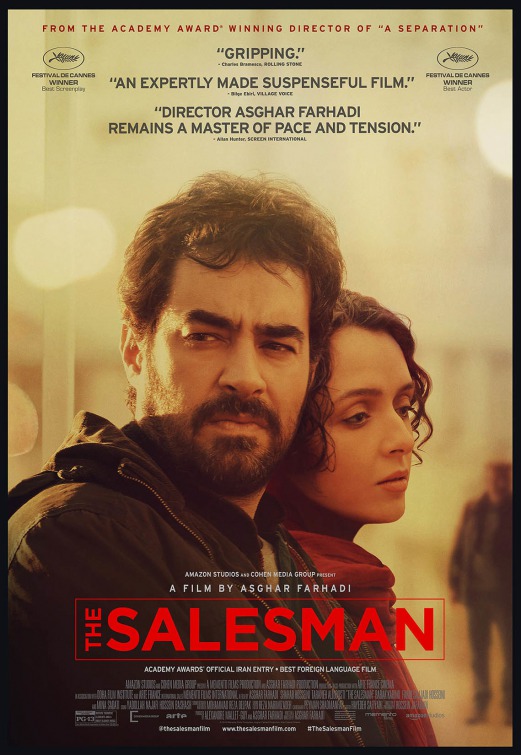
Asghar Farhadi’s The Salesman [Forušande] [فروشنده] is a marvelously dark and brooding study of a married couple that shifts smoothly from a domestic crisis drama to a revenge flick. His approach is a lot more subtle than one an American director might take, but this is precisely what makes The Salesman so satisfying.

While working out the finishing touches of a production of Arthur Miller’s Death of a Salesman in which they play the Lomans, community actors Emad (Shahab Hosseini) and Rana (Taraneh Alidoosti) are forced out of their apartment just days before the play opens when a construction mishap next door weakens the building’s foundation. The cracks in the walls become a metaphor for what’s about to happen to their relatively peaceful marriage.

A fellow cast member, Babak (Babak Karimi), sets them up in temporary digs, a recently and hastily vacated apartment that still contains the previous tenant’s belongings: furniture, bedding, dresses, tons of high heel shoes, a kid’s bike. One night when she’s home alone, a stranger attacks Rana in the shower. She can’t identify him, and she doesn’t want to go to the police. She won’t even say exactly what happened.

Rana starts to go off the deep end; the more unsafe she feels, the less secure Emad is in his own ego. He stews as he pieces together what might have transpired. A set of keys and a delivery truck parked on the street seems like a promising lead to tracking down the stranger, which becomes something of an obsession for Emad.

Farhadi has a straightforward, minimal style. Although he draws a few parallels to Death of a Salesman, he doesn’t beat us over the head with them. He does a nice job dropping us into the story and letting us figure out what he’s getting at. He has a lot to say about male aggression, turning the tables from Rana as the victim to Emad—his masculinity takes a beating as the film progresses.

With Farid Sajadhosseini, Mina Sadati, Mojtaba Pirzadeh

Production: Memento Films Production, Asghar Farhadi Production, Arte France Cinéma

Distribution: Amazon Studios (USA), Cohen Media Group (USA), Filmiran (Iran), Memento Films Distribution (France)

125 minutes
Rated PG-13

(Regal Webster Place) B+

http://www.thesalesmanfilm.com/showtimes

http://cohenmedia.net/films/the-salesman

Julieta

(Spain 2016)

Pedro Almodóvar has his own voice and his own vision, and he’s stayed true to both from the beginnning of his career. He’s an incredible story teller with no shortage of stories to tell; in fact, he once said that he “can make a thousand different movies about the same subject” (https://www.brainyquote.com/quotes/quotes/p/pedroalmod587571.html). His frank treatment of sexuality is as bold as his visual style, and his characters are all memorable. His plots are intricate, loaded with twists and turns and weird things that throw in a wrench that takes the whole thing somewhere you never saw coming. He’s a master of exaggeration—it works just as well in his comedy as it does in his melodrama.

Julieta, Almodóvar’s current film—his twentieth feature—is no exception. Like most of his movies, particularly his post-millennial work, this one centers on women. Inspired by three short stories (“Chance”, “Soon,” and “Silence”) from from Alice Munro’s 2004 book Runaway, Julieta is, in simplest terms, the story of one woman’s search for her estranged daughter. There’s a lot more to it, of course, and Almodóvar slowly reveals it all, layer by layer.

Julieta (Emma Suárez) is a middle-aged woman who lives in Madrid with her boyfriend, Lorenzo (Darío Grandinetti). They’re packing to move to Portugal. Julieta has a secret: she has a daughter, Antiá, who checked out of her life more than a decade ago. She happens to run into Beatriz (Michelle Jenner), an old friend of Antiá, on the street. Beatriz gives Julieta some small information about Antiá, prompting Julieta to drop all plans in the hope of her daughter returning. She begins writing a journal, which turns into a flashback that tells us what happened.

Some 30 years before, young Julieta (Adriana Ugarte) meets scruffy fisherman Xoan (Daniel Grao) on a train. He’s married, but his wife is in a coma. He knocks up Julieta, who receives a letter from him and visits him at his home in a small Spanish fishing town. They decide to raise Antiá together there. When Antiá (Priscilla Delgado) is a teen and away at camp, Julieta and Xoan have a fight that leads to disaster. Julieta doesn’t tell Antiá everything, and it comes back to bite her.

Nothing by Almodóvar ever sucks, but I’ve found his work to be up and down after All About My Mother. It’s to be expected from an artist with a long career, Madonna being a good example. His last project, 2013’s I’m So Excited, was fun but certainly not his most compelling. Julieta, however, is solid—I say it’s his finest hour and a half since Volver. It’s not a light film—it’s an elegant, emotional slow burner that deals with regret, omission, and forgiveness. Ugarte and Grao are both hot, and they have a palpable chemistry. Casting Rossy De Palma as Xoan’s longtime passive-aggressive housekeeper is a nice touch.

With Inma Cuesta, Blanca Parés, Pilar Castro, Tomás del Estal

Production: El Deseo

Distribution: Warner Brothers (Spain), Pathé, 20th Century Fox

99 minutes
Rated R

(AMC River East) B+

http://sonyclassics.com/julieta/

https://youtu.be/YH5_4osOZK8

The Handmaiden [Agassi]

(South Korea 2016)

“Where I come from, it’s illegal to be naive.”

—Sook-hee

I wasn’t sure what to expect from Park Chan-wook’s The Handmaiden [아가씨], but I’m glad I got to see it. One word: wow! A sexy, complex, and intriguing film to say the least, it’s a lavish visual and narrative cinematic experience. The trailer offers only a hint of what awaits.

Park wrote the screenplay, an adaptation of the 2002 novel Fingersmith by Welsh author Sarah Waters, with frequent collaborator Chung Seo-kyung. They change the setting from Victorian Era Britain to 1930s Korea when it was under Japanese colonial rule before the end of World War II. Confession: I did not read the book. The change is brilliant, though, resulting in something far more tense, exotic, and erotic than I imagine it would have been had they stuck to the original concept.

The Handmaiden is a cutthroat tale of power, sex, and deception in the same vein as Dangerous Liasons, though by no means is it the same story. The title refers to “Tamako” (Kim Tae-ri), a young common girl hired to serve as a maid to mysterious Japanese heiress Lady Hideko (Kim Min-hee). Lady Hideko’s authoritarian Uncle Kouzuki (Jo Jin-woong) runs the household, which has a crazy library of antique erotica and a basement used for punishment. The atmosphere is abusive and weird. So much so, in fact, that Lady Hideko’s aunt committed suicide—and she still hears her voice at night.

WARNING: Potential spoilers ahead!

“Tamako” has a secret: she’s really Sook-hee, a master pickpocket from a long line of con artists. Sook-hee is working with Fujiwara (Ha Jung-woo), a dashing con man, on an elaborate scam to bilk Lady Hideko out of her fortune. Fujiwara, posing as a Count, is wooing Lady Hideko into marriage, after which he plans to commit her to her an insane asylum and take off with her money. Fujiwara has a secret, too: he’s double dealing with Lady Hideko, who wants to get away from her uncle. Their plot involves getting married, cashing out her inheritance, and committing her illiterate maid under her name, after which Lady Hideko assumes the identity of “Tamako”—while keeping her money, of course.

The best-laid plans of mice and men gang aft agley, and nothing here is what it seems. Things get interesting and go another route when the two women’s relationship takes a sexual turn, and they like it.

The Handmaiden is an example of near perfect execution. The beginning and end are a little slow, but what’s in between is well worth the slightly draggy bookends. Divided into three parts, it tells the story from the different perpectives of the three scammers. We get more information with each part, and just when it looks like we know what’s coming—bam!, the proverbial rug is pulled out from underneath and the narrative goes somewhere else. The characters are really complex, and the acting here is excellent. The sex scenes are sensual but often have a humorous undertone. Chung Chung-hoon’s cinematography is rich and layered with thoughtful camerawork that adds a nice voyeuristic touch to the whole film, liberally using long shots and peeking through doors and around screens. This is a film you can easily get lost in.

144 minutes
Not rated

(Gene Siskel Film Center) B+

http://www.handmaidenmovie.com/showtimes

Manchester by the Sea

(USA 2016)

Home is where the heart is, but for Boston area janitor Lee Chandler (Casey Affleck) it’s where the heartbreak is. Withdrawn into a dreary and meager existence, he spends his days repairing tubs and toilets, listening to tenants bitch (and in one case talk on the phone about doing him), and shoveling snow at the apartment building where he lives in a dark basement with hardly any furniture and apparently one window. He spends his nights drinking himself stupid—so stupid he gets into the occasional brawl. He gets some positive attention here and there but never responds or engages. He’s dead inside for reasons that aren’t immediately clear.

Flashbacks show that Lee wasn’t always broken. He was married with three children. He had a home. He had friends and a social life. He spent a lot of time with his only sibling, older brother Joe (Kyle Chandler), and his nephew, Joe’s only kid Patrick (Ben O’Brien), on Joe’s boat. Joe’s wife, Elise (Gretchen Mol) is no longer in the picture. Neither is Lee’s, Randi (Michelle Williams).

One cold morning, a friend (C.J. Wilson) calls Lee to inform him that Joe had another heart attack. Joe dies before Lee gets to the hospital in his hometown, Manchester-by-the-Sea, about an hour up the coast from him. He has to tell Patrick (Lucas Hedges), who’s now in high school. Lee sticks around to help put together the funeral and look after his nephew. He gets pulled into a parental role, carting Patrick to hockey events and band —a rock band, not high school marching band—practice, and counseling him on matters of dating and sex. Both are surprised when Joe’s lawyer (Josh Hamilton) reveals his will: he made provisions for Lee to serve as Patrick’s guardian. Too bad Joe never said anything to Lee.

Manchester by the Sea has some truly depressing scenes. The backstory of what brought Lee to his current state is horrible—it’s no wonder he doesn’t want to be anyone’s guardian. One excruciating exchange between Randi and Lee turned on the waterworks—mine (and it takes some doing to get me to cry). Director and writer Kenneth Lonergan is focused on loss, forgiveness, and the complicated nature of taking care of one’s own in tough times. Jody Lee Lipes’s cinematography nicely translates that focus, giving the film its dreary, colorless look.

All that said, Manchester by the Sea really isn’t a depressing movie. Much of the dialogue between Lee and Patrick is amusing: snarky and smartass, they often end up arguing. They’re all macho but obviously have a bond they don’t ever bring up; instead, it shows subtly when they talk about Joe or the boat. Lonergan has a wonderfully dry sense of humor that makes this one more than melodrama. The frozen ground is too hard to dig, so Joe has to stay in a freezer until spring. Patrick tries hard to get into a bandmate’s (Anna Baryshnikov) pants, while her mother (Heather Burns) develops a thing for Lee. Patrick gets in touch with his mother, who to his disdain has become a born again Christian. Plus, her fiancé is played by Matthew Broderick. Nice touch!

Manchester by the Sea has a similar vibe as, say, a Smiths song. I like that. The rather abrupt ending doesn’t resolve much, which is something I’ve heard a few people complain about. It didn’t bother me.

137 minutes
Rated R

(Landmark Century) B+

http://manchesterbytheseathemovie.com