Reservoir Dogs

(USA 1992)

In the grand scheme of all things Quentin Tarantino, Reservoir Dogs is not his best work. Sure, it exhibits his trademark wit, crass, and twisted sense of humor in a few Quent-essential scenes, like the diner analysis of Madonna’s “Like a Virgin” (with Sean Penn’s now dead brother Chris sitting there listening but not contributing) and Mr. Blonde (Michael Madsen) making a Van Gogh out of Officer Marvin Nash (Kirk Baltz) while  blaring Stealers Wheel’s “Stuck in the Middle with You.” Tarantino does a great job assembling memorable characters and setting up an uncomplicated plot. Smartly, he focuses on the aftermath instead of the failed heist itself, dropping only breadcrumbs of info about what exactly went down.

The problem is that for all its charm, Reservoir Dogs just doesn’t bring enough energy; the plot and the characters feel sketchy and underdeveloped. Tarantino relies heavily on dialogue that can’t sustain the whole film; the characters– especially Mr. Pink (Steve Buscemi) and Mr. White (Harvey Keitel)– talk and yell and kvetch an awful lot while not much actually happens. After not seeing it for over a decade, I was surprised at how long it took to get going. As Tarantino’s first directing job– his “lost” 1987 film My Best Friend’s Birthday, which sort of became the script for True Romance, doesn’t count– Reservoir Dogs is most interesting because it shows a pivotal voice still in development.

I loved it when it came out (I was 21 or 22 years old), and Reservoir Dogs is a respectable start– hell, it’s iconic and better than a lot of movies. Hindsight is 20/20, though, and seeing it again demonstrates that Tarantino’s best work was yet to come. Indeed, his very next film, Pulp Fiction, is lightyears ahead in style and substance: it’s tighter, far more cohesive, and has a lot more pizzaz. What a difference two years makes.

(Music Box) B

http://www.miramax.com/movie/reservoir-dogs/

Room

(Canada/Ireland 2015)

Although shortened and accelerated, Room is still a fitting adaptation true to Emma Donoghue’s novel. Some of the nuance is lost in transition from page to screen, but the story is told as much as it probably can be on film from the point of view of Jack (Jacob Tremblay), whose fifth birthday begins our involvement. Tremblay, who is seven years old, does an astounding job; he uses silence as much as sound to convey what’s going on in Jack’s head. Brie Larson as Jack’s mother, Joy, is quietly intense, at least until later; when she explodes, however, her intensity is a bit overdone. Old Nick (Sean Bridgers) initially is shown only in intermittent bits and pieces, keeping his role in the story a mystery– a nice touch. Joan Allen and Tom McCamus, the latter arguably the sole redeeming male character aside from Jack, serve as calming anchors. William H. Macy appears very briefly as Joy’s father.

Director Lenny Abrahamson definitely gives us the claustrophobic feel of “Room.” His depiction of Jack’s foray into “World” about halfway through is the most intense and suspenseful part of the film; I literally held my breath at points. It was done really well, using choppy, moving camera work and tweaky color to illustrate the foreign, unfamiliar appearance of mundane objects to Jack– and how trippy his first experience outside is for him. The rest of the film is quieter, focusing on both Jack and his mother’s assimilation into the real world (Akron, Ohio, in the film– I don’t remember that from the book). I suspect most will agree that the first half of Room is far more compelling.  Still, it’s worth seeing and the story will stick with you after it’s over.

(Landmark Century) B

http://roomthemovie.com/#/

Wings of Desire [Der Himmel über Berlin]

(Germany 1988)

Wings of Desire is Wim Wenders’s take on being human, immortality, love, passion, and maybe even destiny (or lack thereof). Bruno Ganz and Otto Sander play two ageless and voyeristic angels, Damiel and Cassiel, who watch over Berlin, eavesdropping on ordinary citizens’ most personal thoughts. Sometimes they try to help out the mortals; sometimes they don’t. No one can see them except children, and they don’t have any real interaction with anyone. All is well and good until Damiel falls for trapeze artist Marion (Solveig Dommartin)– then things get dicey.

Wings of Desire is a beautiful looking film that closely resembles the midcentury Italian and French neorealist films I’ve seen of late: haunting and gorgeous black and white shots of the city, a cast of mostly everyday characters (except the angels, of course), a hazy plot, and heavy existential themes. Poetic and dreamlike, it’s slow and very German but well worth sticking with to the end. Seeing the Wall, which stood until 1989, as just another part of the landscape adds a cool historical note. Peter Falk as Der Filmstar (a.k.a. himself) and a Nick Cave and the Bad Seeds concert as the setting for one of the last scenes are both nice touches– they provide playfulness in what otherwise would be an overly somber film.

(Gene Siskel Film Center) B

https://www.criterion.com/films/200-wings-of-desire

The Amazing Nina Simone

(USA 2015)

Amazing, indeed– both her talent and her life. This thorough documentary follows singer Nina Simone from her humble beginnings in a tiny North Carolina mountain town where she was Eunice Wayman through her death following a stroke in 2003. A piano prodigy early on thanks to her father– who her brother tells us is where her talent came from– Wayman’s dream of being America’s first black female classical concert pianist was dashed when the Curtis Institute rejected her application. She turned to nightclubs, changed her name to Nina Simone so her mother wouldn’t find out where she was working, and the rest as they say is history.

Director Jeff L. Lieberman touches on a lot of interesting stuff from every period of her life: Simone’s first marriage to a cute but lazy French sponge, her bisexuality, her association with Langston Hughes and MLK, her attitude toward the Black Panthers and Malcolm X, and her mental instability that worsened as she got older. He rounds it out with interviews of those who knew her, music and civil rights history, and academic commentary.

(Gene Siskel Film Center) B

http://www.amazingnina.com

Sandra [Vaghe stelle dell’orsa]

(Italy 1965)

Sandra is Luchino Visconti’s scandalous, wonderfully melodramatic postwar reworking of the story of Elektra and her brother, Orestes. Here, Sandra (Claudia Cardinale) and her husband (Michael Craig), return to her girlhood family estate to dedicate property as a park in the name of her father, a victim of Auschwitz. To her surprise, her brother, Gianni (Jean Sorel), from whom she was “separated” years ago, shows up in the night, dragging skeletons out of the closet with him and his freshly penned novel.

Loaded with longing gazes, forlorn poses, dramatic sighs, and loud piano slams, Sandra plays out like an Italian soap opera. The big question involves incest: did Sandra and Gianni, or didn’t they? Cardinale and Sorel are both beautiful, contrasting nicely with the barren landscape and crumbling structures in Volterra, the Etruscan city where the story takes place. Visconti doesn’t answer the big question, but he offers evidence for us to draw our own conclusion. I sensed but didn’t quite grasp the significance of the siblings being half Jewish; I couldn’t tell whether this was intended to be antisemitic, but it added to the melodrama whatever it was about.

(Gene Siskel Film Center) B

Listen to Me Marlon

(USA 2015)

I’m stating the obvious here, but Marlon Brando was a strange bird. It’s only fitting, then, that his “autobiography” be strange, too. And it is. With narration from the man himself taken from cassette recordings he made in private, he reminisces and philosophizes and prophecizes and lets his ego run loose. Footage of career highlights and personal tragedies round out his story.

At times creepy—that digitized head is a lot to take—Listen to Me Marlon gives some insight into why Brando was the way he was. Still, he remains as enigmatic as ever, even after seeing this.

(Landmark Century) B

http://www.listentomemarlon.com

3-1/2 Minutes, Ten Bullets

(USA 2015)

Another heartbreaking story of another racially fueled shooting of an unarmed black teen, Jordan Davis, in Florida the day after Thanksgiving (“Black Friday”) in 2012. No one wins here: Jordan, his friends who were with him, his parents, Michael Dunn (the man who shot him), Dunn’s fiancé, and society at large. Marc Silver’s 3-1/2 Minutes, Ten Bullets succeeds in reaching beyond race to illustrate why “stand your ground” laws are fatally flawed.

(Gene Siskel Film Center) B

http://www.takepart.com/three-and-a-half-minutes-ten-bullets

Tangerine

(USA 2015)

A day in the life of two transgender prostitutes, Sin-Dee (Kitana Kiki Rodriguez) and Alexandra (Mya Taylor) of West Hollywood. Sin-Dee just got out of jail and is trying to tack down her fiancé/pimp, Chester (James Ransone), who failed to pick her up. Fellow trans hooker Alexandra lets out of the bag that Chester has been shacking up with a real girl (Mickey O’Hagen) while Sin-Dee was in the slammer. Sin-Dee shifts her plan and sets out to kidnap her. Did I mention it’s Christmas Eve? Thrown into all this is Armenian cab driver Razmik (Karren Karagulian), who is married and has a thing for Alexandra. Where is all this going?

Tangerine gets off to a shaky start, but director Sean Baker lets his characters develop into full-fledged people as the film rolls on and ultimately proves to be a beautiful story. With a pervading sense of loneliness, it makes a point about survival and needing to rely on others to do it. No man (or woman) is an island.

(Music Box) B

http://www.magpictures.com/tangerine/

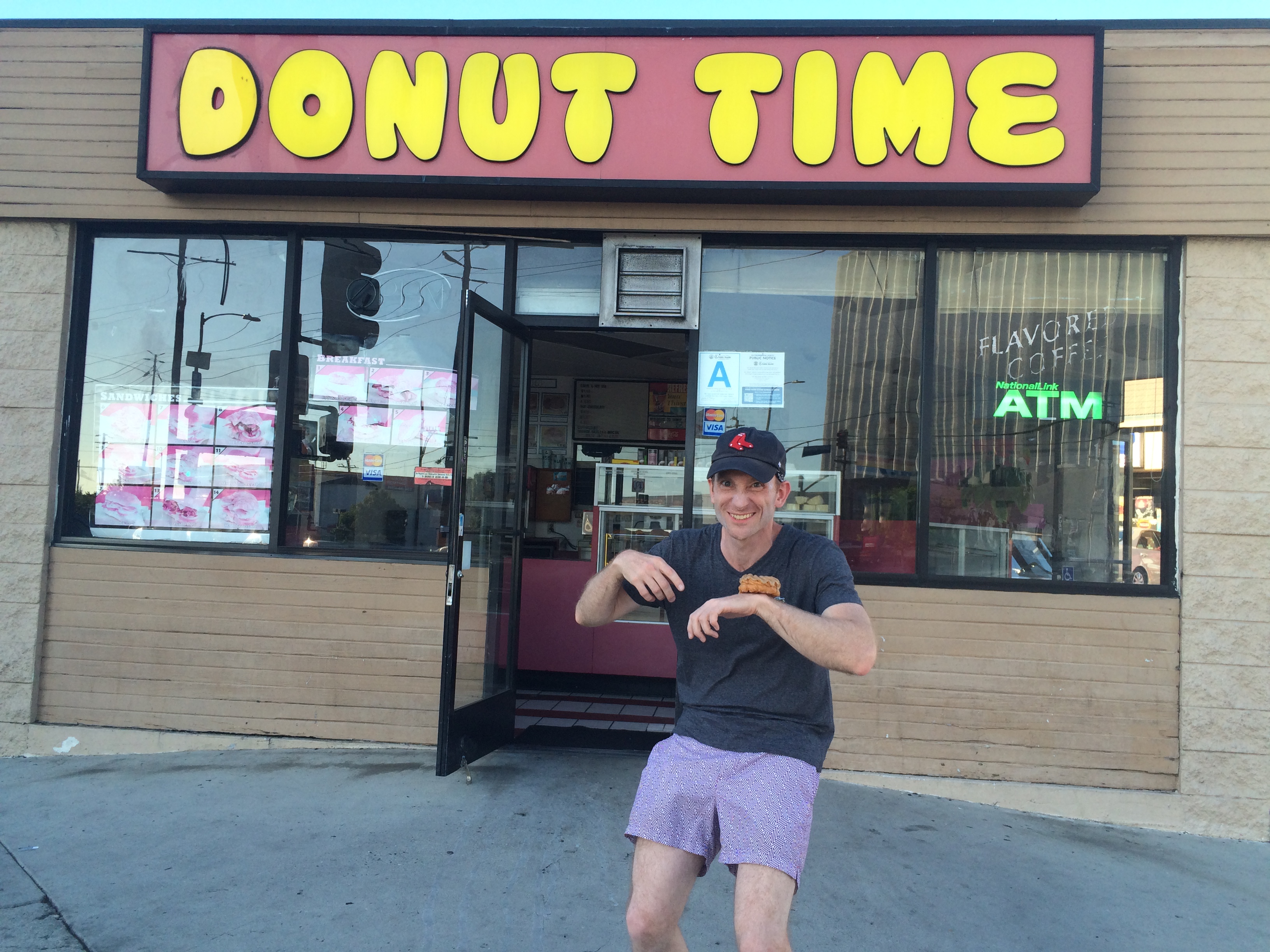
Footnote: I tracked down Donut Time, the donut shop where much of the action in Tangerine takes place. It’s located at 6785 Santa Monica Blvd. at the corner of Highland. I used the ATM and bought a cruller. It was awesome.

IMG_6293

Infinitely Polar Bear

(USA 2015)

Ah, the ups and downs of growing up during the pre-divorce Seventies, not only in a single-parent home but also with a bipolar dad. Directed and written by former The Larry Sanders Show writer Maya Forbes, Infinitely Polar Bear is a warm look back on a less than ideal situation.

Imogene Wolodarsky and Ashley Aufderheide as the lucky daughters create a believable chemistry that works really well with the subject matter. Mark Ruffalo’s performance is outstanding even if it probably isn’t one for which he’ll be remembered—his character’s antics are laugh-out-loud funny at times, and he gives his character (Channing) a loveable dorkish quality. I enjoyed Infinitely Polar Bear: it was funny and touching at once—much like an Afterschool Special.

(Landmark Century) B

http://sonyclassics.com/infinitelypolarbear/

Live from New York!

(USA 2015)

A fortieth anniversary retrospective of NBC’s Saturday Night Live! and its rise from DIY skit show to American institution. Objective and analytical in tone, it’s more oral history than nostalgia, broaching unflattering topics like SNL‘s inherent sexism, “anti Golden Age” of the early Eighties, and historical lack of diversity. Insights from Jane Curtin, Garret Morris, Larraine Newman, Julia Louise-Dreyfus, Dana Carvey, Will Ferrell, Tina Fey, Jimmy Fallon, Andy Samberg, and many others.

(AMC River East) B

http://www.livefromnewyorkmovie.com