Okja

(USA/South Korea 2017)

“We needed a miracle, and then we got one.”

—Lucy Mirando

Bong Joon-ho’s Okja, now streaming on Netflix, is a lot of things; dull is not one of them. A slick, fast-paced, mesmerizing mix of fantasy, sci-fi, comedy, action, satire, and social consciousness, this film has a lot going on—and a lot going for it. I was lucky to see it on the big screen before its official release, and that’s how I recommend seeing it if you can. Sorry, Netflix, Okja is simply too good for TV.

The story begins ten years ago in 2007: in a desperate but brilliant attempt to rebrand a disreputable family business—to make a silk purse out of a sow’s ear, so to speak—Lucy Mirando (Tilda Swinton) announces her master plan to breed an all-natural “superpig” that leaves a minimal footprint, feeds the world, and tastes great (https://superpigproject.com). Her company, Mirando Corporation, devises a competition, sending twenty-some piglets to real farmers across the globe to raise them; the company will monitor each pig over the next ten years and declare a “winner” based on the results. Mirando hires animal television show host Dr. Johnny Wilcox (Jake Gyllenhaal), a zoologist whose star is fading, to lend credibility to the project as well as to generate public interest in it.

Fast forward to 2017: Mirando’s plan is coming to fruition without any hiccups, which makes her happier than a pig in…well, you know. Unfortunately for Mirando, a young South Korean girl named Mija (Ahn Seo-hyun), whose grandfather (Byun Hee-bong) signed onto the project, threatens to derail the entire mission. Mija, you see, essentially raised her grandfather’s pig, Okja. They’ve become dependent on each other. He never explained to her what the deal really is—that Mirando’s silk purse is nothing more than lipstick on a pig.

Dr. Johnny and his television crew show up at their home in the mountains and marvel over Okja, now a magnificently enormous hippopotamus-like creature. He presents her grandfather with an award and takes Okja to Manhattan—actually, New Jersey—for a pig roast sponsored by the Mirando Corporation.

To put it lightly, Mija’s not having it—she takes off after Okja on a chaotic chase through Seoul, where she encounters the Animal Liberation Front, a group of inept animal rights activists led by idealistic but ineffective Jay (Paul Dano). They make a pact, but unfortunately she doesn’t speak English. Mija ends up at the world headquarters of Mirando Corporation in New York City, completely unaware of the cards she holds.

I went into Okja blind—the only thing I knew about it was that its central character is a big pig. I left more than satisfied: the cast is stellar, the effects are flawless, and the script is smart and strong despite its flaws. If that don’t beat a pig a-pecking, I don’t know what does.

In simplest terms, Okja is about our complicated consumerist relationship with food. As one pig farmer put it best, “Okja’s a fake pig in a movie I watched on Netflix. But plenty of real animals are suffering inside a horrific system that don’t have to.” (http://www.huffingtonpost.com/entry/okja-thoughts-from-a-pig-farmer_us_595bd1cde4b0f078efd98cbd). On this point alone, Okja will resonate with anyone who’s ever connected with an animal—pig, dog, cat, bird, horse, aardvark. The story has been compared to E.T. (https://moviebloke.com/2016/03/29/e-t-the-extra-terrestrial-e-t/), and it’s pretty wonderful. The final scene, which takes place in a slaughterhouse, is hard to watch—I got anxious. And queasy. I thought of Morrissey!

Appropriately, the acting is hammy; I love that Swinton plays twins again. She looks like a deranged Uma Thurman in Pulp Fiction. Gyllenhaal teeters on insufferable with his wimpy sniveling, but to his credit he manages to keep it in check. I’m usually unimpressed with computer animation, but here it’s amazingly well done; Okja looks as real as the humans. I think the trick is her eyes. Even with its Hollywood ending, Okja is definitely one of this year’s more interesting movies.

With Steven Yeun, Lily Collins, Yoon Je-moon, Shirley Henderson, Daniel Henshall, Devon Bostick, Choi Woo-shik, Giancarlo Esposito

Production: Kate Street Picture Company, Lewis Pictures, Plan B Entertainment

Distribution: Netflix

118 minutes
Not rated

(AMC River East) B

https://www.netflix.com/title/80091936

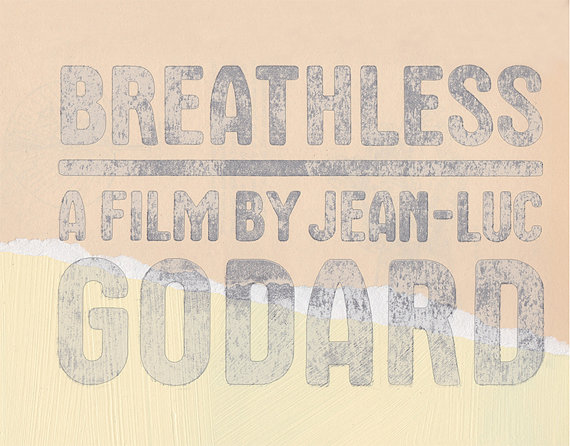
Breathless [Á bout de souffle]

(France 1960)

“After all, I’m an asshole.”

—Michel Poiccard

The third time is a charm: after seeing Jean Luc-Godard’s first full length feature film, Breathless, I now understand the love-meh relationship I have with his work.

On one hand, he’s got a remarkable grasp of human behavior and what motivates it. He’s got a snarky sense of humor. He’s stylish. His technique is gutsy for a lot of reasons. His characters are flawed. His subject matter is cool. He knows how to make a film look pretty, and most of them might as well be deemed official historical documents of the places where they were shot. Seeing a Godard film is like traveling back in time, an incidental bonus he probably never considered. I love all of this.

For all his strengths, on the other hand, a Godard film can be so damned…boring. Merde!

Fortunately, that’s not the case with Breathless, which I enjoyed. Godard and François Truffaut developed the story—I won’t call it a script or a screenplay because they made up much of it as they went along. Plot is always a loose construct with Godard, but there’s enough of one here to follow along fairly easily. Ugly cute guy (or is he a cute ugly guy?) Michel Poiccard (Jean-Paul Belmondo), a drifter car thief who fancies himself a French Humphrey Bogart, steals a car and drives it through the countryside. He shoots a policeman who pursues him and kills him.

With nowhere else to go, he heads straight to his American girl, Patricia (Jean Seberg), an expat student who sells a newspaper, the now defunct New York Herald Tribune, on the Champs-Élysées—that’s kind of weird—and writes articles here and there. She brings Michel to her apartment, where he hides out. He doesn’t mention anything to her about what happened. They get it on, or at least it’s implied that they do. She’s tells him she’s pregnant. One extended scene involves them lying around, talking.

Michel becomes a marked man, which he discovers as soon as he leaves the apartment with Patricia and sees a newspaper with a headline about him. I won’t ruin the ending, but it doesn’t bode well for him—especially after Godard himself sees Michel.

Breathless is a psuedo noir thriller that’s low on action but loaded with morally vacant characters who lack any redeeming qualities. There’s a nihilistic sexiness to it. The narrative moves along in a jazzy free-form way, and the imagery here is every bit a part of the story as the characters. The ending is not a happy one. If nothing else, Breathless is a visual stunner—black and white cinematic candy. The restored digital version I saw literally glowed.

I can handle more films like this one.

With Daniel Boulanger, Henri-Jacques Huet, Roger Hanin, Van Doude, Liliane David, Michel Fabre, Jean-Pierre Melville, Claude Mansard, Jean-Luc Godard, Richard Balducci, Jacques Rivette

Production: Les Films Impéria, Les Productions Georges de Beauregard, Société Nouvelle de Cinématographie (SNC)

Distribution: Films Georges de Beauregard, Les Films Impéria, Société Nouvelle de Cinématographie (SNC), Euro International Film (EIA) (Italy), Pallas Filmverleih (West Germany), British Lion Film Corporation (UK), Cinematográfica Azteca (Mexico), Ciné Vog Films (Belgium), Wivefilm (Sweden), Films Around the World (USA), Rialto Pictures (USA), Criterion Collection (USA)

90 minutes
Not rated

(iTunes rental) B

http://www.jean-lucgodard.com/films.html

https://www.criterion.com/films/268-breathless

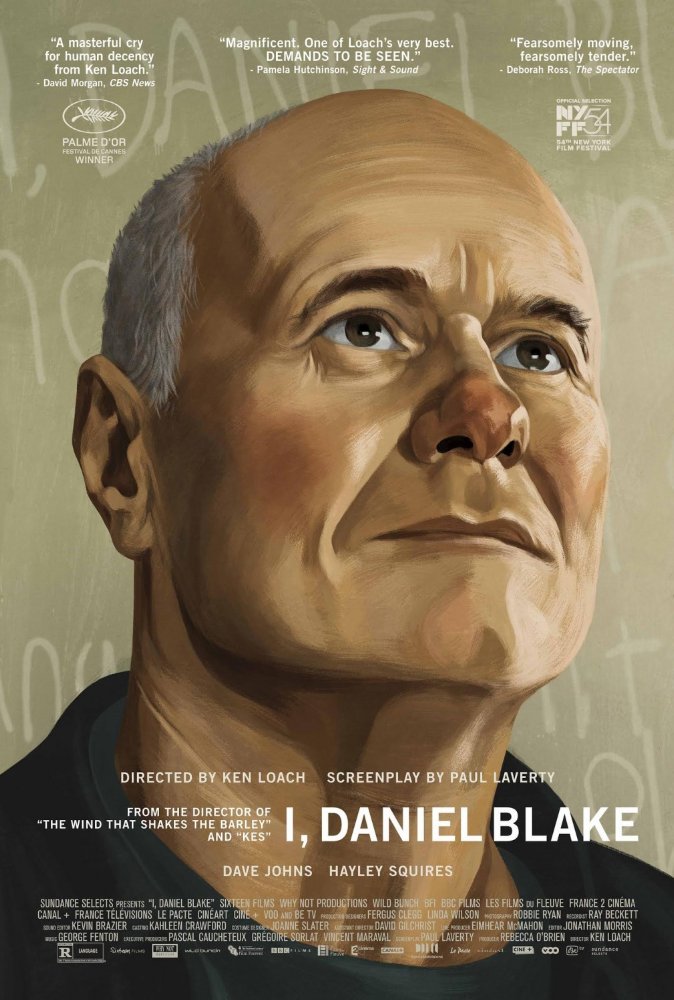
I, Daniel Blake

(UK/France/Belgium 2016)

I Daniel Blake.jpg

Ken Loach’s I, Daniel Blake has gotten a lot of attention and praise. Good: it wrestles with a topic that’s timely on both sides of the Atlantic—and elsewhere, for that matter. A political and poweful message, Loach has touched many a nerve. Case in point: I, Daniel Blake won the Palm d’Or at the Cannes Film Festival, where it finished with a 15-minute standing ovation (http://variety.com/2016/film/global/palme-dor-ken-loach-rebecca-obrien-1201785482/). 15 whole minutes?! Wow.

Daniel Blake (Dave Johns) is a kind of antihero. He’s gruff, he’s private, he’s not handsome or young. He probably goes to church. A heart attack seems like the thing that would change his life, but what really does is a new neighbor (Hayley Squires) and her two kids (Briana Shann and Dylan McKiernan).

I didn’t stand up, but I get it. Bureaucracy versus common sense is always fertile ground for storytelling. I applaud Loach for what he’s saying here, I really do. I, Daniel Blake is a good film: it’s engaging, brave, and relatable. The acting is good all around. So is the premise.

In my opinion, though, it just isn’t a great film. We’re talking shades of meaning here, so if you have five seconds to spare, I’ll tell you why. First, I’ve seen this device many times before—in the last year, even. A cranky old man meets a character that represents youth and hope, and it totally melts the icy facade and changes his life. Well, OK. This sense of hope is usually personified by the very person society looks down on. Next?

Second, I saw where the plot was going way before I got there. Again and again. Predictability is never groundbreaking.

Third, I can’t help but think that this film takes the easy way out. A heart attack in a movie ends only one way. And it’s only a sad ending. Yeah, I, Daniel Blake is emotionally manipulative.

So, my issues center on Paul Laverty’s writing. I wish I had a better way to tell this story. I don’t. For all its pluses and minuses, though, I’d rather watch something more intense. Overall, I, Daniel Blake is disappointingly soft.

With Kate Rutter, Sharon Percy, Kema Sikazwe, Steven Richens, Amanda Payne, Chris Mcglade, Shaun Prendergast, Gavin Webster, Sammy T. Dobson, Mickey Hutton, Colin Coombs, David Murray, Stephen Clegg, Andy Kidd , Dan Li, Jane Birch, Micky McGregor, Neil Stuart Morton

Production: Sixteen Films, Why Not Productions, Wild Bunch, British Film Institute (BFI), BBC Films, Les Films du Fleuve, Canal+, Ciné+

Distribution: Entertainment One Films (UK), Le Pacte (France), Cinéart (Belgium/Netherlands), Cinema (Italy), Feelgood Entertainment (Greece), Prokino Filmverleih (Germany), Scanbox Entertainment (Denmark), Sundance Selects (USA), Transmission Films (Australia), Vertigo Média Kft. (Hungary), Canibal Networks (Mexico), Cine Canibal (Mexico), Imovision (Brazil), Mont Blanc Cinema (Argentina), Longride (Japan)

100 minutes
Rated R

(Music Box) B

https://www.wildbunch.biz/movie/i-daniel-blake/

Love & Anarchy [Film d’amore e d’anarchia, ovvero ‘stamattina alle 10 in via dei Fiori nella nota casa di tolleranza…’]

(Italy/France 1973)

The premise of Lina Wertmüller’s Love & Anarchy [Film d’amore e d’anarchia, ovvero ‘stamattina alle 10 in via dei Fiori nella nota casa di tolleranza…’] has the ring of something from Federico Fellini or maybe Pedro Almodóvar (though Fellini makes a lot more sense because she actually worked as his assistant for a spell).

Freckly yokel farmer Tunin (Giancarlo Giannini) learns that his friend was murdered. Why? Because he was an anarchist who was plotting to assassinate “ll Duce” Benito Mussolini. What’s more, Mussolini’s fascist police killed him. To avenge his friend’s death, Tunin takes up his cause.

Tunin ends up at a brothel in Rome. He spends a night with Salomè (Mariangela Melato), who reveals that she’s a co-conspirator for her own reasons. As the story progresses, it becomes clear that the coup is a harebrained idea.

Salomè takes Tunin to a rural spot just outside Rome with her and another prostitute, Tripolina (Lina Polito). Salomè distracts Spatoletti (Eros Pagni), the head of Mussolini’s police, while Tunin checks out the area; they then devise a plan to execute the mission.

Meanwhile, Tunin and Tripolina fall in love. Convinced that he isn’t going to make it past the assassination alive, he persuades Tripolina to spend the next two days with him.

The same radical spunk that Wertmüller exhibits in The Seduction of Mimi is just as prevalent in Love & Anarchy; this film is loaded with decadent, sexy hijinks. However, it also its share of some really tender moments—that surprised me. Love & Anarchy turns out devastatingly sad—I left the theater literally bummed out. For all its ridiculous sociopolitical and sexual shenanigans, it’s a far more powerful film.

With Pina Cei, Elena Fiore, Giuliana Calandra, Isa Bellini, Isa Danieli, Enrica Bonaccorti, Anna Bonaiuto, Anita Branzanti, Maria Sciacca, Anna Melato, Gea Linchi, Anna Stivala, Roberto Herlitzka

Production: Euro International Film, Labrador Films

Distribution: Peppercorn-Wormser, Kino Lorber

120 minutes
Not rated

(Gene Siskel Film Center) B

https://www.kinolorber.com/film/view/id/1306

The Seduction of Mimi [Mimì metallurgico ferito nell’onore]

(Italy 1972)

I never heard of Lina Wertmüller until a retrospective of her work showed at a theater near me. The Seduction of Mimi [Mimì metallurgico ferito nell’onore] is an excellent starting point because it’s a textbook example of her style and the themes that inspire her. Plus, it’s an entertaining movie.

Mimi (Giancarlo Giannini) is a laborer in Sicily. His trouble begins after he votes for the communist candidate in a local election—his employer has been pushing its employees to vote for the mafia candidate. The ballot is supposed to be secret, but Mimi learns that it isn’t when he’s fired. Fearing that things will get complicated, he leaves his wife, Rosalia (Agostina Belli), behind and skips town.

Mimi ends up in Turin, where he finds work on an illegal construction site. He witnesses an on-the-job fatality and proves to be a problem when he learns that the mafia bosses running the job plan to dump the body. To keep him quiet, they place him in a union job at a factory.

It isn’t long before Mimi meets the alluring Fiorella (Mariangela Melato) selling sweaters on the street. He’s hooked on her; in fact, he knocks her up and she gives birth to a son. This is where The Seduction of Mimi gets really fun. Mimi is promoted to a management position back in Sicily. Naturally, he brings Fiorella and the baby with him. He’s protective of his new family and paranoid that Rosalia will find out about it, so he leads a thorny double life that…let’s just say doesn’t end well.

The Seduction of Mimi is rough, moving along like an episode of The Benny Hill Show. It’s compelling nonetheless because it has a certain elegance. Wertmüller is known for mixing sex, class, and politics. It’s a tricky feat, but she manages to pull it off while keeping The Seduction of Mimi totally amusing even by today’s standards. The stuff with the mafia and the gay rumor that gets out because Mimi won’t have sex with Rosalia are both hilarious. The whole revenge subplot that involves getting Amalia (Elena Fiore) pregnant is brilliant on so many levels, and that scene at the end where all of Mimi’s children clamor for him calling him “Papa!” is perfect. Giannini with his bug-eyed Chaplinesque faces looks crazy throughout this film, nicely underscoring the insanity of his situation. I smiled a lot during this film.

With Turi Ferro, Luigi Diberti, Tuccio Musumeci, Ignazio Pappalardo, Gianfranco Barra, Livia Giampalmo

Production: Euro International Film

Distribution: New Line Cinema (USA), Kino Lorber

121 minutes
Rated R

(Gene Siskel Film Center) B

https://www.kinolorber.com/film/theseductionofmimi

https://youtu.be/gI1C1gy-D1c

Restless Blood [Levoton veri]

(Finland 1946)

The third Nitrate Picture Show ended on a high note with an unidentified film (the “blind date”) that turned out to be Finnish director Teuvo Tulio’s gloriously insane melodrama Restless Blood [Levoton veri]. I never heard of the director, the film, or anyone in it. I adore this silly spectacle, which straddles the line between soap opera and Saturday morning cartoon.

The story is a love triangle involving two sisters, elder Sylvi (Regina Linnanheimo) and younger Outi (Toini Vartiainen), and Valter Sora (Eino Katajavuori), a burly doctor in their small town. Outi is his patient—she broke her leg—but Sylvi snags him as a husband. Not that Outi has no chance—she does, which she proves when she returns after disappearing, heartbroken, for a few years. Oh yeah—Sylvi goes blind in the meantime: she drinks poison.

Written by Tulio, Linnanheimo, and Nisse Hirn, the script is prime time dynamite. And fresh even by today’s standards. Forget the Ewings and the Carringtons—loaded with sibling rivalry and drama, Restless Blood is the raw and bitter real deal.

Here’s Sylvi driving like a maniac, “blinded” by rage:

img_9487

Come on! That coat, those glasses, that pissed off vengeful smoke! It’s perfect. When we see that Sylvi gets what’s going on between her husband and her sister, wow. Just…wow. The story is thin, but the actors put a lot into it. Bonus: Pentti Lintonen’s cinematography is brilliant. Seeing it on a nitrate print was the icing on the cake—totally worth the cinematic fat and calories.

Restless Blood is not the best film screened at this year’s Nitrate Picture Show, but I dare say it’s the most interesting. I’m dying to see more by Tulio—too bad his work is not easily (or cheaply) accessible.

With H. Stenroos, Lauri Korpela, Laina Laine, Nora Mäkinen, Lida Salin, Emma Väänänen, Elli Ylimaa

Production: Teuvo Tulio

Distribution: Väinän Filmi

91 minutes
Not rated

(Dryden Theatre) B

Nitrate Picture Show

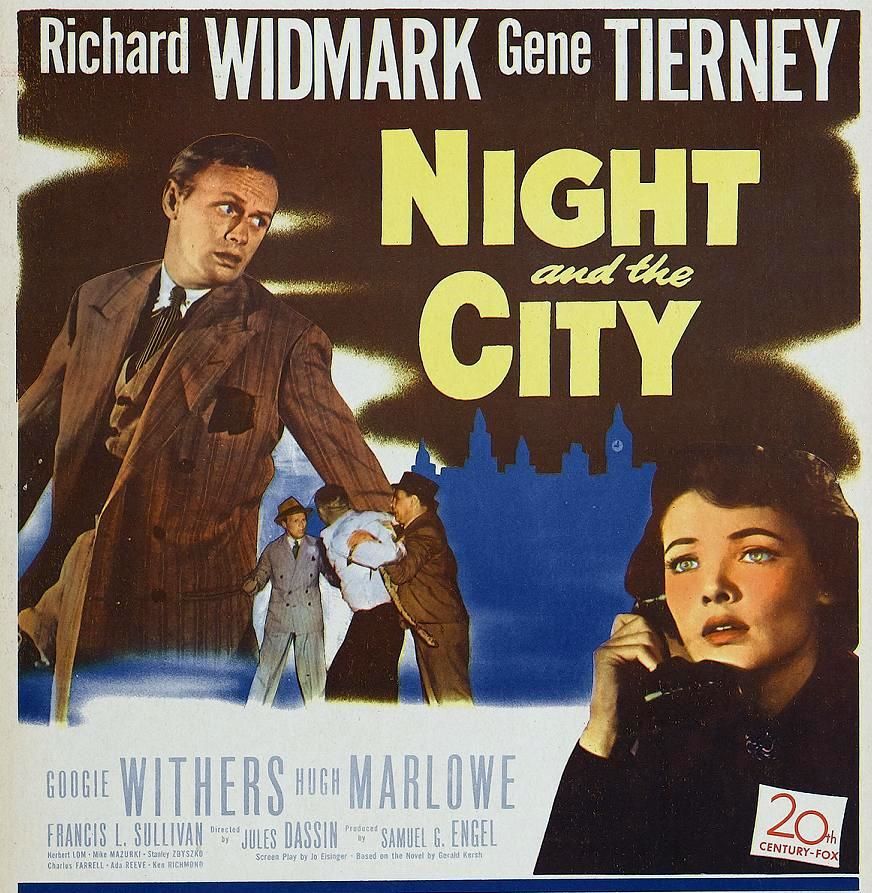
Night and the City

(UK/USA 1950)

“Harry is an artist without an art.”

—Adam Dunne

Jules Dassin’s Night and the City is a fine example of classic film noir. Filmed in smoky black and white mostly at nighttime on location in London, Dassin takes us slumming through the seedy underworld of nightlife, wrestling, and organized crime.

Harry Fabian (Richard Widmark) is a hard-bitten, ambitious, streetwise American con artist living in London. Always on the lookout for a quick buck, he can’t seem to catch a break. Ever. Literally running for his life in the opening scene, his latest career endeavor has failed, and his girl, Mary (Gene Tierney), is losing faith in him—stealing from her will do that.

Things brighten one night after a failed hustle at a wrestling match: Harry crosses paths with famous retired Greek wrestler Gregorius the Great (real life professional wrestler Stanislaus Zbyszko) and his prodigy, Nikolas of Athens (Ken Richmond), who both walk out of the arena in a huff. Gregorius is furious with his son, Kristo (Herbert Lom), who organized the fight, a low-end sort of WWE-like affair that he finds tacky.

Harry schmoozes Gregorius and learns that Kristo is a mobster who controls wrestling in all of London. He devises a plan to create a promotion startup, aligning himself with Gregorius to get around Kristo. He secures funding by double dealing with Phil Nosseross (Francis L. Sullivan), the owner of the Silver Fox Club where Mary works, and Phil’s wife, Helen (Googie Withers). She has plans of her own she doesn’t want Phil to know about.

The whole thing looks like it’s actually going to work despite Kristo’s threats, a plot to murder Harry, and Phil pulling his backing from the project. Harry gets so far as setting up a real fight between Nikolas and the Strangler (Mike Mazurki, also a real life professional wrestler). A miscalculation unravels everything—not just for him but everyone involved.

Jo Eisinger’s screenplay, based on Gerald Kersh’s novel Night and the City with contributions from Austin Dempster and William E. Watts, involves morally bankrupt lowlife characters who lack any redeeming qualities. All of them are scamming for one thing or another, and none of them—except maybe Mary—evokes any sympathy. This plays out nicely with the motifs of money, masculinity, and blind ambition that give this story its dark and bitter hue. It’s suspenseful. Ultimately, evil prevails in this dirty little story, which had to be revolutionary if jarring when this came out.

The backstory here is as interesting as the plot: during the production of Night and the City, Dassin was blacklisted for being a Communist. Pushed into exile, he infuses a strong sense of betrayal and fear into this film (https://en.wikipedia.org/wiki/Jules_Dassin).

Night and the City is desperate, chilly, and magnificently bleak—and it looks it thanks to Mutz Greenbaum’s shadowy and dramatic cinematography. Of the nitrate prints that screened this year, this was a standout. According to the festival program, this pre-release print is ten minutes longer than the UK version and 15 minutes longer than the US version.

With Hugh Marlowe, Ada Reeve, Charles Farrell, Edward Chapman, Betty Shale

Production: 20th Century Fox

Distribution: 20th Century Fox, Criterion

111 minutes (pre-release print)
Not rated

(Dryden Theatre) B

Nitrate Picture Show

https://www.criterion.com/films/933-night-and-the-city

Wild at Heart

(USA 1990)

“Man, I had a boner with a capital ‘O.'”

—Sailor Ripley


“And this here’s a story with a lesson about bad ideas.”

—Lula Pace Fortune


“Don’t turn away from love, Sailor.”

—Glinda the Good Witch

Wild at Heart is one of David Lynch’s more maligned films. Roger Ebert hated it to the point of indignation (https://www.google.com/amp/www.rogerebert.com/reviews/amp/wild-at-heart-1990). Vincent Canby seemed perplexed—I can’t tell whether he was bored, annoyed, or just flummoxed (http://www.nytimes.com/movie/review?res=9C0CE5D7123EF934A2575BC0A966958260). Jonathan Rosenbaum called it “appalling,” “inept,” and “debasing” (https://www.jonathanrosenbaum.net/1990/08/bad-ideas/). A host of other critics rolled their eyes and sighed, dismissing it, I suppose, as a violent and exploitive piece of shock fluff.

I never saw Wild at Heart until now. Some of the points raised by its detractors are valid, but I still liked it for the same things that made them hate it. Erratic, vulgar, and really sweet, it’s offputting yet compelling and—surprise!—it has a happy ending.

An atypically straightforward narrative for a Lynch project, Wild at Heart is a decidedly deranged, bloody road movie/romance/thriller based on Barry Gifford’s novel of the same name. Upon his release from a North Carolina prison after serving time for murder—never mind that it was self-defense—Sailor Ripley (Nicolas Cage) exits the jailhouse to find his lover, Lula Pace Fortune (Laura Dern), waiting for him outside in the sunlight with his snakeskin jacket, the symbol of his individuality and his belief in personal freedom. They spend some time catching up in a motel room and at a speedmetal concert before they decide to blow off his parole and take off for California.

Meanwhile, Lula’s mother, Southern lady Marietta (Diane Ladd), is making plans of her own—and they involve her private detective boyfriend (Harry Dean Stanton) and a hit man (J. E. Freeman) who’s got Sailor as his target. A bad omen detours the starcrossed lovers to Big Tuna, Texas, where they unwittingly plant themselves smack in the middle of a bad situation that looks to be turning deadly fast.

OK, I’ve seen versions of this same story before. The plot is familiar and for the most part implausible—not to mention really, really thin at times. Lynch goes overboard with his depiction of sex, violence, and gore—even though they all have a place here. None of this matters, though, because the characters, which are both the focus and the strength of the film, are fantastic.

As usual, the casting is stellar. Cage is at his best here, working that edgy deadpan earnest manic thing he did so well in his early films. Dern is flawless as a sweet Southern girl who’s found her place with bad boy Sailor, everyone else be damned. Willem Dafoe is super creepy as hayseed bad guy Bobby Peru—those teeth! Above them all, however, is Ladd, who’s fucking fabulous even with her face covered in red lipstick. She’s vengeful at times, remorseful at others; but all the while, a perfect lady. She shines here. There’s a reason she was nominated for an Oscar for her performance (https://www.oscars.org/oscars/ceremonies/1991). This film works because the actors give it their all.

Wild at Heart is loaded with Lynch’s trademark what-the-fuck weirdness—a man at a bar quacking like a duck (you read that correctly) and cousin “Jingle Dell” (Crispin Glover) sitting on the floor in the bathroom screaming for Christmas or standing at the counter in the dark making a hundred sandwiches for lunch are bizarre moments even by Lynchian standards. There’s a lot more to it, though. I love the theme of finding a happy place in the midst of horrible things happening. I love all the references to various staples of Americana—cowboys, cars, highways, Elvis Presley, and my favorite, The Wizard of Oz. I love that underneath it all is a touching love story that we can all relate to.

What I find most interesting, though, is that so many things about Wild at Heart scream Quentin Tarantino, yet he had nothing to do with it. In fact, it came out two years before Tarantino’s first major film, Reservoir Dogs. I never thought of David Lynch as an influence on him, but Wild at Heart makes me wonder.

Side note: Wild at Heart is a rated R movie. For the screening I attended, however, I was lucky enough to catch an unreleased rated X version. The X rating was no doubt due to the graphic violence—it wasn’t the sex scenes. The print was in bad shape, all scratchy and beat up, but it was totally worth it to see an X-rated Lynch film.

With W. Morgan Sheppard, Grace Zabriskie, Isabella Rossellini, Sherilyn Fenn, Sheryl Lee

Production: PolyGram Filmed Entertainment, Propaganda Films

Distribution: Manifesto Film Sales, The Samuel Goldwyn Company (USA), Palace Pictures (UK), Bac Films (France), Cineplex Odeon Films (Canada), Finnkino (Finland), Hoyts Distribution (Australia), Háskólabíó (Iceland), Meteor Film Productions (Netherlands), Sandrew Film & Teater (Sweden), Solopan (Poland)

125 minutes
Rated X (alternate version)

(Music Box) B

David Lynch: A Complete Retrospective

http://www.davidlynch.de

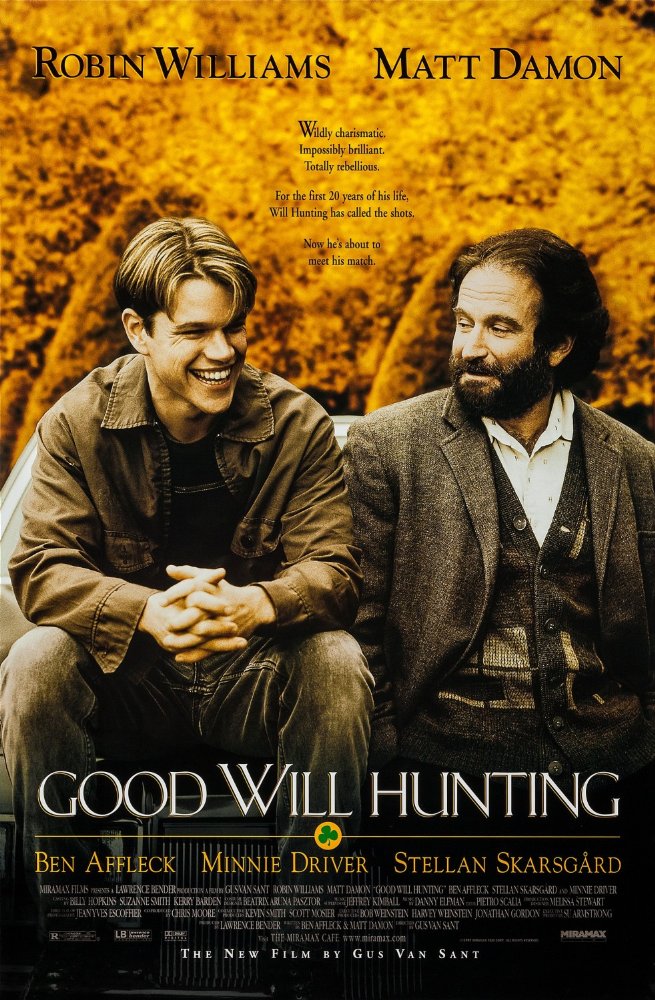
Good Will Hunting

(USA 1997)

“Well, I got her number. How do you like them apples?”

—Will Hunting

Good Will Hunting, the final screening of Chicago International Film Festival’s Totally ’90s series, is not something I associate with its director, Gus Van Sant. Frankly, I didn’t know he directed it until I saw his name in the credits.

No, I associate Good Will Hunting with longtime friends Matt Damon and Ben Affleck, who while they were both still relatively unknown turned the former’s drama class project into the script that would become this film (http://www.eonline.com/news/802830/looking-back-at-the-totally-crazy-story-behind-the-making-of-good-will-hunting). The success of Good Will Hunting seemed to come out of nowhere and established both of them as actors—never mind that they snagged the Oscar for Best Screenplay in 1998 (https://www.oscars.org/oscars/ceremonies/1998). Damon and Affleck have both written since, but none of their screenplays has been as successful as this one.

Gerald Lambeau (Stellan Skarsgård), a professor at MIT, is baffled when someone anonymously solves a wicked hahd math problem he posted on a chalkbaord in the hall as a challenge to his students—he expected it to take the entire semester. No one steps up to claim the work. He posts a second problem, one that took his colleagues two years to figure out. He’s amazed when he catches one of the school’s janitors, Will Hunting (Damon), red-handed. Will won’t have anything to do with Lambeau—until he ends up in jail for assault.

Recognizing Will’s gift, Lambeau makes a deal with him: he’ll pay for bail if Will works with him on math and sees a therapist. The problem is, Will doesn’t make it easy to connect. In fact, five different therapists fail. As a last resort, Lambeau calls former classmate Sean Maguire (Robin Williams), who has a similar Southie background as Will and stands up to his crap. Sean sees that Will is deflecting to hide his self-sabotaging tendencies.

Meanwhile, Will meets Skylar (Minnie Driver), who sweeps him off his feet. It all goes well until she tells him she’s going to medical school at Stanford—and asks him to go with her.

The script here is loaded with good ideas and gorgeous details—that story about Sean ditching a Red Sox game to be with a girl he just met in a bar (she would become his wife) is gold. So is Will’s confrontation with a grad student (Scott William Winters) at a dive. Hearing Damon sing “Afternoon Delight” while he’s faking hypnosis is hilarious. The story, though, is predictable. Good Will Hunting excels because of the acting. The casting—by Kerry Barden, Billy Hopkins, and Suzanne Smith—makes all the difference in the world.

With Ben Affleck, Casey Affleck, John Mighton, Rachel Majorowski, Colleen McCauley, Cole Hauser, Rob Lyons, Steven Kozlowski, Jennifer Deathe, Philip Williams, Patrick O’Donnell, Kevin Rushton, Jimmy Flynn, Joe Cannon, Ann Matacunas, George Plimpton, Francesco Clemente

Production: Lawrence Bender Productions, Be Gentlemen Limited Partnership, Miramax Films

Distribution: Miramax Films (USA), Bac Films (France), Buena Vista International (UK), Cecchi Gori Distribuzione (Italy), Filmes Castello Lopes (Portugal), Intersonic (Czech Republic), Laurenfilm (Spain), Lider Films (Argentina), SF Norge A/S (Norway), Scanbox Entertainment (Sweden), Scotia International Filmverleih (Germany), Shochiku-Fuji Company (Japan), Svensk Filmindustri (SF) (Sweden), Svenska Filminstitutet (SFI) (Sweden), United International Pictures (UIP) (Switzerland)

126 minutes
Rated R

(Public Chicago) B

Chicago International Film Festival

https://www.miramax.com/movie/good-will-hunting/

Exodus: Sounds of the Great Migration [Sounds of Exodus: An Ode to the Great Migration]

(USA 2016)

Chicago filmmaker Lonnie Edwards made some waves with his 2015 documentary A Ferguson Story, which delved into some of the events following Officer Darren Wilson’s deadly shooting of unarmed black teen Michael Brown in Ferguson, Missouri. The subject of Exodus: Sounds of the Great Migration isn’t as heavy or bleak, but it’s every bit as intriguing.

Exodus: Sounds of the Great Migration is a smooth, flashy short film that honors the music and dance forms that black Americans brought to other parts of the country, mostly industrialized cities, through the Great Migration from the South during the first half of the 20th Century. In just a few minutes, Edwards demonstrates how both assimilated into urban life and continue to shape modern culture. I couldn’t find credits, but the guy tap dancing in the stairwell stood out; his taps are downright melodious.

Production: 11 Dollar Bill

Distribution:

4 minutes
Not rated

(The Chop Shop/1st Ward) B

CIMMfest

https://www.soundsofexodus.com