Okja

(USA/South Korea 2017)

“We needed a miracle, and then we got one.”

—Lucy Mirando

Bong Joon-ho’s Okja, now streaming on Netflix, is a lot of things; dull is not one of them. A slick, fast-paced, mesmerizing mix of fantasy, sci-fi, comedy, action, satire, and social consciousness, this film has a lot going on—and a lot going for it. I was lucky to see it on the big screen before its official release, and that’s how I recommend seeing it if you can. Sorry, Netflix, Okja is simply too good for TV.

The story begins ten years ago in 2007: in a desperate but brilliant attempt to rebrand a disreputable family business—to make a silk purse out of a sow’s ear, so to speak—Lucy Mirando (Tilda Swinton) announces her master plan to breed an all-natural “superpig” that leaves a minimal footprint, feeds the world, and tastes great (https://superpigproject.com). Her company, Mirando Corporation, devises a competition, sending twenty-some piglets to real farmers across the globe to raise them; the company will monitor each pig over the next ten years and declare a “winner” based on the results. Mirando hires animal television show host Dr. Johnny Wilcox (Jake Gyllenhaal), a zoologist whose star is fading, to lend credibility to the project as well as to generate public interest in it.

Fast forward to 2017: Mirando’s plan is coming to fruition without any hiccups, which makes her happier than a pig in…well, you know. Unfortunately for Mirando, a young South Korean girl named Mija (Ahn Seo-hyun), whose grandfather (Byun Hee-bong) signed onto the project, threatens to derail the entire mission. Mija, you see, essentially raised her grandfather’s pig, Okja. They’ve become dependent on each other. He never explained to her what the deal really is—that Mirando’s silk purse is nothing more than lipstick on a pig.

Dr. Johnny and his television crew show up at their home in the mountains and marvel over Okja, now a magnificently enormous hippopotamus-like creature. He presents her grandfather with an award and takes Okja to Manhattan—actually, New Jersey—for a pig roast sponsored by the Mirando Corporation.

To put it lightly, Mija’s not having it—she takes off after Okja on a chaotic chase through Seoul, where she encounters the Animal Liberation Front, a group of inept animal rights activists led by idealistic but ineffective Jay (Paul Dano). They make a pact, but unfortunately she doesn’t speak English. Mija ends up at the world headquarters of Mirando Corporation in New York City, completely unaware of the cards she holds.

I went into Okja blind—the only thing I knew about it was that its central character is a big pig. I left more than satisfied: the cast is stellar, the effects are flawless, and the script is smart and strong despite its flaws. If that don’t beat a pig a-pecking, I don’t know what does.

In simplest terms, Okja is about our complicated consumerist relationship with food. As one pig farmer put it best, “Okja’s a fake pig in a movie I watched on Netflix. But plenty of real animals are suffering inside a horrific system that don’t have to.” (http://www.huffingtonpost.com/entry/okja-thoughts-from-a-pig-farmer_us_595bd1cde4b0f078efd98cbd). On this point alone, Okja will resonate with anyone who’s ever connected with an animal—pig, dog, cat, bird, horse, aardvark. The story has been compared to E.T. (https://moviebloke.com/2016/03/29/e-t-the-extra-terrestrial-e-t/), and it’s pretty wonderful. The final scene, which takes place in a slaughterhouse, is hard to watch—I got anxious. And queasy. I thought of Morrissey!

Appropriately, the acting is hammy; I love that Swinton plays twins again. She looks like a deranged Uma Thurman in Pulp Fiction. Gyllenhaal teeters on insufferable with his wimpy sniveling, but to his credit he manages to keep it in check. I’m usually unimpressed with computer animation, but here it’s amazingly well done; Okja looks as real as the humans. I think the trick is her eyes. Even with its Hollywood ending, Okja is definitely one of this year’s more interesting movies.

With Steven Yeun, Lily Collins, Yoon Je-moon, Shirley Henderson, Daniel Henshall, Devon Bostick, Choi Woo-shik, Giancarlo Esposito

Production: Kate Street Picture Company, Lewis Pictures, Plan B Entertainment

Distribution: Netflix

118 minutes
Not rated

(AMC River East) B

https://www.netflix.com/title/80091936

Disco Godfather [The Avenging Disco Godfather]

(USA 1979)

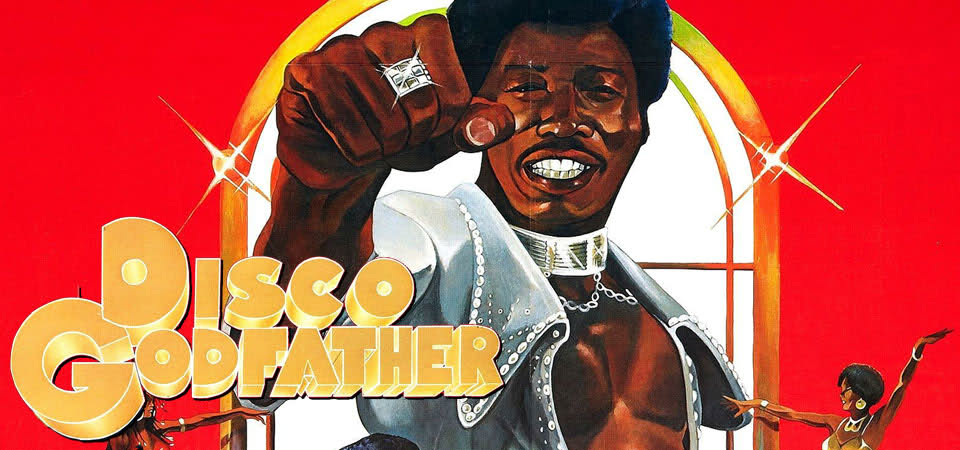
Dear God the Father! Some movies are so terrible, you love them for everything wrong with them—what’s bad is exactly what endears them. Other movies…well, they’re just terrible. It’s a thin line. Sadly, Disco Godfather falls into the latter category.

J. Robert Wagoner and Cliff Roquemore’s screenplay stars Rudy Ray Moore as Tucker Williams, an L.A. cop-turned-DJ at the trashy-ass Blueberry Hill Disco, which looks like a repurposed Denny’s. The plot involves Williams’s nephew, Bucky (Julius J. Carry III), who’s gotten hooked on “angel dust.”

One word: YAWN! What were they thinking? Disco Godfather is so boring, I’d rather watch reruns of 2 Broke Girls. The only thing that saves it from total failure is the wardrobe—Felice Hurtes, Jimmy Lynch, and Kimberly Sizemore deserve major kudos for finding the cool Goodwill stores. Fuck this bullshit: watch Dolemite and call it a day. They could have tried a little harder here.

With Carol Speed, Jimmy Lynch, Jerry Jones, Lady Reed, Hawthorne James, Frank Finn, Julius J. Carry III, Bishop Pat Patterson, Pucci Jhones, Howard Jackson, Yetta Collier, Pat Washington, Doc Watson, Leroy Daniels, Melvin Smith, Ronny Harris, Dolorise Parr, John Casino, Keith David

Production: Generation International

Distribution: Transvue Pictures (USA), Xenon Pictures

93 minutes
Rated R

(DVD purchase) D-

The Godfather

(USA 1972)

“Why did you go to the police? Why didn’t you come to me first? What have I ever done to make you treat me so disrespectfully?”

—Don Vito Corleone


“My father is no different than any powerful man, any man with power. Like a president or a senator.”

—Michael Corleone


“And may their first child be a masculine child.”

—Luca Brasi


“Hey Mikey, why don’cha tell that nice girl you love her? ‘I love you with all a-my heart. If I don’t a-see you again a-soon, I’m a-gonna die!'”

“Leave the gun. Take the cannoli.”

—Peter Clemenza

Pretty much perfect, The Godfather was almost a different movie. Based on Mario Puzo’s insanely popular best selling 1969 novel, studio executives conceived a pulp gangster drama for its film adaptation. Good thing they wanted a “real” Italian-American to direct so it would be so authentic that moviegoers would “smell the spaghetti” (https://www.vanityfair.com/news/2009/03/godfather200903). Several unsuccessful attempts were made to attract a director, including Warren Beatty. Paramount “settled for” unknown Francis Ford Coppola, who took it somewhere else.

The Godfather is universally held in high esteem as one of the greatest films of all time—as it should be. It’s a a movie showered in superlatives—like the bullets that shower, well, most of the characters. It’s impeccable. We caught an anniversary screening.

Coppola’s morality play is a masterpiece, more complex than it seems at first and full of contrast and contradiction. A solemn and ominous mob drama that centers on Don Vito Corleone (Marlon Brando) and his family business, The Godfather boasts one riveting career-defining performance after another—Brando, Al Pacino, James Caan, Richard Castellano, Robert Duvall, and Abe Vigoda, to name a few. The characters are great, and the dialogue—perfect! Not a single second is wasted here, not even that long ass wedding scene.

The observations about human nature are astute, and the spin on assimilation and the American Dream is clever. The dramatic arc involving the descent of younger son Michael (Pacino) into a moral apocalypse is something you can’t shift your eyes away from. Black as its promotional poster, The Godfather leaves so much to chew on. This is what cinema is all about.

In 1990, the United States Library of Congress deemed The Godfather “culturally, historically, or aesthetically significant” and selected it for preservation in the National Film Registry (https://www.loc.gov/programs/national-film-preservation-board/film-registry/complete-national-film-registry-listing/).

With Sterling Hayden, John Marley, Richard Conte, Al Lettieri, Diane Keaton, Talia Shire, Gianni Russo, John Cazale, Rudy Bond, Al Martino , Morgana King, Lenny Montana, John Martino, Salvatore Corsitto, Richard Bright, Alex Rocco, Tony Giorgio, Vito Scotti, Tere Livrano, Victor Rendina, Jeannie Linero, Julie Gregg, Ardell Sheridan, Simonetta Stefanelli, Angelo Infanti, Corrado Gaipa, Franco Citti, Saro Urzì, Sofia Coppola

Production: Paramount Pictures, Alfran Productions

Distribution: Paramount Pictures (USA), Cinema International Corporation (CIC) (International)

175 minutes
Rated R

(AMC River East) A+

Fathom Events

Dolemite

(USA 1975)

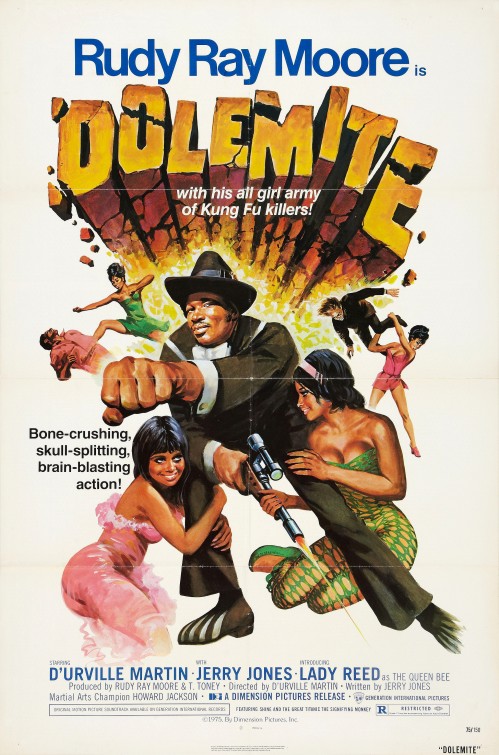
Dolemite (Rudy Ray Moore) is his name, and fuckin’ up mutha fuckas is his game!

He’s the baddest pimp around—well, around Los Angeles, anyway—and he looks every bit the part. Dolemite owns a nightclub and whorehouse but he’s doing time on a drug beef. Maybe it’s bogus, maybe not. Maybe some bad cops set him up, maybe it was archenemy Willie Green (D’Urville Martin), who took over the club and is running shit now. Either way, mother pimp Queen Bee (Lady Reed) and Dolemite’s army of ass-kickin’ kung fu hookers are none too happy about it.

To get out of the big house, Dolemite makes a deal with the po-po, Agent Blakeley (Jerry Jones), to, I think, help clean up his old hood. Dolemite uses this as an opportunity to exact revenge on Green and reclaim his, um, stature in the community.  Along the way, he kicks a lot of ass, takes on two crooked cokehead cops—Mitchell (John Kerry) and White—and gets laid. A lot. He even cuss raps at the end.

Dolemite is not a movie to see because it’s a work of art. On the contrary, it’s terrible. But that’s what makes it so much fun to watch—that’s why it’s a cult classic. Like a lot of things before the late ’80s, it’s not P.C. (i.e., politically correct)—as if that isn’t obvious from the movie poster. The directing by Martin, which probably explains why he has so little screen time, is sloppy. You can count the number of times boom mics pop in. The fight scenes are laughable—Dolemite knocks people out barely lifting a finger (or here,  leg) and sometimes without even touching them. Don’t even get me going on the martial arts stuff!

The plot is confusing and watered down. Jones wrote the screenplay with Moore, and the writing is just bad. I admit, I watched it drunk this time, but I’ve seen Dolemite before while sober. No difference. The events are scattered and at points seem random. The characters are colorful—shady Reverend Gibbs (West Gale), a possible parody of former Chicago leader Mayor Daley (Monte “Hy” Pike), the clearly trippin’ Hamburger Pimp (Vainus Rackstraw), and the many fox females—wander in and out, often without any reason.

Despite all that, Dolemite unquestionably has a charm of its own. Moore likes to rhyme, and he punctuates pretty much every sentence with “mutha FUCKA!” His crib is rent-to-own fabulous—check it out:

Dolemite set 2.jpg

Dolemite set 1.png

The wardrobe looks like it was borrowed from the Salvation Army. The climax at the nightclub goes on longer than it should but is still a showstopper. The soundtrack is a trip. If nothing else—and there is nothing else—Dolemite is a good time.

With Brenda DeLong, Terri Mosley, Marilyn Shaw, Lynell Smith, Vera Howard, Joy Martin, Jana Bisbing, Brenda Banks, Pat Haywood, René Van Clief, Pat Jones, Lola Mayo, Charlene Soulter, Liz Sample, Karolynn Hill, Dino Washington, Johnny J. Brown, Cardella Di Milo

Production: Comedian International Enterprise Productions (C.I.E.)

Distribution: Dimension Pictures, Xenon Pictures

90 minutes
Rated R

(DVD) C-

http://xenonpictures.com/wp/dolemite/

http://www.shockingimages.com/dolemite/films/dolemite.php

Wild at Heart

(USA 1990)

“Man, I had a boner with a capital ‘O.'”

—Sailor Ripley


“And this here’s a story with a lesson about bad ideas.”

—Lula Pace Fortune


“Don’t turn away from love, Sailor.”

—Glinda the Good Witch

Wild at Heart is one of David Lynch’s more maligned films. Roger Ebert hated it to the point of indignation (https://www.google.com/amp/www.rogerebert.com/reviews/amp/wild-at-heart-1990). Vincent Canby seemed perplexed—I can’t tell whether he was bored, annoyed, or just flummoxed (http://www.nytimes.com/movie/review?res=9C0CE5D7123EF934A2575BC0A966958260). Jonathan Rosenbaum called it “appalling,” “inept,” and “debasing” (https://www.jonathanrosenbaum.net/1990/08/bad-ideas/). A host of other critics rolled their eyes and sighed, dismissing it, I suppose, as a violent and exploitive piece of shock fluff.

I never saw Wild at Heart until now. Some of the points raised by its detractors are valid, but I still liked it for the same things that made them hate it. Erratic, vulgar, and really sweet, it’s offputting yet compelling and—surprise!—it has a happy ending.

An atypically straightforward narrative for a Lynch project, Wild at Heart is a decidedly deranged, bloody road movie/romance/thriller based on Barry Gifford’s novel of the same name. Upon his release from a North Carolina prison after serving time for murder—never mind that it was self-defense—Sailor Ripley (Nicolas Cage) exits the jailhouse to find his lover, Lula Pace Fortune (Laura Dern), waiting for him outside in the sunlight with his snakeskin jacket, the symbol of his individuality and his belief in personal freedom. They spend some time catching up in a motel room and at a speedmetal concert before they decide to blow off his parole and take off for California.

Meanwhile, Lula’s mother, Southern lady Marietta (Diane Ladd), is making plans of her own—and they involve her private detective boyfriend (Harry Dean Stanton) and a hit man (J. E. Freeman) who’s got Sailor as his target. A bad omen detours the starcrossed lovers to Big Tuna, Texas, where they unwittingly plant themselves smack in the middle of a bad situation that looks to be turning deadly fast.

OK, I’ve seen versions of this same story before. The plot is familiar and for the most part implausible—not to mention really, really thin at times. Lynch goes overboard with his depiction of sex, violence, and gore—even though they all have a place here. None of this matters, though, because the characters, which are both the focus and the strength of the film, are fantastic.

As usual, the casting is stellar. Cage is at his best here, working that edgy deadpan earnest manic thing he did so well in his early films. Dern is flawless as a sweet Southern girl who’s found her place with bad boy Sailor, everyone else be damned. Willem Dafoe is super creepy as hayseed bad guy Bobby Peru—those teeth! Above them all, however, is Ladd, who’s fucking fabulous even with her face covered in red lipstick. She’s vengeful at times, remorseful at others; but all the while, a perfect lady. She shines here. There’s a reason she was nominated for an Oscar for her performance (https://www.oscars.org/oscars/ceremonies/1991). This film works because the actors give it their all.

Wild at Heart is loaded with Lynch’s trademark what-the-fuck weirdness—a man at a bar quacking like a duck (you read that correctly) and cousin “Jingle Dell” (Crispin Glover) sitting on the floor in the bathroom screaming for Christmas or standing at the counter in the dark making a hundred sandwiches for lunch are bizarre moments even by Lynchian standards. There’s a lot more to it, though. I love the theme of finding a happy place in the midst of horrible things happening. I love all the references to various staples of Americana—cowboys, cars, highways, Elvis Presley, and my favorite, The Wizard of Oz. I love that underneath it all is a touching love story that we can all relate to.

What I find most interesting, though, is that so many things about Wild at Heart scream Quentin Tarantino, yet he had nothing to do with it. In fact, it came out two years before Tarantino’s first major film, Reservoir Dogs. I never thought of David Lynch as an influence on him, but Wild at Heart makes me wonder.

Side note: Wild at Heart is a rated R movie. For the screening I attended, however, I was lucky enough to catch an unreleased rated X version. The X rating was no doubt due to the graphic violence—it wasn’t the sex scenes. The print was in bad shape, all scratchy and beat up, but it was totally worth it to see an X-rated Lynch film.

With W. Morgan Sheppard, Grace Zabriskie, Isabella Rossellini, Sherilyn Fenn, Sheryl Lee

Production: PolyGram Filmed Entertainment, Propaganda Films

Distribution: Manifesto Film Sales, The Samuel Goldwyn Company (USA), Palace Pictures (UK), Bac Films (France), Cineplex Odeon Films (Canada), Finnkino (Finland), Hoyts Distribution (Australia), Háskólabíó (Iceland), Meteor Film Productions (Netherlands), Sandrew Film & Teater (Sweden), Solopan (Poland)

125 minutes
Rated X (alternate version)

(Music Box) B

David Lynch: A Complete Retrospective

http://www.davidlynch.de

Cool World

(USA 1992)

“That one, she’s a waste of ink.”

“What, you got ink for brains? Get down!”

—Det. Frank Harris

Oh boy. Ralph Bakshi’s Cool World is not good. It probably started out with some fun ideas, but man did they get lost in a morass of crap. A jailed cartoonist (Gabriel Byrne) draws a scantily clad floozie, Holli Would (Kim Basinger), whom he fantasizes about and no doubt spills a lot of seed over while he’s locked up. Upon his release from the big house, he gets zapped into Cool World, a fifth dimension where humans (“noids”) interact with cartoons (“scribbles”). They can’t have sex with each other, though—as if that’s the first thing you want to do with a cartoon.

Oh, there’s also a random, inelegantly placed storyline about Detective Frank Harris (Brad Pitt), Cool World’s one-man vice squad, and how he ends up there after a motorcycle accident that kills his mother (Janni Brenn-Lowen).

Where to begin? The plot is full of unexplained holes, and I didn’t care enough to bother trying to fill them in. The jokes are lame, and there’s an awful lot of filler. I’ve never seen Basinger as boring as she is here, with lines like, “Now you can buy me more fries, dickhead.” Whatever. Byrne is an even bigger snooze, unable to feign an ounce of excitement over…anything. Cool World is a blatant ripoff of Who Framed Roger Rabbit, Dick Tracy, and even Tim Burton’s Batman; sadly, the finished product doesn’t come close to any of them.

The animation, however, is cool: a kind of retro-futuristic Ren and Stimpy thing. The soundtrack, which features original songs by the likes of David Bowie, Thompson Twins, and My Life with the Thrill Kill Kult, is great even if it’s so 1992 with its techno-industrial sound. Plus, Pitt is actually decent despite the material, his affected accent and the awful suit and tie combo straight from U Men or Oak Tree aside. It’s strange and sad to see him in something as soulless as Cool World, but he’s nice to look at.

With Michele Abrams, Dierdre O’Connell, Frank Sinatra, Jr.

Production: Rough Draft Studios

Distribution: Paramount Pictures

102 minutes
Rated PG-13

(MoviePlex) D-

Heart Like a Wheel

(USA 1983)

“Trying to make us damned…golf!

—Connie Kalitta

Heart Like a Wheel is the kind of movie you see on late night TV: a mildly amusing true story about someone you’ve never heard of and her struggle to overcome adversity and maybe find herself in the process. In this case, that someone is Shirley Muldowney (Bonnie Bedelia), later known as “Cha Cha,” a 1960s housewife who became the first woman to obtain a license from the National Hot Rod Association (NHRA) and the first person ever to win two and then three Top Fuel titles (https://en.wikipedia.org/wiki/Shirley_Muldowney). Her struggle consists of establishing herself as a serious dragster. The adversity, well, that’s the sexist all-male drag race scene. You might say the whole thing is a drag.

One night, Shirley’s mechanic husband, Jack (Leo Rossi), lets her race his sports car on the street. She beats Jack’s rival and discovers that she digs the thrill of drag racing. Soon, she’s hanging out at the racetrack, where she meets Connie Kalitta (Beau Bridges), a veteran racer and womanizer. Jealous of her success, Jack leaves Shirley to her own devices.

I picked up Heart Like a Wheel for one reason, and one reason only: I read that My Life with the Thrill Kill Kult sampled this movie in a song or two. Overall, it’s a mixed bag, but I was pleasantly surprised to find that it’s better than mediocre. The acting is good. Ken Friedman’s screenplay is competent if not exactly deep, peppered with some snappy dialogue. When a skeezy reporter (Martin Casella) asks Shirley what a beautiful girl like her is doing at a racetrack, for example, her one-word response is casual, bored, and totally fucking awesome: “Winning.” Director Jonathan Kaplan stages realistic fight scenes, particularly between Connie and Shirley’s teenage son, John (played by a young Anthony Edwards). He even throws in a couple of real racers (Steve Evans and Sam Posey) and fire. It was nominated for an Academy Award for costume design (https://www.oscars.org/oscars/ceremonies/1984). The whole thing comes off like a soap opera, but it works. I never did catch those samples, though.

Bonus: the DVD I have includes trailers for four other films, The Turning Point, Kenny & Company, Rhinestone with Dolly Parton and Sylvester Stallone, and Six Pack with Kenny Rogers and Anthony Michael Hall. They all look as awful as “Born to Win” by Jill Michaels, the Heart Like a Wheel theme song.

With Hoyt Axton, Creed Bratton, Tiffany Brissette, Michael Cavanaugh, Diane Delano, Mitzi Hoag, Nora Heflin, Brandon Brent Williams

Production: Aurora Productions

Distribution: 20th Century Fox

113 minutes
Rated PG

(DVD purchase) C

North by Northwest

(USA 1959)

“I’m an advertising man, not a red herring. I’ve got a job, a secretary, a mother, two ex-wives, and several bartenders that depend upon me, and I don’t intend to disappoint them all by getting myself ‘slightly’ killed.”

—Roger Thornhill


“That’s funny. That plane’s dusting crops where there ain’t no crops.”

—Man at the Prairie Crossing

I expected Alfred Hitchcock’s North by Northwest to be suspenseful, cinematic, and even a bit perverse, peppered with the director’s inimitable wit and dark sense of humor. It certainly is all that. However, I didn’t expect it to be altogether facetious, or as fun as it is. Scene after scene, North by Northwest delivers; not many films give as much bang for your buck as this one.

Cary Grant is Manhattan ad executive Roger O. Thornhill—”The ‘O’ stands for nothing,” he quips at one point. A mild-mannered, stylish middle-aged man in a grey flannel Brooks Brothers suit—think Mad Men—he leads a perfectly predictable straight life serving clients, drinking martinis, and keeping his WASPy mother (Jessie Royce Landis) entertained.

While having cocktails at the Plaza Hotel one afternoon, Thornhill is yanked into a treacherous game of cat-and-mouse when the goons of a smooth and well-spoken spy, baritone Phillip Vandamm (James Mason), mistake him for a government agent named George Kaplan. It’s nothing but trouble from here.

Relentlessly hunted after being framed for an incident at the United Nations, Thornhill flees Manhattan on a passenger train that looks a lot like Amtrak’s Lake Shore Limited. He meets cool, mysterious, and sultry stranger Eve Kendall (Eva Marie Saint), who’s headed to Chicago. Her innuendo is sexy, but she’s not exactly trustworthy—Thornhill senses it, and so do we.

North by Northwest is ultimate Hitchcock, fueled by mistaken identity and packed with psychological drama manifest mostly in the form of dizzying pursuit: a drunken car chase on a windy road, a moving train, an out-of-nowhere crop duster in an Indiana cornfield, a race down Mount Rushmore. Nothing about the plot is believable; it’s more preposterous than a James Bond film. Although it shares the same Cold War sensibility, North by Northwest is much more intriguing and memorable. It’s also more entertaining.

Ernest Lehman’s script is brilliantly put together, but the story isn’t what makes this soar; it’s Hitchcock’s directing and the acting, particularly that of Grant, Saint, and Mason. Grant is a hoot to watch here; he plays Thornhill like a high-style Thurston Howell without his Lovie. He walks a fine line between convincing and cartoonish, always coming off as the former. It’s quite an astounding feat of balance, actually. Saint is the perfect counterpart to Grant. I could listen to Mason talk endlessly. Martin Landau plays a secondary character, but he’s awesome as über creepy (and probably closeted) Leonard, Vandamm’s right hand man.

Ahead of its time in many ways, North by Northwest is consciously silly yet pushes a few boundaries. Exceedingly mischievous, it just might be Hitchcock’s most charming film. It’s definitely more fun than any other film of his that I’ve seen—not that I’ve come close to seeing all of them. It’s truly a dazzler.

Personal geek-out side note: in a film full of thrilling moments, the most thrilling for me was the scene outside The Ambassador Hotel in Chicago. I live two doors down from the hotel, now known as Public. I’ve stood in the exact spot Grant did as he exited the alley to cross Goethe to get to the hotel—I walk my dog there all the time. It’s amusingly weird to see a place you know so well onscreen, let alone in something from almost 60 years ago. It’s different, but not much. Here’s what it looked like when North by Northwest was filmed:

IMG_9083.PNG

And here’s what it looks like today:

Ambassador.jpg

In 1995, the United States Library of Congress deemed North by Northwest “culturally, historically, or aesthetically significant” and selected it for preservation in the National Film Registry (https://www.loc.gov/programs/national-film-preservation-board/film-registry/complete-national-film-registry-listing/).

With Leo G. Carroll, Philip Ober, Josephine Hutchinson, Adam Williams, Robert Ellenstein, Edward Platt, Philip Coolidge, Edward Binns

Production: Metro-Goldwyn-Mayer/MGM

Distribution: Metro-Goldwyn-Mayer/MGM

136 minutes
Not rated

(AMC River East) A

Fathom Events

Blade Runner: The Final Cut

(USA 1982, 2007)

Ridley Scott is hit or miss with me, Harrison Ford bores me, and I tend to eschew science fiction. So, neo-noir sci-fi drama Blade Runner doesn’t seem like something that would appeal to me. It does, though—in fact, I love it.

Like Alien, another gem by Scott, Blade Runner succeeds on so many levels. Executed near flawlessly, its themes and narrative, its structure and pace, its sets and technical aspects are all polished, eloquent, and downright cerebral. It cuts right to the heart of humanity—what’s beautiful about it and what isn’t, and what it is to be human.

Los Angeles, November 2019: six rogue artificial humans known as replicants that were banished to an “off-world” work camp in space return to Earth in a desperate attempt to extend their life. Created by tech behemoth Tyrell Corporation, this particular model, the Nexus-6, is the smartest and strongest replicant. However, it has a lifespan of only four years—and the meter is ticking. Fortunately for them, replicants are indistinguishable from real humans, except for their emotional responses. It takes a lengthy question-and-answer test to positively identify them.

Burned out former cop Rick Deckard (Ford), whose job as a blade runner was to track down replicants and “retire,” or kill them, is persuaded—okay, extorted—out of a self-imposed furlough to find and get rid of these troublemakers. Stat. The job isn’t an easy one, particularly where charmingly weird and conniving Pris (Daryl Hannah) and invincible badass Roy (Rutger Hauer) are involved.

As Deckard searches for his targets, he meets and gets to know the rather severely formal Rachael (Sean Young), assistant to replicant inventor Dr. Eldon Tyrell (Joe Turkel). Rachael doesn’t know she’s a replicant. Tyrell asks Deckard to retire her as well, but there’s a problem: Deckard realizes he’s falling for her.

Adapted from Philip K. Dick’s novel Do Androids Dream of Electric Sheep?—with the title taken from Alan E. Nourse’s novel The Blade Runner, which had nothing to do with Dick (https://www.neondystopia.com/cyberpunk-movies-anime/the-story-behind-blade-runners-title/)—Blade Runner is dark in every sense of the word. Jordan Cronenweth’s cinematography is stunningly bleak. The setting might be Los Angeles, but Scott slyly references Metropolis—only he refits it to Hong Kong or Tokyo. Many of the ideas explored here are eerily relevant today, especially the way morality plays out with corporations, genetic engineering, a police state, the environment, and hierarchy of life and life forms.

Blade Runner is a weighty movie, but seriousness aside—I found myself entertained with a number of things that simply aren’t present today: PanAm, Atari, and TDK. Smoking indoors. Pay phones. Photographs. Even urban decay. I was also floored that one of the replicants was “born” 20 days after this screening. Plus, Roy is a bionic Ken doll and Pris looks like a club kid from Party Monster. Still, Blade Runner is timeless; I’ll see it again in three or 33 years and still swoon over it. Yes, it’s that good. The Final Cut is Scott’s own finetuned version of the original theatrical release. It kills me that after all this time, a sequel that I probably won’t see is coming out later this year.

In 1993, the United States Library of Congress deemed Blade Runner “culturally, historically, or aesthetically significant” and selected it for preservation in the National Film Registry (https://www.loc.gov/programs/national-film-preservation-board/film-registry/complete-national-film-registry-listing/).

With Edward James Olmos, M. Emmet Walsh, William Sanderson, Brion James, Joanna Cassidy, Kevin Thompson, John Edward Allen, Robert Okazaki

Production: Ladd Company, The Shaw Brothers/Sir Run Run Shaw, Warner Brothers

Distribution: Warner Brothers

117 minutes
Rated R

(Music Box) A

https://www.warnerbros.com/blade-runner

Kill Bill: Volume 1

(USA 2003)

“Revenge is never a straight line. It’s a forest. And like a forest, it’s easy to lose your way. To get lost. To forget where you came in.”

—Hattori Hanzō

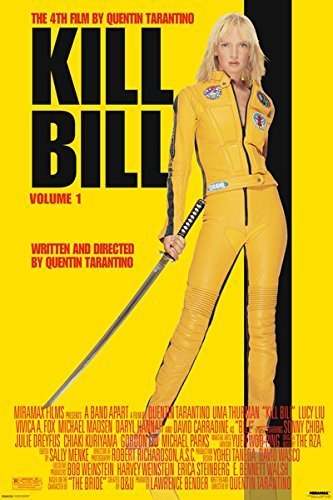
“It’s mercy, compassion, and forgiveness I lack,” The Bride (Uma Thurman) plainly informs one of her assailants before she exacts revenge. “Not rationality.” Uh, really? Right off the bat, Quentin Tarantino’s Kill Bill, Volume 1 (not to be conflated with Kill Bill: Volume 2, which is longer but not quite as good) is an action film packed with snark and coolness. Uma Thurman is The Bride (codeman Black Mamba), who in the sepiatone opening scene is lying on the floor of a chapel in El Paso, Texas. She’s in a wedding dress, bleeding and pleading for her life. “It’s your baby,” she tells Bill (David Carradine, who has a bigger part in the second installment). He shoots her in the head.

Four years later, The Bride wakes up—midfuck, mind you—from a coma in the hospital. There’s no baby. She takes out a would-be rapist, Jasper (Jonathan Loughran), and an orderly named Buck (Michael Bowen), who pimped her out. Incidentally, Buck has a catchphrase that rhymes with his name—you figure it out. The Bride runs off with Buck’s truck, the “Pussy Wagon.” Once she gets her feet and legs moving, she sets out to settle a score—or six. First, though, she has to persuade retired master swordsmith Hattori Hanzō (Sonny Chiba), who runs a sushi bar in Okinawa, to make her a sword.

Kill Bill: Volume 1 is totally far fetched, but that’s not important. Like most Tarantino films, the emphasis here is on the characters and the action, not the plot; otherwise, two hours of not much more than a badass blonde babe methodically killing teammates who double-crossed her when she was a member of something called the Viper Assassination Squad wouldn’t work. Originally intended as one long film (http://killbill.wikia.com/wiki/Kill_Bill:_Vol._1), Kill Bill: Volume 1 depicts two of the paybacks: Vernita Green (Vivica A. Fox), who’s now a housewife and mother in suburban Los Angeles, and O’Ren Ishii (Lucy Liu), the head of the Tokyo Yakuza.

Beautifully staged and shot, the violence is over the top yet perfectly choreographed. The scene at the House of Blue Leaves is eloquent right down to the blood in the snow. Tarantino plays around with the sequence of events and mixes genres including anime. He employs his penchant for sharp dialogue, snazzy settings with memorable names, and sick humor. Plus, he throws in cool music and clothes; Daryl Hannah dressed as a nurse, for example, is fucking fabulous! As a result, Kill Bill: Volume 1 is a dazzling bloodfest. It takes a certain type to love a film like this—and it’s one of my favorites.

With Julie Dreyfus, Chiaki Kuriyama, Gordon Liu, Michael Parks, James Parks, Sakichi Sato, Ambrosia Kelley

Production: A Band Apart

Distribution: Miramax Films

111 minutes
Rated R

(Logan Theatre) A

https://www.miramax.com/movie/kill-bill-volume-1/