Žhavý jícen is an industrial short produced by Pražská železářská společnost a/k/a Prague Ironworks Company. Jiří Lehovec directed it, using footage from two other short films, Výroba oceli [Steel Production] and Poklady země [Treasures of the Earth] both directed by Karel Kohout the same year.
Needless to say, there is no plot; Žhavý jícen is a demonstration of steel production. According to the festival program, it was chosen for screening for technical reasons: its “perfect definition of light in an excellent print.” I’ll give it that.
I doubt Crowther meant “gay” in the current sense of the word, but he certainly wasn’t wrong either way: between all the singing, dancing, handsome sailors in tight pants, and a very young and wide-eyed Frank Sinatra acting out a creepy attachment to Gene Kelly, the only thing that could make Anchors Aweigh any gayer would be an appearance by Judy Garland. Or a raunchy sex scene with all those sailors and the admiral who, in one number (“We Hate to Leave”), said he would beat them with a whip. I half expected and kinda wanted it to happen, but of course it didn’t. Oh well.
As a reward for their bravery, Navy seamen Joe Brady (Kelly) and Clarence Doolittle (Sinatra) are given a four-day leave in Hollywood. Joe plans to hook up with his dame, Lola. After stalking him on the streets of Los Angeles, sweet and naive ex choir boy Clarence asks the apparently more experienced Joe to teach him how to meet girls.
Enter Donald (Dean Stockwell, whom most of us know as a middle-aged man from his many ’80s and ’90s movies), a little tyke who’s running away from home to join the navy. Our boys take him home, where Donald lives with his Aunt Susie (Kathryn Grayson), a nice girl trying to get into the movie industry—if only she could catch a break. Clarence immediately falls head over heels and enlists Joe’s assistance in wooing her, which provides the story here.
Even though (and probably because) the characters, plot, and dialogue are totally corny, Anchors Aweigh is truly a frothy blast—it’s exactly the kind of film that comes to mind when I think of classic Hollywood. A vivacious affair, director George Sidney keeps everything about it big: the sets, the songs, the dance numbers. I was particularly taken by one sequence involving Kelly and various animated figures—it culminates in an awesome song-and-dance with none other than Jerry Mouse of Tom and Jerry cartoons. Flawless!
The whole spectacle is tied up in an amazing Technicolor bow; Charles Boyle and Robert Planck’s color palette is gorgeous, and seeing it on a nitrate print literally left me breathless. From a sensory perspective, Anchors Aweigh was hands down my favorite film at this year’s Nitrate Picture Show.
As a side note, I must confess that one thing threw me for a loop: Kelly and Sinatra (and Grayson, for that matter) are young and beautiful here—not the old timers I’m accustomed to seeing having grown up when I did. They’re actually hot, even by today’s standards. Kelly upstages Sinatra throughout the entire film, which I found bizarre and quite amusing.
With José Iturbi, Pamela Britton, Grady Sutton, Rags Ragland, Billy Gilbert, William Forrest
Richard “Dick” Nugent (Cary Grant) is a dashing, self-absorbed playboy charged with inciting a brawl at a nightclub. A self-employed artist, he shows up late for his hearing before priggish Judge Margaret Turner (Myrna Loy), who’s put off by his casual indifference. Nevertheless, she dismisses the case when she sees that the whole thing started with two floozies (Veda Ann Borg and Carol Hughes) fighting over him. With a slam of her gavel and an eyeroll, she sends Dick on his way, warning him to watch himself.
A free man, Dick heads straight to his next appointment: he’s the guest lecturn at a high school where Margaret’s dramatic 17-year-old sister, Susan (Shirley Temple), is a student. She attends the lecture, and is immediately smitten. Susan approaches Dick afterward and offers to, err, model for him. He’s noncommittal, clearly unaware that he’s dealing with a determined gal.
That evening, Susan gets all dolled up and sneaks out to Dick’s apartment, a spacious two-story downtown suite I’d kill to have. He’s not home, but she persuades the young doorman (Ian Bernard?) to let her up so she can wait for him. Naturally, she falls asleep on the davenport.
A big misunderstanding leads to Dick punching Margaret’s date, district attorney Tommy Chamberlain (Rudy Vallee), when they show up at his apartment to rescue Susan soon after he gets home and discovers her there. Dick is sent to the slammer, where court psychiatrist Dr. Matt Beemish (Ray Collins)—Margaret and Susan’s uncle—figures out what’s up. The good doctor proposes a “simple” solution: Dick agrees to date Susan, Margaret agrees to allow Susan to date Dick until her infatuation runs its course, and Tommy agrees to drop the assault charge. All three grudgingly agree to the plan. Hilarity ensues, especially as Dick and Margaret start digging each other—and Susan proves to be a real pain in the ass.
Penned by future TV creator/writer Sidney Sheldon (The Patty Duke Show, I Dream of Jeannie, and Hart to Hart), The Bachelor and the Bobby-Soxer is a solid textbook screwball comedy. It actually feels like a sitcom. Sheldon won an Oscar for Best Original Screenplay for this (https://www.oscars.org/oscars/ceremonies/1948), and I can see why: his script is light and fun, capitalizing on the generation gap between youth culture and, I guess, middle age. I doubt the story would fly today; the whole premise reads as creepy by 21st Century standards. For a more innocent time, though, it totally works. And it’s amusing.
Director Irving Reis straddles the line between silly and ridiculous without going overboard. Grant, Loy, and Temple all have better work under their belt, but each still gives a memorable performance here even if their characters and this fluffy film are forgettable. I heard some grumbling from others in the audience, but I enjoyed this for what it is—and it ain’t Citizen Kane.
One final word about the nitrate print I saw: it was stunning, exceeding my expectations. I had my doubts that black and white film would make me sing the praises of nitrate, but The Bachelor and the Bobby-Soxer made me a believer; the whites were luminescent and the blacks and greys were deep and complex. Lovely!
With Lillian Randolph, Harry Davenport, Johnny Sands, Don Beddoe, Dan Tobin, Ransom Sherman, William Bakewell, Irving Bacon, Dore Schary
After a presentation of shorts, the George Eastman Museum kicked off its third annual Nitrate Picture Show with a Japanese drama, Yasujirō Ozu’s quiet and gracefully understated Bakushū[麦秋]. In the context of midcentury Japan, Ozu explores the generational clash between tradition and progress, and both the possibilities and the casualties brought on by the latter. Opening with something that deals with changing values was an interesting choice on multiple levels.
Noriko (Setsuko Hara) lives in postwar Tokyo with her parents, Shūkichi (Ichirō Sugai) and Shige (Chieko Higashiyama); her older brother, physician Kōichi (Chishū Ryū); his wife, Fumiko (Kuniko Miyake); and their two unruly young sons, Minoru (Zen Murase) and Isamu (Isao Shirosawa). Noriko earns her own living as a secretary and contributes to the household, maintaining her own active social life. She seems happy, or at least content. Still, her more conventional family is concerned because she’s 28 years old and still isn’t married.
Noriko is a good sport about her family members’ not-so-subtle reminders, but the heat intensifies when an elderly uncle (Kokuten Kōdō) stays for a visit. Her chauvinistic boss (Shūji Sano) plays matchmaker, introducing her to Mr. Matanabe, a business associate in his 40s (all of his interactions occur off camera, so we never see him). He proposes. Naturally, Noriko’s family pushes her to accept his offer, which she considers even though the prospect doesn’t excite her.
Enter childhood friend, Kenkichi (Hiroshi Nihon’yanagi), who returns to the neighborhood with his daughter. He’s a widow in between job assignments. Noriko suddenly develops her own idea about which path she wants to take, much to the dismay of her family.
Bakushū is not a kinetic film—it’s slow, and the action centers on mundane routine activities like preparing meals, eating, conversing, working, and getting ready for bed. Some of the plot’s significant events aren’t even shown. Ozu favors low angles and wide, distant shots. He keeps the camera pretty still. He doesn’t use a lot of sets. On top of that, it takes some effort to keep track of the many characters.
Admittedly, I found myself zoning out at the beginning. Once I settled into Ozu’s rhythm, though, I got more interested in Bakushū. Some of the plot elements make the story seem slightly ahead of its time, but the core themes are universal. This is a family drama; the family unit ultimately falls apart, but it’s not necessarily a bad thing. The family portrait at the end closes things on a bittersweet note. I sensed more than a nod to the burgeoning westernization of Japanese society.
Bakushū fits nicely into the midcentury films I’ve developed a taste for. I never heard of it or Ozu, but I’ve already looked him up. I’m interested in seeing more of his work. As for this print, it was in all likelihood the very first feature film I’ve ever seen on nitrate (we’re not counting the shorts). The picture was crisp, but I must confess: its quality didn’t wow me like some others I saw after this.
With Chikage Awashima, Kuniko Igawa, Haruko Sugimura, Seiji Miyaguchi
Production: Takeshi Yamamoto
Distribution: Shochiku Company Limited, The Voyager Company (USA), Janus Films (USA)
I learned of David Lynch’s Eraserhead, his first feature length film, during my freshman year in college (thank you, U.D.). Somehow, seeing it escaped me until it screened at a recent Lynch retrospective.
The basic premise is easy to follow: Henry Spencer (John Nance, later Jack) is a schlubby factory worker who learns he fathered a mutant baby out of wedlock. At the insistence of her mother (Jeanne Bates), his freaked out girlfriend, Mary (Charlotte Stewart), moves into Henry’s tiny one-room apartment with the baby, who looks like a diseased E.T. wrapped in gauze. The baby cries constantly, driving Mary out of the apartment and leaving Henry to care for it. His neighbor, Beautiful Girl Across the Hall (Judith Anna Roberts), serves as an ever-increasing temptation and torment.
Really, it’s not the plot but Lynch’s presentation that makes Eraserhead unique. To be clear, it’s not his best film—not even close. It isn’t exactly representative of his work, either. Still, it’s interesting to see his trademarks in their infancy: a horrific and surreal atmosphere, bizarre imagery that here includes lots of spermatozoan objects and seemingly random scenes, spooky characters like the Lady in the Radiator (Laurel Near), and of course Lynch’s dry and twisted wit. The sets and costumes are assembled with early 20th Century industrial junk. The soundtrack is essentially white noise in the background. Frederick Elmes and Herbert Cardwell’s cinematography is rich and textured, using black and white to create a look and mood that resembles a silent film. Their camerawork sets up a sense of claustrophobia that lingers for the duration of the film.
Like most of Lynch’s work, Eraserhead is open to interpretation. In simplest terms, it’s a horror story about the demands of the family on the individual, from small talk and dinners with in-laws to appeasing a partner to child rearing to straying from the family unit. In the tradition of great American playwrights like Eugene O’Neill, Tennessee Williams, Arthur Miller, Edward Albee, and August Wilson, Lynch focuses on the pains and dysfunction that often make familial burdens difficult to bear.
I didn’t quite grasp everything here—how pencilmaking fits into the big picture, for example. Regardless, Eraserhead is infinitely interesting. I didn’t find it particularly scary, but it definitely leaves an impression—I guess in that sense it’s a haunting tale. It’s a weird and original film. Here’s the weirdest thing about it: I actually felt something emotional for that mutant baby. Go figure.
With Allen Joseph, Jack Fisk, Jean Lange, Hal Landon Jr., Gill Dennis, Darwin Joston, Jennifer Lynch, Peggy Lynch
Production: American Film Institute (AFI), Libra Films
Distribution: Libra Films International (USA), Creative Exposure (Canada), Mainline Pictures (UK), Toei Yoga and Comstock (Japan), Chapel Distribution and Umbrella Entertainment (Australia), Eye Film Instituut (Netherlands), Potemkine Films (France)
Who hasn’t seen Blue Velvet? Even though David Lynch was already established by the time it came out, it’s the film that introduced me to him. I saw it once or twice in late high school or early college, definitely on VHS. The River’s Edge was the only comparison I had, and that was a weird film but…not on the same level. I found Blue Velvet totally watchable because it’s very dark, very sexual, very fucking weird, and very voyeuristic.
That was then, this is now: Blue Velvet is still all of those things, but I don’t remember it having the sense of humor it does. It’s curiously funny. It marks the start of Lynch’s style as we know it: not just surreal (he had already done Eraserhead), but macabre and perverted underneath the innocuous and mundane premise. Lynch sets up his narrative in pieces that refer back and forth, like a moving puzzle. It’s brilliant, and it’s a formula that’s served him well.
Blue Velvet starts with a severed ear on the ground, bugs crawling all over it. A local college kid turned stalker (Kyle MacLachlan) proves a bit too curious when his minor obsession with a night club singer (Isabella Rossellini) leads him into a sadomasochistic nightmare that neither he nor we viewers can turn away from. The whole bizarre and sordid story goes full circle back to where it started: that ear.
Dennis Hopper as Frank, the gas-huffing sociopath who ends every sentence with the F-word, colors the mood here. None of it would work, though, without Rossellini’s vulnerability, which is crucial.
Lynch considered Molly Ringwald instead of Laura Dern and Val Kilmer instead of MacLachlan. Thank goodness it happened how it did; what a different film Blue Velvet would have been. For a movie that relies so heavily on nuance, that could’ve ruined Lynch’s career. It didn’t.
With Hope Lange, Dean Stockwell, George Dickerson, Priscilla Pointer, Frances Bay, Jack Harvey, Ken Stovitz, Brad Dourif, Jack Nance, J. Michael Hunter, Dick Green, Fred Pickler, Philip Markert, Leonard Watkins, Moses Gibson, Selden Smith, Peter Carew, Jon Jon Snipes, Angelo Badalamenti, Jean Pierre Viale, Donald Moore, A. Michelle Depland, Michelle Sasse, Katie Reid, Sparky
Production: De Laurentiis Entertainment Group
Distribution: De Laurentiis Entertainment Group, 20th Century Fox (UK), Transmundo Films (Argentina), AMLF (France), Concorde Film (Netherlands), Concorde Filmverleih (West Germany), Finnkino (Finland), Hoyts Distribution (Australia), Shochiku-Fuji Company (Japan)
“I don’t think you’re very amusing, Lieutenant…Whatever-Your-Problem-Is.”
—Norah Dain
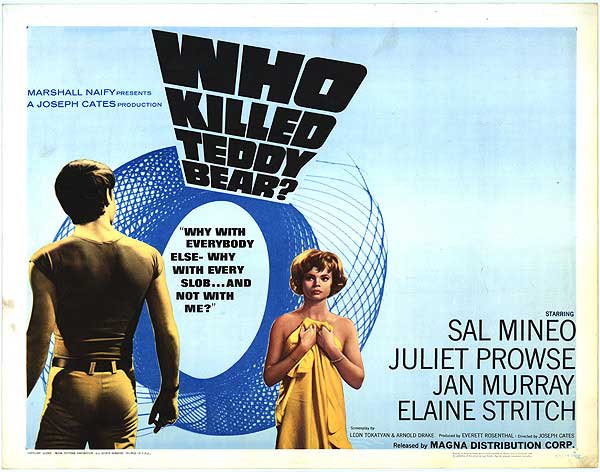
Who Killed Teddy Bear is so far one of the more interesting films I’ve seen this year, which is odd because it’s more than 50 years old. A surprisingly good story and movie, everything about it shines despite its bleak subject matter and an obviously low budget.
The film opens with a little girl who seems to be getting away from something unsettling she just observed. She falls down a set of stairs in the dark. It’s a curious opening, but she ties into the story later.
Cut to mid-sixties Manhattan: Norah Dain (Juliet Prowse) is an aspiring actress who works as a “disc jockey” at a nightclub. She lives alone in a cute three flat. It’s bad enough that she’s getting obscene phone calls from an unknown weirdo, but what’s worse is that he implies he’s watching her.
Enter detective Lt. Dave Madden (Jan Murray) to investigate Norah’s case. His wife was raped and murdered on the streets of New York City. He comes off as part father and part priest, and he takes a special interest in Norah that verges on disturbing. Indeed, he drops in all the time, he secretly records their conversations, and he keeps telling her that he could be the caller. At home, he’s obsessed with “studying” pornography and perverts, which has a distorting effect on his 10-year-old daughter (Diane Moore).
WARNING: Potential spoilers ahead!
We soon learn that Lt. Madden actually isn’t the caller; Lawrence Sherman (Sal Mineo), who works as a busboy with Norah, is. Lawrence has a lot of issues. Awkward and aloof, he lives in a sad, dank apartment with his younger sister, Edie (Margot Bennett). Edie has brain damage and hasn’t developed beyond a child. Their parents died, leaving Lawrence to take care of her. And he does, but he harbors resentment.
On top of all this, Lawrence is incapable of a normal romantic relationship because of his guilt over his sister. He deals with his sexual frustration at adult bookstores and movie theaters in Times Square, and it apparently works until Norah comes along. His obsession with her takes him down a road of murder and ruin.
Directed by Joseph Cates, Who Killed Teddy Bear has a high creepy-icky factor, and it’s absolutely wonderful. Mineo is brooding and sexy, and Lawrence is compelling in the same fucked up way as Travis Bickle in Taxi Driver. Norah and Lawrence don’t have all that many scenes together, but she’s nice to him when they do. This makes their scenes percolate with tension, particularly one at a pool in a gym. We know the whole thing is not going to end well, and Cates slowly but steadily gets us to a nasty climax. To add to the perversion, screenwriters Arnold Drake and Leon Tokatyan drop in little bombshells like incest and lesbian passes. Joseph Brun’s camerawork is lovely, especially in the night scenes; shooting on location in New York City, he cloaks the actors in shadows and neon light in a way that nicely underscores their solitude.
Interesting trivia: a young Dan Travanty, who plays a small part as a nightclub employee, went on to star in Hill Street Blues.
This film has been cut and recut many times over the years, at least once for British television. I’m pretty sure the screening I attended was the original uncut version.
With Elaine Stritch, Tom Aldredge, Frank Campanella, Rex Everhart, Bruce Glover, Casey Townsend
Production: Phillips Productions
Distribution: Magna Corporation, BijouFlix Releasing
94 minutes
Not rated
(The Auditorium at Northeastern Illinois University) A
Odyssey of a Dropout is a black and white educational film shot on 16-millimeter that dramatizes the plight of the American high school dropout. I’ve found only very limited information about it online, and none of it lists the cast or the crew. As far as I can tell, this film is not available anywhere, but you can view other films of the same ilk here:
If these films are anything like Odyssey of a Dropout—and perusing the titles suggests they are—it’s worth a diversion. Appropriately, Odyssey of a Dropout follows one teenage boy through his day after he drops out of school. He meanders aimlessly, going from a diner to a park to a pool hall. He hasn’t told his parents or his girlfriend, and it doesn’t appear that he’s having any fun—which is precisely the point.
Melodramatic and totally moralistic, this heavyhanded little number does a great job painting a hopelessly dire picture for those who don’t finish high school. So, it serves its purpose even if it borders on propaganda. Aside from that, it’s a neat time capsule; loaded with exterior street scenes and youngsters clad in clothes of the day, it documents small town America in a visually authentic way. I’d like to find this and see it again.
Production: Coronet Films
Distribution: Coronet Films
18 minutes
Not rated
(The Auditorium at Northeastern Illinois University) B-
Heart Like a Wheel is the kind of movie you see on late night TV: a mildly amusing true story about someone you’ve never heard of and her struggle to overcome adversity and maybe find herself in the process. In this case, that someone is Shirley Muldowney (Bonnie Bedelia), later known as “Cha Cha,” a 1960s housewife who became the first woman to obtain a license from the National Hot Rod Association (NHRA) and the first person ever to win two and then three Top Fuel titles (https://en.wikipedia.org/wiki/Shirley_Muldowney). Her struggle consists of establishing herself as a serious dragster. The adversity, well, that’s the sexist all-male drag race scene. You might say the whole thing is a drag.
One night, Shirley’s mechanic husband, Jack (Leo Rossi), lets her race his sports car on the street. She beats Jack’s rival and discovers that she digs the thrill of drag racing. Soon, she’s hanging out at the racetrack, where she meets Connie Kalitta (Beau Bridges), a veteran racer and womanizer. Jealous of her success, Jack leaves Shirley to her own devices.
I picked up Heart Like a Wheel for one reason, and one reason only: I read that My Life with the Thrill Kill Kult sampled this movie in a song or two. Overall, it’s a mixed bag, but I was pleasantly surprised to find that it’s better than mediocre. The acting is good. Ken Friedman’s screenplay is competent if not exactly deep, peppered with some snappy dialogue. When a skeezy reporter (Martin Casella) asks Shirley what a beautiful girl like her is doing at a racetrack, for example, her one-word response is casual, bored, and totally fucking awesome: “Winning.” Director Jonathan Kaplan stages realistic fight scenes, particularly between Connie and Shirley’s teenage son, John (played by a young Anthony Edwards). He even throws in a couple of real racers (Steve Evans and Sam Posey) and fire. It was nominated for an Academy Award for costume design (https://www.oscars.org/oscars/ceremonies/1984). The whole thing comes off like a soap opera, but it works. I never did catch those samples, though.
Bonus: the DVD I have includes trailers for four other films, The Turning Point, Kenny & Company, Rhinestone with Dolly Parton and Sylvester Stallone, and Six Pack with Kenny Rogers and Anthony Michael Hall. They all look as awful as “Born to Win” by Jill Michaels, the Heart Like a Wheel theme song.
With Hoyt Axton, Creed Bratton, Tiffany Brissette, Michael Cavanaugh, Diane Delano, Mitzi Hoag, Nora Heflin, Brandon Brent Williams
“I’m an advertising man, not a red herring. I’ve got a job, a secretary, a mother, two ex-wives, and several bartenders that depend upon me, and I don’t intend to disappoint them all by getting myself ‘slightly’ killed.”
—Roger Thornhill
“That’s funny. That plane’s dusting crops where there ain’t no crops.”
—Man at the Prairie Crossing
I expected Alfred Hitchcock’s North by Northwest to be suspenseful, cinematic, and even a bit perverse, peppered with the director’s inimitable wit and dark sense of humor. It certainly is all that. However, I didn’t expect it to be altogether facetious, or as fun as it is. Scene after scene, North by Northwest delivers; not many films give as much bang for your buck as this one.
Cary Grant is Manhattan ad executive Roger O. Thornhill—”The ‘O’ stands for nothing,” he quips at one point. A mild-mannered, stylish middle-aged man in a grey flannel Brooks Brothers suit—think Mad Men—he leads a perfectly predictable straight life serving clients, drinking martinis, and keeping his WASPy mother (Jessie Royce Landis) entertained.
While having cocktails at the Plaza Hotel one afternoon, Thornhill is yanked into a treacherous game of cat-and-mouse when the goons of a smooth and well-spoken spy, baritone Phillip Vandamm (James Mason), mistake him for a government agent named George Kaplan. It’s nothing but trouble from here.
Relentlessly hunted after being framed for an incident at the United Nations, Thornhill flees Manhattan on a passenger train that looks a lot like Amtrak’s Lake Shore Limited. He meets cool, mysterious, and sultry stranger Eve Kendall (Eva Marie Saint), who’s headed to Chicago. Her innuendo is sexy, but she’s not exactly trustworthy—Thornhill senses it, and so do we.
North by Northwest is ultimate Hitchcock, fueled by mistaken identity and packed with psychological drama manifest mostly in the form of dizzying pursuit: a drunken car chase on a windy road, a moving train, an out-of-nowhere crop duster in an Indiana cornfield, a race down Mount Rushmore. Nothing about the plot is believable; it’s more preposterous than a James Bond film. Although it shares the same Cold War sensibility, North by Northwest is much more intriguing and memorable. It’s also more entertaining.
Ernest Lehman’s script is brilliantly put together, but the story isn’t what makes this soar; it’s Hitchcock’s directing and the acting, particularly that of Grant, Saint, and Mason. Grant is a hoot to watch here; he plays Thornhill like a high-style Thurston Howell without his Lovie. He walks a fine line between convincing and cartoonish, always coming off as the former. It’s quite an astounding feat of balance, actually. Saint is the perfect counterpart to Grant. I could listen to Mason talk endlessly. Martin Landau plays a secondary character, but he’s awesome as über creepy (and probably closeted) Leonard, Vandamm’s right hand man.
Ahead of its time in many ways, North by Northwest is consciously silly yet pushes a few boundaries. Exceedingly mischievous, it just might be Hitchcock’s most charming film. It’s definitely more fun than any other film of his that I’ve seen—not that I’ve come close to seeing all of them. It’s truly a dazzler.
Personal geek-out side note: in a film full of thrilling moments, the most thrilling for me was the scene outside The Ambassador Hotel in Chicago. I live two doors down from the hotel, now known as Public. I’ve stood in the exact spot Grant did as he exited the alley to cross Goethe to get to the hotel—I walk my dog there all the time. It’s amusingly weird to see a place you know so well onscreen, let alone in something from almost 60 years ago. It’s different, but not much. Here’s what it looked like when North by Northwest was filmed:






 moviebloke