The Death and Life of Marsha P. Johnson

(USA 2017)

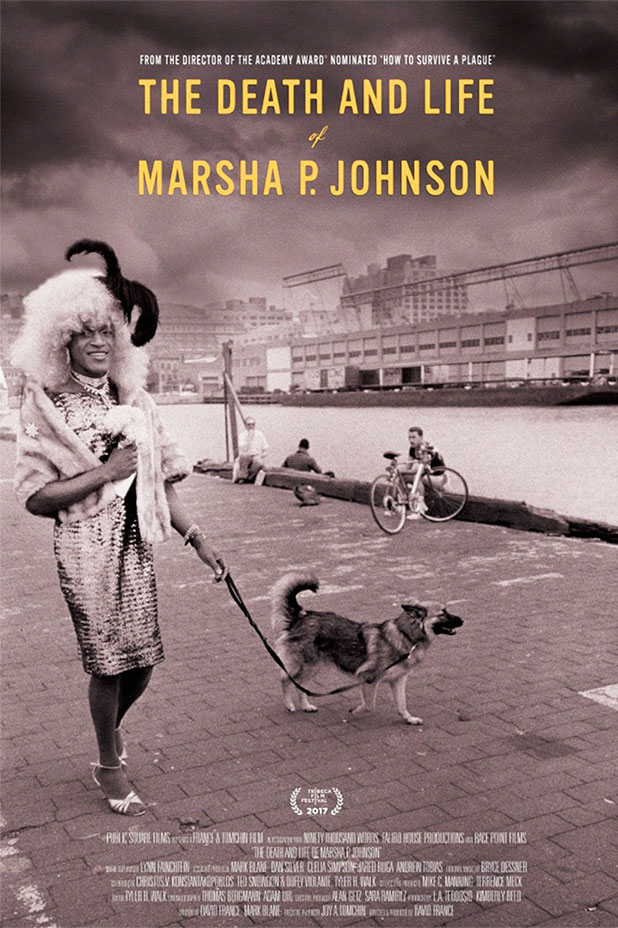
Marsha, Marsha, MARSHA! I’ll say this: David France’s new documentary has a lot going on in it. The center of the film, obviously, is legendary Greenwich Village “street queen” Marsha P. Johnson, a trans LGBT activist who hit the streets and stood at the front line when the fight was just about the “gay rights” movement. In the ’60s. Marsha, a figure at the Stonewall riots, founded Street Transvestites Action Revolutionaries, or S.T.A.R., with Sylvia Rivera in the early ’70s — 1970 to be exact. Her fight continued onto AIDS and transgender issues. She clearly was ahead of her time.

Sadly, Marsha ended up in the Hudson River in 1992, an apparent murder victim. It was almost 25 years to the date that I saw this film. The New York City Police Department called it a “suicide” — then called it a day. It remains an unsolved case.

The Death and Life of Marsha P. Johnson wants to honor Marsha, and it kind of does. At the very least, it sings her praises and puts her in a positive light. Ultimately, though, it fails. Told through the eyes of friend and surrogate Victoria Cruz, it unfortunately lets other things — mainly other people’s egos — get in the way. Part history and part true crime, Marsha’s story is watered down because French crams in more than what’s necessary to tell it, and he loses her in the process.

The Death and Life of Marsha P. Johnson succeeds in showing Marsha’s determination and influence. Perhaps unintentionally, it also shows a wonderfully colorful version of New York City in its cultural — or countercultural — prime, a place that simply doesn’t exist anymore. The hardest part of watching this film, though, is the attitude against trans people — even from gay men. It’s something you might not expect, but there it is.

From a historical or social standpoint, this is a winner. As far as Marsha is concerned, it could have been better. Still, it’s worth the time it takes to see it.

With Michael Baden, Frances Baugh, Pat Bumgardner, Jimmy Camicia, Eddie DeGrand, Matt Foreman, Jacques Garon, Chelsea Goodwin, Xena Grandichelli, Jennifer Louise Lopez, Agosto Machado, Marcus Maier, Ted Mcguire, Jean Michaels, Robert Michaels, Rusty Mae Moore, Candida Scott Piel, Coco Rodriguez, Kitty Rotolo, Vito Russo, Mark Segal, Beverly Tillery, Randy Wicker, Brian R. Wills, Sue Yacka

Production: Public Square Films, Faliro House Productions, Ninety Thousand Words, Race Point Films, Terasem Media & Films

Distribution: The Film Collaborative, Netflix

Screening introduced by David France and followed by a live Q and A with France, Mark Blane, and someone whose name I didn’t catch moderated by Alonso Duralde

105 minutes
Not rated

(Directors Guild of America) B-

Outfest Los Angeles LGBT Film Festival

https://www.netflix.com/title/80189623

An Autumn Afternoon [Sanma no aji] [The Taste of Mackerel Pike]

(Japan 1962)

“We are alone in life. Always alone.”

— Sakuma

If one film perfectly captures what solitude, melancholia, and acceptance of things for what they are feels like, it has to be Yasujirō Ozu’s gorgeous and quietly contemplative An Autumn Afternoon [秋刀魚の味]. Framing death and loneliness in such metaphors as war, alcohol, marriage, aging, and the global impact of postwar America, this one packs a punch that hits like a feather but still leaves a mark.

Shūhei Hirayama (Chishū Ryū) is a middle aged man who emits an air of defeat, as if life has disappointed him. A widower with three adult kids, only one of them, elder son Kōichi (Keiji Sada), is married — and he and his wife (Mariko Okada) have some messed up priorities, especially when it comes to money. No one seems interested in daughter Michiko (Shima Iwashita). Who knows what the deal is with younger son Kazuo (Shin’ichirō Mikami)? Hirayama bides his time between home, work, and dining with former classmates Kawai (Nobuo Nakamura), Horie (Ryūji Kita), Sugai (Tsūzai Sugawara), and Watanabe (Masao Oda) at Sugai’s restaurant. They mostly drink sake, reminisce, and make fun of each other. Horie’s new wife, who’s much younger than he, provides ample material for discussion.

A former professor, Sakuma (Eijirō Tōno), comes to dinner one night. He has way too much to drink. Hirayama and Kawai drive him home, where they meet his spinster daughter Tomoko (Haruko Sugimura). They learn he’s not doing well, operating a jank noodle joint in a low rent neighborhood to make ends meet. This gets Hirayama thinking about his own family and his obligations there.

An Autumn Afternoon is a film you see to experience its mood — not to be entertained. The narrative is engaging and plotted nicely, but it’s only half the story. Ozu uses composition to convey his points as much he uses words and characters. Long shots. Hallways, stairs, and windows. Army green and brown hues, a very ’60s sitcom look. Colors, solids, patterns, and textures. All of this is just as important as the narrative. More important, actually.

Roger Ebert offered the best description of Ozu I’ve seen to date: “He is a man with a profound understanding of human nature, about which he makes no dramatic statements. We are here, we hope to be happy, we want to do well, we are locked within our aloneness, life goes on.” (http://www.rogerebert.com/reviews/great-movie-an-autumn-afternoon-1962). Amen. This is the essence of An Autumn Afternoon, and it’s beautiful.

With Teruo Yoshida, Noriko Maki, Kuniko Miyake, Kyōko Kishida, Michiyo Kan, Daisuke Katō, Shinobu Asaji

Production: Shochiku

Distribution: Shochiku, Shochiku Films of America (USA), Criterion Collection (USA), Janus Films (USA)

113 minutes
Not rated

(iTunes rental) A-

https://www.criterion.com/films/784-an-autumn-afternoon

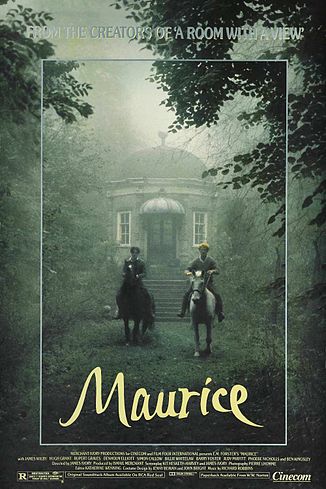
Maurice

(UK 1987)

“England has always been disinclined to accept human nature.”

— Lasker-Jones

I’m not usually a fan of period pieces, especially those set in Victorian or Edwardian England. Somehow, they tend to be stuffy, grandiloquent affairs that warrant a great big yawn — and they turn me off. James Ivory’s adaptation of E.M. Forster’s novel Maurice, however, is an exception.

I caught a 30th anniversary screening, and something crucial struck me: Ivory and cowriter Kit Hesketh-Harvey’s screenplay is downright daring even for the time when Maurice came out (no pun intended). A sort of forbidden romance that one character sees as the love of his life while the other tosses it aside as the folly of youth, I was moved by the frank depiction of gay love as a tender yet treacherous battlefield, no different than any other love — measured by intensity, law, or social construct. For this, Maurice stands way ahead of its time, even today.

Maurice Hall (James Wilby) is essentially Oscar Wilde at Cambridge circa 1910. He makes a move on social climbing classmate Clive Durham (Hugh Grant), who surprisingly welcomes his advances. They can only go so far, though: Clive doesn’t want to jeopradize his social standing, so the two maintain a platonic relationship. This is the key to Maurice, and the thing that makes it monumental: this is a film that attacks appearances.

Time goes by, shit happens, and Maurice ends up with Clive’s gutter cleaner, Alec Scudder (Rupert Graves, who looks like a plebeian Paul Young). This upsets Clive and sends Maurice to therapy. In the end, Maurice makes a choice that so many of us gays have: to be gay, or not to be.

Maurice operates on a strange platitude, one that isn’t clear at first. Maurice is vulnerable, almost stupid. Clive is chilly, reserved, and completely repressed. Both skirt around their issue. I found myself rooting for and actually admiring Maurice, who stays true to himself — class, law, and sexuality be damned. That last look on Clive’s face in the final scene is devastating…for him.

With Denholm Elliott, Simon Callow, Billie Whitelaw, Barry Foster, Judy Parfitt, Phoebe Nicholls, Ben Kingsley, Patrick Godfrey, Mark Tandy, Kitty Aldridge, Helena Michell, Catherine Rabett, Peter Eyre, Helena Bonham Carter

Production: Merchant Ivory Productions, Film Four International

Distribution: Cinecom Pictures (USA), Enterprise Pictures Limited (UK), Concorde Film (Netherlands), Cohen Media Group (USA)

140 minutes
Rated R

(Gene Siskel Film Center) B

http://www.merchantivory.com/film/maurice

Letters from Baghdad

(USA/UK/France 2016)

“We rushed into the business with our usual disregard for a comprehensive political scheme.”

—Gertrude Bell

According to the promotional poster for Sabine Krayenbühl and Zeva Oelbaum’s Letters from Baghdad, the so-called “Queen of the Desert” and “female Lawrence of Arabia” Gertrude Bell “was as controversial as the history she made.” Well, that certainly sounds promising!

Born into a wealthy family, Bell immersed herself in the Middle East in the early 20th Century and used her talents as a writer and a schmoozer to intimately acquaint herself with the area, its people, and their culture (https://en.wikipedia.org/wiki/Gertrude_Bell). Her contacts with influential expats and various Arab leaders combined with her knowledge of the culture led to an appointment as a British officer during World War I and a direct hand in drawing up the borders of modern Iraq.

Tilda Swinton gives Bell her voice, reading off camera Bell’s actual writings about events that occurred on her many trips and the people she met. In Bell’s own words, Swinton offers history, observations, and even some Victorian Era dish. Bell had at least as much influence as T. E. Lawrence a.k.a. Lawrence of Arabia (played here by Eric Loscheider in a staged “talking head” interview made to look like old footage).

Bell’s life and the impact of her deeds a century later make for an interesting story. Painstakingly researched, Krayenbühl and Oelbaum pull from diverse source material—letters, diaries, photos—to show what cities like Baghdad and Damascus were like a hundred years ago. They do a great job humaninzing Bell, getting into personality flaws and personal disappointments. In both respects, Letters to Baghdad works really well.

Not everything works as well as it could, though. Some important items are treated superfically. For example, they mention the tension between the Sunni, Shia, and Kurds even back then, but Krayenbühl and Oelbaum don’t delve into it. They touch on Bell’s reasoning for the borders she devised, but they don’t give much critical assessment to it. I left with the distinct feeling that I didn’t get the whole story. Another problem: the staged interviews give a lot of information, but they’re cheesy.

I found myself glancing at my watch about halfway through Letters from Baghdad. It’s a well made documentary, but it’s not as enthralling as it promises to be.

With Ammar Haj Ahmad, Helen Ryan, Rachael Stirling, Robert Ian Mackenzie, Christopher Villiers, Lucy Robinson, Elizabeth Rider, Michael Higgs, Joanna David, Michelle Eugene, Paul McGann, Pip Torrens

Production: Between the Rivers Productions, Letters From Baghdad, Missing in Action Films

Distribution: Vitagraph Films (USA)

95 minutes
Not rated

(Landmark Century) C

http://lettersfrombaghdadthemovie.com/about/

The 400 Blows [Les Quatre-cents coups]

(France 1959)

Childhood is fertile ground for storytelling. Usually, the stories that sell are heavily nostalgic and sweet, but the more interesting ones tend to come from a darker past. French New Wave pioneer François Truffaut’s autobiographical film The 400 Blows is the latter.

Antoine Doinel (Jean-Pierre Léaud) is a prepubescent boy experiencing an existential crisis. At home, something is bubbling between his parents, mother Gilberte (Claire Maurier) and stepfather Julien (Albert Rémy). At school, a contemptible teacher known as “Sourpuss” (Guy Decomble) has him pegged as a troublemaker.

Antoine and his friend René (Patrick Auffay) cut class one day. They walk around, catch a movie, and enjoy a carnival ride—the Rotor, a cylindrical room that spins and the floor drops out, causing the riders to “stick” to the walls due to centrifugal force. While they’re running around, Antoine sees his mother kissing some man on the street. She sees Antoine when it’s too late.

The next day, Antoine makes up an excuse for his absence: he says his mother died. It doesn’t work. After a few incidents involving Balzac, a fire, running away from home, and a stolen typewriter, Antoine winds up at a reform school.

Some New Wave films are hard to follow or just boring to watch. Not so with The 400 Blows, and for quite a few reasons.

The narrative is definitely loose. Like all New Wave films, what happens isn’t as important as what the director is showing us. Here, though, the plot is straightforward and sticks to a more traditional structure even if it doesn’t have a true “climax” or a single moment of reckoning. Truffaut gives us some really great scenes in this movie, not the least of which is this one:

400 Blows paddywagon.jpg

The 400 Blows is realistic and personal; it unfolds like something literally happening right before us. The acting, naturalistic and unscripted, is probably the biggest boon to the film. That said, Henri Decaë’s camerawork is a major contribution as well. He shoots on the streets of Paris using hand-held equipment, which allows him to get right up in front of the action. It’s likely a product of an independent low-budget film, but intentional or not The 400 Blows is so much better as a result; this film would not work the same way without Decaë.

Truffaut makes us empathize with Antoine. He’s not a bad kid; his behavior is no worse than his classmates or the adults around him. He’s made out to be a bad kid, though. The sad part is that he believes it. What’s more, he clearly sees more to life than the little spot he occupies, but he’s no better off after he tries to be. At the end of the film, I want to be on the beach with him to tell him he’ll be okay.

As for the seemingly nonsensical title, I didn’t realize that it’s a literal English translation of the French idiom “faire les quatre cents coups”, which means “to raise hell.” Now that I know that, the title totally makes sense.

Nominated for an Oscar for its screenplay by Truffaut and Marcel Moussy (https://www.oscars.org/oscars/ceremonies/1960), The 400 Blows is a movie that consistently ends up on many “must see” lists. It’s considered a landmark film for good reason. It’s hard to believe that this is Truffaut’s first film.

With Georges Flamant, Pierre Repp, Daniel Couturier, Luc Andrieux, Robert Beauvais, Yvonne Claudie, Marius Laurey, Claude Mansard, Jacques Monod, Henri Virlojeux, Jeanne Moreau, Jean-Claude Brialy, François Nocher, Richard Kanayan, Renaud Fontanarosa, Michel Girard, Henry Moati, Bernard Abbou, Jean-François Bergouignan, Jacques Demy, François Truffaut, Philippe De Broca, Jean-Luc Godard, Jean-Paul Belmondo, Michel Lesignor

Production: Les Films du Carrosse

Distribution: Cocinor, MK2 Films, Janus Films (USA), Criterion (USA)

93 minutes
Not rated

(iTunes rental) A-

24 Hours in the Life of a Clown [Vingt-quatre heures de la vie d’un clown]

(France 1946)

But where are the clowns? Send in the clowns. Okay, don’t bother, two of them are in this short by the great French director Jean-Pierre Melville. 24 Hours in the Life of a Clown [Vingt-quatre heures de la vie d’un clown] is just that: a day in the life of Beby, a clown who lives in Montmarte. A multitude of fedoras costar.

In between performances at Circus Medrano, Beby walks the streets of Paris, sleeps with his little dog (but not his wife), reads fan mail, drinks at a café, and puts on makeup with his friend and fellow clown Maïss. Interestingly enough, this is not the only short to feature Maïss, who later appeared in Rodolphe Marcilly’s Centaures et pastiche in 1953.

Who knew clowns pray?

24 Hours in the Life of a Clown holds historical and artistic significance as Melville’s first film. It highlights his style, albeit in its infancy, playing with light and dark. His approach is tongue in cheek, and his “narration” (this is not a “talkie”) strongly suggests Melville knew well that his hoary little film is silly.

Still, it’s interesting if only for the scenery, all 1940s drab and threadbare, and the documentary feel of it. Beby’s apartment reminds me of the one in Eraserhead.

Production: Les Films du Panthéon

18 minutes
Not rated

(Gene Siskel Film Center) C

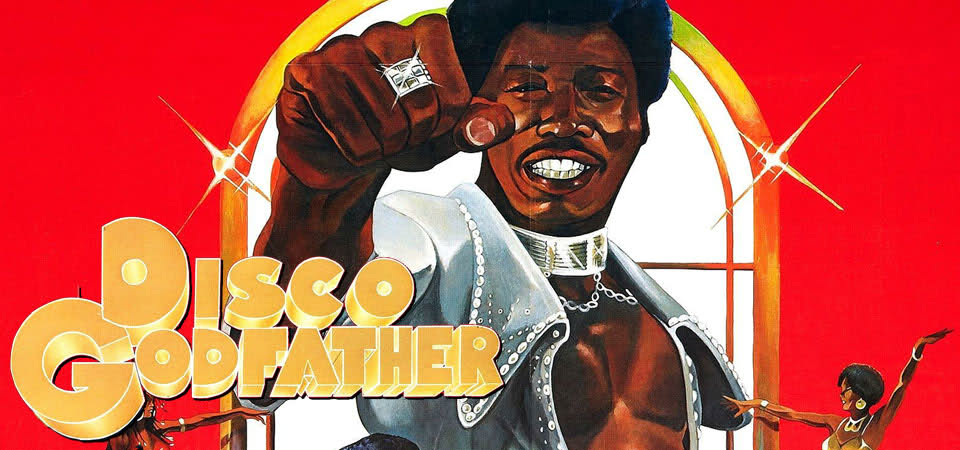
Disco Godfather [The Avenging Disco Godfather]

(USA 1979)

Dear God the Father! Some movies are so terrible, you love them for everything wrong with them—what’s bad is exactly what endears them. Other movies…well, they’re just terrible. It’s a thin line. Sadly, Disco Godfather falls into the latter category.

J. Robert Wagoner and Cliff Roquemore’s screenplay stars Rudy Ray Moore as Tucker Williams, an L.A. cop-turned-DJ at the trashy-ass Blueberry Hill Disco, which looks like a repurposed Denny’s. The plot involves Williams’s nephew, Bucky (Julius J. Carry III), who’s gotten hooked on “angel dust.”

One word: YAWN! What were they thinking? Disco Godfather is so boring, I’d rather watch reruns of 2 Broke Girls. The only thing that saves it from total failure is the wardrobe—Felice Hurtes, Jimmy Lynch, and Kimberly Sizemore deserve major kudos for finding the cool Goodwill stores. Fuck this bullshit: watch Dolemite and call it a day. They could have tried a little harder here.

With Carol Speed, Jimmy Lynch, Jerry Jones, Lady Reed, Hawthorne James, Frank Finn, Julius J. Carry III, Bishop Pat Patterson, Pucci Jhones, Howard Jackson, Yetta Collier, Pat Washington, Doc Watson, Leroy Daniels, Melvin Smith, Ronny Harris, Dolorise Parr, John Casino, Keith David

Production: Generation International

Distribution: Transvue Pictures (USA), Xenon Pictures

93 minutes
Rated R

(DVD purchase) D-

Breathless [Á bout de souffle]

(France 1960)

“After all, I’m an asshole.”

—Michel Poiccard

The third time is a charm: after seeing Jean Luc-Godard’s first full length feature film, Breathless, I now understand the love-meh relationship I have with his work.

On one hand, he’s got a remarkable grasp of human behavior and what motivates it. He’s got a snarky sense of humor. He’s stylish. His technique is gutsy for a lot of reasons. His characters are flawed. His subject matter is cool. He knows how to make a film look pretty, and most of them might as well be deemed official historical documents of the places where they were shot. Seeing a Godard film is like traveling back in time, an incidental bonus he probably never considered. I love all of this.

For all his strengths, on the other hand, a Godard film can be so damned…boring. Merde!

Fortunately, that’s not the case with Breathless, which I enjoyed. Godard and François Truffaut developed the story—I won’t call it a script or a screenplay because they made up much of it as they went along. Plot is always a loose construct with Godard, but there’s enough of one here to follow along fairly easily. Ugly cute guy (or is he a cute ugly guy?) Michel Poiccard (Jean-Paul Belmondo), a drifter car thief who fancies himself a French Humphrey Bogart, steals a car and drives it through the countryside. He shoots a policeman who pursues him and kills him.

With nowhere else to go, he heads straight to his American girl, Patricia (Jean Seberg), an expat student who sells a newspaper, the now defunct New York Herald Tribune, on the Champs-Élysées—that’s kind of weird—and writes articles here and there. She brings Michel to her apartment, where he hides out. He doesn’t mention anything to her about what happened. They get it on, or at least it’s implied that they do. She’s tells him she’s pregnant. One extended scene involves them lying around, talking.

Michel becomes a marked man, which he discovers as soon as he leaves the apartment with Patricia and sees a newspaper with a headline about him. I won’t ruin the ending, but it doesn’t bode well for him—especially after Godard himself sees Michel.

Breathless is a psuedo noir thriller that’s low on action but loaded with morally vacant characters who lack any redeeming qualities. There’s a nihilistic sexiness to it. The narrative moves along in a jazzy free-form way, and the imagery here is every bit a part of the story as the characters. The ending is not a happy one. If nothing else, Breathless is a visual stunner—black and white cinematic candy. The restored digital version I saw literally glowed.

I can handle more films like this one.

With Daniel Boulanger, Henri-Jacques Huet, Roger Hanin, Van Doude, Liliane David, Michel Fabre, Jean-Pierre Melville, Claude Mansard, Jean-Luc Godard, Richard Balducci, Jacques Rivette

Production: Les Films Impéria, Les Productions Georges de Beauregard, Société Nouvelle de Cinématographie (SNC)

Distribution: Films Georges de Beauregard, Les Films Impéria, Société Nouvelle de Cinématographie (SNC), Euro International Film (EIA) (Italy), Pallas Filmverleih (West Germany), British Lion Film Corporation (UK), Cinematográfica Azteca (Mexico), Ciné Vog Films (Belgium), Wivefilm (Sweden), Films Around the World (USA), Rialto Pictures (USA), Criterion Collection (USA)

90 minutes
Not rated

(iTunes rental) B

http://www.jean-lucgodard.com/films.html

https://www.criterion.com/films/268-breathless

The Godfather

(USA 1972)

“Why did you go to the police? Why didn’t you come to me first? What have I ever done to make you treat me so disrespectfully?”

—Don Vito Corleone


“My father is no different than any powerful man, any man with power. Like a president or a senator.”

—Michael Corleone


“And may their first child be a masculine child.”

—Luca Brasi


“Hey Mikey, why don’cha tell that nice girl you love her? ‘I love you with all a-my heart. If I don’t a-see you again a-soon, I’m a-gonna die!'”

“Leave the gun. Take the cannoli.”

—Peter Clemenza

Pretty much perfect, The Godfather was almost a different movie. Based on Mario Puzo’s insanely popular best selling 1969 novel, studio executives conceived a pulp gangster drama for its film adaptation. Good thing they wanted a “real” Italian-American to direct so it would be so authentic that moviegoers would “smell the spaghetti” (https://www.vanityfair.com/news/2009/03/godfather200903). Several unsuccessful attempts were made to attract a director, including Warren Beatty. Paramount “settled for” unknown Francis Ford Coppola, who took it somewhere else.

The Godfather is universally held in high esteem as one of the greatest films of all time—as it should be. It’s a a movie showered in superlatives—like the bullets that shower, well, most of the characters. It’s impeccable. We caught an anniversary screening.

Coppola’s morality play is a masterpiece, more complex than it seems at first and full of contrast and contradiction. A solemn and ominous mob drama that centers on Don Vito Corleone (Marlon Brando) and his family business, The Godfather boasts one riveting career-defining performance after another—Brando, Al Pacino, James Caan, Richard Castellano, Robert Duvall, and Abe Vigoda, to name a few. The characters are great, and the dialogue—perfect! Not a single second is wasted here, not even that long ass wedding scene.

The observations about human nature are astute, and the spin on assimilation and the American Dream is clever. The dramatic arc involving the descent of younger son Michael (Pacino) into a moral apocalypse is something you can’t shift your eyes away from. Black as its promotional poster, The Godfather leaves so much to chew on. This is what cinema is all about.

In 1990, the United States Library of Congress deemed The Godfather “culturally, historically, or aesthetically significant” and selected it for preservation in the National Film Registry (https://www.loc.gov/programs/national-film-preservation-board/film-registry/complete-national-film-registry-listing/).

With Sterling Hayden, John Marley, Richard Conte, Al Lettieri, Diane Keaton, Talia Shire, Gianni Russo, John Cazale, Rudy Bond, Al Martino , Morgana King, Lenny Montana, John Martino, Salvatore Corsitto, Richard Bright, Alex Rocco, Tony Giorgio, Vito Scotti, Tere Livrano, Victor Rendina, Jeannie Linero, Julie Gregg, Ardell Sheridan, Simonetta Stefanelli, Angelo Infanti, Corrado Gaipa, Franco Citti, Saro Urzì, Sofia Coppola

Production: Paramount Pictures, Alfran Productions

Distribution: Paramount Pictures (USA), Cinema International Corporation (CIC) (International)

175 minutes
Rated R

(AMC River East) A+

Fathom Events

The Adventures of Priscilla, Queen of the Desert

(Australia 1994)

The “road movie” is a subgenre that I think of as an American convention. They tend to involve younger people on a quest for something, perhaps a race (The Cannonball Run), a chase (Convoy), a new life (Alice Doesn’t Live Here Anymore), a vacation (National Lampoon’s Vacation), a mission (Pee-Wee’s Big Adventure), or or just getting laid (Losin’ It). They don’t usually involve gay men or drag performers or Australians for that matter, which makes The Adventures of Priscilla, Queen of the Desert rather compelling for its subversiveness if nothing else.

True, the world had seen a road movie with gay characters before (My Own Private Idaho, which predates this one by three years, comes to mind) and Australians (Roadgames, Backroads). However, The Adventures of Priscilla, Queen of the Desert is different. It’s every bit as fierce as Mad Max, but it’s fabulously fun—as though a team of drag queens tossed a bunch of glitter and disco (and CeCe Peniston) into the mix.

Anthony “Tick” Belrose a.k.a. Mitzi Del Bra (Hugo Weaving) is a drag performer in Sydney who accepts an offer to perform at a casino resort operated by his estranged wife, Marion (Sarah Chadwick), in remote Alice Springs—in the middle of the continent. He gets his buds Bernadette Bassinger (Terence Stamp), a recently widowed transgender woman, and Adam Whitely (Guy Pearce), an obnoxious younger queen whose drag name is Felicia Jollygoodfellow, to join him.

They hit the road in a huge silver tour bus that they christen “Priscilla, Queen of the Desert” and embark on a journey through the desert. A clan of Aboriginals is very welcoming, allowing the three to perform for them. Not everyone is nice, though, which they soon discover when some outbackass bumpkins spraypaint “AIDS Fuckers Go Home” across the side of the bus.

The three contend with the bus breaking down, a homophobic gang, what appears to be an inescapable bar brawl, and secrets—quite a few secrets. Some of the stuff that happens is predictable, but writer and director Stephan Elliott manages to keep the whole thing fresh because he infuses some great conflict and character development into the narrative. Bernadette’s subplot, a soul searching midlife “where do I go from here” kind of existential crisis, is probably the most interesting part of the movie. The acting—Weaving and Pearce (who looks like a cross between Brad Pitt and Mark Wahlberg) for sure, but especially Stamp—is moving for something that appears to be heading toward frivolous and campy territory. It doesn’t quite stop there. What the characters all end up with is something maybe none of us saw coming: acceptance.

What makes The Adventures of Priscilla, Queen of the Desert so great, still, is that it’s full of surprises.

With Rebel Russell, John Casey, June Marie Bennett, Murray Davies, Frank Cornelius, Bob Boyce, Leighton Picken, Maria Kmet, Joseph Kmet, Alan Dargin, Bill Hunter, Julia Cortez, Daniel Kellie, Hannah Corbett, Trevor Barrie, Ken Radley, Mark Holmes

Production: PolyGram Filmed Entertainment, Specific Films

Distribution: Gramercy Pictures, Roadshow Films

104 minutes
Rated R

(DVD purchase) B-