Life of an American Fireman 

(USA 1903)

The National Film Registry has some weird shit on it. Life of an American Fireman is a good example. An early “narrative” film produced by Thomas Edison and directed by George S. Fleming and Edwin S. Porter, who worked on other Edison film projects, this one depicts the dangerous work of firemen.

Life of an American Fireman doesn’t waste time or expense on things life title cards or credits. It begins with a fireman (Arthur White) dreaming about his wife and kids, shown in an onscreen thought bubble. He is awakened by the sound of the bell — not that we hear it — because oh, Lord Jesus, it’s a fire! It’s not entirely clear, but it looks like the fire is at his house.

This film is interesting from a historical perspective, and it shows some nice exterior shots of suburban New York or New Jersey. It’s also neat how the aforementioned thought bubble is composed as well as how the action is depicted from various viewpoints — in and outside the house. The fake smoke is a nice detail. Other than that, Life of an American Fireman is a snooze — about as thrilling as watching a fax go through. Thankfully, programming has come a long way.

In 2016, the United States Library of Congress deemed Life of an American Fireman “culturally, historically, or aesthetically significant” and selected it for preservation in the National Film Registry (https://www.loc.gov/programs/national-film-preservation-board/film-registry/complete-national-film-registry-listing/).

With Vivian Vaughan, James H. White

Production: Edison Manufacturing Company

Distribution: Edison Manufacturing Company, Kleine Optical Company

7 minutes
Not rated

(YouTube) D

The Immigrant

(USA 1917)

The Immigrant is quintessential Charlie Chaplin: funny, cute, and touching, it entertains while criticizing the social conditions of the day — here, the treatment of immigrants in “the Land of Liberty.” You decide whether all that much has changed in a hundred years.

Written and directed by Chaplin, The Immigrant follows his Tramp character on a boat bound for the States. He meets a fellow passenger, a beautiful young woman (Edna Purviance) traveling with her mother (Kitty Bradbury), and he has the perfect “in” when money is stolen from her purse. Sparks fly, but unfortunately the two potential love birds are separated by U.S. Customs agents as soon as they reach New York Harbor.

Once in the New World, the Immigrant has some trouble making ends meet. He finds a quarter on the ground one dreary afternoon and heads to a restaurant where a hostile head waiter (Eric Campbell) gives him a hard time. By chance, he sees the young woman from the boat and invites her to his table for beans and coffee (yuck!). Soon realizing that the quarter slipped through a hole in his pocket, he tries to impress her while stalling on the check to avoid ejectment.

The Immigrant starts off rocky — literally: the boat rocks back and forth, lending itself to some nice physical comedy with passengers sliding across the floor, juggling moves, and dishes sliding across a table. Thankfully, the rocking stops just before it becomes annoying. The scene in the restaurant is fascinating both for the character development and the physical choreography. This is a sweet story, an early romcom with a happy ending — and it’s downright charming a century later.

In 1998, the United States Library of Congress deemed The Immigrant “culturally, historically, or aesthetically significant” and selected it for preservation in the National Film Registry (https://www.loc.gov/programs/national-film-preservation-board/film-registry/complete-national-film-registry-listing/).

With Albert Austin, Henry Bergman, Loyal Underwood, William Gillespie, James T. Kelly, John Rand, Frank J. Coleman, Tom Harrington, Janet Miller Sully, Tom Wilson, Tiny Sandford

Production: The Lone Star Film Corporation

Distribution: Mutual Film Corporation

24 minutes
Not rated

(YouTube) B+

Fatty’s Tintype Tangle

(USA 1915)

Roscoe “Fatty” Arbuckle was a huge (no pun intended) but beleaguered star in the early 20th Century. He had a tough life and he died young (https://en.wikipedia.org/wiki/Roscoe_Arbuckle). After a start in vaudeville, he became one of Hollywood’s first movie stars, quickly negotiating a deal worth a million dollars a year plus a quarter of the profits from his films (https://www.thehairpin.com/2012/02/scandals-of-classic-hollywood-the-destruction-of-fatty-arbuckle/). On top of it, he got total artistic control.

It all came to a screeching halt when a young alcoholic actress died after a hotel party he threw, and he was accused of rape. It was Hollywood’s first big scandal, and it ended his career (http://www.smithsonianmag.com/history/the-skinny-on-the-fatty-arbuckle-trial-131228859/).

Incidentally, that hotel party occurred in San Francisco exactly 96 years ago on the day after this post.

Today, I saw my first Fatty Arbuckle film — and it only took me 108 years (https://en.wikipedia.org/wiki/Roscoe_Arbuckle_filmography). I had a loose idea of what to expect but I wasn’t quite sure. Fatty’s Tintype Tangle is familiar and not too crazy, the cinematic equivalent of something that tastes like chicken.

WARNING: Potential spoilers ahead!

A slapstick farce, Fatty’s Tintype Tangle tells of a husband (Arbuckle) whose mother-in-law (Mai Wells) nags the shit out of him. He and his wife (Norma Nichols) laugh at her behind her back. After getting liquored up in the kitchen while cooking breakfast, Fatty tells off his mother-in-law and either throws her ass out of his house or upsets her to the point that she gets up and goes — it’s hard to say.

Fatty goes to the park, where he sits on a bench next to a woman (Louise Fazenda) whose husband (Edgar Kennedy) momentarily leaves her to go do something — the scene card tells us they’re Alaskan “homeseekers,” whatever that is. They seem down and out, staying at an obviously low rent room and board. A photographer (Glen Cavender) snaps their picture — hence the “tintype” in the title — which isn’t cool because, well, they’re both married. The husband returns, mistakes Fatty for a creep, and threatens to kill him if he doesn’t leave town.

Fatty runs home and packs his bags — including his booze. He tells his wife he’s going on a business trip. Despondent, she answers an ad in the paper from someone seeking an apartment. She rents out the house and apparently moves in with her mother. Turns out, her tenants are the Alaskan couple. Doh!

Fatty misses his train and goes home. Unbeknownst to him, the Alaskan woman is in his bathroom. Hilarity ensues.

Fatty’s Tintype Tangle has all the elements of early comedy, a lot of it cliché now: misunderstandings, the hapless henpecked male, a slip and fall on a banana peel, gunshots to the ass, even Keystone cops. The only thing missing is a pie in the face. A rather cool extended scene features Arbuckle climbing up a pole and running across power lines. I was impressed to see him doing his own stunts; he was surprisingly limber for such a big guy.

Slapstick isn’t my favorite form of entertainment, but this is solid physical comedy even if it’s hard to follow at points. The version I saw had no sound at all, which was a bummer — hearing myself breathe adds nothing to the experience.

In 1995, the United States Library of Congress deemed Fatty’s Tintype Tangle “culturally, historically, or aesthetically significant” and selected it for preservation in the National Film Registry (https://www.loc.gov/programs/national-film-preservation-board/film-registry/complete-national-film-registry-listing/).

With Frank Hayes, Joe Bordeaux, Bobby Dunn, Ted Edwards, Charles Lakin

Production: Keystone Film Company

Distribution: Mutual Film Corporation

27 minutes
Not rated

(YouTube) C+

The Asphalt Jungle

(USA 1950)

I expected crime noir classic The Asphalt Jungle to be something of a cheesefest: stiffly acted, overly melodramatic, and maybe a bit hamfisted in its morality, like The Hardy Boys for adults of the Greatest Generation. Thankfully, John Huston’s film adaptation of W.R. Burnett’s 1949 novel is none of that.

No sooner is Doc Riedenschneider (Sam Jaffe) out of the big house when he hatches a plan to do what he does best: steal. Like, a million bucks or more in jewels from a jewelry store (not Jared’s). Yes, a jewel heist. He pitches his plan to Cobby (Marc Lawrence), a two-bit gambling bookie, who puts him in touch with Alonzo Emmerich (Louis Calhern), a rich but shady attorney. Emmerich buys in, not just providing financial backing but also agreeing to handle disposing the booty for cash.

Doc assembles a crew of petty thieves consisting of a “box man,” or a safecracker (Anthony Caruso), a driver (James Whitmore), and an all-important “hooligan” (Sterling Hayden) to execute the plan. The heist goes off without a hitch, mission accomplished. It’s smooth; uneventful, even. That is, until a stray bullet accidentally hits one of the crew members.

This is where the plot gets really interesting, as human nature and a slew of bad decisions rear their ugly heads. It doesn’t help that at the same time, sundry troubles that have been brewing alongside all the planning are coming to a boil. Soon, it’s every man for himself in a sticky web of deception, doublecrossing, and death.

The Asphalt Jungle is an exquisitely layered and calibrated drama that’s tough to turn away from — and tough not to appreciate. Written by Huston with Ben Maddow, the screenplay is tight. The characters — a collection of urban lowlife thieves, thugs, private detectives, crooked cops, and good looking dames — all have dimension. Interestingly, what would probably be the most intense scene in most movies — the break-in — isn’t; the intensity and the drama come from what happens after that. A manhunt that ends in Cleveland and an attempted swindle serve as the ticking clock here. This is the perfect thriller for a hot summer night in the city. Bonus: The Asphalt Jungle features a young but unmistakable Marilyn Monroe in one of her earliest roles.

In 2008, the United States Library of Congress deemed The Asphalt Jungle “culturally, historically, or aesthetically significant” and selected it for preservation in the National Film Registry (https://www.loc.gov/programs/national-film-preservation-board/film-registry/complete-national-film-registry-listing/).

With Jean Hagen, John McIntire, Barry Kelley, Teresa Celli, William “Wee Willie” Davis, Dorothy Tree, Brad Dexter, Helene Stanley, John Maxwell, Strother Martin, Jack Warden, Tim Ryan

Production: Metro-Goldwyn-Mayer

Distribution: Metro-Goldwyn-Mayer

112 minutes
Not rated

(Music Box) A-

Noir City

https://www.warnerbros.com/asphalt-jungle

Drugstore Cowboy

(USA 1989)

“You won’t fuck me and I always have to drive.”

— Dianne Hughes

“If I ever see a hat on a bed in this house, man, like you’ll never see me again. I’m gone.”

“Show time!”

“Well, to begin with, nobody, and I mean nobody, can talk a junkie out of using. You can talk to ’em for years but sooner or later they’re gonna get ahold of something. Maybe it’s not dope. Maybe it’s booze, maybe it’s glue, maybe it’s gasoline. Maybe it’s a gunshot to the head. But something. Something to relieve the pressures of their everyday life, like having to tie their shoes.”

— Bob Hughes

“Narcotics have been systematically scapegoated and demonized. The idea that anyone can use drugs and escape a horrible fate is anathema to these idiots. I predict in the near future right-wingers will use drug hysteria as a pretext to set up an international police apparatus.”

— Fr. Murphy

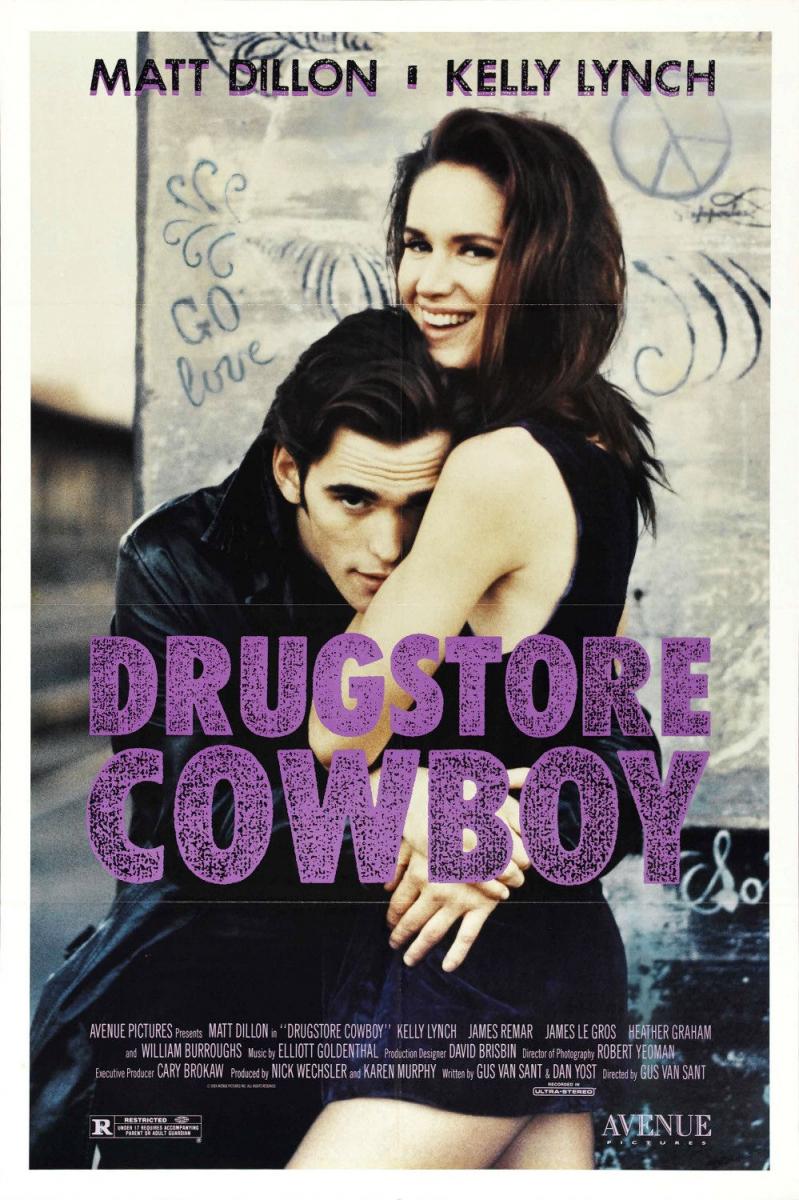
I love everything about Drugstore Cowboy, the first film I ever saw by director Gus Van Sant. It’s the one that I view as his gold standard even after nearly 30 years. Funny, touching, and insightful in ways that have to be seen, it speaks to me. It probably always will. It’s a rare film that has it all: flawlessly executed from start to finish, it’s totally absorbing and entertaining yet still makes its points in a way that hits hard even after seeing it dozens of times.

Bad Bobby Hughes (Matt Dillon) — or just “Bob” — is the first one to tell you he’s a junkie. He and his wife, Dianne (Kelly Lynch), lead a small nomadic “crew” that consists of Rick (James LeGros) and his young girlfriend, Nadine (Heather Graham). The four of them spend their days getting high and devising elaborate — and amusing — schemes to rob drugs from pharmacies and hospitals. Then they go out and execute their mission.

Once they’ve made a score, they do the drugs they like, sell the ones they don’t, hang out doing little more than watching TV, and move onto another neighborhood somewhere else in Portland, Oregon, when they’ve either run out or overstayed their welcome, whichever comes first.

They’ve repeated the cycle so many times that cocky Detective Gentry (James Remar) and his men are on their trail. Bob manages to stay a step ahead, but it’s getting tougher. He sees that his luck is running out — and it’s not just because of the hex that Nadine inadvertently put on them by mentioning a dog (one thing about Bob: he’s a bit superstitious).

To outrun one such hex — and more realistically, because Bob runs out of ideas and doesn’t know what to do next — they hit the road, stuffing their drug stash in suitcases, shipping them on Greyhound buses, and following them by car. A string of bad luck and bad outcomes presents Bob with an epiphany — and a choice.

With both humor and compassion, Van Sant — and for his part, Dillon — tells a moving and curiously relatable story about people who aren’t necessarily bad, but they’ve allowed their lives to drift away from them. Here, it’s for drugs. They don’t always do the right thing, and often the members of this little family of outcasts are each other’s worst enemies. But they’re realistic. Dillon makes Bob so likable that I find myself rooting for him even when he’s making bad choices; despite his flaws, I like him enough that I can see myself having fun with him.

Drugstore Cowboy easily could’ve been a very different movie. It works because it’s not preachy or judgmental or hyperbolic. Based on a novel by real-life criminal and addict James Fogle (https://en.m.wikipedia.org/wiki/James_Fogle), Van Sant and Daniel Yost’s screenplay eschews melodrama for a decidedly objective and almost clinical approach, showing the joys of drugs in some visually well constructed sequences as well as the cost of addiction. The film does an excellent job showing how much work it is to maintain a habit. Throughout the movie, Dillon’s narration keeps the story grounded. Van Sant never sells out his characters’ humanity.

It doesn’t hurt that this film is loaded with spectacular performances all around, including those of Grace Zabriskie as Bob’s battleworn mother and William S. Burroughs as disgraced priest and fellow addict Fr. Tom Murphy. Robert Yeoman’s cinematography gives Drugstore Cowboy a drab, threadbare look that works well with Elliot Goldenthal’s moody score. Every element comes together to make this a truly remarkable film, definitely one of my favorites.

With Max Perlich, George Catalano, Janet Baumhover, Stephen Rutledge, Beah Richards, Robert Lee Pitchlynn, Ray Monge, Woody

Production: Avenue Pictures

Distribution: Avenue Pictures Productions (USA), Astral Films (Canada), Forum Distribution (France), Sandrew Film & Teater (Sweden), GAGA Communications (Japan)

102 minutes
Rated R

(MoviePlex) A+

Kill, Baby…Kill! [Operation Fear] [Operazione paura]

(Italy 1966)

“Something in this town is supernatural. Tell me, why did they abandon the church? I’m scared. I almost think the devil’s here.”

— Monica

The second offering of a Mario Bava weekend double feature, Kill, Baby…Kill! is one of the director’s more commercially successful films. Many commentators have pointed out its influence on the horror genre and praised Bava’s gothic sensibilities, visuals, and use of irony. All good, I agree. Still, none of these things means Kill, Baby…Kill! is a great — or even a good — film.

In the early 20th Century, a coroner, Dr. Paul Eswai (Giacomo Rossi-Stuart), is en route to a remote village in Transylvania to perform an autopsy on a woman who died under mysterious circumstances. In a church — an abandoned one, no less, no doubt to provide a metaphor. The carriage driver, warning that this place is messed up, will only go to the edge of the village, not inside it.

Dr. Eswai finds the police inspector (Piero Lulli) at a local inn, where he is given instructions. When none of the superstitious and rather wan locals volunteer to help him with the autopsy, Monica Shuftan (Erika Blanc), a nurse of some sort who grew up there and just happens to be visiting the graves of her parents, steps up to assist.

During the autopsy, Dr. Eswai is puzzled to find a silver coin stuck in the woman’s heart. It’s a practice to thwart a local ghost that visits villagers in their sleep and puts a hex on them, making them commit suicide in ghastly ways — like jumping from heights and impaling themselves on iron posts.

Dr. Eswai runs into a creepy young thing in a white dress. He soon learns she’s the ghost of seven-year-old Melissa Graps (Valerio Valeri), who died 20 years before. She’s the little bugger who’s been freaking out everyone in the village for the last two decades. The doctor and Monica sense a spark, but first they must deal with this Melissa situation.

Romano Migliorini, Roberto Natale, and Bava all contributed to the screenplay. The story is unoriginal and silly, complete with cringeworthy dialogue and an actual sorceress (Fabienne Dalì). There’s an odd dub thing going on, too.

This being a Bava picture, though, Kill, Baby…Kill! works on primal instinct, here fear. Plus, it has its share of arresting visuals. The colors are vivid, though the palette is heavy on brown and green. The sets have a grimy, dilapidated medieval appearance to them, giving the look of a ghost story. There’s a cool scene where Dr. Eswai chases after Monica through a series of doors that keep taking him back to the same rooms — it’s delightfully dizzying.

Overall, Kill, Baby…Kill! is okay. It’s got Bava’s unique fingerprint all over it, and it’s fun to watch. It’s just not spectacular. Blood and Black Lace grabbed me; this did not, at least not for long. I hate the title — they should’ve kept Operation Fear.

With Luciano Catenacci (Max Lawrence), Micaela Esdra, Franca Dominici, Giuseppe Addobbati, Mirella Pamphili, Giana Vivaldi

Production: F.U.L. Films

Distribution: Internazionale Nembo, Distribuzione Importazione, Esportazione Film, Alpha (Germany), Europix Consolidated Corp. (USA), Astral Films (Canada), Metro-Goldwyn-Mayer

85 minutes
Rated PG

(Gene Siskel Film Center) C

Valley Girl

(USA 1983)

“Girls, we must fuck him.”

— Loryn


“Man, he’s like tripendicular, ya know?”

— Julie Richman


“Kings and queens, they don’t grow on trees.”

— Prom Teacher


“Well, fuck you, for sure, like totally!”

— Randy

“Bitchin’! Is this in 3D?” asks Tommy (Michael Bowen), whom no other Val dude can touch. It’s a fair question for a ticket taker wearing 3D glasses, I guess. “No,” responds Randy (Nicolas Cage) nonchalantly as he rips his ticket. “But your face is.” Burn!

I don’t know why Deborah Foreman isn’t on the poster, but I can’t help love Valley Girl. Directed by Martha Coolidge and written by Andrew Lane and Wayne Crawford, it’s a classic that always makes me smile. It’s not because it’s Nicolas Cage’s debut as Nicolas Cage (before Valley Girl, he was Nicolas Coppola). It’s not because it comes straight from the early ‘80s, or because it’s got a totally narly-ass soundtrack, or because of its awesome lines, or because it resonates, like, totally. It’s all of that. And more.

Well, like, it’s sushi, don’t you know? No one will mistake Valley Girl for anything but a product of its time. However, anyone can identify with the dilemma of Julie Richman (Foreman), who’s into Randy (Cage) because he’s not like all the other guys at school, but her friends don’t approve because, well, he’s not like all the other guys at school. He’s from the city — Hollywood, to be exact — and he’s new wave. Oh, the horror!

Randy sweeps Julie off her feet, taking her on a wild ride and introducing her to things you don’t get in the Valley. Her friends, shallow as they are, pressure her to drop Randy for Val dude Tommy (Bowen), who fits their idea of the right guy for Julie — never mind that they already dated and she broke it off because he made her feel “like an old chair or something.” Julie’s heart tells her not to do it. When her friends all but blacklist her, she capitulates. Spoiler alert: she’s not happy.

Randy’s heart is broken, but he won’t give up. He goes undercover, showing up literally everywhere Julie goes — drive-through diners, movie theaters, even camping out on her front lawn. Thanks to Randy’s bestie Fred (Cameron Dye), a plan to win Julie back comes together at her prom — which, incidentally, features Josie Cotton performing.

Part Rebel Without a CauseFast Times at Ridgemont HighGrease, and even The Graduate (Lee Purcell as Stacey’s mother is fantastic), Valley Girl is definitely romantic. It’s also fun and full of heart. The ending is predictable, but I wouldn’t have it any other way.

With Elizabeth Daily, Heidi Holicker, Michelle Meyrink, Tina Theberge, Richard Sanders, Colleen Camp, Frederic Forrest, David Ensor, Joanne Baron, Tony Markes, Camille Calvet, The Plimsouls

Production: Valley 9000

Distribution: Atlantic Releasing

99 minutes
Rated R

(Impact) B

Léon Morin, Priest [Léon Morin, prêtre]

(France / Italy 1961)

When young widow Barny (Emmanuelle Riva) bursts into a confessional and tells the priest, Léon Morin (Jean-Paul Belmondo), that “religion is the opiate of the masses,” it’s pretty clear that director Jean-Pierre Melville isn’t going easy on us. For awhile, it’s not clear where he’s going at all with Léon Morin, Priest [Léon Morin, prêtre], a moody work that percolates with repressed sexuality while it dives into religion, philosophy, and politics.

The story, based on Béatrix Beck’s novel and set in a tiny town somewhere in the French Alps during the Italian occupation right before the Nazis took over, centers on Barny as her relationship with Fr. Morin develops and intensifies. She reveals that she’s a communist militant, possibly a lesbian, and Jewish by injection (i.e., her dead husband was a Jew). She tries to provoke him with her jabs at the Catholic Church, but Fr. Morin’s responses are measured and considered. She’s seduced.

It looks like something sexual is going to happen between them: he’s young and handsome, and she’s been without a man for so long that she’s lusting after a female coworker (Nicole Mirel). Once the two are alone behind the closed door of Fr. Morin’s office in a church tower, it happens: they engage in…discourse, discussing the tenets of Catholicism.

Léon Morin, Priest is low on action and heavy on dialogue, and as a result it often feels lethargic. All of the “important” discussions — the ones that advance the plot, anyway — occur in one room, which does nothing to accelerate the pace. The discussions involve dry topics like theology and philosophy and religious dogma.

However, Melville keeps it interesting with what’s going on in the background: he’s brutally frank about the casual and pervasive anti-Semitism, the lackadaisical Italian soldiers, and the callous efficiency of the Nazis. Riva and Belmondo smoulder, though the former’s performance is far more compelling. Amid the hasty baptisms of children and the desperate hiding of neighbors is the curiously amusing subplot about Fr. Morin having all the women of the village spellbound. It’s a light touch in an otherwise heavy film.

With Irène Tunc, Gisèle Grimm, Marco Behar, Monique Bertho, Marc Heyraud, Nina Grégoire, Monique Hennessy, Edith Loria, Micheline Schererre, Renée Liques, Simone Vannier, Lucienne Marchand

Production: Georges de Beauregard, Concordia Compagnia Cinematografica, Carlo Ponti

Distribution: Lux Compagnie Cinématographique de France, Ciné Vog Films (Belgium), Cineriz (Italy), Eurooppalainen Filmi (Finland), Rialto Pictures (USA)

130 minutes (restored version)
Not rated

(Gene Siskel Film Center) B-

Dunkirk

(USA / UK / France / Netherlands 2017)

I have mixed feelings about Christopher Nolan’s spectacular Dunkirk, a World War II military drama that has very little to do with battle. Told from three perspectives — land (“the mole”), sea, and air — the story here centers on an evacuation, that of British and allied soldiers from the beaches of Dunkirk, a fishing village in northern France at the Belgian border, over a ten-day period in late Spring 1940 (https://en.wikipedia.org/wiki/Dunkirk_evacuation).

I have to admit ignorance here: I knew nothing about the Dunkirk evacuation going into this film. Nolan doesn’t spend any time on background or what led to this point; instead, he just picks up with British soldier Tommy (Fionn Whitehead) fleeing German fire outside the beach. I wish I had known ahead of time because I would have done some research. I thought a better job could have been done telling the story.

The structure, jumping between the three perspectives, takes a little work to follow. What exactly is going on is unclear and confusing, and it creates a nice sense of claustrophobia and panic in many scenes — especially that boat scene. This is good. However, keeping track of the characters is a tough task not made any easier by giving all the soldiers the exact same black hair dye. I found it hard to relate to or care much about any of them because I was kept at arm’s length. I couldn’t get invested. While definitely not the same story, Dunkirk is a kind of a big budget Son of Saul — just not as good.

As a spectacle, though, Dunkirk is magnificent. Cinematographer Hoyte van Hoytema shot it on 70 millimeter film, and he packs this picture with gorgeous wide shots of the beach, the sea, and throngs of desperate soldiers. He beautifully captures the hopelessness of the situation with a drab palette of only a few army colors: greens, greys, blues, and cold whites that convey a chill I could see and feel. The sound is over the top loud. If nothing else, Dunkirk is total sensory overload. It’s worth seeing for that alone.

Side note: I’m not sure which is the bigger surprise here — that 1D’s Harry Styles actually isn’t terrible, or that Tom Hardy is hidden under aviator goggles for the entire film. The latter is a bummer. He’s so hot!

With Mark Rylance, Tom Glynn-Carney, Jack Lowden, Aneurin Barnard, James D’Arcy, Barry Keoghan, Kenneth Branagh, Cillian Murphy, Michael Caine

Production: Syncopy, Warner Brothers, Dombey Street Productions, Kaap Holland Film, Canal+, Ciné+, RatPac-Dune Entertainment

Distribution: Warner Brothers, Karo Premiere (Russia), NOS Audiovisuais (Portugal), Roadshow Entertainment (New Zealand), Roadshow Films (Australia)

106 minutes
Rated PG-13

(Music Box) C+

http://www.dunkirkmovie.com

The Birdcage

(USA 1996)

“It’s aspirin with the ‘A’ and the ‘S’ scraped off.”

— Agador

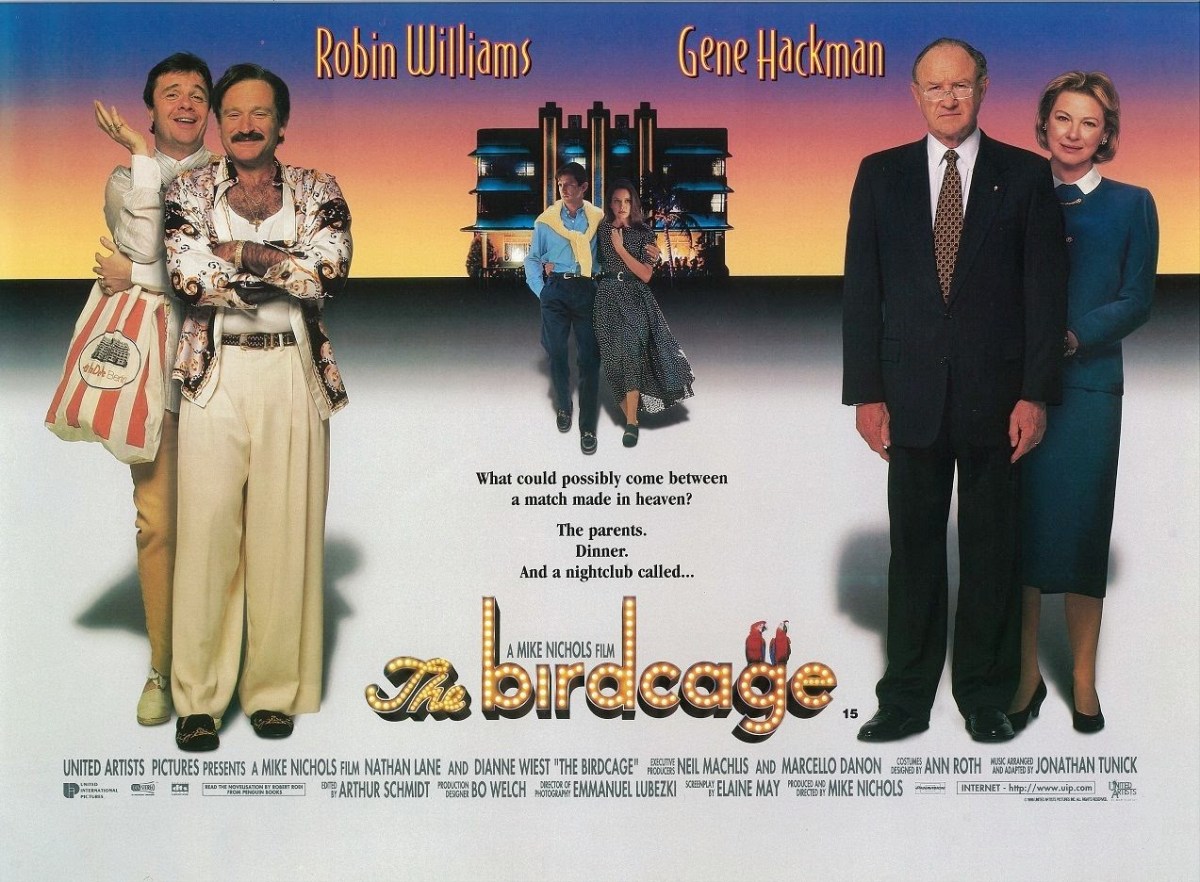
Mark Caro’s latest presentation in his “Is It Still Funny?” series, The Birdcage, is director Mike Nichols’s 1996 Americanized remake of Jean Poiret’s classic 1979 French farce La Cage aux Folles. I’m not sure it was intentional, but this presentation coincides with National Drag Day, something I didn’t know existed.

I left the theater with three impressions: one, things have changed quite a bit in two decades; two, The Birdcage is still funny even if it is silly and dated; and three, Robin Williams could do anything well.

Armand Goldman (Williams) owns and operates a drag nightclub, the Birdcage, in South Beach. His flamboyant husband, Albert (Nathan Lane), is the club’s star attraction. Armand’s son, Val (Dan Futterman), announces his engagement to Barbara Keeley (Calista Flockhart), the daughter of right wing Republican senator Kevin Keeley (Gene Hackman). The kids want to — and should — introduce their parents to each other, but the problem is Barbara’s father, who no doubt will not approve.

Val has a solution: Armand can fake being straight — and married to his biological mother, Katherine Archer (Christine Baranski), who didn’t have much to do with him growing up but maybe will do him this one solid. And the Keeleys will be no worse not knowing the truth.

Albert, who’s a gay giveaway, can’t be part of it. He can’t even be around. This puts Armand — and the entire household — in a tricky situation. Albert is delicate at the moment, and this will hurt him. Little does anyone know how important he’ll prove to be in pulling off the ruse.

It’s easy to dismiss The Birdcage as fluff. The whole thing — plot, setting, characters, that dinner — is really, really silly. The humor relies heavily on stereotypes — histrionic Albert, house “boy” Agador (Hank Azaria), and conservative Kevin are the most obvious examples. Madonna dancers Luis Camacho and Kevin Stea have bit parts as…dancers, big shock. There’s a lot of camp and physical humor here, which doesn’t make for sophisticated comedy.

Nonetheless, the actors bring it, particularly Lane, who imbues his role with unexpected tenderness. Elaine May updates and punches up the screenplay with political jabs and cultural witticisms. At the center of the insanity is Williams, who despite a few glimmers of his wacky old self (“You do Fosse, Fosse, Fosse! You do Martha Graham, Martha Graham, Martha Graham! Or Twyla, Twyla, Twyla! Or Michael Kidd, Michael Kidd, Michael Kidd, Michael Kidd! Or Madonna, Madonna, Madonna!”), plays the Straight Man — that might sound contradictory considering his character here, but I’m not referring to his orientation. And he does it well. The result is a guilty pleasure.

With Dianne Wiest, Tom McGowan, Grant Heslov, James Lally, Luca Tommassini, André Fuentes, Tony Gonzalez, Dante Lamar Henderson, Scott Kaske, Tim Kelleher, Ann Cusack, Stanley DeSantis, J. Roy Helland, Anthony Giaimo, Lee Delano, David Sage, Michael Kinsley, Tony Snow, Dorothy Constantine

Production: United Artists Pictures

Distribution: United Artists (USA), United International Pictures (UIP), Filmes Lusomundo (Portugal)

117 minutes
Rated R

(Music Box) B-

http://www.mgm.com/#/our-titles/187/The-Birdcage/