They

(USA / Qatar 2017)

“You’ll never be a girl. You’re not a boy. So you’re probably nothing.”

— J

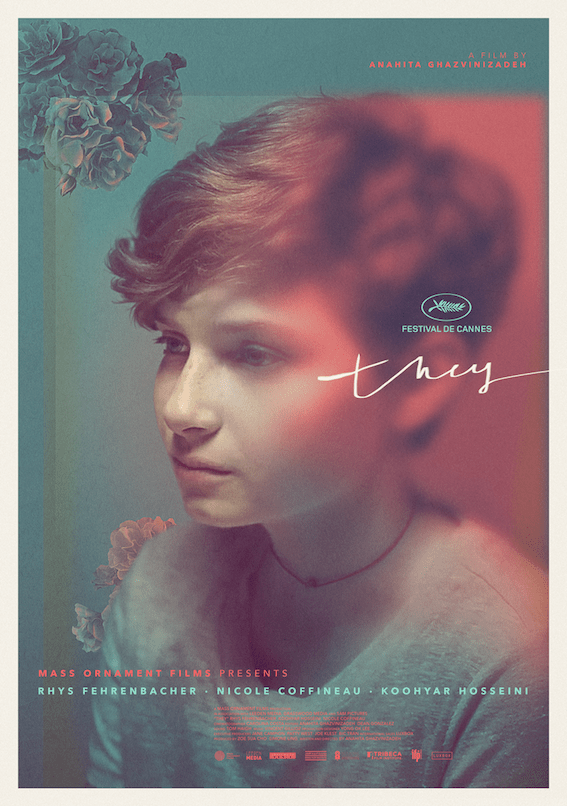
Writer/director Anahita Ghazvinizadeh’s debut feature film They delicately tells the story of J (Rhys Fehrenbacher), a quiet suburban Chicago teen transitioning from male to female. Along with therapy sessions and physician consultations for “puberty blocking” drugs and “bone density” test results, J is processing the social and psychological implications of their change. We know it’s happening, but we see it in action when J puts on a dress and goes outside, or when he explains to others how to make an introduction to a stranger and which pronoun to use (“they,” hence the title).

The process is awkward, particularly when older sister, Lauren (Nicole Coffineau), brings her fiancé, Araz (Koohyar Hosseini), home to meet the family. With mom (Norma Moruzzi) away caring for an aunt who has early onset dimentia, J is left to deal alone. Meeting Araz’s Iranian family in the suburbs seems to be a reckoning for J.

If nothing else, They is visually arresting, artfully shot with georgeous pans and closeups of buildings, walls, plants, and flowers. Ghazvinizadeh plays with reflections on glass and uses a muted color pallet that nicely underscores J’s fluid state of mind. It sets just the right tone: hazy and dreamy.

That said, both the narrative and the character development in They fall short. I’m not sure Lauren and Azaz are necessary, and I certainly don’t have more than a passing sense of who they are or why they’re here. The dinner at Araz’s family is dropped in clumsily, throwing off the trajectory of the story. The focus gradually and inexplicably shifts away from J, which I found strange.

Watching They feels voyeuristic, which isn’t a bad thing in itself. However, it feels like an obstacle — a transparent partition — keeps me from getting too close to the characters. That’s a shame because this is a film that demands an amount of intimacy that simply isn’t accommodated. On top of that, the actors’ naturalistic performances meander quite a bit, which made me zone out at times.

Overall, They could have been a much more powerful statement. Still, it’s a decent effort even with its shortcomings and a few dull parts.

With Diana Torres, Evan Gray, Drew Sheil, Leyla Mofleh, Mohammad Aghebati, Alma Sinai, Arian Naghshineh, Ava Naghshineh, Aerik Jahangiri, Farid Kossari, Kaveh Ehsani, Robert Garofalo, Eric Fehrenbacher, Vicki Sheil

Production: Mass Ornament Films

Distribution: N/A

Screening introduced by Anahita Ghazvinizadeh and followed by a live Q and A with Ghazvinizadeh, Rhys Fehrenbacher, and Rob Garofalo

80 minutes
Not rated

(AMC River East) C-

Chicago International Film Festival

https://www.massornament.com/they

La Chinoise

(France 1967)

“Okay, it’s fiction. But it brings me closer to reality.”

— Véronique

Set in the context of the New Left movement in late 1960s France, Jean-Luc Godard’s La Chinoise is not really about the political ideas it raises — many of which seem relevant today. No, at its core is Godard satirizing the idealism of youth.

Structured as a mockumentary in what undoubtedly is an intentionally scrappy art school style, La Chinoise is a series of “interviews” of five middle class college students about their Maoist terrorist organization. Headquartered in a loft apartment in a suburb of Paris, they named their organization “Aden Arabie” after a novel by French communist Paul Nizan.

The apartment, all done up in primary colors like a Piet Mondrian painting, is owned by one of the members’ parents.

Véronique (Anne Wiazemsky, who sadly died exactly a week before the screening I attended) (https://www.nytimes.com/2017/10/05/obituaries/anne-wiazemsky-french-film-star-and-novelist-dies-at-70.html) is the bossy leader, a philosophy student from a family of bankers. She’s involved with Guillaume (Jean-Pierre Léaud), a “theatrical actor.” Yvonne (Juliet Berto) grew up on a farm and works as a housekeeper and occasional hooker. She’s involved with Henri (Michel Semeniako), a writer who protests and publishes essays. Serge Kirilov (Lex de Bruijin) is a Russian nihilist who is single and suicidal.

La Chinoise is dense with ramblings about social and economic philosophy, politics, and literature. However, Godard uses all of it to make his point: these are kids who are still naïve and don’t fully grasp what they say they stand for. He shows them running around with toy weapons, playing school, and acting out scenes from books in the apartment, often cutting to pictures of comic book and cartoon characters. The joke is pretty funny when you consider the bourgeois backgrounds of the kids.

A conversation between Véronique and French philosopher Francis Jeanson on a train best illustrates Godard’s point: he asks a series of questions challenging her proposal to blow up the university in an effort to expose the flaws in her plan — and maybe get her to question her motives and the depth of her conviction. It goes over her head. So much for carrying pictures of Chairman Mao.

Side note: Claude Channes’s song “Mao-Mao” features prominently here. It’s a nifty little earworm.

With Omar Blondin Diop

Production: Anouchka Films, Les Productions de la Guéville, Athos Films, Parc Film, Simar Films

Distribution: Athos Films (France), Pennebaker Films (United States), Kino Lorber

96 minutes
Not rated

(Gene Siskel Film Center) C+

https://www.kinolorber.com/film/view/id/1111

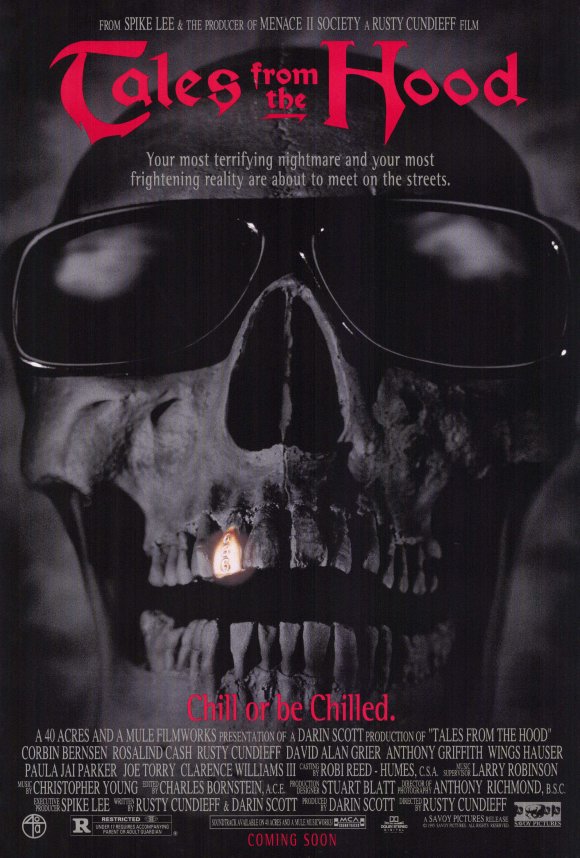
Tales from the Hood

(USA 1995)

The road to hell is paved with good intentions. Rusty Cundieff’s anthology Tales from the Hood is a good idea: four vignettes of black life presented as horror stories — so, a horror flick with a message, more commentary than a “scary movie.” I see why Spike Lee attached his name to it (as executive producer).

Cundieff and cowriter Darin Scott pick material topics that still resonate more than 20 years later: racism, police brutality, domestic abuse, drugs, and black-on-black violence. The messages are strong, but unfortunately the writing always isn’t.

The best segment is “Hard Core Convert,” which is also the closer. Jerome a.k.a. Crazy K (Lamont Bentley) is a drug dealer shot in a gang hit. He wakes up in a Kafkaesue prison, where a stern nurse (Lira Angel) subjects him to rehabilitation methods straight from A Clockwork Orange. This particular piece and the way it’s executed are both powerful and memorable.

The second segment, “Boys Do Get Bruised,” takes on domestic abuse. It’s not bad, but it’s not great. The other two segments, “Rogue Cop Revelation” and “KKK Comeuppance,” fall flat.

Tales from the Hood targets the right notes, but it misses many of them. For one thing, the approach here is really heavy-handed. Plus, the impact is diluted by the silly bit that frames the stories: a funeral home in South Central Los Angeles run by weirdo Mr. Simms (Clarence Williams III). He tells the four stories to three “gangstas,” Ball (De’aundre Bonds), Bulldog (Samuel Monroe Jr.), and Stack (Joe Torry), who stumble into the home looking for drugs. I could have done without this device — it served as a distraction more than anything.

With Wings Hauser, Tom Wright, Anthony Griffith, Michael Massee, Duane Whitaker, David Alan Grier, Brandon Hammond, Rusty Cundieff, Paula Jai Parker, Corbin Bernsen, Roger Guenveur Smith, Art Evans, Rosalind Cash, Chris Edwards , Troy Cartwright, Brenden Jefferson, Tim Hutchinson, John A. Cundieff, Bobby McGee, Christina Cundieff, Ricky Harris, Darin Scott, Mark Christopher Lawrence, Scotty Brulee, Ryan Williams, Kamau Holloway, Tasha Johnson

Production: 40 Acres and a Mule Filmworks

Distribution: Savoy Pictures Entertainment

98 minutes
Rated R

(Music Box) C-

Music Box of Horrors

Hot Dog Hands

(USA 2017)

Part comedy and part horror, Hot Dog Hands by Matt Reynolds is a squiggly little story involving bullying and body issues.

A woman (Gillian Wallace Horvat) becomes a recluse when her hands sprout plump fingers that look like hot dogs — and they won’t stop. The boys on her street notice; they stand in a group outside her house and chant, “Hot dog hands!” It’s upsetting to say the least.

A piece of junk mail leads the woman to a cure, but it’s not what she (or I) expected. It’s a weird but cute and kind of sweet solution that made me smile. Stuck between features of a horror movie marathon during the wee hours of the morning, it also gave me a jolt of energy that perked me up and allowed me to move onto the next film awake. Bravo!

Production: Matt Reynolds

Distribution: Matt Reynolds

6 minutes
Not rated

(Music Box) B

Music Box of Horrors

mattreynoldstreats.com

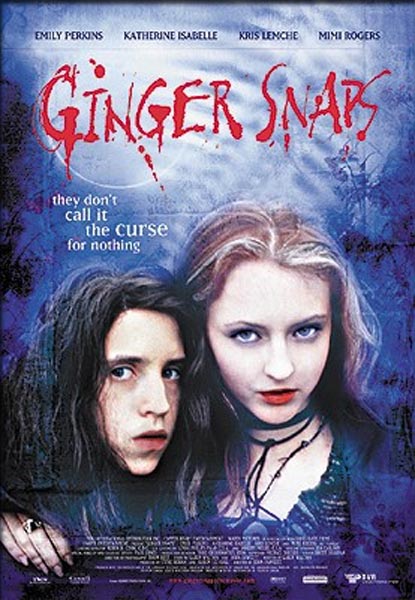
Ginger Snaps

(Canada 2000)

“Shit, wrists are for girls. I’m slitting my throat.”

— Ginger Fitzgerald

Puberty is tough enough without your older sister turning into a werewolf. Just ask 15-year-old Brigitte Fitzgerald (Emily Perkins), who with her sib, Ginger (Katharine Isabelle), stages gory death scenes and takes pictures of them, like a pair of morose Cindy Shermans. When they were kids, they made a pact to die together. Their classmates think they’re weird.

A run-in with mean girl Trina Sinclair (Danielle Hampton) sparks a war. Walking through the woods on their way to exact revenge one October night with a full moon, Ginger gets her first period. She also gets attacked by a mysterious and savage beast — the same one responsible for eviscerating all the dogs in the neighborhood.

Ginger turns increasingly feral over the next few days, growing more aggressive and sexual. Her wounds, which heal almost immediately, are sprouting hair. Oh yeah, she’s also developing what appears to be…a tail?

Brigitte, or “B,” connects with cute, brooding dope dealer Sam (Kris Lemche), who struck and killed the beast while he was driving his van down the road where it ran after it attacked Gretchen. He’s got a recipe for what might be the cure. The clock is ticking as Gretchen gets farther out of control, and Halloween — with another full moon — approaches.

On paper — all I had going into it because I’d never heard of it — John Fawcett’s Ginger Snaps sounds dubious at best. The premise seems trite. The part about the period sounds stupid, and the analogy to “becoming a lady” is obvious.

Turns out, Ginger Snaps is surprisingly good. Incorporating familiar elements of teen movies and splatter flicks, Fawcett, who wrote the screenplay with Karen Walton, pushes the “suspension of disbelief” envelope. He knows just when to stop, though. There’s quite a bit of gore here. The special effects are dated but effective nonetheless.

What really sells this film, though, is the acting: Perkins and Isabelle evoke a warmth to their relationship despite their offputting personalities and a fierceness to their bond. They’re totally believable as sisters. The final scene, which involves only them, is downright sad. Crushing, even.

With Mimi Rogers, Jesse Moss, John Bourgeois, Peter Keleghan, Christopher Redman, Lindsay Leese, Wendii Fulford, Pak-Kong Ho, Lucy Lawless

Production: Motion International, Copperheart Entertainment, Water Pictures, Lions Gate Films, Oddbod Productions, TVA International

Distribution: Motion International (Canada), Unapix Entertainment Productions (USA), Lions Gate Films

108 minutes
Not rated

(Music Box) B-

Music Box of Horrors

http://www.gingersnapsthemovie.com

Hellraiser

(UK 1987)

“Oh, no tears, please. It’s a waste of good suffering!”

— “Pinhead” (the Lead Cenobite)

Roger Ebert famously derided Clive Barker’s directorial debut, the sadomasochistic horror classic Hellraiser, calling it “without wit, style, or reason” for its “bankruptcy of imagination” (http://www.rogerebert.com/reviews/hellraiser-1987). Well, talk about tearing your soul apart!

Hellraiser isn’t particularly scary, but it is creepy and fucking weird. I certainly don’t find it lacking wit, style, or imagination; quite the opposite. It’s a ridiculous, kinky, and bloody telenovela. Based on Barker’s short novel The Hellbound Heart, Hellraiser takes the idea of something in the attic to a place no one else has.

Larry (Andrew Robinson) and Julia Cotton (Clare Higgins) have a strained marriage. After leaving Manhattan to go live in his abandoned boyhood home somewhere on the Atlantic coast, Julia finds Larry’s brother — who’s her ex lover — Frank (Sean Chapman in the flashbacks and Oliver Smith in the present) reanimated without skin in the attic. The movie doesn’t explain it, but the novel does: Larry cuts his hand and drips blood onto the attic floor, right where Frank’s comeshot dried up in the floorboards. Nice.

An unrelenting hedonist, Frank lost his body and soul to demons in his quest for sexual gratification. It started with an antique puzzle box that opened a portal to hell and summoned the Cenobites, led by “Pinhead” (Doug Bradley), the apparent spokesman for the motley foursome. Now, Frank needs blood, which is where Julia comes in. Too bad Frank’s daughter, Kirsty (Ashley Laurence), keeps getting in the way.

The special effects look cheap and the plot is choppy. It isn’t clear at first whether the cuts to Frank and Julia getting it on are flashbacks or fantasy, so this detail could have been done better. Nonetheless, Hellraiser is totally engrossing (and at points, just gross). Barker makes a silly story bizarre enough to keep you interested in what happens next. Higgins effectively channels a tortured melodramatic ’50s B-movie damsel in distress. And her big ’80s hair and sunglasses are fabulous!

Perhaps the best thing Hellraiser has going for it, though, is its twisted sense of humor: all of this happens — and will happen again — because Frank thinks with his dick. Now that’s funny.

With Nicholas Vince, Simon Bamford, Grace Kirby, Robert Hines, Anthony Allen, Leon Davis, Michael Cassidy, Frank Baker, Kenneth Nelson, Gay Baynes, Dave Atkins, Oliver Parker

Production: Cinemarque Entertainment BV, Film Futures, Rivdel Films

Distribution: New World Pictures (USA), Entertainment Film Distributors (UK), Highlight Film (West Germany), Paraiso Films S.A. (Spain), Prooptiki (Greece), Roadshow Film Distributors (Australia), Toei Classic (Japan), Vestron Benelux (Netherlands)

94 minutes
Rated R

(Music Box) B-

Music Box of Horrors

http://www.clivebarker.info/hellraiser.html

Foxy Brown

(USA 1974)

“That’s my sister, baby. And she’s a whole lot of woman.”

— Link


“Death is too easy for you, bitch. I want you to suffer.”

— Foxy

To use a term straight from Willie Hutch’s theme song, director/screenwriter Jack Hill’s Foxy Brown is superbad. It’s definitely not something to see for technical or artistic excellence, but it’s cool nonetheless. A sort of reworking of Coffey, it’s a sexy vigilante revenge tale that doesn’t take itself too seriously.

Pam Grier is Foxy Brown, a bodacious woman on a mission to track down the goons who shot and killed her boyfriend (Terry Carter), a government agent who just had plastic surgery to change his identity, right outside her door. Obviously, this is the work of a Los Angeles drug ring.

Foxy quickly figures out who the rat is: her own brother, Link (Antonio Fargas). He identifies her boyfriend’s killers as affiliates of a “modeling agency.” The agency is run by fixers Miss Kathryn Wall (Kathryn Loder) and Steve Elias (Peter Brown). Their clients are crooked high profile men of the law like judges and politicians who trade favors for girls.

Posing as a prostitute, Foxy gets inside the operation and does some major damage. It gets her in serious hot water when she’s exposed, bringing her into the center of a lesbian bar brawl and then onto a coke ranch as a junky sex slave. Fortunately, she’s tough and resourceful. No one gets the best of Foxy.

Built on sex parties, chase scenes, shoot outs, and boobs, the plot is structured like a sitcom, and it’s about as complicated and predictable. Naturally, Foxy gets what she wants in the end. Except for the very cool opening titles, there are no effects to speak of. The acting is average at best. However, the action is surprisingly steady, leaving very few dull spots. Plus, there’s real sas here, mostly from Grier, that keeps the whole thing interesting.

I wouldn’t go so far as to call Foxy Brown a feminist work, but Foxy is a badass heroine with her heart — and her head — in the right place. It’s a thrill watching her take control, especially in heels and those fabulous frocks. I wouldn’t want to piss her off.

With Harry Holcombe, Sid Haig, Juanita Brown, Sally Ann Stroud, Bob Minor, Tony Giorgio, Fred Lerner, Judy Cassmore, H.B. Haggerty, Boyd ‘Red’ Morgan, Jack Bernardi, Brenda Venus, Kimberly Hyde, Jon Cedar, Ed Knight, Esther Sutherland, Mary Foran, Jeannie Epper, Stephanie Epper, Peaches Jones, Helen Boll, Conrad Bachmann, Russ Grieve, Rodney Grier, Roydon E. Clark, Don Gazzaniga, Jay Fletcher, Gary Wright, Fred Murphy, Edward Cross, Larry Kinley Jr.

Production: American International Pictures (AIP)

Distribution: American International Pictures (AIP) (USA), Sociedade Importadora de Filmes (SIF) (Portugal), Film AB Corona (Sweden), Cinema Mondo (Finland)

92 minutes
Rated R

(Impact) C+

https://youtu.be/eVDvu28O3WU

Il Boom

(Italy 1964, 2017)

For some reason — I can’t find an answer — Il Boom was not released in the States until this year. Madonne! Better late than never, and I’m glad it made it because it reaffirms my love of midcentury Italian cinema.

Giovanni Alberti (Alberto Sordi) lives large. His fabulously modern apartment in Rome features a gorgeous patio for entertaining. He employs a housekeeper and sometimes a wait staff. His beautiful and frivolous wife, Silvia (Gianna Maria Canale), has expensive taste. Every night, they go out on the town for lavish dinners and fancy cocktails, dancing and partying in the most chic and trendy clubs.

A game of footsie under the table suggests that his bourgeois crowd is into some naughty stuff on the side, but Giovanni loves Sylvia way too much for that.

Life is grand, but that’s the problem: Giovanni lives above his means. Unbeknownst to Sylvia, who continues to spend gleefully, he’s over his head in debt and about to be publicly humiliated on “the registry.” He can’t get another loan because his credit is shot. Desperate, he suggests a simpler lifestyle, which Sylvia simply ignores. He can’t bring himself to tell her why.

Giovanni fails miserably to convince a number of friends and associates to invest in his land development plan, which may or may not be a scam. His last hope is one-eyed real estate mogul Mr. Bausetti (Ettore Geri), who like everyone else turns him down. Mrs. Bausetti (Elena Nicolai), however, makes a proposal behind her husband’s back: she offers to buy Giovanni’s left eye. He can name his price.

Il Boom is a lot of fun. The title refers to the postwar economic boom in Italy and elsewhere. Director Vittorio De Sica and writer Cesare Zavattini are critical of consumerism, and there’s definitely a moral. However, they avoid getting on a soapbox and simply make fun of it. The story moves along breezily, and quite a few scenes — the dinner party, the hospital — are memorably offbeat and funny. Sordi is perfect as the hapless Giovanni, displaying a mercurial energy and general uneasiness that keeps you watching. His reaction to Mrs. Bausetti’s offer is priceless. I left with a smile.

Armando Nannuzzi’s cinematography is beautiful in luminous black and white; I can’t imagine Il Boom in color. Billy Vaughn’s super cool “Wheels” plays throughout the film; man, does it stick in your head. I’m humming it now.

With Alceo Barnabei, Federico Giordano, Antonio Mambretti, Silvio Battistini, Sandro Merli, John Karlsen, Ugo Silvestri, Gloria Cervi, Gino Pasquarelli, Maria Grazia Buccella, Mariolina Bovo, Felicita Tranchina, Franco Abbiana, Rosetta Biondi

Production: Dino de Laurentiis Cinematografica

Distribution: Rialto Pictures, StudioCanal

88 minutes
Not rated

(Gene Siskel Film Center) B+

http://www.rialtopictures.com/catalogue/il-boom

The Florida Project

(USA 2017)

“Relax. Your daughter’s perfectly fine in my hands.”

— Moonee

Sean Baker’s Tangerine (https://moviebloke.com/2015/07/28/tangerine/) impressed me. On the surface an offbeat odyssey of castoffs living on the fringe in West Hollywood, it’s one of those films that creeps up and hits you at the end. Comprised largely of small moments and vignettes strung together, its sum is much more — and completely different — than its parts: insightful, powerful, and quietly profound.

Come to think of it, Barry Jenkins’s Moonlight (https://moviebloke.com/2016/11/19/moonlight/) operates in a similar way even though it’s not the same story.

I was thrilled to hear that Baker has a new film, The Florida Project, out this fall. The comments I overheard from audience members while walking out of a prerelease screening were amusing but maddening: “That was realism, hard realism. Too hard.” “Well, that didn’t go anywhere.” “I had to force myself to stay awake.” “I wouldn’t recommend that to anyone.” Insert eyeroll here.

I disagree. The Florida Project switches gears, so it doesn’t end up where it seems to be going. The trailer makes it look like a childhood nostalgia movie, and it starts out like one. But it’s not. Often amusing but just as often difficult to watch, it paints a vivid picture that doesn’t criticize, demean, or sentimentalize its characters or their situation. I’ve heard Baker lauded for his humanism; his work definitely shows plenty of that if nothing else. His best attribute may be his willingness to let his characters develop into real people over the course of two hours or so.

To be clear, the impact of The Florida Project is not immediate. Baker’s pace isn’t quick, either. Written by Baker and Chris Bergoch, The Florida Project starts out as a sort of Little Rascals sitcom involving the misadventures of besties Moonee (Brooklynn Prince) and Scooty (Christopher Rivera), two grade school kids growing up in a sketchy roadside motel, the Magic Castle, that sits along a tawdry strip just outside the Magic Kingdon — a.k.a. Disney World in Orlando. A gun shop, a convenience store, a market that sells oranges, and a boarded up clinic dot the strip, which incidentally intersects with Seven Dwarves Lane.

Moonee and Scooty spend their days running around, screaming, and stirring up mischief. They spit all over a motel guest’s car. They drop water balloons on people. They spy on an elderly topless sunbather (Sandy Kane). They scam change to buy ice cream. They set a fire. They recruit a third hellion, Jancey (Valeria Cotto), who lives next door and easily goes along with their antics probably because there’s no one else to play with. Their favorite target is weary motel manager Bobby (Willem Dafoe).

Slowly, a different picture emerges and The Florida Project becomes another film. Moonee’s mother, Halley (Bria Vinaite), can’t get it together. Feral and clearly her own worst enemy, she lives hand to mouth with her young daughter. She’s constantly about to be evicted, and she takes free meals wherever she can get them. When selling stolen amusement park passes and wholesale perfume in the parking lot of a “nicer” motel up the street doesn’t work, she turns tricks in the room.

After Halley has a falling out with Scooty’s mom, Ashley (Mela Murder), Baker literally zooms in on Moonee.

The events here are purposely mundane, and it’s hard to say exactly where the climax is. It doesn’t matter: The Florida Project works because of the way Baker executes the story. He’s just as careful about choosing what he shows as what he doesn’t. The thrill here is watching the characters develop, anyway; that’s what makes The Florida Project soar. It doesn’t hurt that the acting is superb, particularly Vinaite, Prince (who at six years old is a natural — I almost cried when she did), and Dafoe, whom I haven’t seen this good since Mississippi Burning.

Alexis Zabe’s cinematography — alternating long shots and pans with almost uncomfortably close shots — works beautifully with the gorgeously effervescent color palette. The ending is unexpectedly touching and fun. The Florida Project just might be the first Oscar contender I’ve seen this year.

With Josie Olivo, Aiden Malik, Caleb Landry Jones, Shail Kamini Ramcharan, Sonya McCarter, Karren Karagulian, Kelly Fitzgerald, Lauren O’Quinn, Edward Pagan, Cecilia Quinan, Kit Sullivan, Andrew Romano

Production: Cre Film, Freestyle Picture Company, June Pictures, Sweet Tomato Films

Distribution: A24 (USA), Altitude Film Distribution (UK), Elevation Pictures (Canada), Filmcoopi Zürich (Switzerland), September Film (Netherlands), Front Row Filmed Entertainment (United Arab Emirates)

115 minutes
Rated R

(AMC River East) A-

Chicago International Film Festival

https://a24films.com/films/the-florida-project

Funeral Parade of Roses [Bara no Sōretsu]

(Japan 1969)

Funeral Parade of Roses [薔薇の葬列] is an intriguing film for a few reasons. Clearly influenced by the French New Wave, writer and director Toshio Matsumoto comes up with something simultaneously ordinary yet avant-garde, very much a product of its time yet years ahead. It’s extraordinarily cool.

Structured as a movie within a movie, Funeral Parade of Roses follows Tokyo “gay boy” Eddie (Pîtâ a.k.a. Peter) through his many exploits as a young transvestite immersed in the underground club scene. He might even be a hooker. Meanwhile, he’s carrying on a secret affair with Jimi (Yoshimi Jô), the boyfriend of club elder statesperson and fellow gay boy Leda (Osamu Ogasawara). Leda is onto them. Oh, the drama it creates!

While all this is going on, a camera crew records Eddie as though this were The Real World or Truth or Dare.

As Eddie ponders who he is — and looks to alcohol, group sex, drugs, and lots of attention from others for answers — Matsumoto explores “queer identity” through him. He intersperses interviews, flashbacks, episodes with Eddie’s mother (Emiko Azuma), and even a musical diversion or two to offer clues. A crazy subplot develops, and it references Oedipus in a tacky and sad but clever way.

Clumsy in its exploration of “gay life” and downright disturbing at points, Funeral Parade of Roses is nonetheless fun to watch. Shot in gorgeous black and white, it has an otherworldly feel. When it’s not nihilistic, it’s kitschy and entertaining — almost in a nascent John Waters way, just not quite as rough. The clothes are mod. The music is heavy on classical. The ending, sudden and bloody, is really messed up.

I’m not sure what exactly Matsumoto is saying here — a lot is open to interpretation — or that I agree with him. Either way, I enjoyed the journey.

With Yoshio Tsuchiya, Toyosaburo Uchiyama, Don Madrid, Koichi Nakamura, Chieko Kobayashi, Shōtarō Akiyama, Kiyoshi Awazu, Flamenco Umeji, Saako Oota, Tarô Manji, Mikio Shibayama, Wataru Hikonagi, Fuchisumi Gomi, Yô Satô, Keiichi Takenaga, Hôsei Komatsu

Production: Art Theatre Guild, Matsumoto Production Company

Distribution: Art Theatre Guild, Image Forum (Japan), Cinelicious Pics (USA)

105 minutes
Not rated

(Gene Siskel Film Center) B+