Lost Highway

(USA 1997)

I watched David Lynch’s Lost Highway on my iPad on an Amtrak train from Chicago to Rochester. The one thing I strongly recommend is that it be viewed on the big screen, or at the very least on a flatscreen television. Quite simply, the visuals here are far too beautiful to see in an abridged format. And frankly, the visuals—sets, colors, costumes, actors, props—are the best part of the film.

The second thing I recommend is that it be watched under the influence of something—booze, pot, or better yet, prescription drugs.

This begs a question I’ll just answer: Lost Highway is fucked up—thrillingly so. The whole things starts with a videotape of our unlucky hero, saxophonist Fred Madison (Bill Pullman), murdering his wife (Patricia Arquette), who in an alternate universe is having an affair with Madison’s younger alterego, Pete Dayton (Balthazar Getty). The married couple has no memory of this murder. Neither party seems aware of this wrinkle in time and space, either. The connection lies with two people: demanding gangster Mr. Eddy (Robert Loggia) and creepy-ass flour-faced Robert Blake in what must be his most frightening role as The Mystery Man, a pallid ghost straight from a silent movie or a video by The Cure.

Lost Highway isn’t my favorite David Lynch film. However, it’s intriguing and vague enough to keep me thinking about it. I’m not sure what to make of this one—but I’m also not sure I care enough to do the work to figure it out. Maybe someday, definitely not today. The star cameos are enough for now.

Interesting fact: Lost Highway features the final film performances of Blake, Jack Nance, and Richard Pryor. Who knew?

With Alice Wakefield, John Roselius, Lou Eppolito, Henry Rollins, Mink Stole, Gary Busey, Lucy Butler, Giovanni Ribisi, Marilyn Manson, David Lynch

Production: October Films, CiBy 2000, Asymmetrical Productions, Lost Highway Productions LLC

Distribution: October Films (USA), Polygram Filmed Entertainment (UK), Rialto Film AG (Switzerland), RCV Film Distribution, Cinemussy (Spain), Senator Film (Germany), Atalanta Filmes (Portugal), Edko Films (Hong Kong), NTV-PROFIT (Russia), Artistas Argentinos Asociados (AAA) (Argentina), AmaFilms (Greece), New Star (Greece), Sandrew Film (Sweden), United International Pictures (UIP) (Australia), Warner Brothers (Finland)

134 minutes
Rated R

(iTunes rental) C+

http://www.davidlynch.de

https://youtu.be/1nKjO9QCSic

Empire Records

(USA 1995)

“I’m the idiot, you’re the screw up, and we are all losers,” sums up Empire Records general manager Joe (Anthony LaPaglia) when he realizes that clerk Lucas (Rory Cochrane) blew the store’s receipts in Atlantic City the night before, which incidentally was the first time Joe let him close shop. His heart was in the right place: Lucas wanted to raise capital to buy the store before owner Mitchell (Ben Bode) sells it to a lame corporate chain called Music Town. Empire Records, you see, is more than a retail outlet: it’s a haven for floundering misfits, including a young shoplifter (Brendon Sexton) who goes by “Warren Beatty.”

Empire Records was a box office bomb (http://www.boxofficemojo.com/movies/?id=empirerecords.htm). Carol Heikkinen’s script is earnest in its desire to (I guess) reveal some revelation about ’90s youth, but the plot is all too predictable, coming off as a third-rate The Breakfast Club. The cast, though, is impressive; loaded with professionals (Debi Mazar and Maxwell Caulfield) and future stars like Renée Zellweger and Liv Tyler, the actors collectively ooze a credible chemistry. Director Allan Moyle pulls some decent performances out of them. A playfully snarky sense of humor about American culture pervades this film, evident in such nifty devices as “Rex Manning Day” and a dream sequence involving Gwar.

Empire Records is very much a product of its time, but that’s what makes it interesting to watch now. This no doubt is why it was selected as the third screening of Chicago International Film Festival’s Totally ’90s series.

With Robin Tunney, Johnny Whitworth, James “Kimo” Wills, Ethan Embry, Coyote Shivers

Production: Monarchy Enterprises B.V., New Regency Pictures, Regency Entertainment, Warner Brothers

Distribution: Warner Brothers

90 minutes
Rated PG-13

(Public Chicago) C+

Chicago International Film Festival

Blade Runner: The Final Cut

(USA 1982, 2007)

Ridley Scott is hit or miss with me, Harrison Ford bores me, and I tend to eschew science fiction. So, neo-noir sci-fi drama Blade Runner doesn’t seem like something that would appeal to me. It does, though—in fact, I love it.

Like Alien, another gem by Scott, Blade Runner succeeds on so many levels. Executed near flawlessly, its themes and narrative, its structure and pace, its sets and technical aspects are all polished, eloquent, and downright cerebral. It cuts right to the heart of humanity—what’s beautiful about it and what isn’t, and what it is to be human.

Los Angeles, November 2019: six rogue artificial humans known as replicants that were banished to an “off-world” work camp in space return to Earth in a desperate attempt to extend their life. Created by tech behemoth Tyrell Corporation, this particular model, the Nexus-6, is the smartest and strongest replicant. However, it has a lifespan of only four years—and the meter is ticking. Fortunately for them, replicants are indistinguishable from real humans, except for their emotional responses. It takes a lengthy question-and-answer test to positively identify them.

Burned out former cop Rick Deckard (Ford), whose job as a blade runner was to track down replicants and “retire,” or kill them, is persuaded—okay, extorted—out of a self-imposed furlough to find and get rid of these troublemakers. Stat. The job isn’t an easy one, particularly where charmingly weird and conniving Pris (Daryl Hannah) and invincible badass Roy (Rutger Hauer) are involved.

As Deckard searches for his targets, he meets and gets to know the rather severely formal Rachael (Sean Young), assistant to replicant inventor Dr. Eldon Tyrell (Joe Turkel). Rachael doesn’t know she’s a replicant. Tyrell asks Deckard to retire her as well, but there’s a problem: Deckard realizes he’s falling for her.

Adapted from Philip K. Dick’s novel Do Androids Dream of Electric Sheep?—with the title taken from Alan E. Nourse’s novel The Blade Runner, which had nothing to do with Dick (https://www.neondystopia.com/cyberpunk-movies-anime/the-story-behind-blade-runners-title/)—Blade Runner is dark in every sense of the word. Jordan Cronenweth’s cinematography is stunningly bleak. The setting might be Los Angeles, but Scott slyly references Metropolis—only he refits it to Hong Kong or Tokyo. Many of the ideas explored here are eerily relevant today, especially the way morality plays out with corporations, genetic engineering, a police state, the environment, and hierarchy of life and life forms.

Blade Runner is a weighty movie, but seriousness aside—I found myself entertained with a number of things that simply aren’t present today: PanAm, Atari, and TDK. Smoking indoors. Pay phones. Photographs. Even urban decay. I was also floored that one of the replicants was “born” 20 days after this screening. Plus, Roy is a bionic Ken doll and Pris looks like a club kid from Party Monster. Still, Blade Runner is timeless; I’ll see it again in three or 33 years and still swoon over it. Yes, it’s that good. The Final Cut is Scott’s own finetuned version of the original theatrical release. It kills me that after all this time, a sequel that I probably won’t see is coming out later this year.

In 1993, the United States Library of Congress deemed Blade Runner “culturally, historically, or aesthetically significant” and selected it for preservation in the National Film Registry (https://www.loc.gov/programs/national-film-preservation-board/film-registry/complete-national-film-registry-listing/).

With Edward James Olmos, M. Emmet Walsh, William Sanderson, Brion James, Joanna Cassidy, Kevin Thompson, John Edward Allen, Robert Okazaki

Production: Ladd Company, The Shaw Brothers/Sir Run Run Shaw, Warner Brothers

Distribution: Warner Brothers

117 minutes
Rated R

(Music Box) A

https://www.warnerbros.com/blade-runner

Wait Until Dark

(USA 1967)

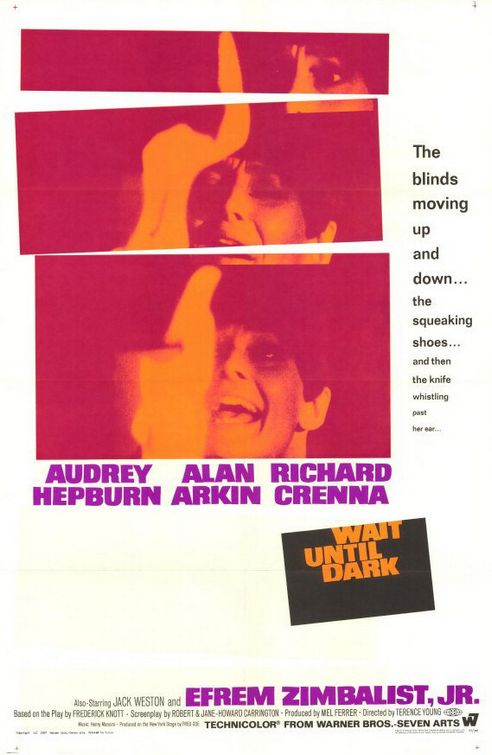
A heroin smuggling ring. A creepy doll. A corpse. A blind woman alone in her basement apartment in the West Village. These are the elements of Wait Until Dark, a quaint and dingy little crime thriller adapted from Frederick Knott’s 1966 play by screenwriters Robert Carrington and Jane-Howard Carrington.

Suzy Hendrix (Audrey Hepburn) is the hapless gudgeon who, being blind, already has the proverbial wool over her eyes. Her husband, Sam (Efrem Zimbalist Jr.), comes home from a business trip with a doll that unbeknownst to him contains a hidden stash of heroin sewn into it. This does not bode well for Lisa (Samantha Jones), the glamorous and sexy stranger who asks him to hold it for her at JFK International Airport.

A case of mistaken identity leads a pair of small time crooks (Richard Crenna and Jack Weston) to Sam and Suzy’s apartment, where psychotic hooligan Harry Roat (Alan Arkin) coerces them into helping him find the doll—as soon as they dispose of a dead body. Nice. They devise an elaborately devious scam to recover the doll when they realize Suzy, who walks in on them, is blind.

Terence Young’s directing is certainly competent. I last saw this movie on some late night UHF station when I was a kid, and two things have stayed with me: a sense of severe claustrophobia as the story unfolds, and that fucking groovy apartment. The plot has flaws that strain credibility. For one thing, Suzy is far too unguarded for a New Yorker. Why doesn’t she lock her door? Roger Ebert pointed out this detail (http://www.rogerebert.com/reviews/wait-until-dark-1968). I didn’t obsess over it like he did, but I noticed it and thought the same thing. When Roat tells her he knows she has the doll, why doesn’t Suzy hand it over? Why does she tell Gloria (Julie Herrod) to meet Sam at the train station instead of going to the police? Why do the guys bother to put on disguises if Suzy can’t see them?

Despite these glaring issues, Young ultimately succeeds in bringing Wait Until Dark to a boil. It lives up to its hype: I saw people jump in their seats at the end. The acting here overcomes any shortcomings in plot. Hepburn is little more than a blind Holly Golightly, but at certain points she reminds me of Barbara Stanwyck screaming that she can’t wake up from a nightmare in, I think, The Night Walker. Weston is a little too bumbling, but Crenna and Arkin are chillingly menacing and foreboding even if they are silly by today’s standards (yeah, sunglasses at night went a long way making Corey Hart look tough). Henry Mancini’s eerie score is the clincher in setting the right mood.

A trivial point of interest: Suzy’s apartment is in the same block of rowhouses as the one used for the Huxtable residence on The Cosby Show (http://www.movie-locations.com/movies/w/Wait_Until_Dark.html#.WRU0W1LMyWY). The small street, St. Luke’s Place, has a bit of literary history, too (http://www.nytimes.com/1996/10/27/realestate/in-a-village-enclave-15-remarkable-rowhouses.html).

With Jean Del Val, Frank O’Brien

Production: Warner Brothers

Distribution: Warner Brothers/Seven Arts

108 minutes
Not rated

(Music Box) B-

Who’s Afraid of Virginia Woolf?

(USA 1966)

Elizabeth Taylor. Richard Burton. Edward Albee. Even George Segal, who was kind of a fixture on NBC during the ’80s and ’90s. Need I say more? Probably not, but I will.

Director Mike Nichols and screenwriter Ernest Lehman stick pretty close to Albee’s 1962 play with their film adaptation of Who’s Afraid of Virginia Woolf?, and it’s hard to watch. Really hard. To be fair, though, it’s supposed to be, and that’s what makes it so good.

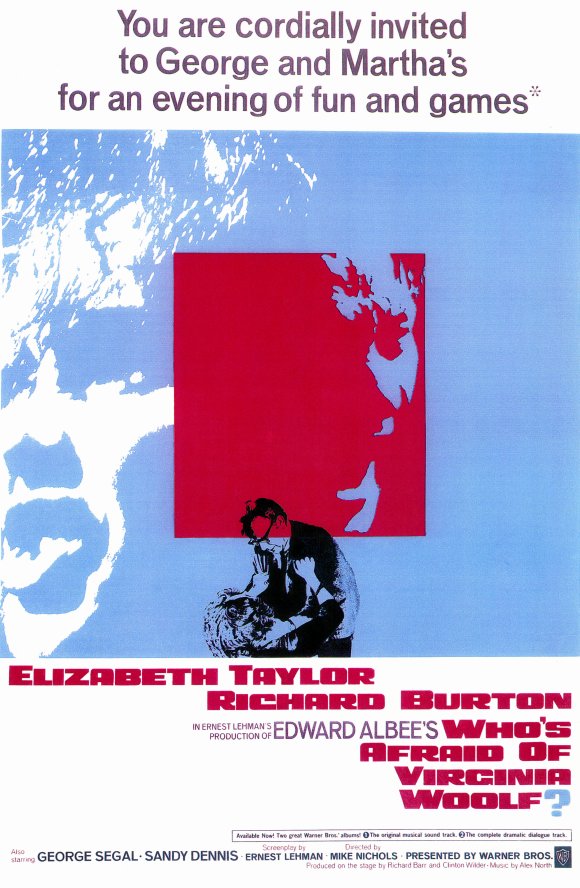
The promotional poster promises an evening of fun and games, but very little joy is to be found here, at least on the surface: all that marital baiting, sniping, and yelling is miserable. Fuck! It took me five or six false starts over a few years before I finally got into the film—and only with the help of a bottle of bourbon. Once I was in, though, I was hooked: watching this disastrous night unfold and all four characters unravel engrossed me desite the buzz I had going.

The oddly but appropriately named George (Burton), a history professor at a small East Coast university, and Martha (Taylor), the daughter of the school’s president, stumble home drunk from a faculty party, neither one listening to the other as they babble about nothing. Martha quotes Bette Davis, which ultimately reveals more about her viewpoint than any other comment she makes—and the woman can talk.

They babble and respond to each other half-heartedly. Martha tells George that she invited a young couple, a professor from another department and his wife, over for a drink. George is miffed, but there’s no time to react.

Enter Nick (Segal) and Honey (Sandy Dennis), a polite, young, good-looking couple that, as we learn, has their own set of problems. Martha and George pour drinks and pick at each other while Nick and Honey watch, uncomfortable at first, thinking maybe they shouldn’t be there. As the drinking continues, though, they’re pulled into the…drama? Turns out, they have more in common with each other than they think.

Here’s the thing about George and Martha: their marriage is dysfunctional, but they seem to operate well inside the confines of their explosive relationship—Martha brays and George stays, responding in a passive aggressive manner as he fixes them both another drink. Over and over and over again. Do they have any limits? It’s hard to say, partly because it’s never clear that we should take anything at face value: what we see is not necessarily what it is. That’s the genius of Who’s Afraid of Virginia Woolf. 

In 2013, the United States Library of Congress deemed Who’s Afraid of Virginia Woolf? “culturally, historically, or aesthetically significant” and selected it for preservation in the National Film Registry (https://www.loc.gov/programs/national-film-preservation-board/film-registry/complete-national-film-registry-listing/).

With Frank Flanagan, Agnes Flanagan

Production: Warner Brothers

Distribution: Warner Brothers

131 minutes
Not rated

(DVD purchase) A

Who’s That Girl

(USA 1987)

“You gotta see me spend money to really appreciate me.”

—Nikki Finn

“¿Quién es esa niña?” asks the buoyant but trite title song, which topped the Billboard Hot 100 charts for a week during the summer of 1987. We all know the answer: it’s Madonna, of course. Perhaps a better question is, what happened with this movie?

Madonna is Nikki Finn, a playful gumcracking ex-con who just got out of jail serving time for a crime she didn’t commit. She’s rough around the edges but dead serious about her mission: she’s determined to find out who framed her for the murder of her boyfriend, Johnny.

Enter uptight humorless yuppie tax attorney Loudon Trott (Griffin Dunne), who works for Manhattan mogul Simon Worthington (John McMartin) and is about to marry his daughter, Wendy (Haviland Morris). Louden is charged with the task of picking up Nikki from the pen and making sure she gets on a bus to Philadelphia. Surprise: it’s not that easy with someone like darling Nikki, which becomes abundantly clear to Louden over the next 24 hours. Talk about causing a commotion.

Originally titled Slammer, Who’s That Girl is an homage of sorts to the screwball comedies of the 1930s and 1940s. It’s a total “summer movie.” Written by Andrew Smith and Ken Finkleman, and directed by James Foley, it shows glimpses of some okay ideas. It’s supposed to be fun, and to a degree it is. Madonna and Dunne concoct a believable chemistry, I’ll give them that. Dunne is a great straight guy, on par with his performance in After Hours. The problem is, Who’s That Girl just isn’t very funny. The jokes are lame, the laughs are far and few between, and the plot is predictable. The whole thing loses steam about halfway through. Murray the cougar (Murray) is a pointless gimmick that, sadly, doesn’t add anything.

The animated opening sequence is cool (and parts of it ended up in the music video for “Who’s That Girl”). The soundtrack is better than the film. Overall, though, Who’s That Girl is a pretty uninspired work. I love Madonna and I ran to the theater when this came out. I was underwhelmed then; after waiting almost 30 years to see it again, I’m underwhelmed now. Fun fact, though: Stanley Tucci and Mike Starr both have minor roles as dockworkers.

With Coati Mundi, Dennis Burkley, James Dietz, Bibi Besch, John Mills, Robert Swan, Drew Pillsbury, Liz Sheridan

Production: Guber-Peters Company

Distribution: Warner Brothers

92 minutes
Rated PG

(iTunes purchase) D+

https://youtu.be/Zi8U2S-2-Cc


Julieta

(Spain 2016)

Pedro Almodóvar has his own voice and his own vision, and he’s stayed true to both from the beginnning of his career. He’s an incredible story teller with no shortage of stories to tell; in fact, he once said that he “can make a thousand different movies about the same subject” (https://www.brainyquote.com/quotes/quotes/p/pedroalmod587571.html). His frank treatment of sexuality is as bold as his visual style, and his characters are all memorable. His plots are intricate, loaded with twists and turns and weird things that throw in a wrench that takes the whole thing somewhere you never saw coming. He’s a master of exaggeration—it works just as well in his comedy as it does in his melodrama.

Julieta, Almodóvar’s current film—his twentieth feature—is no exception. Like most of his movies, particularly his post-millennial work, this one centers on women. Inspired by three short stories (“Chance”, “Soon,” and “Silence”) from from Alice Munro’s 2004 book Runaway, Julieta is, in simplest terms, the story of one woman’s search for her estranged daughter. There’s a lot more to it, of course, and Almodóvar slowly reveals it all, layer by layer.

Julieta (Emma Suárez) is a middle-aged woman who lives in Madrid with her boyfriend, Lorenzo (Darío Grandinetti). They’re packing to move to Portugal. Julieta has a secret: she has a daughter, Antiá, who checked out of her life more than a decade ago. She happens to run into Beatriz (Michelle Jenner), an old friend of Antiá, on the street. Beatriz gives Julieta some small information about Antiá, prompting Julieta to drop all plans in the hope of her daughter returning. She begins writing a journal, which turns into a flashback that tells us what happened.

Some 30 years before, young Julieta (Adriana Ugarte) meets scruffy fisherman Xoan (Daniel Grao) on a train. He’s married, but his wife is in a coma. He knocks up Julieta, who receives a letter from him and visits him at his home in a small Spanish fishing town. They decide to raise Antiá together there. When Antiá (Priscilla Delgado) is a teen and away at camp, Julieta and Xoan have a fight that leads to disaster. Julieta doesn’t tell Antiá everything, and it comes back to bite her.

Nothing by Almodóvar ever sucks, but I’ve found his work to be up and down after All About My Mother. It’s to be expected from an artist with a long career, Madonna being a good example. His last project, 2013’s I’m So Excited, was fun but certainly not his most compelling. Julieta, however, is solid—I say it’s his finest hour and a half since Volver. It’s not a light film—it’s an elegant, emotional slow burner that deals with regret, omission, and forgiveness. Ugarte and Grao are both hot, and they have a palpable chemistry. Casting Rossy De Palma as Xoan’s longtime passive-aggressive housekeeper is a nice touch.

With Inma Cuesta, Blanca Parés, Pilar Castro, Tomás del Estal

Production: El Deseo

Distribution: Warner Brothers (Spain), Pathé, 20th Century Fox

99 minutes
Rated R

(AMC River East) B+

http://sonyclassics.com/julieta/

https://youtu.be/YH5_4osOZK8