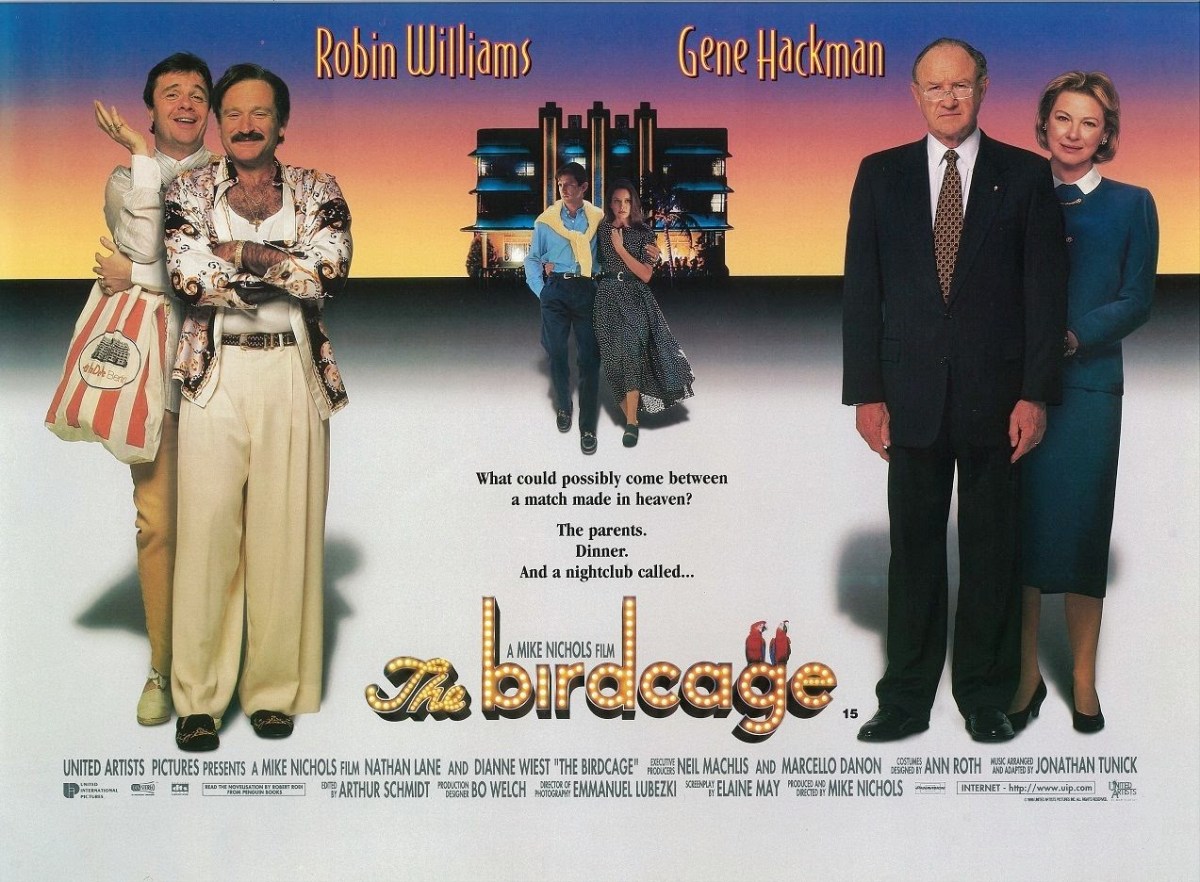
(USA 1996)
“It’s aspirin with the ‘A’ and the ‘S’ scraped off.”
— Agador
Mark Caro’s latest presentation in his “Is It Still Funny?” series, The Birdcage, is director Mike Nichols’s 1996 Americanized remake of Jean Poiret’s classic 1979 French farce La Cage aux Folles. I’m not sure it was intentional, but this presentation coincides with National Drag Day, something I didn’t know existed.
I left the theater with three impressions: one, things have changed quite a bit in two decades; two, The Birdcage is still funny even if it is silly and dated; and three, Robin Williams could do anything well.
Armand Goldman (Williams) owns and operates a drag nightclub, the Birdcage, in South Beach. His flamboyant husband, Albert (Nathan Lane), is the club’s star attraction. Armand’s son, Val (Dan Futterman), announces his engagement to Barbara Keeley (Calista Flockhart), the daughter of right wing Republican senator Kevin Keeley (Gene Hackman). The kids want to — and should — introduce their parents to each other, but the problem is Barbara’s father, who no doubt will not approve.
Val has a solution: Armand can fake being straight — and married to his biological mother, Katherine Archer (Christine Baranski), who didn’t have much to do with him growing up but maybe will do him this one solid. And the Keeleys will be no worse not knowing the truth.
Albert, who’s a gay giveaway, can’t be part of it. He can’t even be around. This puts Armand — and the entire household — in a tricky situation. Albert is delicate at the moment, and this will hurt him. Little does anyone know how important he’ll prove to be in pulling off the ruse.
It’s easy to dismiss The Birdcage as fluff. The whole thing — plot, setting, characters, that dinner — is really, really silly. The humor relies heavily on stereotypes — histrionic Albert, house “boy” Agador (Hank Azaria), and conservative Kevin are the most obvious examples. Madonna dancers Luis Camacho and Kevin Stea have bit parts as…dancers, big shock. There’s a lot of camp and physical humor here, which doesn’t make for sophisticated comedy.
Nonetheless, the actors bring it, particularly Lane, who imbues his role with unexpected tenderness. Elaine May updates and punches up the screenplay with political jabs and cultural witticisms. At the center of the insanity is Williams, who despite a few glimmers of his wacky old self (“You do Fosse, Fosse, Fosse! You do Martha Graham, Martha Graham, Martha Graham! Or Twyla, Twyla, Twyla! Or Michael Kidd, Michael Kidd, Michael Kidd, Michael Kidd! Or Madonna, Madonna, Madonna!”), plays the Straight Man — that might sound contradictory considering his character here, but I’m not referring to his orientation. And he does it well. The result is a guilty pleasure.
With Dianne Wiest, Tom McGowan, Grant Heslov, James Lally, Luca Tommassini, André Fuentes, Tony Gonzalez, Dante Lamar Henderson, Scott Kaske, Tim Kelleher, Ann Cusack, Stanley DeSantis, J. Roy Helland, Anthony Giaimo, Lee Delano, David Sage, Michael Kinsley, Tony Snow, Dorothy Constantine
Production: United Artists Pictures
Distribution: United Artists (USA), United International Pictures (UIP), Filmes Lusomundo (Portugal)
117 minutes
Rated R
(Music Box) B-
http://www.mgm.com/#/our-titles/187/The-Birdcage/


 moviebloke