Postcards from the Edge

(USA 1990)

“I’ll rinse these. I have Woolite in my purse. It’s handy for the road.”

— Doris Mann

Postcards from the Edge is, of course, Carrie Fisher’s semi-autobiographical novel about a floundering actress, Suzanne Vale (Meryl Streep), teetering on has-been status as she puts her life back together after a near fatal overdose. For her film adaptation, Fisher shifts the focus from the rehabilitation process to the relationship between Suzanne and her mother, legendary Hollywood superstar Doris Mann (Shirley MacLaine). It’s a good call: as last year’s documentary Bright Lights: Starring Carrie Fisher and Debbie Reynolds (https://moviebloke.com/tag/bright-lights-starring-carrie-fisher-and-debbie-reynolds/ ) demonstrated, Fisher and Reynolds were a solid and supportive albeit wacky team. Their relationship clearly offers ample fodder for this film.

Ably directed by Mike Nichols, Postcards from the Edge takes on addiction, family relationships, and show biz. In order to continue a film she’s working on, Vale must place herself under the care of a “responsible” adult — strictly for insurance purposes, a producer (Rob Reiner) assures her. That leaves her mother, who’s more than willing to help. In fact, it makes her beam all the more. So, Vale does what she must: she moves into her mother’s mansion in Beverly Hills.

Fisher might embellish a few things or flat out make shit up, like the sleeping pill story and her mother’s closet alcoholism. Maybe not. It doesn’t matter: Streep is excellent here, as is the entire cast. The real fun, though, is watching MacLaine emulate Reynolds. She has every tick and foible down perfectly. The homecoming party Doris throws for Suzanne and the is snarky, hilarious, and illuminating — I have the distinct impression that it really happened exactly the way it plays out here. Genius!

With Dennis Quaid, Gene Hackman, Richard Dreyfuss, Mary Wickes, Conrad Bain, Annette Bening, Simon Callow, Gary Morton, C. C. H. Pounder, Robin Bartlett, Barbara Garrick, Anthony Heald

Production: Columbia Pictures Corporation

Distribution: Columbia Pictures, Columbia TriStar Films

101 minutes
Rated R

(MoviePlex) B

http://www.sonypicturesmuseum.com/collection/719/postcards-from-the-edge

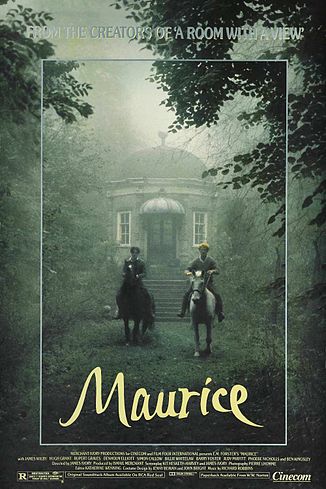
Maurice

(UK 1987)

“England has always been disinclined to accept human nature.”

— Lasker-Jones

I’m not usually a fan of period pieces, especially those set in Victorian or Edwardian England. Somehow, they tend to be stuffy, grandiloquent affairs that warrant a great big yawn — and they turn me off. James Ivory’s adaptation of E.M. Forster’s novel Maurice, however, is an exception.

I caught a 30th anniversary screening, and something crucial struck me: Ivory and cowriter Kit Hesketh-Harvey’s screenplay is downright daring even for the time when Maurice came out (no pun intended). A sort of forbidden romance that one character sees as the love of his life while the other tosses it aside as the folly of youth, I was moved by the frank depiction of gay love as a tender yet treacherous battlefield, no different than any other love — measured by intensity, law, or social construct. For this, Maurice stands way ahead of its time, even today.

Maurice Hall (James Wilby) is essentially Oscar Wilde at Cambridge circa 1910. He makes a move on social climbing classmate Clive Durham (Hugh Grant), who surprisingly welcomes his advances. They can only go so far, though: Clive doesn’t want to jeopradize his social standing, so the two maintain a platonic relationship. This is the key to Maurice, and the thing that makes it monumental: this is a film that attacks appearances.

Time goes by, shit happens, and Maurice ends up with Clive’s gutter cleaner, Alec Scudder (Rupert Graves, who looks like a plebeian Paul Young). This upsets Clive and sends Maurice to therapy. In the end, Maurice makes a choice that so many of us gays have: to be gay, or not to be.

Maurice operates on a strange platitude, one that isn’t clear at first. Maurice is vulnerable, almost stupid. Clive is chilly, reserved, and completely repressed. Both skirt around their issue. I found myself rooting for and actually admiring Maurice, who stays true to himself — class, law, and sexuality be damned. That last look on Clive’s face in the final scene is devastating…for him.

With Denholm Elliott, Simon Callow, Billie Whitelaw, Barry Foster, Judy Parfitt, Phoebe Nicholls, Ben Kingsley, Patrick Godfrey, Mark Tandy, Kitty Aldridge, Helena Michell, Catherine Rabett, Peter Eyre, Helena Bonham Carter

Production: Merchant Ivory Productions, Film Four International

Distribution: Cinecom Pictures (USA), Enterprise Pictures Limited (UK), Concorde Film (Netherlands), Cohen Media Group (USA)

140 minutes
Rated R

(Gene Siskel Film Center) B

http://www.merchantivory.com/film/maurice