Wait Until Dark

(USA 1967)

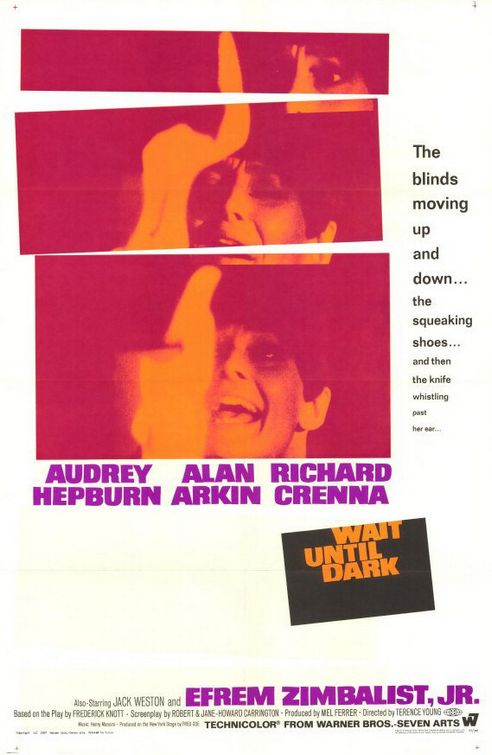
A heroin smuggling ring. A creepy doll. A corpse. A blind woman alone in her basement apartment in the West Village. These are the elements of Wait Until Dark, a quaint and dingy little crime thriller adapted from Frederick Knott’s 1966 play by screenwriters Robert Carrington and Jane-Howard Carrington.

Suzy Hendrix (Audrey Hepburn) is the hapless gudgeon who, being blind, already has the proverbial wool over her eyes. Her husband, Sam (Efrem Zimbalist Jr.), comes home from a business trip with a doll that unbeknownst to him contains a hidden stash of heroin sewn into it. This does not bode well for Lisa (Samantha Jones), the glamorous and sexy stranger who asks him to hold it for her at JFK International Airport.

A case of mistaken identity leads a pair of small time crooks (Richard Crenna and Jack Weston) to Sam and Suzy’s apartment, where psychotic hooligan Harry Roat (Alan Arkin) coerces them into helping him find the doll—as soon as they dispose of a dead body. Nice. They devise an elaborately devious scam to recover the doll when they realize Suzy, who walks in on them, is blind.

Terence Young’s directing is certainly competent. I last saw this movie on some late night UHF station when I was a kid, and two things have stayed with me: a sense of severe claustrophobia as the story unfolds, and that fucking groovy apartment. The plot has flaws that strain credibility. For one thing, Suzy is far too unguarded for a New Yorker. Why doesn’t she lock her door? Roger Ebert pointed out this detail (http://www.rogerebert.com/reviews/wait-until-dark-1968). I didn’t obsess over it like he did, but I noticed it and thought the same thing. When Roat tells her he knows she has the doll, why doesn’t Suzy hand it over? Why does she tell Gloria (Julie Herrod) to meet Sam at the train station instead of going to the police? Why do the guys bother to put on disguises if Suzy can’t see them?

Despite these glaring issues, Young ultimately succeeds in bringing Wait Until Dark to a boil. It lives up to its hype: I saw people jump in their seats at the end. The acting here overcomes any shortcomings in plot. Hepburn is little more than a blind Holly Golightly, but at certain points she reminds me of Barbara Stanwyck screaming that she can’t wake up from a nightmare in, I think, The Night Walker. Weston is a little too bumbling, but Crenna and Arkin are chillingly menacing and foreboding even if they are silly by today’s standards (yeah, sunglasses at night went a long way making Corey Hart look tough). Henry Mancini’s eerie score is the clincher in setting the right mood.

A trivial point of interest: Suzy’s apartment is in the same block of rowhouses as the one used for the Huxtable residence on The Cosby Show (http://www.movie-locations.com/movies/w/Wait_Until_Dark.html#.WRU0W1LMyWY). The small street, St. Luke’s Place, has a bit of literary history, too (http://www.nytimes.com/1996/10/27/realestate/in-a-village-enclave-15-remarkable-rowhouses.html).

With Jean Del Val, Frank O’Brien

Production: Warner Brothers

Distribution: Warner Brothers/Seven Arts

108 minutes
Not rated

(Music Box) B-

Get Out

(USA 2017)

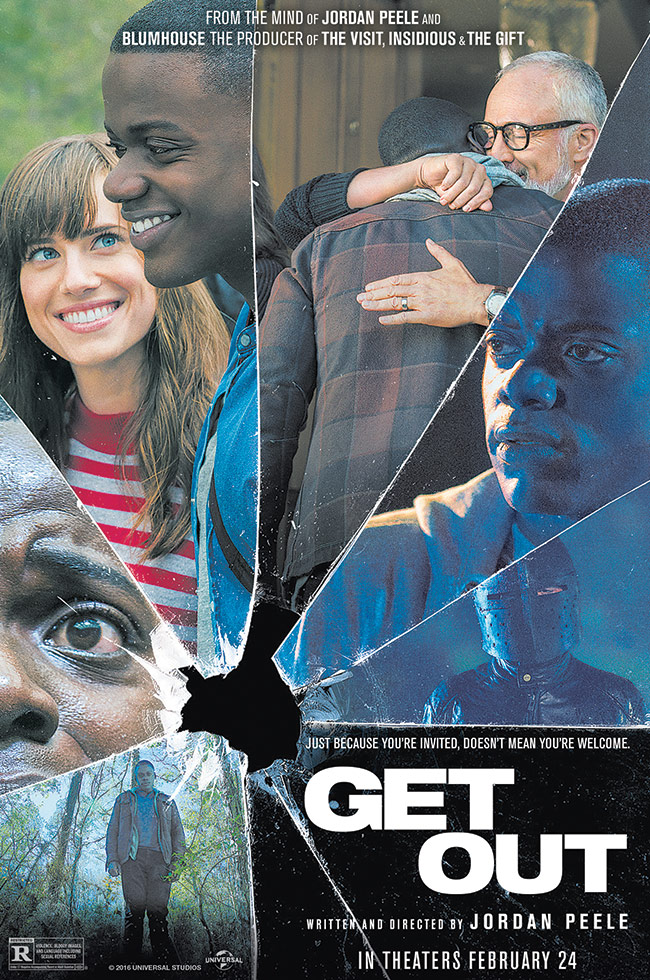
I caught the hype surrounding Jordan Peele’s first feature length film, Get Out, a comedy horror flick that takes on race—specifically, the dynamics of white power and black subordination. He wrote the script and directed the film. I went into Get Out with some doubt and maybe trepidation about how it might come off. The concept is one that seems too easy to go horribly sideways.

I guess if anyone can pull it off, it’s Peele—and I’m relieved to report that he succeeds. With an oddly compelling mix of Guess Who’s Coming To Dinner, Meet the Parents, Nightmare on Elm Street, and The Stepford Wives, he takes on the cultural idiosyncrasies of Caucasian cultural dominance within the constructs of a horror flick. He’s got a lot of points to make, and he gets them across in a sharp but entertaining way. Like the best horror movies, Get Out makes you squirm—but it does so on multiple levels.

New York City photographer Chris (Daniel Kaluuya) is black. His girlfriend, Rose Arlington (Allison Williams), is white. She invites him on a weekend getaway to her parents’ home in upstate New York because, well, it’s time for him to meet the fam. Chris agrees, going into it nervously and not without personal baggage. His hyperactive best bud, Rod (Lil Rel Howery), a TSA agent who always expects the worst, is not helping.

Rose’s parents are, like the quiet town where they live, nice. Or at least welcoming. Dean (Bradley Whitford) drops silly slang, affects a bizarre accent, and praises President Obama. Missy (Catherine Keener) is more direct, asking pointed questions in a weird attempt to get to know Chris. It’s awkward and doesn’t quite break the ice, but it’s harmless. Right?

The family’s two longterm servants, maid Georgina (Betty Gabriel) and gardener Walter (Marcus Henderson), carry themselves like they’ve had lobotomies. Rose’s younger brother, Jeremy (Caleb Landry Jones), is, um, aggressively complimentary to Chris. On top of it, the Armitages’ neighbors are not quite right, obsessed with Chris and his virility.

During the first part of Get Out, Peele keeps things light but lets a sense of creepy unease simmer. The laughs are there, but like all of the characters coming and going from the house, something is off. He makes a major shift in tone once Missy insists on hypnotizing Chris, ostensibly to help him quit smoking. What was innocuous up to now becomes nefarious.

Ultimately, the evil here is not a monster hiding under the bed, but rather something more obvious that exists in broad daylight. I could have done without the bloody finale, but it works in the context of the film; Peele plays with genre, so I see why it’s here. Either way, Get Out is a bold move that pays off.

With Stephen Root, LaKeith Stanfield, Ashley LeConte Campbell, John Wilmot, Caren Larkey, Julie Ann Doan, Rutherford Cravens, Geraldine Singer, Yasuhiko Oyama, Richard Herd, Erika Alexander, Jeronimo Spinx, Ian Casselberry, Trey Burvant, Zailand Adams

Production: Blumhouse Productions, Monkeypaw Productions, QC Entertainment

Distribution: Universal Pictures

104 minutes
Rated R

(ArcLight) B

https://www.uphe.com/movies/get-out

https://youtu.be/A2JbO9lnVLE

All About Eve

(USA 1950)

“Fasten your seatbelts, it’s going to be a bumpy night.”

—Margo Channing

That iconic line succinctly captures the essence of Joseph L. Mankiewicz’s All About Eve, a sharp commentary on the treacherous relationship between female ambition and the American obsession with youth that still rings—and stings—true nearly 70 years later.

Based on Mary Orr’s short story The Wisdom of Eve, Bette Davis is Broadway legend Margo Channing, who’s turning 40 and sees doors closing in her professional and personal life. One rainy night, Karen Richards (Celeste Holm), Margo’s bestie, happens upon a young starstruck fan waiting backstage to meet Margo after a performance of her latest play, the aptly titled Aged in Wood. The fan, of course, is wide-eyed Eve Harrington (Anne Baxter), a mousy but well-spoken girl in an oversized trenchcoat who says she followed Margo from San Francisco to New York City and has seen every performance of the play—from the back of the house.

Karen, whose husband is none other than playwright Lloyd Richards (Hugh Marlowe), Margo’s frequent collaborator and author of Aged in Wood, brings Eve into Margo’s dressing room to meet her. Lloyd is there, along with Margo’s fiancé, director Bill Simpson (Gary Merrill), and her crusty sharp-tongued maid, Birdie (Thelma Ritter). Eve wins over everyone in the room with her poignant backstory about a poor midwestern upbringing on a farm, a husband killed in the War, and a humble stiff upper lip. Everyone, that is, except Birdie—she smells a rat.

Margo takes Eve under her wing as her personal assistant. Eve quickly proves to be an ace at organizing Margo’s affairs—and sneaking herself squarely into the middle of them. She aligns with caustic theater critic Addison DeWitt (George Sanders), who like Birdie doesn’t buy what Eve puts out there but unlike Birdie sees a mutual opportunity. Things sour all around when Margo learns that her producer, Max Fabian (Gregory Ratoff), designates Eve as her understudy without consulting her first.

Often compared to Sunset Boulevard for a variety of reasons, All About Eve is not as dark or campy but is way bitchier. From a technical standpoint, the script is tighter, the production more sophisticated, and the story a lot wittier. All things considered, it’s way more fun and has held up quite well—sure, the voiceovers are overdramatic, but these are theater people so it fits. I found it particularly interesting to see this film again right around the beginning of the FX series Feud, which not only is half about Davis but elaborates on the same issues that All About Eve raises. It underscores much of what Davis said about the industry in interviews late in her life.

None of the men here have any reason to worry about their age; for all of them, their success has nothing to do with how old they are or even how they look (their thing is power, but that’s another discussion). The women, on the other hand, constantly struggle to secure and then maintain their positions—and they’re ruthless about it. Eve earns the acting award she gets at the end (which is really the beginning): she fools everyone to manipulate them into giving her what she wants. It’s clear that sooner than later, she’ll be right where Margo is, for better but more likely for worse.

In one of her earlier roles, Marilyn Monroe makes an amusingly memorable appearance as dippy starlet Miss Casswell, who’s trying to catch a break. She’s got the best line of all: “I don’t want to make trouble. All I want is a drink.” Amen!

In 1990, the United States Library of Congress deemed All About Eve “culturally, historically, or aesthetically significant” and selected it for preservation in the National Film Registry (https://www.loc.gov/programs/national-film-preservation-board/film-registry/complete-national-film-registry-listing/).

With Barbara Bates, Craig Hill, Helen Mowery, Steven Geray

Production: 20th Century Fox

Distribution: 20th Century Fox

138 minutes
Not rated

(AMC River East) A

Fathom Events

Lonesome [Solitude]

(USA 1928)

The promotional poster touts something “New! Different! Refreshing!” It sounds like soda, but it’s not: it’s Lonesome, a real charmer that still works as it nears its centennial.

Music Box Theatre screened a crisp restored 35mm print of Paul Fejos’s Lonesome for Reel Film Day, a countrywide event honoring films of the almost abandoned format (https://drafthouse.com/event/reel-film-day). The program was a double feature that included the Adam Sandler vehicle Punch Drunk. I didn’t stick around so I can’t comment on Punch Drunk, but Lonesome was an excellent choice.

Mary (Barbara Kent), a telephone operator for Ma Bell, and Jim (Glenn Tyron), a punch press operator in a factory, are two young working stiffs in the Big Apple. Both live alone in small rented room (not together—there’d be no movie then), and participate in an urban rat race that actually looks busier and grungier than what we have today.

Clearly, the film predates the standard five-day work week: the calendar in Mary’s room indicates that the day is Saturday, July 3. As Mary and Jim finish their respective jobs, which Fejos shows in a narrative that goes back and forth between the two, their work friends invite them to join in their weekend plans. Mary and Jim both see immediately that they’ll be the odd one out, as all of their friends are paired up. Both politely decline, going home dejectedly without any plans.

After they each see the same marching band advertising a cheap carriage ride to Coney Island, Mary and Jim end up going there solo on the same trip. They meet at the beach, and a modest flitration ensues. He tells her he’s a millionaire, and she tells him she’s a princess. They get along well, and commence an impromptu date, walking around, playing carnival games, and dancing. A fortune teller (Fred Esmelton) reveals that Mary has already met the man who will become her husband.

Mary and Jim get separated after a mishap on a rollercoaster. The problem is, they each have a tiny picture of the other from a photo booth and they only know each other’s first name. Finding each other in the throngs of people at the park that evening is like searching for a needle in a haystack. Have they lost each other before they even had a chance?

Edward T. Lowe, Jr. and Tom Reed adapt a cute story by Mann Page; it’s a simple yet clever plot. Despite its age, one point in Lonesome still rings loud and clear and true: connecting in the big city is harder than it looks. We all get wrapped up in the daily stuff of our lives, and we tend to overlook what’s right in front of us. Kent and Tyron are both adorable. Gilbert Warrenton’s kinetic camerawork captures a lot in the background, and it makes the shots at Coney Island especially fun to watch.

Lonesome features two or three abruptly placed “talking” scenes—the film was made when sound was a new thing—and the dialogue is laughably awful. There are also a few color tinted night shots: marquee lights, fireworks, stars. It’s really cheesy. That said, these are short, minor disruptions that don’t detract from enjoying this film for all its silent era charisma.

In 2010, the United States Library of Congress deemed Lonesome “culturally, historically, or aesthetically significant” and selected it for preservation in the National Film Registry (https://www.loc.gov/programs/national-film-preservation-board/film-registry/complete-national-film-registry-listing/).

With Fay Holderness, Gusztáv Pártos, Eddie Phillips, Andy Devine, Edgar Dearing

Production: Universal Pictures Corporation/Universal Pictures (USA)

Distribution: Universal Pictures Corporation/Universal Pictures (USA), European Motion Picture Company (UK), The Criterion Collection (DVD)

75 minutes
Not rated

(Music Box) A

Reel Film Day: A Celebration of 35mm Cinema

https://www.criterion.com/films/28212-lonesome

http://www.imdb.com/video/screenplay/vi389587993/

The Devil Wears Prada

(USA 2006)

Some movies you watch just because they start and you’re too damned lazy to see what else is on. Such is the case with The Devil Wears Prada, which served as the end of my Christmas night movie binge.

Andy Sachs (Anne Hathaway) just finished school and moved to New York City to become a journalist. While seeking employment with more weighty publications like The New Yorker, she snags a one-off interview for Runway magazine. Surprise: she gets the job—working as personal assistant to ball busting editor-in-chief, Miranda Priestly (Meryl Streep). Andy’s job duties and a chance meeting with handsome magazine writer Simon Baker (Christian Thompson) cause friction in her personal relationships, especially her chef boyfriend, Nate (Adrian Grenier). Is a job worth this much hassle?

Director David Frankel does a competent job with Aline Brosh McKenna’s screen adaptation of Lauren Weisberger’s novel even if the end result is nothing special. The acting is fine, particularly Stanley Tucci as caddy and nelly designer Nigel. It’s nice to hear Madonna’s “Vogue” in one scene outside Andy’s car. The problem I have is the script, which is formulaic and predictable girl movie stuff: awkward girl in the big city reinvents herself and not just survives but excels in the face of adversity. Of course, there’s a happy ending. The Devil Wears Prada is not my cup of tea: it’s cute, but that’s about it.

109 minutes
Rated PG-13

(Bravo) D+

http://www.foxmovies.com/movies/the-devil-wears-prada

Sad Vacation: the Last Days of Sid and Nancy

(USA 2016)

It doesn’t get more P.R. (“punk rock”) than the final days of Sid Vicious and Nancy Spungen, the notorious and dysfunctional so-called “Romeo and Juliet of punk”—frankly, I’ve always viewed them as not too far off from John and Yoko, but I digress. Two messy heroin junkies, they bounced around for most of 1978 after the Sex Pistols disbanded. In September, they landed in Manhattan, where they rented a room at the Chelsea Hotel and Nancy appointed herself Sid’s manager. A month later, she ended up slumped next to the toilet in their room, dead from a stab wound to the abdomen (though she had multiple shallow stabs all over). Sid was arrested and allegedly confessed to her murder. While out of prison on bail, he died of a heroin overdose—some claim accidentally administered by his mother, others claim suicide—just four months later.

Danny Garcia’s Sad Vacation, a straight-to-video release coming out almost exactly 30 years after Alex Cox’s biopic Sid and Nancy, revisits these legendary rock and roll deaths. Interviewing many a soul who was there—Steve “Roadent” Conolly, Kenny “Stinker” Gordon, Hellin Killer, Walter Lure, Howie Pyro, Cynthia Ross, Gaye Black, Phyllis Stein, and Sylvain Sylvain to name a few—Garcia presents the facts, which are conflicting and not at all clear. Although Sad Vacation covers a little history of the punk movement, Malcolm McLaren, and the Sex Pistols, the focus is assiduously on what happened at the Chelsea. Narrated by Fun Lovin’ Criminals front man Huey Morgan, Sad Vacation takes on the tone of a crime documentary, laying out evidence and showing the holes in it. Not surprisingly, Garcia reveals some of the “eight thousand or so” conspiracy theories surrounding the murder, with those who knew the couple speculating on who really killed Nancy. Many point to Rockets Redglare, a drug dealer and bodyguard who worked for them. Redglare, who went on to appear in a number of films you’ve actually seen, died in 2001 (https://en.m.wikipedia.org/wiki/Rockets_Redglare).

Sad Vacation is not essential viewing; it doesn’t uncover anything new, raise any points that haven’t been raised before, or even pick a theory to endorse. It concludes that no one will ever know what happened. Big wow. That said, Garcia succeeds in showing that Sid and Nancy were kids—flawed ones, but still. After hearing words like “mess,” “dysfunctional,” and “destructive” to describe their relationship, it’s sweet to learn that his ashes were spread on her grave because they couldn’t be buried together. Now that’s P.R.

94 minutes
Not rated

(Home via iTunes) C

https://m.facebook.com/sadvacationdocumentary/

http://www.chipbakerfilms.com

Coming Through the Rye

(USA 2015)

Occasionally, I’m a real starstruck starfucker; I’ve met two of my own idols, and each time was a story in itself. I’m a fan of both The Catcher in the Rye and Nine Stories, too (though not so much Franny and Zooey).

So not surprisingly, I found the premise of Coming Through the Rye appealing and totally relatable: set in 1969, Jamie Schwartz (Alex Wolff), an angsty, unpopular, nerdy high school student at an all-boy boarding school in Pennsylvania, sets out to track down the reclusive J.D. Salinger (Chris Cooper). Like many a midcentury American boy, Jamie says Salinger’s Catcher changed his life; although he’s not as harsh, he identifies with Holden Caulfield because he sees himself isolated and surrounded by phonies. He seeks the author’s blessing on his senior project, a stage adaptation of Catcher (in which Jamie plays Caulfield, of course) to be performed at his school.

Anyone remotely familiar with Salinger knows that Jamie isn’t getting his wish, something at least two teachers let him know. The kid will not take no for an answer. After failing to reach Salinger both by letter and by dropping in on his agent in New York City, a series of unfortunate events at school prompts Jamie to take off and look for Salinger himself. Deedee (Stefania Owen), a local girl who likes him and fortunately for him has a car (a cool Rambler), picks him up and offers to drive. The two embark on a short odyssey through New England.

Equal parts road movie, romance, and coming of age story, there’s quite a bit to like here. Based on actual events from his own high school years, writer and director James Steven Sadwith crafts a straightforward, easygoing story that flows naturally. The many parallels between Jamie and Caulfield—right down to a red hunter’s cap and a disquieting older brother (Zephyr Benson)—are cute; the fact that Jamie is the only Jewish kid at a WASPy boarding school is a nice touch that underscores his status as an outsider. Sadwith does a fine job showing the loss of Jamie’s innocence through a number of small events. Wolff and Owen have a wonderfully guileless chemistry that works really well; a scene with milkweed blowing in the wind is downright beautiful. Jamie’s ultimate discoveries, however, aren’t so cute—this is what keeps Coming Through the Rye from turning into nostalgic drivel.

97 minutes
PG-13

(Gene Siskel Film Center) B

http://www.comingthroughtheryemovie.com

Nocturnal Animals

(USA 2016)

Tom Ford is a Virgo, and everything he does reflects textbook traits of his sign: his products are sharp, observant, and meticulous. He exhibits impeccable style and substance. He’s a perfectionist, and it shows. His films are no exception, and his aesthetic serves them well. I seriously dug A Single Man, but I figured it was a one-off project after a few years passed without a follow up. I’m glad Ford proved me wrong: Nocturnal Animals is great. It’s also different; A Single Man is in essence a gentle and compassionate love story, whereas Nocturnal Animals is a bitter tale about a bad romance, regret, revenge, and closure with a comment on how art mirrors life. Certainly not a breezy endeavor, it offers quite a bit of food for thought.

WARNING: Potential spoilers ahead!

Susan Morrow (Amy Adams), a study in contradictions, has all the material trappings of the glamorous life—too bad none of it brings her happiness. A rich and successful Los Angeles gallery owner, she hates what she does for a living. Her husband (Armie Hammer) is dashing but absent, offering more of an arrangement than a marriage. Part of the problem might be the bankruptcy he alludes to in one of their conversations early on. Or maybe it’s the transcontinental affair he’s carrying on in New York City. Their home is a chic box in the hills; Susan is alone in it—except for the hired help, of course.

A package arrives out of the blue from her ex-husband, Edward Sheffield (Jake Gyllenhaal). They haven’t spoken in years; their relationship did not end well. A simple guy she knew from growing up in Texas, she broke his heart with three horrible things she did—not the least of which was telling him he lacked what it takes to be a writer. Edward sent her the manuscript of his forthcoming novel, Nocturnal Animals, which he dedicates to her. He included a note stating that he will be in town and wants to meet her out.

Susan opens it and starts reading. Immediately, the story seduces her. Edward’s novel, depicted from her imagination as a film within the film, is a tragically violent work of pulp noir. Tony Hastings (Gyllenhaal) is driving down a dark desert highway in Texas with his wife (Isla Fisher) and their daughter (Ellie Bamber) when a band of hicks runs them off the road. Facing a menacing proposal, Tony tries to talk his way out. Sensing weakness, nefarious psychopath ringleader Ray (Aaron Taylor-Johnson) exploits the situation and separates Tony from the girls. With one potential shot at saving his family, Tony blows it and ends up seeking help from the police. Officer Bobby Andes (Michael Shannon), a pithy cowboy with a badge, can’t comprehend why Tony didn’t put up a fight, but he helps track down the bastards so Tony can exact revenge.

Ford adapted his screenplay from Austin Wright’s 1993 novel Tony and Susan. What’s both interesting and distracting about Nocturnal Animals is the way he presents the story: he bounces back and forth between Susan’s present reality, her past, and Edward’s work of fiction that ties both together. It’s a very tricky feat, but he absolutely nails it with smooth transitions and masterful use of imagery and symbolism to connect the three narratives. Like most people (I suspect), I was far more interested in Tony than Susan even though Susan’s past and present are necessary to understand the story: Edward’s novel is a metaphor for his relationship with her. Many have complained about the ending, which is open to interpretation. I found it both realistic and satisfying whether Edward says “fuck you” to Susan or lets her off gently.

Visually, Nocturnal Animals is flawless. Ford’s sets, props, clothes, colors, and staging all work together with Seamus McGarvey’s dark and lovely cinematography to create a striking realm where naked fat ladies, a hick taking a dump, a bloody papercut, and discarded corpses are all things of beauty. The acting is superb all around, but Laura Linney is particularly exquisite in her brief role as Susan’s Lone Star Republican mother. All big-haired and dripping pearls and superiority, she sips her martini at an exclusive restaurant and urges Susan to forget about marrying a weak man like Edward. Fabulous!

116 minutes
Rated R

(Landmark Century) B+

http://www.focusfeatures.com/nocturnalanimals

Party Monster

(USA 2003)

“Money. Success. Fame. Glamor.”

—Michael

“Clubbing” in the late ’80s and early ’90s was about having fun, being seen, getting some attention when you could, and simply being fabulous. I was already past my clubbing days (or nights) and into raves when I read something about the horrific murder and dismemberment of a club kid in New York City in 1996. It hit home, albeit in a small way: not a club kid myself, some of my friends had been—or at least they were club kid lite—and I was familiar with the scene, which wasn’t violent. I followed the story for a little while but didn’t keep up to see what eventually happened—I was busy doing other stuff, like getting my shit together to go to law school and move somewhere else. The incident wasn’t front page news. A few years later, a friend gave me a copy of Disco Bloodbath by James St. James. I was floored to discover that it chronicled the story I started to follow. I absolutely loved the book—even with a drug fueled murder at its climax, it’s an irresistible mix of club queen adventures, flip observations, dish, dirt, and even a dash of nostalgia. Plus, it’s well written. I devoured it over a few days on the beach in Puerto Vallarta.

Party Monster is Fenton Bailey and Randy Barbato’s film adaptation of St. James’s memoir. They take some liberties—they aren’t totally by the book and some of the music isn’t quite right—but they still manage to brilliantly capture the look and feel of those days and that scene. The cast members, known and unknown, are excellent: Seth Green, Macaulay Culkin, Dylan McDermott, Wilmer Valderrama, Wilson Cruz, Justin Hagan, Chloë Sevigny, even Marilyn Manson. John Stamos makes a cameo as a talk show host with actual club kids, including Amanda Lepore, Richie Rich, and Walt Paper (who oddly enough I knew briefly in undergrad). Green and Culkin have a natural chemistry as friends and foes—one of my favorite scenes is James (Green) showing Michael (Culkin) how to work a room at a Dunkin Donuts knockoff. The thing I love about the movie is how fun this world is—parties, costumes, Disco 2000, ordering burgers for 300 clubgoers at a fast food chain, piling into the back of a semi with a guy in a chicken suit, even doing drugs. The genius of the film is that, like the book, it makes me want to be a part of this world despite its flaws and the tragic ending.

98 minutes
Rated R

(Home via iTunes) B

Play It Again, Sam

(USA 1972)

“It’s from Casablanca. I’ve waited my whole life to say it!”

—Allan

Play It Again, Sam is a rare Woody Allen film that he wrote and starred in but did not direct; it’s only his second such screenplay (http://www.ibtimes.com/8-films-woody-allen-acted-didnt-direct-video-1386755). Herbert Ross directed this film adaption of Allen’s play of the same name. Interestingly, it’s set in San Francisco, not New York or Los Angeles.

Allan Felix (Allen) is a neurotic film critic whose flaky wife (Susan Anspach) just left him. All on his own in their small apartment crammed with his film memorabilia, he’s understandably out of sorts and depressed; being Woody Allen, though, it’s a hundred times worse than anyone else, which makes it funny. His friends Dick (Tony Roberts) and Linda (Diane Keaton), a married couple, encourage him to meet new women, even going so far as setting him up on a date (Jennifer Salt). It’s not working because, well, his neurotic tendencies undermine his efforts—breaking record albums, spilling drinks, knocking down furniture, getting beat up. Not even the ghost of Humphrey Bogart (Jerry Lacy) popping up here and there to offer advice on babes helps. Allan crosses a line when he falls for Linda—and Dick catches a whiff of something going on.

Play It Again, Sam is typical Woody Allen—need I say more? He’s relatably cringeworthy, which is his gift. I loved Linda’s “I love dick” speech and Allen’s date with hot redhead Jennifer (Viva). All the references to Casablanca are fun. The story is a bit predictable, but the characters here keep the film enjoyable. So do the situations, which are just silly enough to remain believable without going too far.

83 minutes
Rated PG

(MoviePlex) B