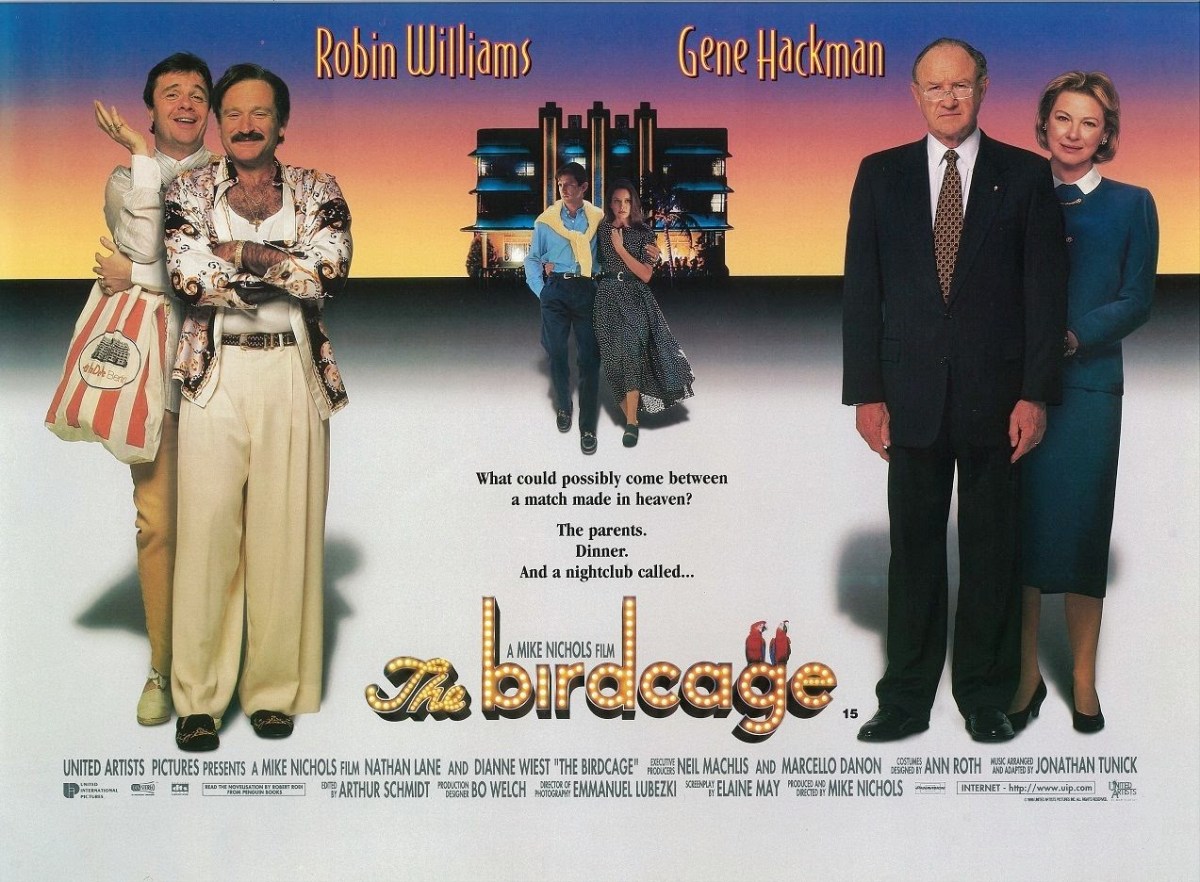
The Birdcage

(USA 1996)

“It’s aspirin with the ‘A’ and the ‘S’ scraped off.”

— Agador

Mark Caro’s latest presentation in his “Is It Still Funny?” series, The Birdcage, is director Mike Nichols’s 1996 Americanized remake of Jean Poiret’s classic 1979 French farce La Cage aux Folles. I’m not sure it was intentional, but this presentation coincides with National Drag Day, something I didn’t know existed.

I left the theater with three impressions: one, things have changed quite a bit in two decades; two, The Birdcage is still funny even if it is silly and dated; and three, Robin Williams could do anything well.

Armand Goldman (Williams) owns and operates a drag nightclub, the Birdcage, in South Beach. His flamboyant husband, Albert (Nathan Lane), is the club’s star attraction. Armand’s son, Val (Dan Futterman), announces his engagement to Barbara Keeley (Calista Flockhart), the daughter of right wing Republican senator Kevin Keeley (Gene Hackman). The kids want to — and should — introduce their parents to each other, but the problem is Barbara’s father, who no doubt will not approve.

Val has a solution: Armand can fake being straight — and married to his biological mother, Katherine Archer (Christine Baranski), who didn’t have much to do with him growing up but maybe will do him this one solid. And the Keeleys will be no worse not knowing the truth.

Albert, who’s a gay giveaway, can’t be part of it. He can’t even be around. This puts Armand — and the entire household — in a tricky situation. Albert is delicate at the moment, and this will hurt him. Little does anyone know how important he’ll prove to be in pulling off the ruse.

It’s easy to dismiss The Birdcage as fluff. The whole thing — plot, setting, characters, that dinner — is really, really silly. The humor relies heavily on stereotypes — histrionic Albert, house “boy” Agador (Hank Azaria), and conservative Kevin are the most obvious examples. Madonna dancers Luis Camacho and Kevin Stea have bit parts as…dancers, big shock. There’s a lot of camp and physical humor here, which doesn’t make for sophisticated comedy.

Nonetheless, the actors bring it, particularly Lane, who imbues his role with unexpected tenderness. Elaine May updates and punches up the screenplay with political jabs and cultural witticisms. At the center of the insanity is Williams, who despite a few glimmers of his wacky old self (“You do Fosse, Fosse, Fosse! You do Martha Graham, Martha Graham, Martha Graham! Or Twyla, Twyla, Twyla! Or Michael Kidd, Michael Kidd, Michael Kidd, Michael Kidd! Or Madonna, Madonna, Madonna!”), plays the Straight Man — that might sound contradictory considering his character here, but I’m not referring to his orientation. And he does it well. The result is a guilty pleasure.

With Dianne Wiest, Tom McGowan, Grant Heslov, James Lally, Luca Tommassini, André Fuentes, Tony Gonzalez, Dante Lamar Henderson, Scott Kaske, Tim Kelleher, Ann Cusack, Stanley DeSantis, J. Roy Helland, Anthony Giaimo, Lee Delano, David Sage, Michael Kinsley, Tony Snow, Dorothy Constantine

Production: United Artists Pictures

Distribution: United Artists (USA), United International Pictures (UIP), Filmes Lusomundo (Portugal)

117 minutes
Rated R

(Music Box) B-

http://www.mgm.com/#/our-titles/187/The-Birdcage/

https://youtu.be/MxfXR1zSj1k

Harold and Maude

(USA 1971)

“And if you want live high, live high;
And if you want to live low, live low;
Cuz there’s a million ways to go, you know that there are.”

—Cat Stevens (Yusuf Islam), “If You Want to Sing Out, Sing Out”


“Dinner at eight, Harold. And do try and be a little more vivacious.”

—Mrs. Chasen (Harold’s mother)


“I feel that much of the world’s sorrow comes from people who are this, yet allow themselves to be treated as that.”

—Maude

For a double date night, we caught a screening of Harold and Maude at Chicago Tribune film critic Mark Caro’s series, “Is It Still Funny?” I was astonished to learn that this film was a box office bomb. Indeed, many respected critics, Roger Ebert and Vincent Canby among them, were not impressed when it originally came out (http://www.rogerebert.com/reviews/harold-and-maude-1972 ) (http://www.nytimes.com/movie/review?res=990CE7DF1138EF34BC4951DFB467838A669EDE ). Maybe its morbid overtones and absurdist deadpan black humor put people off. Maybe, like some of the authority figures in the film, the idea of the title characters “doing it” grossed them out. Maybe they couldn’t see beyond the obvious to get the point of the whole thing. Whatever it was, they clearly missed the beauty here. I don’t know, but Harold and Maude is one of my all-time favorites.

Young Harold Chasen (Bud Cort) is obsessed with death, probably because he’s not particularly invested in his own privileged life. He stages elaborate and often gruesome suicides to distress his wealthy, prim, socialite mother (Vivian Pickles). He drives a hearse. He hangs out in cemeteries. He crashes random funerals. One day, Harold crosses paths with Maude (Ruth Gordon), a crazy old lady he saw scarfing down an apple and sneezing loudly at a burial just a few days earlier. She approaches him in church during a funeral mass, and afterwards drives off in the priest’s car. Harold doesn’t know what to make of her. Maude is wacky and carefree with a rebellious streak. She lives in an old train car. She talks incessantly about life. She used to “liberate” canaries from pet shops, and now she enlists his assistance in rescuing a tree from a city sidewalk. Maude takes Harold on something of a roller coaster ride, going on adventures and showing him life’s many pleasures: art, music, dancing, flowers, just being alive. After he sabotages his mother’s attempts to find him a wife through a computer dating service, Harold decides to marry Maude. Their relationship culminates with a surprise party he throws for her 80th birthday—and a surprise she gives him.

Harold and Maude, which started out as a masters thesis that screenwriter Colin Higgins wrote at UCLA, easily could have slid into a mawkish mess. It doesn’t, though: it’s deceptively deep, and director Hal Ashby strikes an inimitable balance of sweet and weird. For one thing, he keeps things simple and lets them unfold naturally. Harold and Maude are both odd, but not in a forced or creepy way; they’re tender, relatable, and even adorable despite the fact that they make an unlikely match and cause discomfort to everyone around them. Their chemistry, like this entire film, has an easiness to it. Cat Stevens’s breezy soundtrack is the perfect accompaniment—I can’t imagine anyone else’s music here (Ashby originally approached Elton John: http://mentalfloss.com/article/69546/10-perfectly-paired-facts-about-harold-and-maude ). The story is interesting far beyond a formulaic romantic comedy; it maintains its edge with biting and macabre humor—fake suicides, dates gone horribly wrong, sessions with a psychiatrist, Harold’s fake murder of Maude, and that hilariously ghasly denouncement from a repressed priest (Eric Christmas). Pickles is flawlessly uptight and understated, and watching her is a delight in every single scene she has. Tom Skerritt (he’s the cop) in a small early role is a bonus. The tone and look both grow cheery as Maude pulls Harold out of his shell and he starts making his own choices.

This film has so many moments that still give me chills, not the least of which is Harold’s cry when he learns what Maude has done on her birthday. The hospital scene is wrenching for so many different reasons. The conversation in the daisy patch that pans out and turns into a graveyard (a la Arlington National Cemetery) and the momentary glimpse of the tattoo on Maude’s arm are subtle but jolting. Harold’s metamorphosis is the best part: standing on top of a cliff holding his banjo, he walks away playing “If You Want to Sing Out, Sing Out.” It’s one of the few happy endings to a film that I truly love.

In 1997, the United States Library of Congress deemed Harold and Maude “culturally, historically, or aesthetically significant” and selected it for preservation in the National Film Registry (https://www.loc.gov/programs/national-film-preservation-board/film-registry/complete-national-film-registry-listing/).

91 minutes
Rated PG

(Music Box) A+

https://youtu.be/869cNCAqoZE